
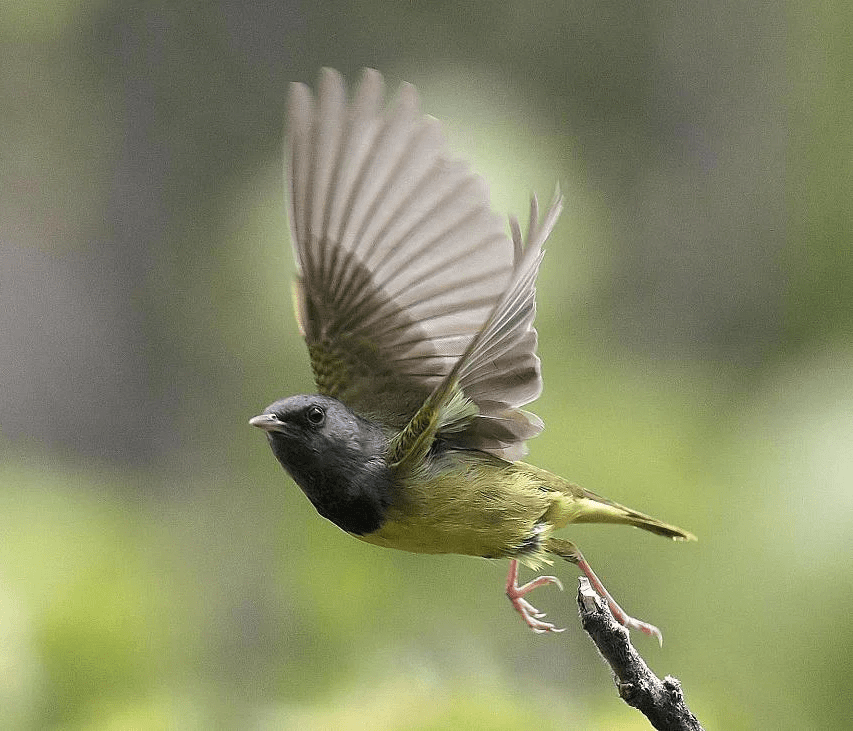
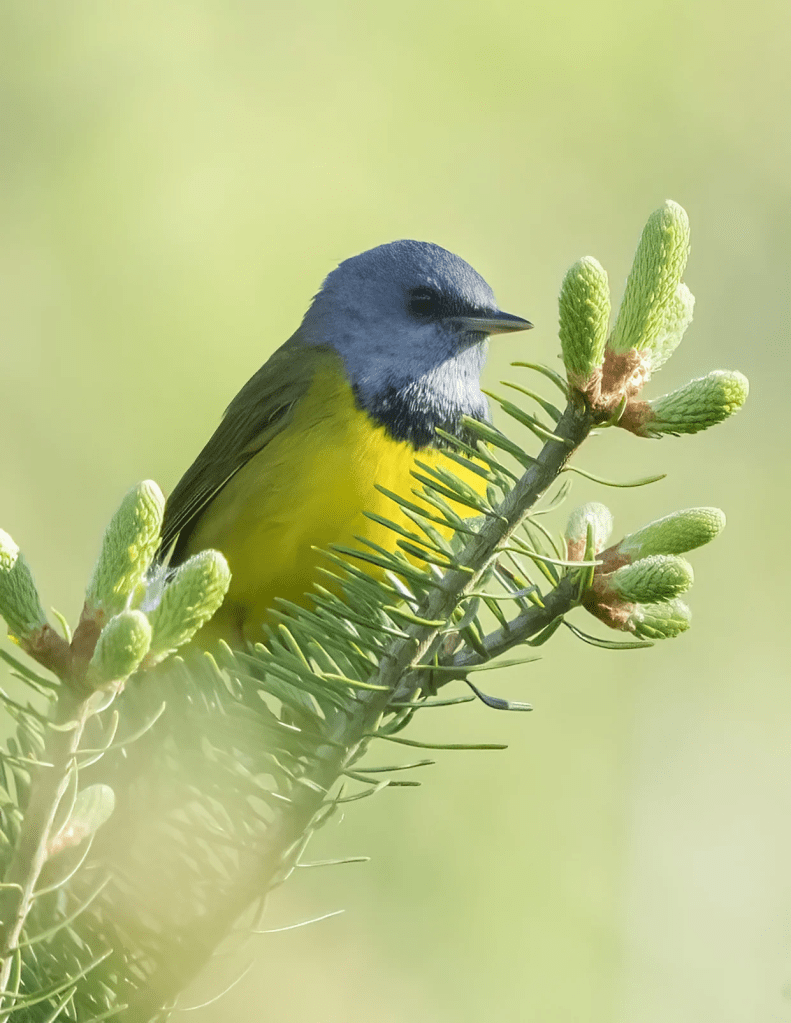
Mourning Warbler
Geothlypis philadelphia
Also Known As
- Reinita Enlutada (Spanish)
- Chipe Llorón (Spanish)
About
Though relatively common over much of its range, the Mourning Warbler is secretive and notoriously hard to observe. These birds mostly stay close to the ground in dense thickets and brush where they forage and nest. Outside of the breeding season, Mourning Warblers are also fairly quiet and can easily go unnoticed. As a result, very little is known of this bird’s life history outside of the breeding season. In fact, there are sizable gaps in our understanding of its breeding biology as well — for instance, no researchers have documented the courtship behavior of this species.
However, one thing we do know is that these birds are fairly particular about their habitat requirements. Mourning Warblers are reliant on thick, brushy second-growth forest, the result of big ecological disturbances, such as fire or major storms, that kill numerous trees and open up gaps in the canopy. Following such a disturbance, habitat becomes acceptable after about two or three years. After another seven or eight years, the forest will have grown back enough that Mourning Warblers will no longer use it. This means that breeding areas for this species are constantly shifting, as one forest regrows and a new opening is (hopefully) created elsewhere. Sometimes referred to as a “fugitive species,” Mourning Warbler populations are frequently “on the run,” fleeing the regenerating forest and searching for another suitable opening.
Fortunately, these birds are not terribly picky about exactly what kind of disturbance creates this ideal habitat. Drought, disease, insect outbreaks, and especially fire are natural disturbances that this species probably relied on historically. In the current day, large forest fires are far less common, but for the Mourning Warblers, human activities seem to work just as well. These birds are commonly found in old clearcuts, abandoned agricultural areas, along logging roads, and even mining and oil well sites. While these heavily disturbed areas do not benefit most species, the Mourning Warbler makes it work. (snip-see MORE here)

 Scottie's Playtime
awwww
LikeLike