I love dogs and people. I want living creatures to thrive. I love to cook, and share the food, but ya gotta get in line in front of the dog, and greatest good luck with that!
It’s all a lot of money. But one party doesn’t get the amounts of dark money that the other party receives; one party has access to the US Treasury through POTUS that the other party does not have, as well.
House and Senate candidates recently filed their fundraising reports covering the first six months of 2025. OpenSecrets analyzed the data to determine which candidates have raised the most money and which ones are sitting on the biggest piles of cash.
Let’s start with a look at Senate races. Jon Ossoff (D) is seeking reelection in Georgia, where he won his first term in the most expensive Senate race in history. (That record has since been broken). During the first half of this year, he raised more money than any other candidate running in 2026.
Sen. Cory Booker (D-N.J.), who was fifth in fundraising, has the most cash on hand, with Ossoff running third after this big first-half haul.
As of today, the well-respected Cook Political Report has identified three tossup races that could determine control of the Senate in 2027: Georgia, Michigan and North Carolina. The Tar Heel State race just moved into that category because Sen. Thom Tillis (R) announced his retirement June 29, so the candidate field has not yet solidified.
The three most senior members of the House of Representatives rank among the top fundraisers this year, but they were dwarfed by Rep. Alexandria Ocasio-Cortez (D-N.Y.), who raised $6.7 million more than Rep. Mike Johnson (R-La.), the speaker of the House.
Ocasio-Cortez and Rep. Ro Khanna (D-Calif.) raised the most among Democrats and also have two of the biggest stockpiles of campaign cash heading into the second half of the year. It remains to be seen whether Rep. Elise Stefanik (R) will stand for re-election to Congress or make a run for governor of New York in 2026. Rep. Raja Krishnamoorthi (D-Ill.) is running for an open Senate seat.
This article was originally published by OpenSecrets, a nonpartisan, nonprofit organization that tracks money in politics. View the original article. (The original includes pertinent charts that make the article make better sense. I recomment clicking through; I’m not sure why their republish code doesn’t include the charts. I tried to copy them separately to insert them, but copying was not allowed. -A.)
The United States has more money held by private citizens than any other country in the world. According to the Federal Reserve, U.S. households hold a total of $160.35 trillion, which is the value of each person’s assets minus their liabilities. However, many Americans are perplexed by the fact that, in a country with such wealth, so many people still struggle to make ends meet.
Although Americans hold the largest amount of privately held wealth in the world, many of us still struggle with financial stress. A recent report found that 68% don’t have enough money to retire, 56% are struggling to keep up with the cost of living, and 45% are worried about their debt levels. A significant reason is that a small number of people hold a large portion of the privately held wealth in the U.S..
Nearly two-thirds of America’s private wealth is held by the top 10% of people, leaving the remaining one-third to be divided among 90% of the population. (snip)
With so many people struggling in America, while a few at the top are unbelievably wealthy, what would happen if the money were magically divided evenly among the 340 million people who live in the United States? If everyone received a truly equal share of the American pie, every person would receive approximately $471,465. That’s $942,930 per couple and $1.89 million for those with two kids. (snip)
However, such a drastic redistribution of wealth would be cataclysmic for the economy, as people would have to liquidate their investments to give their assets to others. The sudden increase in wealth for many, without a corresponding increase in goods and services, would lead to incredibly high inflation. The dramatic reconfiguring of the economy would also disincentivize some from working and others from innovating. Some posit that if everyone were equal, in just a few months, those with wealth-generating skills would immediately begin rising to the top again, while others would fall behind. (snip)
Although it seems that a massive redistribution of wealth isn’t in the cards for many reasons, we do have some evidence from recent history on how programs that give people money can help lift them out of poverty. Government stimulus programs during the COVID-19 pandemic brought the U.S. poverty level to a record low of 7.8% in 2021. Child poverty was also helped by the American Rescue Plan’s Child Tax credit expansion, which drove child poverty to an all-time low of 5.2%. It’s also worth noting that the trillions in government stimulus had a downside, as it was partially responsible for a historic rise in inflation. (Note from A.: The hyperlink takes you to CNBC, which hastens to report this: “But the widespread rise in prices was mostly “a supply-side phenomenon” caused by the Covid-19 pandemic itself, Yellen told CNBC in an exit interview.”) (snip-a little MORE)
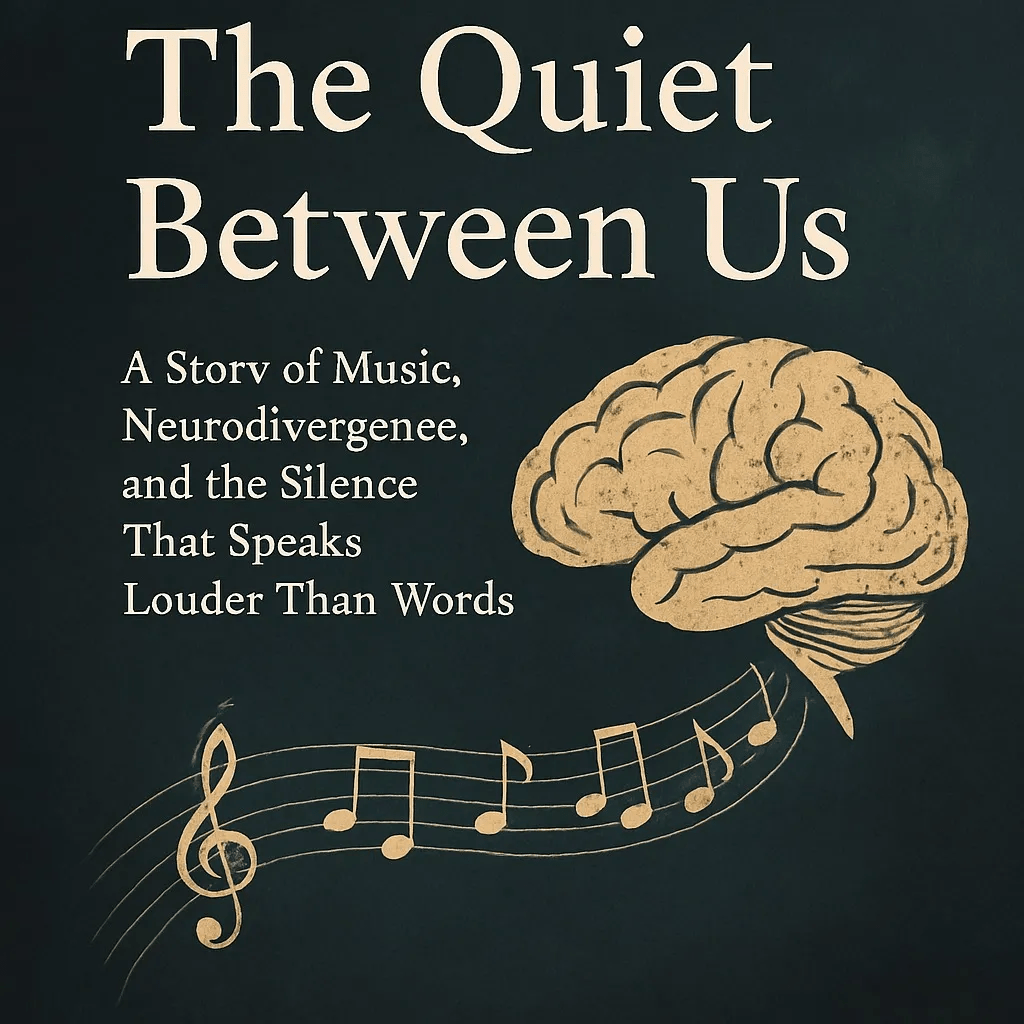
This is not a work of fiction. It’s from my clinical notes, drawn from the quiet corners of a family learning how to listen, how to see, and how to love. What follows is Maya’s story—and ours too. It began with misunderstanding and grew into music. It was shaped by silence, and strengthened by learning how to hear what was never said out loud.
—
🧠 Main Characters
• Maya (17) – A brilliant, autistic teen who expresses herself through music but struggles with verbal communication and sensory overload. Her inner world is rich, but rarely understood.
• Daniel (45) – Her father, a pragmatic man who misinterpreted Maya’s behavior as defiance. He’s emotionally shut down but carries deep guilt.
• Leah (43) – Her mother, who tried to advocate for Maya but became isolated in the process. She’s exhausted, but still hopeful.
• Eli (15) – Maya’s younger brother, who felt invisible growing up. He’s witty, sarcastic, and secretly protective of Maya.
—
I. The Fracture
The house had grown quiet over the years—not the peaceful kind, but the kind that echoed with things unsaid. Leah sat at the kitchen table, her fingers wrapped around a chipped mug, staring at the steam like it held answers. Upstairs, Maya rocked gently in her chair, headphones on, fingers twitching over her keyboard. Her music was her voice now.
Eli moved through the house like a ghost. He didn’t slam doors or raise his voice. He just existed in the spaces between tension. And Daniel—he hadn’t been home in months. He lived alone now, in a small apartment filled with regrets and unopened letters.
Maya had always been different. Brilliant, but misunderstood. Her silence wasn’t emptiness—it was survival. Her meltdowns weren’t tantrums—they were overload. But Daniel never saw that. He saw defiance. He saw rebellion. And slowly, the family unraveled.
—
II. The Breaking Point
It happened at school. Maya, overwhelmed by noise and light and chaos, collapsed in the hallway. Hands over her ears, rocking, humming. Someone filmed it. Of course they did.
Eli found the video first. He didn’t speak. Just slid his phone across the table to Leah and walked out.
That night, Leah called Daniel.
“She was screaming,” she said. “And no one heard her.”
Daniel arrived the next morning. He stood in the doorway like a stranger. Eli didn’t look up. Maya didn’t come down. Leah didn’t cry. Not anymore.
“She doesn’t talk much,” Leah said. “But she plays.”
Daniel didn’t understand. Not yet.
—
III. The Song
Eli knocked on Maya’s door. “Can I record you?” he asked.
She didn’t answer, but she didn’t say no.
He sat on the floor, phone in hand, and watched as Maya’s fingers danced across the keys. The melody was aching, defiant, beautiful. It was everything she couldn’t say.
He uploaded it that night. The Quiet Between Us.
The video spread. Comments poured in. People who felt seen. People who understood.
Daniel watched it on repeat, tears streaking his face.
“I didn’t know she could feel like that,” he said.
“She always did,” Leah replied. “You just didn’t know how to listen.”
—
IV. The Shift
Daniel knocked on Maya’s door. She didn’t look up, but she didn’t turn away.
“I heard your song,” he said. “I’m sorry I didn’t hear you sooner.”
Maya reached for her keyboard. Played a single note. Then another.
Daniel sat beside her, silent. Listening.
Leah watched from the hallway, hand over her heart.
Eli uploaded another video: The Quiet Between Us – Live.
They began to change. Slowly. Imperfectly.
Daniel stopped trying to fix. He started trying to understand.
Leah stopped carrying everything alone. She let herself be held.
Eli stopped disappearing. He became the bridge.
And Maya? She kept playing.
—
V. The Reconnection
They sat together in the living room. Maya played. Eli recorded. Leah smiled. Daniel closed his eyes and listened.
No one spoke. But everything was said.
They weren’t perfect. But they were real.
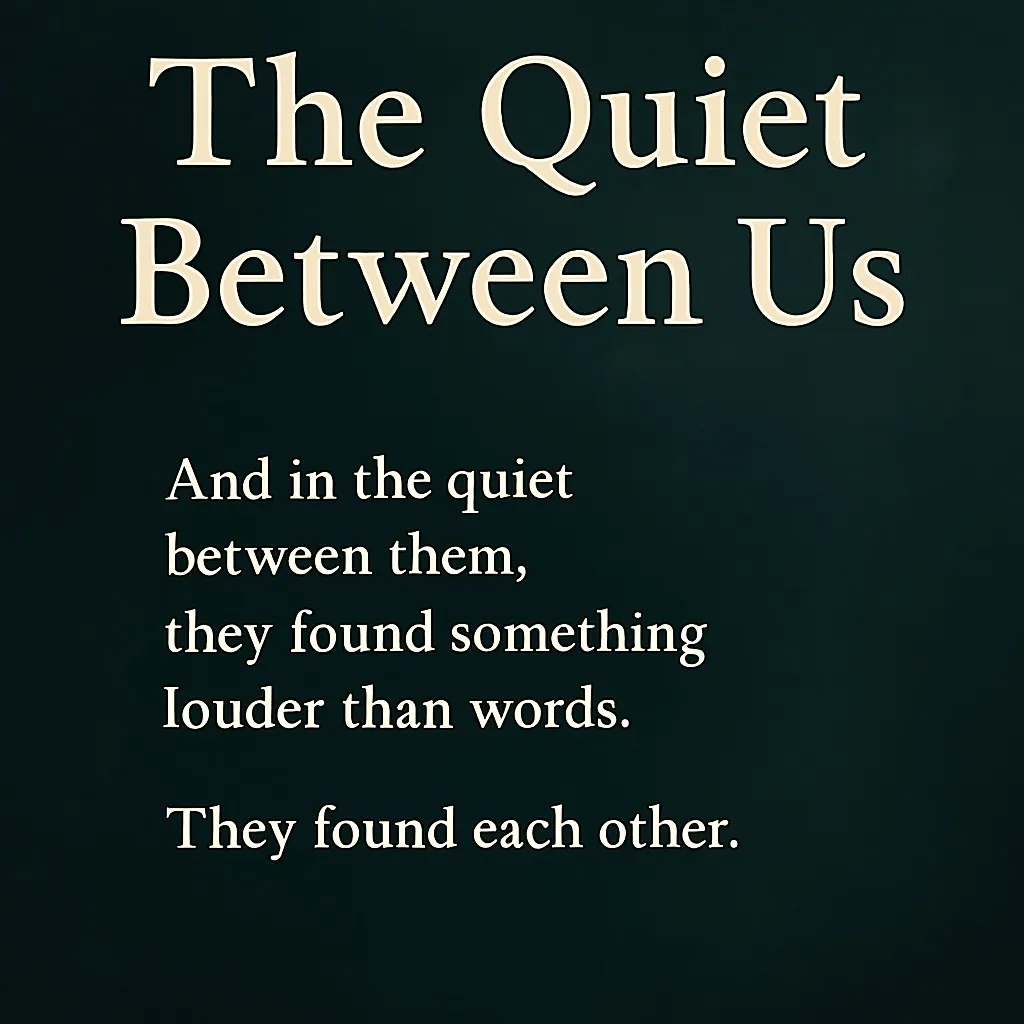
And in the quiet between them, they found something louder than words.
They found each other.
🎵 Epilogue: The Song That Speaks (Follows graphic)
—
🎵 Epilogue: The Song That Speaks
Maya’s music became a language for others.
Eli started a podcast for neurodivergent families.
Daniel and Leah spoke at workshops. Not as experts—but as learners.
Their story wasn’t about fixing.
It was about listening.
About loving each other—not in spite of difference,
but with it.
Because love isn’t always loud.
Sometimes, it’s quiet.
And sometimes, the quiet is where love begins.
This is more than a story. It’s a lived truth. Signed not with ink—but with the quiet strength of love, survival, and rediscovery.
July 24, 1974 The United States Supreme Court (U.S. v. Nixon) unanimously ordered President Richard Nixon to surrender tape recordings of White House conversations regarding the Watergate affair. Speaking for the Supreme Court in front of a packed and hushed courtroom, Chief Justice Warren E. Burger (a Nixon appointee) rejected President Nixon’s claims of executive privilege (virtually total confidentiality for the White House) because the need for fair administration of criminal justice must prevail. The White House feared review of the recordings by a U.S. district judge would reveal, among other crimes, impeachable offenses. Listen to the tapes online (It’s a YouTube playlist!)
July 24, 1983 Canadians and Americans spanned the international border at Thousand Islands Bridge, linking New York and Ontario, to protest nuclear weapons and border harassment of peace activists. Thousand Islands Bridge
July 24, 1983 Women tagged a U.S. warplane with anti-nuclear graffiti at Greenham Common, an air base in England. The Greenham Common Women’s Peace Camp had been set up just outside the perimeter of the base in 1981 to get U.S. Cruise missiles, some of which were deployed at the base, out of their country. Other tactics included disrupting construction work at the base, blockading the entrance, and cutting down parts of the fence. Read more about The Greenham Common Women’s Peace Camp
Mesopithecus pentelicus thrived in the rainforests of the late Miocene, 7 million years ago. Credit: Mauricio Antón
Small, slender and short-lived, with broad noses, big, dark-adapted eyes, living underground, and in the shadows of a shattered, steamy, chaotic world. Richard Musgrove asks: will this be us in 10,000 years?
Climate change is the greatest challenge in human history – current trends could have us eventually approaching extremes not seen on our planet for 15 million years. Will a destabilised global climate wreak economic havoc, leading to societal collapse, mass mortalities, even extinction? Or will we pull ourselves out of this spectacular self-imposed nose-dive?
Which raises the question – what if we don’t? How will humanity change on a much hotter Earth?
Numbers matter
Uncharted territory approaches as we nudge the Paris Agreement’s 1.5°C above preindustrial levels, on track for a potentially catastrophic 2.7°C by 2100. What about 2200, or 3200?
Globally, days above 50°C have doubled since the 1980s – in Australia, Pakistan, India and the Persian Gulf – with the ‘feels-like’ temperature often higher. Even immediately reduced carbon emissions will still mean lingering planet-wide heating and associated effects for many thousands of years.
Our adaptability has led us this far, but what does evolution have in store for our species if we don’t rise to face our greatest challenge? The answer is unlikely to be in the mirror.
Nothing sweats like us (snip-MORE)
===========
Medicaid ‘gamers’ are the new ‘welfare queens’ by Aaron Rupar
Republicans are taking strawman arguments to absurd extremes. Read on Substack
Earlier this month, Donald Trump and congressional Republicans passed a grotesque budget bill that (partially) funds massive tax breaks for the wealthy and a ramped-up ICE goon squad by cutting cutting $1.1 trillion from Medicaid and an additional $185 billion from federal food assistance programs, all while adding $2.8 trillion to the deficit.
Not surprisingly, the bill is massively unpopular. As a result, Republicans are gaslighting Americans about its impact, particularly regarding the cuts to Medicaid, which are expected to cost 10 million Americans their health coverage.
The Medicaid cuts could result in more than 16,000 extra deaths per year, researchers say. Republicans have tried to distract from that reality with a combination of blatant lies and misdirecting rhetoric. To hear them tell it, they’re only cutting supposed waste, fraud, and abuse. So when you lose benefits, they’re here to explain why it’s probably your own damn fault.
The lazy gamer myth
Republican messaging surrounding Medicaid cuts borrows heavily from Ronald Reagan’s playbook. (snip- MORE)
Of course, there are innumerable instances when the Bible has historically been used to enforce the idea that gender is a divinely ordained binary, with male and female genders that are distinct, complementary, and assigned at birth.
Indeed, the Bible’s general attitude toward gender is expansive, with verses exploring God’s focus on the interior over the exterior, the distinction between sex and gender, the role of eunuchs in scripture, and more.
Here are 10 Bible verses that show a biblical approach to gender that is as varied as the colors in a rainbow.
Genesis 1:27 So God created humans in his image, in the image of God he created them; male and female he created them.
Day and night. Water and dry land. Male and female. The creation poem might sound like it’s dealing in binaries, but we know that all of these things have transitional elements. Day and night contain transitions at dawn and dusk; the spectrum of water and dry land includes tidal plains and coral reefs; and people who are intersex, genderqueer, nonbinary, and more can be found between “male and female”.
Genesis 25:27 When the boys grew up, Esau was a skillful hunter, a man of the field, while Jacob was a quiet man, living in tents.
Jacob is described as “smooth” (Genesis 27:11) and stays in the tent where he cooks – traditional female attributes in the ancient world. Yet he is chosen over his “hairy” brother Esau, a skilled hunter, to lead God’s people, showing that God does not place value on traditional gender norms.
Isaiah 56:4-5 For thus says the Lord: To the eunuchs who keep my Sabbaths, who choose the things that please me and hold fast my covenant, I will give, in my house and within my walls, a monument and a name better than sons and daughters; I will give them an everlasting name that shall not be cut off.
Eunuchs were men who had been castrated, especially those employed to guard the women’s living areas. They represent clear historical examples outside of the gender binary in the Bible and are welcomed into the temple and to the community of worship.
Matthew 19:11-12 But [Jesus] said to them, “Not everyone can accept this teaching, but only those to whom it is given. For there are eunuchs who have been so from birth, and there are eunuchs who have been made eunuchs by others, and there are eunuchs who have made themselves eunuchs for the sake of the kingdom of heaven. Let anyone accept this who can.”
The disciples ask Jesus to clarify the explanation of gender in Genesis 1 as it relates to divorce. In answering them, Jesus offers this non-judgmental example of eunuchs that invokes a range of genders. This indicates the law should be flexible enough to allow for this range, instead of being too narrow to recognize its existence.
Galatians 3:27-28 As many of you as were baptized into Christ have clothed yourselves with Christ. There is no longer Jew or Greek; there is no longer slave or free; there is no longer male and female, for all of you are one in Christ Jesus.
The apostle Paul explains that unity in Christ is what’s important, superseding the concept of gender and other identity markers.
Mark 11:17 [Jesus] was teaching and saying, “Is it not written, ‘My house shall be called a house of prayer for all the nations’? But you have made it a den of robbers.”
In this verse, Jesus is referencing Isaiah 56, when eunuchs are welcomed into the community at temple. He prioritizes welcoming all people, regardless of gender.
Acts 8:38-39 He commanded the chariot to stop, and both of them, Philip and the eunuch, went down into the water, and Philip baptized him. When they came up out of the water, the Spirit of the Lord snatched Philip away; the eunuch saw him no more and went on his way rejoicing.
1 Samuel 16:7 But the Lord said to Samuel, “Do not look on his appearance or on the height of his stature, because I have rejected him, for the Lord does not see as mortals see; they look on the outward appearance, but the Lord looks on the heart.”
When the prophet Samuel was charged by God to look for a new king, David didn’t seem as king-like as the other options presented to Samuel — but he was still the right choice. Once again, we see that God does not share the human preoccupation with external biological features. Our physical bodies do not determine deeper matters of our identity.
Romans 2:29 Rather, a person is a Jew who is one inwardly, and circumcision is a matter of the heart, by the Spirit, not the written code. Such a person receives praise not from humans but from God.
As with the example of God choosing David because of what was in his heart, here the Bible says that physical alteration (like being circumcised) isn’t what matters to God — it’s what’s in the heart.
Genesis 16:13 So [Hagar] named the Lord who spoke to her, “You are El-roi,” for she said, “Have I really seen God and remained alive after seeing him?”
Hagar changes the name she uses for God, reflecting a change in how she recognizes who God is — not a change in God’s own identity, but an uncovering that leads to a fuller understanding and affirmation of God’s identity. Similarly, someone may choose to change the gender (and the name that goes with it) that they identify with as a reflection of a greater understanding and affirmation of who they are, out of a desire that the world may better know and understand them, too.
Heather BradyHeather Brady is the audience engagement manager at Sojourners.
I was not a massive fan of Ozzy Osbourne, but I was still a fan. When I got a news alert in a text while on the city bus (see? I get news alerts, people) telling me he had passed, and just a few weeks after his final performance, I knew I had to honor him.
I was never really a metal head, but Ozzy ruled. Even if I didn’t like him, I was in a scene where everyone else did. I was very much in the know about Ozzy. If nothing else, I liked him solo more than I liked Black Sabbath.
Randy Rhoads is why I’m an Ozzy fan, and I still listen to him after Randy’s tragic death in 1982 from a plane crash. Randy’s career was just getting started with a bright future in front of him.
So, did Ozzay really bite the head off a bat? I have been hearing different versions of this story for years. But yes, it appears that he actually did. Reportedly, it wasn’t a stunt.
Ozzy used to throw out real animal parts during a tour in the early 80s. Fans learned about this, so they were prepared when they went to his shows. Somewhere in Iowa, a 17-year-old Ozzy fan threw a bat on stage. Ozzy thought it was fake and bit its head off. In one version, he said he discovered it was real when it was in his mouth and he tasted “warm, gloopy liquid,” and the head twitched. He claimed it was a live bat.
In a different version, he said it was dead. The kid who brought the bat also said it was dead.
Ozzy also told two different stories about biting the heads off doves at a meeting with CBS executives. In one version, he brought three live doves, and being drunk (Oz had substance issues), he bit the heads off all three of the LIVE doves.
In a second version, he brought one to release at the end of the meeting, but it died, so waste not, want not….he made use of it by biting its head off. I don’t know what actually happened. I wasn’t there.
Ozzy had just done his final performance a few weeks ago at a concert billed as “Back To The Beginning: Ozzy’s Final Bow,” in Birmingham, England, in front of 42,000. He sang from a custom-built throne as he had been suffering from Parkinson’s Disease for the past five years, and walking was extremely difficult for him. (snip-MORE)
“This is supposed to be my farewell tour,” says Ozzy Osbourne in a clip included in the Biography television documentary above. He then gives the finger and adds, “We’ll see.” The year was 1993, and indeed, there turned out to have been much more to come for the former frontman of Black Sabbath, the band that opened the floodgates — or perhaps hellgates — of heavy metal. After an impoverished childhood spent playing in the bomb sites of postwar Birmingham, Osbourne hopped from job to job, including one failed stint at a slaughterhouse and another as a criminal. He then turned singer, receiving a PA system from his father and forming a blues group with a few local musicians. People pay good money to see scary movies, they one day reckoned, so why not make scary music?
The time was the late nineteen-sixties, when listeners approached record albums as quasi-cinematic experiences. Taking their name from Mario Bava’s anthology horror film, which had come out a few years before, Black Sabbath delivered on expectations many weren’t even aware they had. Today, anyone can put on an early Black Sabbath album and identify the music as heavy metal, not a world apart from any of its newer variants. (snip-MORE)
July 23, 1846 Author Henry David Thoreau was jailed for refusing to pay the poll tax as a protest against the Mexican war, which in turn led to his writing “Civil Disobedience.” This essay became a source of inspiration for Leo Tolstoy, Mahatma Gandhi, and Martin Luther King, Jr. From Thoreau’s essay: “Unjust laws exist: shall we be content to obey them, or shall we endeavor to amend them, and obey them until we have succeeded, or shall we transgress them at once?” Daguerreotype of Henry David Thoreau Out of Thoreau’s jailing grew a legend: The great American philosopher Ralph Waldo Emerson visited Thoreau in jail. Emerson asked, “Henry, why are you here?” Thoreau replied, “Why are you not here? Under a government which imprisons unjustly, the true place for a just man is also a prison.” Thoreau was not alone in his opposition: Thomas Corwin of Ohio denounced the war as merely the latest example of American injustice to Mexico: “If I were a Mexican I would tell you,‘Have you not room enough in your own country to bury your dead.’” Henry Clay [former speaker of the House and presidential candidate] declared, “This is no war of defense, but one of unnecessary and offensive aggression.” Abraham Lincoln also opposed the war, and lost his seat in Congress as a result. The entire essay (in annotated form)
July 23, 1967 Detroiters angry at loss of jobs and, especially, at the abusive and virtually all-white police department, started rioting in what became known as the Detroit Rebellion. The intitiating incident was an early-morning raid on a blind pig (Detroit for after-hours drinking club) on 12th Street. The violence spread elsewhere in the city, and led to President Lyndon Johnson’s calling out 8000 members of the National Guard. Order was not restored for six days. In the end, there were 43 known dead, 347 injured, 3800 arrested, 1000 families homeless. Thirteen hundred buildings burned to the ground and twenty-seven hundred businesses were looted. Online documentary on all aspects of what happened, “Ashes to Hope” The Rebellion from a 40-year perspective
While asshole billionaires are enjoying the continuation of huge tax cuts, Donald Trump and Republicans realized, maybe, that this will actually increase our national debt. Why didn’t somebody say something? So in order to slow down the bleeding, the goons looked for where they could make some cuts and save. No, they did not cut the budgets for ICE, defense, bombs for Israel to drop on the kids in Gaza, Trump golf trips, or Trump birthday parades. Maybe they could sell the plane Qatar bribed Trump with, if anyone else actually wanted it.
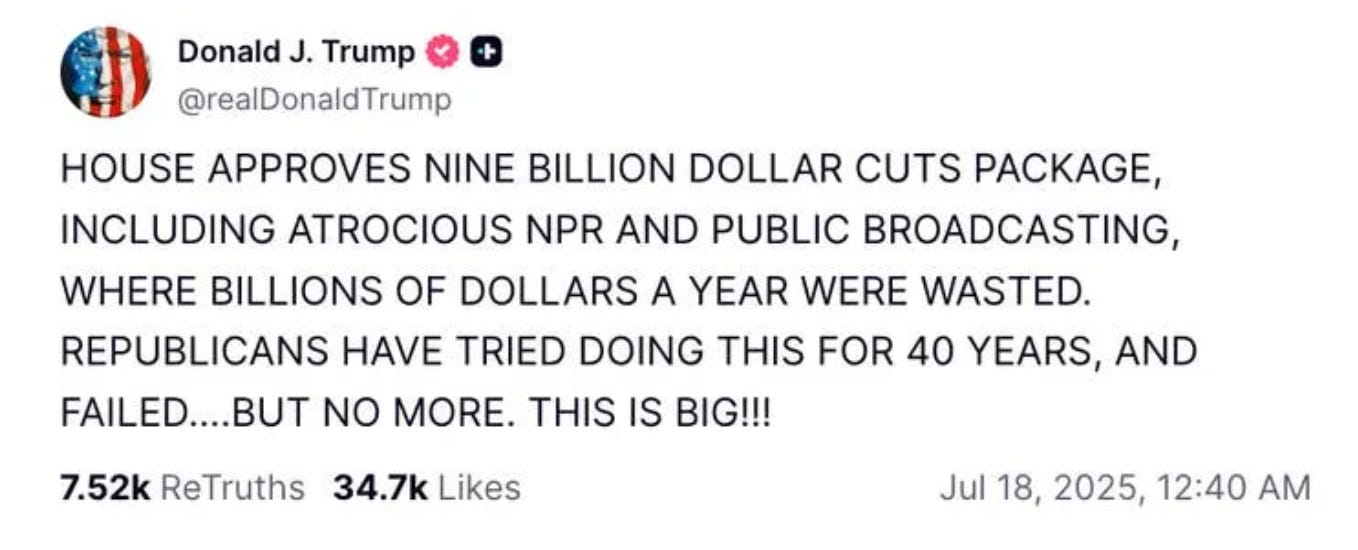
Trump and Republicans passed a bill that will cut $1.1 billion in federal funding for PBS and NPR. Trump is all giddy about this and posted to ShitSocial…
Of course, this impacts Sesame Street. What kind of asshole hates Sesame Street? Donald Trump is that kind of asshole. Donald Trump was an asshole millionaire by the time he was 8 years old. His allowance at 3 years old was around $200,000 a year. That explains why he doesn’t have any appreciation for Sesame Street. If nothing else, Sesame Street could have taught him how to count his money and maybe realize that if you spend more than you bring in, you will increase debt. Cookie Monster knows this. You can’t eat more cookies than you have. Maybe if Trump watched Sesame Street, he wouldn’t speak like a drugged-out crackhead and could talk the king’s English as well as the president of Liberia.
Sesame Street might have saved Trump from being the kind of asshole who sexually assaults and rapes women. It could have saved him from being a grifter and a thief. It could have saved him from growing up into a racist liar. Sesame Street could have saved Trump from turning into Trump.
As Matt Hooper said in Jaws while describing a Great White Shark as a machine, “All this machine does is swim and eat and make little sharks, and that’s all.” Trump is also a machine, and all that asshole machine does is grift, sexually assault women, and make little assholes.
By the way, have you seen a photo of Barron Trump lately? He’s cultivating the asshole look. He may be taking grooming tips from older brother, Don Jr. Fortunately, Barron hasn’t developed the coke-up dazed expression yet, so for now, he only has the Christian Bale serial killer look from American Psycho.
Anyhoosies, we’re supposed to be talking about Big Bird and not Big Turd, the serial killer of democracy. I wanted to avoid drawing Big Bird for a cartoon on this subject, as so many other cartoonists did this week. But after I got the bucket idea, how could I not?
That’s the blog for today, Peezeheads. One of my clients asked for a local cartoon this morning, and he asked about an hour ago if he could have it by 11 a.m. tomorrow. I haven’t even read the article yet, so I should do that. You’re also going to get a blog about Ozzy. Stay tooned. And no talking about Ozzy in the comments until the Ozzy blog. Pretend you’re a Republican and Ozzy is the Epstein Client List. (snip-MORE)
Have you heard about Vortex Bladeless Ltd.? It’s a Spain (just outside Madrid) based tech company developing a wind power generator without rotating blades.
STRUCTURE & OPERATION ~~~ There is a fixed base and a cylindrical mast that oscillates freely perpendicular to the wind direction, jointed by a carbon rod.
Inner parts never collide with each other, but interact to generate electricity.
ENERGY HARNESS When the wind passes around a structure, vortexes of pressure are created.
The frequency of vortexes depends on the wind speed, and if the structure has a similar natural resonating frequency, it begins to oscillate and harness their energy.
This phenomenon of aeroelastic resonance is called Vortex Shedding, and happens regularly in nature.
ENERGY CONVERSION Similar to a traditional alternator, our device gets an interaction between coils and magnetic fields, generating electricity by electromagnetic induction without need for rotation on a shaft nor a gearbox.
The skybrators, as some wits have amusingly dubbed them, stand at a hair over nine feet (2.75 metres) tall.
“Our technology has different characteristics which can help to fill the gaps where traditional windfarms might not be appropriate,” says Yáñez (Inventor, Founder and Co-CEO of Vortex Bladeless).
These gaps could include urban and residential areas where the impact of a windfarm would be too great, and the space to build one would be too small.It plugs into the same trend for installing small-scale, on-site energy generation, which has helped homes and companies across the country save on their energy bills.
This could be wind power’s answer to the home solar panel, says Yáñez. (source)
Snip-More, Not Too Much, Go Read It, It’s Exciting!
This is the latest installment in the Sacrilegious Humor series. This is a series that I would like readers to help me with. If you know of a comedy bit that is irreverent towards religion, makes fun of religion, pokes fun at sincerely held religious beliefs, or challenges the firmly held religious beliefs of others, please email me the name of the bit or a link to it.
Even as an atheist, I’m a big fan of Jesus. I really am. What’s not to like? A tall, gorgeous man with great abs and flowing hair getting his feet washed by prostitutes. And encouraging people to love their neighbors while slaying in a loose kaftan. And Jesus was an immigrant, by the way. Let’s not forget . . .
Jesus would have loved trans people. He changed water into wine; is that not itself an act of transition? And you know how I know Jesus would love trans people? Because he loved people. He loved all people. So, of course, he would love trans people and all queer people. I mean, Jesus was followed around at all times by 12 single hot guys, all of them also sporting kaftans. You do the math. Jesus loved the gays, America. Deal with it.
The only thing our current president has in common with Jesus is that they both owe their career to their dads.
Seriously, just think to imagine what it must feel like to be trans person in America today. Our government has legislated that trans people do not exist. It is trying to erase them completely. Imagine having to stockpile your essential lifesaving medicine because your president might cut off access to it for no other reason than it makes him look strong to his base. If the government is going to declare a whole group of people shouldn’t exist, why can’t it be truly a dangerous group of people like those who take off their socks and shoes on airplanes and then go into the bathroom? Why can’t it be people who use leaf blowers at unearthly hours in the morning? Why can’t it be unkind people? Which brings us back to Jesus. Yes, of course. Jesus just wants all of us to be kind. So, for once, America, I beg you, let’s all really try to give kindness a go. Like my little mom says, “It doesn’t cost anything to be kind.” And I guarantee you any situation you find yourself in will go better with a little kindness.
Bruce Gerencser, 68, lives in rural Northwest Ohio with his wife of 47 years. He and his wife have six grown children and sixteen grandchildren. Bruce pastored Evangelical churches for twenty-five years in Ohio, Texas, and Michigan. Bruce left the ministry in 2005, and in 2008 he left Christianity. Bruce is now a humanist and an atheist. (snip)