
Author: ali redford
I love dogs and people. I want living creatures to thrive. I love to cook, and share the food, but ya gotta get in line in front of the dog, and greatest good luck with that!
A Coupla Comics Apropo Of Nothing (or, maybe they are…)
https://www.gocomics.com/furbabies/2024/10/03
FurBabies by Nancy Beiman for October 03, 2024

==========
https://www.gocomics.com/calvinandhobbes/2024/10/03
Calvin and Hobbes by Bill Watterson for October 03, 2024

A Cog in the Wheel? Not a Chance. by Jess Piper
Good trouble if you can get it…
I will be discussing the Koch brothers in this essay. If you are unfamiliar with them, here is a primer.
“Never, ever be afraid to make some noise and get in good trouble, necessary trouble.”
~John Lewis
I once left an educational conference with nearly a dozen cans of Diet Coke, several boxed lunches, a handful of cookies, and every handout I could get my hands on. I left with every pen, lanyard, and every lesson plan that was out for the taking.
I’m not a hoarder or even participating in minor theft — it was all free. I was attending a Koch-funded Bill of Rights Teacher Institute and I was going to take those folks for every penny I could. The next day, I delivered the cookies and boxed lunches to the teachers’ lounge. I drank the Diet Cokes.
Koch money paid for my day out of school for this seminar by giving me a stipend and paying for my sub while I was out of the classroom. I think it was around $400 in total.
Did I make a dent in a billionaire’s pocketbook? No. Would I participate as a cog in the wheel in their dystopian vision of education? Hell no.
“If the injustice is part of the necessary friction of the machine of government, let it go, let it go: perchance it will wear smooth–certainly the machine will wear out… but if it is of such a nature that it requires you to be the agent of injustice to another, then I say, break the law. Let your life be a counter-friction to stop the machine. What I have to do is to see, at any rate, that I do not lend myself to the wrong which I condemn.”
~Henry David Thoreau
I have read enough protest literature to know one thing: don’t be a cog in the wheel. If you see something you don’t like, shut it down. If you can’t shut it down, make the harmful agenda more difficult.
That’s exactly the sort of minor mayhem I have caused for years. Slight chaos. A burr under the saddle. A thorn in the side. A constant irritation.
The older I get, the more brazen I have become in not lending myself to the wrong which I condemn. I applied to the Koch-funded Bill of Rights Teacher Institute after hearing about it at other teacher seminar I had attended.
My last five years of teaching had grown a little tired and monotonous so I applied for summer travel institutes with the National Endowment for the Arts and the National Endowment for the Humanities and others like the summer program at George Washington’s Mount Vernon. All were prestigious and admission was difficult.
I was lucky to be admitted to several.
I love to travel, but what I really loved about these institutes was learning about American History from scholars in the places where history happened. It makes a huge difference. I have learned from scholars across the country.
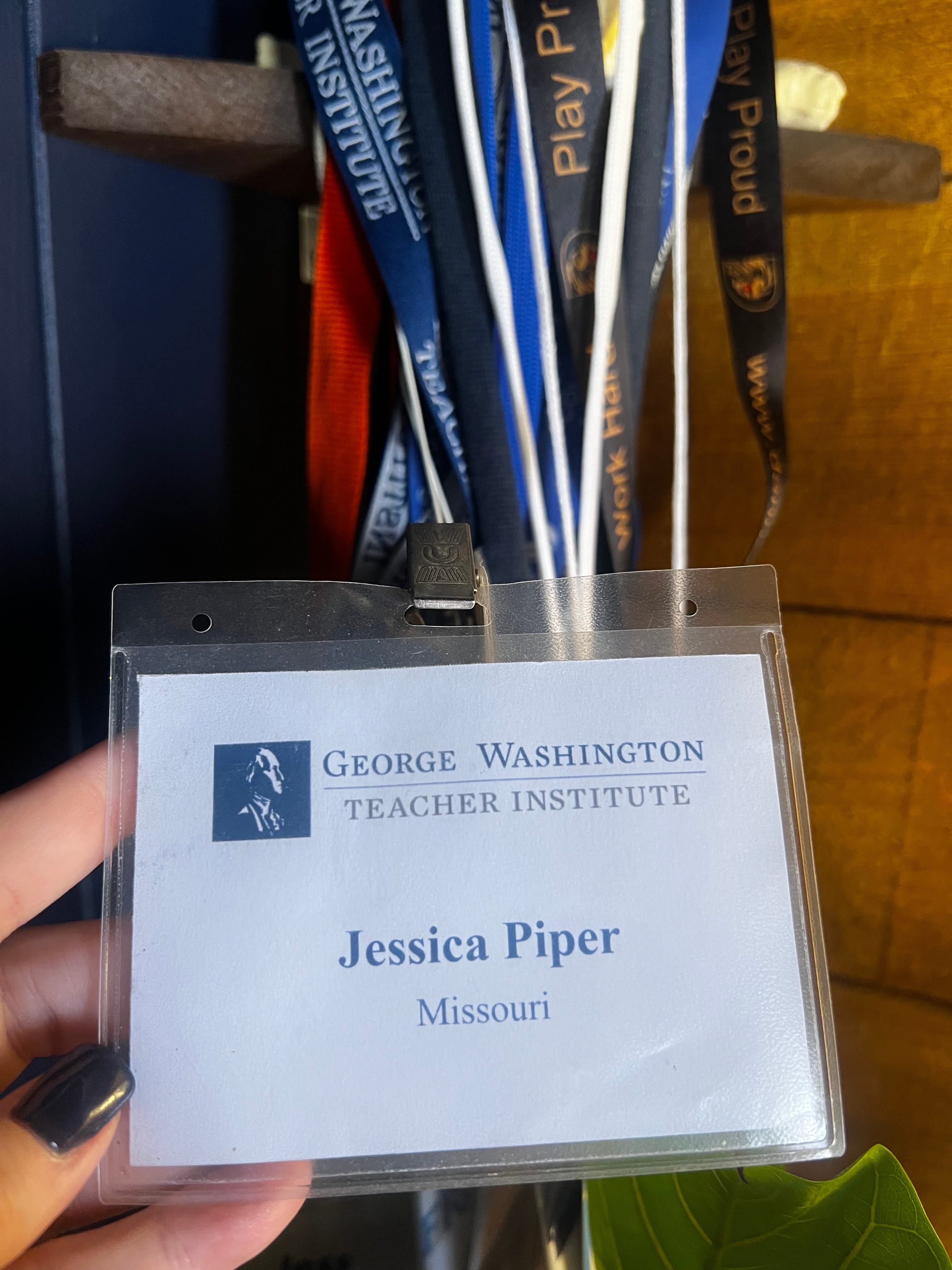
My lanyard from the George Washington Institute. I have 15 keepsake lanyards from teacher institutes I have attended. I am almost as proud of them as I am my degrees.
Once I found out that Koch money is used to sponsor teacher institutes, I knew I had to go. The Koch brothers —David has since died, while Charles remains— are from Kansas and several seminars happen right over the state line.
By attending these seminars, I was taking up the space of another educator. I was thinking of young teachers who might be indoctrinated by their bullshit. I was using up Koch time and resources and there was no way I would use their material or their instruction in my classroom.
Koch money is funding extremism across the country, especially in their vision of the future when it comes to education. They push for universal school vouchers which defund public schools, but it’s even more insidious than that. The Bill of Rights Institute offers curriculum workshops throughout the country, distributes teaching materials, holds essay contests for students, and displays its wares at the National Council for the Social Studies conference.
In its materials for teachers and students, the Bill of Rights cherry-picks the Constitution, history, and current events to hammer home its libertarian message that the owners of private property should be free to manage their wealth as they see fit. As one lesson insists: “The Founders considered industry and property rights critical to the happiness of society.” This message—that individual owners of property are the source of social good, their property sacred, and government the source of danger—is woven through the entire Koch curriculum.
The material and the professional development are sneaky. A teacher could attend a training and walk out thinking not much about it, but there is an underlying premise…the right to private property (wealth) is the only right that needs any defense. That is exactly the point of the Koch doctrine.
The Koch billionaires spent much of their lives and a good chunk of their fortune pushing anti-tax policies. They helped found the Cato Institute, a right-wing think tank, and helped fund the Heritage Foundation.
Yes, the folks behind Project 2025.
I found it so odd that the Bill of Rights Institute was even funding teacher seminars in the first place knowing that the brothers hate public education.
David Koch once stated, “We advocate the complete separation of education and state. Government schools lead to the indoctrination of children and interfere with the free choice of individuals. Government ownership, operation, regulation, and subsidy of schools and colleges should be ended.”
Good god. Talk about the quiet part out loud. Koch money is hosting seminars to disseminate propaganda directly to public school teachers in an effort to end public schools.
They also fund seminars for students.
I had heard they have a Bill of Rights summer institute for students in high school. A fully-paid trip to Washington, DC. I encouraged my 16-year-old son to apply and he was accepted. He learned to interact with very right-wing topics and children who are being indoctrinated to speak and debate on those topics.
My son came out stronger in his liberal values — he also used up about $2500 in Koch money and took the seat of a student who may have been susceptible to indoctrination.
I do these things to give these oligarchs no rest. No peace. It is my small way of throwing a wrench into the gears.
I work just as hard to be a constant sort of irritation to the Herzog Foundation. A billion dollar Missouri-based company whose mission is to “catalyze Christian education.” In smaller words, they want to send taxpayer money to private religious schools and even push for vouchers for homeschoolers. The less they know, right?
The Herzog Foundation is also on the Board of Advisory for Project 2025.
I once stood in a cornfield with a dozen friends to protest the “school choice” grifter they brought to town. I often tweet out their events and hundreds of folks have signed up to fill the seats. The foundation had to shut down an event and re-register people after I tweeted out the registration link for a Sarah Huckabee Sanders visit. She came to Missouri to sell her school voucher snake oil.
How can I help it if hundreds of folks who have no interest in an event, and have a burner email account, register for Herzog events and break the registration links?
I constantly comment on their social media posts. I write about them. I tell others about their mission. In general, I make a nuisance of myself.
No rest. No peace.
You can do these things too. You can be a burr. A constant irritation. An annoyance.
What can we do about the oligarchs who are taking over our institutions and forcing propaganda into our schools?
We can be counter-friction to stop the machine. We can create good trouble.
Peace & Justice History for 10/3:
| October 3, 1967 Thich Nu Tri, a Buddhist nun, immolated herself in protest of the repression of the Government of (South) Vietnam. It had denied participation in recent elections of peace and neutralist elements. Buddhist leaders thus boycotted the elections, and the Ngo Dinh Diem regime received only 35% of the vote. Within four weeks, three more nuns followed Thich Nu Tri’s example (among them Thich Nu Hue and Thich Nu Thuong), all in an effort to bring peace to the their country, split in two and caught up in a war with their countrymen in the North, and the escalating presence of U.S. troops. |
October 3, 1967 Woody Guthrie, 1912-1967 Woody Guthrie, 1912-1967Folksinger/songwriter Woody Guthrie died in New York City at the age of 55. He had spent the last decade of his life in the hospital, suffering from Huntington’s chorea. Woody called his songs “people’s songs,” filled with stinging honesty, humor and wit, exhibiting Woody’s fervent belief in social, political, and spiritual justice.  Extensive bio with photos and Woody’s writing |
| October 3, 1972 The SALT I treaties, which placed the first limits on nuclear arsenals, went into effect. The Strategic Arms Limitation Talks succeeded when U.S. President Richard Nixon and Soviet General Secretary Leonid Brezhnev agreed to limit anti-ballistic missile systems, and to freeze the number of intercontinental and submarine-based missile launchers (1,710 for the United States, some of which had multiple warheads, and 2,347 for the Soviet Union). |
| October 3, 1981 Irish republicans at the Maze Prison near Belfast, Northern Ireland, ended seven months of hunger strikes that had claimed 10 lives. The first to die was Bobby Sands, the imprisoned Irish Republican Army (IRA) leader who initiated the protest on March 1—the fifth anniversary of the British policy of “criminalisation” of Irish political prisoners.  Prior to 1976, Irish political prisoners were incarcerated under “Special Category Status,” which granted them a number of privileges that other criminal inmates did not enjoy. Despite Sands’s election (while an inmate) as member of Parliament from Fermanagh and South Tyrone after the first month of his hunger strike, and his death from starvation a month later, the government of British Prime Minister Margaret Thatcher would not give in, and nine more Irish republicans perished before the strike was called off. The dead included Kieran Doherty, who had been elected to Parliament in the Irish Republic during the strike. In the aftermath, the British government quietly conceded to some of the strikers’ demands, such as the rights to wear civilian clothing, to associate with each other, to receive mail and visits, and not to be penalized for refusing prison work. |
| October 3, 1994 The United States and South Africa signed a missile non-proliferation agreement committing South Africa to abide by the The Missile Technology Control Regime, and to end its missile program and its space-launch vehicle program. More about MTCR |
https://www.peacebuttons.info/E-News/peacehistoryoctober.htm#october3
” A Review of the VP Debate in Rhyme”
Updated: Trump’s Team Is Trying to Stop — Or Heavily Redact — the Release of Jack Smith’s Election Fraud Report
Tengrain’s Mock Paper Scissors has the pleading, which has been unsealed. Though there are redactions, they’re easily ID’d by people like us who pay attention, and there’s a nice index of them on MPS’s page. The link to the pleading, which is delicious (the pleading, I mean,) is also here.
The former president’s lawyers are trying to get ahead of what could be his campaign’s October surprise.
Donald Trump’s lawyers are scrambling to get ahead of what could be this election’s October surprise: the public release of special counsel Jack Smith’s report detailing evidence in the election fraud case against the former president.
In a court filing on Tuesday, Trump’s legal team accused the Department of Justice of putting together a “politically motivated manifesto” specifically timed to influence voters “in the final weeks of the 2024 Presidential election while early voting has already begun throughout the United States.”
They asked U.S. District Judge Tanya Chutkan to highly redact the report or stop it from appearing in the court’s public docket altogether.
The report, which runs approximately 180 pages and was filed last Thursday under seal pending the judge’s approval for public release, would reveal grand jury testimony and what Trump lawyers called “sensitive witness statements” gathered by federal investigators over recent years.
Trump’s team says prosecutors must explain “why their proposed public disclosure … will not pose risks to potential witnesses and unfairly prejudice the adjudication of this case.” Ironically, their argument comes after Trump, for months, has been complaining that a judge-imposed gag order has prevented him from attacking former allies for assisting FBI agents and testifying against him.
Trump’s defense attorneys, John F. Lauro and Todd Blanche, turned that narrative upside down, claiming that the DOJ special counsel is hypocritically publicizing investigative materials after vehemently trying to keep them secret in Trump’s classified records case. (Trump-appointed Judge Aileen Cannon dismissed those charges this past summer, and the case is on appeal.)
“Now that public disclosure serves their politically motivated mission, the special counsel’s office takes a different view. The office believes President Trump’s constitutional rights to
impartial jurors and fair proceedings — to say nothing of witness privacy and even safety — all take a back seat to the office’s political goals,” they wrote.
Unstated in today’s filing is that the potentially disastrous timing of this report — and its existence — is only due to the Trump team’s delay tactics in the case. Trump managed to push back the trial by fighting the indictment all the way up to the Supreme Court, which granted him an expansive new definition of presidential immunity. That opinion ultimately sent the trial judge on a fact-finding mission to figure out what alleged misconduct counts as personal versus official actions — hence Smith’s latest report.
Trump’s lawyers initially tried to file their counterargument under seal, but Chutkan ordered the D.C. federal court’s clerk to post it publicly by midday Tuesday.
The judge gave Trump’s team until noon today to file their proposed redactions to the report and until Oct. 10 to go over what they want to keep secret in what’s expected to be a large and detailed appendix to the report. Chutkan could order the report’s release at any time after that.
—
Jose Pagliery is a reporter at NOTUS.
https://www.notus.org/trump-team-jack-smith-election-fraud-report-redaction
Gee-I wonder why?
Springfield meeting change: Only Clark County residents can speak at city meeting
Springfield city government announced Wednesday that only residents of Clark County will be permitted to speak during the public comment portion of City Commission meetings in the future.
“The city of Springfield is committed to prioritizing the voices of our local residents at all commission meetings,” a city statement released Wednesday said. “To enhance community engagement and ensure that our decisions reflect the needs and interests of Springfield residents, we are implementing a new policy effective immediately.”
For months, Springfield City Commission meetings have been packed with attendees, many of them addressing grievances toward the commission over Haitian immigration issues. Some recent meetings have met the capacity limit for the City Hall Forum, forcing some later arrivals to sit outside on City Hall plaza.
To participate in the public comment portion of future commission meetings, speakers will have to complete a comment card and present valid proof of residency. Accepted forms of identification will include a State of Ohio driver’s license or a State of Ohio ID card.
“This requirement for proof of residency is designed to uphold the integrity of our meetings by ensuring that Clark County residents have a proper platform to address issues that matter to them,” city officials said. “This policy also aims to minimize disruptions from individuals who may misrepresent their residency to seek notoriety or cause distractions during meetings.
City officials said they do encourage all residents to speak up and share their perspectives on community matters at the meetings.
The next City Commission meeting is scheduled for 7 p.m. Tuesday, Oct. 8, in the City Hall Forum at 76 E. High St. in downtown Springfield.
Good Review of Last Night’s Debate
with a transcript link.
For Science on Wed.
Some sloths among animals unable to adapt to rapid climate change
A new study warns that sloths living in high-altitude rainforests of South and Central America could face extinction if temperatures there continue to rise according to climatic predictions.
The research, published in PeerJ Life & Environment, suggests that some sloths’ restricted ability to migrate to cooler regions and limited metabolic flexibility make them particularly vulnerable to climate change.
“Sloths are inherently limited by their slow metabolism and unique inability to regulate body temperature effectively, unlike most mammals,” says Dr Rebecca Cliffe, lead researcher of the study from Swansea University and The Sloth Conservation Foundation in the UK.
“Our research shows that sloths, particularly in high-altitude regions, may not be able to survive the significant increases in temperature forecast for 2100.” (snip-MORE)
===================================================
Structure of important male contraceptive target finally solved
A team at Monash University in Victoria developing a hormone-free, reversible male contraceptive has now figured out the 3D structure of one of their primary therapeutic targets – the P2X1-purinergic receptor (P2X1).
According to Dr Sab Ventura from the Monash Institute of Pharmaceutical Sciences (MIPS), this has been the main stumbling block that has so far hindered the team from progressing the drug discovery program to the next stage.
“Our primary goal is to develop a male contraceptive pill that is not only hormone-free but also bypasses side effects such as long-term irreversible impacts on fertility, making it suitable for young men seeking contraceptive options,” says Ventura.
In previous research in mice, the team showed that simultaneous inactivation of P2X1 and a second protein, α1A-adrenergic receptor, resulted in male infertility.
“Now we know what our therapeutic target looks like, we can generate drugs that can bind to it appropriately, which totally changes the game,” says Ventura. (snip-MORE)
=====================================
River piracy pushing Mount Everest upwards
Mount Everest is tall. In other news, the sky is blue.
But Everest (also called Chomolungma and Sagarmāthā) is taller than it logically should be – towering 238m above the world’s next highest peak, K2, and more than 250m higher than any of its counterparts in the relatively uniform Himalaya range.
Plus, it’s growing at about 2mm a year, faster than the expected rate for the range.
A team of Chinese and UK scientists have now suggested why this is the case.
The researchers think the culprit is a nearby river which “captured” another river 89,000 years ago, causing erosion that made Everest more buoyant.
They’ve published their findings in Nature Geoscience.
The Himalayan peaks get their extraordinary height from the collision of the Indian and Eurasian tectonic plates, causing the Earth’s crust to thicken and the mountain range to push upwards.
“An interesting river system exists in the Everest region,” says co-author Dr Jin-Gen Dai, from China University of Geosciences.
The team used numerical modelling to see how the river changed over time. They found that, about 89,000 years ago, the Arun river “captured” another nearby river.
This event, referred to as “river piracy”, happens when a river diverts its course and takes up the discharge of another river or stream.
“Our research shows that as the nearby river system cuts deeper, the loss of material is causing the mountain to spring further upwards,” says co-author Adam Smith, a PhD student at University College London, UK.
The team estimates that the river piracy has made Everest between 15 and 50m higher than it would otherwise be.
It’s also made neighbouring peaks, Lhotse and Makalu, unusually tall. These are the 4th and 5th highest mountains in the world, respectively. (snip-MORE)
======================================
Science fiction health technology a step closer
It’s not the famous Star Trek tricorder but it’s close: researchers have developed a hand-held scanner that can generate highly detailed 3D images of body parts in almost real time.
The technology can accurately image blood vessels up to 15mm deep in human tissue, which the researchers say could help to diagnose conditions such as cancer, cardiovascular disease, and arthritis.
“We’ve come a long way with photoacoustic imaging in recent years, but there were still barriers to using it in the clinic,” says Paul Beard of University College London (UCL), UK, corresponding author of the new Nature Biomedical Engineering paper.
“The breakthrough in this study is the acceleration in the time it takes to acquire images, which is between 100 and 1,000 times faster than previous scanners.
“This speed avoids motion-induced blurring, providing highly detailed images of a quality that no other scanner can provide. It also means that rather than taking 5 minutes or longer, images can be acquired in real time, making it possible to visualise dynamic physiological events.
“These technical advances make the system suitable for clinical use for the first time, allowing us to look at aspects of human biology and disease that we haven’t been able to before.” (snip-MORE)
Here’s to a morning transcript
I am enjoying “Elizabeth and Essex” with Bette Davis because I’ve not seen it in full to just enjoy her talent. Tonight’s debate will be very like the first debate between the Don and Pres. Biden, with Sen. Vance playing the Don. I have no doubt Gov. Walz can handle it all, but there will be no fact checking or corrections, the two mods are women so I expect Vance to be abusive if one does try to control the program, and then there is this from the Daily Beast:
You Won’t Like Who JD Vance Will Copy at Tonight’s Debate
The past is always prologue and this one features another shouty Yale Law School graduate.
Nell Scovell Updated Oct. 01, 2024 12:52PM EDT / Published Oct. 01, 2024 12:46PM EDT
Snippet:
Look for candidate JD Vance to come out swinging at Tuesday’s vice presidential debate against Minnesota Governor Tim Walz. Odds are good that Vance will go for the Trumpian emotional trifecta: playing the victim, spewing anger, and attacking women and immigrants.
While not everyone is charmed by righteous rage, Donald Trump is the “audience of one” who needs to hear his chosen candidate mimic the boss. There’s precedent for this behavior from fellow Yale Law School graduate, Brett Kavanaugh. (snip)
Vance knows that his debate performance must please an “audience of one.” Job one is to make Daddy Donald proud. Reasonable and empathetic just won’t cut it. Here are ten predictions for how Vance will follow in Kavanaugh’s footsteps by using a sharp tone, being overly emotional and saying a few things he should not say. (snip-MORE)

