Flamy Grant Pushes the Boundaries of Christian Music — and Drag

By Mitchell Atencio

Full confession; this is an article from Sojourners Magazine. I subscribe, and I brought the whole piece here, for those who may wish to read it but don’t want to go on a Christian site. I did not see anything besides that to warn about; there is discussion of church but not of bad happenings. However, if I missed something, I am so sorry; if you would be able to let me know in comments, that helps me learn what I should look for. This article struck me as something that should be at Scottie’s Playtime.

This interview is part of The Reconstruct, a weekly newsletter from Sojourners. In a world where so much needs to change, Mitchell Atencio and Josiah R. Daniels interview people who have faith in a new future and are working toward repair. Subscribe here.

Flamy Grant called in to her morning interview after participating in a day-long silent retreat. Well, not a silent retreat exactly — it was a vocal rest.

After spending the last year touring the U.S. off the success of her album, Grant, who prefers to use her stage name in interviews, needed to rest her voice. Since her rise to Christian music stardom — or infamy, depending on how one feels about a drag queen topping the Christian charts — she has performed in bars, clubs, and churches spreading the good news in glitter.

Since then, Grant has collaborated with artists like Semler, Derek Webb, and Jennifer Knapp. And she has spoken out for LGBTQ+ rights, joining a lawsuit against the state of Tennessee in 2023.

A few weeks before the release of her second album, CHURCH, Grant and I spoke about her time touring the country, writing songs in drag, leaving the church but still going to churches weekly, and more.

Coincidentally, as the interview ended, Amy Grant’s “Lucky One” began playing over the hotel lobby’s speakers.

[Editor’s note: This interview was performed before Hurricane Helene devastated many regions in the South, including Flamy Grant’s hometown of Asheville, N.C. Grant and her team canceled shows in North Carolina, but continue touring in Georgia and Nashville this week before touring the West Coast.]

This interview has been edited for length and clarity.

Mitchell Atencio: How is touring? What have you heard from folks while on the road?

Flamy Grant: I feel like I’ve been on tour pretty much nonstop for the past year. A year ago I quit my day job and moved back to Asheville, N.C., where I was born and raised. And honestly, this is not even an exaggeration, I’ve spent more time on the road than I have in my bedroom at home.

This [tour], though, is very different. I’m on a tour with two other acts and a full band. Mostly, I’ve just been solo on the road, which I love in a lot of ways because I’m actually very much an introvert.

We’re only in our second week right now of the “No More Trauma” tour, and the response has been amazing so far. Now that I’m a year in, there have been people who’ve come up to me to say hello afterwards, and [they say], “This is our third or fourth time seeing you!” And I’m like, I’ve really only been doing this full-time for a year. What do you mean the third or fourth time? It is really cool to know that there’s this community and fan loyalty.

My favorite moment on tour so far was in St. Louis. We were getting ready, there was no green room at the venue, so I was literally just painting my face in front of the windows, right outside where the line was forming to get in. There was this family — a mother and a little girl, around 7-9 years old. She had a sign, painted in full rainbow lettering, that said, “This is my first concert!” And she was just holding it up to the window. So I popped out to say hello, and they had driven two hours to St. Louis to come to this show. Her name was Claire, and I’m her favorite artist, and I’m her first concert.

That was wild because it just threw me back to when I was that age and excited about music and wanting to go to concerts for the first time. Everybody always asks that question, “What was your first concert?” throughout your entire life. And now Claire is always going to say, “I saw a drag queen in St. Louis.” 

Now I’m curious what your first concert was.

Clay Crosse. He had quite a big hit with that song “I Surrender All” in the ’90s. I just loved him. I probably had a crush on him, if we’re being honest. He had that classic jawline, that beautiful blonde hair, and yeah, I was obsessed with him. My parents couldn’t take me, so I roped one of my friends from church and got his dad to drive us down to this show. What I remember most about it was that Jaci Velasquez opened and she was so good. She was phenomenal.

Mine, for fairness, was the Newsboys back when Peter Furler was still leading them. Speaking of touring, I noticed you have a different booking process for churches and for “traditional venues” like bars and clubs. Why is that?

That’s been interesting to navigate. I feel like I’m definitely straddling two worlds. I very much want to be taken seriously as a musician and songwriter. The drag can sometimes be a little bit of a barrier to that, because people tend to see drag and think it’s a gimmick or, they just immediately associate it with Sunday drag brunch or weekend clubs.

I have done a fair bit of that, especially early on, but I’m a singer-songwriter and I write my own original music, and I happen to perform in drag. It’s been a challenge to convey that as we’re booking and marketing shows. My booking agent is fantastic, and she’s been really good at helping people understand that they’re booking a singer-songwriter who needs an extra hour in the green room to get ready.

What happened last year, with “Good Day” hitting number one, so many churches reached out and the first question was, “Can we do ‘Good Day’ in Sunday worship?” And I’m like, of course you can, just make sure they know it’s written by a drag queen. The next question was, “How do we get you to come?” Either on a Sunday morning or to do a special concert on an evening.

Because I know the church world and was a worship leader for 22 years, it just makes more sense for me to book those myself. I don’t generally go out seeking church bookings, those really do come to me, and that’s a gift in so many ways.

I’ve played in over 50 churches in the last year. Some want to integrate me into their Sunday morning service, I’ll be part of the service planning, and we’ll have a song during communion or the offertory. Others want to bring me in on a Saturday night and have me come sing to their congregation and community.

I have officially left the church myself. The last church I was involved in was in San Diego, I was a worship leader there for 8-and-a-half years and it closed down after the pandemic. I have not sought out a new church home since then, but I’m still in churches a lot.

You’re in churches about once a week  that’s more than many church members. What makes writing music as Flamy Grant feel different? How does one write songs in drag?

In some ways, there’s no difference at all. At the end of the day, I’m just writing about my experiences. Derek Webb says the artist’s role is just to look at the world and speak about it. That’s so much of what I’ve done since I was 9 years old when I wrote my first song. That process of songwriting doesn’t necessarily feel all that different.

And yet, there is this shift in the tone and subject matter of what I write about, because my life has changed so dramatically. And drag is a huge part of that change.

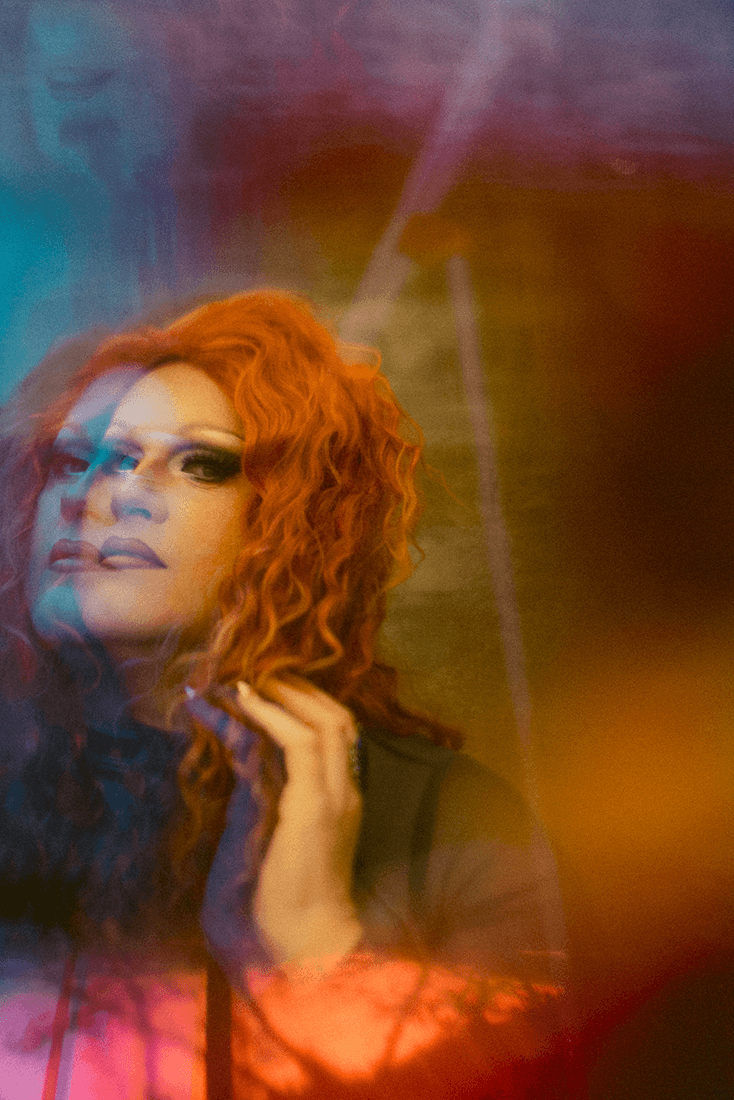
Flamy Grant poses for a photo. Photo by Ash Perlberg/Courtesy Flamy Grant

It’s been really fun to feel like I’m excavating parts of myself that have been dormant or suppressed for so long. [Drag] definitely changes the subject matter of what I’m writing about.

And it’s been there all along, I just haven’t allowed myself the pleasure and joy of exploring the range of my own gender identity, even the range of my physical voice. Being able to play with how I sing a song or a lyric, it’s opened up a world of songwriting to me. There are times now, when I’m writing, where I do think about what this is going to look and feel like on stage, in drag, in a big wig with sequins and glitter on my face and all of this.

I still love to write a gut-punch ballad; that’s one of my specialties. And I love doing that because that’s not really a thing you tend to associate with drag too much. That tends to be a more surprising moment for people in my concerts, when I get serious. People expect the fierceness and sass and qualities of drag that they’re used to.

Mostly it’s just a lot of fun. I really enjoy the opportunity to play with music in new ways.

It sounds like part of what you’re saying is that it offers an added element of creativity to a songwriting process, even in the “constraint” of writing as Flamy Grant.

That’s absolutely right, there is a constraining piece to it. Whatever music I put out, it’s going to be out under that name, Flamy Grant, and I know it’s going to be associated with drag.

In some ways it’s obviously pushing the boundaries of Christian music, but it’s also pushing the boundaries of what people might consider drag to be.

What has the response been like from the drag community?

I just got a message from a drag queen back in San Diego. Her drag name is Nadya Symone. I love this queen. She’s just one of the people I look up to. She’s a Southern queen who lives in San Diego now. She was there at my very first drag show; I was nervous, and she could tell. And she just said, “Baby, whatever happens, the show goes on. You make a mistake, you forget a lyric, you forget a line, your wig falls off, whatever — the show goes on.”

I just felt so taken in, included, and welcomed. And that’s never changed. The people who get [Flamy] the quickest are other drag performers. I don’t have to explain much to them. They’re like, “Oh you’re just bringing yourself to drag, which is what we all do.”

Anyway, the message that Symone sent me just yesterday was just, “I’m so proud of you, baby.” I don’t know what she had seen, but she’s still there and cheering me on. I had a lot of anxiety coming into this and a lot of imposter syndrome. Am I a real drag queen? Do I really belong in this community if what I want to do is write my own folk songs and sing them? And that has all been laid to rest by interacting with other performers.

Is there anything that you wanted to do differently between your first album, Bible Belt Baby, and your second album, CHURCH?

I’m so proud of Bible Belt Baby, but it did come together circumstantially and without a lot of intention. My initial conversation with my producer, Ben, who was my housemate in San Diego at the time, was, I think I want to sing in drag. And we were going to put together a five-song EP. I ran a Kickstarter, and we raised more than I expected. And it just continued to blossom and grow until it was a full album.

And in order to make it a full album, I was pulling from songs that predated Flamy. What was really cool about that was discovering that Flamy has been there all along, right?

But with CHURCH, I had the opportunity to really, for the first time, think about crafting a complete narrative. Thinking about themes that would all be contained on one record and writing, for the first time, a full album in Flamy’s voice intentionally.

The second thing was having the resources to go to Nashville and make a Nashville record with Nashville players. That was a really exciting prospect for me.

We sent them all the demos in advance. I, [pauses] I don’t know that they listened to them, but they didn’t need to. They heard the song one time, took a couple notes, went to their instruments, and five, six, seven takes later we had what we needed. It was wild to watch how, at the skill level of those musicians, they brought the songs to life in ways I could have only hoped for.

I really wanted a sound that was in this Nashville vein, but we also talked about how to make it still a drag record. How do we pull in some of this country disco feel? How do we make sure it stands on par with anything coming out of Nashville, but also uniquely Flamy. They did a phenomenal job.

[Lastly], with Bible Belt Baby, I didn’t know, up until a couple months before releasing it, whether I would even put it out as a Christian record. It wasn’t until we finished it that I was like, yeah, this absolutely belongs in the Christian genre

Now, Christian music is largely worship music, which I personally don’t care for. I like music that tells someone’s story. I want to hear what an individual person has gone through in their life and how they got to where they are.

And that’s why I loved artists like Margaret Becker, or Jennifer Knapp, Caedmon’s Call, and folks famous for writing really personal. What’s that thing people say? We find the universal in the specific — that’s what I love about singer songwriters. I don’t know if I’ll continue to make Christian music forever or what the next album will look like yet, but for this album, I [wanted] to be really intentional with the messaging. I think the tagline for the Kickstarter was “Flamy Grant’s Big Gay Christian Record.”

https://sojo.net/articles/interview/reconstruct/flamy-grant-pushes-boundaries-christian-music-and-drag

Update:

Links: Romancing the Vote, Yarn, & More

by Amanda · Oct 2, 2024 at 2:00 pm ·

Good info regarding books that could be near and dear to hearts of readers, some other stuff, and Romancing the Vote helping to save democracy.

Good Humans

There’s a Game for That!

A Coupla Comics Apropo Of Nothing (or, maybe they are…)

https://www.gocomics.com/furbabies/2024/10/03

FurBabies by Nancy Beiman for October 03, 2024

FurBabies Comic Strip for October 03, 2024

==========

https://www.gocomics.com/calvinandhobbes/2024/10/03

Calvin and Hobbes by Bill Watterson for October 03, 2024

Calvin and Hobbes Comic Strip for October 03, 2024

A Cog in the Wheel? Not a Chance. by Jess Piper

Good trouble if you can get it…

Read on Substack

I will be discussing the Koch brothers in this essay. If you are unfamiliar with them, here is a primer.

“Never, ever be afraid to make some noise and get in good trouble, necessary trouble.”

~John Lewis

I once left an educational conference with nearly a dozen cans of Diet Coke, several boxed lunches, a handful of cookies, and every handout I could get my hands on. I left with every pen, lanyard, and every lesson plan that was out for the taking.

I’m not a hoarder or even participating in minor theft — it was all free. I was attending a Koch-funded Bill of Rights Teacher Institute and I was going to take those folks for every penny I could. The next day, I delivered the cookies and boxed lunches to the teachers’ lounge. I drank the Diet Cokes.

Koch money paid for my day out of school for this seminar by giving me a stipend and paying for my sub while I was out of the classroom. I think it was around $400 in total.

Did I make a dent in a billionaire’s pocketbook? No. Would I participate as a cog in the wheel in their dystopian vision of education? Hell no.

“If the injustice is part of the necessary friction of the machine of government, let it go, let it go: perchance it will wear smooth–certainly the machine will wear out… but if it is of such a nature that it requires you to be the agent of injustice to another, then I say, break the law. Let your life be a counter-friction to stop the machine. What I have to do is to see, at any rate, that I do not lend myself to the wrong which I condemn.”

~Henry David Thoreau

I have read enough protest literature to know one thing: don’t be a cog in the wheel. If you see something you don’t like, shut it down. If you can’t shut it down, make the harmful agenda more difficult.

That’s exactly the sort of minor mayhem I have caused for years. Slight chaos. A burr under the saddle. A thorn in the side. A constant irritation.

The older I get, the more brazen I have become in not lending myself to the wrong which I condemn. I applied to the Koch-funded Bill of Rights Teacher Institute after hearing about it at other teacher seminar I had attended.

My last five years of teaching had grown a little tired and monotonous so I applied for summer travel institutes with the National Endowment for the Arts and the National Endowment for the Humanities and others like the summer program at George Washington’s Mount Vernon. All were prestigious and admission was difficult.

I was lucky to be admitted to several.

I love to travel, but what I really loved about these institutes was learning about American History from scholars in the places where history happened. It makes a huge difference. I have learned from scholars across the country.

My lanyard from the George Washington Institute. I have 15 keepsake lanyards from teacher institutes I have attended. I am almost as proud of them as I am my degrees.

Once I found out that Koch money is used to sponsor teacher institutes, I knew I had to go. The Koch brothers —David has since died, while Charles remains— are from Kansas and several seminars happen right over the state line.

By attending these seminars, I was taking up the space of another educator. I was thinking of young teachers who might be indoctrinated by their bullshit. I was using up Koch time and resources and there was no way I would use their material or their instruction in my classroom.

Koch money is funding extremism across the country, especially in their vision of the future when it comes to education. They push for universal school vouchers which defund public schools, but it’s even more insidious than that. The Bill of Rights Institute offers curriculum workshops throughout the country, distributes teaching materials, holds essay contests for students, and displays its wares at the National Council for the Social Studies conference.

In its materials for teachers and students, the Bill of Rights cherry-picks the Constitution, history, and current events to hammer home its libertarian message that the owners of private property should be free to manage their wealth as they see fit. As one lesson insists: “The Founders considered industry and property rights critical to the happiness of society.” This message—that individual owners of property are the source of social good, their property sacred, and government the source of danger—is woven through the entire Koch curriculum.

The material and the professional development are sneaky. A teacher could attend a training and walk out thinking not much about it, but there is an underlying premise…the right to private property (wealth) is the only right that needs any defense. That is exactly the point of the Koch doctrine.

The Koch billionaires spent much of their lives and a good chunk of their fortune pushing anti-tax policies. They helped found the Cato Institute, a right-wing think tank, and helped fund the Heritage Foundation.

Yes, the folks behind Project 2025.

I found it so odd that the Bill of Rights Institute was even funding teacher seminars in the first place knowing that the brothers hate public education.

David Koch once stated, “We advocate the complete separation of education and state. Government schools lead to the indoctrination of children and interfere with the free choice of individuals. Government ownership, operation, regulation, and subsidy of schools and colleges should be ended.”

Good god. Talk about the quiet part out loud. Koch money is hosting seminars to disseminate propaganda directly to public school teachers in an effort to end public schools.

They also fund seminars for students.

I had heard they have a Bill of Rights summer institute for students in high school. A fully-paid trip to Washington, DC. I encouraged my 16-year-old son to apply and he was accepted. He learned to interact with very right-wing topics and children who are being indoctrinated to speak and debate on those topics.

My son came out stronger in his liberal values — he also used up about $2500 in Koch money and took the seat of a student who may have been susceptible to indoctrination.

I do these things to give these oligarchs no rest. No peace. It is my small way of throwing a wrench into the gears.

I work just as hard to be a constant sort of irritation to the Herzog Foundation. A billion dollar Missouri-based company whose mission is to “catalyze Christian education.” In smaller words, they want to send taxpayer money to private religious schools and even push for vouchers for homeschoolers. The less they know, right?

The Herzog Foundation is also on the Board of Advisory for Project 2025.

I once stood in a cornfield with a dozen friends to protest the “school choice” grifter they brought to town. I often tweet out their events and hundreds of folks have signed up to fill the seats. The foundation had to shut down an event and re-register people after I tweeted out the registration link for a Sarah Huckabee Sanders visit. She came to Missouri to sell her school voucher snake oil.

How can I help it if hundreds of folks who have no interest in an event, and have a burner email account, register for Herzog events and break the registration links?

I constantly comment on their social media posts. I write about them. I tell others about their mission. In general, I make a nuisance of myself.

No rest. No peace.

You can do these things too. You can be a burr. A constant irritation. An annoyance.

What can we do about the oligarchs who are taking over our institutions and forcing propaganda into our schools?

We can be counter-friction to stop the machine. We can create good trouble.

~Jess

Peace & Justice History for 10/3:

October 3, 1967
Thich Nu Tri, a Buddhist nun, immolated herself in protest of the repression of the Government of (South) Vietnam. It had denied participation in recent elections of peace and neutralist elements. Buddhist leaders thus boycotted the elections, and the Ngo Dinh Diem regime received only 35% of the vote. Within four weeks, three more nuns followed Thich Nu Tri’s example (among them Thich Nu Hue and Thich Nu Thuong), all in an effort to bring peace to the their country, split in two and caught up in a war with their countrymen in the North, and the escalating presence of U.S. troops.
October 3, 1967
Woody Guthrie, 1912-1967
Folksinger/songwriter Woody Guthrie died in New York City at the age of 55. He had spent the last decade of his life in the hospital, suffering from Huntington’s chorea. Woody called his songs “people’s songs,” filled with stinging honesty, humor and wit, exhibiting Woody’s fervent belief in social, political, and spiritual justice.

Extensive bio with photos and Woody’s writing
October 3, 1972
The SALT I treaties, which placed the first limits on nuclear arsenals, went into effect. The Strategic Arms Limitation Talks succeeded when U.S. President Richard Nixon and Soviet General Secretary Leonid Brezhnev agreed to limit anti-ballistic missile systems, and to freeze the number of intercontinental and submarine-based missile launchers (1,710 for the United States, some of which had multiple warheads, and 2,347 for the Soviet Union).
October 3, 1981
Irish republicans at the Maze Prison near Belfast, Northern Ireland, ended seven months of hunger strikes that had claimed 10 lives.
The first to die was Bobby Sands, the imprisoned Irish Republican Army (IRA) leader who initiated the protest on March 1—the fifth anniversary of the British policy of “criminalisation” of Irish political prisoners.


Prior to 1976, Irish political prisoners were incarcerated under “Special Category Status,” which granted them a number of privileges that other criminal inmates did not enjoy.
Despite Sands’s election (while an inmate) as member of Parliament from Fermanagh and South Tyrone after the first month of his hunger strike, and his death from starvation a month later, the government of British Prime Minister Margaret Thatcher would not give in, and nine more Irish republicans perished before the strike was called off.
The dead included Kieran Doherty, who had been elected to Parliament in the Irish Republic during the strike. In the aftermath, the British government quietly conceded to some of the strikers’ demands, such as the rights to wear civilian clothing, to associate with each other, to receive mail and visits, and not to be penalized for refusing prison work.
October 3, 1994
The United States and South Africa signed a missile non-proliferation agreement committing South Africa to abide by the The Missile Technology Control Regime, and to end its missile program and its space-launch vehicle program.
More about MTCR 

https://www.peacebuttons.info/E-News/peacehistoryoctober.htm#october3

” A Review of the VP Debate in Rhyme”

Updated: Trump’s Team Is Trying to Stop — Or Heavily Redact — the Release of Jack Smith’s Election Fraud Report

Tengrain’s Mock Paper Scissors has the pleading, which has been unsealed. Though there are redactions, they’re easily ID’d by people like us who pay attention, and there’s a nice index of them on MPS’s page. The link to the pleading, which is delicious (the pleading, I mean,) is also here.

The former president’s lawyers are trying to get ahead of what could be his campaign’s October surprise.

Donald Trump’s lawyers are scrambling to get ahead of what could be this election’s October surprise: the public release of special counsel Jack Smith’s report detailing evidence in the election fraud case against the former president.

In a court filing on Tuesday, Trump’s legal team accused the Department of Justice of putting together a “politically motivated manifesto” specifically timed to influence voters “in the final weeks of the 2024 Presidential election while early voting has already begun throughout the United States.”

They asked U.S. District Judge Tanya Chutkan to highly redact the report or stop it from appearing in the court’s public docket altogether.

The report, which runs approximately 180 pages and was filed last Thursday under seal pending the judge’s approval for public release, would reveal grand jury testimony and what Trump lawyers called “sensitive witness statements” gathered by federal investigators over recent years.

Trump’s team says prosecutors must explain “why their proposed public disclosure … will not pose risks to potential witnesses and unfairly prejudice the adjudication of this case.” Ironically, their argument comes after Trump, for months, has been complaining that a judge-imposed gag order has prevented him from attacking former allies for assisting FBI agents and testifying against him.

Trump’s defense attorneys, John F. Lauro and Todd Blanche, turned that narrative upside down, claiming that the DOJ special counsel is hypocritically publicizing investigative materials after vehemently trying to keep them secret in Trump’s classified records case. (Trump-appointed Judge Aileen Cannon dismissed those charges this past summer, and the case is on appeal.)

“Now that public disclosure serves their politically motivated mission, the special counsel’s office takes a different view. The office believes President Trump’s constitutional rights to

impartial jurors and fair proceedings — to say nothing of witness privacy and even safety — all take a back seat to the office’s political goals,” they wrote.

Unstated in today’s filing is that the potentially disastrous timing of this report — and its existence — is only due to the Trump team’s delay tactics in the case. Trump managed to push back the trial by fighting the indictment all the way up to the Supreme Court, which granted him an expansive new definition of presidential immunity. That opinion ultimately sent the trial judge on a fact-finding mission to figure out what alleged misconduct counts as personal versus official actions — hence Smith’s latest report.

Trump’s lawyers initially tried to file their counterargument under seal, but Chutkan ordered the D.C. federal court’s clerk to post it publicly by midday Tuesday.

The judge gave Trump’s team until noon today to file their proposed redactions to the report and until Oct. 10 to go over what they want to keep secret in what’s expected to be a large and detailed appendix to the report. Chutkan could order the report’s release at any time after that.


Jose Pagliery is a reporter at NOTUS.

https://www.notus.org/trump-team-jack-smith-election-fraud-report-redaction