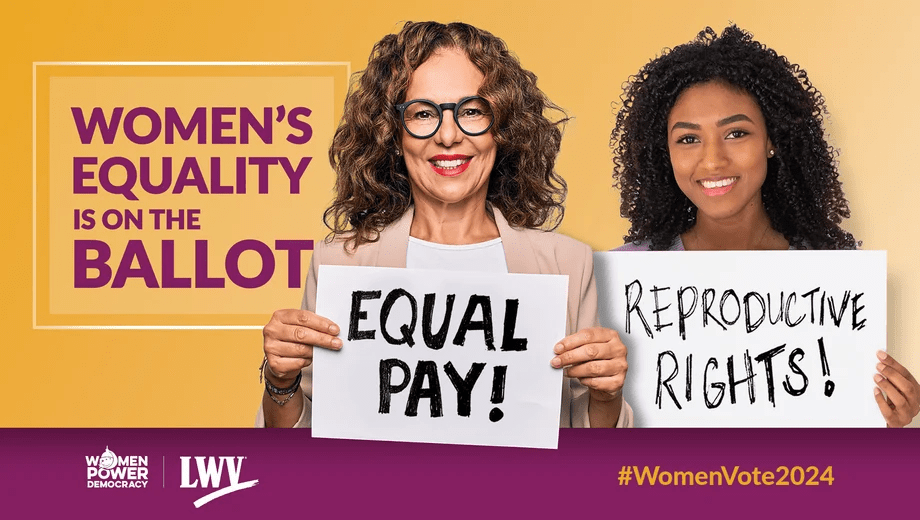
August 26, otherwise known as Women’s Equality Day, marks the anniversary of the certification of the 19th Amendment, which granted some women the right to vote.
Yet today, women have fewer rights than they’d had in decades. To recognize this, we acknowledge Women’s Inequality Day.
Inequality impacts our health: although women pay $15 million more each year for health care than men, we spend more of our lives in poor health. Those who may experience pregnancy no longer have reproductive freedom; and when we do give birth, we (particularly women of color) face high rates of maternal mortality.
It impacts our work: we’re paid less than our male counterparts and are underrepresented in leadership roles. We also deal with workplace harassment, insufficient maternal leave, and disproportionate caretaking responsibilities that affect our ability to work.
It impacts our representation: women are severely underrepresented in politics, making up only 25% of the Senate, 29% of the House, and 31.9% of statewide elective executives.
How can we make policies that protect and serve women without more women in office? And in an age where our basic freedoms and bodily autonomy are under fire, how can we ensure our rights aren’t degraded further?
The 2024 federal election is a critical moment in the fight for our equality.
The people we elect in November will be in charge of our rights – including the right to reproductive freedom – for the next four years.
So when you cast your vote in 2024, will you vote for someone who defends those rights? Or someone who wants to take them away?
Our 2024 campaign centers around empowering women to make their voices heard at the ballot box by equipping them with essential voter information. We’re highlighting our free, bilingual one-stop-shop for nonpartisan election information, VOTE411.org.
This year’s Women’s Inequality “Day” campaign will take place from August 26-30, with unique calls to action engaging voters every day! Get involved by sharing content via our social toolkit.
“Bad Romance: Women’s Suffrage is a parody music video paying homage to Alice Paul and the generations of brave women who joined together in the fight to pass the 19th Amendment, giving women the right to vote in 1920.” Watch here.
=====
WOMEN’S PROGRESS THROUGH THE YEARS…
Prior to 1918 Doctor’s weren’t allowed to advise married patients about birth control. Prior to 1920 Women couldn’t vote in all elections until 19th Amendment was ratified. Prior to WWII Female teachers couldn’t be married. During 1950’s Domestic abuse was not considered a crime but a’family matter’. Prior to 1963 Equitable wages for the same work, regardless of race, color, religion, national origin, or sex of the workers were not promised until passage of Equal Pay Act. Prior to 1964 Discrimination on the basis of race, color, religion, national origin, or sex was not prohibited until passage ofthe Civil Rights Act. Prior to 1965 State laws could prohibit the prescription or use of contraceptives by married couples. In some states, the woman needed her husband’s permission to purchase contraceptives. Prior to 1969 Yale and Princeton didn’t accept female students. Prior to 1969 Women couldn’t work at jobs that had been for men only. Prior to 1971 Women with a law degree could be denied the right to plead a client’s case in court. Prior to 1971 Private employers could refuse to hire women with pre-school children. Prior to 1972 The Boston Marathon was an all-male event. There was no Women’s Division. Prior to 1972 The right to privacy didn’t encompass an unmarried person’s right to use contraceptives. Prior to 1972 Title IX of the Education Amendment didn’t exist. Schools that received Federal support didn’t need to provide the same programs to women as they did men.
Prior to 1973 Abortions weren’t legal in the entire U.S. until Roe v. Wade decision by Supreme Court declared the U.S. Constitution protected a woman’s right to terminate an early pregnancy. Prior to 1974 Housing discrimination on the basis of sex and credit discrimination against women existed. Prior to 1974 It was legal to force pregnant women to take maternity leave on the assumption they were incapable of working in their physical condition. Prior to 1974 Single, widowed, or divorced women had to bring a man along to open a bank account or to cosign any credit application. Married women couldn’t open a bank account without their husband’s permission. Prior to 1975 Women were excluded from serving on juries. Prior to 1976 West Point Academy didn’t admit female students. Prior to 1977 Harvard didn’t admit female students. Prior to 1978 There was no ban on discrimination against women on the basis of pregnancy, childbirth, or related medical issues. Prior to 1984 Women were not allowed to join all-male organizations (Jaycees, Kiwanis, Rotary, Lions) Prior to 1994 There were no funded services for victims of rape or domestic violence. Prior to 2013 Women in the military were banned from combat positions. Prior to 2022 Since the 1973 Supreme Court decision (Roe v. Wade), a woman’s right to terminate a pregnancy was protected by the U.S. Constitution. This decision was reverse by the current U.S. Supreme Court in 2022. Information provided by Soroptimist site. Learn more about Soroptimist’s by visiting their site here.
LEARN MORE ABOUT THE HISTORY OF WOMEN’S EQUALITY DAY
The state is one of the epicenters of the moral panic and anti-trans rhetoric that have dominated campaigns and media cycles during the presidential election. Under the guise of fighting the “indoctrination of our children”, Republicans have made restricting trans rights a focus of their platforms. Donald Trump has vowed to stop “the leftwing gender insanity” while a leading Missouri Republican has celebrated residents leaving the state due to anti-trans policies, saying: “We are better if they are gone.”
The toxic discourse has fomented fear and anger among conservatives about trans people’s increasing visibility in society and created deep anxiety and distress for queer and trans people and their families.
Parents of trans youth across the St Louis region interviewed for this article said they were desperately trying to protect their kids’ health and wellbeing as politicians have zeroed in on their children. They are rationing medications and traveling hours out of state for care. Some are counting the days until their kids turn 18 and the laws don’t apply; “We are truly doing what we can to keep our children alive,” said one mother of a trans boy.
“Kids are being told by their government that they have to be eradicated from public life,” said Chelsea Freels, a recent high school graduate from St Louis, who has become a vocal advocate for trans youth like herself. “I’m 18 now. I can handle it – ish. But I have to help the kids who are younger. It’s like Sisyphus pushing a boulder up a hill. You can help them get better, but then it’s gonna go back down.”
In Missouri, less than 1% of young people identify as trans, but lawmakers have made control over their lives an increasing priority.
“It’s stressful and physically and mentally exhausting,” said Corey Hyman, an 18-year-old trans man who has been testifying against anti-trans bills for roughly five years. “These legislators really didn’t take me seriously as a young kid, and they don’t see me as human. I just wish they’d give up.”
Republicans have long sought prohibitions on puberty blockers and hormone therapy, treatments that allow children to medically transition, which families can consider when trans youth are persistent and consistent about their gender identities. The treatments are part of the gender-affirming care model, which is endorsed by the American Academy of Pediatrics, American Medical Association and othermajor US medicalgroups. There has been growing global scrutiny of the medications, including in the UK, which recently adopted restrictions, but they remain part of the recommendedstandards of care in America.
In Missouri, Republicans’ efforts were boosted last year by a media firestorm at a St Louis clinic for trans youth. Jamie Reed, a former caseworker at the Washington University (WashU) transgender center at St Louis Children’s Hospital, publicly denounced the clinic in February 2023, alleging youth who might not actually be trans were being rushed into treatments. A group of patients publicly rebutted the claims, sayingthe care was methodical and vital. Families argued lawmakers should stay out of their private medical decisions, but the GOP governor last June adopted a law banning gender-affirming treatments for minors.
The law said youth already receiving treatments could continue. WashU, however, ceased prescribing medications to all trans youth, meaning families could no longer continue treatment at a top children’s hospital.
Christine Hyman, Corey’s mom, recalled listening to the Senate hearing in her car when the ban passed: “I’ll never forget that feeling. First I was screaming, then I was crying. I sat in my car for half an hour when I got home, thinking, ‘How do I tell my son?’”
Living under the anti-trans laws
In the backyard of their St Louis house, Danielle Meert and James Thurow have a luscious garden of herbs and fruit trees that has become their oasis – a respite from the anxiety of trying to raise a trans boy in Missouri. “To be in the garden, not distracted by the bullshit that has consumed us for the past four years has been wonderful,” Thurow said, sitting in his living room one recent afternoon.
“Then there’s the guilt.”
That guilt, the couple said, comes from feeling they could always be doing more to stop anti-trans bills and protect their son Miles, who was turning 18 the following day.
WashU prescribed Miles hormones at age 15, and the treatment had obvious benefits, he said: “I feel comfortable in public. I don’t feel out of place with my friends who are dudes. It just feels good for people to view you as you are.”
Meert said the family was prepared for the healthcare ban. “We’ve been stockpiling medication and hiding it around town with friends and families in case child services shows up and raids our house. People say we’re overreacting or being hysterical, but these Republicans think I belong in jail, that my child is the downfall of America … He’s just a happy kid living his best life.”
They had rationed Miles’s medications so he had enough for his final year underage, but during that time, he lost access to his doctor; the law threatens revoked licenses for practitioners.
Miles said he had become adept at managing stress from anti-trans bills, joking of the sports bans: “It’s not like trans and gay people are known for their athleticism.” He knows how to calm his mother when she suffers panic attacks. He extends grace to those who oppose his rights, saying he understands people have questions about something unfamiliar.
He felt “very relieved” to turn 18, making his care lawful again. But he worries about younger kids.
Republican lawmakers in Missouri have made it one of the most hostile states in the nation for trans youths. Photograph: Hudson Heidger/Missourian
One St Louis mother of a 12-year-old trans boy has spent months talking to clinics in Illinois, Maryland, Minnesota and Michigan to try to find care for her son, who had been seen by WashU.
At a young age, the boy had repeatedly spoken of dying. “He didn’t want to grow up because he knew what that would look like,” said the mother, who requested anonymity to protect her son’s privacy. Once he started living as a boy and received gender-affirming treatment, his anger issues dissipated and he excelled at school, she added.
She scoffed at the media narrative that parents were trying to turn their kids trans. “You wouldn’t wish this upon anyone – for your child to feel uncomfortable in their body. But you do have to give freedom to children to tell you if something is wrong. You have to be loving and affirming and open to your child’s journey.”
In November, WashU sent her a letter expressing “deep regret” that a former staffer had publicly discussed her family’s treatment – an apparent reference to Reed, the former caseworker, who seemed to suggest in the media that this mother was rushing treatments.
“I was working with world-class doctors and the brightest minds in this science – how can that be wrong, how can that be illegal, how can that be bad parenting? I’m not denying my child medical care. I’m making sure I comply with the best practices,” said the mother, who provided records indicating there were roughly three years of appointments before her son got puberty blockers, which doctors recommended.
Her boy will soon need additional treatment. She has scheduled an initial appointment in Chicago, but she is anxious about travel costs and worried she will have to take medical leave. “This has robbed us of joy,” she said. “I hate counting the years until my son is 18 and he can move where he wants and go get care. I hate that I’m rushing his young, beautiful life to beat the legislative actions mandating what he can do.”
Reed declined to comment on the mother’s story and criticisms of her efforts, but has previously stood by her claims and continued to argue that the “clinic was harming kids” with medical interventions.
A ‘nightmare’ at schools
Missouri Republicans’ efforts have not stopped at healthcare. Earlier this year, lawmakers proposed bills to end legal recognition of trans people, prevent trans people from using facilities that match their gender identity in schools and workplaces and criminalize teachers who use trans students’ pronouns.
The bills did not pass, but LGBTQ+ families say the demeaning debates and news cycles have taken a toll. Some said they encountered bullying at school, hateful comments from neighbors and casual transphobia at social gatherings. Others said they were forced to cut off relatives who had absorbed misinformation or refused to use correct names and pronouns. Some outspoken advocates said they feared for their safety. Several parents said the stress had made them physically ill.
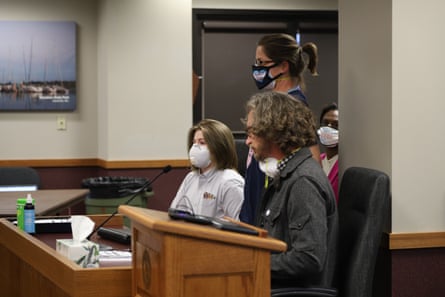
At one school board meeting last month in St Charles county, a more conservative county neighboring St Louis, queer and trans youth and their supporters sat through a lengthy discussion surrounding a proposal to make it easier for civilians to challenge potentially “obscene” materials – a move seen as an effort to increase censorship of LGBTQ+ content. Some attendees held “trust our teachers and librarians” signs and a trans pride flag, applauding when a student criticized the removal of queer characters from shelves; another speaker said kids shouldn’t be exposed to “sexual scenes”.
Toward the end of the meeting, a board member gave a speech about her disdain for trans youth using locker rooms, an item not on the agenda.
Youth protesters and parents of trans kids gathered at the end of the meeting to commiserate.
“The trans community is burning to the ground here. It’s a nightmare. Where are the national LGBTQ+ organizations?” said Kim Hutton, who has a trans son.
“They frame these policies as ‘protecting the children’, but they’re really just hurting specific marginalized groups. It’s not fun to see when you’re part of those marginalized groups,” said Hannah Yurkovich, a 17-year-old St Louis high schooler at the meeting. “I grew up here, I love St Louis, but I can’t be part of it, if it’s going to keep being against who I am.”
Her friend, Rohan Webb, 18, attended a neighboring high school that adopted gender-neutral bathrooms to better support LGBTQ+ students and had queer support groups. “To see this school district move in the exact opposite direction is saddening,” they said. “To see them getting to make students’ lives so much worse is infuriating.”
‘Will Democrats throw us to the fire?’
Trans Missourians and their families say they have endured by leaning on each other. Families carpool to government hearings. A regional summer camp provides a safe haven for LGBTQ+ youth. Rene and Kyle Freels, the parents of Chelsea, the recent high school graduate, run a support group for trans kids and parents, and they have organized “Transgiving” potlucks for Thanksgiving.
Chelsea has dedicated significant time to supporting trans youth who don’t have the resources she has had. Over breakfast at a queer-friendly cafe with her parents, she described how she assists others in legally changing their name, saying she had just received a court alert about a case she was managing.
“It’s all in the bucket of preventing suicidality,” Chelsea said matter-of-factly. “That is what worries me the most about going to college, because sometimes I have to talk them down … What happens if I’m not in St Louis?” She said she has been fighting to stop friends’ suicides since she was 15 and learned to always gets friends’ addresses in cases of emergencies.
“The public only hears from trans people in the positions of the highest of privileges. I have supportive parents, I’m white, I’m 18, I got healthcare – later than I needed it, but I got it. But my story is one aspect of the trans story, and it’s one of the better ones, and even it is filled with sadness.”
Chelsea, who is leaving the state for college and is interested in coding and liberal arts, said she felt disillusioned with politics. On the Republican side, people were using “genocidal rhetoric” to talk about trans people, she said, referencing calls for the “eradication of transgenderism” at last year’s Conservative Political Action Conference and demonization of trans people in the Trump-aligned Project 2025.
On the Democratic side, candidates defend trans rights, but it feels fragile, she said.
“The Democrats in Missouri are our allies, they’re the best support we have in the chamber, but there’s an anxiety they won’t always be that way. When shit hits the fan, they’ll say, is it worse to be out of office and standing on your morals, or is better to just throw a little bit to the fire? But the thing they’re throwing to the fire are my friends and family.”
The Freels considered relocating to Illinois last year, but couldn’t afford it.
“There will always be trans kids and they will be out and asserting themselves,” Rene Freels said. “We’re part of this leftover crew that is super mad and stubborn and wants to see this resolved and want our kids to have full civil rights.”
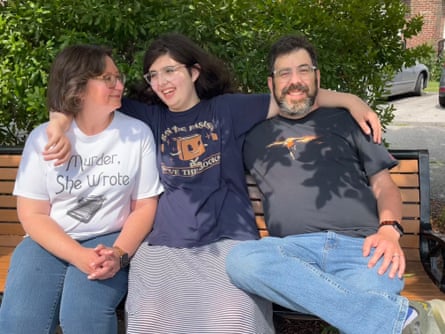
(From L-R) Rene, Chelsea and Kyle Freels pose for a photo. ‘There will always be trans kids and they will be out and asserting themselves,’ says Rene Freels. Photograph: Sam Levin/The Guardian
Miles, who hopes to become a teacher or work with youth, said leaving is not an option: “I’ve always wanted to stay here. It sounds weird, but I really love Missouri. I have so many memories here and I could see myself raising my kids here.”
Missouri is where he spent his whole life, where his favorite restaurants and hiking trails are, where his girlfriend and her family live, where he had his first date, he said.
He can’t imagine moving away from his elderly grandparents, who he stays with on a weekly basis. “I have a plan for my life,” he said, “and I couldn’t imagine doing it somewhere else.”
Throughout Meert and Thurow’s home are objects they have repurposed from friends who left the state due to anti-trans laws.
In the garden, the couple recently put up a sign saying they had planted beans “in remembrance of the 50+ families we know that have left Missouri”. But the number of departures is greater, she said. They’ve lost count.
President Trump is refusing intelligence briefings because the Deep State continues to try and sabotage him:
“They come in, they give you a briefing and then two days later they leak it and then they say you leaked it. The only way to solve that problem is not to take them.” pic.twitter.com/8UEhoE2Qsm
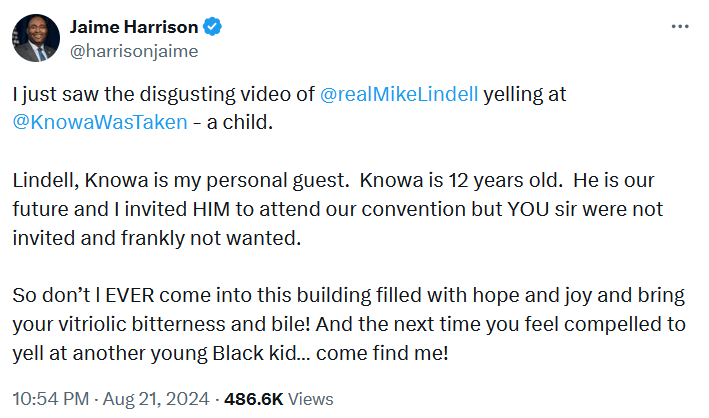
Lindell has been spotted at the United Center wandering around in a fedora to “investigate” gender-neutral bathrooms and peddle his baseless election conspiracy theories. On Wednesday, the pillowmonger got into a verbal altercation with Knowa De Brasco, a 12-year-old activist who was there supporting Kamala Harris. Read the full article. Watch all of the LOL clips.
Knowa: Lindell provided no facts, no sources. I’m confused as to why his source was ‘trust me bro’ pic.twitter.com/qXtOUbkECq
New York state lawyers urged an appeals court to uphold Donald Trump’s nearly $500 million civil fraud judgment, arguing there’s “overwhelming evidence” to support the finding that Trump lied for years about his wealth as he built his real estate empire. https://t.co/8KZh4WASDi
Read the full article. Almost all voters register using the state form. As of last month, only 42,000 Arizonans are registered to vote via the federal form.
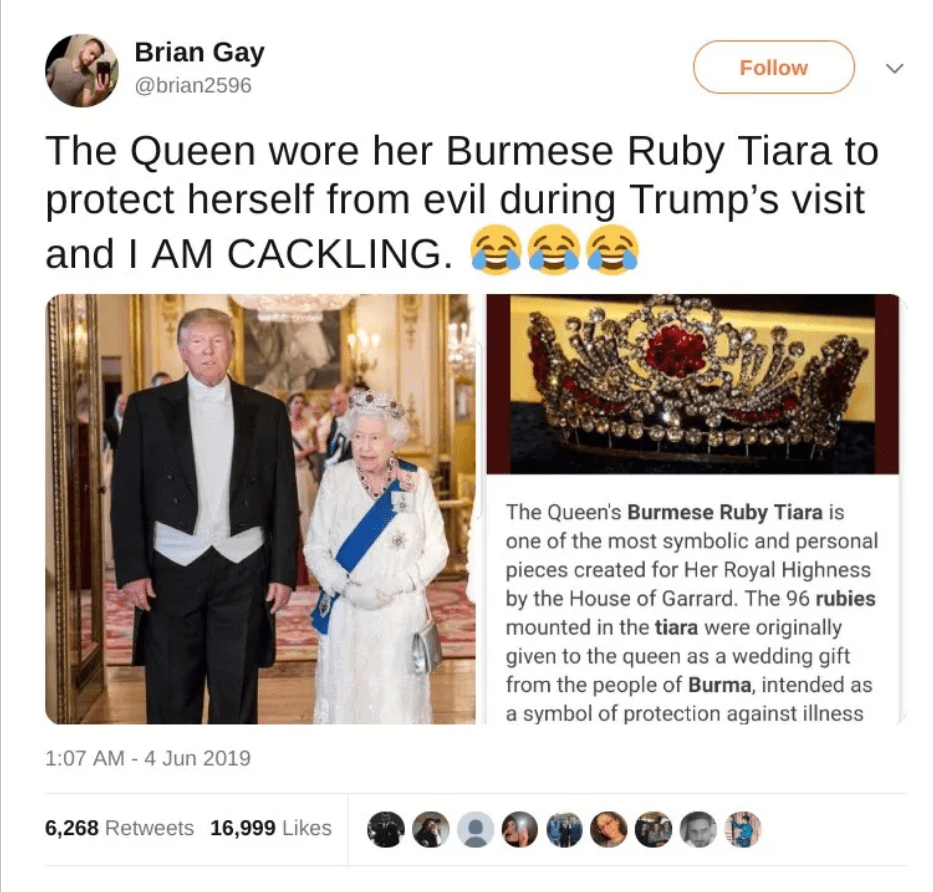
According to a coming biography, Queen Elizabeth told others that she found Trump “very rude” and that he always seemed to be looking over her shoulder “as if he was looking for someone more interesting.” The book further claims that the Queen believed that Trump and Melania must have “some kind of special arrangement,” considering his flagrant serial adultery.
Read the full article. Sentencing will be determined next week. As you can see below, Reimer’s first arrest last year resulted in a money beg from a major right wing Canadian outlet. Reimer’s previous non-drag related convictions resulted in sentences totally nearly three years.
Election officials said Arkansans for Limited Government failed to comply with state law primarily because it submitted documentation regarding paid signature gatherers separately and not in a single bundle.
As I said last month, it appears that the office of Secretary of State John Thurston [photo] deliberately withheld the above-cited rule about petition bundling. Thurston was a pastor before entering politics.
“I got a message for the Republicans and the justices of the United States Supreme Court. You can pry this wedding band from my cold, dead, gay, hand. And I’m retaining a lot of water, so good luck with that.” – Michigan AG Dana Nessel, last night.
WATCH: Michigan Attorney General Dana Nessel speaks at the Democratic National Convention.
“I got a message for the Republicans and the justices of the United States Supreme Court," Nessel said. "You can pry this wedding band from my cold, dead, gay hand.” pic.twitter.com/0rN3OuhVTt
“What they’ve done is they’ve allowed murderers, people in prisons, people in jails, people in mental institutions, insane asylums, and terrorists to pour into our country by the hundreds of thousands. And they are in our country right now, and the country that brought them out said, ‘If you ever come back, we’re giving you the death penalty or we’re gonna kill you.’” – The world’s most famous liar, inventing a death penalty for migrants who return to their home countries.
Trump claims countries are threatening migrants with the death penalty if they leave the United States and return to their country of origin. pic.twitter.com/d2kxR6czcN
“President Trump knew more about diplomacy than any president of the last 40 years. And Asia, he opened diplomatic talks with North Korea after a half century of stagnation.
🚨 SENATOR JD VANCE: “While all these Democrats lied about Donald Trump being the candidate of nuclear war, Donald Trump is the person who prevented nuclear war, and if we're not careful, Kamala Harris is going to walk us right into nuclear war.” pic.twitter.com/juUSChErYB
MIT’s Black student enrollment drops significantly after Supreme Court affirmative action ruling
The university’s white and Asian American student populations have increased, while all others have declined — some even down to zero, according to MIT.
Enrollment for Black and Latino students dropped at the Massachusetts Institute of Technology in the first class formed after the Supreme Court found race-conscious admissions in colleges unconstitutional.
The university’s admissions department on Wednesday released its first-year class profile, showing a sharp drop in its Black student population. About 5% of MIT’s incoming class of 2028 is Black, a significant drop from its 13% average in recent years. Latino students make up 11% of the class of 2028, compared to a 15% average in recent years. Overall, 1,102 students make up the incoming class.
Stu Schmill, MIT’s dean of admissions, attributed the drop to the high court’s 2023 decision to end consideration of race in the admissions process.
“We expected that this would result in fewer students from historically underrepresented racial and ethnic groups enrolling at MIT,” Schmill said of the ruling. “That’s what has happened.”
The white and Asian American student populations have increased, while all other groups have declined — some even down to zero, the profile shows. (snip-More) (grrrr)
It’s a newsletter I read because I enjoy tea. Also, she’s a part of Romancing the Vote, an organization that does work near and dear to my heart. I also own one of her books, with several more on my wishlist. Anyway, she’s got a little editorial in the letter this week, worthy of a read. There is no link to the letter, but the link to sign up for the letter is here.
“The Purpose of the Postmenopausal Female…
“I’ve been immersed in politics for, um, several weeks. Part of it is hope that finally, endlessly, we will be able to put some of the awfulness of the last years behind us and move forward into a world where we care about an equitable future.
“But also, confession time: JD Vance speaks directly to a very specific grudge that I’m holding.
“You want to know my grudge? I am endlessly grudging against what I call in my head the ‘legal abuser network’—that set of people who think that power is more important than, you know, treating folks with dignity. They’ve aligned themselves with abusers over and over and gaslit everyone who remains. JD Vance is On My List. In other circumstances, ‘stop being such assholes and treat people well!’ would be a moral statement and not a grudge. But they tried to induct me into the ‘no, look, you’ll get power, it’s cool, just pretend the abuse didn’t happen’ club, and so it’s absolutely a grudge and I want them all to fail.
“But I digress.
“I have been taking a very grim pleasure in watching people flip over rocks and seeing—yet again—that there is JD Vance, writhing away from the light like a many-legged centipede, leaving a trail behind him filled with things like his rancor for childless cat ladies and his belief that the Italians and the Irish were violent immigrants who maybe should have been banned from entering the country in the 1840s, and his statement that the only purpose that a postmenopausal female (it’s always females! Jerks like JD Vance can never use the word ‘women!’) serves is to do childcare.
“Last night, I was thinking about how Vice President Harris has reinvigorated a campaign that many (but not me) thought dead. I was watching Michelle Obama deliver a speech as probably one of the best orators in the nation, possibly beating out her husband who is a generational talent at giving speeches. And I thought about how many women in their generation—a scant decade older than me—faced barriers to entry from so many sides, and how much of who they have become was shaped by opposition.
“And it made me doubly proud to be the party of Not JD Vance, because as we can all plainly see, the purpose of a postmenopausal female is to kick ass.”
August 22, 1958 President Dwight Eisenhower announced a voluntary moratorium on nuclear weapons testing. A report outlining a system for monitoring and verifying compliance of a complete ban on such testing had been released just the day before. The Conference of Experts, as it was known, had been meeting in Geneva, Switzerland, to work out the details on detection of violations of such a treaty. The U.S. delegation was led by Nobel physics laureate Ernest Lawrence from the University of California (the Lawrence Livermore National Laboratory is named after him). Eisenhower predicated his moratorium on U.S.S.R. and U.K. agreement to the same limitations. All three countries agreed to the one-year halt in testing and to begin negotiations on a complete test ban at the end of October; all three performed last-minute (atmospheric) tests before the opening of talks.
August 22, 1964 Fannie Lou Hamer, leader of the Mississippi Freedom Democratic Party (MFDP), testified in front of the Credentials Committee at the Democratic National Convention. She was challenging the all-white delegation that the segregated regular Mississippi Democrats had sent to the presidential nominating convention. Singing at a boardwalk demonstration: Hamer (with microphone), Stokely Carmichael (in hat), Eleanor Holmes Norton, Ella Baker . Mississippi’s Democratic Party excluded African Americans from participation. The MFDP, on the other hand, sought to create a racially inclusive new party, signing up 60,000 members. The hearing was televised live and many heard Hamer’s impassioned plea for inclusion of all Democrats from her state.The hearing was televised live and many heard Hamer’s impassioned plea for inclusion of all Democrats from her state. In her testimony she spoke about black Mississippians not only being denied the right to register to vote, but being harassed, beaten, shot at and arrested for trying. Concerned about the political reaction to her statement, President Lyndon Johnson suddenly called an impromptu press conference, thereby interrupting television broadcast of the hearing. Hear her testimony Link to photo gallery
August 22, 1971 The FBI (Federal Bureau of Investigation) arrested twenty in Camden, New Jersey, and five in Buffalo, New York, for conspiracy to steal and destroy draft records. Eventually known as the Camden 28, most were Roman Catholic activists, including four priests, and a Lutheran minister. “We are not here because of a crime committed in Camden but because of a war committed in Indochina….” Cookie Ridolfi The Camden 28
August 22, 1972 Rhodesia’s team was banned from competing in the Olympic Games with just four days to go before the opening ceremony in Munich, Germany. The National Olympic Committees of Africa had threatened to pull out of the games unless Rhodesia was barred from competing. Though the Rhodesian team included both whites and blacks, the government was an illegal one, controlled by whites though they represented just 5% of the country’s population. It had broken away from the British Commonwealth over demands from Commonwealth member nations that power be yielded to the majority. Read more
August 22, 1986 The Kerr-McGee Corporation agreed to pay the estate of the late Karen Silkwood $1.38 million ($2.68 in 2008), settling a 10-year-old nuclear contamination lawsuit. She had been active in the Oil, Chemical and Atomic Workers union, specifically looking into radiation exposure of workers, and spills and leaks of plutonium. The story of Karen Silkwood
I hate the sound but know of no way to improve it with this mic. If anyone knows a way let me know. Ron and I have been talking to getting a Yeti Blue mic or a label mic. The lighting was off again. I can not seem to get it right like I used to do when I was in my other office. Hugs. Scottie













 Scottie's Playtime