Category: Construction / Building
Staying Cool: Helpful Hints From History
Take a look back at how others have survived—and thought about—the high heat of summer.
By: Matthew Wills July 28, 2024
In an episode of The Twilight Zone called “The Midnight Sun,” first broadcast in November 1961, the apocalyptic temperature of an Earth getting ever closer to the Sun is represented by a thermometer bursting at…130°F. On July 5, 2024, Palm Springs, California, reached 124°F, while the next day, Death Valley hit 128°F, amidst a shattering of triple-digit temperature records across the American West.
Benchmarks have shifted. In 1961, the amount of carbon dioxide (CO2) in the atmosphere was 318 parts per million by volume (ppmv). CO2 is a greenhouse gas, acting as atmospheric insulation, preventing heat radiation from dissipating into space. Last year, 2023, the amount of CO2 in the atmosphere was 421 ppmv. It continues to increase, not least as we battle the resulting heat by burning fossil fuels to stay cool. We’re in a global greenhouse, and the doors seem to be locked as we paradoxically produce more CO2 to stay cool in the face of heating caused by the production of more CO2.
Humans have long worked to beat the heat, especially in the tropics and in deserts. Their perfectly rational strategies—stay out of the midday sun, live underground, cover up completely—may once have been criticized by those from temperate zones, sometimes in racist terms, but more and more parts of the world are having to learn the lesson of those strategies.

What, after all, would it be like without air conditioning? Take a look at this Before Air-Conditioning piece in Scientific American’s “Hints for Keeping Cool.” Published in July 1858, the piece begins with a dietary suggestion: eat “fruits, vegetables, and farinaceous food, and the lighter kinds of meat.” In 1858, the amount of CO2 in the atmosphere was 286 ppmv. Seven years earlier, Dr. John Gorrie, striving to cool down his malaria and yellow fever patients in Florida, patented the first ice-making machine (1851, 285 ppmv).
The first modern, electrical air condition system dates to 1902 (297 ppmv), when inventor Willis Carrier cooled and dehumidified the Sackett-Wilhelms Lithographic & Publishing Company in Brooklyn, New York. The publishing company was most concerned about humidity warping their paper supplies. Carrier is still a going concern.
A little over a century after Scientific American’s helpful hints, The Science News-Letter’s “Keeping Cool in Summer Heat” (1961: 318 ppmv) wasn’t so very different.
“If you suffer from heat frustration when the mercury hits the 90’s, a little scientific knowledge of summer heat can help your body temperature and state of mind remain well within the comfort zone,” the editors claim.
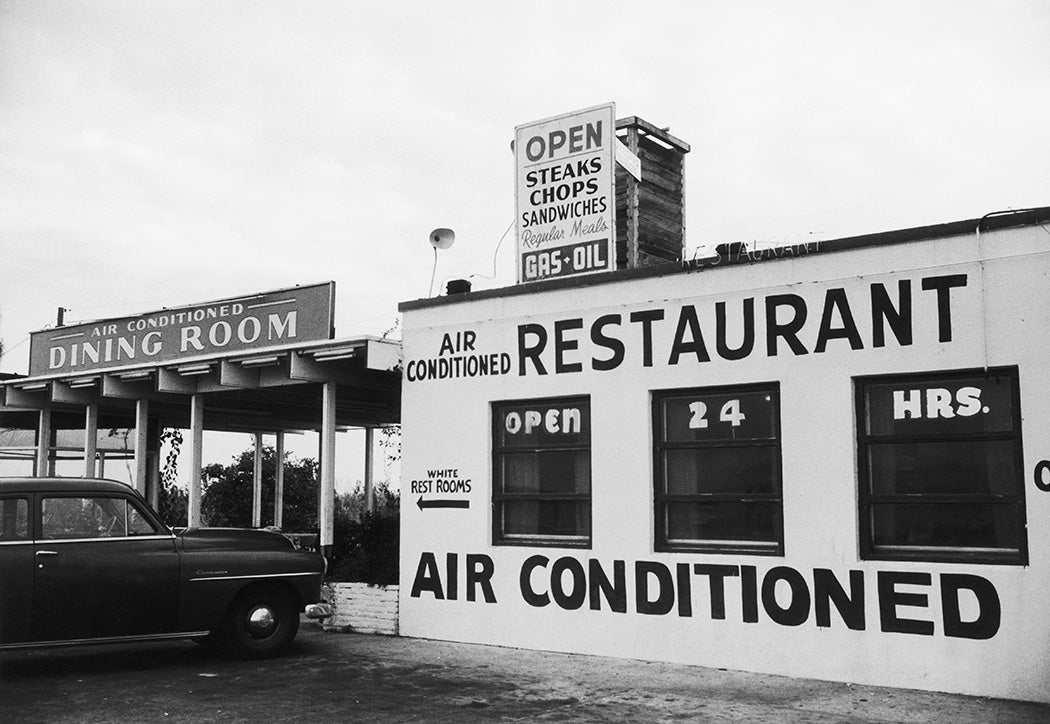
These hints were essential for those without air conditioning, that wonder of the twentieth century. Try to imagine cars, theaters, restaurants, the suburbs, office towers, apartment blocks, malls, et cetera, without A/C. The post-World War II population growth across the Sun Belt, stretching from Southern California to North Carolina, would most likely not have been possible without it.
In his exploration of how A/C transformed the South, Raymond Arsenault quotes a Floridian circa 1982 (341 ppmv).
“I hate air conditioning,” the woman confirmed. “It’s a damnfool invention of the Yankees. If they don’t like it hot, they can move back up North where they belong.”
But most people—in the South and elsewhere—welcomed A/C with a passion. Arsenault notes that historians tended to shy away from writing about the transformative power of air-conditioning on the South because they were leery of falling into an old climate-is-destiny paradigm. In the first three decades of the twentieth century, the South’s climate was held responsible for everything from the Southern drawl to plantation slavery. Climate determinism faded by mid-century (1950: 311 ppmv), as the “long hot summers” of the Civil Rights years transitioned into the “New South,” supposedly post-racial but definitely all indoor-cooled.
Inside The Homes of Black History Legends
This is a slide show, on the page. I sometimes enjoy seeing bits of the lives of people I admire. Click through to see the slide show, here’s a snippet of the text:
-Almost everyone has been on those Victorian house tours where they give stories about the white people who lived there, potential ghosts sightings and whatnot.
-Well, allow us to take you on a trip through the homes of some of the most beloved Black history legends. Not everyone stops to think about the four walls Martin Luther King Jr. grew up in or the massive estate of Madame C.J. Walker, both of which are among other historic locations preserved for touring. The architecture, lofty details and machinery we wouldn’t even know how to operate today, but they keep alive the memory not only of our historical figures but also show us what Black life looked like through their lens.
-If you’re planning a trip to some of these historical sites, first take get a preview into the homes of some our favorite Black historical figures. (snip-photos on the page, with More)
https://www.theroot.com/inside-the-homes-of-our-black-history-legends-1851599161
A Prayer for Resistance. Please join, if you will.
The West Bank: Last Week Tonight with John Oliver (HBO)
Let’s talk about shifting opinions on Project 2025….
AP News: Top UN court says Israel’s presence in occupied Palestinian territories is illegal and must end
When I first posted this it was from my phone in bed. I am sorry I did not check but no link or story posted. Thankfully wonderful Ali jumped to the rescue and added the link. Thank you Ali. Hugs. Scottie
Report: Staggering Number Of Palestinians Have And Will Die Because Of Israel Since Oct. 7th
President Biden sits down for interview with George Stephanopoulos l ABC News exclusive
The media is desperate to push Biden out so they can get more money. The papers that Stephanopoulos quoted are owned and run by well known tRump conservatives like Rupert Murdock. Stephanopoulos kept hammering Biden was too old, was not fit, was kidding himself how fit he was, stuff like that no matter what Biden answered. After Biden would list his accomplishments Stephanopoulos said yes but aren’t you frail, then when they talked about the future Stephanopoulos asked if Biden had it to finish the next few years, which Biden talked of what he did recently Stephanopoulos asked yes but what did it cost you physically and mentally. He just was desperate to break Biden, and Biden was getting sick of him hammering on the same thing and not acknowledging anything Biden said. I thought Biden did great during the interview, but I would have demanded to know who was paying Stephanopoulos to push the republican talking point. Even when Biden brought up tRump’s lies and actions, Stephanopoulos did not talk about it, only again turning to ask if Biden was not too old and mentally gone to do the job. Hugs. Scottie
At half a mile a week, Gov. Greg Abbott’s border wall will take around 30 years and $20 billion to build
https://www.texastribune.org/2024/07/03/texas-mexico-border-wall-greg-abbott-progress-cost/
Some quotes from the article that show these walls are useless, and can be over come with a battery operated reciprocating saw most hardware stores sell rather cheaply. What I want to know is what is driving this need by Texas republicans? Is it political or is it hate and bigotry, racism to save the white majority they will soon lose. Hugs. Scottie
But smuggling gangs have used ordinary power tools to saw through parts of Trump’s wall and scaled it using disposable ladders. Some immigration experts say border walls fail to solve the underlying factors driving people to migrate, such as the poverty, violence and political upheaval in Central America, Haiti and Venezuela that is driving millions to flee and straining U.S. resources at the border.
“Walls do not achieve the objectives for which they are said to be erected; they have limited effects in stemming insurgencies and do not block unwanted [migrant] flows, but rather lead to a re-routing of migrants to other paths,” wrote Élisabeth Vallet of the nonpartisan Migration Policy Institute in a 2022 report.
————————————————————————————————————-
Credit: Jason Garza for The Texas Tribune
Three years after Gov. Greg Abbott announced Texas would take the extraordinary step of building a state-funded wall along the Mexico border, he has 34 miles of steel bollards to show for it.That infrastructure — which has so far run up a price tag of some $25 million per mile — isn’t yet a contiguous wall. It has gone up in bits and pieces spread across at least six counties on Texas’ 1,254-mile southern border. Progress has been hampered by the state’s struggles to secure land access, one of myriad challenges signaling a long and enormously expensive slog ahead for Abbott.
Nonetheless, state contractors have already propped up more wall mileage than former President Donald Trump’s administration managed to build in Texas, and Abbott’s wall project is plowing ahead at a quickened pace. State officials hope to erect a total of 100 miles by the end of 2026, at a rate of about half a mile per week. The governor frequently shares video of wall construction on social media and has credited the project with helping combat immigration flows. To date, though, steel barriers cover just 4% of the more than 800 miles identified by state officials as “in need of some kind of a barrier.” And at its current rate — assuming officials somehow persuade all private landowners along the way to turn their property over to the state — construction would take around 30 years and upwards of $20 billion to finish.
Under Abbott’s direction, state lawmakers have approved more than $3 billion for the wall since 2021, making it one of the biggest items under the GOP governor’s $11 billion border crackdown known as Operation Lone Star. The rest of the money is being used for items like flooding the border with state police and National Guard soldiers and transporting migrants to Democrat-controlled cities outside Texas, all of which Abbott and other Republicans say is needed to stem the historic number of migrants trying to enter the country.
Democrats and immigration advocates have cast the wall project as a taxpayer-funded pipe dream that will do nothing to address the root causes driving the immigration crisis. And they say the governor, in reviving what was once a hallmark of Trump’s agenda, is using public money to boost his political stock.
Even some immigration-hawk Republicans are showing unease about the mounting costs of the wall.
“I am, too, concerned that we’re spending a whole lot of money to give the appearance of doing something rather than taking the problem on to actually solve it, and until we do that, I don’t expect to see much happen,” state Sen. Bob Hall, R-Edgewood, said last fall before voting in committee to spend another $1.5 billion in wall funding.
Abbott’s office did not respond to a request for comment for this story.
Acquiring land
The construction pace has largely hinged on the state’s success securing rights to build the wall through privately owned borderland. Early on, the project showed little signs of life as state contractors struggled to obtain the needed easements. But things picked up last year as the state began working out more agreements covering larger tracts. Through mid-June, officials had secured 79 easements covering about 59 miles of the border, according to Mike Novak, executive director of the Texas Facilities Commission, which is overseeing the effort.
At a facilities commission meeting last month, Novak said state officials were in various stages of negotiation with landowners over another 113 miles.
“We knew from the beginning that this was going to be the choke point, you know, one of the most challenging parts of this program,” Novak said of land acquisition. “And it proved true. But we’ve remained steadfast.”
Officials had built 33.5 miles of wall through June 14, a facilities commission spokesperson said.
The state’s ability to secure land rights has also dictated the wall’s location, though officials say they have focused on areas pinpointed by the Department of Public Safety as the “highest priority.” TFC officials have declined to share exactly where the wall is being built, citing security concerns, though Novak recently said construction was underway on wall segments in Cameron, Maverick, Starr, Val Verde, Webb and Zapata counties.
Though the Texas-Mexico border spans more than 1,200 miles, Abbott’s budget director, Sarah Hicks, told a Senate panel in 2022 that DPS had identified 805 miles “as vulnerable, or [that] is in need of some kind of a barrier.” Another 180 miles are covered by natural barriers, mostly in the Big Bend region of West Texas, while existing barriers already cover another 140 miles, according to state officials.
Novak has said the pace of building about half a mile of wall per week is expected to continue for the “foreseeable future.” At that rate, about 100 miles would go up every four years, with the full 805 miles covered sometime after 2050, when Abbott would be in his 90s.
The earliest wall construction has cost roughly $25 million to $30 million per mile, according to TFC officials. That would amount to $20 billion to $24 billion for the entire 805-mile span, or about three times the cost of paying every Texas public university student’s tuition last year. The estimate does not account for the cost of maintaining the wall once it is built, which TFC estimates will cost around $500,000 per mile each year.
Lubbock state Sen. Charles Perry, who last year carried Texas’ new immigration law that allows state police to arrest people for illegally crossing the Mexico border, is another Republican who has expressed concern about the wall’s cost.
“I am for border security. I am not against a wall. But to me, at least from what I can tell, it is a perpetual circle. We’re on the hamster wheel,” Perry said last fall as he prepared to vote for the $1.5 billion wall funding bill. “[At some point] the response has not to be more money for infrastructure. At some point this state must draw the line in the sand.”
Still, no Texas Republican has voted against border wall funding. Lawmakers approved nearly $2.5 billion for the effort in the state’s current two-year budget — more than was allotted in state funds to all but a handful of state agencies, and more than twice what Texas spends on its court and juvenile justice systems.
State Rep. Christina Morales, D-Houston, said she doesn’t think Texas’ GOP leadership “really understands why people are crossing in the first place.”
“Spending billions of dollars on a wall really does not address the root causes of the migration that’s happening,” said Morales, who is vice chair of the House’s Mexican American Legislative Caucus. “What we should be investing in is our education, our health care, real solutions for problems that are happening right now in Texas.”
Since 2021, federal officials have recorded an average of about 2 million illegal border crossings a year, a record that Abbott has attributed to President Joe Biden for rolling back some of Trump’s border policies. The governor has touted the wall construction as a way for Texas to “address the border crisis while President Biden has sat idly by.” Biden and other Democrats have blamed Republicans for shooting down a sweeping bipartisan border deal earlier this year.
The scope of Texas’ wall construction — and Abbott’s broader border security efforts — are unprecedented in nature, as the federal government is generally responsible for immigration enforcement and the costs associated with it.
Even with the state’s improved pace securing easements, Novak has said land access remains the biggest challenge for the project, and “it’ll probably remain that way through most of the program.” The Trump administration encountered the same issue after the former president famously said he would build the wall and make Mexico pay for it. Even using the federal government’s power to seize some borderland, Trump’s administration built just 21 miles of new wall along the Texas-Mexico border.
The painstaking negotiations are required for Texas’ wall because lawmakers barred the use of eminent domain to gain land access.
Last year, state Sen. Brandon Creighton, R-Conroe, filed legislation to change that, arguing TFC officials could only build a complete wall if they were authorized to use eminent domain powers. The proposal failed to make it through the Senate, though Creighton said he plans to file it again for the session that starts next January.
“Of course, we can continue to negotiate with ranchers, but that is a very slow process,” Creighton said. “And it’s an incomplete process, because there will always be holdouts for different reasons.”
Creighton, one of the upper chamber’s more conservative members, said he still supports using state funds to build a border wall, even as some of his GOP colleagues have raised objections.
“I say no to waste, inefficiencies, potential fraud and unreasonable spending as much as any member,” Creighton said. “But … there are times, with all of that fiscal conservatism, that we have to use the money that we save efficiently to protect Texans and Texas.”
“A difficult and complex task”
Most border wall advocates acknowledge barriers alone will not deter people from trying to enter the country illegally. But they say a wall would work if paired with more law enforcement officers and technology, arguing it would slow down attempted crossers to give border agents more time to apprehend them and encourage migrants to seek asylum via ports of entry.
But smuggling gangs have used ordinary power tools to saw through parts of Trump’s wall and scaled it using disposable ladders. Some immigration experts say border walls fail to solve the underlying factors driving people to migrate, such as the poverty, violence and political upheaval in Central America, Haiti and Venezuela that is driving millions to flee and straining U.S. resources at the border.
“Walls do not achieve the objectives for which they are said to be erected; they have limited effects in stemming insurgencies and do not block unwanted [migrant] flows, but rather lead to a re-routing of migrants to other paths,” wrote Élisabeth Vallet of the nonpartisan Migration Policy Institute in a 2022 report.
Those sorts of objections have done nothing to deter Abbott and GOP lawmakers, who are armed with a huge budget surplus and polling that shows a majority of Texas voters support the state’s wall effort and overall border spending. More than 90% of Republican voters support the wall, with 74% voicing “strong” support, according to an April poll by the Texas Politics Project.
With construction plunging ahead, Novak has projected confidence about the wall’s status, pointing to the recent progress after an initial slow start, which saw officials build less than 2 miles in the 12 months after Abbott announced the effort.
It’s not just land access that complicates wall construction, Novak said at the June TFC meeting, where he ticked off a list of other factors: changing soil conditions that require “complicated engineering solutions”; steering clear of irrigation systems when building on agricultural land; weather; and “sensitivity” to cattle, oil and gas and hunting operations.
“It’s a difficult and complex task, at best,” Novak said. “But with that said, we’re whipping it. The latest stats reflect what I like to call just steadfast progress.”