The MR crew looks at horrifying reports coming out of Texas that show Republican governor Greg Abbott ordered border agents to begin drowning and dehydrating migrant children.
A woman who is undergoing hormone treatments calls in to dispel the myths that transgendered individuals are dominating women’s sports and then gives a powerful story of her own transition.
Jeff Sharlet, professor of English at Dartmouth College, joins to discuss his recent book The Undertow: Scenes From a Slow Civil War.
Ben Shapiro reacts to a piece in the New York Times about a recent fashion trend that is seeing men wearing crop tops. Shapiro says: “Just as a fashion matter, no one wants to see the midriff of another man. Just as a general-i’m not going to speak for gay men. women, i don’t think, are interested. Neither are straight men.”
Charlie Kirk responds to reporting from MSNBC that far Right-Wing extremists have used at-home workout trends to expand their reach into mixed martial arts spaces. Kirk says that reporting like this shows that liberals only want men to be weak, depressed, and have low testosterone.
CNN’S Kaitlan Collins asks Senator Tommy Tuberville about the comments he made regarding White Nationalists serving in the military. Collins asks if he’d want to clarify that he wouldn’t want racists to be serving in the military. Tuberville reiterates his belief that he doesn’t see White Nationalists as necessarily racist, and that it’s people’s opinions that they’re racist. He says, however, that if there are White Nationalists who are racist, he wouldn’t support them serving in the military.
Later Tuberville was asked by reporters on Capitol Hill About why he continued to double down on his stance on White Nationalists. Tuberville attempted to amend his response: “I’m totally against racism. If the Democrats want to say that White Nationalists are racists, i’m totally against that, too.”
For those that kept telling me these drag bans were not outlawing cross dressing or trans people you need to read this. They changed the law to include people dressing as a gender different from that assigned at birth. No more wearing pants women! The bill is totally driven by fundamentalist ideas of morality in that they include wearing clothing stereotypical for a gender the wearer is not assigned to in the same category as strippers and topless dancers. In their minds, a man in a dress or a woman in a tux is the same as showing boobies / tits to children. Yes a man in a skirt is the same as a man being nude? This is how regressive these people are and where they want to force the country to be. To these people the Handmaid’s Tale is a user manual. Hugs
House Bill 245 expands the definition of adult cabaret performers from strippers and topless dancers to include “entertainers who exhibit a gender identity that is different from the performer’s or entertainer’s gender assigned at birth.”
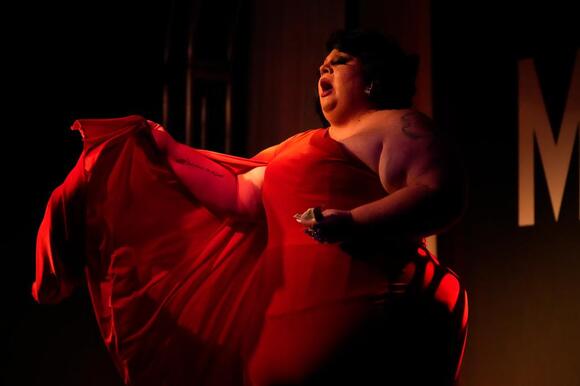
Ohio Republicans introduce bill to ban public drag performances
Drag performances in Ohio could be banned from public parks, parades and other places children might be if a bill introduced by House Republicans becomes law.
House Bill 245 expands the definition of adult cabaret performers from strippers and topless dancers to include “entertainers who exhibit a gender identity that is different from the performer’s or entertainer’s gender assigned at birth.”
A change that would restrict certain drag events to bars and other spaces where minors are prohibited.
“It doesn’t mean all performances,” Reps. Josh Williams, R-Sylvania, said. “A man dressed as a woman reading a book is constitutionally protected speech…But I’ve seen videos of performances here in the state of Ohio and across the nation that are improper to be done in the presence of minors.”
Drag queens and kings would face charges if local prosecutors decided their performances were obscene or harmful to juveniles as defined by Ohio law.
Williams said that delineation strikes a balance between free speech and protecting Ohio’s children, but opponents say current obscenity laws already cover his concerns and singling out LGBTQ performers in this way perpetuates stereotypes about gay people being inherently dangerous to children.
“I live in a mostly red area and people’s beliefs drive their decisions and hate,” said Kody Boggs, who performs as Redd Velvet. “It’s going to be a problem.”
Performing in drag was popular during the Shakespearean era (late 1500s) when women weren’t allowed to act on stage. A handful of drag queens like Dame Edna Everage achieved notoriety in the centuries since, but it wasn’t until the Emmy Award-winning show “RuPaul’s Drag Race” launched in 2009 that drag culture really entered the modern mainstream .
Drag queen story hour was created in 2015 , and the backlash against the concept soon followed.
Conservative writers and pundits called these events inappropriate at best, claiming their not-so-hidden purpose is to sexually groom children. And while Williams was clear that not all drag is inherently obscene, he believes there are performers who behave inappropriately.
That’s why he and 42 other Republicans think HB 245 is necessary. Williams said it will “put the power and the discretion in the hands of law enforcement officials” to decide whether individual shows or events were ” harmful to juveniles .”
A charge that can have serious consequences.
Ohio Revised Code defines that harm as “any material or performance describing or representing nudity, sexual conduct, sexual excitement, or sadomasochistic abuse” where the following conditions are met:
Appeals to the “prurient” or excessive interest of juveniles in sex.
Offensive to “prevailing standards in the adult community” about what is suitable for children.
Lacks serious literary, artistic, political, and scientific value for children.
Obscene performances are defined as those where the show’s “dominant” or primary purpose is to arouse lust by depicting sexual activity, sexual excitement or nudity. And if a drag queen or king was convicted under HB 245, they would be facing a first-degree misdemeanor at minimum.
If a minor saw their show, they could face a first-degree misdemeanor. If the performance was deemed obscene, the charge would be a fifth-degree felony.
If a minor younger than 13 was at an obscene performance, that charge would climb to a fourth-degree felony, which carries a maximum prison sentence of 18 months.
“You’re talking about the potential for actual jail time,” said Gary Daniels, a lobbyist for the American Civil Liberties Union of Ohio. “Does this apply to someone walking down the street or waiting for a bus? I don’t read it that way. But it does beg the question of let’s say you are walking as part of a gay pride parade. It can be said you are performing there.”
Daniels worried that enforcement of HB 245 might depend on where the event took place.
For example, Small Town Pride hosts an annual event in Celina, a small town in western Ohio. Its drag show has come under fire from locals who say some of the dance moves and costumes are inappropriate for children.
Boggs, who organizes the drag queens for that Celina show, told the USA TODAY Network Ohio Bureau the performer in question is a gymnast with a background in dance and opponents were “twisting it to make it seem worse than what it was.”
“This is the problem with bills that impact freedom of speech,” Daniels said. “When they are broad when they are open interpretation. you have people afraid to speak.”
What’s happening in other states?
Ohio isn’t the first state to consider a ban on public drag performances. Lawmakers in at least eight other states have introduced similar legislation.
Tennessee Republicans banned public drag performances in March, but a U.S. district judge overturned it in June saying the law violated the First Amendment right to freedom of speech.
Williams, who is an attorney himself, said he crafted his legislation with that in mind, “This is the most narrowly tailored bill on this subject matter in the nation.”
LGBTQ groups don’t see it that way, saying HB 245 is “censorship over safety.”
“There have been multiple documented incidents of self-identified Nazis showing up to performances in Ohio in the past nine months. The Department of Homeland Security has sent out multiple alerts indicating the growing threat of hate crimes against LGBTQ+ people,” Equality Ohio policy director Maria Bruno said in a statement. “Yet instead of addressing guns, targeted intimidation, or any of the escalations of violence that we are seeing in our communities, Ohio’s statehouse politicians instead have chosen to broadly criminalize performing arts.”
Anna Staver is a reporter for the USA TODAY Network Ohio Bureau, which serves the Columbus Dispatch, Cincinnati Enquirer, Akron Beacon Journal and 18 other affiliated news organizations across Ohio.
Migrants cool themselves in the waters of the Rio Grande after crossing to the U.S. from Mexico near a site where the state is installing large buoys to be used as a border barrier along the Rio Grande near Eagle Pass, Texas, Monday, July 10, 2023. (AP Photo/Eric Gay)Eric Gay/Associated Press
WASHINGTON — Officers working for Gov. Greg Abbott’s border security initiative have been ordered to push small children and nursing babies back into the Rio Grande, and have been told not to give water to asylum seekers even in extreme heat, according to an email from a Department of Public Safety trooper who described the actions as “inhumane.”
The July 3 account, reviewed by Hearst Newspapers, discloses several previously unreported incidents the trooper witnessed in Eagle Pass, where the state of Texas has strung miles of razor wire and deployed a wall of buoys in the Rio Grande.
According to the email, a pregnant woman having a miscarriage was found late last month caught in the wire, doubled over in pain. A four-year-old girl passed out from heat exhaustion after she tried to go through it and was pushed back by Texas National Guard soldiers. A teenager broke his leg trying to navigate the water around the wire and had to be carried by his father.
The email, which the trooper sent to a superior, suggests that Texas has set “traps” of razor wire-wrapped barrels in parts of the river with high water and low visibility. And it says the wire has increased the risk of drownings by forcing migrants into deeper stretches of the river.
The trooper called for a series of rigorous policy changes to improve safety for migrants, including removing the barrels and revoking the directive on withholding water.
“Due to the extreme heat, the order to not give people water needs to be immediately reversed as well,” the trooper wrote, later adding: “I believe we have stepped over a line into the inhumane.”
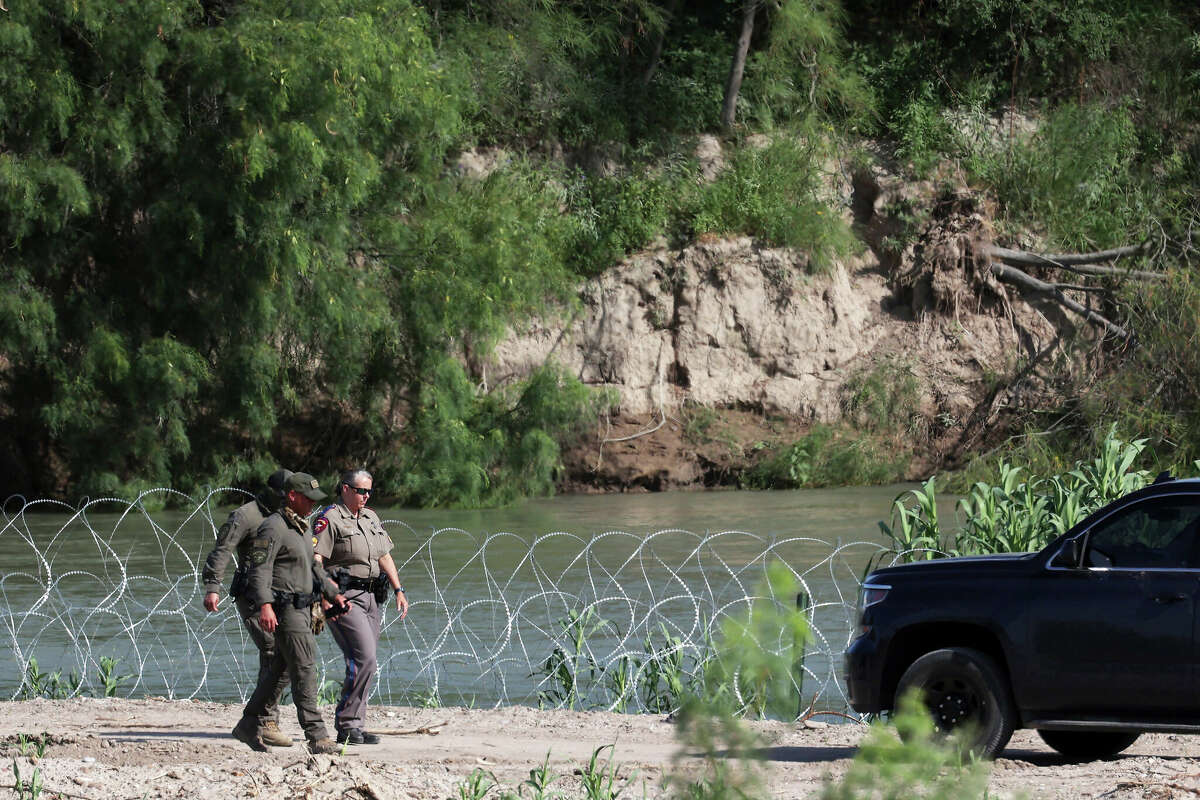
Migrants walk along concertina wire blocking their entrance to the U.S. in Eagle Pass, Texas, Monday, July 10, 2023.Jerry Lara/San Antonio Express-News
Department of Public Safety spokesman Travis Considine did not comment on all the contents of the trooper’s email, but said there is no policy against giving water to migrants.
Considine also provided an email from DPS Director Steven McCraw on Saturday calling for an audit to determine if more can be done to minimize the risk to migrants. McCraw wrote troopers should warn migrants not to cross the wire, redirect them to ports of entry and to closely watch for anyone who needs medical attention.
In another email, McCraw acknowledged that there has been an increase in injuries from the wire, including seven incidents reported by Border Patrol where migrants needed “elevated medical attention” from July 4 to July 13. Those were in addition to the incidents detailed by the trooper.
“The purpose of the wire is to deter smuggling between the ports of entry and not to injure migrants,” McCraw wrote. “The smugglers care not if the migrants are injured, but we do, and we must take all necessary measures to mitigate the risk to them including injuries from trying to cross over the concertina wire, drownings and dehydration.”
Texas Department of Public Safety personnel are seen in a closed off area of a public park by the Rio Grande in Eagle Pass, Texas, Monday, July 10, 2023.Jerry Lara/San Antonio Express-News
The incidents detailed in the email come as Abbott has stepped up efforts in recent weeks to physically bar migrants from entering the country through his Operation Lone Star initiative, escalating tensions between state and federal officials and drawing increased scrutiny from humanitarian groups who say the state is endangering asylum seekers. The most aggressive initiatives have been targeted at Eagle Pass.
Federal Border Patrol officials have issued internal warnings that the razor wire is preventing their agents from reaching at-risk migrants and increasing the risk of drownings in the Rio Grande, Hearst Newspapers reported last week.
The DPS trooper expressed similar concerns, writing that the placement of the wire along the river “forces people to cross in other areas that are deeper and not as safe for people carrying kids and bags.”
The trooper’s email sheds new light on a series of previously reported drownings in the river during a one-week stretch earlier this month, including a mother and at least one of her two children, who federal Border Patrol agents spotted struggling to cross the Rio Grande on July 1.
According to the email, a DPS boat found the mother and one of the children, who went under the water for a minute. They were pulled from the river and given medical care before being transferred to EMS, but were later declared deceased at the hospital. The second child was never found, the email said.
The governor has said he is taking necessary steps to secure the border and accused federal officials of refusing to do so.
“Texas is deploying every tool and strategy to deter and repel illegal crossings between ports of entry as President Biden’s dangerous open border policies entice migrants from over 150 countries to risk their lives entering the country illegally,” said Andrew Mahaleris, Abbott’s press secretary. “President Biden has unleashed a chaos on the border that’s unsustainable, and we have a constitutional duty to respond to this unprecedented crisis.”
Migrants cross the Rio Grande as state troopers guard workers installing buoys on the Rio Grande south of Eagle Pass, Texas, Monday, July 10, 2023.Jerry Lara/San Antonio Express-News
The DPS trooper’s email details four incidents in just one day in which migrants were caught in the wire or injured trying to get around it.
On June 30, troopers found a group of people along the wire, including a 4-year-old girl who tried to cross the wire and was pressed back by Texas Guard soldiers “due to the orders given to them,” the email says. The DPS trooper wrote that the temperature was “well over 100 degrees” and the girl passed out from exhaustion.
“We provided treatment to the unresponsive patient and transferred care to EMS,” the trooper wrote. A spokesperson for the Texas National Guard did not respond to a request for comment.
In another instance, troopers found a 19-year-old woman “in obvious pain” stuck in the wire. She was cut free and given a medical assessment, which determined she was pregnant and having a miscarriage. She was then transferred to EMS.
The trooper also treated a man with a “significant laceration” in his left leg, who said he had cut it while trying to free his child who was “stuck on a trap in the water,” describing a barrel with razor wire “all over it.” And the trooper treated a 15-year-old boy who broke his right leg walking in the river because the razor wire was “laid out in a manner that it forced him into the river where it is unsafe to travel.”
In another instance, on June 25, troopers came across a group of 120 people camped out along a fence set up along the river. The group included several small children and babies who were nursing, the trooper wrote. The entire group was exhausted, hungry and tired, the trooper wrote. The shift officer in command ordered the troopers to “push the people back into the water to go to Mexico,” the email says.
The trooper wrote that the troopers decided it was not the right thing to do “with the very real potential of exhausted people drowning.” They called command again and expressed their concerns and were given the order to “tell them to go to Mexico and get into our vehicle and leave,” the trooper wrote. After they left, other troopers worked with Border Patrol to provide care to the migrants, the email said.
Migrants trying to enter the U.S. from Mexico approach the site where workers are assembling large buoys to be used as a border barrier along the banks of the Rio Grande in Eagle Pass, Texas, Tuesday, July 11, 2023.Eric Gay/AP
The trooper did not respond to a request for comment Monday. His email was shared by a confidential source with knowledge of border operations. It was unclear whether the trooper received a response from the sergeant he’d messaged.
Considine acknowledged that DPS was aware of the email and provided the additional agency emails in response. Those emails detail seven other incidents reported by federal border agents in which migrants were injured on the wires, including a child who was taken to the hospital on Thursday with cuts on his left arm, a mother and child who were taken to the hospital on Wednesday with “minor lacerations” on their “lower extremities,” and another migrant taken to San Antonio on July 4 to receive treatment for “several lacerations” that required staples.
Victor Escalon, a DPS director who oversees South Texas, wrote in an email Friday to other agency officials that troopers “may need to open the wire to aid individuals in medical distress, maintain the peace, and/or to make an arrest for criminal trespass, criminal mischief, acts of violence, or other State crimes.
“Our DPS medical unit is assigned to this operation to address medical concerns for everyone involved,” Escalon wrote. “As we enforce State law, we may need to aid those in medical distress and provide water as necessary.”
Benjamin Wermund is the Washington correspondent for the Houston Chronicle and San Antonio Express-News. He covers the Texas delegation and the many ways the state and its leaders shape national politics and policy. He’s a Texas native and a diehard Spurs fan.VIEW COMMENTS
U.S. District Judge Gregory Presnell on Wednesday denied a motion asking that his injunction blocking the law apply only to the plaintiff in the case, the Hamburger Mary’s restaurant in downtown Orlando.
“This injunction protects Plaintiff’s interests, but because the statute is facially unconstitutional, the injunction necessarily must extend to protect all Floridians,” Presnell wrote in his order.
At issue is a new Florida law that contains penalties for any venue allowing children into a sexually explicit “adult live performance.” The law includes potential first-degree misdemeanor charges for violators.
Hamburger Mary’s filed a lawsuit in May against Gov. Ron DeSantis, the state, and Melanie Griffin, secretary of Florida’s Department of Business and Professional Regulation. DeSantis, who signed the measure into law, and the state have since been dropped as defendants, with Griffin remaining.
The downtown Orlando restaurant, which opened in 2008, has held drag performances that include bingo, trivia and comedy.
Presnell in June issued an order preventing Griffin’s agency from enforcing the law pending the outcome of a trial. He also denied the state’s motion to dismiss the lawsuit.
In that ruling, Presnell, an appointee of President Bill Clinton, questioned what the line in the law about “prosthetic or imitation genitals or breasts” would mean for cancer survivors.
“It is this vague language — dangerously susceptible to standardless, overbroad enforcement which could sweep up substantial protected speech — which distinguishes [the new Florida law] and renders Plaintiff’s claim likely to succeed on the merits,” Presnell wrote.
State attorneys representing Griffin then requested a stay to Presnell’s order for parties other than Hamburger Mary’s. The state also has filed an appeal to Presnell’s ruling.
“The Court’s injunction also sweeps beyond Plaintiff to nonparties who may wish to expose children to live obscene performances in violation of the statute,” lawyers for the state agency argued in requesting the stay. “The portion of the injunction that applies to nonparties threatens Florida, and the children Florida enacted the law to protect, with irreparable harm, and is beyond the Court’s remedial authority.”
But Presnell on Wednesday denied that request, writing: “By her motion, Defendant seeks to neuter the Court’s injunction, restricting her enforcement only as to Plaintiff and leaving every other Floridian exposed to the chilling effect of this facially unconstitutional statute.”
Texas doctors fear a new era of government intrusion into medicine as lawmakers ban transition care for kids following prohibitions on abortion.
By William Melhado,The Texas TribuneJuly 17, 2023
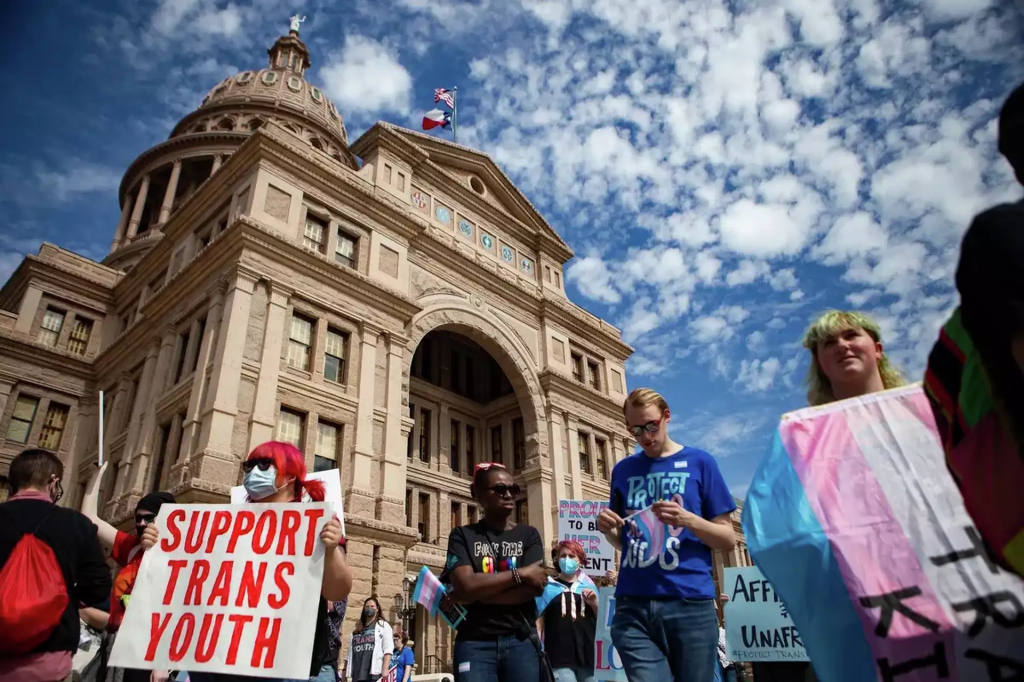
People gather in front of the Texas Capitol during a protest against bills limiting transgender kids’ access to puberty blockers and hormone treatments in March.
Lauren Witte/The Texas Tribune
At least once a day Dr. Ximena Lopez sees a parent crying in her clinic. They’re crying because Lopez just told them they need to find a new way to get transition-related care for their children — by leaving Texas or sourcing treatments outside the state — because the state outlawed these treatments for trans youth.
After a yearslong barrage by activists and lawmakers, the state has won the battle against the use of transition-related care, like puberty blockers and hormone therapies, for transgender youth. While the war over this health care remains in question — and a legal fight to block the new law begins in Texas — clinics have closed and some doctors have stopped providing this care.
“The reason why I’m leaving Texas is that it’s unbearable for me,” Lopez said. “It’s so devastating that I just can’t bear living in a state where I feel oppressed and where I’m just seeing my patients suffer.”
Lopez formerly provided gender-affirming care to trans youth as the director of the GENder Education and Care, Interdisciplinary Support (GENECIS) program, which was jointly run by the Children’s Medical Center and the University of Texas Southwestern Medical Center in Dallas. By the end of July, she’ll no longer practice at the Dallas hospital and plans to move out of Texas.
In light of the state’s ban on gender-affirming care for kids, The Texas Tribune spoke with over half a dozen doctors who practice this type of medicine about the fear of losing their jobs, scaring away medical providers from working in Texas and — most importantly — revoking this critical health care for transgender children.
From state-launched investigations into the families of trans youth, to threats of actual violence, doctors are fearful to speak out against the attacks on transgender health care. Physicians raised concerns that the state is driving physicians away from Texas and inadequately training the next generation of medical professionals.
Many said Texas was treading into a new era of medicine — marked by restrictions to gender-affirming care and reproductive health care — one in which the government tells doctors how and who they can treat.
Many doctors the Tribune spoke with declined to share their names for fear of harassment. Some likened the conversations with parents informing them that they can no longer provide this type of care to their children to cancer diagnoses or impending hospice care.
Medical providers say this type of care is lifesaving for transgender youth who face higher rates of suicide attempts and mental health problems than their cisgender peers. One in five trans and nonbinary young people attempted suicide in the past year, according to a 2023 survey conducted by The Trevor Project, a suicide prevention organization that focuses on LGBTQ+ youth.
Last month Gov. Greg Abbott signed legislation that restricts transgender youth from accessing puberty blockers and hormone therapy, two treatments used to address gender dysphoria, the medical term for the distress someone experiences when their gender identity doesn’t match their body.
“In Texas we must protect children from making permanent, life-altering decisions before they have the mental capacity to do so, and Senate Bill 14 does just that,” Andrew Mahaleris, a spokesperson for Abbott, said in a statement to the Tribune. Medical providers say puberty blockers are reversible and hormone therapy is partially reversible.
Mahaleris pointed to a recent survey from the Washington Post and the Kaiser Family Foundation that found a majority of the Americans surveyed oppose the use of puberty blockers and hormone therapy to treat transgender youth.
Senate Bill 14 was the forerunner in a broad swath of bills, aimed at reshaping the lives of LGBTQ+ Texans, that lawmakers pushed through this legislative session. Republican politicians also passed restrictions on drag shows and transgender athletes this session, but the implications of SB 14 are long reaching and profoundly affecting the lives of Texas families, said doctors who practice gender-affirming medicine. Families of trans youth have already fled Texas, but those who remain in the state must grapple with the consequences of losing health care access.
In recent months, many patients — including adults — have lost access to care as providers have left the state, a spokesperson for Texas Health Action, a nonprofit health care provider with clinics in Dallas, San Antonio and Austin, told the Tribune.
Dr. Anita Vasudevan, a primary care physician from Texas who chose to continue practicing in California instead of returning to her home state because of the ban on gender-affirming care and abortion, said the loss of Lopez and the GENECIS program highlights the issue of specialized providers leaving the state. This translates to missed learning opportunities for medical professionals in training, which will result in worse care for patients, she said.
“We’re building a generation of providers that just, unfortunately, won’t receive the level of training that they need in order to take care of patients in the ways that they need to be taken care of,” Vasudevan told the Tribune. “That’s a hard pill to swallow.”
An onslaught of interventions
For children already receiving puberty blockers and hormone therapy under the guidance of their medical team, SB 14 taking effect presents a daunting transition.
Lawmakers decided doctors must “wean” their patients under 18 of these treatments “in a manner that is safe and medically appropriate.”
But doctors who administer gender-affirming medical treatments say there is no such thing.
“This is comparable to asking a medical professional to wean a Type 1 diabetic off of their insulin — you would never do that,” Brett Cooper, an adolescent medicine physician from Dallas, said in a statement to the Tribune.
Cooper said SB 14 prohibits medical professionals from providing evidence-based, best-practice care to their patients. Including evidence that supports the use of these treatments and the recommendations of major medical groups like the American Medical Association.
He added that, like the state’s ban on abortions, this legislation will make it more difficult to recruit medical professionals to do business in Texas.
“There has been a chilling effect of the Legislature getting involved in the doctor-patient relationship and attempting to prevent physicians from providing the evidence-based and medically necessary care to their patients,” Cooper said. “Physicians know best how to care for their patients, not the Legislature.”
Texas Republicans’ effort to regulate the lives of transgender youth started long before Abbott signed SB 14 in June. Six years ago, the Legislature unsuccessfully tried to pass a bill requiring transgender people to use restrooms in public schools and governmental buildings that aligned with their sex assigned at birth.
In the years since, Republicans in the state have mounted a multipronged attack on gender-affirming care, in part, because issues like restrictions to medical care for LGBTQ+ people and drag shows had strong support from Republican voters.
In 2021, after the Legislature failed to restrict gender-affirming care, activists turned their attention to Lopez’s GENECIS program, targeting hospital board members and accusing the program of committing child abuse. Shortly after Children’s Health quietly closed the clinic, which was jointly run by UT Southwestern, Lopez was prompted to sue the hospital for shutting down operations to new patients.
The following year, Abbott directed the state’s Department of Family and Protective Services to investigate parents providing this type of care to their trans children for child abuse, terrifying families that they might be separated from one another.
More recently, suspended Attorney General Ken Paxton launched investigations against both Texas Children’s Hospital in Houston and Dell Children’s Medical Center of Central Texas for providing this type of care — even before SB 14 became law. Doctors working at Dell Children’s parted ways with the hospital after Paxton’s announcement, which left patients and their families scrambling to find specialty care, some of the needed treatments were unrelated to the gender-affirming treatments the state targeted.
Other states that have passed laws forbidding trans youth from taking puberty blockers and hormone therapy have encountered legal challenges. In Arkansas, a similar restriction to gender-affirming care was struck down as unconstitutional on the basis that it violated the due process and equal protection rights of transgender children and families. Legal groups in Texas have already committed to challenging SB 14.
Despite the rebukes of these laws in the courts across the country, the quiet closures of clinics and doctor departures in Texas have left medical professionals feeling alone in the fight for their patients’ best interests. Evidence shows access to gender-affirming care for young people improves the mental health of trans minors. Doctors said hospitals facilitating this type of health care are aware of its benefits, but are fearful of pushback from politicians.
“Many hospitals in these states, like Texas, I think are against these politicians and extremists and legislators, [but] they’re afraid of financial risks, they’re afraid of retaliation and they’re taking the easy way out which is to abandon their doctors and their patients and just subdue to this political pressure,” Lopez said.
Her employer, UT Southwestern, did not return requests for comment for this story.
While large hospital systems are not the only providers who treat trans youth, advocates say it’s evident that a chilling effect has reached physicians who prescribe gender-affirming care across the state.
In San Antonio, a city of nearly 1.5 million, only one doctor was administering gender-affirming care to trans youth in recent years, said Andrea Segovia, senior field and policy adviser for the Transgender Education Network of Texas. But after Abbott leveraged DFPS to investigate Texas families, the provider stopped providing these treatments, Segovia said.
She’s watched the number of providers who care for trans patients shrink. She said parents of trans youth are struggling to find pediatricians for their trans kids even for non-gender affirming care purposes, like routine vaccinations and physicals.
“People are being treated like they have a scarlet letter,” Segovia said.
De facto elimination of care
Prior to his graduation from UT Southwestern Medical School this spring, Antonio García was deliberating where to pursue his residency training in family medicine.
He could stay in Texas, where he grew up and his family lives, by leveraging his existing geographic connections to ”match” into a residency — a competitive process in which medical students are placed at specialized programs in hospitals or clinics for further medical training after graduating.
During medical school, García worked with providers in the GENECIS program, including Lopez, where he saw the positive impact the clinic had on patients and their families. He wanted to continue doing that important work, by providing gender-affirming care to trans people.
To do that García has decided to leave Texas.
“I also saw that as an opportunity to leave all of this behind and go somewhere where I knew that I was going to be able to get gender-affirming-care training, where I was going to be able to live my life openly, freely and not have to have all of these kind of concerns,” García told the Tribune. As a gay man, García said the state’s increasing hostility to the LGBTQ+ community prompted his decision to leave Texas.
Seeing the backlash against individual providers and clinics has been devastating, García said. Noting Lopez’s departure, he said the animosity toward medical professionals and trans people is driving doctors away.
“[The doctors are] doing the right thing for these families, for these kids, and seeing that work be stifled and impeded has been just really unfortunate,” he said.
One area of particular concern, doctors said, is the worsening of an existing pediatric specialists shortage. In Texas, an estimated 17.4% of children have special health care needs that require attention from specialized pediatricians, according to the American Academy of Pediatrics. These shortages mean patients have to travel longer distances and wait for weeks or months to see subspecialists, which can result in delaying or forgoing treatment.
Lauren Wilson, a pediatric hospitalist and the president of the AAP Montana chapter, partially attributes this shortage of doctors for children to the disparity in pay between adult and pediatric specialists. According to a 2023 compensation report from the healthcare-related companies Doximity and Curative, endocrinologists make nearly $60,000 more annually than their pediatric specialist peers, who undergo commensurate levels of training.
Shortages in this speciality — pediatric endocrinology — is of particular concern to Wilson because these doctors treat a wide range of children. This area of medicine deals with hormones and associated issues and mostly treats children with diabetes or growth problems. But these physicians also often specialize in gender-affirming care treatments like puberty blockers and hormone therapies for trans children (less specialized physicians can also administer gender-affirming care.)
Wilson said these laws targeting pediatric health care — which could criminalize medical practices not even related to gender-affirming care — are unprecedented. In April, Montana became one of 20 states to ban trans youth from accessing gender-affirming care. It’s also the state that barred a transgender lawmaker from the Montana House floor for violating “decorum” rules after she told colleagues that voted in favor of restricting gender-affirming care would have blood on their hands.
Wilson also noted the de facto elimination of care by targeting clinics, by state leaders and extremists, has forced hospitals to stop this care.
“We’re in a position as physicians where we want to do what’s best for our patients, we want to follow all relevant guidelines. But we also want to not go to jail or lose our license to practice medicine,” Wilson said.
The Tribune asked Abbott’s office about the prospect of Texas losing medical providers because of the new law.
“Passed by a bipartisan majority in the Texas Legislature, SB 14 ensures access to appropriate and medically necessary services, with parental or legal guardian’s consent. Endocrinology treatments and procedures that are not intended to change the biological sex of a minor are unaffected by this law,” Mahaleris, Abbott’s spokesperson, said.
It’s not clear how many doctors have left or will leave Texas in response to restrictions on gender-affirming treatments, but states that have enacted other health care restrictions offer some clues.
States with abortion bans saw a 10.5% decrease in applications for obstetrics and gynecology residencies in 2023 compared to the previous year, according to data from the Association of American Medical Colleges.
Doctors, including Lopez, said they have already seen the effects with candidates deciding after the interview process not to accept positions in Texas “because of the politics.”
“Living in a medical dictatorship”
Treating gender dysphoria in Texas is not new. In 1965, the UT Medical Branch opened a gender clinic, providing treatment for hundreds of transgender people in the decades that followed.
Most major hospitals in Texas have been providing this type of care for over a decade. It only became widely controversial after lawmakers sought to criminalize doctors for providing this care, Lopez said.
Doctors lamented the spread of misinformation by lawmakers advocating against gender-affirming care during the most recent legislative session. Experts say this has further contributed to distrust between the public and the medical community, which worsened during the COVID-19 pandemic because of vaccine misinformation.
Hospitals across the country, including Children’s National Hospital in Washington, D.C. and Boston Children’s Hospital, have received bomb threats and violent messages after far-right harassment campaigns falsely accused the hospitals of performing genital surgery on minors.
Doctors say while transition-related surgeries are rarely performed on people under the age of 18, these procedures were also banned by SB 14. Conservative activists have incorrectly cast gender-affirming care as irreversible “genital mutilation” in an effort to restrict access to these treatments.
Several doctors declined to share their names publicly, citing a fear that false allegations would be directed at them. Doctors suspect threats of violence and harassment are why some Texas hospitals targeted by far-right activists chose to quietly stop providing these medical treatments, instead of standing with patients and doctors.
“No one feels particularly safe,” said one doctor who spoke with the Tribune on the condition that their name would not be published.
Lawmakers who oppose this type of care feel emboldened, Lopez said.
“It’s just also, again, a dangerous precedent because if politicians can tell hospitals what to do, then they can do that for so many things,” she said. “And then where is the patient’s autonomy? Where’s the voice of science and medicine at that point?”
Doctors pointed to an example of a trial court in 2021 that ordered doctors to administer the drug ivermectin, commonly used to treat parasitic worms in horses, after a patient’s relative sued the Fort Worth hospital to compel physicians to administer it. The treatment gained notoriety as a false cure for COVID-19 in right-wing circles, including from then President Donald Trump. The 2nd Court of Appeals reversed the lower court’s decision, but the attempt to supersede the doctor’s expertise was clear.
Doctors worry that the latest health care restriction for trans youth is a dangerous precedent with an uncertain future. While much of the attention around gender-affirming care was aimed at children, bills limiting this type of care for adults have also gained traction in the Texas Legislature.
“I can compare this with living in a medical dictatorship, in which you are told what treatment you can and can’t do,” Lopez said. “But it’s not based on reason. It’s based on whatever the person in power is saying is best.”
Republicans have introduced more than 500 anti-LGBTQ+ bills in 2023 alone, all over the country. They’re obsessed with controlling who Americans love, how they identify, and even where they can go to the bathroom. Here’s why.
I have not been able to get to all the news tabs I had opened, so each night I pushed them into the next morning. I had several hundreds of open tabs, at least past the beginning of the month into last June. Maybe 300+ But Ron left Sunday morning to go to NC to pick up his family and take them to see their brother in a nursing home under hospice care. He does this at least once a year, often more. This year with everything going on, it is a huge hardship drain on our finances. But it is family, so …
So with Ron gone, no distractions over the simple needed chores (feeding cats, cleaning cat boxes, doing dishes, taking out trash) I have had all the free time to work on the computer. I am now with this post caught up to Friday night / Saturday morning. I hope to finish the next few days worth quickly, so I can tell everyone what my medical tests showed. Spoiler I have minor heart damage, but seem to have a bad lung problem. The first meme is my fav. More later. Best wishes and hugs
Ron DeSantis has quietly rejected hundreds of millions of dollars in federal energy funding https://t.co/Xlm7tHGFxr
According to a green energy group, the rebates would have meant people in Florida would get “lower utility bills and healthier and more comfortable homes as well as lower greenhouse gas emissions.” Meanwhile, DeSantis has proposed millions in tax credits for people who buy gas stoves.
The "missing" Hunter Biden witness the GOP was promising for a while there was just charged by the DOJ with being a Chinese spy. https://t.co/lLiVEmfrU1
— follow @bencollins on bluesky (@oneunderscore__) July 10, 2023
Timeline:
Gal Luft was arrested for allegedly acting as an unregistered foreign agent in February.
Released on bail, he fled.
GOP Rep. Comer claimed "we can't track down the [Hunter Biden] informant" in May.
Luft put out a videos 5 days ago.
DOJ announced charges today.
— follow @bencollins on bluesky (@oneunderscore__) July 10, 2023
House Oversight Committee chair James Comer was on Laura Ingraham's Fox News show last night raising questions about whether the arrest of one of his supposed whistleblowers for serving as an unregistered agent of China may be political. pic.twitter.com/AoxnbQjYqv
Whoops. Gal Luft, the GOP's new fake Hunter Biden "whistleblower," was just indicted by the Justice Department for arms trafficking, violating U.S. sanctions against Iran, making false statements to federal agents, and being an unregistered foreign agent for China.
Gal Luft knew he was being indicted for being a foreign agent for China & charged w/arms trafficking, violating sanctions against Iran & making false statements to the feds so he decided to team-up w/corrupt Republicans and become a fake whistleblower for Hunter Biden. #DOJhttps://t.co/kUDzoOfZXjpic.twitter.com/LnwYqFKUsE
At the beginning of the video, the host gives a funny simple understanding of how sex and gender are not binary nor simple. It is a fun video about a serious topic. But I guess you have to click to watch it. Hugs













 Scottie's Playtime