May 30, 1868 Memorial Day, originally known as Decoration Day, was first observed some say [see May 1, 1865] when two women in Columbus, Mississippi, placed flowers on the graves of Civil War soldiers, both Confederate and Union. War widow Augusta Murdoch Sykes, one of the Columbus planners, pointed out that “after all, they are somebody’s sons.” It is now celebrated to honor all those who have died in America’s wars. “The 30th day of May, 1868, is designated for the purpose of strewing with flowers, or otherwise decorating the graves of comrades who died in defense of their country….” -from an order from the Grand Army of the Republic ========================================================= May 30, 1937 1000 striking steel workers (and members of their families), on their way to picket at the Republic Steel plant in south Chicago where they were organizing a union, were stopped by the Chicago Police. In what became known as the “Memorial Day Massacre,” police shot and killed 10 fleeing workers, wounded 30 more, and beat 55 so badly they required hospitalization. More on the incident Watch a video of oral history with historic footage
(Both important stories. Of course, language alert, but definitely good reading here. -A)
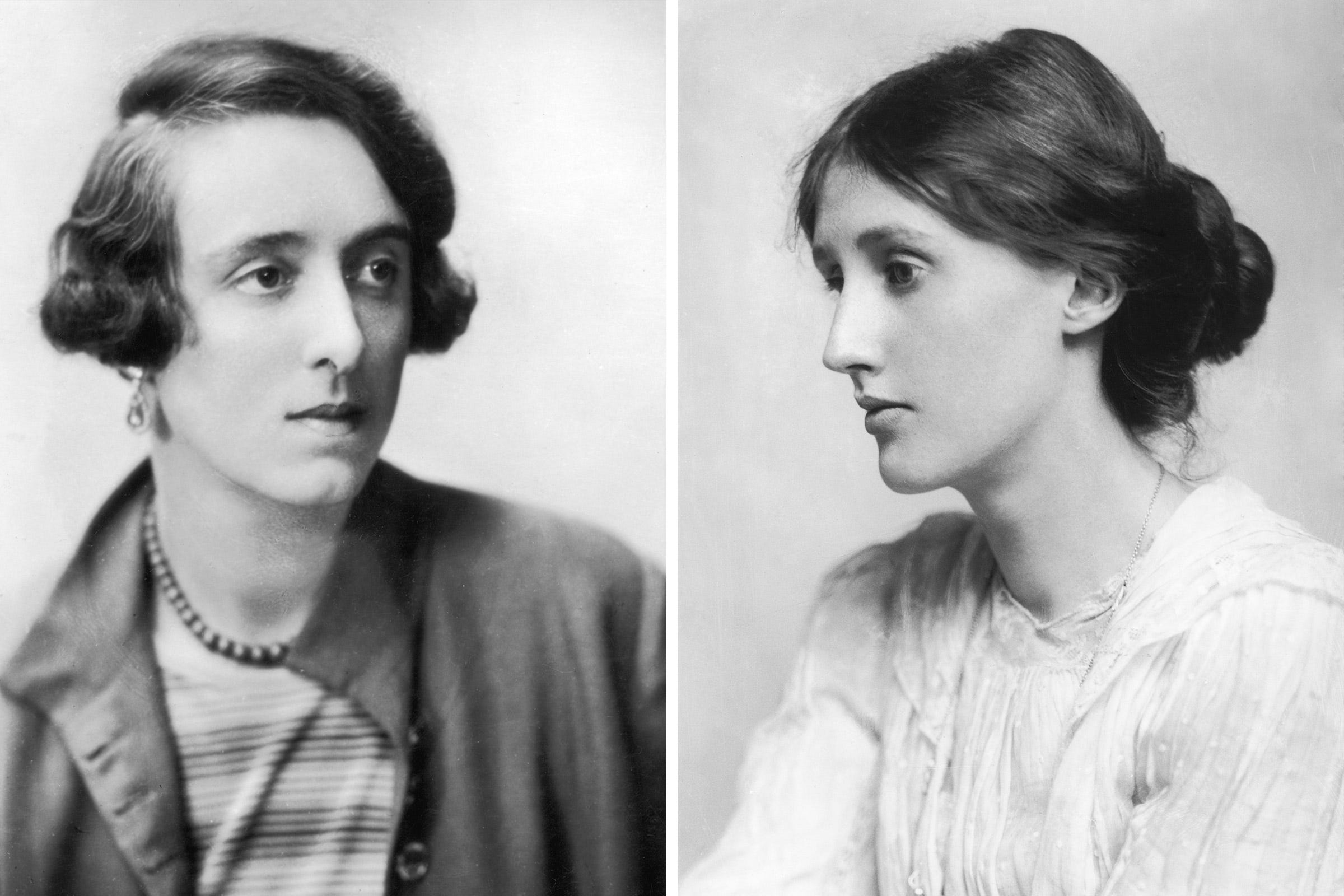
Queer History 124: Virginia Woolf & Vita Sackville-West by Wendy🏳️⚧️🏳️🌈🌈
How an aristocratic garden-loving poet inspired the 20th century’s most experimental “love letter” ….. Read on Substack
When Virginia Woolf first met Vita Sackville-West at a dinner party in 1922, neither woman could have possibly predicted that their relationship would produce one of the most revolutionary novels of the 20th century. On the surface, they seemed like complete opposites: Virginia—brilliant, fragile, middle-class, and sexually timid; Vita—aristocratic, confident, adventurous, and sexually voracious. Yet their decade-long affair transcended a simple romance to become one of the most creatively fertile partnerships in literary history, producing a groundbreaking gender-bending masterpiece that still feels radical nearly a century later.
Let’s cut through the academic bullshit that often sanitizes their relationship and explore what really happened between these remarkable women. Their letters reveal a passionate connection that was intellectual, emotional, and unmistakably physical. “I am reduced to a thing that wants Virginia,” Vita wrote in one letter. Not exactly the chaste “friendship” that some literary historians tried to paint it as for decades. Their affair challenged the conventions of their time, their social circles, and ultimately, the very form of the novel itself.
The Women Behind the Legend: Who They Really Were
(snip-More; it’s really good!)
Queer History 125: The Raw, Unfiltered History of Sapphic and Platonic Queer Cultures by Wendy🏳️⚧️🏳️🌈🌈 Read on Substack
The Goddamn Poetry of Desire: An Introduction
The ancient world was no fucking stranger to same-sex love. While modern society often frames homosexuality as a contemporary phenomenon—something that emerged from the shadows of the closet into the damn light of day during the liberation movements of the 20th century—the historical record tells a far more complex and fascinating story. Long before we had Pride parades and marriage equality, we had Sappho of Lesbos and Plato of Athens, two figures whose works and philosophies have profoundly shaped how we understand same-sex desire.
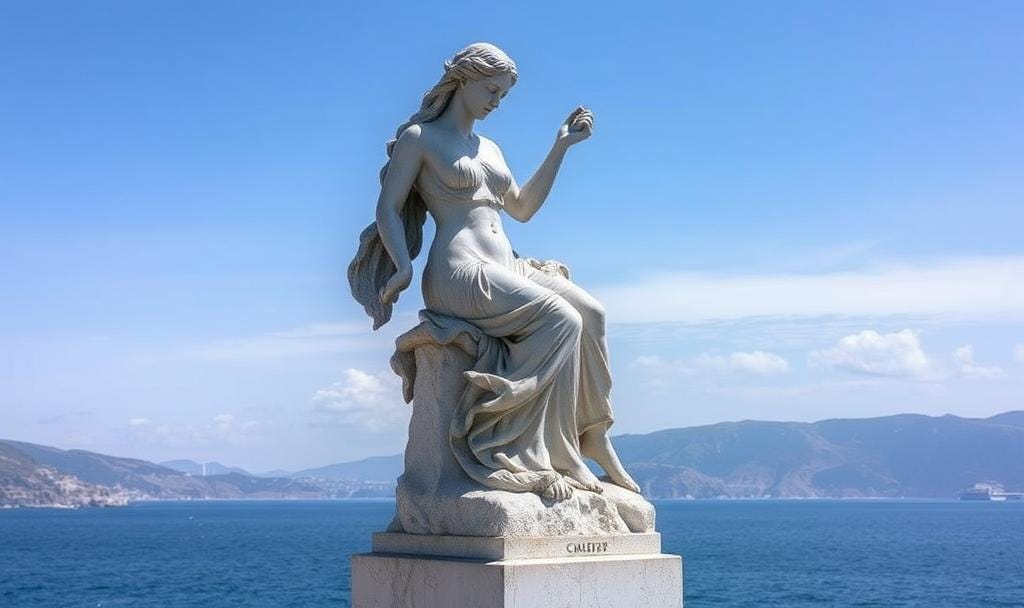
Sappho Lesbos
The rocky shores of Lesbos and the philosophical gardens of Athens—separated by the azure waters of the Aegean—gave birth to two distinct yet equally significant homosexual cultural traditions that continue to echo through the halls of queer history. These traditions, one centered on the passionate lyrical expressions of a woman poet, and the other on the philosophical musings of a male thinker, offer us a window into the complex ways same-sex desire was articulated, celebrated, and sometimes condemned in ancient Greek society.
Standing on the windswept cliffs of Lesbos, one can almost hear the lyrical whispers of Sappho’s poetry carried on the salt-laden breeze—fragments of desire that have survived over two and a half millennia. Meanwhile, in the once-bustling agora of Athens, the philosophical dialogues of Plato still reverberate, offering a theoretical framework for understanding male same-sex love that has influenced Western thought for centuries.
This analysis isn’t just about ancient history—it’s about the living, breathing legacy of these traditions and how they’ve been twisted, reimagined, and reclaimed through the bloody centuries. It’s about the raw power of words to shape how we understand our deepest desires and most intimate connections. It’s about the tension between poetic expression and philosophical reasoning in articulating the ineffable experiences of love and longing.
So let’s cut through the academic bullshit and get to the heart of the matter. Let’s explore the goddamn fascinating parallels and divergences between these two seminal traditions—one rooted in the fragmented verses of a woman whose very name has become synonymous with female homosexuality, and the other in the philosophical dialogues of a man whose ideas about love between men have shaped Western thought for millennia.
The Lyrical Fucking Fire: Sappho and Her Sacred Circle
On the sun-drenched isle of Lesbos, around 630-570 BCE, Sappho created a world of women that would reverberate through time like a pebble dropped in still water, its ripples still touching distant shores millennia later. The island’s rugged landscapes and azure waters formed the sensuous backdrop to her life and work—a physical paradise that mirrored the emotional and erotic paradise she created in her verses. (snip-More important history)
May 29, 1932 In the depths of the Great Depression, the “Bonus Expeditionary Force,” a group of 1000 World War I veterans seeking to cash in their veterans’ bonus certificates, arrived in Washington, D.C. Though issued to the veterans in 1924, the certificates were not scheduled to be paid until 1945. By mid-June, the vets had set up a massive “Hooverville,” a contemporary term for an encampment of the homeless. The St. Louis contingent of the Bonus Expeditionary Force is pictured here as it starts for Washington, D.C., in May 1932. One month later, other veteran groups made their way to the nation’s capital, swelling the Bonus Marchers to nearly 20,000 strong, most of them unemployed veterans in difficult financial straits. President Herbert Hoover ordered the Army to clear out the veterans when they resisted being evicted by Washington police. Infantry and cavalry supported by six tanks were dispatched with Chief of Staff General Douglas MacArthur in command. Major Dwight D. Eisenhower served as his liaison with Washington police and Major George Patton led the cavalry. This was a direct violation of the Posse Comitatus Act, which prohibits the armed forces’ being used against U.S. citizens. More on the Bonus Army
May 29, 1965 In one of the first demonstrations promoting equal treatment of homosexuals, Jack Nichols, Barbara Gittings and others picketed in front of the White House. Her sign read, “Sexual preference is irrelevant to federal employment.” More about Barbara Gittings
May 29, 1986 The Christic Institute filed a lawsuit charging U.S. government complicity in an assassination bombing at La Penca, Nicaragua, and that the CIA had a role in smuggling cocaine into the U.S. to fund the Contras, an insurgent military force working to bring down the government of Nicaragua. Find out more about the Christic Institute
May 28, 1892 The Sierra Club, America’s oldest, largest and most influential grassroots environmental organization, was organized in San Francisco with wilderness explorer John Muir as its first president. The organization’s initial effort was to defeat a proposed reduction in the boundaries of Yosemite National Park. Muir introduced President Theodore Roosevelt to Yosemite the following year, inspiring him during his presidency to establish the U.S. Forest Service, create 5 national parks, and sign the 1906 Antiquities Act, under which he proclaimed 18 national monuments. “Everybody needs beauty as well as bread, places to play in and pray in, where nature may heal and give strength to body and soul alike.” – John Muir, The Yosemite (1912) John Muir The Sierra Club today
May 28, 1961 Amnesty International (AI) was founded on this date in Great Britain. It is a worldwide movement of people who campaign for internationally recognized human rights, particularly as laid out in the United Nations Universal Declaration of Human Rights. Members of AI help maintain a media focus on political prisoners, and organize public pressure to afford them their legal rights and obtain their release. Visit Amnesty International Read the Universal Declaration of Human Rights: Amnesty International projects
May 28, 1963 Black and white civil rights advocates were attacked as they sat-in at a Woolworth’s lunch counter in Jackson, Mississippi. They were defying state laws against serving “colored” citizens at “whites-only” public facilities. According to John Salter, AKA Hunter Bear, one of those who sat in: “This was the most violently attacked sit-in during the 1960s and is the most publicized. A huge mob gathered, with open police support while the three of us sat there for three hours. I was attacked with fists, brass knuckles and the broken portions of glass sugar containers, and was burned with cigarettes. I’m covered with blood and we were all covered by salt, sugar, mustard, and various other things.” Attacked for trying to eat at Woolworth’s (L to R): John Salter (Hunter Bear), Joan Trumpauer (now Mulholland), and Anne Moody. More photos and the story of the struggle against segregation Freedom Movement Bibliography
May 28, 1982 Seven women fasted for 10 days in Springfield, Illinois, in support of ratification of the Equal Rights Amendment by the Illinois state legislature. The amendment had already been ratified by 35 other states of the 38 required.
May 28, 1998 Pakistan exploded five underground nuclear devices in response to India’s most recent nuclear tests. Since the British partitioned the subcontinent in 1947, there have been three wars between the two countries and numerous border clashes over the disputed Kashmir province. Kashmir had a majority (77%) Muslim population at the time of partition, but became part of predominantly Hindu (80%), though constitutionally secular, India. Dr. Abdul Qadeer Khan, widely proclaimed as the ” Father of Pakistan’s atomic bomb,” stands in the access tunnel inside the Chagai Hills nuclear test site before Pakistan’s 28 May 1998 underground nuclear test. Read more
May 27, 1940 The U.S. Supreme Court ruled a sit-down strike was not a violation of the Sherman Anti-Trust Act even if it interfered with interstate commerce. The company had sued for treble damages (triple their financial loss) under the Act. The Court said that if the strike were found to be a restraint of trade, then “practically every strike in modern industry would be brought within the jurisdiction of the federal courts under the Sherman Act.” The American Federation of Full Fashioned Hosiery Workers under its president, William Leader, had declared a strike at Apex Hosiery Co. in Philadelphia, and had organized support among other workers in the city. When Apex refused to recognize the union, he declared a sit-down strike and led an occupation of the factory which lasted for seven weeks. Unlike the UAW sit-down at the GM plant in Flint, however, violence was committed against the management personnel and significant damage was done to manufacturing equipment. Summary and full text of the Supreme Court decision
May 27, 1963 The record album, The Freewheelin’ Bob Dylan, which featured the song “Blowin’ in the Wind,” was released. The song warns of the perils of nuclear war.“ …how many times must the cannon balls fly Before they’re forever banned?” The song and the lyrics
May 26, 1647 The first person in America was executed for the crime of witchcraft. Alse Young was arrested, tried in Windsor, Connecticut, and hanged at Meeting House Square in Hartford, the site of what is now the Old State House. There is no further record of Young’s trial or the specifics of the charge — only that she was a woman, as 80% of those executed for witchcraft were. The Salem witch trials would not begin for another 45 years. Some 300 years later the U.S. experienced another “witch hunt” as Senator Joe McCarthy and the House Un-American Activities Committee pursued communists. Arthur Miller makes this comparison in his famous play “The Crucible.” Read more about the play “The Crucible” The Guardian
May 26, 1937 United Auto Workers organizers and Ford Service Department men clashed in a violent confrontation on the Miller Road Overpass outside Gate 4 of the Ford River Rouge Plant in Dearborn, Michigan. It became known as “The Battle of the Overpass.” Henry Ford announced: “We’ll never recognize the United Automobile Workers Union or any other union.” Though General Motors and Chrysler signed collective bargaining agreements with the UAW in 1937, Ford held out until 1942. More background and photos Read more T The Ford Servicemen (goons) approach Walter Reuther and Richard Frankensteen, third and second from right, and the other unionists. UAW official Richard Frankensteen being beaten by Ford goons
May 26, 1946 A patent was filed in the U.S. for the H-Bomb, the hydrogen, or fusion-based, nuclear explosive device.
May 26, 1969 John Lennon and Yoko Ono (along with her 5-year-old daughter Kyoko) held their second Bed-in for Peace at the Queen Elizabeth Hotel in Montreal, Quebec. A late-night rendition of “Give Peace a Chance,” recorded in the hotel room with their visitors singing and accompanying, reached No.14 on the Billboard pop music charts. John and Yoko meet cartoonist Al Capp in their hotel room
May 26, 1972 The Anti-Ballistic Missile (ABM) Treaty was signed by U.S. and U.S.S.R. (Union of Soviet Socialist Republics which included Russia and 15 other republics). The two countries agreed not to build defensive missile systems and thus to limit escalation of the nuclear arms race. It was reasoned that if either side deployed defensive missiles, the other would be forced to respond by increasing the number, explosive yield or effectiveness of their offensive nuclear weapons and delivery systems to maintain the balance of nuclear deterrence. Research and development of defensive systems was allowed under the ABM treaty, the U.S. having spent about $100 billion in the 20 years before the treaty was abrogated by President George W. Bush in the first months of his presidency.
May 26, 1991 20,000 Israeli Jews and Palestinians participated in a peace rally in Israel’s capital, Tel Aviv.
Everyday’s a good day to do that!Jeff Tiedrich included this in his substack today about the President’s grad speech at West Point. I also linked that below this snippet, if anyone’s interested in that. It’s TMI for me today, but very good; I read his most days. Meanwhile, back to the Army news: -A
Ronald Reagan was even involved in this largely-forgotten tradition.
By Dan Tracer Friday, June 21, 2024 · Updated on June 22, 2024
Long before RuPaul’s Drag Race, Drag Queen Story Hour, or any one of the countless drag shows gracing the stages of LGBTQ+ bars around the world, there was another popular spot for performative gender-bending: U.S. military bases in the 1940s.
During World War II, the military embraced drag shows as a unique form of entertainment and a morale-boosting activity. These officially sanctioned events featured all-male performances with soldiers often dressing in women’s attire. According to author Allan Bérubé, GIs staged these shows everywhere from makeshift platforms to grand theater stages, incorporating popular female impersonation routines of the day.
Due to the official segregation of the armed forces, service-member theater productions had no option but to cast men in female roles.
One of the most iconic productions of the era, “This is the Army,” was initially a Broadway musical designed to raise funds for troops. It later became a sensation as a 1943 film starring Ronald Reagan, 37 years before he was elected President of the United States. These shows not only provided soldiers with much-needed diversion during the stresses of conflict but also served as a safe haven for gay service members, as explained by Joe E. Jeffreys, a drag historian and professor at New York University’s New School. (snip; a little MORE with video)
==========================
elderly golfer’s brain goes fuckity-bye in batshit West Point speech by Jeff Tiedrich
Donny can’t be bothered to act like a human being Read on Substack
May 25, 1774 A group of African slaves in Massachusetts Bay colony petitioned the British royal governor for freedom as their natural right: “. . . we have in common with all other men a natural right to our freedoms without Being depriv’d of them by our fellow men as we are a freeborn Pepel [people] and have never forfeited this Blessing by aney compact or agreement whatever.”
May 25, 1925 John T. Scopes was indicted for teaching Darwin’s theory of evolution. Scopes, a football coach and substitute high school biology teacher in Dayton, Tennessee, agreed to be arrested and put on trial for teaching evolution. He was challenging the legitimacy of a four-day-old state law barring Darwin’s theory from the public school curriculum. The Scopes “Monkey Trial” ACLU
May 25, 1948 Garry Davis, formerly a member of the U.S. military, renounced his American citizenship to become a Citizen of the World. Davis continued to promote “world citizenship” for over 50 years; 400,000 have, at one time or another, joined the movement. watch trailer “THE WORLD IS MY COUNTRY” Read more about Garry Davis NY Times
May 25, 1963 Leaders of 32 African nations met in Addis Ababa, Ethiopia, to set up the Organization of African Unity (OAU), giving them a united voice for the first time in the continent’s history. The primary aim of the OAU was to end European colonial control in the countries where it still existed at the time: Southern Rhodesia (now Zimbabwe), South Africa, Mozambique and Angola. OAU flag Read more
May 25, 1986 An estimated 7 million Americans participated in Hands Across America, forming a line across the country from Los Angeles to New York to raise public awareness of the issues of hunger and homelessness in the U.S. Participants paid ten dollars [almost $20 in 2009] to reserve their place in line; the proceeds were donated to local charities to feed the hungry and help the homeless.
May 25, 2003 Four activists, members of the Catholic Worker movement and known as “Riverside Ploughshares,” were arrested for pouring blood and hammering on the USS Philippine Sea’s Tomahawk cruise missile hatches. The ship was visiting New York City for the annual “Fleet Week.” “With hammers we have initiated the process of disarming this battle ship, of transforming this carrier of mass destruction into a vessel for peace…” pouring blood and hammering.. Details of the Riverside Ploughshares action
I keep meaning to get them posted, then I don’t get it done. Here they are; readers can pick and choose, or read each one in your own time. Enjoy!
This one has 2: 120, and 120a! -A
Queer History 120: Sappho by Wendy🏳️⚧️🏳️🌈🌈
How a woman from ancient Lesbos changed literature and sexuality forever Read on Substack
Queer History 119: Dr Alan Hart, Trans Guy Super Power by Wendy🏳️⚧️🏳️🌈🌈
“What does it feel like to save countless lives while being forced to hide who you really are? To revolutionize medicine while living in constant fear of being “discovered”? To fight a deadly disease that ravaged millions while battling a society that treated your very existence as a fucking scandal?” Read on Substack
Queer History 118: The Tragedy of Carmen Carrasco (1932) by Wendy🏳️⚧️🏳️🌈🌈
“In a Spain teetering between progress and persecution, one woman’s death exposed the brutal reality faced by those who dared to love differently.
The day they found Carmen Carrasco’s body, Madrid whispered.” Read on Substack
Queer History 117: The Boys of Boise Scandal by Wendy🏳️⚧️🏳️🌈🌈
“In 1955, the sleepy city of Boise, Idaho became ground zero for one of the most fucked-up anti-gay witch hunts in American history. What began as arrests of three men exploded into a moral panic that would rip families apart like wet paper, crush reputations under its boot, and drive some to blow their brains out—all under the bullshit guise of ‘protecting the children.'” Read on Substack
Queer History 116: Natalie Clifford Barney by Wendy🏳️⚧️🏳️🌈🌈
How an American heiress built a lesbian literary empire in the heart of French culture while telling society to go fuck itself Read on Substack
Queer History 115: The Radical Queer Brotherhood in Walt Whitman’s Revolutionary Circle by Wendy🏳️⚧️🏳️🌈🌈
How America’s “Good Gray Poet” built a secret society of gay intellectuals that changed literature forever Read on Substack
“I am most grateful that…I was born long enough ago to have known people who lived in the ancient way before everything started to change.” –Mourning Dove
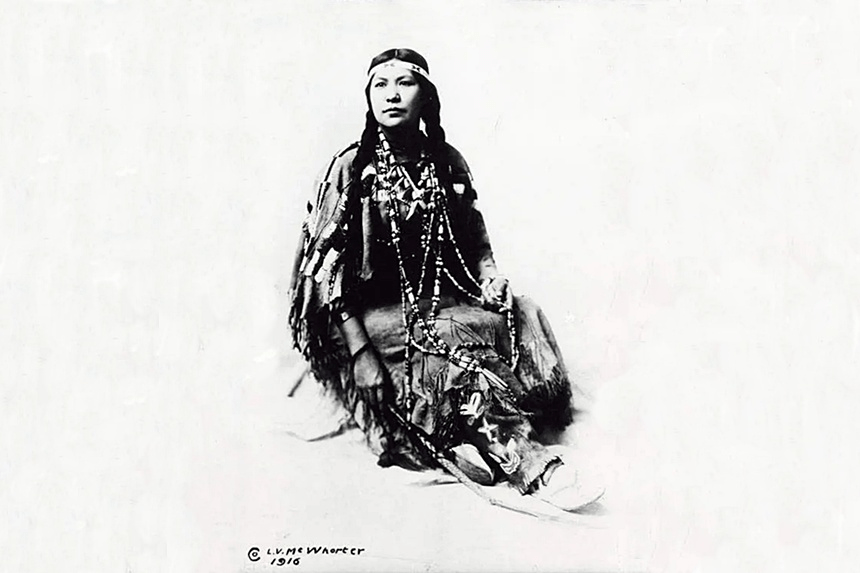
Maybe it was because she was born in a canoe on Idaho’s Kootenai River. Or because she was multiracial. Or because she went to a convent school to learn English as a ten-year-old. Whatever the reason, Christine Quintasket, whose Salish language name was Hum-ishu-ma (Mourning Dove in English, which she adopted as her literary name as an adult), wrote stories about the hostility white people had toward Native Americans and the confusion they suffered when educated in white schools.
Born around 1884 to Sinixt/Colville Lucy Stukin of the upper Columbia River and Okanagan/Irish Joseph Quintasket of British Columbia, the future writer grew up speaking the Salishan dialect in her mother’s home near Kettle Falls, Washington, according to her autobiography. Mourning Dove’s grandmother taught her the traditional customs of Columbia Plateau natives. Teequalt, an older woman who lived with the family, introduced her to tribal spirituality, and Jimmy Ryan, an adopted white orphan, taught her to read English through dime novels.
As a young girl, Mourning Dove remembered sitting by a campfire and listening to the animated voice of a tribal storyteller imitating an animal. “We thought of this as all fun and play, barely aware that tale-telling and impersonations were part of our primitive education,” she recalled decades later.
Mourning Dove’s indigenous education ended in 1894 when she went to the Sacred Heart School at the Goodwin Catholic Mission near Kettle Falls. When her mother died in 1902, the writer returned home to care for her younger siblings. After her father remarried in 1904, she moved to Great Falls, Montana to attend the Fort Shaw Industrial Indian School. In 1908 Mourning Dove sorrowfully watched the last roundup of America’s wild bison herd as the Old West faded. “One magnificent fellow fought like a lion as they tried to crowd his wonderful shaggy head into a box car,” she told an interviewer. She later incorporated the roundup in her writing. (snip-MORE, not too long to read, and it’s really interesting!)




 T
T


 Scottie's Playtime