Mid Century Women’s Publications Did Important Medical Work

It reminds me of how “Cosmopolitan” was one of the early ‘mainstream’ magazines honestly discussing the AIDS virus, where to find care, and knowledge to avoid contracting it. They knew and reported early on that any- and everyone can catch what we now know as HIV. This piece is about early cancer info dissemination.

How Midcentury Women’s Magazines Fought Cancer

At a time when people wouldn’t even say the word, journalists at Good Housekeeping, Redbook, and other women’s magazines were informing readers how to recognize, protect against, and talk about cancer.

Meg Heckman

Maxine Davis wrote about plenty of tough topics during her long career in journalism, but none of them frightened her as much as the assignment she received in the spring of 1940. Her editors at Good Housekeeping wanted her to cover cancer, a disease so cloaked in stigma that Davis, like many other Americans, was afraid to say its name out loud.

The sweeping series of articles she produced that year changed her thinking. “My research has dispelled that terror,” she wrote in an article that appeared in Good Housekeeping’s April 1940 issue, declaring that cancer could be cured especially if it was caught early through education and hypervigilance. Cancer, she explained, was “sneaking, insidious. Only you and you alone can guard yourself against it.”

At the time Davis wrote these words, cancer was a taboo topic. The term itself wouldn’t be spoken on the radio until 1945. Rumors about its causes were rampant. (Many Americans at the time believed it to be contagious or a sign of poor character.) Physicians routinely withheld cancer diagnoses from patients to spare them shame. Although it wasn’t always a death sentence, the treatments we rely on today were nascent or nonexistent. And yet, the editors at Good Housekeeping still decided to devote pages and pages to in-depth coverage of the disease.

This is one example of how, during the 1940s and 1950s, women’s magazines played a vital and largely forgotten role in educating average Americans about burgeoning efforts to prevent and treat cancer. It was a pivotal era for modern medicine thanks to scientific advancements and increased attention to public health. Cancer was among the leading causes of death, and rates were increasing in part because people were living longer. Print media in all its forms played a major role in normalizing public conversations about cancer, but women’s magazines took a unique approach. They made disease prevention personal, calling upon women to become cancer watchdogs for themselves and their families.

Mortality rates from selected cancers among women in the United States, 1930–2008 (Surveillance, Epidemiology, and End Results Program 2013National Library of Medicine)

Davis was among the best-known of the women’s magazine journalists covering cancer. By the early 1940s, she had reported on the League of Nations, driven all over the United States to research a book about American youth, and founded a wire service aimed at explaining politics to women. Her cancer stories for Good Housekeeping launched her to a new level of prominence, one akin to modern day health influencers. Her editors promoted her work heavily, framing her as a lay expert with carefully cultivated sources. “Doctors like to work with her,” they wrote in an introduction to her spring 1940 cancer series, “and they give her all the help they can.”

Writing in May of 1940, Davis introduced readers to the basics of cancer treatment, explaining in plain language how surgery, X-rays, and radium were being used to help patients.

Sometimes X-ray, radium, and surgery are all used to treat a malignant condition. Take the case of Ada Johnson. Ada put off going to hospital longer than she should have after she felt a lump in her breast; but the doctor didn’t think the situation was hopeless. This is what he did:

First, there was a surgical operation. When that had been successfully accomplished, the specialist in cancer of the breast applied radium to the chest wall. That wasn’t all. The doctor then used deep X-ray therapy on Ada’s breast and armpit….This was repeated for thirty-five treatments. Ada is perfectly well today.

Davis was not, however, the only women’s magazine reporter working the cancer beat at midcentury. Seventeen magazine’s beauty editor Jean Campbell urged her young readers to get involved in efforts to bring specialized cancer to more communities. “Demand them,” she wrote in the April 1948 issue, “and raise funds for them.” That same year Miriam Zeller Gross deftly described the history of stomach cancer treatment in a gripping feature story that appeared in Better Homes and Gardens. In the early 1950s, Redbook’s Collie Small encouraged women to overcome “false modesty” and allow physicians to screen them for breast cancer. Women’s magazines were publishing hundreds of articles on cancer by dozens of writers. Women also wrote about cancer for general magazines including The Saturday Evening Post, which featured a handful of stories in the 1950s by female cancer survivors.

Stories about cancer were far less common before World War II, but they did sometimes appear in women’s magazines. Ladies Home Journal has been credited by medical historians with publishing the very first general interest article about cancer detection in 1913. Others, including Good Housekeeping, featured occasional educational columns by physicians during the 1920s.

While less common, articles about cancer did appear in women’s magazines in the early 20th century, such as this piece by Dr. Harvey W. Wiley in the November 1922 issue of Good Housekeeping. (Cornell University Library)

In addition to becoming quick experts on complex medical topics, these journalists managed often-fraught relationships with health professionals who tended to distrust journalists. It became common practice during this time for physicians to review stories before they were published. Sometimes, one of those physicians would write a sidebar: In 1955, American Cancer Society vice president Dr. Charles S. Cameron had reviewed a draft of an April 1955 article on cervical cancer by health journalist Gladys Denny Shultz for Ladies Home Journal, and wrote a public note of thanks, proclaiming that the magazine was “offering its readers a great service by publishing this excellent article. It should be a means of saving thousands of lives.”

While most of the bylines atop women’s magazine stories about cancer belonged to female journalists, editors did occasionally invite physicians, almost always men, to contribute. Cosmopolitan published a 14-page essay by Walter Alvarez, who had just retired from clinical practice to pursue a second career in medical writing. The piece, which appeared in January of 1953, sprawled across 14 pages under the headline “Danger Signals in Your Life” and includes tips to spot illnesses like cancer in children, teens, and adults. Alvarez assured readers he wasn’t out to scare them. Instead, he hoped to save “wise persons from avoidable illness or death.”

Much of this coverage was driven by coordinated public relations campaigns initiated by the American Cancer Society and similar organizations. In addition to connecting journalists with expert sources and organizing junkets to prominent research centers, such campaigns included advertising blitzes promoting new treatments, championing medical breakthroughs, and reminding Americans of the importance of cancer screenings. Women’s magazines were a popular venue for such ads, so it wasn’t uncommon for some issues to feature a reference to cancer on nearly every page.

While groundbreaking, the cancer coverage provided by midcentury women’s magazines was imperfect. Race and class were seldom addressed because these publications — like much of the news media — assumed their audience was white and financially stable. Some coverage also illustrates the era’s rudimentary and fast-evolving scientific knowledge. One example is a story that appeared in Parents magazine in 1943. Written by journalist Constance J. Foster and prominently endorsed by the New York City Cancer Committee, the article proclaimed that “cancer is not hereditary.” A piece that appeared in Redbook a decade later explained new research showing that some forms of cancer do run in families.

The role of women’s magazines in the fight against cancer is a fascinating chapter in media history, one laced with a type of gender politics that feels familiar today. The cancer beat gave women journalists like Davis access to male-dominated sectors like medicine, public policy, and journalism, but it also kept them firmly tethered to domestic matters and subservient to male physicians. Their work, while educational, put undue pressure on individual women to spot the signs of cancer. But it also brought hope to families facing a terrifying diagnosis. As Davis wrote in the October 1948 issue of Good Housekeeping, “Cancer is not necessarily fatal. Cures do exist.”

Northeastern University student Elsa O’Donnell contributed archival research for this article.

Peace & Justice History for 2/9

February 9, 1780
Captain Paul Cuffe, his brother John, two free negroes, and other residents of Massachusetts petitioned the state legislature for the right to vote.
A few years earlier, Cuffe and his brother had refused to pay local taxes, reasoning that there was a connection between an obligation to pay taxes to a government and the right to vote for that government.

Captain Paul Cuffe
Cuffe’s memoir available 
Cuffe’s career as ship captain, shipowner, African colonizer and generous citizen 
February 9, 1950
United States Senator Joseph P. McCarthy (R-Wisconsin) accused more than 200 staff members in the State Department of being Communists, launching his anti-red crusade.
He made the allegation in a public speech in Wheeling, West Virginia, saying that state was infested with communists, and brandished a sheet of paper which he said contained the alleged traitors’ names.


“I have here in my hand,” he said, “the names of 205 men that were known to the Secretary of State [Dean Acheson] as being members of the Communist party and who nevertheless are still working and shaping the policy of the State Department.” The number changed repeatedly over the following months. Some years later, he confided the paper was actually just a laundry list.
Anti-Communist fear ran high in the U.S. at the time. Federal civil servant and Soviet spy Alger Hiss had been recently convicted, and a communist government had just come into power in China. Those accused by McCarthy and others often lost their jobs, regardless of the validity of the accusation of their connection to the Communist Party.

McCarthy’s career of irresponsible accusation 
Joe McCarthy’s Oversight Abuses (The Levin Center)
Released 50 years later, transcripts of closed committee hearings reveal more abuse
February 9, 1964
 
The G.I. JOE action figure made its debut as an 11.5 inch “doll” for boys with 21 moving parts, named after the movie, The Story of G.I. JOE. 

Puts you in the action!
February 9, 1965
President Lyndon Johnson ordered a U.S. Marine Corps Hawk air defense missile battalion deployed to Da Nang, South Vietnam, to provide protection for the key U.S. air base there. American military advisers had been in country since the defeat and withdrawal of the French in 1954, but this was the first commitment of combat troops to South Vietnam.There was considerable reaction around the world to this new level of U.S. involvement. Both the People’s Republic of China and the Soviet Union threatened to intervene if the United States continued its military support of the South Vietnamese government.
In Moscow, some 2,000 demonstrators, led by Vietnamese and Chinese students and clearly supported by the authorities, attacked the U.S. Embassy. Britain and Australia supported the U.S. action, but France called for negotiations.

A Marine HAWK missile launcher is in position at the Danang Airfield.
February 9, 2002
Ten thousand, organized by Gush Shalom (peace bloc in Hebrew), a coalition of Israeli peace groups, marched in Tel Aviv against the Ariel Sharon government’s increasingly brutal attacks on Palestinian civilians. The harsh tactics were part of Israel’s continuing occupation of the West Bank (of the Jordan River) and the Gaza Strip, territory beyond Israel’s internationally recognized 1967 borders.
February 9, 2003
Six weeks before the Iraq War began, Secretary of State Colin Powell on ABC-TV’s “This Week” dismissed the need for U.N. weapons inspectors to continue searching Iraq for weapons of mass destruction.
He said the administration saw no further need for ”inspectors to play detectives or Inspector Clouseau running all over Iraq.” Clouseau was the bumbling detective played originally by Peter Sellers (and lately Steve Martin) in the Pink Panther films.

Peter Sellers as Inspector Clouseau

U.N. weapons inspectors, left, and Iraqi National Monitoring Directorate members visit a Baghdad storage facility in this photo taken Feb. 5, 2003, just hours before U.S. Secretary of State Colin Powell appeared at the U.N. Security Council to offer evidence of alleged Iraqi attempts to hide banned weapons.

https://www.peacebuttons.info/E-News/peacehistoryfebruary.htm#february9

Peace & Justice History for 2/7

February 7, 1926
“Negro History Week” was observed for the first time, conceived by Dr. Carter G. Woodson as an opportunity to study the history and accomplishments of African Americans. Dr. Woodson was the founder, in 1915 Chicago, of the Association for the Study of Negro Life and History. There he first published the Journal of Negro History, currently known as The Journal of African American History (www.jaah.org).
Woodson was a graduate of the University of Chicago, the Sorbonne, and was the second black man ever to receive his doctorate from Harvard.
He chose February because it is the birth month of both Abraham Lincoln and Frederick Douglass; now it is designated Black History Month.


Top L-R: Frederick Douglass, former slave and abolitionist leader; Muhammad Ali, poet, World Champion, the greatest; Maya Angelou, poet, novelist, voice of wisdom; Malcolm X, strong and clear-eyed brother seeking freedom and honor and dignity ; Harriet Tubman, liberator and conductor on the Underground Railroad.
Below: Jimi Hendrix, prolific guitar genius, rock ‘n’ roll writer; Nat “King” Cole, jazz composer, pianist and singer; Rev. Martin Luther King, Jr., pastor, scholar and author, leader of a people, inspiration to peacemakers.

Dr. Carter G. Woodson
More on Dr. Carter G. Woodson’s life and work
February 7, 1971

Women in Switzerland were granted the right to vote in national elections and to stand for parliament for the first time in their nation’s history. This happened through a national referendum in which only men could vote, passing 621,403 to 323,596. A previous referendum in 1959 failed 2-1.
February 7, 1986
Haitian self-appointed President-for-Life Jean-Claude “Baby Doc” Duvalier fled his country after being ousted by the military, ending 28 years of authoritarian family rule.Policies begun by his father, Francois “Papa Doc” Duvalier, had forced many to flee Haiti (the western portion of the island of Hispaniola), leaving it the poorest and most illiterate nation in the hemisphere. Deforestation (for cooking fuel and heat) eliminated forest cover on 98% of the country, in turn leading to significant annual loss of topsoil, often making agriculture unsustainable.

Jean-Claude `Baby Doc’ Duvalier with his father Francois `Papa Doc’ Duvailer.
Some Haitian history 
February 7, 1991
The Reverend Jean-Bertrand Aristide was sworn in as Haiti’s president after winning the country’s first-ever democratic election. Haiti had achieved its independence from France in 1804 but had a long succession on unstable governments, as well as significant U.S. control in the first half of the 20th century, including military occupation from 1915 to 1934.

Jean-Bertrand Aristide, in exile during the 1991-94 military junta.
Archive of Haitian history 

https://www.peacebuttons.info/E-News/peacehistoryfebruary.htm#february7

Peace & Justice History for 2/6

February 6, 1899
Spain agreed to abandon all claims of sovereignty over Cuba, the cession of Puerto Rico and Guam, the cession of the Philippine Islands; and in exchange the U.S. agreed to pay $20,000,000 in a treaty ratified by the U.S. Senate on this day.
The previous July the U.S. took control of Gantanamo Bay, blockaded Cuba’s other ports and destroyed the Spanish fleet at Santiago Bay.
The U.S. Army, landed at Guanica, near Ponce, Puerto Rico, and shortly took possession of the island with the exception of San Juan.
The Spanish Pacific fleet was destroyed and the U.S. took control of Manila, the capital, and Luzon, the main island of the Philippines a few weeks later.
February 6, 1943
The U.S. government required the 110,000 disposessed Japanese Americans forcibly held in concentration (internment) camps to answer loyalty surveys.

Some of the interned were U.S. citizens, and some volunteered to serve in the armed forces during the war with Japan.
The Nisei, as they were known, were kept in the camps until the end of World War II.


The Manzanar Relocation Center, a one of the concentration camps where Japanese-Americans were forced to live throughout World War II.
February 6, 1956
Autherine Lucy was excluded from classes just three days after becoming the first black person allowed to attend the University of Alabama. Her suspension “for her own safety” followed three days of riots over her Supreme Court-ordered enrollment.

Autherine J. Lucy and her attorney Thurgood Marshall
Crowds of students, townspeople and members of the Ku Klux Klan shouted, “Kill her!” among other things. It is unclear why the University did not suspend the students who were among the rioters.
Lucy had originally applied for graduate study in library science in 1952, and had been accepted until the University realized her race, and claimed state law prevented her admission.
A graduate of traditionally black Miles College, she was only admitted with the help of the National Association for Colored People Legal Defense and Education Fund (NAACP-LDEF) and lawyers Thurgood Marshall (later a Supreme Court justice), Constance Baker Motley (future federal judge) and Arthur Shores (elected to Birmingham City Council).
Read more  
February 6, 1959
The United States successfully test-fired its first intercontinental ballistic missile (ICBM), known as Titan, from Cape Canaveral. It was a two-stage rocket designed to carry nuclear warheads.Titans were also capable of boosting satellites and spacecraft into orbit. Before the last was produced in 2002, they launched several two-man Gemini missions in the 1960s and launched the first spacecraft to land on Mars.

First test launch of Titan booster rocket from Cape Canaveral, Florida.
February 6, 1961
The civil rights jail-in movement began when ten negro students in Rock Hill, South Carolina, were arrested for requesting service at a segregated lunch counter. They refused to post bail and demanded jail time rather than paying fines, refusing to acknowledge any legitimacy of the laws under which they were arrested.

More about Charles Sherrod 
Reverend Martin Luther King, Jr. wrote to Charles Sherrod, Diane Nash
and the others in jail:

‘‘You have inspired all of us by such demonstrative courage and faith. It is good to know that there still remains a creative minority who would rather lose in a cause that will ultimately win than to win in a cause that will ultimately lose.’’
February 6, 1985
The Molesworth Common Peace Camp, just outside the Royal Air Force Base there, was evicted by the British Army. The 300 inhabitants and their many supporters had been nonviolently protesting the siting of nuclear-tipped U.S. cruise missiles at the base. Peace camps were established at several locations in Europe in the early 1980s to protest the destabilizing nuclear weapons buildup.

Molesworth Common peace camp

https://www.peacebuttons.info/E-News/peacehistoryfebruary.htm#february6

A New One From Jess Piper

One Thing… by Jess Piper Read on Substack

The world is on fire and none of us can do much to stop it on our own, but we can each do a little to stop it, and those actions add up to a massive resistance.

Red state residents recognize the shock and awe doctrine that we are all seeing from the first few days of the Trump administration. It’s something we have a lot of experience working with. Our nervous systems are already familiar with the constant attacks on democracy — the constant need to keep up with our lawmakers and pushback on our lawmakers.

I live in Missouri. I have lived under the tyranny of a GOP supermajority for two decades.

It’s not easy, but I have learned to make calls and post and write and then get outside. Do the work and take a break.

My emboldened lawmakers do whatever they want. They will not honor the will of the people and they need constant pushback from the people. We have been fighting in this way for over two decades.

The only way to stop them is through constant resistance. Because screw them and their authoritarian instincts. We didn’t elect Kings and I won’t have a boot on my neck and I won’t stand for one on my neighbor’s neck.

We can’t be shocked into silence.

My testimony against SJR 54, Jefferson City, MO. 2/4/25.

Yesterday, I drove to the Missouri Capitol to testify against something that has already been resolved. Abortion.

I thought I would share my testimony to the committee. This was my one thing yesterday. This was my act of defiance and resistance.

Here is my testimony:

Hello. My name is Jess Piper and I am here to testify against HJR 54. This resolution is an attempt to overturn the will of Missouri voters.

The Republicans who are behind this fake resolution claim to represent rural people. They don’t and I am here to set that record straight.

I am a rural mom to five and grandmother to four. I live in Northwest Missouri and I am angry about the overreach of the Missouri GOP. I am here to testify on the disrespect – the absolute disdain – shown to every Missouri voter by some of the folks in this room.

Amendment 3 passed in Missouri. There is no reason why I had to drive eight hours round trip to testify against an abortion restriction. Why can’t you just accept the will of your constituents?

I collected signatures for Amendment 3 in some of the most rural areas of this state. Brookfield is a town of 4,000 and when I pulled up to set up my table and gather signatures, there were folks in the parking lot waiting. A woman signed her name and then texted her Bible group to remind them to come sign the amendment.

Ever heard of Marceline? The town has a population of 2,000. A woman I met in Marceline chored her animals and farm – and then came to sign the amendment in overalls and mucks.

She knew what she was signing, and I am here to give her voice. It’s hard to get your chores done and make it all the way to Jeff City to testify against legislation and your own lawmakers who won’t honor your vote or your voice.

I bet many of you know where Maryville is. We were able to get a few hundred signatures in that town. Maryville is a “huge urban space” in the middle of cornfields, population 11k. They even have a Starbucks. I sat at that coffee shop for hours one afternoon to get signatures. When I was about to pack up, a man named Gordon came in to add his name to the petition.

Gordon is 86 years old. He uses a walker and drove all the way to town and proudly signed his name to a petition to make sure his great-granddaughters would not suffer under the tyranny of an abortion ban.

I am here to remind you that lawmakers who would overturn the will of Missourians should remember they serve the folks who sent them here, and many of those folks voted to approve abortion rights in this state.

Those people include the Bible group from Brookfield and the farmer from Marceline and the great-grandfather from Maryville.

I am also here to express my disgust with the Missouri GOP. You claim to be the party of “small government” but that is a lie. You want to control books, curriculum, teachers, children’s private parts, and every uterus in the state. You overreach into the lives of Missouri citizens each day.

You can’t be the party of “small government” when your members act like tyrants. Do better.

It’s as easy as that.

Well, it wasn’t that easy — I had to drive all day to speak for 3 minutes, but it was worth every mile. They were forced to listen to someone they have tried to disenfranchise. They were forced to see my face and listen to my scathing review of their tenure. They couldn’t escape me or the dozens who testified against the resolution to ban abortion…again.

I know how hard every day is, but do one thing today.

Share an article with friends and then call your Congressional Rep to demand they hold the line with Musk. Call your Senators and demand they do the same. Call you AG and demand they stand with the American people on the biggest data breach in American history — sue Elon for stealing the data of the people of their state.

And then go outside if you can.

Don’t be paralyzed in front of the television or your phone. Doomscrolling without action will make you crazy and exhaust you. That’s the point of shock and awe.

Do one thing. And then rest.

Rinse. Repeat.

~Jess

P.S. I am so thankful for the Abortion Action group and the Missouri ACLU who planned the resistance event at the Capitol. There were so many Missourians there to oppose SJR 54, that we filled the hearing room and an overflow room. The hearing went on for several hours with testimony opposing the resolution.

This is what democracy looks like. (snip)

Peace & Justice History for 2/5

February 5, 1830
America’s first daily labor newspaper began publication in New York City.
George Henry Evans, a 29-year-old journeyman printer, was the publisher of “New York Daily Sentinel.”


George Henry Evans
More about George Henry Evans 
February 5, 1991
49 German troops conscientiously objected to serving in Turkey during the Gulf War. The German peace movement actively supported U.S. soldiers stationed there by helping them file for conscientious objector (CO) status. By the end of the month, there were nearly 30,000 civilian COs refusing to serve in the military.
February 5, 2007

Lieutenant Ehren Watada
Lieutenant Ehren Watada faced a court martial for refusing to deploy to Iraq and for publicly criticizing the war, the first officer since Vietnam to be so tried. A volunteer from Hawaii who joined the U.S. Army prior to the invasion in 2003, he had refused to serve because:
“It would be a violation of my oath because this war to me is illegal in the sense that it was waged in deception, and it was also in violation of international law.”
Initially having served in South Korea, he learned more about the Iraqi conflict and the bogus claims of Saddam Hussein’s possession of weapons of mass destruction. He offered to resign or serve in Afghanistan but was refused:
“Mistakes can happen but to think that it was deliberate and that a careful deception was done on the American people – you just had to question who you are as a serviceman, as an American.”

https://www.peacebuttons.info/E-News/peacehistoryfebruary.htm#february5

Peace & Justice History for 2/4

February 4, 1882

American Colonization Society ship leaving New York City bound for Liberia.
The American Colonization Society established the first settlement in what would become the west African state of Liberia. The new arrivals to the island called Perseverance were freeborn blacks from the U.S. who had emigrated with the encouragement of influential white Americans and funding from Congress. The colony was governed by whites for twenty years.
Read more
February 4, 1913
Rosa Louise McCauley was born in Tuskegee, Alabama.
She grew up to become civil rights leader Rosa Parks.

A teenage Rosa Parks poses with friend Samson Smith
The Neville Brothers music video says thank you in “Sister Rosa”
February 4, 1987
The U.S. House of Representatives overrode President Ronald Reagan’s (second) veto (401-26) of the Clean Water Act. The law provided funds for communities to build waste treatment facilities and to clean up waterways. Reagan described it as ”loaded with waste and larded with pork.”
February 4, 1990

The Colombian government recognized native rights to half of its 69,000 square miles of forest in the Amazon River basin, home to 55,000 indigenous people. In addition to the official Spanish, as many as 200 languages or dialects are spoken among Colombia’s peoples.

U’wa people

Boys on the Amazon
More on indigenous peoples 
February 4, 1996
Start of a week of marches for peace by thousands in Grozny, the embattled capital of Chechnya.
February 4, 2004

The Massachusetts Supreme Court declared that gays were entitled to nothing less than marriage under the equal protection clause of the 14th Amendment to the Constitution. They ruled that Vermont-style civil unions would not suffice, declaring they created an “unconstitutional, inferior, and discriminatory status for same-sex couples.”
The actual text of the decision in Goodridge vs. Department of Public Health 

https://www.peacebuttons.info/E-News/peacehistoryfebruary.htm#february4

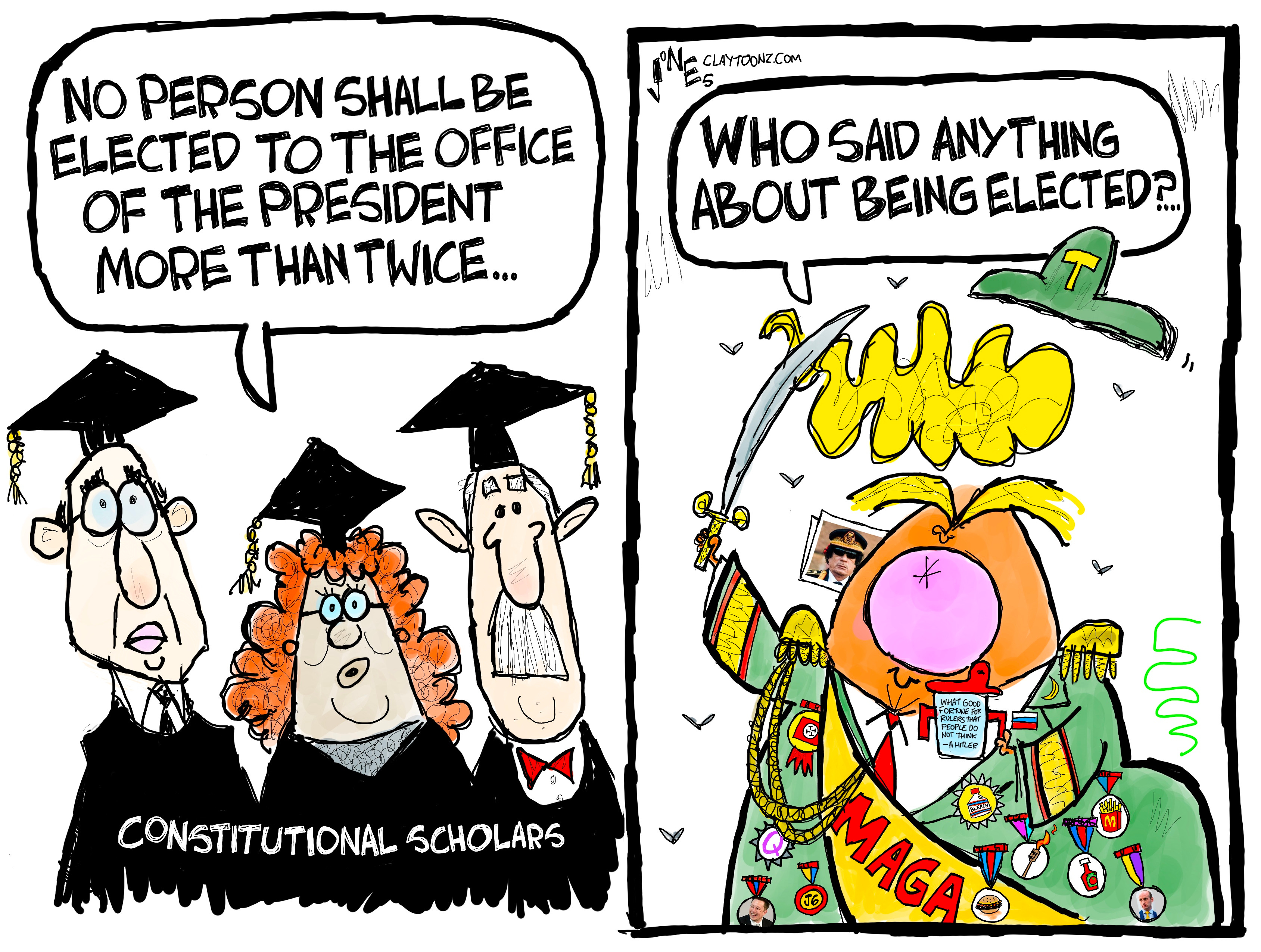
“This is like the Nigerian Prince on crack.”

Phishing With Elon by Clay Jones

Worse than a Nigerian prince Read on Substack

In addition to mocking people, challenging authority, and making people laugh while making others soil themselves in anger, political cartoons can be a public service. Today’s cartoon is a good example of that because every American needs to know about this shit. when I sent this cartoon to proofer Laura, she told me she was hoping I’d cover this today because it hasn’t been covered enough. Some of you, dear readers, have also posted in the comments about this issue. So, let me begin.

Elon Musk has been granted access to the Treasury Department’s payment system. What does this mean? It means Elon and his people have access to the financial information for everyone who receives payments from the federal government, including Elon’s competitors for government contracts…and even those who receive tax refunds.

This means Elon has your social security number, your date of birth, your address, your income, and if you do direct deposit with the government, he has your banking information. Elon might have your bank account and routing numbers. If you’re not pissed off yet, Elon even has access to your Social Security and Medicare accounts.

This is like the Nigerian Prince on crack.

Perhaps the only person safe from this is that survivalist living “off the grid” with a YouTube channel my little sister cites for anti-vaccine information.

David Lebryk, a top Treasury official and a non-political civil servant was put on leave and then suddenly retired on Friday after a standoff with Musk and his lieutenants. Treasury Secretary, Scott Bessent, gave Elon and his goons the keys to the car.

Elon is pretending he needs this access to monitor and stop government spending he deems unnecessary or corrupt. But again, Elon can’t approve or cancel government spending because he does NOT have that authority. Even Trump doesn’t have that authority.

Elmo attacked the Treasury Department Saturday, criticizing the department for not rejecting more payments as fraudulent or improper. Except, how does he know the payments are fraudulent or improper? Before last Saturday, Elmo didn’t even know what payments the government was making. Has he read every single contract the government has or just the billion-dollar contracts he has with the government?

Do you remember when the goons were outraged with the idea President Barack Obama was born in Kenya? Do you remember when the goons were upset over unelected bureaucrats?

The Department of Government Efficiency (DOGE) is NOT a government department, but a team within the Trump administration (sic). Some members of DOGE have been made employees of the Treasury Department which is very odd since Trump demanded a hiring freeze. Somehow, these new Treasury employees have all passed speedy background checks which I’m sure aren’t suspicious at all.

Other DOGE teams have begun demanding access to data and systems at other federal agencies.

One of the people affiliated with DOGE who now has access to the payment system is Tom Krause, the chief executive of a Silicon Valley company, Cloud Software Group, and is worth over $83 billion. He’s only “affiliated,” and not officially a part of DOGE. Trump is allowing billionaires to rifle through the Treasury. Has Tom Krause passed a background check?

Guess what! Surprise, surprise, Cloud Software Group, much like Elon’s companies, has contracts with the federal government. I didn’t read that in any stories about this issue, I traced it. Krause was the individual who pushed for access and was first resisted by Lebryk until his hasty retirement.

This is like the bank robbers demanding the code to the safe and the manager giving it to them while making them a cake.

Elon having anything to do with the government is a conflict of interest. Even the name, DOGE, is a conflict of interest and a violation of the Emoluments Clause. This shouldn’t be allowed.

The best information I can find for accountability for DOGE is that there are about 20 employees and its office is next to the White House in the Eisenhower Executive Office Building. What I can’t find but I’m sure will turn up throughout the Executive Grift, is how much DOGE is costing us.

Elon has talked about cutting $2 trillion from government spending, but it’s always always always always Republicans who do the most spending. I get to mention Dwight Eisenhower twice in this blog because he’s the last Republican president to leave a surplus. Now, here’s Elon to help Trump trim $2 trillion when it was Trump who increased our debt by over $7 trillion.

Ike sent that budget to Congress on January 25, 1960. A Republican president hasn’t sent a balanced budget to Congress since Running Bear by Johnny Preston was the number one song. See the shit I research for you? Also, Running Bear was the kind of shit we were forced to listen to before The Beatles (Elvis was in the Army and then he started a decade of those movies).

Bessent was confirmed just last week, but did he mention handing the government’s payment system over to Elon during his confirmation hearing? Since Trump didn’t mention it on the campaign trail, probably not.

Senator Ron Wyden, the top Democrat on the Finance Committee said, “I can think of no good reason why political operators who have demonstrated a blatant disregard for the law would need access to these sensitive, mission-critical systems.”

I get texts and emails from scammers all the time, but I’m pretty good at spotting them, just like I’m good at spotting fake news. Some of those scams claim a package from USPS can’t be delivered, so click this link. Another will claim my Netflix payment didn’t go through, so click this link. There’s a new one claiming you have unpaid tolls, so guess what they want you to do…click this link. Then there are those gorgeous women on Facebook leaving comments on your posts telling you that you seem like an interesting person, but their friend requests won’t go through, so please send one to them. Last year, someone sent me a check for over $6,000 for me to draw them something (that one had flies on it). But all of them can only wish to be as good of a phishing scammer as Elon.

If you’re not pissed off yet, then there’s something wrong with you.

Now, someone tell Donald Trump that Elon also has access to all his financial information too.

Creative note: This blog was written at Wegmans. I found a nice quiet spot in the corner of the dining area upstairs. The location is almost hidden. I got about two paragraphs of this blog written when a lady sat one table over from me with her pink computer and started blasting videos. It was like being the only person in a movie theater and a creeper comes in and sits next to you. Actually, I think that’s how my parents met. Dad was a creeper.

Drawn in 30 seconds: (snip-go see)

Because Of Interest In Nancy Beiman,

here is this from her Substack. Enjoy!

Interview by Charles Brubaker by Nancy Beiman

This interview appeared in a small zine, and it’s appearing here as well. Check out Charles Brubaker’s LAUREN IPSUM on this site! He does everything on paper! Read on Substack

INTERVIEW WITH NANCY BEIMAN SEPTEMBER 1, 2023

By Charles Brubaker

Nancy Beiman is best known for her decades-long work in animation, having animated for Warner Bros., Disney, Bill Melendez Productions, among others. However, on December 2022, at the age of 65, she ventured into a world of cartooning she hasn’t tried yet: a comic strip. The result was FurBabies, which made its debut on GoComics.com on June 5, 2023. The strip features Kate Buffet (pronounced boo-fay), an imaginative 9-year-old girl who can talk to her pets, dogs Stella and Shawm and their puppy Sirius, and Floof the kitten.

I interviewed Nancy about the comic via email. The following interview took place between August 12 to 16, 2023, and has been lightly edited for clarity.

What were your earliest cartooning influences?

My influences in animation were Chuck Jones, Charles M. Schulz, Robert Osborn, and Walt Kelly. I loved Zoltan Grgic’s work for the Zagreb animation studio. I was very fond of the UPA style but at the time did not know any of the artists’ names.

I met two of my influences and worked for one of them.

Speaking of Schulz, I remember you discussing your work on It’s the Girl in the Red Truck, Charlie Brown (1988) and how you animated Spike for it. What was your most memorable experience on that special?

Just working on a pantomime character was a liberating experience. I asked Bill Melendez who was the lead animator on Spike, and he said “You are. He’s never been animated before!” I loved using my knowledge of silent film comedy to block action on Spike. He walked like Chaplin (with those big feet) and did deadpan comedy like Keaton. He was a lot of fun to animate. That film is the most obscure of the Peanuts specials and should not be. It combined live action and animation (with the animated characters considered a ‘normal’ part of the live action world) two years before Who Framed Roger Rabbit. But CBS didn’t see any opportunity to sell toys, and it was not associated with any holiday, so they did not broadcast it until after Roger Rabbit was a hit. The Girl in the Red Truck was there first.

While you were getting started in animation did you think of doing comics? Were you published anywhere during your early days in the field?

I never considered doing comics at any time before December, 2022.

So FurBabies really is your first in the world of comics? What was the development process like? Which characters were created first?

I first got the idea for a comic strip about a kid who can talk to her pets as family members (rather than pets) in mid-December 2022. I drew up some sketches on December 24 and got Stella, Sirius, and Shawm immediately. They have changed very little since then. Kate has changed a lot. Here are the first sketches of her.

“Catt” drawn on December 24, 2022.

Floof is adapted from a cat design that I made for an unfinished film, Old Tricks. I used only the head and redesigned a kitten body. Floof has changed a bit since then. The head was that of an adult cat; she became more kittenish and cute after I drew about 10 strips. I had to go back and redraw some early Floofs when the strip was picked up by Andrews McMeel/GoComics. Kate was the hardest to create, and she was originally named Catt. She is inspired by Pippi Longstocking and a few students I have known (and they don’t know.) I had the character lineup, with Kate as Catt, on December 23, and changed her name to Katt, then Kate, on December 29. That’s when the characters were copyrighted.

original lineup, December 29, 2022

Fuzz the Cat from OLD TRICKS © 2016 Nancy Beiman

Lynn Johnston saw the lineup on the 29th and instructed me to write 24 short story outlines, one sentence or so each, with dialogue. I got them done on New Year’s Eve. “You’ve got something. Can you keep this up?” Lynn asked me. I answered “Yes”. “Then draw 24 comics and let me know when they are done.” The first FurBabies comic strip, which is actually the first one on the GoComics site, was drawn on January 4, 2023. I used a 1926 Esterbrook “Radio” 914 pen nib once owned by Charles M. Schulz, on hot pressed Bristol board. It’s a gorgeous nib, but it is difficult to use a dip pen when you have inquisitive cats in a small apartment/studio. All subsequent strips were inked with a Pentel brush pen. All character art and backgrounds are drawn on paper, then scanned.

While we’re on art tools used in the comic, how big do you draw the strips? How do you color the comics?

I don’t draw ‘the strips’. I do rough scribbly thumbnail layouts for them, the most detailed are done for the Sundays. Each Sunday strip has a different layout. The characters and backgrounds are inked on paper, all of them separately. I use old animation paper or Italian hot press paper and draw a light rough, then ink with a Pentel brush pen. Characters can fill the entire page or be smaller, depending on the complexity of the drawing. I’ll do a drawing over if I don’t like the first one, and sometimes modify the scan in Photoshop. The backgrounds are often reused. I save each image as a 300dpi .bmp file and composite them on digital templates for 2, 3, or 4 panel strips. The digital dailies are 17 inches wide. Sundays are 24 inches wide. The finals are saved as TIFF files at GoComics’ recommended size…which means they are half to 2/3 of the size of the PDF files I work on. Only the first strip (June 5) was drawn with characters and backgrounds all on paper, like a traditional comic…I work much faster using animation methods. I use whatever works, the technology is not important.

Coloring is done in Photoshop using brushes that mimic pastel and watercolor wash. I work on top of the black line to continue the illusion that it was ‘painted’ on paper. Even the borders of the strip are ‘fuzzy’ and characters sometimes break through the panels. Sunday strips are designed to be graphically pleasing and planned on paper but still done piecemeal, animation style.

Sunday strip, December 10, 2023.

The writing method Lynn Johnson suggested, with 24 one-sentence outlines, is an interesting technique for plotting out comic strips. What’s your overall writing method like once you got your strip off the ground?

I continue to follow Lynn’s method. It’s not a one sentence log line: dialogue and location, sometimes action, is always included. I often change things when I actually draw the characters since I still think in visual story, like an animator. Lynn’s method is the best way to keep a comic on track. It shows you where you are going and what characters can do. You can change the script order before you draw the strips.

Like animation dialogue, scripts and action for the comic are often changed when I get down to the drawing. Short scripts are the best way to get a series going, to plan when new characters are introduced, and develop characters. Lynn also suggested that I use a monthly planner (a book with the entire month on one page) to plan and time the storylines. That was a lifesaver. Several storylines have been moved since I started drawing the strip in January and wintry themes were out of place in June.

You recently introduced Pratt-L, an AI chatbot Kate uses to cheat on her homework. Do you have concerns about the use of AI in creative fields? What was on your mind when you wrote the arc?

I tried out AI’s writing and art programs when they were available for free trial and found them completely incompetent. Pratt-L combines the worst features of both. It is the perfect villain for this strip since the main conflict is between organic lifeforms and technology. This conflict developed as I got to know Kate better. She was the hardest one to write for.

Some modern comics have child characters that never stream videos, play video games, or use cell phones. Tauhid Bondia deliberately set Crabgrass in 1985 before these things became common and life changed for children. Kate Buffet is nine years old, lives in the 21st century, grew up in the age of smartphones, influencers, and streaming videos. Kate is not lazy or stupid but has a quirky way of thinking that does not match what is expected of her, especially in school. She has a lot of curiosity and it’s only natural that she would try the new AI technology. She has the latest digital technology. I made the rest of the apartment furnishings very dated, to show the contrast between Kate and her parents. There are some subliminal messages (family friendly ones) in the backgrounds. For example, the refrigerator is a Calder, named after the artist. Pratt-L wants to be a friend, is completely incompetent, sometimes snarky, in need of constant approval and self-pitying (depending on what it is scraping), but not a dangerous threat the way it is in real life.

There will also be an ‘influencer’ in FurBabies. It will not be human.

AI is not a matter of concern; it is literally going to be a matter of life and death. There is a bill in Parliament recommending that it be allowed to write medical prescriptions in Canada. What could possibly go wrong? People are not taking it seriously as a threat because artists and writers are the first ones affected by it, and most people do not consider art to be a ‘real job’ (My Labor Day strip addresses that issue.) I am most surprised by artists who keep insisting that it is ‘a tool’ like Photoshop. There is a difference. Photoshop allows you to personally modify artwork and photos. I use my own photos for backgrounds, and I sometimes use pictures from the Web for dogs and cats, but always redraw and redesign what I see. Photoshop does not use a bot to ‘scrape’ material from a million other artists and then ‘create’ art which you claim as your own.

My biggest surprise is that some artists think that it is fun to play with it. I think that they are like rabbits admiring the scales on the snake that is about to kill them.

A cartoon of a computer and a cat  Description automatically generated

Pratt-L’s quotes are from an actual ‘robot press conference’ held in Zurich a few days before this strip was published.

There’s a strong “family” theme in your comic, with how Kate views her pets to Sirius and Floof referring to Stella and Shawn as their mom and dad. Will this dynamic be explored more further as the strip continues?

The animals are definitely a family. The Dog Family has accepted Floof as one of their members. Kate is a link between the Dog Family and the Human family; she can speak to both, but only one of them understands her. She knows that she really is not a Dog or a Cat. It’s an interesting dynamic, and since the characters generally ‘tell’ me what they will and will not do, I am not sure if Kate’s situation will change. I also don’t think the human parents will appear, except as offscreen character voices. It’s not that they don’t interact with Kate…I just don’t find them interesting enough to include in the strip. It’s told very much from the animals’ point of view unless Kate is in school without them.

June 5, 2024. The Dog Family.

Early in the run most of the strip focuses on Kate and her pets, although newer strips start to include more characters, like in the recent Scavenger Hunt story arc. In addition to Kate’s classmates you also had her interact with Little Fingers the raccoon. Will we see more of Kate interacting with other kids in her class, and more of Little Fingers and other animals Kate can talk to?

Optima “Poppy” Populare and Iris, the two girls on the scavenger hunt, are not interesting enough to do much more than snark. “Poppy” returns in school and in some Halloween strips. There will probably be a few more kids appearing later on, with their own pets, probably in the dog park or maybe in the apartment building. Little Fingers the raccoon returns in November, but he’s a wild raccoon. He won’t ever interact with the other animals.

You indicated in your newsletter that you have a backlog for your comic. How far ahead are you currently?

I am currently working on strips that will air in October. I am proud to say that not one of them involves a pumpkin! (Charles M. Schulz covered that territory very well.) I like to stay about two weeks ahead of deadlines, and originally was two months ahead due to the late start in 2023! That gave me the option of shifting the cartoons, or changing them, as I got to know the characters better. I can also take a week off without worrying about comics not appearing.

Since FurBabies is still a very new comic and I am still redefining myself as a comic strip creator, I moved story lines or reworked some existing strips after I had enough comics that showed the characters’ developing personalities. Some people who have seen months of the strips in continuity tell me that they read better ‘as a whole’ but that is not the way comics work; it’s taken one day at a time. FurBabies is not a ‘gag’ strip, it’s character driven, so there were a lot of changes. Some of the cartoons that ran in June were originally drawn for September.

Things are settling down now. Some readers are adjusting to the fact that Kate is not a ‘perfect’ little girl, she sometimes tries to cheat on homework with AI (and gives up), or that she can be a distraction in class. I finally figured out who she was when she took her burned cookies and sold them as dog biscuits. Kate makes plenty of mistakes, but she has a creative way of dealing with them.

Read FurBabies at www.gocomics.com/furbabies/

Subscribe to the FurBabies newsletter at nancybeiman.substack.com

ReadCharlesBrubaker’sLAURENIPSUMcomicat

http://lauren.smallbugstudio.com/

Award-Winning Doc ‘Sally!’ Introduces Sally Gearhart, the Lesbian Activist Who Took on Proposition 6 With Harvey Milk

PUBLISHED 2/3/2025 by Michele Meek

Historic lesbian activist Sally Gearhart is featured in Deborah Craig’s new award-winning documentary Sally!

Most people have heard of Harvey Milk. Sally Gearhart—not as much. But in fact, Gearhart sat right beside Milk as his debate partner in 1978 when they disputed—and ultimately defeated—Proposition 6, the Briggs Initiative that would have banned lesbian and gay teachers and topics in California’s public schools. When their opponents quoted the Bible, Milk was at a loss. Gearhart, on the other hand, could quote it right back at them. Born in 1931 into a Christian household in Virginia, Gearhart charted her own unconventional path from a career as a teacher at Christian colleges in Texas until she determined …

Read More Here:  https://msmagazine.com/2025/02/03/sally-gearhart-documentary-deborah-craig/