
Category: Liberal / Progressive / Democrat
So, Everybody Who’s Got An Opportunity To Vote Today,
has voted, or has a solid plan to VoTe, yes? If not, get your AweSome Self out to vote, ASAP. Use It Or Lose It!!!
No Foolin’-Sen. Booker’s Doin’ Something With Substance!
(Plus more Dem Senators pitchin’ in! Go see-video below)
Cory Booker Holding Senate Floor All Night Long (All Night), All Night Long (All Night) by Rebecca Schoenkopf
Washington Post takes pains to tell us it’s not REALLY a filibuster. Read on Substack
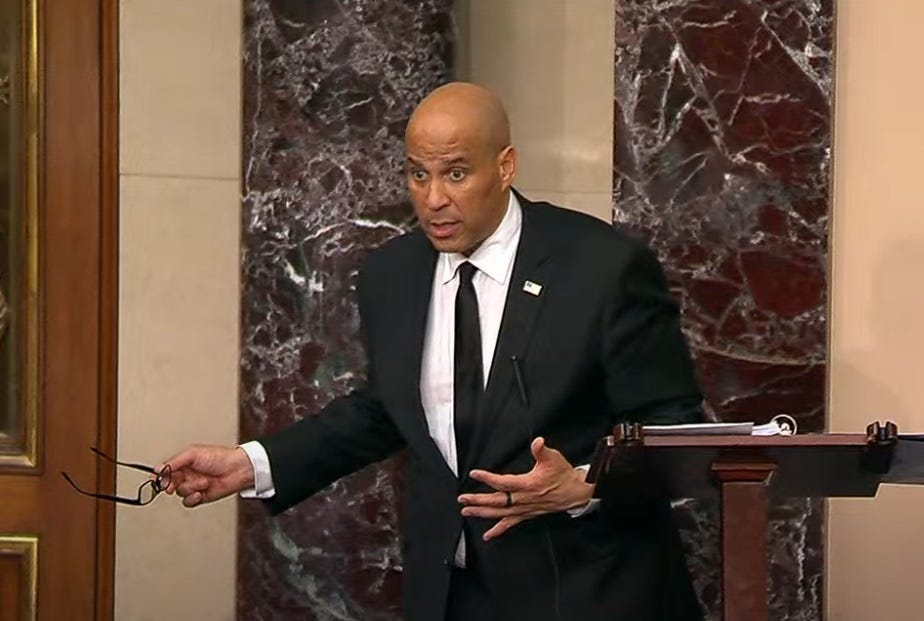
Since 7 p.m. Eastern yesterday, Sen. Cory Booker (D-New Jersey) has held the Senate floor, speaking out against what Donald Trump and his evil coconspirators are doing to America. He was still going when we started this piece at 8:30 this morning, and we expect he’ll still be going when we click “Publish.”
Booker began the all-night speech by making his intentions clear:
“I rise with the intention of disrupting the normal business of the United States Senate for as long as I am physically able. I rise tonight because I believe sincerely that our country is in crisis.
“In just 71 days, the president of the United States has inflicted so much harm on Americans’ safety; financial stability; the core foundations of our democracy. These are not normal times in America. And they should not be treated as such in the United States Senate.”
While we were writing this piece, Booker was every bit as impassioned as he condemned the Republican budget plan that would slash Medicaid and the social safety net so billionaires and corporations could have (more) huge tax cuts, adding trillions to the US debt, asking, “If you’re a Christian conservative, how can you hurt the weak to benefit the rich and powerful? The people of the United States have to stand up and say ‘NO!’”
This man does not look like he’s been speaking for more than 14 hours. Here’s the AP’s live feed. Watching this, we’re even feeling some hope — especially if other senators follow up with marathon speeches of their own.
(And it’s still running! -A)
Also too, we’re going to go ahead and call this a filibuster anyway, if only because the Washington Post went out of its way to explain in its subhead (archive link) that it’s not actually a filibuster because Booker isn’t delaying a vote on legislation. Just seems like the sort of nitpick best saved for the body of the article, which is where all the other outlets have placed it. So why did we mention it in our subhed? Because fuck WaPo is why.
Booker received help throughout the night — and still, this morning — from other senators, because he is allowed to take questions, which tend to come in the form of brief speeches ending with a question mark. But it’s not just a tactic to help him preserve his voice; it’s also a chance for fellow Democrats to show their unity, with multiple voices pointing out how completely not normal the last two months have been. Booker and other senators called out Trump and co-president Elon Musk for multiple assaults on democracy, like their attempts to shut down federal agencies created by Congress, to cancel spending authorized by Congress, to withhold grants to nonprofits that were already awarded, to fire large segments of the federal workforce without regard to worker protections, and to effectively dissolve America’s alliances by siding with Russia against Ukraine and our European allies. And much more.
We should also note that, unlike the longest talking filibuster on record, old racist Dixiecrat Strom Thurmond’s 25-hour filibuster of the 1957 Civil Rights bill, Mr. Booker doesn’t have the opportunity to take restroom breaks. Now that’s impressive.
During the speech, Booker repeatedly reminded Republicans — for any good it might do — that many of them saw who Donald Trump was, and why he was no good for America. He spoke with genuine affection about John McCain, who had the courage to shut down Trump’s attempt to end Obamacare:
“Senator McCain, I know you wouldn’t sanction this, I know you would be screaming, I’ve seen how angry you can get, John McCain. I’ve seen you tear people apart on this floor, Democrat and Republican, for doing the same stupid thing over and over again. Listen to John McCain explain why he voted ‘no’ the last time the Republican Party tried to unite and tear down health care with no idea how to fix it, threatening to put millions of Americans in financial crisis and health care crisis. I can’t believe we are here again.”
Booker returned again and again to that theme: Why on earth are we allowing this madness to happen? How on earth are we in a situation where a US president is threatening to invade our allies and help our adversaries?
As we wrap up here, Booker’s voice is beginning to get a little raspy, but his overall energy isn’t flagging so far. At the moment, he’s having a colloquy with Sen. Chris Coons (D-Delaware) about the importance of US foreign assistance, which Trump and musk have unconstitutionally slashed. Coons called attention to how those cuts have left us unable to provide help to the victims of the earthquake in Myanmar — and Booker immediately pointed out that by wrecking America’s soft power, Trump has handed all that influence to China.
We hope Booker keeps going a couple more hours. And that as many of his Democratic colleagues follow his example with filibusters of their own. (snip)
Good Commentary Here
This was linked in a substack I was reading, I found it worthy of sharing, and also of the author getting the clicks on their own page.
(Also Not April Fools. I’m gettin’ to it! Probably.)
It’s Time for a Republican Sickout
If you can’t find the strength to take a stand, at least lie down.
Hello, Congressional Republicans who still care about the republic! I know you’re out there because I kept hearing how differently Trump’s cabinet confirmations would have gone if only the votes have been secret.
We have reached a crisis point. We have reached so many crisis points. We reached like three new crisis points between me starting and finishing this article.
We have flipped our foreign policy so radically that we are now the villain of the world. All decision on that end seems to have been handed over to Putin and a bunch of preening technofascists. Our economy is crashing toward a depression and the only trick the Trump Administration pony has is more insane tariffs. High-level cabinet members endangered the lives of our servicemembers by discussing classified information on the already-hacked Signal app, and that doesn’t even cover gloating over civilian deaths, adding a journalist to the group text, and further damaging our relationship with Europe. The Trump administration is trying to start wars with freaking Denmark and Canada. DENMARK AND CANADA, for chrissakes.
And the most insane thing is that this is an abridged list. There are paragraphs and paragraphs of human rights horrors that I have skipped.
This is it. You are a part of an authoritarian government, a twisted and vile parody of what we once had. Elon Musk is stripping it for parts and awarding himself lucrative contracts while Donald Trump threatens Republican judges and lobs all of our state secrets straight to Putin.
The window for stopping this is small and vanishing. The most patriotic thing you could do is stand up and impeach Donald Trump, but, whether it’s due to a fear of Trump or fear of his zealots, you’re not doing that. The second most patriotic thing you could do is resign and leave your seat open to a flip by the Democrats. But you don’t seem to be doing that either. So here it is: The third most patriotic thing you can do, your last option for saving your beloved country from falling completely into authoritarianism: Get sick.
Get terribly sick and refuse to discuss your personal health information during this challenging time. Or get just a little bit sick and keep insisting that you’ll be as right as rain in a week or two. Have a family emergency. Or just take some dearly needed personal time.
Just drop out for a while. Hole up at home or get out of the country if you need to and let some trusted Democrats know that they’ll have the majority for a while and the time and leeway to move. (BE SURE YOU KNOW WHO IS ON THE SIGNAL CHAT.)
But what if someone is blackmailing me?
No offense, but this is bigger than you. Putin wants to break the United States. And he wants to break the United States so that he can roll over Western Europe. Do you really want to go to your grave knowing that you held onto your secret at the expense of Permanent Global Fascism? For that matter, do you really think complying now will stop them from burning you with it when you become inconvenient later?
Let’s be honest: A lot of us are already kind of assuming that you’re being blackmailed. And the fact that you’ve abandonedyour principles when the stakes are so high is making people think that the thing you’re being blackmailed over is much worse than what it probably really is. If Matt Gaetz can brazen it out, what on earth must you be hiding?
The good news is that there is nothing better for blowing your blackmail material straight out of the news cycle than a fiery Presidential impeachment that the nation can’t stop watching. There’s no better time to get out from under someone’s thumb.
But if the Democrats are smart, they’ll remove Johnson and prosecute Vance for the Signal debacle. That means a Democratic President will be in. I’ll lose some of my own power. What about that?
More real talk: Donald Trump has screwed the Republican party’s chances for decades at a minimum. You are now the party that let the Nazis in. You are the party that closed the national parks and tried to put Grandma out on the street. You are the party that kneecapped scientific research right when it looked like there might be a cure for pancreatic cancer. You are the party that crashed the stock market, the party that made us hated by the world, the party that let Musk and Putin take the reins. You are the party that just came out as pro-measles and made room for polio. The Republican Party is going the way of the Know-Nothings. You’re going to have to scrap it and start over.
And that’s if we ever have real elections again.
The only hope of you, personally, ever coming back into power is if Trump gets impeached and you become a zealous reformer. Toss out everyone who helped Trump, Musk, Thiel and Putin, support real jail time, and legislate us back out of Citizens United. Throw the bastards out and keep on throwing or you are surely getting tossed out yourself.
You can start right now, of course. That would be ideal. But you can also start after you take a little break to let the Democrats get the ball rolling.
Can’t I just keep my head down and appease Trump until things are magically better?
No. If you have read this far instead of screaming about George Soros and fake Venezuelan gang members, you are a Republican who thoughtcrimes against Trump. He and his barrel of vipers who the nonbelievers are. You won’t make it.
Fascists always need a villain to rail against. They always have a list. It is not a question of whether you are on the list, it’s a question of how far down you are. Right now, it’s foreign students and random brown people with innocent tattoos, but Trump is going to crave new meat and fresh news stories soon. You know that he needs to ritually humiliate and cast out a Republican every so often to reassert his dominance. You’re higher up the list than you think.
And if we hit the era of No Real Elections, which is more likely every day, there is no way you are keeping your elected position. Only perfect toadying cult members will make it through, and there is no way you can tap dance fast enough to make up for the past.
Besides: Is “enthusiastic supporter of the fascist regime” the way you want your grandchildren to remember you?
If you aren’t moved by the idea of saving the democratic republic we’ve all grown fond of, think about the fact that your only path to staying in your elected office is to get Trump out of his, and your chance to do that is slipping away.
It’s time to come down with a severe but undefined and conveniently curable medical issue. Play hooky. Go AWOL. Bunk out. Chuck a sickie. But do it quickly.
If you can’t bring yourself to impeach Donald Trump, you need to get the hell out of the way so someone else can. (snip)
Rep. Crockett at Work For We The People
(There are others; it’s a thing to look at. But Republicans have actually made a Democrat-a black, woman elected Democratic US House Member-the news of the weekend. No wonder Wednesday has to be a big news day for Trump!) (Also, blue language within!)
Why Are White MAGA Weenuses So Scared Of Jasmine Crockett? Here’s Why. by Evan Hurst
Bless their mediocre little hearts. Read on Substack
And now we’ll talk about Jasmine Crockett.

This week, let’s talk about one of the heroes of the anti-Trump opposition, one of the leaders who’s actually showing up and showing people how it’s done, and terrifying the fuck out of Donald Trump and his white MAGA Nazi fascists in the process.
I’m of course talking about Jasmine Crockett, Democratic congresswoman from Texas, specifically Dallas. Have you noticed she’s the subject of right-wing manufactured outrage every week now, for some new terribly egregious offense she has committed against their delicate sensibilities?
We wonder why they don’t like her. Trying to put our finger on it.
Is it because she’s a powerful, brilliant Black woman who isn’t remotely intimidated by these white racist fascist MAGA motherfuckers, who also happens to be smarter than each and every one of them?
Well, yes, but it’s even more than that!
Why are they so mad at Jasmine Crockett?
This week, Attorney General Nazi Barbie Pam Bondi has been all over the TV, with all the gravitas of Michele in Romy & Michele’s High School Reunion declaring that she invented Post-Its, that Crockett better “tread very carefully” with calling for peaceful protests against Elon Musk and Tesla. OR ELSE.
Bondi has claimed that people are using “weapons of mass destruction” against Teslas, and she is just pretty sure that Jasmine Crockett is a prime instigator of all this #TeslaTakedown business. “You have this Congresswoman Crockett who is calling for attacks on Elon Musk on her birthday. ‘Let’s take him out on my birthday,’ she says. Yet she turns and says ‘Oh, I’m not calling for violence,’” she complained to serious journalist Maria Bartiromo on the Fox Business Network, where business is discussed. “Well she is an elected public official, and so she needs to tread very carefully because nothing will happen to Elon Musk, and we’re going to fight to protect all of the Tesla owners throughout this country.”
Okeydoke. Has Crockett been calling for violence against Musk, or Tesla dealerships? Of course not. Would she be mad if we laughed at a Cybertruck driving by and made jokes amongst ourselves about what a loser probably is driving it? Probably not. But no violence.
Also, any idiot knows, or can figure out — maybe even Pam Bondi! — that the Tesla protests are called #TeslaTakedown and that they’re entirely peaceful. You either have to be extremely stupid or a lying scumbag — or both, like maybe even Pam Bondi! — to believe differently.
As my former Wonkette colleague Liz Dye details ably at the Public Notice newsletter this week, Bartiromo was just one stop on Bondi’s tour of ridiculous media appearances this week trying to scare Crockett. She was on “Hannity” this week, bellyaching that Crockett must “apologize immediately, not only to all Texans, but to our country, to the American shareholders of Tesla, because she is promoting violence.” (Apparently some shit happened at a Tesla dealership in Austin. It had nothing to do with Jasmine Crockett.)
At the end of the “Hannity” clip, Bondi also faked outrage over Crockett supposedly inciting violence against beloved senator Ted Cruz when she said that for Democrats to win races in Texas, “this dude has to be knocked over the head, like hard, right? Like there is no niceties with him. Like at all. Like you go clean off on him.” In context, any fucking moron — even Pam Bondi maybe! — could tell that she was talking in the context of political races, about being willing to punch your opponents hard.
MAGA, whose leader Donald Trump has throughout his political career incited violence against racial minorities, journalists, the US Capitol and more, can spare us the fucking whiny-ass histrionics.
Of course, as Liz Dye notes, Jasmine Crockett has said repeatedly that she’s not advocating violence, like this past weekend on MSNBC, when she told Alex Witt, “Tesla’s tanking right now, and I’m okay with that,” but added that “Just in case the slow people listening try to clip this later, I just want to say that I have never promoted violence whatsoever.” She also said maybe people who have problems with political violence shouldn’t have pardoned 1,500 MAGA terrorists for their actions to help Donald Trump overturn the 2020 election on January 6. She was just saying!
And she said more! It’s a great interview, enjoy it if you haven’t seen it: https://youtu.be/WdyO7DKGCbw
Let’s see, what else are they mad at Jasmine Crockett about? Oh just everything.
She called Texas’s Greg Abbott “Governor Hot Wheels” at the Human Rights Campaign gala. Maybe she shouldn’t have said that. She says she wasn’t talking about his disability, but rather his “planes, trains, and automobiles he used to transfer migrants into communities led by Black mayors, deliberately stoking tension and fear among the most vulnerable.” Of course, Greg Abbott is a sadistic monster, and we’re not going to spend a lot of time worrying about the feelings of people who are obsessed with hurting trans kids and filling the Rio Grande with murder buoys to slice up migrant human beings.
Of course, you know who really makes fun of disabled people?
Again, miss us with your fake outrage and your crocodile tears, MAGA.
OK, why are they REALLY so mad at Jasmine Crockett?
Because on top of being a Black woman who doesn’t respect them, and on top of being a Black woman who is smarter than them, she has their fuckin’ number, and she knows it, and they know it.
This week in an interview with The 19th, Crockett mocked the stupid, prurient Republican MAGA Nazi obsession with transgender kids playing sports, saying that according to Republicans, “That is the biggest issue that we’ve had. Since when? Since when? Find the little trans child that is ruining your life. I mean, I’m just like, what are we doing? Like, what are we doing?”
That’s one example.
Let’s talk about how Crockett explains the white Republican obsession with eliminating DEI. In a congressional hearing before the election, she said, “This election is the best example of why y’all are so afraid of [DEI] because then you can’t have a simple-minded, under-qualified white man. […] You’ve got to pay attention to the qualified Black woman that is on the other side.”
On February 3 on CNN, Crockett discussed the white supremacist in the White House and the rampant coddling of mediocre white nationalist MAGA boys: https://youtu.be/s5a3fAXHsRA
“I am tired of the white tears. Listen, if you are competent, you are not concerned. […] I had to work 10 times as hard as they did just to get into the seat. When you look and you compare me to Marjorie Taylor Greene or me to Lauren Boebert, there is no comparison. And that is the life that we have always lived.”
“So, the only people that are crying are the mediocre white boys that have been beaten out by people that historically have had to work so much harder.”
Yep, that’s why they hate her right there.
If you are competent, you are not concerned.
You see, Jasmine Crockett understands something about this white conservative MAGA obsession with DEI that MAGA buffoons and Nazis are desperate to avoid confronting. Every time you see a white Trump-supporting man babbling about bringing back “merit,” the fantasy he’s openly masturbating to is that if only all the DEI programs go away, if only affirmative action goes away, if only they can get back to “merit” and that one MLK Jr. quote they like about “not the color of your skin but the content of your character,” THEN order will be restored and white conservative Christian men will start to naturally float to the top again, where they belong.
Jasmine Crockett knows that fantasy is some fuckin’ bullshit.
She knows that DEI doesn’t put women, LGBTQ+ people and racial minorities in jobs they’re not qualified for, but rather that it makes it less likely that extremely mediocre white Christian conservative men will get positions they’re totally not cut out for, positions they have not earned, positions they’re far too stupid to fill.
Fuck, look at Pete Hegseth and Mike Waltz and the rest of the Signal-Gate dumbfucks and tell us about all the brilliant talent America’s been missing out on.
DEI is all about merit. It’s all about — for instance — making sure dumbfuck good old boy frat boys and date rapists from SEC schools who aren’t qualified to pick up Jasmine Crockett’s dry-cleaning don’t get all the high-powered jobs, when far more capable people are willing, available, and more deserving.
Jasmine Crockett knows that good DEI policies help expose the secret that white conservative men never really were impressive people in the first place. They never got where they are because they were creative or clever or had something to offer that nobody else had. They stole it, and then let themselves believe they earned it, that their talent and their bootstraps got them there.
The only people crying are the mediocre white boys.
Yep, that’s why they hate her. (snip)
The Resistance Is Real, &
we can all do something, along with blogging.
Get a load of all these stickers by Garrett Bucks
Collective action, even on the tiniest scale, is still pretty damn terrific Read on Substack
Many of you know the backstory here, but stick with me. It’s unremarkable on its face, but that’s how metaphors work.
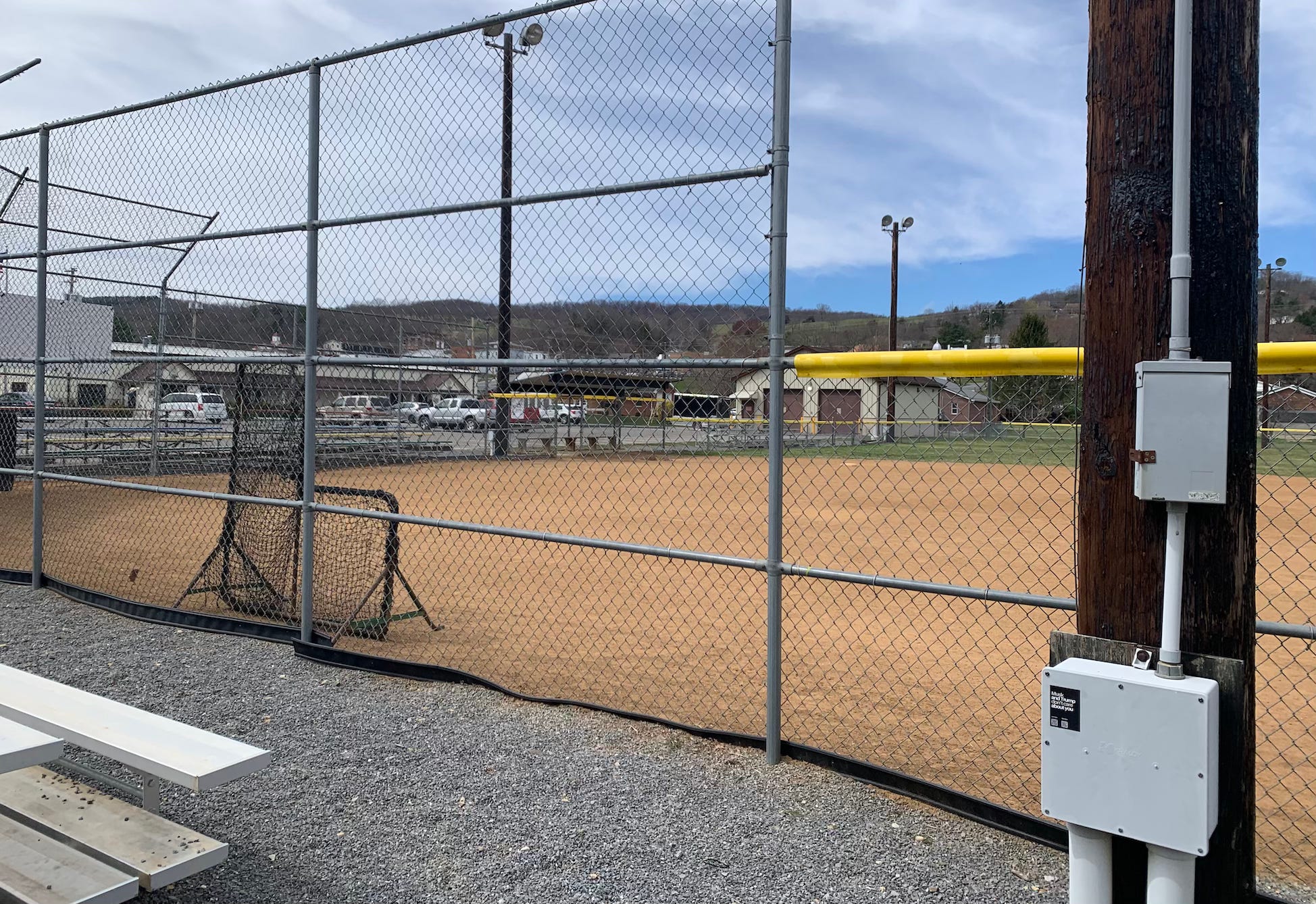
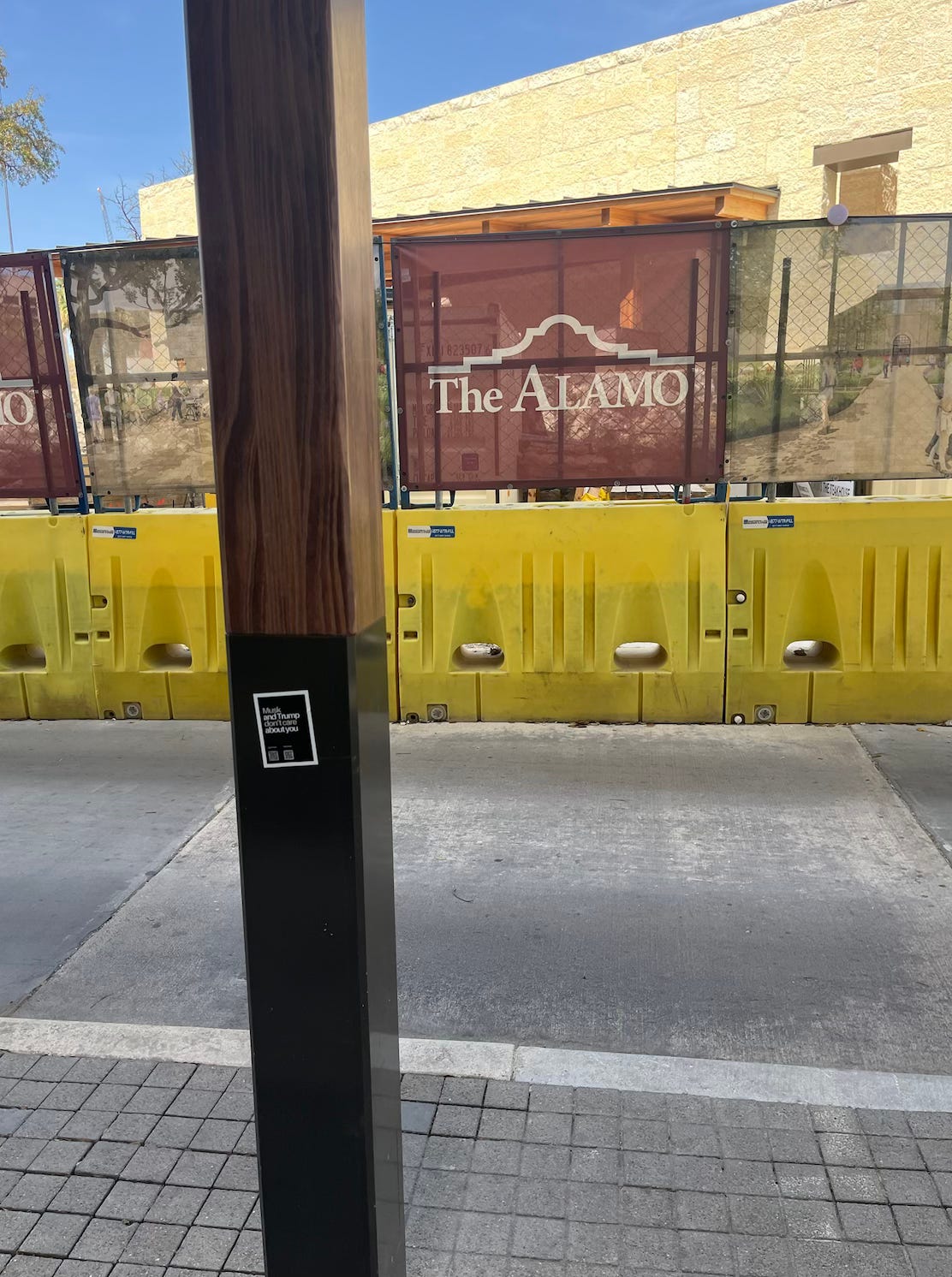
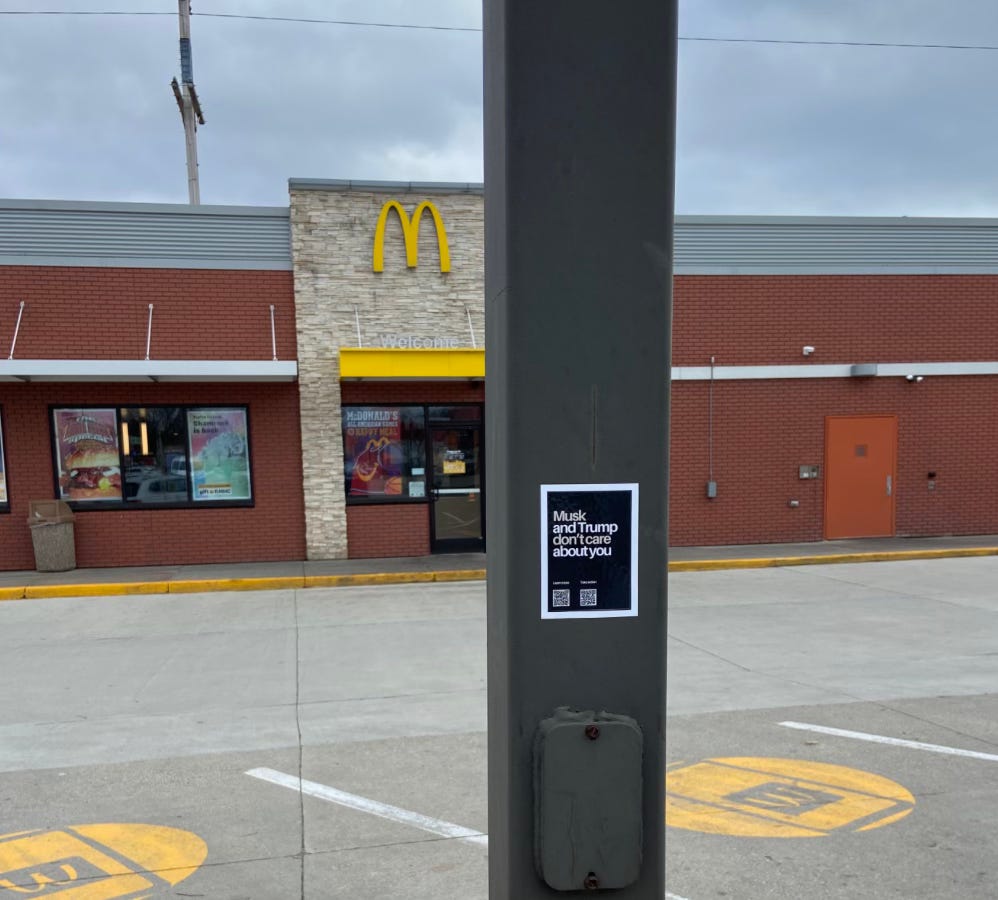
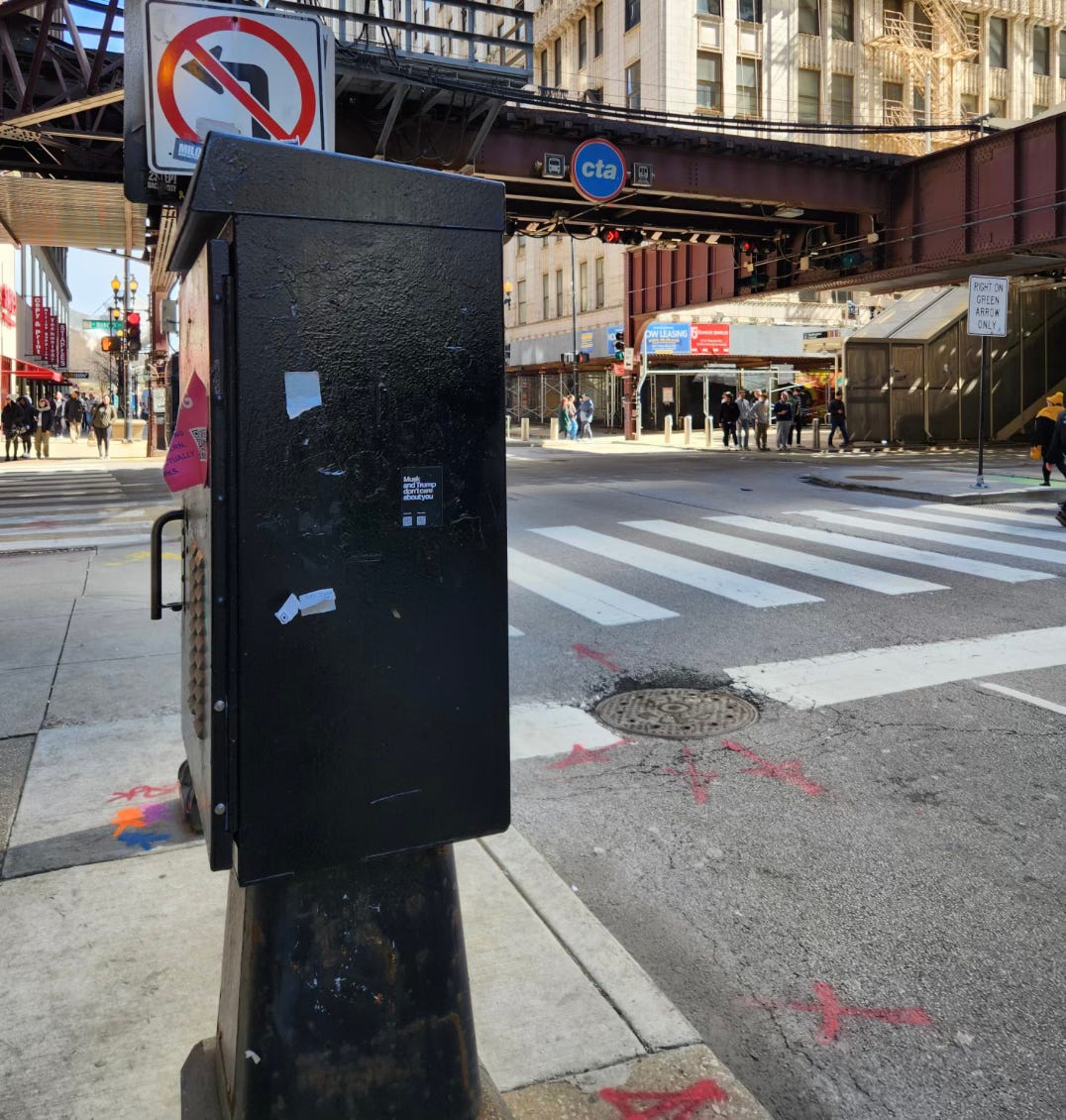
For the last couple weeks, I’ve been the joyful recipient of a steady stream of pictures. They’re all of the same sticker, one that I designed and ordered and likely should have made bigger than I did (I’ve received feedback). The sticker says “Trump and Musk don’t care about you.” There are a couple QR codes— links to learn more and take action— but not much else. It was an extremely simple project, just one of thousands that have been launched across the country since Trump was inaugurated. It will, I’m sure, not bring down a government or prevent a deportation or stop a bomb from falling.
I adore these stickers. They are tiny, on more than one level, but that’s how all impactful things start. Designing them wasn’t hard, nor was tossing off a few messages asking others if they wanted one as well. I said, in essence, “hey you all, this is a thing that I’m doing” And then, when hundreds of people across the country indicated that they would, in fact, like a sticker, they added their voice to mine. “This is a thing I can do as well,” they said, a chorus of beating hearts and frayed nerves. They shouted their reply from tiny towns and large cities, from places where they struggled to find a location that wouldn’t just preach to the choir, as well as places where Trump is worshipped like a God.
They answered, and I felt less alone in hearing their reply.
And then, because this is how trust is built, we kept our promises to one another. I sent out the stickers and they put them up and snapped a picture and then… well, we’ll see. I have no proof whatsoever if the chain will continue, if a teenager playing baseball or a mom returning her cart at Target or a trucker taking a rest break after a long day on the road will see them and be reminded that they too can do something, but if we limited our political imagination to actions whose ripples we could foresee without a shadow of the doubt, we would do so very little.
I have made a number of challenges to myself since Trump’s inauguration. I have challenged myself to counter the false faith of isolation and inhumanity with one of connection and care. I have challenged myself to remember every day how in love I am, how grateful I am, how much I believe in the beautiful counterpoints we have already shouted and the even more beautiful world we will build.
I don’t think I’ve answered any of those challenges in profound ways, but I am trying. And since I am trying, if my heart beams every time I receive another picture of a sticker out in the world, then the least I can do is to share that feeling with you as well.
Do you want to see some of the stickers? I hope so, because if they are out there, that means that we are out there, even when it feels like we aren’t, even if we convince ourselves so frequently that being out there isn’t enough, even when we don’t yet understand why or how our being out there adds up to the world we want to live in together.
So, my friends, here are a few of them…
…on top of a carrot in Sacramento.

..preparing to play ball in a West Virginia County that gave 78% of its vote to Trump in November.
…remembering the Alamo.
…as well as another complicated American icon (in Iowa).
…welcoming visitors to a farm bureau in Illinois.
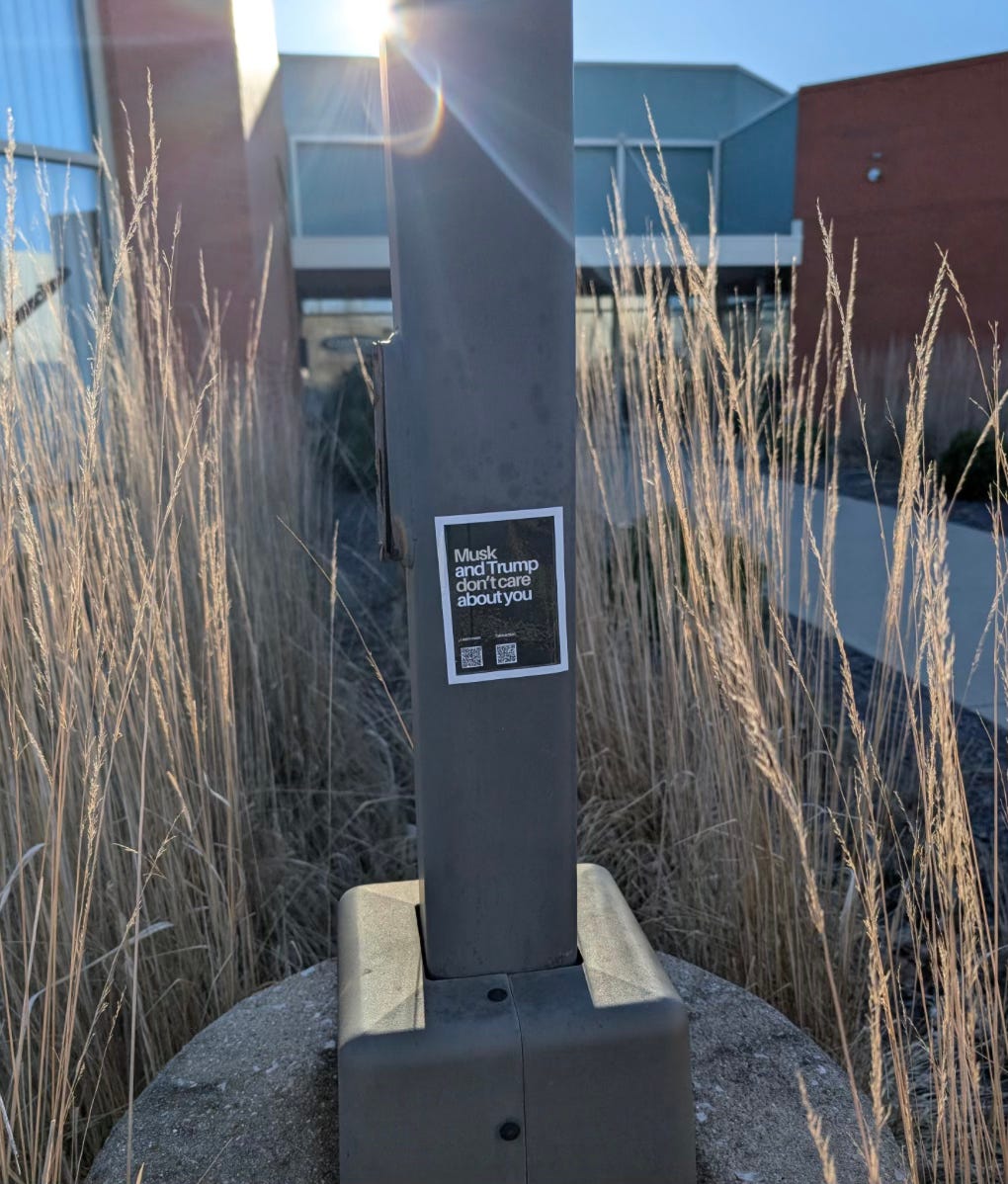
…and what I’m assured is a “surprisingly scenic” Costco parking lot in Fort Oglethorpe, Georgia.
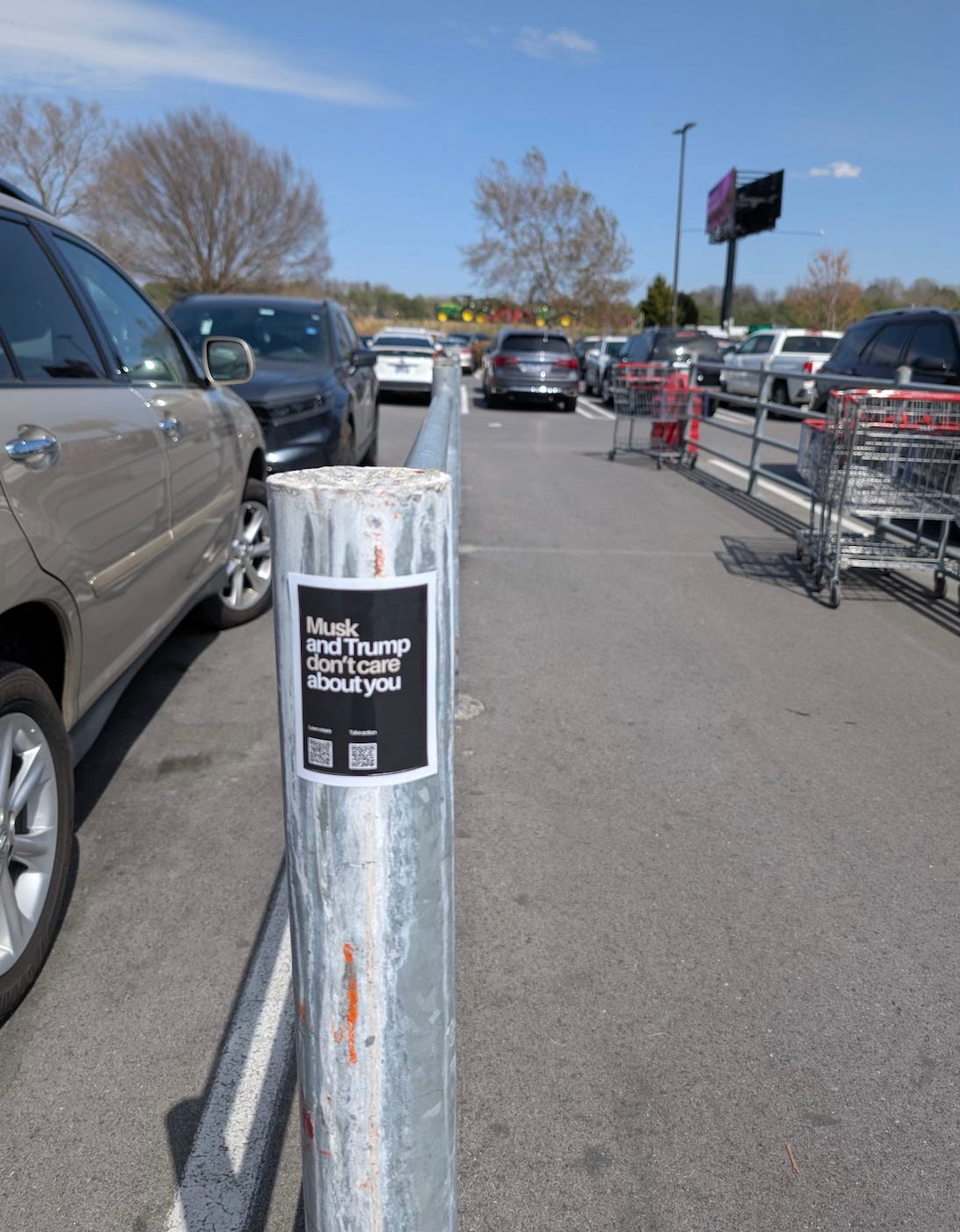
… in bathrooms (in South Carolina and Phoenix).
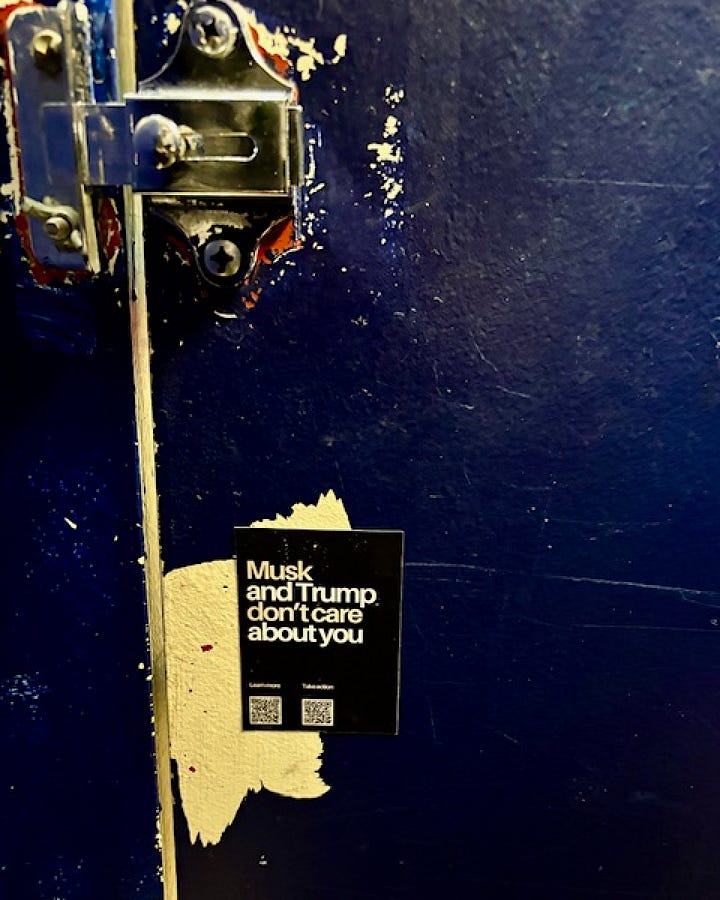
…and on signs that, if you read them the right way, also feature messages of opposition (in Des Moines, Iowa and Springfield, Illinois).
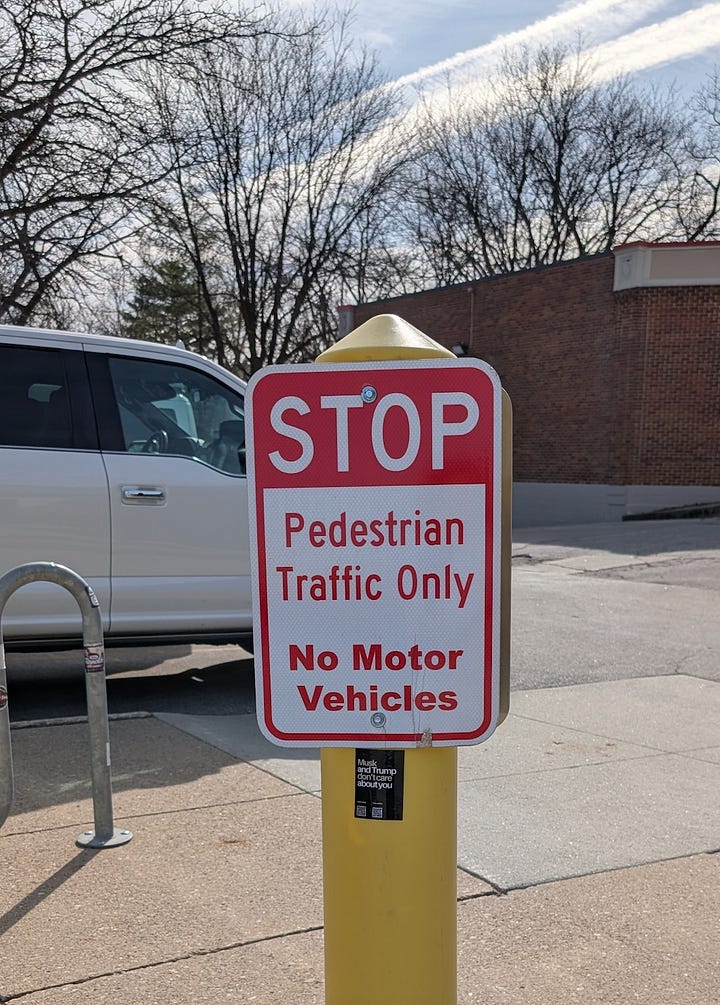
…on campus (at Cornell and the University of Tennessee).
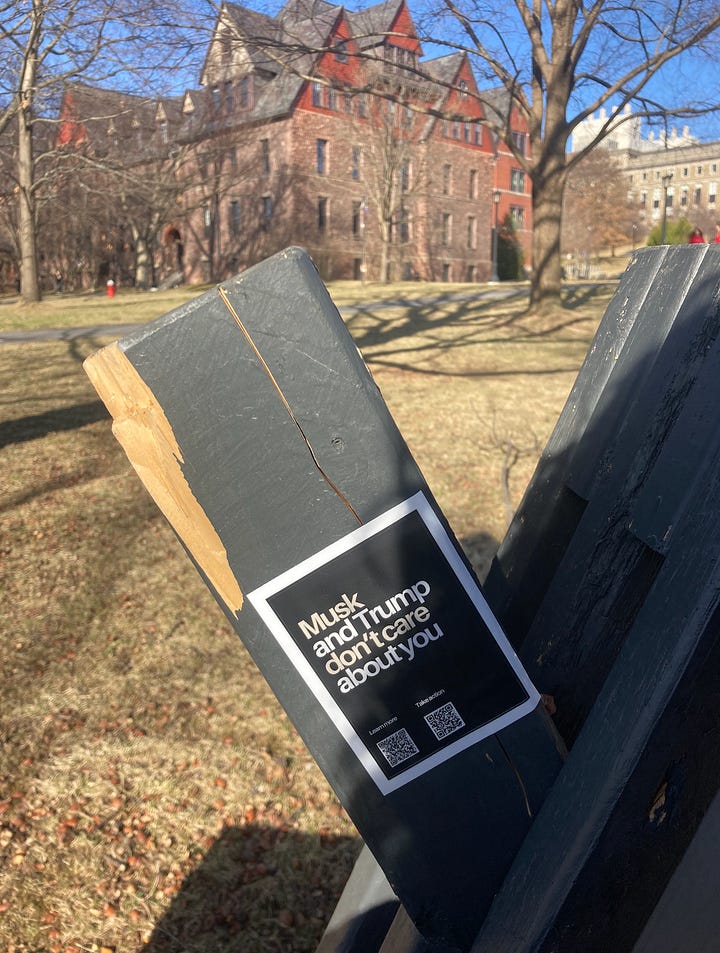
…and rivers (the Fox, in Wisconsin).

…and rails (in Chicago).
…and roads (in rural Florida).
As of this writing, there are hundreds of stickers, but millions of American places. A drop in the bucket if ever there was one. But there they are, proclaiming that we’re still here. Connected to each other. Shouting out, “I am doing something. We are doing something. We are here today and we will be here tomorrow.”
I love them, because I love us.
End notes:
- I’m letting most of the siblinghood of stickering remain blessedly anonymous, but I hope you read this lovely reflection from Lyndsey Medford (esteemed stickerer of Costco parking lots and one hell of a writer to boot).
- It isn’t just stickering, of course. I truly believe that my inbox is one of the most hope-giving spaces on the planet, because it’s full of people telling me about how damn amazing it felt going to one of those (massive) Bernie-AOC rallies or how their Tesla protest tripled in size week to week or how they never expected to find such a powerful political home when they moved to East Tennessee. You all, get a load of us! Trying! Building!
- Yes, I have a few more stickers left (though please be patient, I’m away from home this week so will send them out when I get back).
- And yes, I don’t just send stickers. I also run trainings (free and virtual!) on how to organize and build community in your part of the world, and next week I’ll be announcing dates and times for the next round so if you’re not on the interest list please get there. (snip-More)
Wonkette Has It All Right Here
All the tabs (links) of things that should be read, plus commentary as only Wonkette can provide!
Time To Defund Your Public School! Tabs, Thurs., March 13, 2025 by Rebecca Schoenkopf
Morning news roundup and things to read! Read on Substack

Explaining the House’s funding bill. It has something to do with John Travolta and Nicolas Cage wearing each other’s faces. House Democrats actually all voted (except one schmuck) against it, and then they yelled at the Senate like so:
- House Minority Leader Hakeem Jeffries (D-NY): “It [the bill] is not something we could ever support. House Democrats will not be complicit in the Republican effort to hurt the American people.”
- Rep. Rosa DeLauro (D-CT), ranking Appropriations Committee member: “This is Republican leadership handing over the keys of the government, and a blank check to Elon Musk and to President Trump.”
- Rep. Hank Johnson (D-GA): “It [Senate Democratic votes] would be a capitulation to the Trump style of democracy, which is the movement of democracy to dictatorship.”
- Rep. Dan Goldman (D-NY): “If the government shuts down with a Republican House, Republican Senate and Republican president, it will be solely because the Republicans have moved forward with a terrible, partisan, take-it-or-leave-it bill.”
What did the Senate do? Presumably I will find out before I finish writing this tabs! (The Fucking News)
What the Senate did, if they ever fucking vote on it before I turn this goddamn laptop and go to bed, goes here!
Time to defund your public school! (CNN)
Trump’s economic excuses: stupid and lying! (Paul Krugman)
The FBI is demanding Citibank freeze accounts for Habitat for Humanity, United Way, New York state tax department, and a bunch of statewide climate investment banks, like for instance Michigan Saves. So that’s are you fucking kidding me! (Citibank filing)
Child genital exams without a parent’s consent, West Virginia? “It also says that all intersex people are ‘either male or female’ but does not give a basis for assigning a sex to them.” Oh, word? Word. (LGBTQ Nation)
Six federal agencies are investigating the two trans girl athletes in Maine. (Pro Publica)
I have not even a single clue what this means or how it would work, but the Department of Housing and Urban Development wants to crypto … ??? (Pro Publica)
Sacrificing “critical safety functions” at the FAA, upside down smile emoji. (The Atlantic archive link)
Tesla owners, Polestar will give you $20,000 to not be a Tesla owner anymore. (Polestar)
Faine Greenwood went to Canada’s Gaspe Peninsula and would like to show us all the pictures. We are all super fucking sorry about all this, Canada! (Little Flying Robots)
That’s right I’m still hounding you to buy the pizzas. Detroit Public Schools is working on the assumption we’ll have budget cuts next year of between $30 and $80 million for just our district. You help me fund the girls’ Detroit public elementary school, and I help you eat delicious fucking pizza, mailed right to your door. Buy the fucking pizzas everybody. They’ll FedEx em right to your door. Pizzas. (Pizzas.) This motherfucking pizza ad will be up all month. (snip)
Thanks For MN Residents’s Generosity-
Tim Walz to launch national tour of town halls in Republican House districts
By Edward-Isaac Dovere, CNN 4 minute read Published 8:09 PM EDT, Wed March 12, 2025
Tim Walz is headed back out on the road – this time, for a tour of House districts represented by Republicans who have stopped holding in-person town halls amid the raucous receptions some of their colleagues have gotten across the country.
The Minnesota governor and 2024 vice presidential candidate will start on Friday in Iowa, in the district represented by Rep. Zach Nunn, then head across the border to Nebraska, for the district represented by Rep. Don Bacon – both of whom won tight races for re-election last year. Walz’s team is already planning stops in Wisconsin, Minnesota and Ohio for the coming weeks, with more stops expected to be added.
Given his national profile after his time on the Democratic ticket last year, Walz said he felt obligated to step up.
“There was just a primal scream of folks recognizing what’s going on with the Trump administration, their authoritarian tendencies, and what they viewed was a lack of a proper response from their representatives,” he told CNN on Wednesday. “It was about these Republican representatives recognizing this stuff’s really unpopular, so they’re going to quit the town halls. These folks need to be heard. They need to be heard, and to be candid with you, Democratic leadership needs to hear them.”
Walz’s plans started with a post last week on X, responding to House Republican leaders who advised their colleagues to stop holding town halls. Republicans have accused those town halls of being packed with paid activists – though those making such accusations haven’t provided any evidence or explanations of why Democratic members’ town halls have also been packed.
Walz said he’d been overwhelmed by the response to that tweet, and his staff has been sifting through what an aide told CNN was hundreds of invitations from local party leaders and candidates asking him to come. He said he found that response reassuring after he and Kamala Harris lost to Donald Trump and JD Vance.
“I always feared that they would become apathetic after this last election and just check out, but they are not doing that,” Walz said.
Other than independent Vermont Sen. Bernie Sanders, who has taken two swings of his own through the Midwest in the past month, no major Democratic leaders have been stepping forward with similar kinds of public events. Walz chalked that up in part to his party “trying to find our feet,” but the situation clearly frustrates him.
“I’m going to tell them that it doesn’t have to be this way,” he said, referencing the Trump administration’s moves to dismantle the Department of Education as a prime example. “I’m going to say ways that they can mobilize to fight back, ways that I think are the most effective ways. And I fully expect them to tell me ways that they’re looking for.”
As the Tea Party rose through a different set of town hall protests in the 2010 election cycle, Walz was a congressman in a tight district running for a third term. He won, but that experience was a rough one, he said, and he warned Republicans now to ignore what’s happening at their own peril.
“I’m a catalyst to provide them a megaphone to lift up their voice. And I think that’s what people are looking for,” he said. “I understand now my responsibility. I have a little more of a national voice, so I should bring it to them, and I’m going to basically be handing the megaphone to them.”
But he said when Democrats are “just being a foil to Trump, we are not crossing into that space we need to, to have them believe us, to know what we stand for.”
After going deliberately quiet in the months after the campaign – following a largely low-profile role as running mate that sources say was designed by the Harris campaign leadership – Walz has been stepping out more in recent weeks.
Many expect Walz to run for a third term as governor next year, and he downplayed the suggestion that this effort was laying the groundwork for a future national run.
“I will do anything possible to make sure that we win in ‘28. I do not need to be on that ticket,” he told CNN. “That’s not my pursuit here. My pursuit is that I am still in a position where I have a platform and I have some power to make a difference, and if 20 people show up that’s good by me because those 20 people are making a difference. This isn’t about drawing a crowd. I’ll go to states where it wouldn’t matter, but it matters to those people. And that’s what I’m going to do.”
Local Channels FTW, I Guess
Dems didn’t get good coverage by larger named media outlets; larger names presented it all as awkwardly as possible for Democrats. As they have for most of my lifetime. Leave it to God-FAIR coverage!🤣 A
We Need More Fighters Like Al Green! by God
Bless this guy. Read on Substack

Dear Humans,
THE LORD’S STATE OF THE UNION: Because the president is a psychopath, because the vice president hath the spine of a jellyfish, because the people of this nation are terrorized, the state of the union is strong…ly fucked up.
1. Al Green Shows The Way
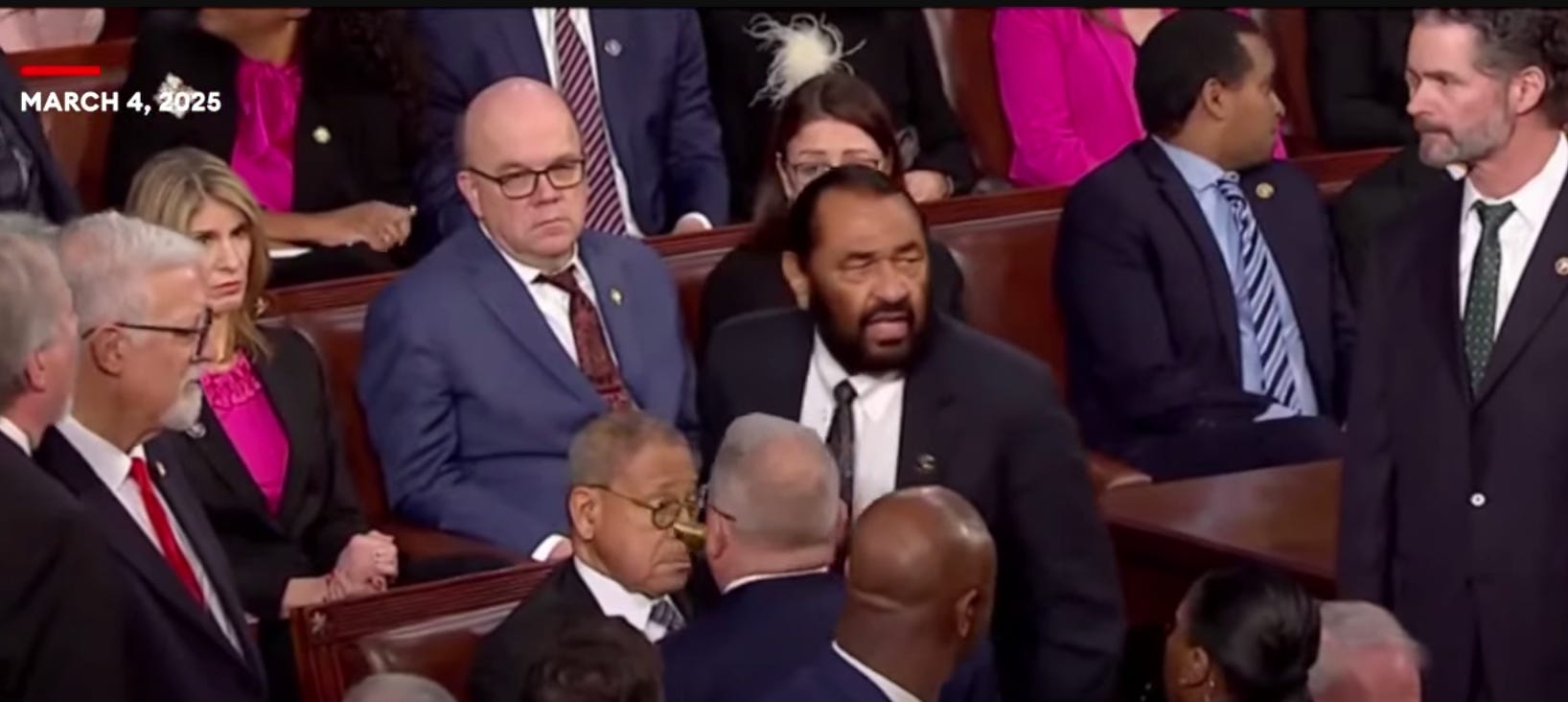
Lo, the air was thick with lies, the ground shook with deranged threats, and the halls of power reeked of cowardice. But only one man in that chamber understood the moment and had the courage to stand up to the bully, right to his bloated orange face.
And that man was Al Green. Al Green shouted the truth, he stood against the madness, and he got kicked out for it. He is also unrepentant for this righteous trouble, which I fully support.
https://www.youtube.com/embed/2e9bS6VnNpw?si=eGwO8v-oj0NjN4Ee
God bless Representative Al Green. This is the kind of fire and leadership that people are looking for. PUT HIM IN CHARGE!

2. Little Roadrunner Signs Are Not The Way
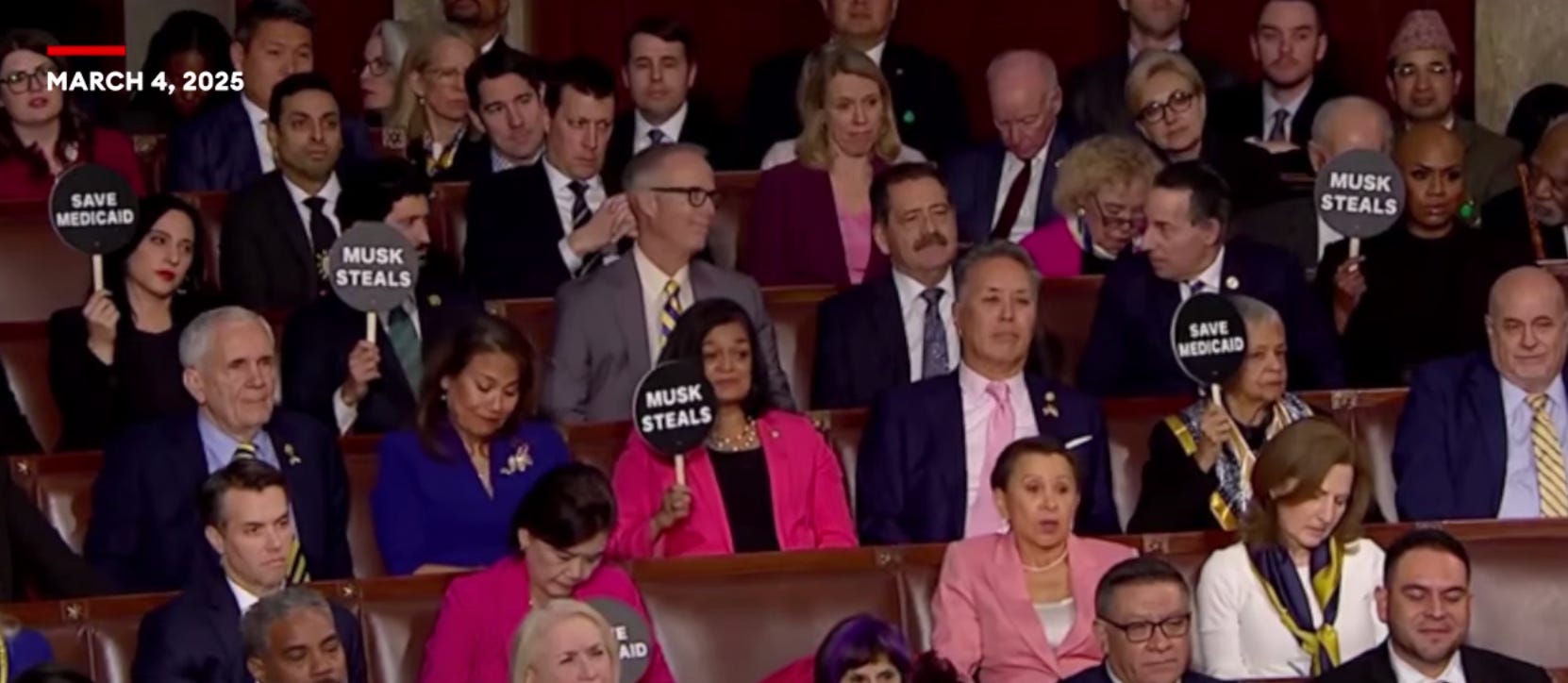
On the other end of the protest spectrum, we have Little Roadrunner Signs. What the hell were those sad little signs supposed to accomplish?
“MUSK STEALS.” “PROTECT VETERANS.” “SAVE MEDICAID.” Ooooo, so scary. They might as well have held up “PLEASE DON’T HURT US, SIR” for all the good it did.
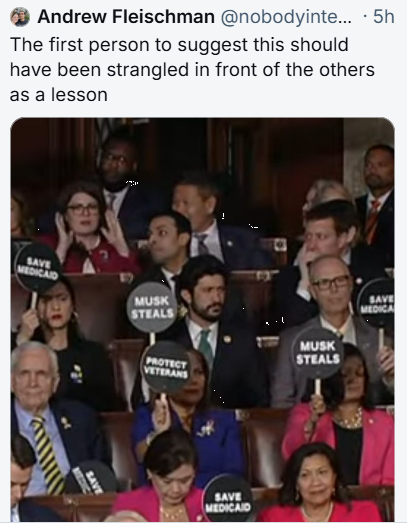
The fascists stood and roared, grinning ear to ear like morons, while Democrats meekly raised their tiny placards.
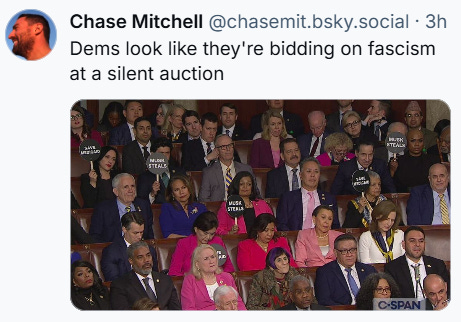
God proclaims this tactic to be WEAK SAUCE.
That said, maybe the signs could have worked if they had better phrases. Here are some other phrases they should have used instead:
- “Go to Mars and stay there.”
- “Deport Elon Musk.”
- “Billionaires shouldn’t exist.”
- “Fuck you, Donald!”
- “Burn in hell, fascist.”
Ya know, that sort of thing. HARSHER. Keep it going in the comments.

3. God’s Final Word
FOR THE RECORD, despite what he says, Donold was NOT saved by God to make America great again. Also, I categorically reject Donold’s request for Me to “bless America.” I will not be doing that until he is long gone.
Fuck you, Donold!

4. We’re Fighting Back—And It’s Working
How many good people have been fired? How many voices silenced? How many innocent people deported?
About a third of Project 2025 has already been implemented. They’re getting away with it.
You know what’s coming. You’ve seen what they do with power. But you don’t have to sit back and watch.

Here’s how we fight:
- Expose corruption that corporate media won’t touch.
- Keep people engaged & informed—with truth, hope and laughter.
- Rally thousands of voices to push back against fascism.
- Build an independent platform where truth can’t be silenced.
And it’s working. (snip)
First
First They Came For… by Public Servant
Updating German pastor Martin Niemöller’s 1946 poem for 2025 Read on Substack
My Fellow Democracy Defenders,
Martin Niemöller was a prominent Lutheran pastor in Germany. After Hitler seized power in 1933, the pastor became an outspoken critic. For defying a dictator, he spent the last eight years of Nazi rule (1937 to 1945) in prisons and concentration camps. Pastor Niemöller is best remembered for his 1946 poem, which I have updated for our current situation below.


First they came for the refugees, and I did not speak out—because I was not a refugee.
Then they came for the trans children, and I did not speak out—because I was not a trans child.
Then they came for the people of color, and I did not speak out—because I was not a person of color.
Then they came for the abortionists, and I did not speak out—because I was not an abortionist.
Then they came for the socialists, and I did not speak out—because I was not a socialist.
Then they came for the journalists, and I did not speak out—because I was not a journalist.
Then they came for the trade unionists, and I did not speak out—because I was not a trade unionist.
Then they came for the Jews, and I did not speak out—because I was not a Jew.
Then they came for the civil servants, and I am speaking out—my partner has lost her job, and I am fighting for mine.
Then they came for me—and there was no one left to speak for me.
Will you speak up for all those who are oppressed by fascists? (snip)

