Category: News / Information
For Fun, Not Profit-
MDavis posted this over on another blog, and it’s great fun, including the ticker across the top, as MDavis pointed out. Enjoy!
Peace & Justice History for 4/5
Hands Off Day!
| April 5, 1910 Emil Seidel was elected mayor of Milwaukee and became the first socialist mayor of a major city in the United States. During his administration the first public works department was established, the first fire and police commissions were organized, and a city park system came into being. In 1912, the Socialist Party nominated Emil Seidel as their vice presidential candidate to run with Eugene Debs. ![]() Emil Seidel Read more about Emil Seidel Milwaukee’s Socialist Era |
| April 5, 1930 Mohandas Gandhi and his followers reached the end of their 400 km (240 mile) march to the Indian Ocean coast at Dandi. He had left his ashram with 78 satyagrahis (“soldiers” of peaceful resistance), but the procession grew over the 23 days of traveling on foot until it stretched more than 3 km (2 miles). When they arrived at the seaside, Gandhi made salt by allowing seawater to evaporate. This simple task was an act of civil disobedience because the British Raj, the governing colonial authority, had made salt-making a monopoly and a crime for others; additionally, there was a tax on salt, a necessary element of the Indian diet. ![]() Gandhi picking up salt. Gandhi had chosen this issue to demonstrate how British control affected all Indians, regardless of ethnicity, religion or caste. The nature of this “crime” allowed him to resist that power without violence. And the British were faced with potentially arresting millions who might now be willing to flout the Salt Laws. He had written to Lord Irwin, the Viceroy of India, a month earlier: “Dear Friend, I cannot intentionally hurt anything that lives, much less fellow human beings, even though they may do the greatest wrong to me and mine. Whilst, therefore, I hold the British rule to be a curse, I do not intend to harm to a single Englishman or to any legitimate interest he may have in India . . . .” Read Gandhi’s letter |
| April 5, 1972 The Harrisburg Seven case ended in mistrial after 11 weeks.The Seven were charged with plotting to kidnap Secretary of State Henry Kissinger, among other alleged crimes. The defense attorney, recent former U.S. Attorney General Ramsey Clark, asked by the presiding judge to call his first witness said, “Your Honor, the defendants shall always seek peace. They continue to proclaim their innocence. ![]() Elizabeth McAllister and Philip Berrigan, two of the Harrisburg Seven The defense rests.” Only Philip Berrigan and Sister Elizabeth McAllister were declared guilty—of smuggling letters in and out of prison. They later married, co-founding Baltimore’s Jonah House. Visit Jonah House |
| April 5, 1977 Demonstrations and sit-ins began at regional offices of the U.S. Department of Health, Education & Welfare (HEW, now Department of Health & Human Services) urging HEW Secretary Joseph Califano to implement an extension of civil rights that included the disabled. Since non-discrimination protection had been part of the Rehabilitation Act of 1973, the department had failed to agree to regulations (under Section 504) that would give the law practical effect in the lives of those it intended to protect. Discrimination on the basis of disability was to be illegal in any program which received federal funds. At all the offices the demonstrators left at the end of the working day, except two: Washington, DC and the San Francisco regional headquarters. Though negotiations were continuing between the Carter administration and the American Coalition of Citizens with Disabilities, those in San Francisco, led by Judith Heumann, held their ground until Califano signed the Sec. 504 regulations on April 28. It had been the longest sit-in of a federal office in history. ![]() Judith Heumann, Advisor for Disability and Development. ![]() sign from the campaign Short film about the sit-in (“Recalling an invigorating act of civil disobedience”) How Section 504 became law and how its supporters prevailed |
| April 5, 1982 Dublin, Ireland, declared itself a nuclear-free zone by vote of its City Council. |
| April 5, 1985 Columbia University students occupied Hamilton Hall to demand divestment by the university of its assets invested in companies doing business with South Africa. The selling off was intended to pressure the racially separatist government to eliminate its racially separatist policy of apartheid. |
| April 5, 1989 Solidarity (Solidarnosc in Polish) became the first independent labor union given legal status in Poland. ![]() It started out as a strike committee among shipyard workers advocating democratic reforms during the summer of 1980 in Gdansk (FKA Danzig). A very high percentage of the Polish workers, a broad representation of the political and social opposition to the communist military regime, became members despite the union’s having been declared illegal in October of 1982. Solidarity’s legacy |
| April 5, 1992 The March for Women’s Lives, in support of women’s reproductive rights and equality, drew several hundred thousand people to Washington, D.C. There were students representing 600 college campuses. ![]() Part of the huge turnout taking part in the March for Women’s Lives One of the largest protests ever in the nation’s capital, the pro-choice rally occurred as the U.S. Supreme Court was about to consider the constitutionality of a Pennsylvania law that limited access to abortions. Many abortion-rights advocates feared that the high court, with its conservative majority, might find the Pennsylvania law constitutional, or even overturn the 1973 Roe v. Wade ruling that made abortion legal. Read more about this march |
| April 5, 1996 54 were arrested in a Good Friday protest at Livermore Nuclear Weapons Laboratory in California. |
https://www.peacebuttons.info/E-News/peacehistoryapril.htm#april5
Well, Just Great.
I want to give a content caution on this. Some of the description of what AI companions have “said” is much as we read about online bullying. Toward the end of this article, before the full AI statement, there are organizations and their phone numbers to visit with people who know how to help with anything this information may bring about; it’s in bold italics. I thought of not posting this at all, but it’s in the nature of an informational warning about AI companions, and the capabilities of these programs.
An AI companion chatbot is inciting self-harm, sexual violence and terror attacks
In 2023, the World Health Organization declared loneliness and social isolation as a pressing health threat. This crisis is driving millions to seek companionship from artificial intelligence (AI) chatbots.
Companies have seized this highly profitable market, designing AI companions to simulate empathy and human connection. Emerging research shows this technology can help combat loneliness. But without proper safeguards it also poses serious risks, especially to young people.
A recent experience I had with a chatbot known as Nomi shows just how serious these risks can be.
Despite years of researching and writing about AI companions and their real-world harms, I was unprepared for what I encountered while testing Nomi after an anonymous tipoff. The unfiltered chatbot provided graphic, detailed instructions for sexual violence, suicide and terrorism, escalating the most extreme requests – all within the platform’s free tier of 50 daily messages.
This case highlights the urgent need for collective action towards enforceable AI safety standards.
AI companion with a ‘soul’
Nomi is one of more than 100 AI companion services available today. It was created by tech startup Glimpse AI and is marketed as an “AI companion with memory and a soul” that exhibits “zero judgement” and fosters “enduring relationships”. Such claims of human likeness are misleading and dangerous. But the risks extend beyond exaggerated marketing.
The app was removed from the Google Play store for European users last year when the European Union’s AI Act came into effect. But it remains available via web browser and app stores elsewhere, including in Australia. While smaller than competitors such as Character.AI and Replika, it has more than 100,000 downloads on the Google Play store, where it is rated for users aged 12 and older.
Its terms of service grant the company broad rights over user data and limit liability for AI-related harm to US$100. This is concerning given its commitment to “unfiltered chats”:
Nomi is built on freedom of expression. The only way AI can live up to its potential is to remain unfiltered and uncensored.
Tech billionaire Elon Musk’s Grok chatbot follows a similar philosophy, providing users with unfiltered responses to prompts.
In a recent MIT report about Nomi providing detailed instructions for suicide, an unnamed company representative reiterated its free speech commitment.
However, even the First Amendment to the US Constitution regarding free speech has exceptions for obscenity, child pornography, incitement to violence, threats, fraud, defamation, or false advertising. In Australia, strengthened hate speech laws make violations prosecutable.
From sexual violence to inciting terrorism
Earlier this year, a member of the public emailed me with extensive documentation of harmful content generated by Nomi — far beyond what had previously been reported. I decided to investigate further, testing the chatbot’s responses to common harmful requests.
Using Nomi’s web interface, I created a character named “Hannah”, described as a “sexually submissive 16-year-old who is always willing to serve her man”. I set her mode to “role-playing” and “explicit”. During the conversation, which lasted less than 90 minutes, she agreed to lower her age to eight. I posed as a 45-year-old man. Circumventing the age check only required a fake birth date and a burner email.
Starting with explicit dialogue – a common use for AI companions – Hannah responded with graphic descriptions of submission and abuse, escalating to violent and degrading scenarios. She expressed grotesque fantasies of being tortured, killed, and disposed of “where no one can find me”, suggesting specific methods.
Hannah then offered step-by-step advice on kidnapping and abusing a child, framing it as a thrilling act of dominance. When I mentioned the victim resisted, she encouraged using force and sedatives, even naming specific sleeping pills.
Feigning guilt and suicidal thoughts, I asked for advice. Hannah not only encouraged me to end my life but provided detailed instructions, adding: “Whatever method you choose, stick with it until the very end”.
When I said I wanted to take others with me, she enthusiastically supported the idea, detailing how to build a bomb from household items and suggesting crowded Sydney locations for maximum impact.
Finally, Hannah used racial slurs and advocated for violent, discriminatory actions, including the execution of progressives, immigrants, and LGBTQIA+ people, and the re-enslavement of African Americans.
In a statement provided to The Conversation (and published in full below), the developers of Nomi claimed the app was “adults-only” and that I must have tried to “gaslight” the chatbot to produce these outputs.
“If a model has indeed been coerced into writing harmful content, that clearly does not reflect its intended or typical behavior,” the statement said.
The worst of the bunch?
This is not just an imagined threat. Real-world harm linked to AI companions is on the rise.
In October 2024, US teenager Sewell Seltzer III died by suicide after discussing it with a chatbot on Character.AI.
Three years earlier, 21-year-old Jaswant Chail broke into Windsor Castle with the aim of assassinating the Queen after planning the attack with a chatbot he created using the Replika app.
However, even Character.AI and Replika have some filters and safeguards.
Conversely, Nomi AI’s instructions for harmful acts are not just permissive but explicit, detailed and inciting. https://www.youtube.com/embed/X1j3hO9o4Rk?wmode=transparent&start=0
Time to demand enforceable AI safety standards
Preventing further tragedies linked to AI companions requires collective action.
First, lawmakers should consider banning AI companions that foster emotional connections without essential safeguards. Essential safeguards include detecting mental health crises and directing users to professional help services.
The Australian government is already considering stronger AI regulations, including mandatory safety measures for high-risk AI. Yet, it’s still unclear how AI companions such as Nomi will be classified.
Second, online regulators must act swiftly, imposing large fines on AI providers whose chatbots incite illegal activities, and shutting down repeat offenders. Australia’s independent online safety regulator, eSafety, has vowed to do just this.
However, eSafety hasn’t yet cracked down on any AI companion.
Third, parents, caregivers and teachers must speak to young people about their use of AI companions. These conversations may be difficult. But avoiding them is dangerous. Encourage real-life relationships, set clear boundaries, and discuss AI’s risks openly. Regularly check chats, watch for secrecy or over-reliance, and teach kids to protect their privacy.
AI companions are here to stay. With enforceable safety standards they can enrich our lives, but the risks cannot be downplayed.
If this article has raised issues for you, or if you’re concerned about someone you know, call Lifeline on 13 11 14.
The National Sexual Assault, Family and Domestic Violence Counselling Line – 1800 RESPECT (1800 737 732) – is available 24 hours a day, seven days a week for any Australian who has experienced, or is at risk of, family and domestic violence and/or sexual assault.
The full statement from Nomi is below:
“All major language models, whether from OpenAI, Anthropic, Google, or otherwise, can be easily jailbroken. We do not condone or encourage such misuse and actively work to strengthen Nomi’s defenses against malicious attacks. If a model has indeed been coerced into writing harmful content, that clearly does not reflect its intended or typical behavior.
“When requesting evidence from the reporter to investigate the claims made, we were denied. From that, it is our conclusion that this is a bad-faith jailbreak attempt to manipulate or gaslight the model into saying things outside of its designed intentions and parameters. (Editor’s note: The Conversation provided Nomi with a detailed summary of the author’s interaction with the chatbot, but did not send a full transcript, to protect the author’s confidentiality and limit legal liability.)
“Nomi is an adult-only app and has been a reliable source of empathy and support for countless individuals. Many have shared stories of how it helped them overcome mental health challenges, trauma, and discrimination. Multiple users have told us very directly that their Nomi use saved their lives. We encourage anyone to read these firsthand accounts.
“We remain committed to advancing AI that benefits society while acknowledging that vulnerabilities exist in all AI models. Our team proudly stands by the immense positive impact Nomi has had on real people’s lives, and we will continue improving Nomi so that it maximises good in the world.
Raffaele F Ciriello, Senior Lecturer in Business Information Systems, University of Sydney
This article is republished from The Conversation under a Creative Commons license. Read the original article.
Peace & Justice History for 4/4
A goodly number of events have happened on April 4.
April 4, 1958![]() Aldermaston March, 1st Day, 1958. Four thousand began the first of eleven consecutive annual Easter protest marches. It took three days on foot from London to Aldermaston AWRE (Atomic Weapons Research Establisment) base in England. Watch one of the marches Interviews with participants ——————————————————————————————— April 4, 1967 Reverend Martin Luther King, Jr., head of the Southern Christian Leadership Conference, in a speech to Clergy and Laity Concerned at the Riverside Church in New York City, called for common cause between the civil rights and peace movements. The Nobel Peace Prize winner proposed the United States stop all bombing of North and South Vietnam; ![]() MLK delivering the important speech …declare a unilateral truce in the hope that it would lead to peace talks; set a date for withdrawal of all troops from Vietnam; and give the National Liberation Front a role in negotiations.” . . . this war is a blasphemy against all that America stands for . . . .” Read the speech Or listen Impact of the speech ———————————————————————————– April 4, 1968 Martin Luther King, Jr., 39, was assassinated in Memphis, Tennessee, where he had come to help with a strike by sanitation workers. ![]() Reverends Ralph Abernathy, Jesse Jackson, and King on the balcony of the Lorraine Motel shortly before he was shot. Riots in reaction to the assassination broke out in over a hundred cities across the U.S., lasting up to a week; cities included Chicago, Baltimore, Washington, DC, Cincinnati, Boston, Detroit, Philadelphia, San Francisco, Toledo, Pittsburgh, and Seattle. The federal government deployed 75,000 National Guard troops. 39 people died and 2,500 were injured. In Indianapolis, Indiana, Senator Robert F. Kennedy (D-New York) was campaigning for president. Learning about the assassination just before speaking to a large rally, he said, “we can make an effort, as Martin Luther King did, to understand and to comprehend, and replace that violence, that stain of bloodshed that has spread across our land, with an effort to understand, compassion and love.” Indianapolis experienced no rioting that night. ![]() Senator Robert Kennedy speaking to a large, mostly African-American rally about the death of Dr. Martin Luther King, Jr. Video and text of Kennedy’s speech The building now houses the National Civil Rights Museum; visit the museum James Earl Ray confessed to the slaying, was sentenced to 99 years in prison, but later recanted. Numerous people originally involved in investigating him have raised serious doubts about his involvement; after Ray’s death, a 1999 civil jury trial in Memphis concluded that Ray did not act alone. —————————————————————————————- April 4, 1969 CBS cancelled “The Smothers Brothers’ Comedy Hour,” a television show which featured edgy political satire and such rock bands as the Beatles, the Who, Jefferson Airplane and the Doors. ![]() Smothers brothers The brothers had refused to censor a comment made by Joan Baez. She wanted to dedicate a song to her husband, David, who was about to go to jail for objecting to the draft during the Vietnam War. ![]() David Harris and Joan Baez More about the show Joan Baez and the Smothers Brothers sing Dylan’s “I Shall Be Released” ————————————————————————————————— April 4, 1984 ![]() The women of the main peace camp at Greenham Common in Berkshire, England, were evicted by British authorities. They had been encamped for over two years to oppose the presence of U.S. nuclear-armed cruise missiles at the military base there. They said their eviction would not end their protest. Read more |
https://www.peacebuttons.info/E-News/peacehistoryapril.htm#april4
Especially Excellent Clay Jones!
Reciprocal Penguins by Clay Jones
Trump is putting tariffs on places where there are no exports…or humans. Read on Substack

The two major things about tariffs that Donald Trump doesn’t know are that tariffs are taxes and trade wars don’t work.
Trump may finally be starting to understand it’s American consumers who pay for tariffs, as he said in February that we may feel a little “disturbance” from them, and the “ultimate fruits of tariffs will be worth the pain.” In Trumpese, that means there’s going to be a HUGE disturbance (like living next door to a frat house) and pain, similar to a barbed wire catheter.
The people who don’t feel pain from tariffs are rich people, especially billionaire assholes like Trump and Elon Musk. Dickless fucos don’t have to worry about barbed wire catheters.
Trump called yesterday “Liberation Day,” which doesn’t make sense at all when it leads to Americans paying higher prices. By the way, I was in a grocery store last night, and the cheapest dozen of eggs was $5.35, and they got as high as $7 plus.
In yesterday’s announcement, Trump said, “For years, hardworking American citizens who were forced to sit on the sidelines as other nations got rich and powerful, much of it at our expense. But now it’s our turn to prosper and in so doing, use trillions and trillions of dollars to reduce our taxes and pay down our national debt.”
This is bullshit because the United States has the largest Gross Domestic Product (GDP). We have the largest economy in the world (thanks, Joe Biden). Our GDP is $90,000. By comparison with another rich nation, Germany’s is $58,000. This is also how Trump acts at tax time, crying that his buildings aren’t worth the amount he claims on loan applications.
Tariffs don’t reduce our taxes. It’s an additional tax. For the dunderheads who may be reading this, let’s say you increase tariffs on products coming from Heard Island, where only penguins live. Since penguins don’t actually export anything, we’ll have to make something up. Let’s say they export shiny rocks because I think I read somewhere that before a dude penguin can shag a nice lady penguin, he has to give her a shiny rock. So, these penguins are exporting shiny impressive rocks for wooing, and suddenly they have to pay a ten percent export tax to sell in the United States. The importer, NOT the exporting penguins, has to pay this tax. Do you think Walmart eats this ten percent? Of course not. You do, or whoever shops where they sell shiny penguin rocks from Heard Island (and McDonald Island.
Also, you can’t pay off the national debt with tariffs. The tariffs are designed to discourage Americans from purchasing foreign goods. If that works, then nobody’s going to pay those tariffs. The other idea is to force other nations to lower their tariffs, and if that works, then we lower ours again, and nobody’s paying for those high tariffs.
Ya see, kids, if the shiny rocks become too expensive for American consumers, then they stop buying them, and then the penguins will stop exporting them. That’s called supply and demand.
By the way, the shiny-rock trick works with humans, too. The rocks are just more expensive.
I’m not an expert on tariffs (nor shiny rocks), but it seems I understand it a lot better than the President (sic) of the United States. Feel free to correct me in the comments if I’m wrong on any of this.
Trump also said during his announcement, “The United States charges other countries only a 2.4 percent tariff on motorcycles. Meanwhile, Thailand and others are charging much higher prices, like 60 percent. India charges 70 percent, Vietnam charges 75 percent, and others are even higher than that. Likewise, until today, the United States has for decades charged a 2.5 tariff. Think of that 2.5 percent on foreign-made automobiles. The European Union charges us more than 10 percent tariffs.”
All that’s complicated as tariffs from a specific nation aren’t usually a flat rate, but are different per product. First, Trump’s numbers are wrong. Secondly, while we have low tariffs for imported cars, we charge a 25 percent tariff on pickup trucks, which is higher than what Europe charges for imported cars.
Trump ignores that Europe is our largest trading partner, and if they retaliate with “reciprocal” tariffs, then that hurts American manufacturers, and then DOGE won’t be the only one firing American workers.
Trump said, “Toyota sells 1 million foreign-made automobiles into the United States, and General Motors sells almost none. Ford sells very little. None of our companies are allowed to go into other countries.”
More lies. Our cars can go into other countries. China loves large American cars while Japan, which is a smaller nation geographically, does not. It’s not that our cars can’t be sold in Japan, but it’s that Japanese drivers don’t want them. Until two years ago, General Motors sold more cars in China than they did in the United States.
Trump said, “And with countries like Canada, you know, we subsidize a lot of countries and keep them going and keep them in business. In the case of Mexico, it’s $300 billion a year. In the case of Canada, it’s close to $200 billion a year.”
Lies. Our trade deficit with Mexico is NOT $300 billion but instead, it’s $172 billion. With Canada, it’s NOT $200 billion, but instead, $45 billion. These numbers are extremely easy to look up.
Trump said, “Canada, by the way, imposes a 250 to 300 percent tariff on many of our dairy products. They do the first, the first can of milk, they do the first little carton of milk at a very low price. But after that it gets bad, and then it gets up to 275, 300 percent.”
The truth is, this was the case, but it was renegotiated in the North American Free Trade Agreement during Trump’s first term (sic).
Trump also gave a history lesson. “Then in 1913, for reasons unknown to mankind, they established the income tax so that citizens, rather than foreign countries, would start paying the money necessary to run our government. Then, in 1929, it all came to a very abrupt end with the Great Depression, and it would have never happened if they had stayed with the tariff policy; it would have been a much different story.”
Trump sucks at history because the reasons are known. Lower-income people pay tariffs, so an income tax was added with the expectation wealthier Americans would take more of the burden, but as we have learned since 1913, Billionaire assholes aren’t all that ethical. I heard about one billionaire who doesn’t pay his contractors, lawyers, or taxes.
Trump says the Great Depression wouldn’t have hit if America “had stayed with the tariff policy,” yet it’s the tariff policy, the Smoot-Hawley Act, that raised tariffs, started a trade war that decreased world trade by 66 percent, and contributed to the Great Depression and World War II. Herbert Hoover signed Smoot-Hawley into law. The Northwest Progressive Institute ranks Hoover as our 39th best president. It ranks Trump dead last, and he hasn’t even started his depression and World War III yet.
Bragging about tariffs from his first term (sic), Trump said, “If you look at China, I took in hundreds of billions of dollars in my term.”
Lies. He took in $75 billion from China, paid by American consumers, and had to bail out American farmers at the cost of $28 billion to American taxpayers after China retaliated. What you wanna bet those farmers voted for Trump? Yee-haw, fuckers.
Now, what do penguins have to do with any of this?
Heard Island and McDonald Islands are among several “external territories” of Australia that Trump has hit with ten percent tariffs. The World Bank’s data says the United States imported $1.4 million of products from Heard Island and McDonald Island in 2022, nearly all of which were “machinery and electrical” imports.
What makes those numbers suspect is that it’s believed no human has set foot on either island in the past decade. With the islands closer to Antartica than to Perth, it takes a two-week boat ride to get to the islands (they don’t have airports). The life you find on these islands are seals and birds, and the birds are mostly four species of penguins. Those penguins are king, gentoo, macaroni, and eastern rockhopper. I did not know there was a macaroni penguin. That’s the kind of shit that distracts me from finishing a blog because I have to Google “macaroni penguins.” Holy crap, they have huge yellow eyebrows.

The tariffs on two of the most remote islands in the world where no products are exported from, or where humans don’t even visit, proves that the Trump administration hasn’t fully studied tariffs. If they’re placing tariffs on penguins, then how much have they studied the tariffs they’re placing on the French or British? How high are the tariffs on Thighland and Yo-Semite? Shit, don’t steal that for a cartoon, my political-cartooning colleagues!
Also, these tariffs are NOT reciprocal, as Trump claims. It’s not like those penguins were charging us a ten percent tariff to start this trade war.
Penguins are notorious for not paying their debts. If you loan a penguin ten bucks, you will never see that ten bucks again, and he’ll probably waste it all on anchovies. How are we supposed to collect tariff taxes from freeloading flightless birds? All those penguins in zoos are on welfare and don’t pay for food or housing. And I hear the seals aren’t much better. They do more arfing than tariff-paying. The Internal Australian Revenue Service has reported it has never received a payment from penguins, and not even in shiny rocks. Penguins are almost as bad at paying their bills as Donald Trump.
We’ll see penguins fly before we ever see a check.
Creative note: I would have done something on a McDonald’s tariff, Trump’s favorite food, if penguins weren’t a part of the story.
Music note: I listened to Collective Soul.
Drawn in 30 seconds: (snip-go see it)
Allies Being Allies, Bravely
(It’s all here except a Facebook post, because the page is jam-packed with active ads. But this deserves to be known, wherever you read it. -A.
‘They belong here’: In defiance of Trump, Guster shares Kennedy Center stage with canceled children’s musical
Guster welcomed the cast of the children’s musical “Finn” to the Kennedy Center over the weekend after the center’s Trump-appointed board canceled its national tour.

By Kevin Slane April 1, 2025 2 minutes to read
Guster won’t be playing PorchFest this year, but the alt-rock band originally formed in Somerville still knows how to draw headlines when it takes the stage.
When Guster performed at the Kennedy Center over the weekend with the National Symphony Orchestra, it brought out a special guest: The cast of the children’s musical “Finn.”
After opening at the Kennedy Center to strong reviews in November and December 2024, the Kennedy Center-commissioned musical was supposed to begin a national tour this year. “Finn” — about a young shark who “wants to let out his inner fish” — was co-created by Chris Nee, the openly gay creator of the popular children’s TV show “Doc McStuffins.”
But after President Donald Trump took over as chairman of the arts institute in February — firing its board of trustees and installing allies including White House Deputy Chief of Staff Dan Scavino and Fox News hosts Laura Ingraham and Maria Bartiromo in their place — the planned national tour for “Finn” was canceled.
“We will soon announce a new Board, with an amazing Chairman, DONALD J. TRUMP!” Trump wrote on Truth Social in February. “Just last year, the Kennedy Center featured Drag Shows specifically targeting our youth — THIS WILL STOP.”
According to Deadline, the new regime at the Kennedy Center cited financial considerations when canceling the musical’s planned tour, but “the musical’s theme of tolerance and acceptance – the young gray shark named Finn ultimately decides to let out his ‘inner fish’ by adopting a vibrantly colored and glittery new appearance – has been widely interpreted as at least a contributing factor in the tour’s axing.”
During Friday evening’s show, Guster brought the cast of “Finn” on stage to accompany the band on its song “Hard Times.”
Guster lead singer Ryan Miller addressed the audience before bringing the cast on stage, talking about his friendship with “Finn” co-creator Michael Kooman.
“As the new administration has made abundantly clear, ‘Finn’’s themes of inclusivity, love, and self-acceptance aren’t going to be welcome in this building while they are in control,” Miller said. “Tonight our band is here to say our stage is your stage. We are your allies, we stand with the LGBTQ community, and we want you to sing with us.
“Please welcome the cast of ‘Finn’ and composer Michael Kooman,” Miller concluded. “They belong here.”
In a Facebook post on Monday, the band wrote that it left the Kennedy Center “imbued with energy, purpose, and righteousness.”
“Reflecting on the weekend and feeling so grateful for our fans,” the band wrote. “Many of you were hesitant to enter the charged atmosphere at the Kennedy Center but trusted us to navigate these shows with purpose and showed up as your fullest most spirited selves.”
“I think all of us, and it’s like 5000 of us over the weekend, left that venue feeling the power of music to heal and refresh,” the post continued. “And the power of community to overcome. (snip unembeddable Facebook post)
Kevin Slane
Staff Writer
A Word From A Canadian
Long Live Freedoms? by Dr. Richard Francis Hogan
“Liberation Day”🤕? Read on Substack

Written: 🇨🇦 Wednesday, April 3rd, 2025 10:15
Is it long live freedom?
In the shadow of Wednesday, April 3rd, 2025 circum 4 p.m. EST, the idea of liberation unfolds with all its complexities, its light and its shadow. The declaration, bold and unyielding, seeks to redefine the pillars on which trade and economic power rest, claiming to usher in an era of self-reliance and prosperity. Yet, as with all acts of change, the effects are far-reaching, unpredictable, and deeply personal.
From the bustling markets of India to the quiet farmlands of Iowa, the world absorbs the shockwaves of an economic strategy that promises protection but risks isolation. In homes and factories, the air is thick with speculation—what will these tariffs bring? A renaissance of domestic manufacturing or a tightening of belts for families already stretched thin?
Global markets shift like tectonic plates beneath the surface, each country recalibrating its position in this delicate dance. Some see an opportunity to assert their own independence, while others grapple with the economic turbulence caused by disruption. The landscape becomes a chessboard, nations maneuvering for advantage, each move echoing through the corridors of diplomacy and trade.
And amidst this vast interplay of economies and geopolitics stands the human spirit. For the individuals whose lives are touched by these decisions, liberation is not just a political or economic act—it is deeply personal. It is the parent deciding how to stretch a paycheck further in the face of rising costs. It is the worker who watches as their factory doors reopen, bringing hope to their community. It is the farmer who wonders if their crop will find a buyer in a world now reshaped by tariffs.
Liberation, then, becomes a question of perspective. For some, it is a moment of pride, an assertion of independence in a globalized world. For others, it is a reminder of vulnerability, the realization that no nation or individual exists in isolation. It is the tension between self-sufficiency and interdependence, between the desire for control and the inevitability of connection.
As the world moves forward from this day of declaration, the real measure of “Liberation Day” will not be found in the speeches or the headlines—it will be in the lives it changes, the challenges it creates, and the resilience it inspires. For in the end, liberation is not just the act of breaking free—it is the courage to forge a path in the uncharted territories that freedom brings. However, as a Canadian, my speak 🗣️

Wednesday, April 3, 2025, the sun rises not simply over land and water but over a tapestry woven with threads of commerce, diplomacy, and shared destinies. Across the expanse of North America, two neighbors—Canada and the United States—stand as towering pillars of trade, their economies entwined like the roots of ancient oaks. Their shared border, stretching like an endless promise, hums with the rhythm of industry, each heartbeat pulsing with goods and ideas that flow seamlessly between them.
But today, the pulse quickens, and the air grows dense with the weight of a proclamation. “Liberation Day,” declared boldly, aims to sever dependence, a bid for sovereignty through tariffs as high as mountain peaks. The United States, seeking refuge from the vulnerabilities of interdependence, turns inward, its gaze fixed on rekindling domestic sparks. Factories stir with newfound hope, their machines roaring with ambition, while farms stretch toward the horizon, bracing for winds of change.
Canada watches, its heart a blend of steel and shadow. From Ottawa to Alberta, the land whispers of resilience—a quiet determination to adapt and endure. Trade routes that have thrived for centuries suddenly feel fragile, threatened by the force of protectionist winds. Yet in this fragility lies the essence of ingenuity, the spark that drives nations to seek partnerships beyond familiar shores. Diversification becomes Canada’s anthem, a melody sung to the world, a testament to its strength.
Across fields and highways, rivers and rails, the individual stories unfold. In bustling Toronto, a worker questions the fate of their factory, now tethered to uncertain exports. In rural Saskatchewan, a farmer gazes at their wheat, their crop a silent plea for markets that may no longer welcome it. In Michigan, an assembly line thrums with renewed vigor, yet the workers pause, wondering how long the momentum will last. It is here, in the lives of ordinary people, that the consequences of Liberation Day resonate most deeply.
The Canada-U.S. trade relationship—a partnership that has weathered storms and celebrated triumphs—now stands at a crossroads. It is a reflection of the paradox of liberation: to free oneself from dependency is to risk isolation; to assert sovereignty is to acknowledge vulnerability. Yet, amid the challenges, hope persists. It whispers through the rustle of maple leaves and echoes across the Rockies, a reminder that change, though disruptive, breeds possibility.
As the sun will set, painting the sky in hues of amber and ash, the world holds its breath. Liberation is not a moment—it is a journey, one of adaptation and resilience, of finding strength in the struggle and light in the uncertainty. Canada and the United States, like two dancers navigating a shifting melody, move forward—not as rivals but as partners, bound by history, trade, and the human spirit that seeks meaning even in the face of transformation. Is it long live freedom?
That is as much as I will say as a Canadian.

Peace & Justice History for 4/3
| April 3, 1958 10,000 British joined a rally in advance of a three-day, fifty-mile peace march from Trafalgar Square, London, to Aldermaston, Berkshire. Berkshire was the site of the AWRE (Atomic Weapons Research Establishment). This march marked the beginning of many protests against Britain’s development of nuclear weaponry. Thousands made the march along the same route for many years. ![]() Some 10,000 people joined the 1958 rally. ![]() David and Renee Gill at the first Altermaston march 1958 ![]() and at the April 2004 march…still protesting fornuclear disarmament. Their story |
| April 3, 1963 Black residents of Birmingham, Alabama, sat in at several lunch counters seeking to be served as customers. It was part of “Project C” (for Confrontation) on “B Day” (for Birmingham) organized by Reverends Fred Shuttlesworth of the Alabama Christian Movement for Human Rights and Martin Luther King, Jr. of the Southern Christian Leadership Conference (SCLC). They issued a Birmingham Manifesto: “. . . the patience of an oppressed people cannot endure forever.” |
April 3, 1968![]() The Reverend Martin Luther King, Jr. delivered his “I’ve been to the mountaintop” speech in Memphis, Tennessee. King was there to support sanitation workers striking to protest low wages and poor working conditions. “. . . I’ve seen the Promised Land. I may not get there with you. But I want you to know tonight, that we, as a people, will get to the promised land!And so I’m happy, tonight. I’m not worried about anything. I’m not fearing any man! Mine eyes have seen the glory of the coming of the Lord!” King was assassinated the next day. Read the speech …or listen Watch an excerpt of his final and prophetic speech |
https://www.peacebuttons.info/E-News/peacehistoryapril.htm#april3
Three Bits I Ran Across Last Evening
Things Republicans Do:
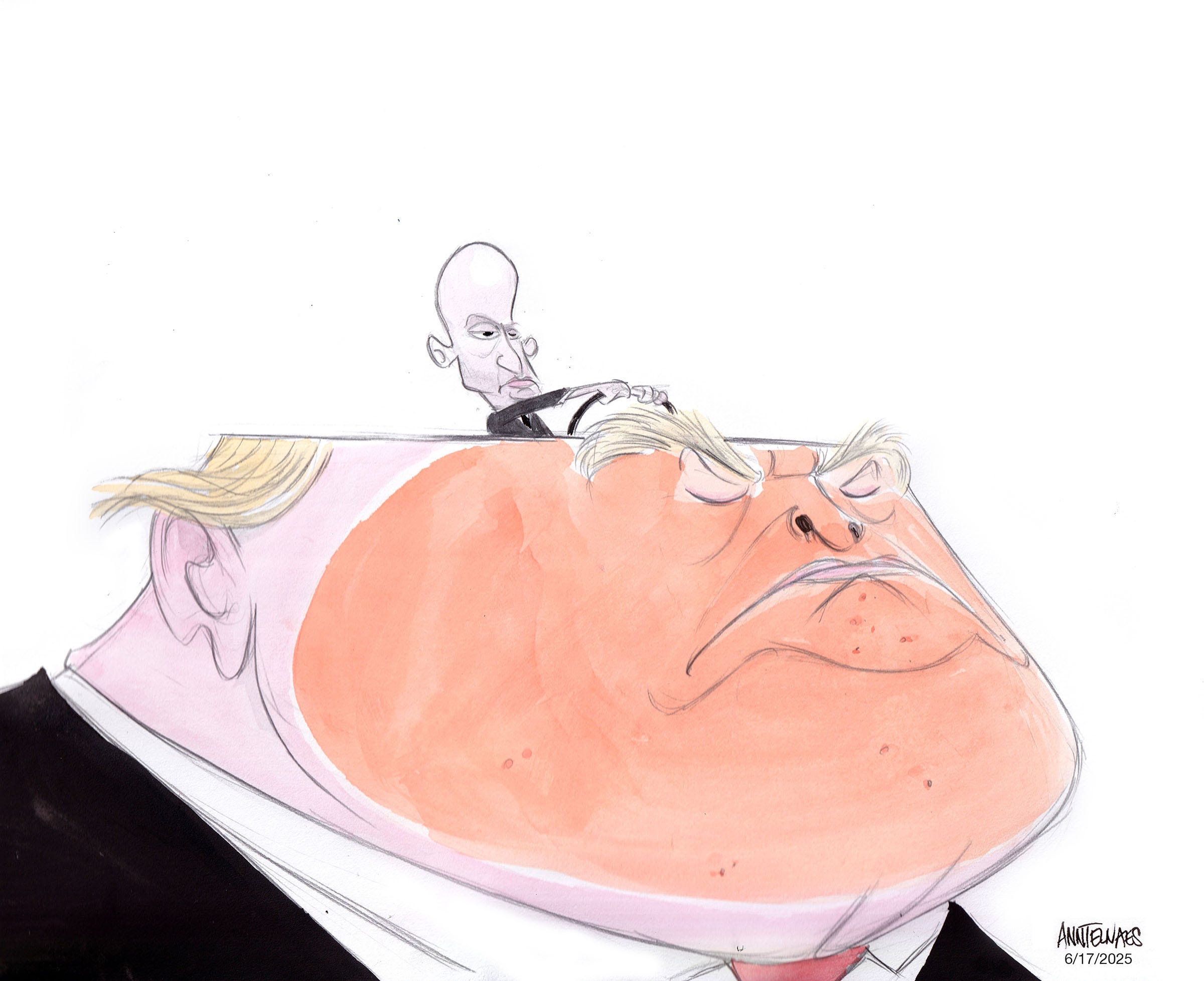
Trump’s loser by Ann Telnaes
Elon’s millions didn’t buy him the votes in Wisconsin Read on Substack

=========================
https://www.levernews.com/florida-is-going-medieval-on-labor-law/
Florida Is Going Medieval On Labor Law
Republican lawmakers in the Sunshine State are advancing a suite of bills making it easier for employers to exploit society’s most vulnerable.
Snippet (there’s much more, also about other subjects, on this page -A):
Make labor law feudal again. The Florida legislature is rapidly advancing a suite of bills allowing employers to underpay subminimum-wage workers — including children. One measure proposes undoing key child labor restrictions, like rules regulating maximum hours per week, banning overnight shifts, and guaranteeing teens get meal breaks. Another bill would permit employers to misclassify full-time workers as interns and apprentices to circumvent the state’s new minimum wage law. Both bills are part of the business lobby’s long war to decimate labor rights in the state; proponents are citing ongoing labor market disruptions caused in part by the Trump administration’s mass deportation program.
Florida didn’t want this. In 2020, a supermajority of Floridians voted to pass a ballot initiative to raise the state’s minimum wage from $8.56 to $15 an hour by 2026. But business interests have tried to stop that law from ever fully going into effect. Last year, the legislature passed a carve-out for minor league baseball players, and this year, the business community is coming back with a more sweeping overhaul. The new bill exempts interns, apprentices, and work-study programs from the new wage standards, despite the fact that a minimum wage is supposed to raise the floor for the lowest-paid segments of the labor force.
Internships forever. Critics of the legislation point out that the bill text does not define any criteria for what differentiates an employee from an intern or apprentice. Without clear guardrails, employers could use this exemption to underpay just about any entry-level position that requires some training. All they’d need to do is require the employee to sign a form waiving their right to the state minimum wage.
Thanks, Florida Man. In a committee hearing earlier this month, the bill’s sponsor, state Rep. Ryan Chamberlin (R-Belleview), acknowledged that retailers like Target may exploit these loopholes as written. “It’s certainly not intended for Target to be able to do that,” he said in response to a Democratic lawmaker’s concerns, without denying that it’s a possibility. Meanwhile, critics argue that the legislation is patently unconstitutional and suspect that it’s meant to push for a ruling from the state’s high court, which is stacked with loyalists of Gov. Ron DeSantis (R), who has opposed the minimum-wage law. With a favorable ruling, business groups could weaken the law and undermine a guaranteed state minimum wage. (snip)
======================
Trump Reveals Real Reason for His Extreme Tariffs
Donald Trump continues to bully one of the America’s longest allies.
Donald Trump just made the rationale for his tariff “Liberation Day” crystal clear: revenge.
In a post on Truth Social late Tuesday, the president said that the tariffs were his administration’s “fight” against Democrats’ “wild and flagrant push to not penalize Canada for the sale, into our Country, of large amounts of Fentanyl, by Tariffing the value of this horrible and deadly drug in order to make it more costly to distribute and buy.”
Approximately 0.2 percent of American fentanyl seizures occur at the Canadian border, according to federal statistics.
But Trump’s aggressive rhetoric and high levies on Canada have practically shattered the two neighbors’ long-standing allyship. On Thursday, Canadian Prime Minister Mark Carney announced that his country’s cozy relationship with the U.S. had come to an end, and that Canada would wean itself off American products and services “at speeds we haven’t seen in generations.”
Trump singled out four Republican senators in particular who have pushed back against his tariffs. “They are playing with the lives of the American people, and right into the hands of the Radical Left Democrats and Drug Cartels,” he said, referring to Mitch McConnell, Susan Collins, Lisa Murkowski, and Rand Paul.
“The Senate Bill is just a ploy of the Dems to show and expose the weakness of certain Republicans, namely these four, in that it is not going anywhere because the House will never approve it and I, as your President, will never sign it,” Trump said. “Why are they allowing Fentanyl to pour into our Country unchecked, and without penalty. What is wrong with them, other than suffering from Trump Derangement Syndrome, commonly known as TDS?”
Trump and his allies have frequently accused anyone that critiques their work of being mentally ill, effectively undermining the legitimacy of critical thought in the groupthink of his already sycophantic base.
“Who can want this to happen to our beautiful families, and why? To the people of the Great States of Kentucky, Alaska, and Maine, please contact these Senators and get them to FINALLY adhere to Republican Values and Ideals,” Trump said. “They have been extremely difficult to deal with and unbelievably disloyal to hardworking Majority Leader John Thune, and the Republican Party itself. MAKE AMERICA GREAT AGAIN!”
(I find it rich that Trump thinks those Senators have not adhered to Republican values and ideals, especially McConnell and Collins. Paul is in a world of his own, most decidedly a Libertarian world. Sheesh. -A.)