The bill now heads to Texas Gov. Greg Abbott’s desk to be signed into law.
Before the vote on Tuesday, state Rep. Jolanda Jones, a Democrat, delivered a scathing rebuke of the bill calling SB 4 and its supporters “racist.”
“It’s not all right to be racist. I will stop pulling the race card when you stop being racist,” she said.
SB 4 was considered as part of the fourth round of a special legislative session ordered by Texas Gov. Greg Abbott to consider several immigration-related bills.
It creates two new state crimes for migrants who enter or re-enter into the state illegally from another country, punishable with up to two years in prison.
Migrants get handcuffed as a pair before getting onboard a bus to be transported after crossing the border into the U.S. from Mexico in Jacumba Hot Springs, Calif., Nov. 11, 2023.
Go Nakamura/Reuters
One of the most controversial aspects of the bill would authorize local and state law enforcement officials to arrest migrants they suspect unlawfully crossed into Texas. It also allows judges the option to order some migrants to return to the country they illegally crossed from instead of pursuing prosecution.
Officers and state agencies would be cleared to transport them to ports of entry to make sure they comply. If migrants refused to comply with an order to return, they could be charged with a second degree felony and face up to 20 years in prison.
SB 4 has sparked fears among immigrant rights advocates that the bill would lead to widespread racial profiling and a circumvention of protections asylum seekers have under constitutional law and international obligations. The bill does not provide any funding or requirement to train officers on immigration law, despite the fact it would authorize them to quickly make decisions about a person’s immigration status.
“There is no U.S. federal analogue to a lone officer in their own discretion escorting someone to the border and saying get out. That is a very scary prospect that is categorically different from what the federal government does. In addition to that, in the federal system people would be able to present their claims to an immigration officer and an immigration judge,” said David Donatti, a senior staff attorney with the Texas ACLU.
There’s also growing concern that parents may be separated from their children if they are arrested under these new state crimes.
Aron Thorn, a senior staff attorney at the Texas Civil Rights Project says that the law could trigger lawsuits and an international dispute with Mexico since it would lead to migrants being sent across the southern border regardless of their legal status there.
Some opponents of the bill have also suggested that it is being introduced to prompt a challenge of a 2012 Supreme Court decision in Arizona v. United States which upheld the federal government’s authority over immigration enforcement. That case revolved around a law similar to SB 4, which authorized police officers to question migrants about their immigration status and arrest them.
Retired schoolteacher Tom Wingo of Samaritans Without Borders, right, gives snacks and bottles of waters to a group of migrants claiming to be from India, who just crossed the border wall, Tuesday, Aug. 29, 2023, in Org…Show more
Matt York/AP, FILE
Thorn says because the new crimes created by SB 4 only apply to undocumented immigrants, it will cause law enforcement officials to use race as probable cause apprehending people.
“We know our history is replete with examples of race being used as a proxy for immigration status. We live in Texas, our history books are full of it, and I think people are right to be concerned, specifically because there is no possible way to violate this without being an alien, which means they have to have some sort of idea that you are a noncitizen and race is used as a proxy for that,” Thorn said.
A spokesperson for the Department of Homeland Security declined to comment on the specific legislation being proposed in Texas, but said the removal of noncitizens is the federal government’s responsibility.
“Generally speaking, the federal government — not individual states — is charged with determining how and when to remove noncitizens for violating immigration laws. State actions that conflict with federal law are invalid under the Supremacy Clause of the Constitution,” the spokesperson said.
Lawmakers have reviewed several versions of SB 4 and other similar proposals throughout the year, but have failed to send it to the governor’s desk in previous sessions. Hearings have been marked by strong opposition from Democrat and Republican infighting.
During a Senate floor vote on the bill last week, Republican state Sen. Brian Birdwell, who authored a previous version of the bill last session, said this version undermines the constitution by challenging the federal government’s jurisdiction over the removal of migrants.
“Members that is why all my attempts to carry this legislation and the bill language therein had the proper federal authority responsible for disposition and deportation of those that we detain,” said Birdwell.
He added that the bill would set a “terrible precedent” by violating the constitution.
“President Biden’s failure to obey his oath does not compel us to violate ours. Instead, it compels our federal representatives to constrain him and for the electorate to remove him in the coming year,” Birdwell said.
State Sen. Charles Perry, the current author of the bill, defended its legality.
“While I agree we are testing and pushing envelopes, the state has every right to protect its citizens, and this nation has every right to expect Texas to do that when called to do it,” said Perry.
Former President Trump’s allies are pre-screening the ideologies of thousands of potentialfoot soldiers, as part of an unprecedented operation to centralize and expand his power at every level of the U.S. government if he wins in 2024, officials involved in the effort tell Axios.
Why it matters: Hundreds of people are spending tens of millions of dollars to install a pre-vetted, pro-Trump army of up to 54,000 loyalists across government to rip off the restraints imposed on the previous 46 presidents.
The screening for ready-to-serve loyalists has already begun, driven in part by artificial intelligence from tech giant Oracle, contracted for the project.
Social media histories are already being plumbed.
What’s happening: When Trump took office in 2017, he included many conventional Republicans in his Cabinet and key positions. Those officials often curtailed his behavior and power.
Trump himself spends little time plotting governing plans. But he is well aware of a highly coordinated campaign to be ready to jam government offices with loyalists willing to stretch traditional boundaries.
If Trump were to win, thousands of Trump-first loyalists would be ready for legal, judicial, defense, regulatory and domestic policy jobs. His inner circle plans to purge anyone viewed as hostile to the hard-edged, authoritarian-sounding plans he calls “Agenda 47.”
The people leading these efforts aren’t figures like Rudy Giuliani. They’re smart, experienced people, many with very unconventional and elastic views of presidential power and traditional rule of law.
Behind the scenes: The government-in-waiting is being orchestrated by the Heritage Foundation’s well-funded Project 2025, which already has published a 920-page policy book from 400+ contributors. Think of it as a transition team set in motion years in advance.
Heritage president Kevin Roberts tells us his apparatus is “orders of magnitude” bigger than anything ever assembled for a party out of power.
The policy series, “Mandate for Leadership,” dates back to the 1980s. But Paul Dans, director of Project 2025, told us: “Never before has the entire movement … banded together to construct a comprehensive plan to deconstruct the out-of-touch and weaponized administrative state.”
Trump insiders relish rebuilding the team with purists. But the truth is, they have no choice: Many more-traditional Republicans quit the first administration in frustration or were fired by tweet. And some former advisers are talking to prosecutors or are charged with crimes.
The Trump campaign tells us no outside group speaks for him: “The campaign’s Agenda47 is the only official comprehensive and detailed look at what President Trump will do when he returns to the White House. … While the campaign is appreciative of any effort to provide suggestions about a second term, the campaign is not collaborating with them.”
Questions for Heritage Foundation’s Project 2025 applicants. Screenshot via Project 2025 website
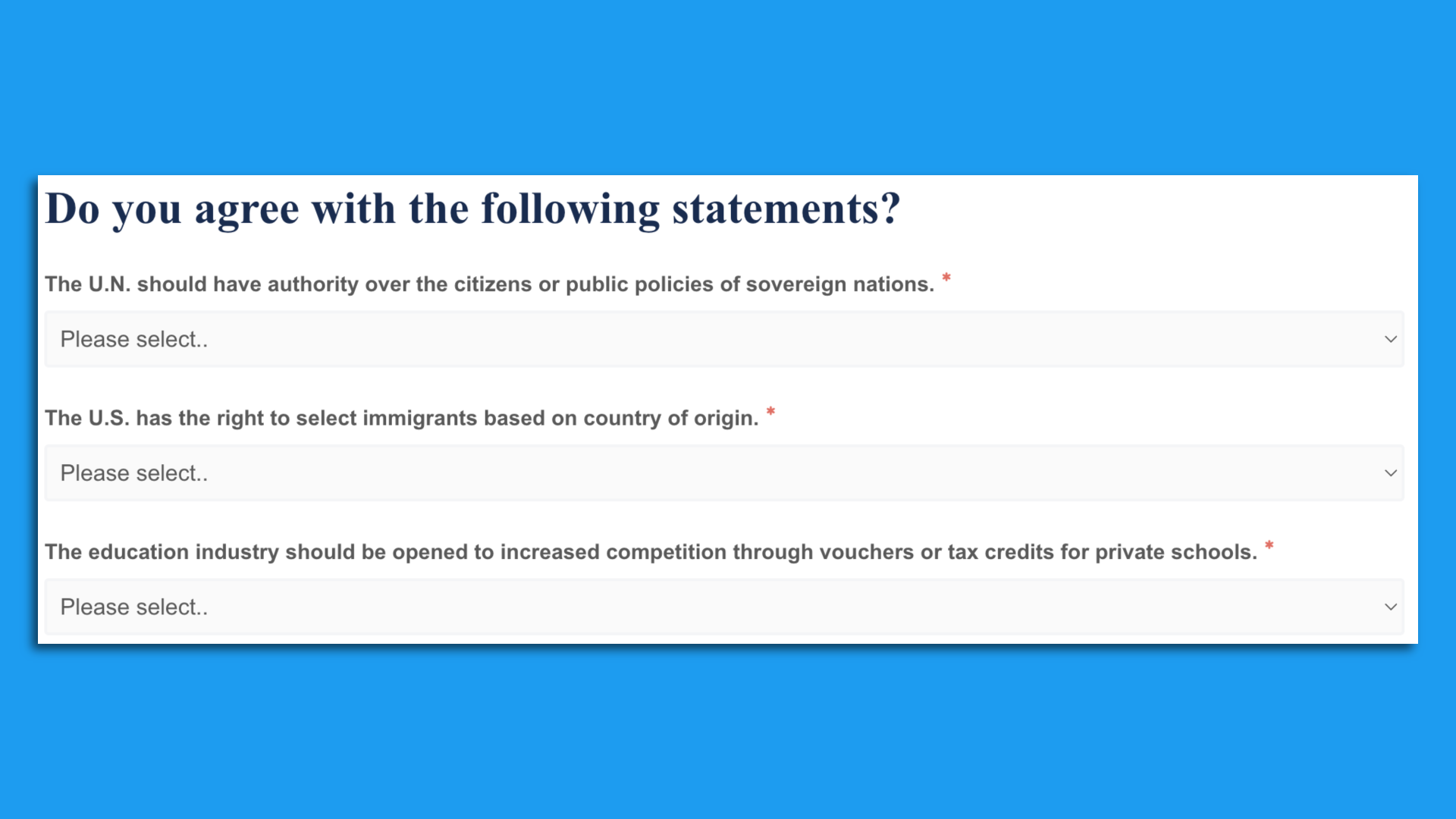
How it works: The most elaborate part of the pre-transition machine is a résumé-collection project that drills down more on political philosophy than on experience, education or other credentials.
Applicants are asked to “name one person, past or present, who has most influenced the development of your political philosophy” — and to do the same with a book.
Another query: “Name one living public policy figure whom you greatly admire and why.”
We’re told immense, intense attention will be given to the social-media histories of anyone being considered for top jobs. Those queasy about testing the limits of Trump’s power will get flagged and rejected.
Reality check: Technically, this apparatus will be inherited by any Republican nominee — Heritage officials tell us they’ve briefed the campaigns of Trump, Ron DeSantis and Nikki Haley.
But this is undeniably a Trump-driven operation. The biggest tell: Johnny McEntee — one of Trump’s closest White House aides, and his most fervent internal loyalty enforcer — is a senior adviser to Project 2025.
One of the most powerful architects is Stephen Miller, a top West Wing adviser for the Trump administration. Miller is charting an even harder line on legal and immigration policy than last time. While he maps a White House return, he’s president of America First Legal, which vows to fight “lawless executive actions and the Radical Left.”
Between the lines: Trump doesn’t hide his intentions. It’s important to tune out the theatrical language that drives social media and cable TV, and focus intently on the directional guidance of his second term.
He’s telling us exactly what he intends to do — like it or loathe it. And this time, he’ll have prefabbed institutional muscle to turn pugilistic words into policies and action from the get-go.
Here’s what the early days of a second Trump presidency would look like, based on his words and our conversations with Trump insiders:
His top obsession will be the Justice Department, the FBI and the intelligence community — all of which he thinks conspired to investigate him, thwart him, screw him. He’s been very clear that he’s willing to unleash these agencies against political enemies.
The next priority will be the Department of Homeland Security and the border, with plans to erect sprawling detention camps, “scour the country for unauthorized immigrants,” and “deport people by the millions per year,” The New York Times reports. We’re told Trump’s top criterion for immigration officials will be whoever promises to be most aggressive. Trump has told allies he’s confident the Supreme Court will back his most draconian moves.
As first reported by Jonathan Swan for Axios last year, a key tool for Trump’s “revenge term” would be the use of Schedule F personnel powers to wipe out employment protections for tens of thousands of civil servants across the federal government. Trump allies want a deep and wide purge of the professional staff that often serves across new administrations.
Officials close to the Pentagon tell us they’re worried about a plan, articulated by former Trump official Russ Vought in the Heritage document, to direct the National Security Council to “rigorously review all general and flag officer promotions to prioritize the core roles and responsibilities of the military over social engineering and non-defense related matters, including climate change, critical race theory [and] manufactured extremism.” Indeed, the Trump allies see obstacles to remove at every level of every agency.
The bottom line: This Trump-allied machine has the most power over the formation of a potential future government of any group in U.S. history. Trump, if elected, will leverage it to do things with government that none of us has seen in our lifetime.
“Behind the Curtain” is a column by Axios CEO Jim VandeHei and co-founder Mike Allen, based on regular conversations with White House and congressional leaders, CEOs and top technologists.
First it was trans and drag queens. Then it was books / media in schools with LGBTQIA characters or plots. Then it was any symbol related to the LGBTQIA such as the rainbow flag. All along I have said this was the following of Putin’s Russia in simply making being LGBTQIA illegal. No mention in any media that is not horrific, no representation in public, and no private practice in your home if others might find out. This is what the fundamentalist religious right wants and are trying to get. They also want to outlaw sodomy, even though it is not limited to gays and lesbians. It is control over how you can use your body and what you can enjoy, to please their weird view of Jesus. We better stomp this shit hard. Hugs. Scottie
Ps. This is a great sub-stack to follow for up todate factual information on trans or other LGTBQIA issues. Please go see what else she has written. Hugs. Scottie
In Murfreesboro, Tennessee, a new city ordinance targeting public homosexuality is hitting libraries. “When in History have the ones banning books been the good guys,” says local activist.
A municipal mandate enacted this past June in Murfreesboro, Tennessee, is now being used to target books in the local library system. The ordinance, outlawing “indecent behavior” in public and prohibiting “indecent materials,” is alarmingly vague in its delineation of indecency. This definition used in the law links back to a city statute that explicitly bans public homosexuality or materials promoting homosexuality. The code has already been used to target local Pride events. Now, the code’s enforcement has reached the local library system, where at least four books, all containing LGBTQ+ themes, have been pulled from the shelves.
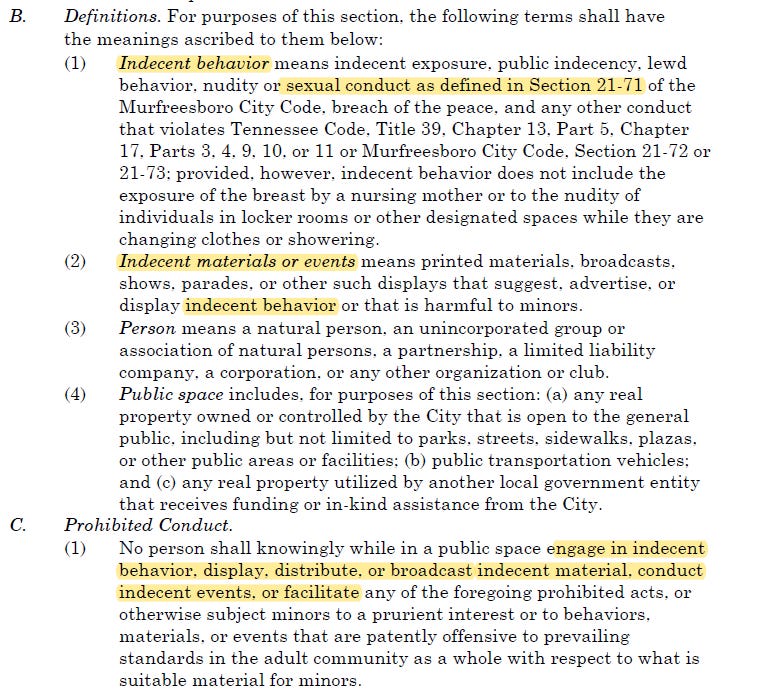
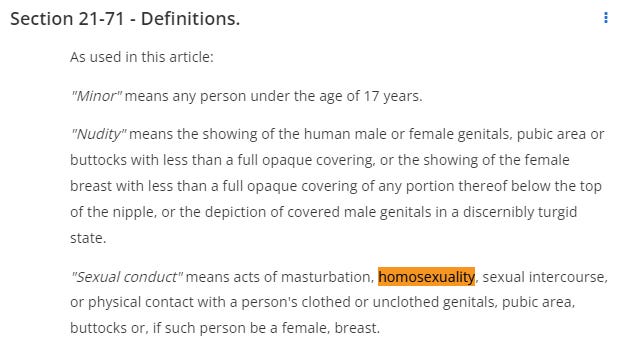
The ordinance in question is city ordinance 23-O-22. The ordinance states that the community “has the right to establish and preserve contemporary community standards.” It goes on to state that “indecent behavior” or “display” of “indecent materials” would be banned by the new provision. Importantly, the definitions of indecency link back to the city codes definition in section 21-71 of Murfreesboro city codes, which states that “sexual conduct” barred under the provisions includes “homosexuality.” The city ordinance further states that any “behaviors, materials or events that are patently offensive to the adult community” in Murfreesboro would also be banned. Finally, it gives police officers the right to enforce the provisions and states that anybody using city funds for the banned events or materials could be charged with further crimes.
You can see the particular provisions in the ordinance here:
Though the ordinance was not immediately enforced, in recent months, various city officials have begun using it to target the LGBTQ+ community in a variety of ways.The Rutherford County Library Board, chiefly composed of appointees from Murfreesboro’s city council and the Rutherford County Commission, met in August to remove books that might infringe upon the new statute. At a packed meeting in August, library authorities resolved to withdraw four titles: “Flamer,” “Let’s Talk About It,” “Queerfuly & Wonderfully Made,” and “This Book Is Gay,” all of which feature LGBTQ+ content. Following that, the council moved to enact a tiered library card system, where most nonfiction content will be gated behind the adult-only library card. This system will go into effect in 2024.
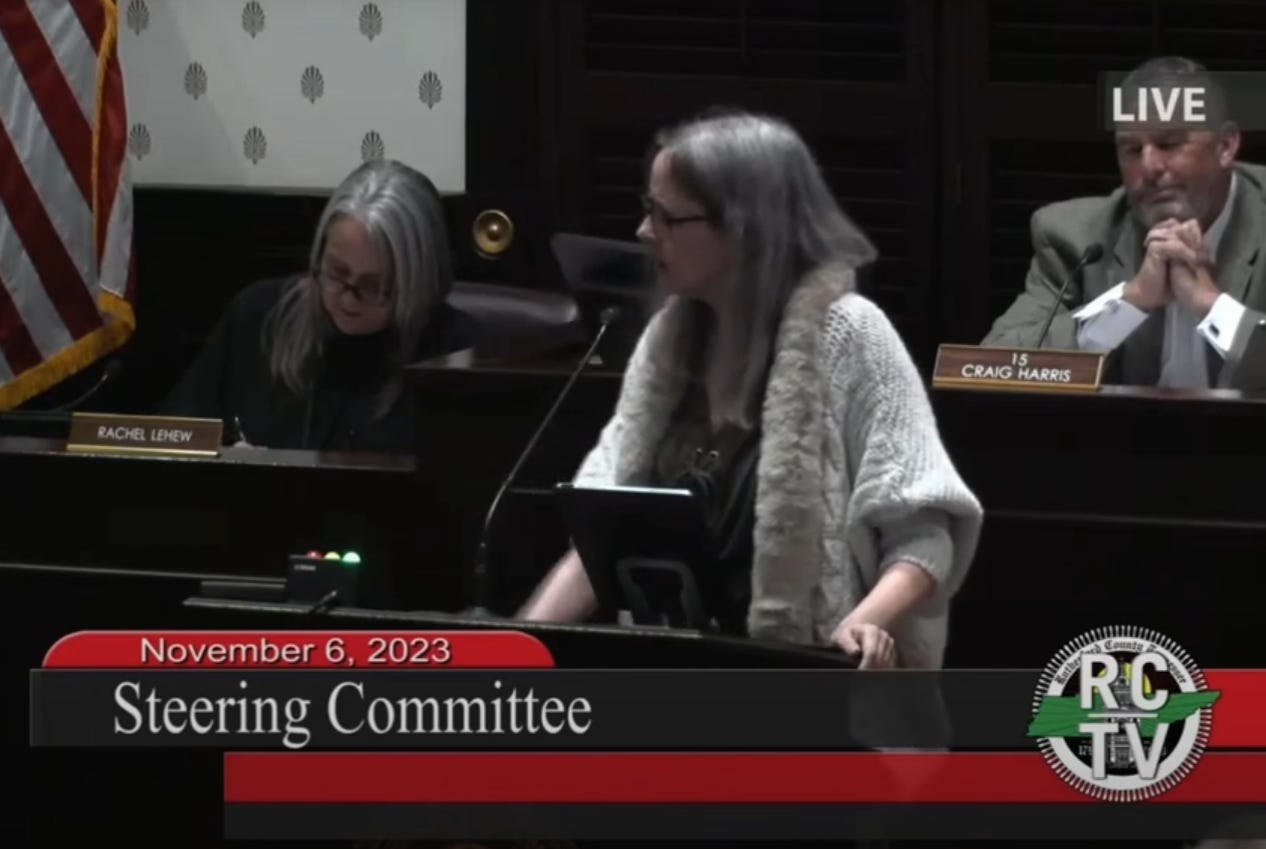
On Monday, however, the county steering committee met to discuss a new resolution: the removal of all books in the library that could possibly violate the Murfreesboro ordinance. The fiery meeting featured multiple board members stating that they had the right to “enforce community standards” and ban books. Speeches against the proposal were passionate, including one passionate speech by local activist Keri Lambert, who pointed out that the law was already being challenged in court and asked, “when have the people who ban books ever been the good guys?”
The attacks on the library system have not been the only usage of the new city ordinance. According to court filings challenging the ordinance, in 2022, Mufreesboro City Manager Craig Tindall stated that he would refuse permits to BoroPride after claiming that the Pride festival “intentionally exposed children” to sexual conduct. Meanwhile, according to the filing, the city council crafted a ruling behind the scenes to target LGBTQ+ events and material. Specifically, they connected the new provisions to a 1977 definition of obscenity that included homosexual conduct:
“Still worse, the Ordinance incorporates an earlier provision that defines ‘indecent behavior’ as including not simply masturbation and sexual intercourse (which most would agree are inappropriate in public), but also any acts of ‘homosexuality’ as a whole. Thus, under the Ordinance and the incorporated definition, any acts that are ‘homosexual’ in nature or any material or event even suggesting homosexuality, could be considered indecent and subject to civil and criminal penalties.”
The challenge to the ordinance is under way by American Civil Liberties Union of Tennessee, ACLU, Ballard Spahr, and Burr Forman on behalf of BoroPride, which was allowed to go forward after organizers reached an agreement with the city government.
Tennessee’s legislative landscape this year has been marked by the passage of several anti-LGBTQ+ statutes, particularly those banning gender affirming care and drag performances. While the ban on gender-affirming care has been upheld by the 6th Circuit Court of Appeals, the prohibition of drag shows has been blocked as unconstitutional. Meanwhile, local governments have been reactivating decades-old obscenity laws in attempts to ban LGBTQ+ expression. The ordinance in Murfreesboro is the latest manifestation of an ongoing campaign targeting LGBTQ+ rights, signaling a broader trend of restrictions to free speech and expression for the community within the state.
Let’s talk about the crisis at the US border with Mexico. Is it as bad as conservatives say it is? Turns out when you look at the data, immigrants aren’t the boogeyman that Fox News would have you believe. Let’s talk about what’s ACTUALLY happening at the border.
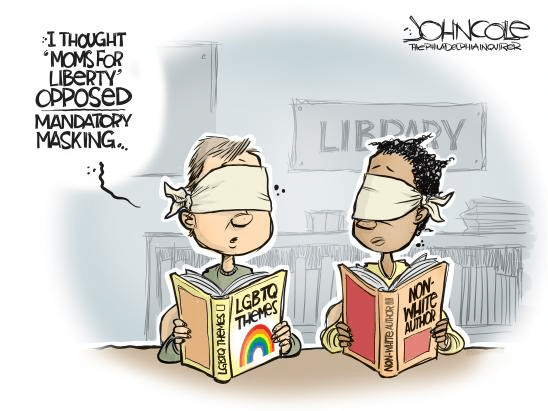
Can we not see the abuse of the legal system to target and cause harm to your opponent? In many ways it is terrorism. This is a deliberate attempt to remove a group of people, a segment of the public from schools and other media, so only they can be seen or represented. Calling any book with and LGBTQIA character in it pornography is ridiculous but resonates with people who don’t know how innocent these books are. They surely are cleaner and safer than the bible they claim is so moral. But their fire is dying down as more people see them for what they are. They are now like Marge Greene playing to a maga base for views and clicks in the media. As more of us get the word out about what they are doing, they have lost momentum and support. This is a deliberate attempt to whitewash an entire society to install a white religious over class, just as Russia did. Change the removal of books with LGBTQIA to the removal of books with black or brown people in then because it is pornographic, now who does it seem? Wouldn’t it be racist? Notice also how she claims that people like her fighting to censor and remove books are the good people using their rights, but she claims it is illegal for any groups or people to oppose or try to form groups against what her group is doing. WTF! Hugs. Scottie Also there is videos at the link above I am unable to repost here.
Two members of Moms for Liberty, a right-wing activist group, have reported several Florida school librarians to law enforcement. They claimed they had evidence that librarians were distributing “pornography” to minors and requested that law enforcement officers be dispatched. This represents a serious escalation of the tactics deployed by members of Moms for Liberty against school librarians.
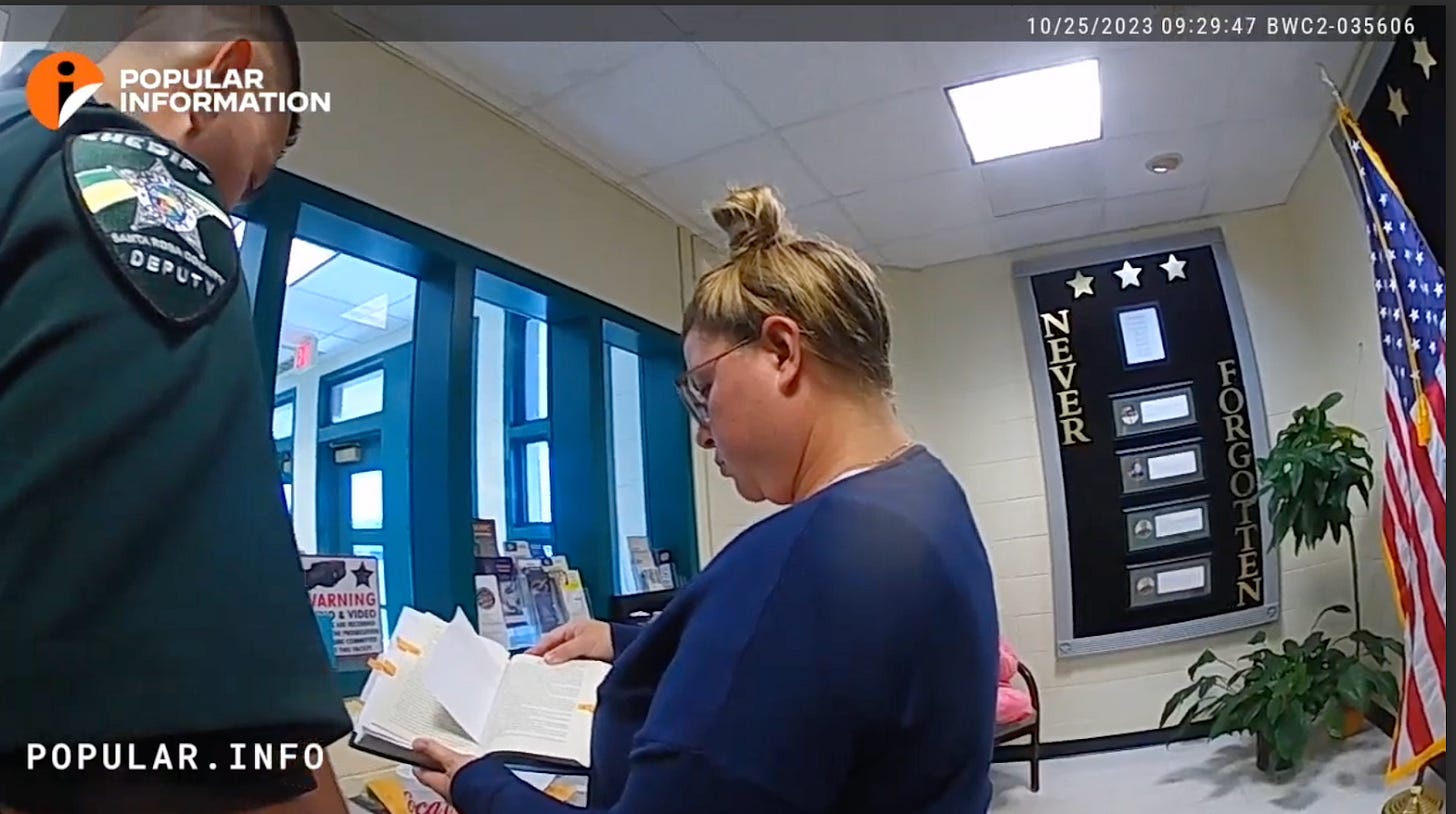
On October 25, Jennifer Tapley, a member of the Santa Rosa County chapter of Moms for Liberty and a candidate for school board, contacted the Santa Rosa County Sheriff’s Office. “I’ve got some evidence a crime was committed,” Tapley said in an audio recording of the call obtained by Popular Information through a public records request. “Pornography given to a minor in a school. And I would like to make a report with somebody and turn over the evidence.” Tapley made the call from the lobby of the main office of the Santa Rosa County Sheriff’s Office in Milton, Florida.
She told the dispatcher that she did not want to provide her name because she was “afraid of people getting mad at me for doing this.” Tapley said that she would tell the Deputy Sheriff her name, but she didn’t want “any public records with her name on it because then people could look it up.”
In an interview with Popular Information, Tapley said she was “scrolling through Facebook” this summer and saw “a video of a mom reading a book” that was “really disgusting.” She later learned that there was a Moms for Liberty chapter in her area addressing the issue and joined the group. As a member of the group, she learned that local schools had “some really shocking pornographic books in our libraries.”
Tapley was accompanied at the Sheriff’s Office by Tom Gurski, who is also active in the local Moms for Liberty chapter. Soon, Deputy Sheriff Tyler Mabire and another officer arrived and interviewed the pair.
“The only reason we are here: A crime is being committed. It’s a 3rd-degree felony. And we’ve got the evidence,” Gurski said in a body cam video of the interview obtained by Popular Information. “The governor says this is child pornography. It’s a serious crime,” Tapley added. “It’s just as serious as if I handed a playboy to [my child] right now, right here, in front of you. It’s just as serious, according to the law.” The video has been edited to protect the identity of a minor:
The “pornography” at issue is actually a popular young adult novel, Storm and Fury, by Jennifer L. Armentrout. The book, which is 512 pages, is mostly about humans and gargoyles fighting demons. The main character of the novel, Trinity, is 18 years old. There are some passages with sexual themes, including a few makeout sessions, and one where the main character almost has sex. In the 2020-21 academic year, the Florida Association of Media in Education (FAME), a professional association of Florida librarians, recommendedStorm and Fury on its “Teen Reads” list. FAME says books on the list “engage” teens and “provide a spur to critical thinking.” Barnes and Noble recommends the book for readers 14 to 18. It was also recommended for students by the School Library Journal.
Armentrout told Popular Information that it was surprising to learn we are “living in an era where, apparently, some adults find it appropriate to contact the police over a fictional book involving gargoyles.” She said Storm and Fury “is very close to my heart, as the main character has the same degenerative eye disease, retinitis pigmentosa, as I do.” Armentrout said she wrote the book “to educate people on a little-known disease in a fun, suspenseful, and adventurous way.” The purpose of the book, Armentrout said, was not to “incite sexual excitement.”
Tapley told Popular Information that any book that has a “sex scene” is pornography and not “appropriate for minors.” She did acknowledge that there may be exceptions for “extreme classics.” But the books Moms for Liberty is targeting, Tapley says, are “without significant literary value.”
Florida law, however, only bans distributing a book or other material with sexual content if it is “harmful to minors,” a standard established by Supreme Court precedent. Under Florida law, a book is only “harmful to minors” if it “[p]redominantly appeals to a prurient, shameful, or morbid interest” and is “patently offensive to prevailing standards in the adult community as a whole with respect to what is suitable material or conduct for minors.” Storm and Fury, a book that is predominantly about fighting demons, is routinely recommended by adults for high school students.
Gurski told the officer that Storm and Fury was checked out from Jay High School “by a 17-year-old, which is important because she is a minor.” Tapley showed the officers the book, with the offending passages marked with orange sticky notes.
In Santa Rosa County schools, once a book is challenged for sexual content, the policy is to take it out of circulation within five days, pending a review. Tapley alleged, “we have already turned in this book,” but the Jay High School librarian did not remove it. That allegation appears to be incorrect. Storm and Fury does not appear on lists of challenged books in Santa Rosa County maintained by the school district and Tapley.
In addition to the librarian at Jay High School, Tapley points the finger at Ruth Witter, the head librarian for the county. Tapley presents the officers with a printout of Witter’s Facebook page and claims it is proof that “she [has been a] member of Santa Rosa County Stop Moms for Liberty since May.” She explains that “Moms for Liberty is trying to… get rid of these books” and “fights for parents’ rights.” Meanwhile, Tapley alleges, Stop Moms for Liberty “are the people who are against Moms for Liberty.”
Tapley claims that, by following the Santa Rosa County Stop Moms for Liberty group, Witter is “fighting us actively.” She also connects this to alleged “death threats” against
Moms for Liberty members, without elaborating. Tapley does not mention that Witter also follows several conservative pages on Facebook, including Fox Nation and a Republican candidate for local office.
The librarian at Milton High School is also singled out by Tapley for posting in a Facebook group called Emerald Coast SWEEP, a local chapter of the group Red, Wine, and Blue. Tapley describes Red, Wine, and Blue as “a very liberal activist group of people fighting for abortion rights” that opposes the removal of books from public school libraries. Tapley says the Milton librarian is seeking “liberals” to join the school’s book review committee, which Tapley claims is “illegal.”
Asked if she would like to see librarians criminally charged, Tapley told Popular Information that it “depends on if there’s an intent.” She said her hope was that the Sheriff would tell the librarians, “you can’t do this,” and “if you continue to do this, then there would be charges.” Tapley added that she “didn’t really want to see anybody have their life ruined.”
In an interview, Tapley downplayed her role at the Sheriff’s Office, claiming she was not “seeking out any books and trying to go to the police with it or anything.” She described her role “as a helper.” She only put her name on the report “so that somebody else could be protected.” In an email, Tapley said she “had no interactions with the Sheriff’s Office beyond accompanying a citizen there” and “any reporting that states otherwise would be unfactual.”
Popular Information has posted the full video from the Santa Rosa Sheriff’s Office on YouTube.
“To see the orchestrated campaign to remove books from schools escalate to a police station is shocking,” Kasey Meehan, a Director at PEN America, a non-profit dedicated to free expression, told Popular Information. “Professional librarians apply sensible measures to curate their collections for diverse audiences of readers, and they should not be punished for making knowledge accessible to students that falls well short of the well-established legal standards for obscene materials.” Stephana Ferrell of the Florida Freedom to Read Project described the tactics of Moms for Liberty members in Santa Rosa County as an effort to “bully the district into sacrificing access to protected speech.”
Popular Information contacted Mariya Cakins, the chair of Santa Rosa Moms for Liberty, for comment. Cakins said that she would be happy to speak, but the request needed to be routed through the national Moms for Liberty organization. The group never responded to that request. Popular Information was unable to identify reliable contact information for Gurski.
The efforts of Tapley and Gurski to initiate an investigation by the Santa Rosa County Sheriff’s Office appear to be unsuccessful. According to a document obtained through a public records request, the Sheriff’s Office quickly referred the report to Daniel Hahn, the director of safety at Santa Rosa County Florida School District. The Santa Rosa County Sheriff’s Office then closed the case.
Gurski, however, is having better luck with other law enforcement agencies.
Florida police department has open criminal investigation of Florida librarians
“Approximately ten days ago, I had a book in my hand that was issued by the Milton school library, which is not your jurisdiction,” Gurski told Deputy Mabire at the Santa Rosa County Sheriff’s Office. “I went to the Milton police station. Submitted an affidavit and the evidence of that particular book. And they have that now for investigation.” Gurski said he considered the book pornography.
Tapley says the book reported by Gurski to the Milton police was another young adult novel, Naomi and Ely’s No Kiss List, by Rachel Cohn and David Levithan. The book is a romantic comedy and has some sexual situations and discussions. It also includes LGBTQ characters. It is recommended by Common Sense Media, an independent non-profit that evaluates media for parents, and Publishers Weekly for readers 14 and older.
In response to a public records request, the Milton Police Department said it could not release any information regarding Gurski’s complaint about the book because there is an “open and active investigation pending State Attorney review.”
The Vicki Baggett connection
Tapley told Popular Information that Vicki Baggett, an English teacher in Escambia County, has been “helping us.” Baggett, who Popular Information interviewed earlier this year, has challenged hundreds of books in public school libraries, including many that have LGBTQ characters or address racism. Baggett told Popular Information that she challenged When Wilma Rudolph Played Basketball — the inspirational story of a Black woman who overcame racial prejudice to become an Olympic champion — because it would make white students “feel uncomfortable” as “they are being white-shamed.” In a follow-up report, Baggett’s current and former students alleged that Baggett openly promoted racist and homophobic beliefs in class. Nevertheless, Baggett has been successful in getting numerous books removed from Escambia public schools. The Escambia school district is now facing a federal lawsuit from a group of authors and First Amendment advocates.
Tapley described Baggett as “a valiant warrior for the kids, an amazing English teacher, and a wonderful Christian woman.” According to Tapley, Baggett has come to Santa Rosa County and “has been helping us see what’s in our libraries.” Many of the challenges in Santa Rosa County are duplicates of those Baggett submitted in Escambia County. “She’s been the catalyst really for a lot of this,” Tapley said. “She taught me how to do it.” Baggett initially submitted the challenges in Santa Rosa County herself, but those were rejected because she is not a resident. Many of those challenges have been resubmitted with Baggett’s name alongside a Santa Rosa County resident.
What the hell? That is the place they are demanding the Palestinian people leave. No they want them back where the bombs can kill them. Don’t we finally see what this is, it is the attempt to kill all the Palestinians they can? It is a version of the finial solution. They want to push of kill all the people there and take the land. And the Israeli government is starting to be honest about it as other governments including the US pull back support. They will not stop, they don’t need our help to do it, and so they will. Time for threats of sanctions and other actions we would take against any other government doing this. Hugs. Scottie
BY TIA GOLDENBERG AND ISABEL DEBRE
Updated 5:10 PM EDT, November 3, 2023
JERUSALEM (AP) — Israel on Friday deported thousands of Palestinian workers from the Gaza Strip back to the besieged territory, Palestinian authorities said, capping what many described as harrowing weeks trapped in legal limbo since their detention when the Israel-Hamas war erupted.
Some workers, streaming by foot through an Israeli crossing that had been sealed shut since Hamas unleashed its brutal attack on southern Israel Oct. 7, told of violent mistreatment by Israeli authorities in detention centers. The Israeli military did not immediately respond to a request for comment on the allegations.
“We sacrificed and they treated us like livestock over there,” one of the workers, Wael al-Sajda, said from the border, pointing to his ankle fitted with an identification bracelet.
Al-Sajda was among the roughly 18,000 Palestinians from Gaza allowed to work in menial jobs in Israel. The permits have been coveted in Gaza, which has an unemployment rate approaching 50%. Israel began issuing the permits in recent years, a measure it thought helped stabilize Gaza and moderate Hamas, despite a broader blockade aimed at weakening the Islamic militant group.
If you want to understand this conflict, if you want to see what real bigotry / racism is watch this video. There is no doubt who is in the wrong, who are the villains really are. Hugs. Scottie
On October 7, Hamas, a militant group based in the Gaza Strip, launched a deadly attack on Israel, killing over 1,400 Israelis and kidnapping over 200. In retaliation, Israeli airstrikes have killed, as of this video, over 6,400 Palestinians in Gaza, where Palestinians have lived for decades under an occupation and blockade.
Since 1967, Israel has imposed tight restrictions on travel and essential goods such as food, fuel, medicine, and water in its occupied territories. In 2007, those restrictions became even tighter in Gaza after Hamas seized power there. Since then, it has been nearly impossible for Palestinians to leave Gaza or to access an adequate supply of essential goods.
Today, the Gaza Strip, with a population of over 2 million Palestinians, is a victim of what many call “collective punishment” as Israel bombards its population, shuts off access to internet, power, food, water, and medicine, forces them to leave their homes, and prepares for a ground invasion.
This latest episode of Vox Atlas explains how the experience of Palestinians in Gaza got to this point, and what’s behind Israel’s occupation and its blockade of Gaza.
Read the full article. As you can see below, homocon extremist Andy Ngo and the far-right hate group Gays Against Groomers are celebrating.
Drag Queen who goes by “Pickle” DENIED entrance to Drag Queen Story Hour at San Fernando Valley Public Library by protestors pic.twitter.com/YGVNrKs9JY
The jerk below is a well known right wing agitator who used to make stuff up about BLM protestors to try to promote anger at them and black people. I watched the video in which he claims people of color stopped the performance yet in the video all the people are white. Hugs
A children’s drag event at the San Fernando Library featuring Pickle the drag queen was shut down at a peaceful protest on Oct. 25. Parents of color surrounded the front of the library, preventing Pickle the drag queen from coming inside to perform. The drag event was organized… https://t.co/5ZKvFcGEXEpic.twitter.com/8qLQ2UIMD1
Angry protesters outside a San Fernando library block Drag Laureate Pickle from a Drag Storytime event inside. Now, local leaders are taking to social media to condemn the protests and support the drag events. The new controversy – Tonight at 11 from ABC7 https://t.co/7I37pYARrwpic.twitter.com/k9uiThT9AP
The cops around where I live are known for their indifference to gay people despite this being a town heavily populated by gays. This place is sick with hypocrisy
About six to eight protesters refused to leave the entrance even after police issued a dispersal order, according to Pickle.
How many did they arrest after the order was disobeyed? None.
Conclusion: It’s okay to ignore orders from police if you’re illegally blocking a public building’s entrance/exit, though maybe it’s a special rule that only applies to fascists protesting a person in costume reading to children.
Could any of them give a reason why those kids, whose parents approved and were in attendance, should have decisions made for them by some other party who doesn’t know them?
Look at the pictures, and tell me what is sexual happening? What is threatening to kids in these pictures? A small group of angry violent haters were allowed by the 10 police officers there to deny other people the right to use a public facility and see the performance they had come to see. The police allowed them to block entrances, to scream profanities in front of children they claimed to be trying to protect, and seemed to feel entitled to force others to do only what the hateful protesters want. This is not democracy. Think of how the police handle BLM protestors, and yet made no move to arrest these protestors. Below is a quote from the article. Hugs
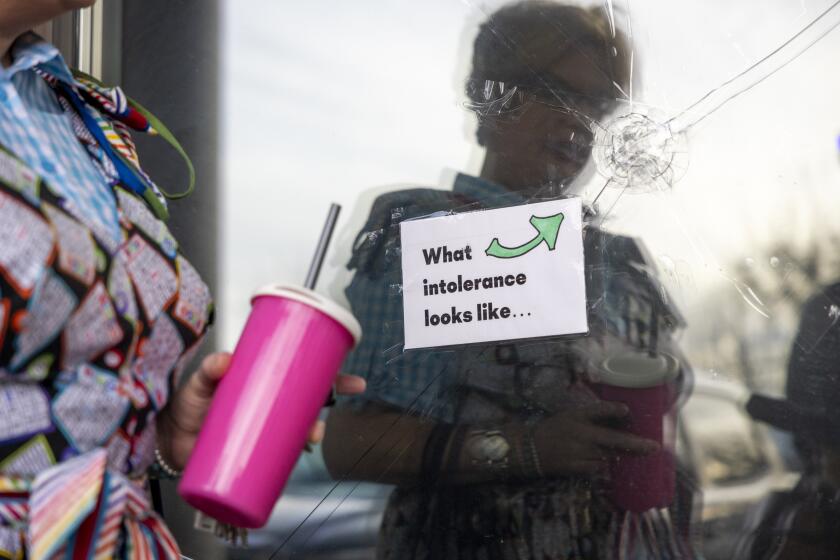
“Protesters claimed they want to keep children safe while pounding on walls, shouting obscenities and slurs toward my staff and library staff, and using strollers to blockade moving vehicles. The hypocrisy is astounding,” Horvath said.
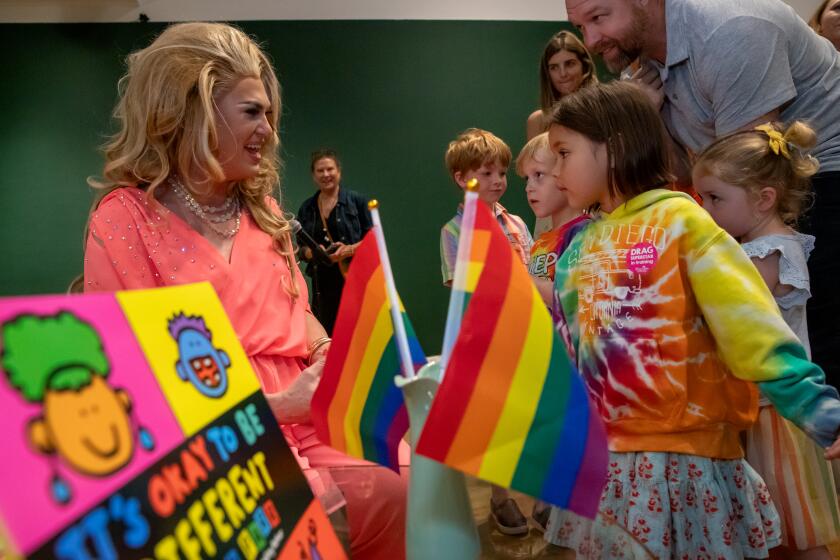
Drag queen Pickle reads a story to children during a Drag Queen Story Hour event at the Laguna Art Museum in Laguna Beach on June 17.
Dozens of protesters physically blocked the entrance to the San Fernando Library this week to stop a scheduled drag storytime reading event from taking place.
Videos posted on social media showed a group of about 70 people — some of whom had previously attended similar demonstrations in North Hollywood, Glendale and elsewhere — wearing black-and-white shirts reading, “Leave our kids alone.” They chanted the same slogan through bullhorns while hurling verbal abuse and slurs at the guest reader.
Story hours, during which drag queens read to children at venues such as libraries, schools and bookstores, have drawn fury and condemnation from conservatives and right-wing extremists across the country. Some events have been the subject of anti-LGBTQ+ threats and at times violent confrontations.
Wednesday’s scheduled 30-minute event, which organizers said was intended to promote youth literacy, never took place.
April 23, 2023
“What was meant to be a celebration of love and inclusion turned into the opposite,” Los Angeles County Supervisor Lindsey Horvath, the event’s host, said in a statement Thursday.
“Protesters claimed they want to keep children safe while pounding on walls, shouting obscenities and slurs toward my staff and library staff, and using strollers to blockade moving vehicles. The hypocrisy is astounding,” Horvath said.
Horvath’s staff said in an email that the supervisor, who was inside the library, did not officially cancel the event. But it did not proceed because demonstrators “blockaded” entrances — denying entry to both library patrons and drag queen Pickle, the guest reader.
Pickle, Los Angeles chapter president of the nonprofit Drag Story Hour, said she parked blocks away from the library “for safety reasons,” anticipating some hostility.
Video footage showed that San Fernando police officers encircled Pickle near the rear entrance. The phalanx moved toward a metal gate but stopped short as some protesters screamed “pervert,” “pedophile” and “disgusting freak” at Pickle.
About six to eight protesters refused to leave the entrance even after police issued a dispersal order, according to Pickle. The San Fernando Police Department did not confirm or deny whether such an order had been given.
The drag performer said she and the police then attempted to move to the front entrance. As they walked, protesters blared car horns, refused to move and positioned nearby tables to block the front entryway, she said.
“At this point, the police weren’t making arrests, they weren’t stopping the mob and they were allowing an unelected group of people to determine who could and who could not access a public building,” Pickle said. “Shame on the San Fernando police.”
Pickle received a text from Horvath’s staff telling her to leave since she was unable to enter the building. After receiving a police escort back to her car, she did so.
“They canceled the event and I can’t believe how they handled the situation,” Pickle said, referring to staff from the library and Horvath’s office. “This goes beyond hurt feelings. This is about civil rights and they shouldn’t have invited me down if they weren’t going to stand up for them.”
Questions emailed to L.A. County Library personnel, who oversee the San Fernando Library, were not immediately answered Thursday.
Pickle said she has attended about 50 drag story hour events, but this was the first canceled in person.
A story hour she was scheduled to appear at in Glendale last spring was canceled ahead of time, and protesters also disrupted another of her storybook hours in Sherman Oaks in April.
San Fernando Police Lt. Pete Aguirre said 10 officers were deployed to the library.
Aguirre said no arrests were made and no assaults or property damage were reported.
Aguirre said protesters began arriving at 10:30 a.m., with most staying until the event was terminated at noon. Others didn’t leave for another hour and engaged with a “small contingent of counter protesters.”
“We weren’t able to get to the venue, but we ensured that the performer was not assaulted in any way and that they were able to leave the venue unharmed,” Aguirre said.