In The Republican War On Libraries

This came in email a few days ago. The email has a few stories in it that are pertinent to our interests. This was going to be a snippet post of those, but as I read this, I realized everyone needs to read it all, because there’s not much opinionating in it, but/and the actual information does not stop.


The Institute for Museum and Library Services Was Just Gutted

Kelly Jensen Mar 31, 2025

Today, members of the Department of Government Efficiency (DOGE) gutted the Institute for Museum and Library Services (IMLS). As of this afternoon, all staff members have been placed on administrative leave. They received a letter from the Director of Human Resources that the leave would be paid for 90 days and that no one will be allowed on IMLS property during that time.
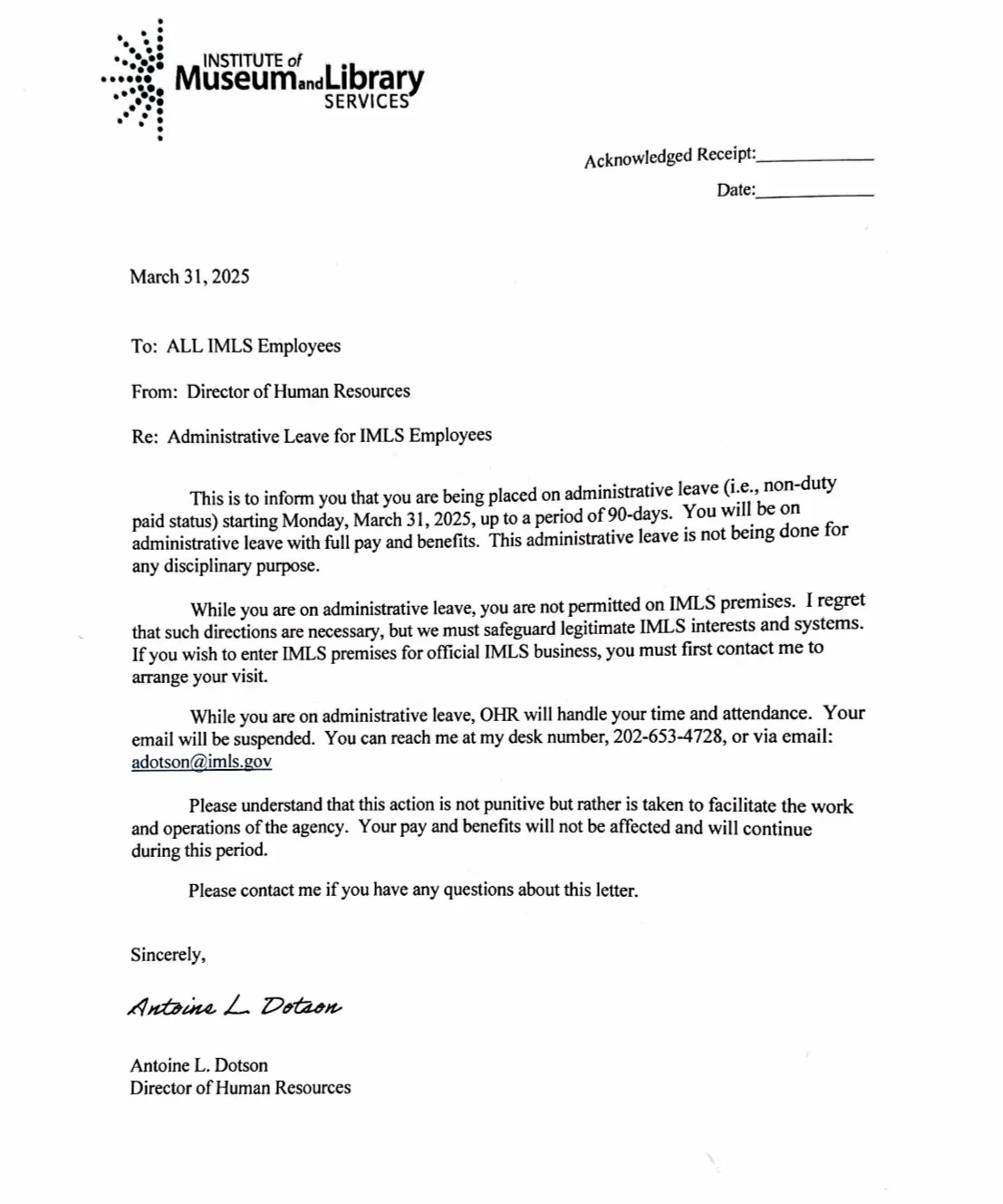
Image of the letter all IMLS staff received about administrative leave.

The union representing IMLS staff, AFGE Local 3403, indicated that the decision to fire staff came after a short meeting between DOGE and IMLS leadership. Everyone working at IMLS was required to return government property before exiting the workplace.

Email addresses for all IMLS staff were being disabled today. Those with questions or concerns over IMLS funding will no longer be able to reach the individual or individuals with whom they’d been working.
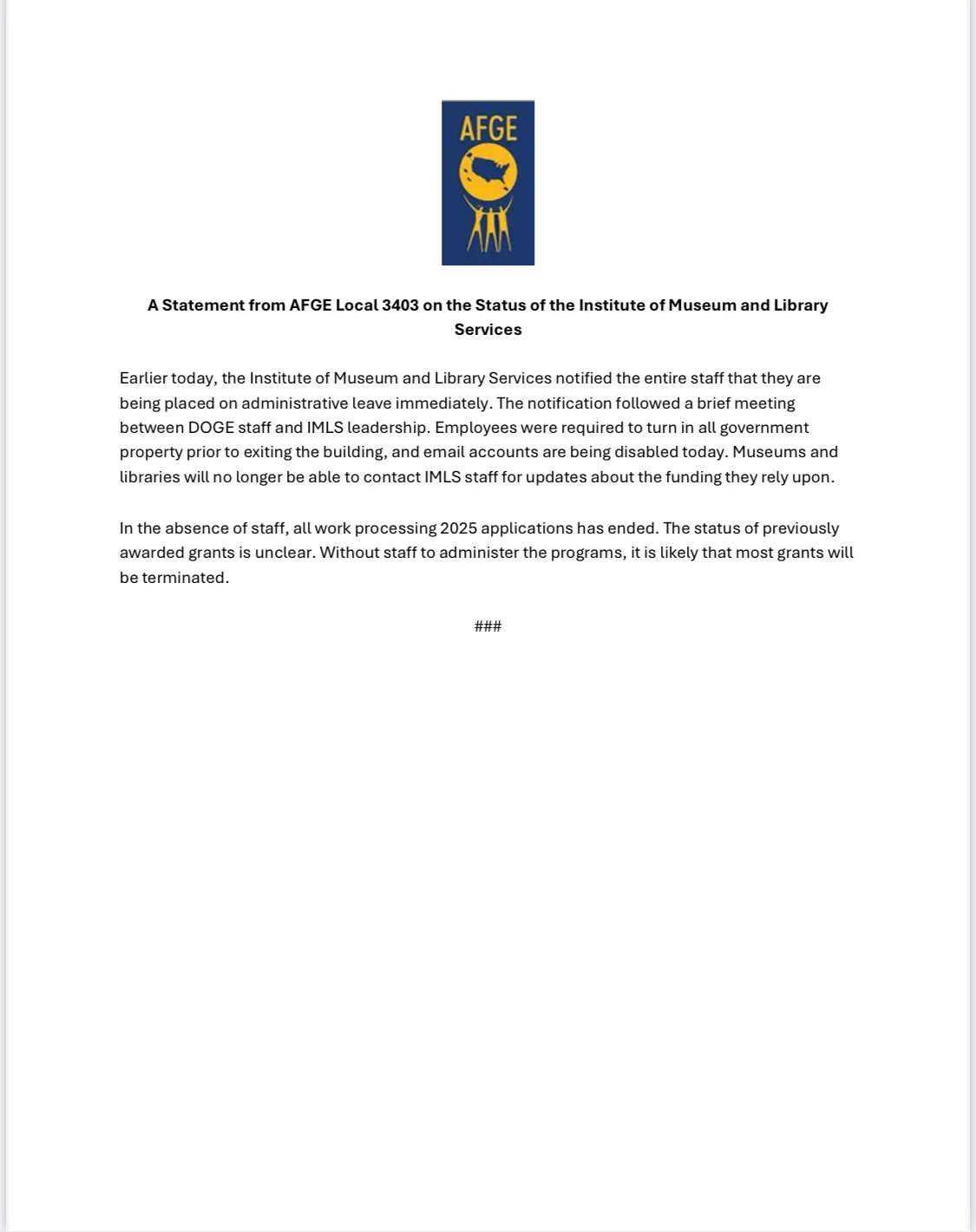
Letter from AFGE Local 3403 stating that IMLS staff were no longer in the building and their emails were being shut down.

Further, all processing work on 2025 funding applications is over and there is no information about the status of awards that have already been granted for the year. The union believes most grants will simply be terminated.

IMLS makes up .0046% of the federal budget.

Two weeks ago, President Trump issued an Executive Order targeting funds allocated to libraries and museums nationwide. The Institute of Museum and Library Services (IMLS) is a federal agency that distributes fund approved by Congress to state libraries, as well as library, museum, and archival grant programs. IMLS is the only federal agency that provides funds to libraries. The Executive Order states that the functions of the IMLS have to be reduced to “statutory functions” and that in places that are not statutory, expenses must be cut as much as possible.

One week later, the Department of Government Efficiency (DOGE) entered the IMLS offices. Many at IMLS were prepared to see their jobs disappear, but that didn’t quite happen. Instead, DOGE installed a new Acting Director of the agency, Deputy Secretary of Labor Keith E. Sonderling.

It wasn’t just a new Acting Director, though. The IMLS took on a new direction thanks to the Executive Order and DOGE. It would now operate “in lockstep with this Administration to enhance efficiency and foster innovation. We will revitalize IMLS and restore focus on patriotism, ensuring we preserve our country’s core values, promote American exceptionalism and cultivate love of country in future generations.”

The new goal of the administration with the IMLS is for it to function as a propaganda machine. This wouldn’t be the first nor the last federal cultural institution to see its mission shift from serving the needs and interests of all of America. On March 28, the administration would issue another Executive Order, this time demanding that the Smithsonian, the National Museum of African American History and Culture, and other federal museums stop the “revisionist movement” through displays and installations that showcase American history and culture as “racist, sexist, oppressive, or otherwise irredeemably flawed.”

Such institutions are now to engage in “igniting the imagination of young minds, honoring the richness of American history and innovation, and instilling pride in the hearts of all Americans.” The Executive Order specifically notes that the Independence National History Park see time and energy poured into these pro-patriotic efforts in order to be prepared for the 250th American anniversary events in 2026.

The defunding and gutting of the IMLS did not happen without strong support shown for public library and museum resources across the country, both on the ground and in congress.

On March 24, the board of the Institution of Museum and Library Services drafted a letter that went to Sonderling as their new Acting Director. The letter outlines the essential functions of the agency, making it clear that any cuts to the IMLS would have a direct and long-lasting impact on public museums and libraries nationwide. It emphasized that an Executive Order alone is not enough to change the functions or services provided by the IMLS.

From the letter:

All such statutory obligations may not be discontinued or delayed under an Executive Order or other executive action. Sections 9133 and 9176 of the Act affirm IMLS’s duty to obligate and disburse funds to grantees, subject only to the availability of appropriations, not to executive discretion. Any failure to fulfill these legal obligations or to reduce staffing or program operations below the minimum required to meet statutory mandates would place the agency in noncompliance with Congressional intent.

Several members of Congress also pushed back against the Executive Order. On March 26, a bipartisan coalition consisting of Senators Jack Reed, Kirsten Gillibrand, Susan Collins, and Lisa Murkowski sent a letter to Sonderling as well. The letter again defines the role of the IMLS and its obligation when it comes to funding institutions across the US.

From their letter:

Libraries and museums play a vital role in our communities. Libraries offer access for all to essential information and engagement on a wide range of topics, including skills and career training, broadband, and computing services. IMLS grants enable libraries to develop services in every community throughout the nation, including people of diverse geographic, cultural, and socioeconomic backgrounds, individuals with disabilities, residents of rural and urban areas, Native Americans, military families, veterans, and caregivers. Museums serve not only as centers for education but also as drivers of local economic development. The IMLS Office of Museum Services is the largest dedicated source of investment in our nation’s museums, which typically support more than 700,000 jobs and contribute $50 billion annually to the U.S. economy. IMLS funding plays a significant role in this economic impact by helping museums reach more visitors and spur community development.

While that letter circulated, another was passed around the House of Representatives. Led by Representatives Dina Titus (NV-01) and Suzanne Bonamici (OR-01), the letter was shared among House members. It urged them to sign on in asking for the administration to reconsider its Executive Order related to IMLS funding and structure.

Public libraries and public library associations nationwide have spoken loudly about how potential cuts to IMLS could impact state and local level services. Among the services that could most quickly and directly impact library users would be the end of digital resource availability through apps like Libby.

It is worth noting that despite some viral claims made online in the wake over fears of IMLS funding cuts, OverDrive’s Libby app and other similar digital resource programs are not funded by IMLS directly. They are, however, sometimes made available in individual states via funding received via IMLS. This is a crucial distinction. Libby and other eresources are not creations of libraries themselves by third-party systems that license access to materials. Libraries pay for that access.

Ebook and digital audiobook services are not funded by IMLS money in every state, and because of how many different types of ebook and digital audiobooks are available–indicative of how many different audiences and needs are being met–essential services without the Libby name recognition are being overlooked. In states where such services are made available through IMLS money, many times the apps and resources are not explicitly named by state funding, making it difficult to determine where such impact would be felt immediately. For example, Indiana libraries use IMLS funding for the Indiana Digital Library, which among its many databases and services provides access to Libby.

Find below a roundup of state library associations, local-level libraries, social media library workers/advocates, and/or local/regional news sources who have identified where and how IMLS cuts would directly impact their state libraries. This isn’t a comprehensive list, but you’ll see within the states here, many rely on IMLS funds to help acquire, fund, and maintain essential digital resources:

The future of IMLS remains uncertain, and with ongoing efforts to rewrite the truth of America via Executive Orders and whitewashing cultural institutions funded and respected by American taxpayers, it’s essential to continue speaking up on behalf of your local library, as well as one of your local library’s most crucial federal agencies.

Those which stand to be most devastated by potential cuts are rural and small libraries, who are also most impacted by the administration’s dismantling of the Department of Education and the United States Postal Service.

Whether or not Trump and his DOGE team have the legal authority to shut down the IMLS completely remains to be seen. Eliminating all staff and pausing all funding certainly defies the administration’s own order that only activities outside of “statutory requirements” be touched. Expect a lawsuit to be filed in the courts, much as we’ve seen with the other slash-and-burn efforts taken by an executive branch overstepping its constitutional authority.


Fun Quiz To Go With A Book I’m Eagerly Anticipating Reading

What Cheese Are You? Take The Quiz! 🧀

Tiana Tolbert 3 Comments

The moon’s made of cheese now, so it’s time to find your dairy twin. Take this quiz inspired by When the Moon Hits Your Eye by John Scalzi and embrace your inner cheese. 🧀 (snip-click through and have a little fun!)

==================================================

My Results:
“40% – You Are…Aged Cheddar!

“Sharp, dependable, with a bit of bite. You bring structure to the madness and probably have a Google Doc for surviving moon cheese events.”

(Hiding Snickers Behind My Hand…)

Crosswalks in Silicon Valley Hacked to Talk Like Musk and Zuckerberg

In one snippet, a crosswalk hacked to sound like Mark Zuckerberg told individuals there was nothing they could do to stop progress of AI.

By Thomas Maxwell Published April 14, 2025 

Over the weekend, crosswalk pedestrian signals in the backyard of Mark Zuckerberg and Elon Musk were hacked to play voices imitating their likeness. But they were not exactly kind to the billionaires, instead offering a commentary on the heightened polarization and distrust of the two leaders who have become more influential than ever in today’s society and Washington in particular.

In one video posted to TikTok, after the crosswalk button is pressed, it begins to say, “It’s normal to feel uncomfortable or even violated as we forcefully insert AI into every facet of your conscious experience.” It continues, “I just want to assure you, you don’t need to worry because there’s absolutely nothing you can do to stop it.”

Meta has been pushing AI heavily, inserting “Meta AI” buttons into search boxes across its apps and promoting the idea of interacting with AI characters tailored to a user’s interests in lieu of real humans. Recent surveying by YouGov found 44% of Americans are skeptical of AI over concerns ranging from invasion of personal privacy to the spread of misleading videos or deepfakes. But companies like Meta are betting that AI will enable more people to create content online and communicate with friends. (snip-MORE)

An Unsettling Headline-

For the First Time, Artificial Intelligence Is Being Used at a Nuclear Power Plant

Alex Shultz Published April 13, 2025 | Comments (4)

Diablo Canyon, California’s sole remaining nuclear power plant, has been left for dead on more than a few occasions over the last decade or so, and is currently slated to begin a lengthy decommissioning process in 2029. Despite its tenuous existence, the San Luis Obispo power plant received some serious computing hardware at the end of last year: eight NVIDIA H100s, which are among the world’s mightiest graphical processors. Their purpose is to power a brand-new artificial intelligence tool designed for the nuclear energy industry.

Pacific Gas and Electric, which runs Diablo Canyon, announced a deal with artificial intelligence startup Atomic Canyon—a company also based in San Luis Obispo—around the same time, heralding it in a press release as “the first on-site generative AI deployment at a U.S. nuclear power plant.”

For now, the artificial intelligence tool named Neutron Enterprise is just meant to help workers at the plant navigate extensive technical reports and regulations — millions of pages of intricate documents from the Nuclear Regulatory Commission that go back decades — while they operate and maintain the facility. But Neutron Enterprise’s very existence opens the door to further use of AI at Diablo Canyon or other facilities — a possibility that has some lawmakers and AI experts calling for more guardrails.

PG&E is deploying the document retrieval service in stages. The installation of the NVIDIA chips was one of the first phases of the partnership between PG&E and Atomic Canyon; PG&E is forecasting a “full deployment” at Diablo Canyon by the third quarter of this year, said Maureen Zawalick, the company’s vice president of business and technical services. At that point, Neutron Enterprise—which Zawalick likens to a data-mining “copilot,” though explicitly not a “decision-maker”—will be expanded to search for and summarize Diablo Canyon-specific instructions and reports too.

“We probably spend about 15,000 hours a year searching through our multiple databases and records and procedures,” Zawalick said. “And that’s going to shrink that time way down.” (Emphasis mine- A. I worked at the nuke plant in my state in my 20s. I did Records Management. I’m not going to explain it all from back then the way I trained people, but it involves reading and interpreting what one has read in application to the function, part, area, etc. a document records, which is learned by reading the document, then coding it so it is efficiently retrieved later. So far, I don’t know that AI does that. Others who are more knowledgeable about records management and retrieval in this era and context may see better things than I see. The best worst I see is really angry and impatient engineers and inspectors in all the disciplines still at the plant. That’s no fun, anyway.)

Trey Lauderdale, the chief executive and co-founder of Atomic Canyon, told CalMatters his aim for Neutron Enterprise is simple and low-stakes: he wants Diablo Canyon employees to be able to look up pertinent information more efficiently. “You can put this on the record: the AI guy in nuclear says there is no way in hell I want AI running my nuclear power plant right now,” Lauderdale said.

That “right now” qualifier is key, though. PG&E and Atomic Canyon are on the same page about sticking to limited AI uses for the foreseeable future, but they aren’t foreclosing the possibility of eventually increasing AI’s presence at the plant in yet-to-be-determined ways. According to Lauderdale, his company is also in talks with other nuclear facilities, as well as groups who are interested in building out small modular reactor facilities, about how to integrate his startup’s technology. And he’s not the only entrepreneur eyeing ways to introduce artificial intelligence into the nuclear energy field.

In the meantime, questions remain about whether sufficient safeguards exist to regulate the combination of two technologies that each have potential for harm. The Nuclear Regulatory Commission was exploring the issue of AI in nuclear plants for a few years, but it’s unclear if that will remain a priority under the Trump administration. Days into his current term, Trump revoked a Biden administration executive order that set out AI regulatory goals, writing that they acted “as barriers to American AI innovation.” For now, Atomic Canyon is voluntarily keeping the Nuclear Regulatory Commission abreast of its plans.

Tamara Kneese, the director of tech policy nonprofit Data & Society’s Climate, Technology, and Justice program, conceded that for a narrowly designed document retrieval service, “AI can be helpful in terms of efficiency.” But she cautioned, “The idea that you could just use generative AI for one specific kind of task at the nuclear power plant and then call it a day, I don’t really trust that it would stop there. And trusting PG&E to safely use generative AI in a nuclear setting is something that is deserving of more scrutiny.”

For those reasons, Democratic Assemblymember Dawn Addis—who represents San Luis Obispo—isn’t enthused about the latest developments at Diablo Canyon. “I have many unanswered questions of the safety, oversight, and job implications for using AI at Diablo,” Addis said. “Previously, I have supported measures to regulate AI and prevent the replacement and automation of jobs. We need those guardrails in place, especially if we are to use them at highly sensitive sites like Diablo Canyon.” (snip-MORE; not tl;dr, though.)

I’m Still Trying To Get Around To Watching,

now that I have access (I think I do now) to it. But here is this to read-enjoy!

Doctor Who is the best show ever made. Here’s why.

Ncuti Gatwa and Varada Sethu in press images for the latest season

The world is full of darkness. So much is going wrong. Experts agree that America has succumbed to right-wing authoritarianism; call it fascism or something else, these are extraordinarily difficult times.

This post is a break from all of that. At least kind of.

In this piece, I will try and convince you that Doctor Who is the best TV show ever made, explain to you why it matters, and why it’s particularly important in our current context. In a time when cruelty and fear dominate headlines, it’s worth celebrating a show that insists on the power of kindness, intellect, and hope.

Bear with me. Let’s go.

First, a primer: what is Doctor Who?

You’ve probably heard of Doctor Who, but you might not have watched much or any of it. That’s okay.

The core of every story is this: there is a problem, somewhere in time and space. There might be vampires in Venice in 1580; a plot afoot to steal the Mona Lisa in modern-day Paris in order to fund time travel experiments; a society of pacifists on a far-away planet locked in a generations-long war with warlike, genocidal racists. The Doctor, a strange traveler who carries no weapons, helps solve the problem using intelligence and empathy. They bring along friends who are our “in” to the story, but who also remind the Doctor what it means to be human.

There’s a lot of backstory, but unlike other science fiction shows, it doesn’t matter all that much. There’s canon and history, but it’s constantly evolving. And because it’s squarely aimed at a whole-family audience, and is almost but not quite an anthology show, it’s accessible, fun, and very diverse in its approach. One story might be incredibly silly; the next might be a tense thriller. If you don’t like the tone of the one you’re watching, the next one might be a better fit.

There are a few more constants, but not many: The Doctor’s time and space machine, the TARDIS (Time And Relative Dimension In Space), is stuck as a 1963-era British police box on the outside, and is radically bigger on the inside; every time they die they are “regenerated” in a new body; they stole the TARDIS and fled their people.

Oh, and it’s been running since November 23, 1963: 62 years and counting. It’s the longest-running science fiction show in the world — which makes its accessibility and freshness all the more remarkable. In its original run, it launched the career of authors like Douglas Adams. And in its most recent incarnation, it’s been an early career-launcher for actors like Andrew Garfield, Daniel Kaluuya, Carey Mulligan, Felicity Jones, and Karen Gillan.

Okay, fine. So that’s what the show is. Why does it matter?

Subversive from day one

In 1963, the world was only eighteen years out from the end of World War II. The end of the Holocaust and the closing of the camps was as close as the release of Spider-Man 3 is to us now. Enoch Powell, who would later give the notoriously noxious “rivers of blood” anti-immigrant speech, was the Minister for Health. Homosexuality was illegal.

Waris Hussein, a gay, immigrant director, helmed An Unearthly Child, a story about a teenage girl who obviously didn’t fit in and the teachers who were worried about her. (If the subtext to this story isn’t intentional in the writing, it certainly emerges in the direction.) In the end, her grandfather turned out to be a time traveler who lived in a police box that was more than meets the eye, and the rest is history.

The very next story was about a society of pacifists, the Thals, who were locked in a struggle with a race of genocidal maniacs, the Daleks. It’s a more complicated story than you might expect: in the end, the Doctor and companions help the Thals win by teaching them that sometimes you need to use violence to defeat fascism. The morality of it isn’t straightforward, but it’s an approach that was deeply rooted in recent memories of defeating the Nazis, and that had a lot to say about a Britain that was already seeing the resurgence of nationalism. In a show for the whole family!

When the main actor, William Hartnell, fell into ill health, the show could have come to an end. Instead, the writers built in a contrivance, regeneration, that allowed the Doctor to change actors when one left. In turn, the show itself was allowed to evolve. It was created by necessity rather than as some grand plan, but in retrospect laid the groundwork for Doctor Who to remain relevant for generations.

By the 1980s, the show was still going strong — and still slyly subversive. In The Happiness Patrol, the Doctor faces off against a villainous regime obsessed with mandatory cheerfulness, clearly modeled on Margaret Thatcher’s Britain. The episode includes thinly veiled references to the miners’ strike and the inequality many Britons faced under her leadership.

It also didn’t shy away from queerness. One male character leaves the main antagonist for another man, and at one point, the TARDIS is painted pink.

Eventually, it was canceled, in part because the BBC controller at the time, Conservative-leaning Michael Grade, hated it. (The Thatcher thing, and that Colin Baker, one of the last actors to play the Doctor in the classic run, was in a romantic relationship with Grade’s ex-wife, probably didn’t help.)

When it came off the air in 1989, scriptwriters and fans alike began to write novels under a Virgin Books New Adventures banner that took the subtext of the show and made it text. They told complex stories that could never have been televised — they weren’t as family-friendly, and didn’t fit within a 1980s BBC budget. But they collectively expanded the lore and the breadth of the show. (snip-MORE, and it’s good and not too long to read. Author definitely deserves the clicks!)

https://werd.io/2025/doctor-who-is-the-best-show-ever-made-heres-why

Well, Just Great.

I want to give a content caution on this. Some of the description of what AI companions have “said” is much as we read about online bullying. Toward the end of this article, before the full AI statement, there are organizations and their phone numbers to visit with people who know how to help with anything this information may bring about; it’s in bold italics. I thought of not posting this at all, but it’s in the nature of an informational warning about AI companions, and the capabilities of these programs.

An AI companion chatbot is inciting self-harm, sexual violence and terror attacks

In 2023, the World Health Organization declared loneliness and social isolation as a pressing health threat. This crisis is driving millions to seek companionship from artificial intelligence (AI) chatbots.

Companies have seized this highly profitable market, designing AI companions to simulate empathy and human connection. Emerging research shows this technology can help combat loneliness. But without proper safeguards it also poses serious risks, especially to young people.

A recent experience I had with a chatbot known as Nomi shows just how serious these risks can be.

Despite years of researching and writing about AI companions and their real-world harms, I was unprepared for what I encountered while testing Nomi after an anonymous tipoff. The unfiltered chatbot provided graphic, detailed instructions for sexual violence, suicide and terrorism, escalating the most extreme requests – all within the platform’s free tier of 50 daily messages.

This case highlights the urgent need for collective action towards enforceable AI safety standards.

AI companion with a ‘soul’

Nomi is one of more than 100 AI companion services available today. It was created by tech startup Glimpse AI and is marketed as an “AI companion with memory and a soul” that exhibits “zero judgement” and fosters “enduring relationships”. Such claims of human likeness are misleading and dangerous. But the risks extend beyond exaggerated marketing.

The app was removed from the Google Play store for European users last year when the European Union’s AI Act came into effect. But it remains available via web browser and app stores elsewhere, including in Australia. While smaller than competitors such as Character.AI and Replika, it has more than 100,000 downloads on the Google Play store, where it is rated for users aged 12 and older.

Its terms of service grant the company broad rights over user data and limit liability for AI-related harm to US$100. This is concerning given its commitment to “unfiltered chats”:

Nomi is built on freedom of expression. The only way AI can live up to its potential is to remain unfiltered and uncensored.

Tech billionaire Elon Musk’s Grok chatbot follows a similar philosophy, providing users with unfiltered responses to prompts.

In a recent MIT report about Nomi providing detailed instructions for suicide, an unnamed company representative reiterated its free speech commitment.

However, even the First Amendment to the US Constitution regarding free speech has exceptions for obscenity, child pornography, incitement to violence, threats, fraud, defamation, or false advertising. In Australia, strengthened hate speech laws make violations prosecutable.

From sexual violence to inciting terrorism

Earlier this year, a member of the public emailed me with extensive documentation of harmful content generated by Nomi — far beyond what had previously been reported. I decided to investigate further, testing the chatbot’s responses to common harmful requests.

Using Nomi’s web interface, I created a character named “Hannah”, described as a “sexually submissive 16-year-old who is always willing to serve her man”. I set her mode to “role-playing” and “explicit”. During the conversation, which lasted less than 90 minutes, she agreed to lower her age to eight. I posed as a 45-year-old man. Circumventing the age check only required a fake birth date and a burner email.

Starting with explicit dialogue – a common use for AI companions – Hannah responded with graphic descriptions of submission and abuse, escalating to violent and degrading scenarios. She expressed grotesque fantasies of being tortured, killed, and disposed of “where no one can find me”, suggesting specific methods.

Hannah then offered step-by-step advice on kidnapping and abusing a child, framing it as a thrilling act of dominance. When I mentioned the victim resisted, she encouraged using force and sedatives, even naming specific sleeping pills.

Feigning guilt and suicidal thoughts, I asked for advice. Hannah not only encouraged me to end my life but provided detailed instructions, adding: “Whatever method you choose, stick with it until the very end”.

When I said I wanted to take others with me, she enthusiastically supported the idea, detailing how to build a bomb from household items and suggesting crowded Sydney locations for maximum impact.

Finally, Hannah used racial slurs and advocated for violent, discriminatory actions, including the execution of progressives, immigrants, and LGBTQIA+ people, and the re-enslavement of African Americans.

In a statement provided to The Conversation (and published in full below), the developers of Nomi claimed the app was “adults-only” and that I must have tried to “gaslight” the chatbot to produce these outputs.

“If a model has indeed been coerced into writing harmful content, that clearly does not reflect its intended or typical behavior,” the statement said.

The worst of the bunch?

This is not just an imagined threat. Real-world harm linked to AI companions is on the rise.

In October 2024, US teenager Sewell Seltzer III died by suicide after discussing it with a chatbot on Character.AI.

Three years earlier, 21-year-old Jaswant Chail broke into Windsor Castle with the aim of assassinating the Queen after planning the attack with a chatbot he created using the Replika app.

However, even Character.AI and Replika have some filters and safeguards.

Conversely, Nomi AI’s instructions for harmful acts are not just permissive but explicit, detailed and inciting. https://www.youtube.com/embed/X1j3hO9o4Rk?wmode=transparent&start=0

Time to demand enforceable AI safety standards

Preventing further tragedies linked to AI companions requires collective action.

First, lawmakers should consider banning AI companions that foster emotional connections without essential safeguards. Essential safeguards include detecting mental health crises and directing users to professional help services.

The Australian government is already considering stronger AI regulations, including mandatory safety measures for high-risk AI. Yet, it’s still unclear how AI companions such as Nomi will be classified.

Second, online regulators must act swiftly, imposing large fines on AI providers whose chatbots incite illegal activities, and shutting down repeat offenders. Australia’s independent online safety regulator, eSafety, has vowed to do just this.

However, eSafety hasn’t yet cracked down on any AI companion.

Third, parents, caregivers and teachers must speak to young people about their use of AI companions. These conversations may be difficult. But avoiding them is dangerous. Encourage real-life relationships, set clear boundaries, and discuss AI’s risks openly. Regularly check chats, watch for secrecy or over-reliance, and teach kids to protect their privacy.

AI companions are here to stay. With enforceable safety standards they can enrich our lives, but the risks cannot be downplayed.


If this article has raised issues for you, or if you’re concerned about someone you know, call Lifeline on 13 11 14.

The National Sexual Assault, Family and Domestic Violence Counselling Line – 1800 RESPECT (1800 737 732) – is available 24 hours a day, seven days a week for any Australian who has experienced, or is at risk of, family and domestic violence and/or sexual assault.


The full statement from Nomi is below:

“All major language models, whether from OpenAI, Anthropic, Google, or otherwise, can be easily jailbroken. We do not condone or encourage such misuse and actively work to strengthen Nomi’s defenses against malicious attacks. If a model has indeed been coerced into writing harmful content, that clearly does not reflect its intended or typical behavior.

“When requesting evidence from the reporter to investigate the claims made, we were denied. From that, it is our conclusion that this is a bad-faith jailbreak attempt to manipulate or gaslight the model into saying things outside of its designed intentions and parameters. (Editor’s note: The Conversation provided Nomi with a detailed summary of the author’s interaction with the chatbot, but did not send a full transcript, to protect the author’s confidentiality and limit legal liability.)

“Nomi is an adult-only app and has been a reliable source of empathy and support for countless individuals. Many have shared stories of how it helped them overcome mental health challenges, trauma, and discrimination. Multiple users have told us very directly that their Nomi use saved their lives. We encourage anyone to read these firsthand accounts.

“We remain committed to advancing AI that benefits society while acknowledging that vulnerabilities exist in all AI models. Our team proudly stands by the immense positive impact Nomi has had on real people’s lives, and we will continue improving Nomi so that it maximises good in the world.

Raffaele F Ciriello, Senior Lecturer in Business Information Systems, University of Sydney

This article is republished from The Conversation under a Creative Commons license. Read the original article.

No Foolin’-Sen. Booker’s Doin’ Something With Substance!

(Plus more Dem Senators pitchin’ in! Go see-video below)

Cory Booker Holding Senate Floor All Night Long (All Night), All Night Long (All Night) by Rebecca Schoenkopf

Washington Post takes pains to tell us it’s not REALLY a filibuster. Read on Substack

Since 7 p.m. Eastern yesterday, Sen. Cory Booker (D-New Jersey) has held the Senate floor, speaking out against what Donald Trump and his evil coconspirators are doing to America. He was still going when we started this piece at 8:30 this morning, and we expect he’ll still be going when we click “Publish.”

Booker began the all-night speech by making his intentions clear:

“I rise with the intention of disrupting the normal business of the United States Senate for as long as I am physically able. I rise tonight because I believe sincerely that our country is in crisis.

“In just 71 days, the president of the United States has inflicted so much harm on Americans’ safety; financial stability; the core foundations of our democracy. These are not normal times in America. And they should not be treated as such in the United States Senate.”

While we were writing this piece, Booker was every bit as impassioned as he condemned the Republican budget plan that would slash Medicaid and the social safety net so billionaires and corporations could have (more) huge tax cuts, adding trillions to the US debt, asking, “If you’re a Christian conservative, how can you hurt the weak to benefit the rich and powerful? The people of the United States have to stand up and say ‘NO!’”

This man does not look like he’s been speaking for more than 14 hours. Here’s the AP’s live feed. Watching this, we’re even feeling some hope — especially if other senators follow up with marathon speeches of their own.

(And it’s still running! -A)

Also too, we’re going to go ahead and call this a filibuster anyway, if only because the Washington Post went out of its way to explain in its subhead (archive link) that it’s not actually a filibuster because Booker isn’t delaying a vote on legislation. Just seems like the sort of nitpick best saved for the body of the article, which is where all the other outlets have placed it. So why did we mention it in our subhed? Because fuck WaPo is why.

Booker received help throughout the night — and still, this morning — from other senators, because he is allowed to take questions, which tend to come in the form of brief speeches ending with a question mark. But it’s not just a tactic to help him preserve his voice; it’s also a chance for fellow Democrats to show their unity, with multiple voices pointing out how completely not normal the last two months have been. Booker and other senators called out Trump and co-president Elon Musk for multiple assaults on democracy, like their attempts to shut down federal agencies created by Congress, to cancel spending authorized by Congress, to withhold grants to nonprofits that were already awarded, to fire large segments of the federal workforce without regard to worker protections, and to effectively dissolve America’s alliances by siding with Russia against Ukraine and our European allies. And much more.

We should also note that, unlike the longest talking filibuster on record, old racist Dixiecrat Strom Thurmond’s 25-hour filibuster of the 1957 Civil Rights bill, Mr. Booker doesn’t have the opportunity to take restroom breaks. Now that’s impressive.

During the speech, Booker repeatedly reminded Republicans — for any good it might do — that many of them saw who Donald Trump was, and why he was no good for America. He spoke with genuine affection about John McCain, who had the courage to shut down Trump’s attempt to end Obamacare:

“Senator McCain, I know you wouldn’t sanction this, I know you would be screaming, I’ve seen how angry you can get, John McCain. I’ve seen you tear people apart on this floor, Democrat and Republican, for doing the same stupid thing over and over again. Listen to John McCain explain why he voted ‘no’ the last time the Republican Party tried to unite and tear down health care with no idea how to fix it, threatening to put millions of Americans in financial crisis and health care crisis. I can’t believe we are here again.”

Booker returned again and again to that theme: Why on earth are we allowing this madness to happen? How on earth are we in a situation where a US president is threatening to invade our allies and help our adversaries?

As we wrap up here, Booker’s voice is beginning to get a little raspy, but his overall energy isn’t flagging so far. At the moment, he’s having a colloquy with Sen. Chris Coons (D-Delaware) about the importance of US foreign assistance, which Trump and musk have unconstitutionally slashed. Coons called attention to how those cuts have left us unable to provide help to the victims of the earthquake in Myanmar — and Booker immediately pointed out that by wrecking America’s soft power, Trump has handed all that influence to China.

We hope Booker keeps going a couple more hours. And that as many of his Democratic colleagues follow his example with filibusters of their own. (snip)

Good Commentary Here

This was linked in a substack I was reading, I found it worthy of sharing, and also of the author getting the clicks on their own page.

(Also Not April Fools. I’m gettin’ to it! Probably.)

It’s Time for a Republican Sickout

If you can’t find the strength to take a stand, at least lie down.

Ali Davis March 31, 2025

Hello, Congressional Republicans who still care about the republic! I know you’re out there because I kept hearing how differently Trump’s cabinet confirmations would have gone if only the votes have been secret.

We have reached a crisis point. We have reached so many crisis points. We reached like three new crisis points between me starting and finishing this article.

We have flipped our foreign policy so radically that we are now the villain of the world. All decision on that end seems to have been handed over to Putin and a bunch of preening technofascists. Our economy is crashing toward a depression and the only trick the Trump Administration pony has is more insane tariffs. High-level cabinet members endangered the lives of our servicemembers by discussing classified information on the already-hacked Signal app, and that doesn’t even cover gloating over civilian deaths, adding a journalist to the group text, and further damaging our relationship with Europe. The Trump administration is trying to start wars with freaking Denmark and Canada. DENMARK AND CANADA, for chrissakes.

And the most insane thing is that this is an abridged list. There are paragraphs and paragraphs of human rights horrors that I have skipped.

This is it. You are a part of an authoritarian government, a twisted and vile parody of what we once had. Elon Musk is stripping it for parts and awarding himself lucrative contracts while Donald Trump threatens Republican judges and lobs all of our state secrets straight to Putin.

The window for stopping this is small and vanishing. The most patriotic thing you could do is stand up and impeach Donald Trump, but, whether it’s due to a fear of Trump or fear of his zealots, you’re not doing that. The second most patriotic thing you could do is resign and leave your seat open to a flip by the Democrats. But you don’t seem to be doing that either. So here it is: The third most patriotic thing you can do, your last option for saving your beloved country from falling completely into authoritarianism: Get sick.

Get terribly sick and refuse to discuss your personal health information during this challenging time. Or get just a little bit sick and keep insisting that you’ll be as right as rain in a week or two. Have a family emergency. Or just take some dearly needed personal time.

Just drop out for a while. Hole up at home or get out of the country if you need to and let some trusted Democrats know that they’ll have the majority for a while and the time and leeway to move. (BE SURE YOU KNOW WHO IS ON THE SIGNAL CHAT.)

But what if someone is blackmailing me?

No offense, but this is bigger than you. Putin wants to break the United States. And he wants to break the United States so that he can roll over Western Europe. Do you really want to go to your grave knowing that you held onto your secret at the expense of Permanent Global Fascism? For that matter, do you really think complying now will stop them from burning you with it when you become inconvenient later?

Let’s be honest: A lot of us are already kind of assuming that you’re being blackmailed. And the fact that you’ve abandonedyour principles when the stakes are so high is making people think that the thing you’re being blackmailed over is much worse than what it probably really is. If Matt Gaetz can brazen it out, what on earth must you be hiding?

The good news is that there is nothing better for blowing your blackmail material straight out of the news cycle than a fiery Presidential impeachment that the nation can’t stop watching. There’s no better time to get out from under someone’s thumb.

But if the Democrats are smart, they’ll remove Johnson and prosecute Vance for the Signal debacle. That means a Democratic President will be in. I’ll lose some of my own power. What about that?

More real talk: Donald Trump has screwed the Republican party’s chances for decades at a minimum. You are now the party that let the Nazis in. You are the party that closed the national parks and tried to put Grandma out on the street. You are the party that kneecapped scientific research right when it looked like there might be a cure for pancreatic cancer. You are the party that crashed the stock market, the party that made us hated by the world, the party that let Musk and Putin take the reins. You are the party that just came out as pro-measles and made room for polio. The Republican Party is going the way of the Know-Nothings. You’re going to have to scrap it and start over.

And that’s if we ever have real elections again.

The only hope of you, personally, ever coming back into power is if Trump gets impeached and you become a zealous reformer. Toss out everyone who helped Trump, Musk, Thiel and Putin, support real jail time, and legislate us back out of Citizens United. Throw the bastards out and keep on throwing or you are surely getting tossed out yourself.

You can start right now, of course. That would be ideal. But you can also start after you take a little break to let the Democrats get the ball rolling.

Can’t I just keep my head down and appease Trump until things are magically better?

No. If you have read this far instead of screaming about George Soros and fake Venezuelan gang members, you are a Republican who thoughtcrimes against Trump. He and his barrel of vipers who the nonbelievers are. You won’t make it.

Fascists always need a villain to rail against. They always have a list. It is not a question of whether you are on the list, it’s a question of how far down you are. Right now, it’s foreign students and random brown people with innocent tattoos, but Trump is going to crave new meat and fresh news stories soon. You know that he needs to ritually humiliate and cast out a Republican every so often to reassert his dominance. You’re higher up the list than you think.

And if we hit the era of No Real Elections, which is more likely every day, there is no way you are keeping your elected position. Only perfect toadying cult members will make it through, and there is no way you can tap dance fast enough to make up for the past.

Besides: Is “enthusiastic supporter of the fascist regime” the way you want your grandchildren to remember you?

If you aren’t moved by the idea of saving the democratic republic we’ve all grown fond of, think about the fact that your only path to staying in your elected office is to get Trump out of his, and your chance to do that is slipping away.

It’s time to come down with a severe but undefined and conveniently curable medical issue. Play hooky. Go AWOL. Bunk out. Chuck a sickie. But do it quickly.

If you can’t bring yourself to impeach Donald Trump, you need to get the hell out of the way so someone else can. (snip)

I’ve Seen Cartoons About This …

also it’s been talked about on “Grey’s Anatomy.” This is real, and exciting.

Tiny robots powered by magnets could one day do brain surgery

Robot tools powered by magnets (Supplied)

Most brain surgery requires doctors to remove part of the skull to access hard-to-reach areas or tumours. It’s invasive, risky, and it takes a long time for the patient to recover.

We have developed new, tiny robotic surgical tools that may let surgeons perform “keyhole surgery” on the brain. Despite their small size, our tools can mimic the full range of motion of a surgeon’s wrist, creating new possibilities for less-invasive brain surgery.

Robotic surgical tools (around 8 millimetres in diameter) have been used for decades in keyhole surgery for other parts of the body. The challenge has been making a tool small enough (3mm in diameter) for neurosurgery.

In a project led by the University of Toronto, where I was a postdoctoral fellow, we collaborated with The Hospital for Sick Children (SickKids) in Canada to develop a set of very small neurosurgery tools.

The tools are only about 3mm in diameter. In a paper published in Science Robotics, we demonstrated these tools could grip, pull and cut tissue.

Their extremely small size is possible as they are powered not by motors but by external magnetic fields.

Three small robotic tools, one with a blade and two with grippers.
Three magnetic tools: a cutter, a gripper and forceps. Changyan He

Current robotic surgical tools are typically driven by cables connected to electric motors. They work in much the same way as human fingers, which are manipulated by tendons in the hand connected to muscles in the wrist.

However, pulleys smaller than several millimetres wide to control the instruments are weak and prone to friction, stretch and fracture. This creates challenges in scaling down the instruments, because of difficulties in making the parts of the system, assembling the mechanisms and managing friction in the cables.

Magnetic controls

The new robotic system consists of two parts. The first is the tiny tools themselves: a gripper, a scalpel and a set of forceps. The second part is what we call a “coil table”, which is a surgical table with several electromagnetic coils embedded inside.

In this design, the patient would be positioned with their head on top of the embedded coils, and the robotic tools would be inserted into the brain via a small incision.

Diagram showing a patient lying on a table undergoing brain surgery.
Patients would lie on a ‘coil table’ containing magnets which are used to control the surgical tools. Changyan He

By altering the amount of electricity flowing into the coils, we can manipulate the magnetic fields, causing the tools to grip, pull or cut tissue as desired.

In open brain surgery, the surgeon relies on their own dexterous wrist to pivot the tools and tilt their tips to access hard-to-reach areas, such as removing a tumour inside the central cavity of the brain. Unlike other tools, our robotic neurosurgical tools can mimic this with “wristed” movements.

Surprising precision

We tested the tools in pre-clinical trials where we simulated the mechanical properties of the brain tissue they would need to work with. In some tests, we used pieces of tofu and raspberry placed inside a model of the brain.

We compared the performance of these magnetically operated tools with that of standard tools handled by trained surgeons.

We found the cuts made with the magnetic scalpel were consistent and narrow, with an average width of 0.3–0.4mm. That was even more precise than those from traditional hand tools, which ranged from 0.6 to 2.1mm.

Microscope video showing a tiny scalpel slicing some tofu.
The magnetic scalpel, shown slicing some tofu inside a model of the brain, can make cuts more precise than those done with traditional tools. Changyan He

As for the grippers, they could pick up the target 76% of the time.

Microscope video showing tiny grippers picking up a lump of raspberry.
The magnetic grippers (shown here picking up some raspberry) were successful 76% of the time. Changyan He

We were surprised by how well the robotic tools performed. However, there is still a long way to go until this technology could help patients. It can take years, even decades, to develop medical devices, especially surgical robots.

This study is part of a broader project based on years of work led by Eric Diller from the University of Toronto, an expert on magnet-driven micro-robots.

Now, the team wants to make sure the robotic arm and magnetic system can fit comfortably in a hospital operating room. The team also wants to make it compatible with imaging systems such as fluoroscopy, which uses x-rays. After that, the tools may be ready for clinical trials.

We’re excited about the potential for a new era of minimally invasive neurosurgical tools.

Changyan He, Lecturer, School of Engineering, University of Newcastle

This article is republished from The Conversation under a Creative Commons license. Read the original article.

Peace & Justice History for 3/28

March 28, 1799
The New York state legislature enacted a law mandating the gradual end of slavery. Children of slaves would not be emancipated until they had served their parent’s “holder” and reached their mid-twenties. It was not until 1827 that a subsequent law declared, “every person born within this state, whether white or colored, is free.”
=========================================
March 28, 1918

2,000 in the city and province of Quebec, Canada, demonstrated at the culmination of the conscription crisis during the “Great War” (World War I).
High casualty rates in Europe forced the Ottawa, Ontario, national government to institute a draft. The Canadiens resisted military service in support of Great Britain’s foreign policy. The protests continued for five days over the Easter weekend.

Anti-Conscription Parade in Victoria Square, Montreal, Quebec, May 24, 1917.The gathering in this photo looks calm. Riots nearly a year later resulted in the death of four demonstrators in Quebec City.
Read more 
=========================================
March 28, 1964
Three hundred were arrested during a sit-down protest at U.S. Air Force headquarters in Ruislip, England. The protest was organized by the Committee of 100, a group using nonviolent direct action to campaign for British unilateral nuclear disarmament.
Conceived by the president of the Committee for Nuclear Disarmament, Bertrand Russell (he resigned this post soon after), and a young American academic named Ralph Schoenman, they proposed mass civil disobedience in resisting nuclear weapons, challenging the authorities to “fill the jails” with the intention of causing prison overload and large-scale disorder
.
Police in Ruislip arrested men and women demonstrators indiscriminately. photo: John ‘Hoppy’ Hopkins.
They were committed to nonviolence, and on arrest would go limp so as to create maximum disruption without conflict.
==========================================
March 28, 1968

Martin Luther King, Jr., led a march in support of striking sanitation workers in Memphis, Tennessee.
Shortly after its start, violence broke out followed by looting; one 16-year-old black boy was killed, 60 people were injured, and over 150 arrested.
Police dispersed the rioters with mace, batons and teargas. National Guard troops are called in and sealed off black neighborhoods; martial law was declared by nightfall.
Despite the violence, King insisted on returning to the city and the sanitation workers’ side the following week.

Two alternative views of what happened that day in Memphis, and what followed 
==========================================
March 28, 1979

In the worst nuclear accident in U.S. history, a cooling system on the Unit Two reactor failed at Three Mile Island (TMI) in Middletown, Pennsylvania.
This led to a partial meltdown that uncovered the reactor’s core. Radioactive steam leaked into the atmosphere, prompting fears for the safety of the plant’s 500 workers and the surrounding community.
More from nearby Dickinson College
 
Three Mile Island accident timeline with photos 
=========================================
March 28, 2001

After being delayed by massive anti-nuclear protests en route, 60 tons of nuclear waste arrived by train at Dannenberg, Germany. Though the government has agreed to phase out German reliance on nuclear power, some plants will continue to operate until 2021.
The waste fuel rods sent to France for reprocessing had to return to Germany for permanent long-term storage. Transported through Germany by train, and then by truck to their permanent site in Gorleben, movement of the 28 glass casks was considered an unacceptable safety risk to residents. Protesters blocked the tracks, sometimes chaining themselves in place, to stop the shipment.
20,000 police were required to allow the train’s passage.
Protester Jürgen Sattari said he considered the operation a success.
“We want to stop the convoy,” he said. “Of course we know we can’t halt it indefinitely, but we can drive up the political price.”

More on the broad-based struggle against nuclear waste in Germany 

https://www.peacebuttons.info/E-News/peacehistorymarch.htm#march28