
Category: Vote / Voting
Wisconsin GOP Mayor Carts Off Town’s Ballot Drop Box
This is totally illegal. It is voting interference that tRump keep claiming the democrats are doing. Yet we see which party is purging voter rolls, doing over the top gerrymandering to make sure only they can win, restricting early voting, restricting mail in ballots, making voting in person harder with aggressive poll watchers challenging any person of color who goes to vote. This man doesn’t like drop boxes and even though the supreme court of the state made it legal he just decided to steal the box before it could be locked down. Even though the elections supervisor’s office is the one with the authority to approve their use and had done so. Another republican who thinks the laws and rules do not apply to them. This is such preformative for the camera / clicks action. Notice how he dressed up for it. Also note he is holding the box hostage in his office. Plus no one had put ballots in it because it was closed and locked and due to be locked down that very morning. Hugs. Scottie
The Washington Post reports:
A years-long fight over voting rules in the swing state of Wisconsin sparked a criminal investigation this week after a mayor — wearing a hard hat and Department of Public Works jacket — carted off a ballot drop box the city clerk was about to make available to voters.
The mayor, who was elected in the spring with the help of the Republican Party, said he moved the drop box to his office Sunday because he believed the city council should decide whether the city should use it.
The Wausau drop box was placed outside of city hall late last week, and the clerk planned to have it secured to the ground so that it could be used starting Monday, according to city officials. It was locked, and voters could not place ballots inside while it was awaiting installation, City Clerk Kaitlyn Bernarde said.
The Wausau Pilot reports:
City Council President Lisa Rasmussen had sharp words for the mayor and is now asking for a public apology. She also suggested Diny could face significant consequences for his actions and said she is not aware of “issues” that would explain the removal.
“I have huge concerns about this behavior, as there is no place for elected officials to manage, alter or tamper with drop boxes, whether they agree with their use or not,” Rasmussen told Wausau Pilot.
“I have voiced my concerns to the mayor about his conduct, and requested he return the box and issue a public apology to the clerk and the community, as his actions violate the public trust and likely also the law.”
We’re going to see a lot more of this.

Crime Down, Blowing Another Hole In Republican Doomsaying
https://hackwhackers.blogspot.com/2024/09/crime-down-blowing-another-hole-in.html
Thanks to Ten Bears for the link. His link below. Hugs. Scottie
Republicans, uh, robbed of another campaign issue. From the FBI:
The FBI released detailed data on over 14 million criminal offenses for 2023 reported to the Uniform Crime Reporting (UCR) Program by participating law enforcement agencies. More than 16,000 state, county, city, university and college, and tribal agencies, covering a combined population of 94.3% inhabitants, submitted data to the UCR Program through the National Incident-Based Reporting System (NIBRS) and the Summary Reporting System.
The FBI’s crime statistics estimates, based on reported data for 2023, show that national violent crime decreased an estimated 3.0% in 2023 compared to 2022 estimates:
- Murder and non-negligent manslaughter recorded a 2023 estimated nationwide decrease of 11.6% compared to the previous year.
- In 2023, the estimated number of offenses in the revised rape category saw an estimated 9.4% decrease.
- Aggravated assault figures decreased an estimated 2.8% in 2023.
- Robbery showed an estimated decrease of 0.3% nationally…
The complete analysis is located on the FBI’s Crime Data Explorer. (our emphasis)Well, we hear there’s someone who’s been found by a jury to be a sexual abuser and who’s been convicted of 34 felonies who’s running for President, so there’s that.

Well, this is a big deal-
Former Sen. Kassebaum-Baker made one brief statement about the changing Republican and political climate when she retired; that’s pretty much what she said: that it was changing. She retired, as did Bob Dole, with the first wave of Tea Partiers (though a couple of years apart.) Since then, she’s been even more discreet, mostly concentrating on land and habitat conservation. This endorsement is a Big Deal. (I’ll copy it in here so you don’t have to take your computer to the carwash to get the stupid off.)
EXCLUSIVE: Three more Republicans are crossing the aisle to endorse Vice President Kamala Harris for the White House.
Former U.S. Sen. Nancy Kassebaum, R-Kan., former Kansas state senator and Insurance Commissioner Sandy Praeger and Deanell Reece Tacha, a retired federal judge, condemned the current state of the GOP in a statement shared with Fox News Digital Thursday.
“This election presents a stark choice that is not easy for any of us. The Republican Party of Dwight D. Eisenhower, Bob Dole, Frank Carlson, Jan Meyers, and generations of Kansas leaders does not exist within the current Republican Party,” the former officials wrote.
“But, it requires Republicans speaking out and putting country over party when those values are at stake.”
They added that the race between Harris and former President Trump presented a “stark choice,” but not an easy one.
“No candidate is perfect, and we do not pretend that we subscribe to all the policy positions taken either by the national parties or any individual candidates,” they wrote.
“However, we fervently believe that we must do our part to try to build a brighter future, which is why we will be voting for Kamala Harris and [Minnesota Gov. Tim Walz] in this election. We believe they most closely align with the aspirations of Kansans and reflect our rich history of working together ‘to the stars through difficulty.’”
All three have backed Democrats in recent elections, however.
Kassebaum, who now goes by Nancy Kassebaum Baker, served in the U.S. Senate from December 1978 through January 1997.
She was the first woman elected to represent Kansas in the chamber, and her career included a stint as chair of the Senate Labor Committee.
Tacha was nominated to the U.S. Court of Appeals for the Tenth Circuit by former President Reagan in 1985 and served as chief judge from 2001 until 2008.
Praeger served as the Kansas Insurance commissioner from 2003 to 2015.
Harris’ campaign has made a point of courting Republicans in a bid to widen her appeal and cast Trump as an extreme and polarizing choice.
A majority of Republicans, particularly those still in elected office, do support Trump.
The vice president has scored support from several notable GOP figures, however. Former Rep. Liz Cheney, R-Wyo., former Vice President Dick Cheney and former Trump administration aides Stephanie Grisham and Olivia Troye have all publicly stated support for Harris.
Troye is one of several people who headlined a Republicans for Harris event Thursday alongside former representatives Barbara Comstock, R-Va., and Denver Riggleman, R-Va.
A new Marist College poll found Harris and Trump neck and neck in three critical states.
(Snip-skipping blah-blah race tied crap to the final graf, which is satisfying:)
The Trump campaign said of the Harris endorsement, “Nobody knows who these people are, and nobody cares.”
Some news you might have missed
Higgins last appeared here when he lied that ABC News had given Kamala Harris the debate questions in advance.
Earlier this year he appeared here when he threatened to show Trump’s hush money judge “where the ocean is,” which is a reference to mob killings. Higgins has had several tweets removed by Twitter for inciting violence.
In his former career as a Louisiana cop, Higgins resigned from one police force after being accused of striking a handcuffed suspect and then became a spokesman cop for another city, where his bombastic video threats against suspects went viral.
Higgins, who has been sued by one of his four wives for $140,000 in unpaid child support, claims that his current wife has the power of premonition.
He regularly posts calls for civil war.
Swing state election officials say they’ll sue counties that won’t certify 2024 result
Erin Mansfield USA TODAY
ANN ARBOR, Mich. − Top election officials in major swing states say they are prepared to take local governments to court if they refuse to certify the 2024 presidential election, a move that could impede an effort to overturn the election if former President Donald Trump loses.
Officials from Arizona, Pennsylvania and Wisconsin made the comments in interviews with USA TODAY and at a public event at the University of Michigan on Thursday as they sought to assure the public that they would protect the legitimacy of the election.
“We would immediately take them to court to compel them to certify, and we’re confident − because of how clear the election law is in Pennsylvania − that the courts would expeditiously require the counties to certify their election results,” said Pennsylvania Secretary of State Al Schmidt.
In battleground states and states where Vice President Kamala Harris is depending on victories to secure an Electoral College majority, county officials have voted against or delayed certifying the results of elections at least three dozen times since 2020 − from the presidential race down to school board recounts.
It’s an outgrowth of Trump and his allies’ strategy to overturn the 2020 election by stopping Congress from certifying President Joe Biden’s victory. Local officials who refuse to certify a county’s results in 2024 may intend to stop Harris’ electoral votes from their state from being sent to Congress in the first place. (snip-More)
Harris holds a big lead with Asian-American voters, new survey shows
Sep 24, 2024 Jennifer Gerson, Jasmine Mithani
Originally published by The 19th
Your trusted source for contextualizing abortion and Election 2024 news. Sign up for our daily newsletter.
More Asian-American voters are planning to support the Democrat at the top of the presidential ticket now that Vice President Kamala Harris is the nominee, according to the 2024 AAPI Voter Survey released Tuesday.
Harris, whose campaign has been specifically reaching out to Asian American and Pacific Islander (AAPI) voters, has a 38-point lead over Republican former President Donald Trump among Asian Americans. It’s a significantly wider advantage than the 15-point lead President Joe Biden had with Asian-American voters in a spring survey, before Biden dropped out of the presidential race and Harris became the Democrats’ standard-bearer.
In May, Biden led Trump 46 percent to 31 percent, with 23 percent undecided or backing a third-party candidate. Now, 66 percent of Asian-American voters back Harris, compared with 28 percent for Trump and just 6 percent for a third party.
It’s a return to 2020 levels of support for the Democratic ticket, according to Karthick Ramakrishnan, the executive director and founder of AAPI Data, one of the groups that conducted the survey. “When it comes to voter enthusiasm and intention to vote, we’re seeing levels on par with 2020, which was a historic election in terms of having record high turnout for Asian Americans. All these ingredients point toward Asian Americans having a pretty powerful role in the Harris candidacy.”
Harris’ favorability has also risen 18 points; it is 62 percent now versus 44 percent in the spring.
For Asian-American voters, Harris’ gender is more important (38 percent) than her Asian-American identity (27 percent). It’s noteworthy given that Harris’ mother was an immigrant from India.
It’s all the more surprising given the role that race has come to play in the campaign, especially since Trump has sought to center Harris’ race by questioning whether she is Black or South Asian. (She is both.) “Gender is not explicitly talked about as much in this campaign by Trump — it’s [Harris’] racial identity that’s being talked about a lot more. So I think it’s one of those things that seems under the radar compared to Hillary Clinton’s 2016 candidacy, but is emerging as a pretty powerful force,” Ramakrishnan said.
Christine Chen, a co-founder and executive director of APIAVote, added that AAPI voters’ attitudes on Harris’ gender reflect much of the grassroots organizing happening on her behalf. “South Asians for Harris, Chinese Americans for Harris, Korean Americans for Harris — we saw such activation coming from the community and partially, I think it is because of her ethnicity, but it was also driven by the women in those communities.”
AAPI women are more likely to support Harris (70 percent) than AAPI men (57 percent). Chen said much of this work, and excitement, also has to do with how Asian-American women are working with Black women and Latinas across organizing spaces, bringing together a racially diverse coalition of voters.
And these women have been organizing for a decade already, Ramakrishnan said.
“So you combine that with having the historic nature of her candidacy as not only the first Asian American but as the first woman and Asian-American woman, and that combines, I think, into a pretty potent combination,” he said.
The AAPI Voter Survey is a joint effort between AAPI Data and APIAVote, and was administered Sept. 3-9 by NORC at the University of Chicago. The survey was offered in English, Chinese dialects of Mandarin and Cantonese, Vietnamese and Korean, and oversampled citizens and registered voters. The margin of error is 4.7 percentage points.
The Harris campaign has been working to reach AAPI communities, and it appears to be paying off: 62 percent say they have been contacted by the Democratic Party, compared with 46 percent who have had the Republican Party reach out.
Last week, the Harris campaign released its third ad specifically targeting Asian-American voters, titled “My Mother.” It repurposes part of Harris’ acceptance speech from last month’s Democratic National Convention when she described her mom — “a brilliant 5-foot-tall Brown woman with an accent” — and said her mother taught her family “to never complain about injustice but do something about it.”
Meanwhile, when APIAVote had a presidential town hall earlier this summer, Republicans didn’t even send a surrogate, Chen said.
For many AAPI voters, Ramakrishnan said, the top issue is “racism and discrimination.” Seventy-two percent of AAPI voters said they wouldn’t be willing to vote for a candidate who doesn’t share their views on racism or discrimination.
Since first entering presidential politics in 2015, Trump has demonized immigrants. He also repeatedly referred to COVID-19 as the “China virus,” which was followed by a rise in discrimination and attacks against Asian Americans. Recently, Trump’s running mate, Sen. JD Vance of Ohio, has amplified racist conspiracy theories about Haitian immigrants in Springfield, Ohio, that he knows are false.
“Even if the Republican Party is investing in voter outreach, to the extent that party leaders continue to engage in talk that is perceived as xenophobic or racist, it’ll make it really difficult to win support among Asian-American voters,” Ramakrishnan said. “That’s just very real. Absolutely, the parties need to invest, but what party leaders say also matters.”
“I don’t want to ignore the role of racism and discrimination,” Ramakrishnan continued. “So the extent that you see both Trump and Vance not only dog whistling on race, but blowing their bullhorns on race, that’s something that will prevent the Republican Party from capitalizing on any frustration people have with not only Biden, but Harris.”
The Trump campaign did not respond to a request for comment on outreach to AAPI voters.
According to a separate survey released Tuesday by KFF, 45 percent of Asian immigrants say the way Trump talks about immigrants has negatively affected the way they’re treated. Just 7 percent said that about Harris. In fact, 30 percent of Asian immigrants said Harris’ rhetoric has had a positive effect on how they have been treated.
Chen pointed to Georgia as a state where AAPI voters — particularly newly registered voters — could make a difference. Biden won the state in 2020 by less than 12,000 votes in a year with about 39,000 first-time AAPI voters, she said.
Ramakrishnan said the second biggest issue for AAPI voters is abortion, which Harris has made a centerpiece of her candidacy.
“Asian Americans are some of the strongest supporters of abortion rights in this country,” Ramakrishnan said. “Support for abortion rights is high even among Asian Americans who are predominantly Catholic, like Filipinos. I think something very underappreciated is how much abortion plays a role in the public opinion of Asian American voters.”
Among AAPI voters in the survey, 63 percent said they would not vote for a candidate who does not share their view on abortion policy. There is a 20-point gender split — 72 percent of AAPI women and 52 percent of AAPI men — on the question.
Though there are six weeks until Election Day, Chen said the candidates would be wise to understand that for AAPI voters, the window to reach them is even shorter: in the 2022 midterms, 73 percent voted early or by mail.
To check your voter registration status or to get more information about registering to vote, text 19thnews to 26797.
Yikes-bribery
I read/saw this on:
“the press is failing us — just when we need them the most by Jeff Tiedrich” Read on Substack . It’s a worthy read, and this bit is at the very end.
finally, here’s another thing Donny did yesterday. at grocery store photo op, he pulled out a hundred-dollar bill and handed it to a prospective voter.
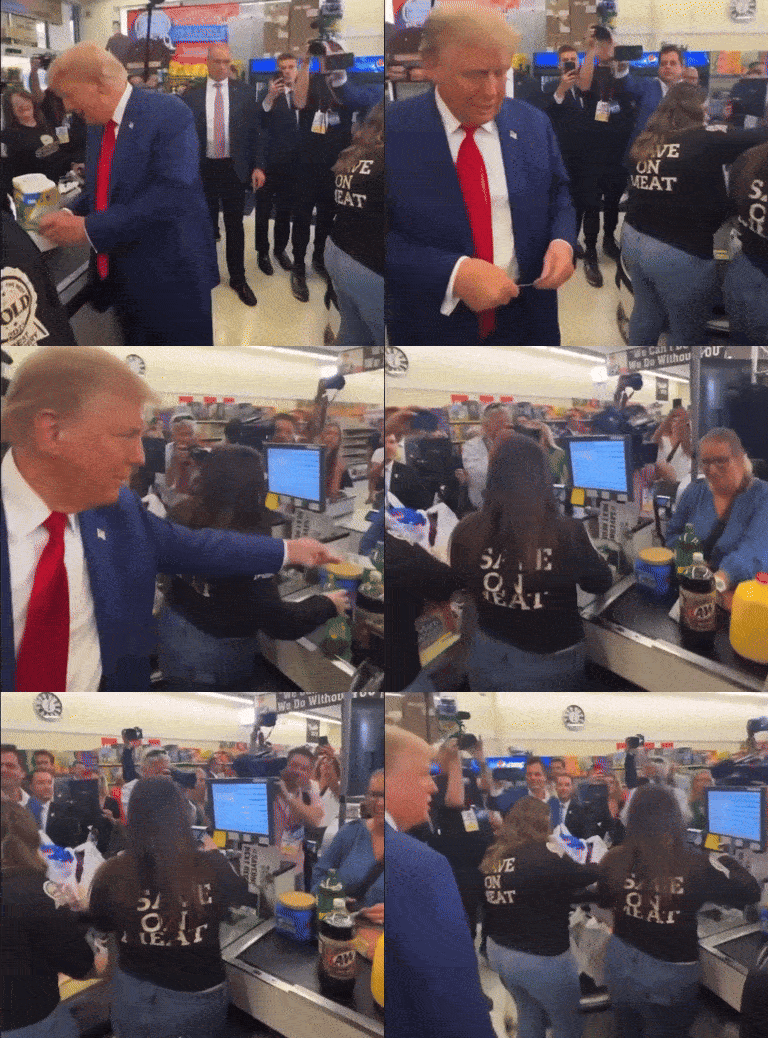
what a guy, huh? by the way, there’s a word for handing cash to a voter. that word is bribery. but it’s all in a day’s work for America’s Con-Artist-in-Chief.
Within the above is a link to the below on Threads, but I’ve copied the text here:
It is illegal for a presidential candidate, or any candidate, to hand out cash to voters in the U.S.
Offering money or any form of valuable consideration in exchange for a vote is considered bribery and violates federal election laws.
The Federal Election Campaign Act and related laws prohibit this type of conduct to ensure elections are free and fair.
Both the person offering the bribe and the person receiving it could face legal consequences.
Some republican maga stuff
“Well, obviously, it would take, you know, 10,000 inaccurate ballots or 20,000 ballots to turn things around,” he said. “No, we don’t have evidence of that. But who knows? If you find a little bit of cheating, who knows if you had the time and resources to look around for more. Who knows what you’d find.”
Grothman last appeared here in July when he lamented that society should return to living “like it was in the 1960s.”
He appeared here last year when he declared that low-income housing discourages people from getting married.
That same week he complained that Biden won’t nominate “straight white guys” to the federal judiciary.
He also appeared here in January 2023 when he posted a flag associated with the Christian nationalist movement outside his Capitol office.
Months earlier he gave a floor speech condemning the US Census for collecting data on LGBTQ Americans, which he found “horrifying.”
Before that he appeared here in June 2021 when he authored a bill that would ban teaching the history of racism in Washington DC public schools.
His first appearance here came in September 2011 when as a Wisconsin state senator he authored a successful bill that banned mentioning contraception in sex ed classes.
Grothman opposes recognizing Kwanzaa and Martin Luther King Jr. Day as state holidays. In 2015, he authored a bill to place a ban on same-sex marriage in the US Constitution.
He ran unopposed in the 2022 election.
This is because of the lies Vance and tRump spread about Haitian eating peoples pets
This next one is because DeathSantis wants to be able to make a political hit job on this incident to score points and claim that Biden Harris refused to give tRump proper Secret Service protection. Hugs. Scottie
Read the full article. DeSantis has said that the feds can’t be trusted to properly investigate the shooting attempt since they are also prosecuting Trump for stealing classified documents.
This week, Montel Williams called out a now deleted post of an unaltered photo claiming that he was Diddy. Williams stated, “Here they go again with ‘all black people look alike.”
All four memes below were posted separately today by the multiple felon.


GA Election Board May Force Hand-Counting Of Ballots
This is a two part post. The first part is what they intended to do, the second is them doing it. The intent is well expressed in the comments. The goal is to have the red rural parts of the state that vote republican to be in and recorded with the urban blue lagging way behind so the cultist can claim tRump won and the Democrats cheated at the last minutes. Then if time runs out for the count to be done the state will only certify the tRump voting areas leaving the cities out of the count, throwing the state to tRump even if Kamala Harris wins. Again republicans know that their plans are unpopular and they don’t care. They don’t want to represent people, they want to rule over the people. Hugs. Scottie
The Washington Post reports:
The Georgia State Election Board is expected to vote on a measure to force counties to hand-count all ballots this year, a requirement that could delay reporting of results by weeks if not months and that critics say is designed to inject chaos and uncertainty into the presidential contest in a vitally important swing state. The board will take up the proposal, which would require the hand count in addition to the customary machine count, Friday morning at the state Capitol in Atlanta.
The flurry of rulemaking is the work of a new right-wing majority that took control of the board in May with an avowed mission of preventing fraud and other irregularities from tainting the presidential result this year. All three are supporters of former president Donald Trump, and the rules they are pushing have been promoted by the state’s leading proponents of the false claim that President Joe Biden stole the Georgia election in 2020.
Read the full article.

The Washington Post reports:
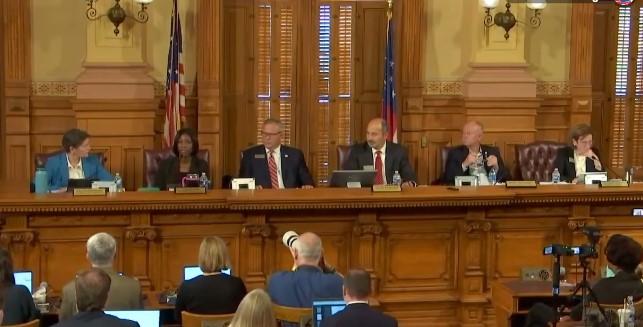
The Georgia State Election Board approved a rule Friday requiring counties in the critical presidential battleground to hand-count all ballots this year, potentially upending the November election by delaying reporting of results by weeks if not months.
The change was spearheaded by a pro-Trump majority that has enacted a series of changes to the state’s election rules in recent weeks and approved the hand-count requirement despite a string of public commenters who begged them not to.
Critics included democracy advocates who accused the board of intentionally injecting chaos and uncertainty into the presidential contest as well as election supervisors and poll workers who said hand counts would take too long, cost money and almost certainly produce counting errors.
Read the full article.
 Scottie's Playtime