You can not give into to these fundamentalist people. They see any attempt to compromise with them as a chance to take even more rights away. They are driven to return the country to a distant past where women had little to no rights. A time when women were not even allowed a credit card in their own name, they had to have their husband or father’s permission or co-sign major purchases. Doctors would talk to the husband about the wife’s medical problems instead of the woman. They crave a return to when it was legal for a man to rape his wife, forcer her to please him sexually against her will. The really see women as only house keepers, child birthing, child raising, and sex objects to please men. Women are not people to them, women do not equal men in their world. Sad. But also these states no have the idea that because the president is a democrat their state doesn’t have to follow the laws and rules the administation makes. Nope they have decided that red states are superior and above the federal government. Never mind the constitution claims otherwise, these are republicans who claim to love the constitution yet violate it at will. Hugs. Scottie
Someone possessing the pills without a valid prescription or outside of professional practice could be prosecuted and sentenced to prison.
Mifepristone is one of the two drugs prescribed for medication abortions. Louisiana lawmakers are moving to put it, along with misoprostol, in the same category of drugs as opioids and depressants. (Anna Moneymaker/Getty images
Louisiana couldbecome the first state in the country to categorize mifepristone and misoprostol — the drugs used to induce an abortion — as controlled dangerous substances, threatening incarceration and fines if an individual possesses the pills without a valid prescription or outside of professional practice.
Legislators in Baton Rouge added the provision as a last-minute amendment to a Senate bill that would criminalize an abortion if someone gives a pregnant woman the pills without her consent, a scenario of “coerced criminal abortion” that nearly occurred with one senator’s sister.
A pregnant woman obtaining the two drugs “for her own consumption” would not be at risk of prosecution. But, with the exception of a health-care practitioner, a person helping her get the pills would be.
The amendment would list mifepristone and misoprostol under the state’s Uniform Controlled Dangerous Substances Law, which regulates depressants, opioids and other drugs that can be highly addictive. It elicited a strong reaction from more than 240 Louisiana doctors, who called it “not scientifically based.”
“Adding a safe, medically indicated drug for miscarriage management … creates the false perception that these are dangerous drugs that require additional regulation,” they wrote in a letter sent last week to the bill’s sponsor, Republican Sen. Thomas Pressly. They noted misoprostol’s other critical uses, including to prevent gastrointestinal ulcers and to aid in labor and delivery.
“Given its historically poor maternal health outcomes, Louisiana should prioritize safe and evidence-based care for pregnant women,” they urged.
The amendment, written with guidance from Louisiana Right to Life, was added after the Senate unanimously passed S.B. 276 in mid-April. The measure is awaiting a final vote in the House before the session ends June 3, with little opposition expected.
“As Senator Pressly has stated, the medical community regularly uses controlled substances in a myriad of medical situations, including emergencies,” said Sarah Zagorski, communications director for the antiabortion organization. “The use of these drugs for legitimate health-care needs will still be available, just like all other controlled substances are still available for legitimate uses.”
The pending language appears to open yet another front in the country’s bitter battle over if and how women can obtain an abortion. Attempts to curtail medication abortions — which now constitute more than half of all abortions in the United States — are part of legislative agendas not just in deep-red Louisiana but in many Republican-controlled statehouses. And in March, the U.S. Supreme Court heard arguments in a case brought against the Food and Drug Administration by a group of antiabortion doctors seeking to limit access to mifepristone.
Pressly did not respond to repeated requests for comment, but in a statement released by his office, he explained that he was seeking to “control the rampant illegal distribution of abortion-inducing drugs” in Louisiana. He said abortion medication “is frequently abused and is a risk to the health of citizens.” By including the drugs on the controlled-substances list, he added, “we will assist law enforcement in protecting vulnerable women and unborn babies.”
His connection to the issue is in part personal. During public testimony in April before the Senate Judiciary Committee, his sister recounted how her then-husband surreptitiously gave her an abortion drug in 2022 when he brought her breakfast for St. Patrick’s Day. They were separated, but Catherine Pressly Herringsaid she had learned she was pregnant with their third child and he had agreed to marriage counseling.
After she noticed him serving her “cloudy water,” she said she started having “intense cramping.” Doctors were able to stop the process so that the pregnancy could continue. He was sentenced to180 days in jail. Under Pressly’s bill, a perpetrator would face a maximum sentence of 10 years in prison and a $75,000 fine.
“Through our knowledge of other stories, and from the testimony of local centers in Louisiana caring for women in these situations, the abuse of abortion pills is not isolated to Herring’s situation,” Zagorski said Saturday. “It is very simple for a man to pose as a woman to order these pills online without a prescription, even for a minor, and then to pressure a woman to take the pills.”
While doctors say Herring’s experience is deeply troubling, they remain concerned that her brother’s proposed solution would make mifepristone and misoprostol even harder for Louisianans to get for reasons having nothing to do with abortion. Misoprostol is prescribed for treatment after a miscarriage, for example, and to help stop postpartum hemorrhage, one of the leading causes of maternal mortality in the state.
“To OB/GYNs, this is very worrisome,” said Neelima Sukhavasi, an OB/GYN in Baton Rouge and a fellow with Physicians for Reproductive Health. “There’s no one that would endorse what happened to his sister. But this is a safe medication that has many important lifesaving uses. It’s not addictive.”
Misoprostol isalso taken to soften the cervix during labor, biopsies for cancer and placement of IUDs. Sukhavasi said she is concerned that Pressly wrote the amendment without consulting physicians or enforcement agencies.
Nimra Chowdhry, senior state legislative counsel at the Center for Reproductive Rights, echoed those concerns but in harsher terms. She accused abortion opponents in Louisiana of misrepresenting the safety and efficacy of the two drugs — a manipulation “in pursuit of blocking people from care.”
This ultimately “turns back the clock on modern medicine,” she said.
Abby Ledoux, vice president of communications at Planned Parenthood Gulf Coast, is worried about the “far-reaching” consequences because of the drugs’ other uses.
There are “real questions,” she said, “about what it would mean in practice to open the controlled-substances list like this, including what aspects of state law legislators think manufacturers would follow, even locally.”
Emily Wax-Thibodeaux is a National staff writer who covers national news, with a focus on gender issues and social movements for the America desk. She is an award-winning former foreign correspondent who covered Africa and India for nearly a decade.Twitter
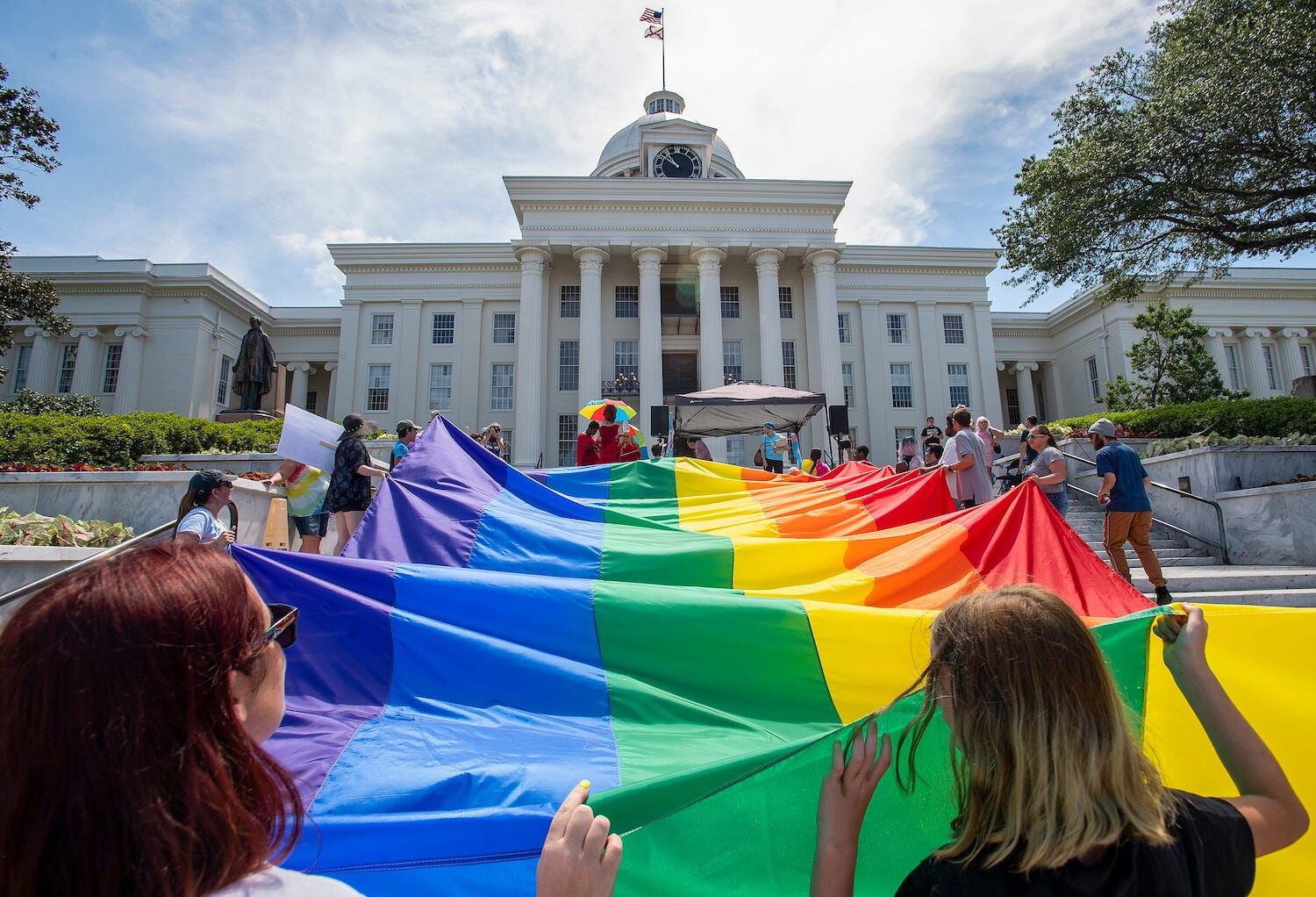
Marchers carry a rainbow flag to the Alabama Capital during the 2019 Pride March and RallyPhoto: Mickey Welsh / Advertiser/ via IMAGN
Alabama’s legislature is advancing two censorious anti-LGBTQ bills: H.B. 130 would ban LGBTQ+ flags in classrooms and expand the state’s “Don’t say gay” law to include grades 6-8; H.B. 385 would jail librarians for giving “sexual or gender-oriented material” to minors without parental consent. Both bills were approved in the Alabama House of Representatives this week and now head to the state’s Republican-led upper legislative chamber.
Alabama’s current “Don’t Say Gay” law says that K-5 classrooms “shall not engage in classroom discussion or provide classroom instruction regarding sexual orientation or gender identity in a manner that is not age appropriate or developmentally appropriate for students in accordance with state standards.” H.B. 130 would also remove the section “in a manner that is not age appropriate or developmentally appropriate for students in accordance with state standards,” banning LGBTQ+ discussions completely.
The sweeping education bill also includes a trans bathroom ban.
The H.B. 130 expansion, which passed the state House on Tuesday, would expand the law to include grades 6-8 and also prohibit “flags symbolizing sexual orientations or gender identities” in all grade school levels.
The bill’s sponsor, state Rep. Mack Butler (R), said the bill is necessary to “purify the schools” of “some indoctrination going on,” ABC News reported.
“[LGBTQ+ discussions and flags are] a component of Marxism where we’re – you know – destroying the family and teaching some of these things. Let it happen somewhere else other than our schools.” Butler said.
The ACLU of Alabama has spoken against the law, saying that it would silence “inclusive” and “essential” discussions among students and teachers in classrooms while violating their First Amendment rights to free speech.
On Thursday, the Alabama House also passed H.B. 385, a bill would expand the state’s definition of “sexual conduct” to include conduct that “knowingly exposes minors to persons who are dressed in sexually revealing, exaggerated, or provocative clothing or costumes, or are stripping, or engaged in lewd and lascivious dancing, presentations, or activities in K-12 public schools, public libraries, and other public places where minors are expected and are known to be present without parental consent.”
The law would place libraries in the same category as “adult-only” stores, movies, and entertainment” in order to criminalize librarians who provide “sexual or gender-oriented material” to minors without parental consent.
The bill would force school and public librarians to remove any books that other people find “obscene” or “harmful” to minors — though the law doesn’t specify who would determine what’s “obscene” or “harmful.” After filing a written objection to the library director or principal, librarians would then have seven days to remove the book from shelves.
Librarians who fail to do so could initially face a misdemeanor criminal charge and a fine of up to $10,000 and a county jail or hard labor sentence of up to one year. If a librarian is convicted of a second or subsequent violation, they could face a class C felony charge punishable by up to 10 years in prison, The Alabama Reflector reported.
State Rep. Neil Rafferty (D) said the law is so broadly written that it could allow a single complaint to result in a warrant being issued for someone who wears an objectionable Halloween costume or sundress.
“I do still have some serious problems with this because I feel like this is a violation of First Amendment, I feel like is easily going to be abused, and we will be dealing with unintended consequences of it,” Rafferty said.
“This bill is government overreach, robs parents of their rights, and would have a chilling effect on free speech by potentially incarcerating librarians because particular books are available, including even the Bible,” wrote Craig Scott, president of the Alabama Library Association.
Both bills are among several copycat laws across the country that seek to block minors from accessing LGBTQ+ content under the belief that such content “sexualizes” and “indoctrinates” children. Sponsors of these bills never note that numerous types of classroom and library materials have depicted heterosexual romance and issues without much parental or political objection.




































 Scottie's Playtime