
Category: Written Media / Books
Jen Sorensen Nails It
Thanks to Zorba for this:
Letters from an American-September 3, 2024
So much information today!
September 3, 2024 by Heather Cox Richardson Read on Substack
Last night the Boston Globe published a leaked email from a top volunteer with the Trump campaign, former Massachusetts Republican Party vice chair Tom Mountain, telling volunteers that the Trump campaign “no longer thinks New Hampshire is winnable” and is “pulling back” from that important swing state. He urged volunteers to turn their attention instead to Pennsylvania. After the story dropped, the Trump campaign cut ties with Mountain.
Stephen Collinson of CNN and Isaac Arnsdorf, Josh Dawsey, and Marianne LeVine of the Washington Post reported today that Trump’s team has given up on trying to get Trump to talk about the economy and other issues voters care about. The former president has decided to spend the rest of the campaign attacking Vice President Harris to destroy her popularity and drive voters away from her, rather than trying to attract them to himself. The Washington Post reporters noted that likely voters view Trump unfavorably and his team has concluded that while he can’t improve his own standing, he can damage hers.
Collinson dubbed Trump’s plans a “feral political offensive.”
It is not clear that this will work. As Collinson notes, Harris has refused to get dragged into the gutter with Trump, and Sarah Longwell of The Bulwark, who studies focus groups, notes that voters appear to want to put the nastiness of the past several years behind them. Still, the media-tracking company AdImpact reported that between August 23 and August 29, 57% of the total television spending for political ads was on Republican attacks on Harris.
Trump also continues to demand that Republicans support his attempt to suppress voting. Having failed to pass any of the necessary appropriations bills before going on August recess, Congress will be in a rush when it comes back into session next week. It needs to fund the government before the end of the fiscal year on September 30 in order to prevent a partial shutdown. Last Thursday, Trump told right-wing podcast host Monica Crowley that he would “shut down the government in a heartbeat” unless the government funding package includes the Safeguard American Voter Eligibility (SAVE) Act—which would give credence to the idea that noncitizens are voting in national elections despite the fact it is already illegal—and a bill restricting legal immigration.
Zeeshan Aleem of MSNBC today took public notice of Trump’s “deteriorating ability to clearly communicate.” His speeches “seem to be growing more discursive and difficult to comprehend by the day,” Aleem wrote. “Those speeches are making it hard, if not impossible, for people listening to them to understand what he wants to do with his power in office, and they’re reportedly turning off voters.” A reporter for The Guardian pointed out that attendees at Trump’s rallies are leaving as he rambles for nearly two hours, and complaining that he is “babbling.”
For his part, Trump says his wandering speech is deliberate. He calls it “the weave.” I’ll talk about, like, nine different things, and they all come back brilliantly together, and it’s like, and friends of mine that are, like, English professors, they say, ‘It’s the most brilliant thing I’ve ever seen.’”
Aleem notes that this less-focused, less-capable Trump would be exceptionally dangerous in office a second time. And yet, he was dangerous enough the first time. Today Adam Klasfeld and Ryan Goodman of Just Security released a study showing at least twelve times that Trump used the power of the presidency to retaliate against his political enemies. They note that there is no evidence that President Joe Biden or anyone else at the Biden White House ever took similar actions.
John McCain’s son Jimmy today announced that he has switched his voter registration from Republican to Democrat and will work to elect Vice President Harris and Minnesota governor Tim Walz in 2024. The younger McCain enlisted in the Marine Corps at 17 and is now an intelligence officer in the 158th Infantry Regiment of the Arizona Army National Guard. He said he is speaking out because Trump’s conduct at Arlington National Cemetery was a “violation.”
Last Friday, just before the long weekend, Trump announced that he would vote against a Florida ballot measure that would essentially enshrine in the Florida state constitution the abortion rights formerly protected by the 1973 Roe v. Wade decision. When Trump had bowed to popular support for abortion rights and expressed uneasiness at the state’s current six-week ban—a cutoff reached before most women know they’re pregnant—antiabortion activists launched fierce attacks on him. So, on Friday, Trump switched his position and announced he would vote against restoring access to abortion in Florida.
That announcement has given wings to the Democrats’ messaging about Republicans’ determination to end abortion rights. It did not help the Republicans that more videos have been unearthed in which Republican vice presidential nominee J.D. Vance said that “a childless elite” is ruling the country. He went on to excoriate this elite for what he claimed was their pride that they didn’t have children and that they had abortions, and said “they look down on people who invest their time and their future in their children. And that is a dangerous place to live as a country.” Even a right-wing Newsmax interviewer suggested that he was “painting this group with perhaps a broad brush?”
On October 1, in Louisiana, a law will go into effect that reclassified the drug misoprostol as a controlled dangerous substance. Misoprostol can be used for abortion. It is also used for routine reproductive care and during medical emergencies to treat postpartum hemorrhage. It is on the World Health Organization’s list of essential medications, a list containing those medications that are the most effective and safe to meet a health care system’s most important needs. After antiabortion activists targeted the drug, Louisiana governor Jeff Landry signed a law reclassifying it as a controlled dangerous substance. The reclassification means that the drug will no longer be easily available on obstetric hemorrhage carts.
“Take it off the carts?” one doctor said to Lorena O’Neil of the Louisiana Illuminator. “That’s death. That’s a matter of life or death.”
The Harris campaign said: “Let’s be clear: Donald Trump is the reason Louisiana women who are suffering from miscarriages or bleeding out after birth can no longer receive the critical care they would have received before Trump overturned Roe. Because of Trump, doctors are scrambling to find solutions to save their patients and are left at the whims of politicians who think they know better. Trump is proud of what he’s done. He brags about it. And if he wins, he will threaten to bring the crisis he created for Louisiana women to all 50 states.”
Vice President Harris’s campaign started its “Fighting for Reproductive Freedom” bus tour today in Palm Beach, Florida, where it drove past the Trump Organization’s Mar-a-Lago club. The bus will make at least 50 stops across the country.
Pollster Tom Bonier today continued his examination of new registrants to vote. This time his focus was North Carolina. The pattern he has found across the country continues: “surges in registration are being driven by women.” In North Carolina, he writes, the number of registrants was almost 50% higher during the week of July 21 than in the same week in 2020, and the gender gap was +12 women, compared to +6 women in 2020. The new registrants were +6 Democratic, and 43% were younger than 30.
The Harris-Walz campaign today joined the Democratic National Committee in announcing a transfer of nearly $25 million to support Democratic candidates in down-ballot state and federal races. The Democratic Congressional Campaign Committee and the Democratic Senatorial Campaign Committee will get $10 million each in hopes of supporting a Democratic majority in each chamber of Congress in the new administration.
The Democratic Legislative Campaign Committee, the organization devoted to winning state legislatures, will receive $2.5 million. The Democratic Governors Association and the Democratic Attorneys General Association will get $1 million each.
Finally, today, a federal judge issued a preliminary injunction to stop the Trump campaign from playing the song he likes to dance to at his rallies: “Hold On, I’m Coming.” The estate of Isaac Hayes Jr., the artist who co-wrote the song, filed a copyright infringement lawsuit against Trump, his campaign, and a number of his allies, noting that they have never obtained a public performance license for the song although they have used it at least 133 times.
—
Notes:
https://www.cnn.com/2024/09/03/politics/trump-quest-destroy-harris-momentum/index.html
https://www.washingtonpost.com/politics/2024/09/02/trump-strategy-campaign-harris/
https://www.huffpost.com/entry/donald-trump-government-shutdown_n_66d21e56e4b013957161cd53
https://www.msnbc.com/opinion/msnbc-opinion/trump-age-harris-ramble-rcna168979
https://www.cnn.com/2024/09/03/politics/jimmy-mccain-decries-trump-arlington-appearance/index.html
https://www.washingtonpost.com/elections/2024/09/03/harris-25-million-transfer/
https://www.cbsnews.com/news/trump-isaac-hayes-hold-on-im-coming-lawsuit/
https://www.theguardian.com/us-news/article/2024/sep/03/mccain-trump-arlington-democrat
X:
AudreyWSBTV/status/1830996525499011242
tbonier/status/1831139736477430080
cwebbonline/status/1830967329297178761
lorenaoneil/status/1831123870507552901
Hate Preacher Shows Us How To Hate God’s Word
I was not going to post another video, especially not of the Rev Ed Trevors. But … this one touched my heart. He refutes using the bible against the gay and trans community. In fact he slams using the bible against anyone, that is not its purpose. In this video he takes on a hate preacher bashing gay men. He is reasonable and well reasoned. Hugs. Scottie
New study provides the “definitive answer on masks.” They work.
Masks WORK! Photo: Jennifer Sandlin
I’ve masked consistently since the beginning of the ongoing COVID-19 pandemic, first with a cloth mask, before I knew better, and then for the last few years with KN95s or N95s. And I have, to my knowledge, continued to avoid catching the virus. In fact, I haven’t been sick for at least 4.5 years, and I attribute that in large part to masking. I also opt for patios if I go out to eat, if at all possible, so that’s also part of why I haven’t been sick. But it’s also definitely the masking. Needless to say, I’m already a huge believer in the science of masking. In simple terms: masks work.
Masks and respirators for prevention of respiratory infections: a state of the science review [journals.asm.org]
However, it’s hard to convince folks who have swallowed the fake news that masking is harmful or that masks don’t work. I won’t link to those (flawed) “studies” because I definitely don’t want to share more misinformation, but suffice it to say, folks who believe masks don’t work are either not reading actual science, or aren’t actually masking, or aren’t using high quality masks, or if they are wearing masks, aren’t wearing them properly (yeah, you’re right, masks around your chin don’t actually work!).
In case you still have the patience to try to convince a mask skeptic—or even a rabid anti-masker—that masks *do* actually work, here’s a great, brand-new, peer-reviewed study to share with them. The paper, which is based on a narrative review and meta-analysis research project, was written by an international team of 13 researchers from universities including University of Oxford (UK), University of New South Wales (Sydney, Australia), University of Toronto (Canada), University of Otago (Wellington, New Zealand), and University of Calgary (Alberta, Canada).
The paper synthesizes evidence from over 400 studies in total, including 100 published reviews, as well as primary studies from disciplines such as epidemiology, public health, engineering, and social studies—all of which focused on the exploring the efficacy of masking. The authors explain that they even re-analyzed “contested meta-analyses of key clinical trials”—including the infamously controversial Cochrane review. In fact, the authors state specifically that their review “was commissioned partly because of controversy around a Cochrane review which was interpreted by some people as providing definitive evidence that masks don’t work.” However, that’s never what the Cochrane review actually stated, as explained by the authors of this current review:
The need for a new review on masks was highlighted by a widely publicized polarization in scientific opinion. The masks section of a 2023 Cochrane review of non-pharmaceutical interventions (9) was—controversially—limited to randomized controlled trials (RCTs). It was interpreted by the press and by some but not all of its own authors to mean that “masks don’t work” and “mask mandates did nothing” (10). Cochrane’s editor-in-chief felt the need to state publicly that in Cochrane’s view, the review’s findings did not support such a conclusion (11). Some scholars were quick to question the review’s methodology, especially key flaws in the meta-analysis and omission of a vast body of non-RCT evidence (12–16).
I, for one, am thrilled that this study explicitly addresses—and debunks—the Cochrane review, because that single study probably did more damage than almost anything else to widespread attempts to get people to mask to keep themselves and others safe from COVID-19.
The authors of this new review found evidence that led them to seven main findings:
First, there is strong and consistent evidence for airborne transmission of severe acute respiratory syndrome coronavirus 2 (SARS-CoV-2) and other respiratory pathogens.
Second, masks are, if correctly and consistently worn, effective in reducing transmission of respiratory diseases and show a dose-response effect.
Third, respirators are significantly more effective than medical or cloth masks.
Fourth, mask mandates are, overall, effective in reducing community transmission of respiratory pathogens.
Fifth, masks are important sociocultural symbols; non-adherence to masking is sometimes linked to political and ideological beliefs and to widely circulated mis- or disinformation.
Sixth, while there is much evidence that masks are not generally harmful to the general population, masking may be relatively contraindicated in individuals with certain medical conditions, who may require exemption. Furthermore, certain groups (notably D/deaf people) are disadvantaged when others are masked.
Finally, there are risks to the environment from single-use masks and respirators.
The authors also provide some recommendations for future research:
We propose an agenda for future research, including improved characterization of the situations in which masking should be recommended or mandated; attention to comfort and acceptability; generalized and disability-focused communication support in settings where masks are worn; and development and testing of novel materials and designs for improved filtration, breathability, and environmental impact.
University of Calgary News recently published an overview of the study which included some discussion of the study by lead author Professor Trisha Greenhalgh from the Nuffield Department of Primary Care Health Sciences, University of Oxford, who stated, “Our review confirms that masks work, with a clear dose-response effect. . . The more consistently and correctly you wear a mask, the better protected you are. Respirators, when worn continuously, provide even greater protection than ordinary masks.”
Co-author Dr. Joe Vipond, MD and Associate Professor at University of Calgary’s Cumming School of Medicine also commented on the study, stating that it is the “definitive answer on masks”:
“In a world of misinformation, questioning the effectiveness of everything from masking to vaccines, it’s important to have solid science to support any assertion . . . This is the definitive answer on masks, looking beyond the narrow view of randomized controlled trials to the entirety of the evidence. And behold, the current science upholds the standards and protocols that for decades have protected health care workers, and more recently the public, from biohazards.”
I know it would be naive to think that this robust study on the efficacy of masking will change die-hard anti-maskers’ minds. But perhaps it will persuade some people who are still open to learning from actual data. Here’s hoping, anyway! Mask up, folks! And if you’re looking for me, I’m the one in the hot pink mask!
Click here to read the full study and here to read the rest of the summary and interviews with several of the authors from University of Calgary News
Remembering Metrosexuality, the Trend That Taught Straight Men It’s OK to Be a Little Gay
From David Beckham’s poreless skin to the tastes of Queer Eye’s original Fab Five, metrosexuality marked an essential step toward a more open masculinity.
(This came from a magazine Janet linked a few days ago. I’m sitting and reading around in it today, and this struck me, especially in light of certain dark comments made over the past few years by the Republican VP nom. So I’m posting for juju. Or mojo. Mostly humorous spite, on my part. NVM me and enjoy the story.)
2004 Was So Gay is Them’s look back at a pivotal year for queer history and pop culture. Read more from the series here.
“Precise, smooth, and powerful:” the sexual energy rippling through Gillette’s 2004 ad campaign nearly leaps from the page — not because razors were suddenly sexy, but because its star, David Beckham, was known at the time as “the biggest metrosexual in Britain.” With a freshly shaved head, glistening muscles, and a green-tipped razor in hand, the image cemented what the world already knew, by way of a £40 million global ad campaign. This British soccer star — this man who wore pink nail polish and, occasionally, his wife’s panties — was seen as the peak of masculinity that year, and nobody else came close. As Gillette’s tagline went, Beckham was “the best a man can get.”
Beckham may have been the gold standard for The Metrosexual, a “type” of man that entered the popular consciousness in the mid-2000s, but really the inspiration for the movement looked more like Stefon from Saturday Night Live. The character, played by Bill Hader, stopped by Weekend Update with highlights in his side-swept hair and Ed Hardy’s rhinestone regalia covering his body to let viewers in on the hottest new spots in nightlife. Stefon’s outfits were modeled after 2000s nightlife looks, a fitting visual metaphor for the chaotic, homoerotic overtones of the early 2000s.
Much like the fictitious clubs Stefon gushed over, metrosexuality had everything. There were the menswear bibles you had to subscribe to (Details, Esquire, and GQ); must-have fashion labels (from Paul Smith and Hugo Boss to Dolce & Gabbana); and, of course, grooming brands like Axe body spray, which launched in the U.S. in 2002. On TV, the metrosexual movement was dominated by the likes of Queer Eye’s “Fab Five,” who burst into straight men’s homes like a glitterati SWAT team, and by Stacy London and Clinton Kelly on What Not to Wear, the more composed (but equally bitchy) spiritual sister in the makeover reality show genre.
Men had been Yassified, remade in His image; “His” being, if it weren’t clear by now, a fashion-conscious, grooming-obsessed gay man. Yes, the homoerotic undertones of metrosexuality weren’t exactly subtle, but it was the 2000s, damnit, and men were allowed to be a little fruity and high maintenance as a treat. For those caught in the metrosexualmania, the fad might’ve felt like a flash of lightning: suddenly there, lighting up every follicle and pore. Google search results for the phrase exploded from 25,000 in mid-2002 to nearly a million by the end of 2005. But the term had roots far beyond its early 2000s heyday, first entering the cultural lexicon via the self-proclaimed “daddy” of metrosexuality, Mark Simpson, and his seminal 1994 essay, “Here Come the Mirror Men: Why the Future is Metrosexual.”
Written as a taxonomy on fascinating, capitalist animals who’d just discovered oil-free moisturizer and form-fitting pants, Simpson’s essay announced the arrival of the “[m]etrosexual man, the single young man with a high disposable income, living or working in the city (because that’s where all the best shops are), is perhaps the most promising consumer market of the decade […] he’s everywhere, and he’s going shopping.” Or put more succinctly: “Metrosexual man is a commodity fetishist: a collector of fantasies about the male sold to him by advertising.”
The notion that you should spend more time and money on clothes, grooming, and fitness wasn’t exactly reinventing the wheel. What made metrosexuality unique wasn’t its deep roots in capitalism, but rather its flirtation with queering masculinity in a way that felt fundamentally new. This was a tectonic vibe shift that democratized desire, cracking open the door for straight men to edge into femininity. Metrosexuality’s origin was also fundamentally shaped by the HIV pandemic, which spawned its own obsession with self-image. LGBTQ+ people — and particularly gay men — idolized gym-hardened bodies and obsessed over looking affluent and “healthy.”
The rise of the “metrosexual” may have been a straight thing, but the through lines of these two movements ran concurrently, separated more by who you wanted to sleep with and less by what designer brand you went shopping for. We may feel trapped today in a timeline that’s more metro than ever, but the newness and, frankly, the edginess of metrosexuality 20 years ago was historic — especially as it grew from that tiny 1994-era seedling into a blossoming flower.
Like Simpson’s read of heterosexuality in 90s menswear magazines being “so self-conscious, so studied, that it’s actually rather camp,” it was the self-serious, studied, and camp character of Patrick Bateman in 2000’s American Psycho that finally put the nail in the coffin of the 1990s’ dominant, grungy aesthetic. The film about full-time Wall Street hotshot and part-time murderer, played perfectly by a svelte and smug Christian Bale, rewrote the codes of the New Man for a new decade within its first 10 minutes. In an opening monologue that feels created in a lab for future metrosexuals to studiously replicate, Bateman walks through a morning routine that includes ice-pack facials, a thousand stomach crunches, deep pore cleanser lotion, water-activated gel cleanser, honey almond body scrub, exfoliating gel scrub, herb-mint facial masque (leave on for 10 minutes), moisturizer, anti-aging eye balm, and aftershave lotion with no alcohol (“because alcohol dries your face out and makes you look older.”) By the time the film shows him studying himself in a mirror, flexing his muscles as he mindlessly fucks a woman, the codes of this new kind of man were crystallized.
By 2004, “metrosexual” had been crowned “Word of the Year” by the American Dialect Society. Naturally, culture was flooded with glistening bodies, clouds of cologne, hardened hair gel, and at least five pairs of queer eyes regularly dissecting and rebuilding straight guys. These habits and inclinations toward presenting health and wealth have hardened with the passing of time, like a particularly sculpted torso. To put this in more Shakespearean terms: Metrosexuality by any other name (say, a looksmaxxing alpha male, or muscle gay) smells just as strongly of whatever scent we’re being marketed that day. Just like in 2004, turn on the TV or open a fashion publication’s homepage, and you’ll be knocked on your ass by capitalism’s consumptive frenzy; the major difference now is the somehow more relentless push to sculpt, shop and spend, driven into hyperdrive by our social media feeds. No matter if you’re gay, straight, femme, or them, we’re bombarded by messaging that tells us to work out, dress better, and start an 84-step skincare routine. My algorithm seems to hit me with a barrage of perfectly toned, sexually ambiguous guys every time I doomscroll.
It doesn’t take an armchair anthropologist to tell you that every trend, no matter how culturally ingrained it seems, will fade out over time. See “demure,” “Brat,” and whatever microtrend TikTok’s algorithms push today. As culture shifted and economics crashed, so did the desire to spend exorbitantly on grooming. The word “metrosexual” now feels as dated as Carson Kressley and the other original Fab Five members I simply cannot remember, but its cultural impact has lived on; every subsequent movement owes a debt to the metrosexual — from hipsters and their gallons of beard oil all the way to streetwear bros with sneaker collections rivaling even Carrie Bradshaw.
Metrosexuality’s chokehold on the 2000s taught men to be more comfortable in their femininity, but in the 20 years that have passed, our cultural understanding of manhood has splintered. There is the darker side, filtering metrosexuality’s obsessive grooming into a toxic, warped worldview dominated by obsessively coiffed, overly buff, and deeply insecure influencers. This is the side where young men are breaking their legs to be taller and smashing their jaws to be more “alpha.”
But luckily, it’s not all broken bones and toxic trauma. There’s a more healthy, nuanced exploration of modern masculinity that leans into the queerer side of our metrosexual forefathers. One that has allowed rockstars like Harry Styles to grace magazine covers in womenswear, release a gender-neutral beauty brand (Pleasing), and say, “I think there’s so much masculinity in being vulnerable and allowing yourself to be feminine” in a 2018 interview with fellow softboy Timothée Chalamet. You can see it during a night out as you spot straight men with painted nails and crop tops dancing with their girlfriends. You can see it in the celebrity role models of Steve Lacy, Paul Mescal, and Josh O’Connor — the latter helping launch both the “rat boy” and “fruity boy” micro-trends. This particular flavor of New Man is united in an embrace of and comfort with the duality of their feminine and masculine sides — and, notably, not separated by sexuality. Omar Apollo, Steve Lacy, Frank Ocean, and Tyler, the Creator meld effortlessly with the likes of Jaden Smith and the airbrushed perfection of K-pop supergroup BTS.
It has been thirty years since the “metrosexual” emerged and twenty years since its cultural reign. As we continue to navigate this modern era, redefining what it means to be a man, we’d do well to remember just how many boundaries metrosexuality broke down. Sure, it may be responsible for the poisonous clouds of Axe body spray we endured and ushered in a new era of hyper-commodification, but it also brought newfound sexual confidence and liberation to masculinity that taught us that it’s okay to be a little gay. Had it not been for our metrosexual forefathers (and the queers that guided them), who knows what rigid sartorial hellscape we’d all be living in today.
https://www.them.us/story/metrosexuality-retrospective-history-2000s-david-beckham-fab-five
Pink! Another thing to look at and enjoy.
I have to take Corky for her spa morning, then I will likely spend the day making that up to her, as she hates getting her nails clipped, and doesn’t care much for baths, either. The shelter here does both for a very reasonable price, and she’s such a good girl-she lets them do it with no problem. Then I have to provide treats for several hours afterward so I remember that she knows what I did. Enjoy the hypothetical pink Guggenheim!
A little something to look at, if you’re enjoying the weekend looking at stuff
We had a Radio Shack here in town for a lot of years, but not as long as till 2015. The manager/co-owner also had a story in another, larger city, and eventually moved there. He and DH were really good friends before I came along, and then we all made friends. I used to do volunteer literacy tutoring; one time, our director asked me if I’d try working with a young woman who could read and pronounce English, but had no idea how to converse, having only ever used Farsi for communication. Of course I tried it. It turned out she was our Radio Shack friend’s sister in law! I still am not really sure I taught her much; she already knew how to greet people, and some rudimentary questions and answers, “What do you think about this weather?” “Do you know whose cat that is?” But, she was not confident. She could comprehend and repeat, but not necessarily always apply and respond conversationally in English (her husband sometimes came along, and did translation.) I worked with her for a few years and she seemed to feel better about it all and I saw improvement, but no real click. One time, they didn’t show up for a session, and I’ve never seen them again. I’d heard that our friend had had a little trouble, too, here in town; this would have been a few weeks after the plane crashes in Sept. of 2011. I finally got up the nerve to just ask him if they were OK. He said they moved a little farther East, by some other relatives. They were doing fine, and he’d tell them I said hello. I asked him to tell their little girl that our son said hello, too; she had a crush on him because he read to her while I was working with her mom. I guess I just needed to share that story; this Radio Shack piece reminded me of all of that. Thanks for hangin’ in with me on this!
Four Things I Hope You’ll Share With Friends & Family
Pretty neat. by Charlotte Clymer Read on Substack
A few months ago, Substack generously invited thirty or so of their writers to NYC for the opportunity to create some ads for our blogs. I really didn’t know what to expect, but the experience itself with Cash Studios (cashstudios.co) was delightful.
For about an hour, I worked with the staff in their studio on various ideas they had, all of which I found interesting. Moreover, I was quite impressed with their creativity and professionalism. They were kind, curious about my work, and really wanted to bring out my authenticity.
A few days ago, the ads were sent out to all of us, and I was quite blown away by the care and thoughtfulness put into creating them. I feel that Cash Studios did an exceptional job in capturing what I try to do with Charlotte’s Web Thoughts, and I’m thankful to the folks at Substack for this level of investment in my work.
They cut four ads, and I want to share them with all my subscribers, with a humble request: if you have friends, family, colleagues, or whomever you think might connect with my writing, send them one of these ads. Tell them that it’s free to subscribe to the blog, that all they need is an email, and that I don’t spam.
Here are the ads! Enjoy:
The Road to Splitsville AND THE AWARD FOR OUTSTANDING ACHIEVEMENT IN TRASHING ICONIC BUILDINGS GOES TO…
Written in Wonkette style. Must be read! It’s not long. It’s jaw-droppingly appalling. Not the article, the subject of it.
by Rebecca Schoenkopf Read on Substack
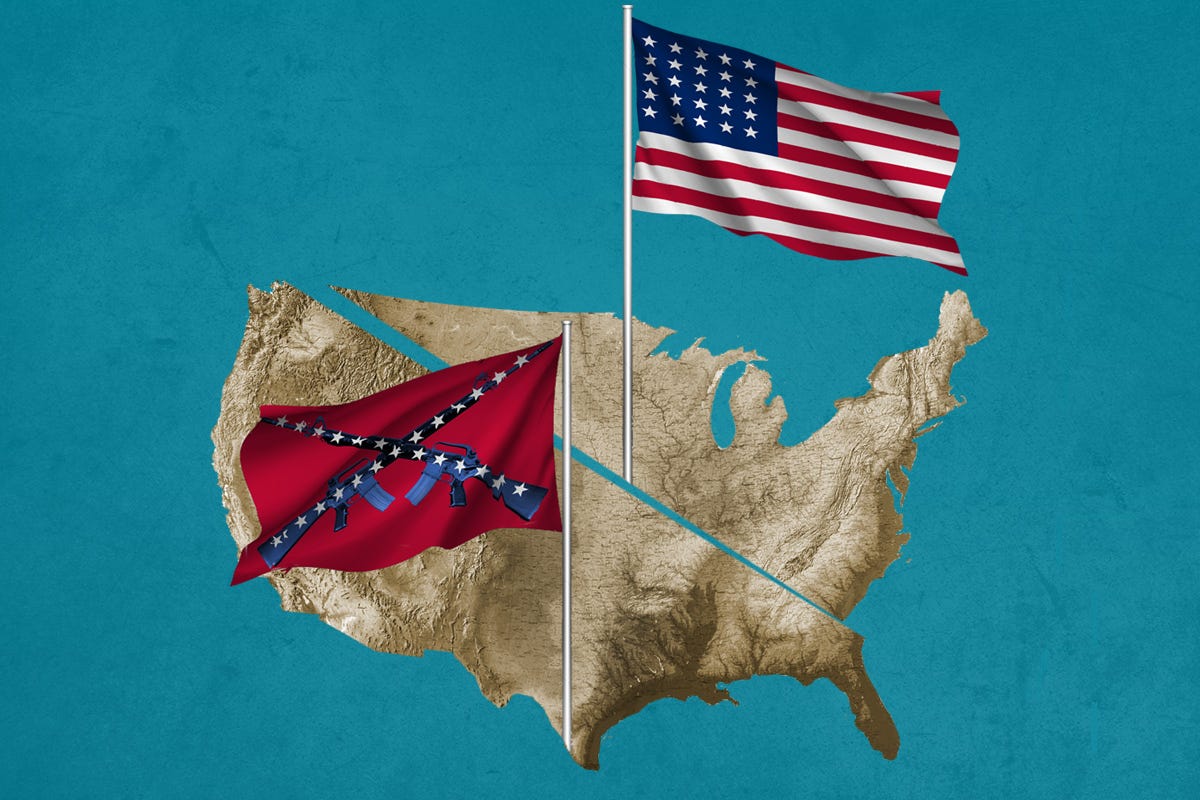
How do we know we’re on the Road to Splitsville (and possibly headed to a political and legal separation of the red states and the blue), and not on some other thoroughfare, like the Highway to Hell or the Boulevard of Broken Dreams? We know, because such a Split would be absurd and grotesque. But the red states are Republican states, and the Republican Party is the Donald Trump Party, and the fans of Donald Trump love the absurd and eat the grotesque with a fucking spoon.
Speaking of which: what are you doing on September 5?
If you’ve got some time, and $2,500 (per individual) to spare, you could join Christ-knows-how-many dipshits, ghouls, imbeciles, and traitors at—we kid you not—the “J6 Awards Gala,” to be held at Donald Trump’s golf club-cum-Ex Sematary in Bedminster, N.J. Go alone, with your significant other, or rope together eleven of your chums and snag a table for 12. Yes, 12 x $2,500 = $30,000 but, because this a Donald Trump-related production, the actual cost of a table for 12 is a cool $50,000. But think of th—
What? You have a question? (snip-a bit more, well worth the click. You can read if you’re not a subscriber.)
 Scottie's Playtime