Maybe others here enjoyed Sergio Mendes’s talent, too.
Sérgio Mendes, Brazilian Bossa Nova Musician, Dies of Long Covid at 83
The two time Grammy winner died on Thursday, Sept. 5, in a Los Angeles hospital
By Charna Flam Published on September 6, 2024 06:40 PM EDT
Kendall Jenner’s Most Stylish MomentsClose
Sérgio Mendes in Beverly Hills in May 2018. Photo: Chrissy Hampton/Getty
Sérgio Mendes, the Brazilian-born musician who brought bossa nova music to a global audience in the 1960s, died on Thursday, Sept. 5, in a Los Angeles hospital. He was 83.
The renowned musician’s family announced his death in a statement on his social media channels. His family said that his death was caused by effects of long Covid.
“His wife and musical partner for the past 54 years, Gracinha Leporace Mendes, was by his side, as were his loving children,” the statement read. “Mendes last performed in November 2023 to sold out and wildly enthusiastic houses in Paris, London and Barcelona.”
Throughout his six-decade career, Mendes recorded more than 35 albums, but he is best known for popularizing Brazilian music on a global stage beginning in the 1960s, starting with his composition of “Mas Que Nada.”
“It was completely different from anything, and definitely completely different from rock ’n’ roll,” the Latin music scholar Leila Cobo said in the 2020 HBO documentary Sergio Mendes in the Key of Joy. “But that speaks to how certain Sérgio was of that sound. He didn’t try to imitate what was going on.” (snip-MORE)
Barbara Gittings was a lover of books. She realized, from a young age, that she also loved girls. So when, in 1949, she left Wilmington, Delaware to attend Northwestern University, she did what any bookish young lesbian would do: research homosexuality in the school’s library. What Gittings found was not comforting. The vast majority of sources were written by medical professionals and described homosexuality as an illness or a perversion. She became so consumed with spending time in various Chicago libraries that she neglected her coursework and flunked out of school. But as a result of the discouraging information she found, an activist was born. With passion, determination, and what she would come to refer to as “gay gumption,” Gittings would spend the rest of her life working, in various ways, to correct those lies she found in the pages of books and scientific journals on the library shelves.
Gittings moved to Philadelphia in 1950 and supported herself with part-time clerical work. She continued to read everything she could find on homosexuality and, as part of her search, discovered Donald Webster Cory’s The Homosexual in America: A Subjective Approach, originally published in 1951. Gittings was particularly impressed with Cory’s arguments that gays and lesbians constituted a large unrecognized minority who deserved civil rights and his attempts to cultivate empathy in his readers by outlining the difficulties faced by American homosexuals. She wrote to Cory’s publisher and discovered he lived in New York City. The two met on several occasions, and Cory informed Gittings of a newly-formed gay organization in Los Angeles: the Mattachine Society, founded in 1950 by Harry Hay.
In the summer of 1956, when she was on vacation from her office job, Gittings boarded a plane to Los Angeles and visited the office of ONE, Inc., a homophile organization who had amicably split from the Mattachine Society in 1952. The members of ONE, Inc. informed her of the existence of a San Francisco-based organization for lesbians, the Daughters of Bilitis (DOB), founded in 1955 by lesbian partners Del Martin and Phyllis Lyon.
Gittings once again boarded a plane, this time bound for San Francisco. The DOB were, fatefully, having a meeting that very evening in a member’s apartment. The meeting was the first time in her life Gittings would interact with a group of lesbians outside of a bar setting. Two years later, in 1958, Gittings officially joined the DOB and was tapped by Martin and Lyon to start an East Coast chapter of the organization based in New York City. With her co-founder, Marion Glass, Gittings built the chapter into the largest in the country.
In 1963, Gittings, whose enthusiasm and knowledge of literature left an impression on Martin and Lyon, was tapped to be the editor of The Ladder, the DOB’s national magazine for gay women. Gittings transformed The Ladder from what was essentially a newsletter to a national magazine respected within gay circles. With the help of her partner, Kay “Tobin” Lahusen, whom she met in 1961 at a DOB picnic in Rhode Island, Gittings replaced the amateurish illustrations that typically adorned the cover of The Ladder with photographs taken by Lahusen of actual lesbians who appeared confident and happy.
Gittings began to take The Ladder in an increasingly militant direction, reporting on protests, questioning the merits of various activist strategies such as picketing, and engaging in debates with so-called “experts,” arguing that homosexuality was a social and cultural problem, not a psychological problem. The activist bent of The Ladder under Gittings’ editorship alarmed the West Coast leadership of the DOB. When Gittings, amidst her many activities on behalf of gay rights, was late with the August 1966 issue, Martin and Lyon used her tardiness as an excuse to oust her as editor.
Gittings would also find a kindred spirit in Frank Kameny, who she credited as the first person to articulate a fully coherent philosophy of gay rights. She and Lahusen partnered with Mattachine Washington, of which Kameny was a co-founder, working alongside other lesbians and gay men to directly challenge the federal government. Gittings participated in the first picket of the White House for homosexual rights on April 17th of 1965.
Gittings worked with Kameny and other activists to lobby the American Psychiatric Association (APA) to remove homosexuality as a diagnostic category from the Diagnostic and Statistical Manual (DSM). At the APA’s 1972 conference, held in Dallas, Texas, Gittings, Kameny, and Lahusen created a display entitled “Gay, Proud, and Healthy: The Homosexual Community Speaks.” The exhibit, which featured photographs of gay couples taken by Lahusen, was adorned with the word “LOVE” in bold letters and portrayed gay people as healthy and happy, not as patients who were tormented and in need of a cure. In December of 1973, the APA board of trustees voted to pass a resolution to remove homosexuality from the DSM, effectively declassifying it as a mental illness.
Gittings was a lifelong bibliophile, and though she recognized the importance of taking on the federal government and institutions such as the APA, she never lost sight of the “lies in the libraries” she discovered as a college freshman and the importance of gay representation. In 1970, she joined the American Library Association’s (ALA) newly-formed Task Force on Gay Liberation (TFGL). The TFGL, whose mission was to provide support for gay librarians within the profession and increase gay representation in libraries, was glad to have a veteran activist like Gittings join their ranks.
With the help of Israel Fishman, the first coordinator of the TFGL, Gittings organized a gay kissing booth — titled “Hug-a-Homosexual: Free Kisses” — for the 1971 ALA conference in Dallas, Texas. While the group could have created a nice display featuring gay books, periodicals, and their bibliography, they instead decided to make their presence known by showing gay love live. The publicity was better than Gittings and the TFGL could have imagined, and continued to spark discussions within the ALA over the next year.
In 1999, in honor of her contributions to create more visibility for gays and lesbians in libraries and in the profession, Gittings was awarded a lifetime membership at the annual ALA conference, held that year in New Orleans, Louisiana. The ALA also named an award after Gittings as part of their Stonewall Book Awards, sponsored by the Gay, Lesbian, Bisexual, and Transgender Round Table (GLBTRT), the contemporary iteration of the TFGL. The Stonewall Book Award-Barbara Gittings Literature Award is given annually for works of fiction that exhibit “exceptional merit relating to the LGBT experience.”
Barbara Gittings died on February 18th, 2007 at the age of 74 after a long battle with breast cancer. In a 1999 interview with American Libraries magazine, she summarized her career as a gay activist with the wit and wisdom she was known for:
“As a teenager, I had to struggle alone to learn about myself and what it meant to be gay. Now for 48 years I’ve had the satisfaction of working with other gay people all across the country to get the bigots off our backs, to oil the closet door hinges, to change prejudiced hearts and minds, and to show that gay love is good for us and for the rest of the world too. It’s hard work — but it’s vital, and it’s gratifying, and it’s often fun!”
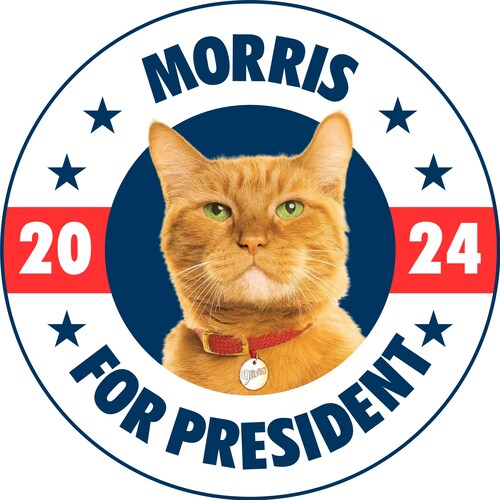
First, it is absolutely a promotion for 9Lives kitty stuff and the shelter charity to which they’re contributing. I’m mainly posting this for the video; the ad ran while a mahjong game was loading on Shockwave. I’d never seen it before, and it’s cool, even though it’s an ad. Scottie’s kitties might also like it, along with anyone else kitty- or not kitty-related. I always loved Morris! To skip the blahblahblah and see the video, just scroll down.
=====
If your cat or dog is chosen to be Morris’ Vice President, you’ll choose which animal shelter will receive a $35,000 donation, estimated to be worth half a million 9Lives meals
LAKEVILLE, Minn., Aug. 14, 2024 /PRNewswire/ — Earlier today, Morris, the legendary 9Lives spokescat, announced he’s once again running for President of the United States of America. He has already run for President on three separate occasions in 1988, 1992 and 2012. Fourth time’s the charm! Morris believes that meow is the time to bring his presidential hopes back into the spotlight and put renewed focus on the importance of pet adoption.
Morris the 9Lives spokescat is uniting everyone in the animal world – even cats and dogs – to help shelter pets during his presidential run. Photo Credit: 9Lives
As he spreads his message of paws-itivity, Morris is eagerly on the hunt for a running mate – any cat or dog who shares his belief in The Good Life is invited to apply! If you think your pet has what it takes, visit www.MorrisforPresident.com to submit your nomination.*
The winner will receive a $1,000 prize and the chance to choose which animal shelter will receive a $35,000 donation from 9Lives – estimated to be worth half a million 9Lives meals. Internet sensation Doug the Pug will be serving as Morris’ Campaign Manager to help with his VP search.
As a bona fide rescue cat success story himself, Morris is an advo-cat for pets in need. In fact, he’s conceived five paw-licies to help all pets live The Good Life:
RIGHT TO PROSPURR Every pet deserves a good home, good health and good food. “Meow’s the time” to find fur-ever families for all shelter pets.
BE PAW-SITIVE Morris envisions a world where anything is paws-ible – even cats and dogs getting along.
DOMESTIC PAW-LICY Morris promises to keep the “CAT” in DOMESTI-CAT-ED. How will he do it? By taking cat naps 24/7.
DECLAW RIDICULOUS CAT LAWS Morris will declaw every law that stops cats from living their best nine lives. “No yowling after 9pm?” You gotta be kitten me.
THE RIGHT CATITUDE Morris believes in fostering a world of purrrr-fect harmony for all pets.
“Since becoming the 9Lives spokescat in 1968, my true purrrrr-pose in life has been to promote cat adoption and make it easier for humans to give cats a comfortable life with plenty of tasty, nutritious food,” said Morris the Cat. “I was a shelter cat myself before my rise to stardom. As President, I won’t quit until every cat out there is living The Good Life!”
For more information about Morris the Cat and 9Lives, head to www.9Lives.com. (snip)
A few months ago, Substack generously invited thirty or so of their writers to NYC for the opportunity to create some ads for our blogs. I really didn’t know what to expect, but the experience itself with Cash Studios (cashstudios.co) was delightful.
For about an hour, I worked with the staff in their studio on various ideas they had, all of which I found interesting. Moreover, I was quite impressed with their creativity and professionalism. They were kind, curious about my work, and really wanted to bring out my authenticity.
A few days ago, the ads were sent out to all of us, and I was quite blown away by the care and thoughtfulness put into creating them. I feel that Cash Studios did an exceptional job in capturing what I try to do with Charlotte’s Web Thoughts, and I’m thankful to the folks at Substack for this level of investment in my work.
They cut four ads, and I want to share them with all my subscribers, with a humble request: if you have friends, family, colleagues, or whomever you think might connect with my writing, send them one of these ads. Tell them that it’s free to subscribe to the blog, that all they need is an email, and that I don’t spam.
I am an admirer of hers, and maybe when I finally grow up, I’ll be as like her as possible. I’ve named my phone after her, just as a reminder. She once said that no one can make us feel inferior without our consent. Many people say/said similar things, but when I first saw she said that, it clicked. I don’t always remember, but mostly I do. We all should. Now, here is Gavin Aung Than’s Zen Pencils for this week. I really appreciate this one, too!
Zen Pencils by Gavin Aung Than for August 26, 2024

:max_bytes(150000):strip_icc():focal(772x268:774x270):format(webp)/Sergio-Mendes-singer-090624-tout-42d35e2856b247dbae70bc53fd46e33b.jpg)