
One Bird’s Biography
(You may listen to this, on the page linked above)
Sparky the Baltimore Oriole. Photo by Melissa Groo.
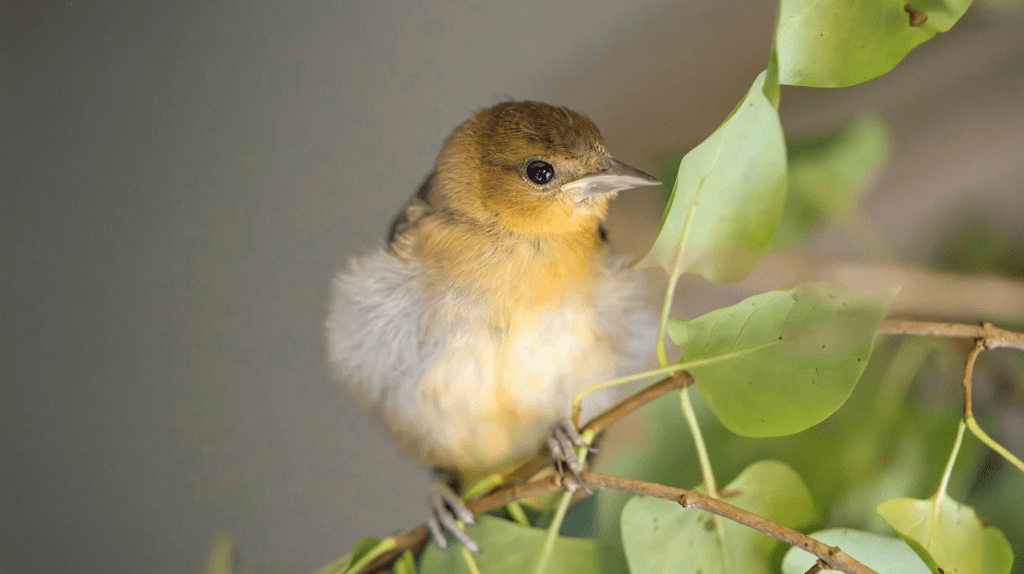
One early May, I watched a pair of Baltimore Orioles courting in my backyard. Before long, the female was weaving an intricate nest in the sugar maple outside my bedroom window. Three weeks later, the begging calls of chicks emanated from within.
As a self-professed “wildlife biographer,” I sought to photograph every stage of their story. I learned each oriole’s unique traits: the father’s dulcet chirrups as he patrolled his territory and the specific flight paths he took to the nest, the mother’s burnt-orange plumage as she moved surreptitiously through the trees, and her cryptic, leaf-like flutter down to the jelly feeder. I marveled at their tireless vigilance against marauding Blue Jays and squirrels and the dozens of daily forays they made to find insects for their nestlings.
One day, hearing a great ruckus, I rushed outside to find the parents flitting about a chick on the ground. She was injured and squawking piteously, likely captured by a predator and then released in the ensuing fray.
I scooped her up, pleading uselessly with the parents for forgiveness, and raced her to Cornell University’s wildlife hospital, not far from my home. She’d suffered puncture wounds and a ruptured air sac. After a stint in the hospital and then with a rehabilitator, she was transferred to me (a subpermittee under a wildlife rehabilitator’s license) in hopes of a release. But first, we needed to prove she could fly.
I named this tiny, spunky bird Sparky. (snip-MORE)
Pigeon Guillemot
Cepphus columba
Also Known As
- Surf Pigeon
- Курильский чистик / Kuril’skiy chistik (Russian)
About
The Pigeon Guillemot is an attractive member of the auk family, a group of marine birds that also includes the puffins, murres, and auklets. The auks are largely known to forage on the open ocean, with some species diving to extraordinary depths for their food. The Pigeon Guillemot, however, forages in shallow waters near the shore and doesn’t usually dive deeper than about 100 feet. Nonetheless, they are graceful divers, “flying” underwater, their partially opened wings helping them maneuver and propelling them along. Like other auks, they use their feet as rudders.
Pigeon Guillemots are particularly fond of small fish and crustaceans, which they chase out from under rocks on the sea floor. But foraging among the nooks and crannies is not without its risks — the Pigeon Guillemot itself is food for other marine life, including the giant Pacific octopus!
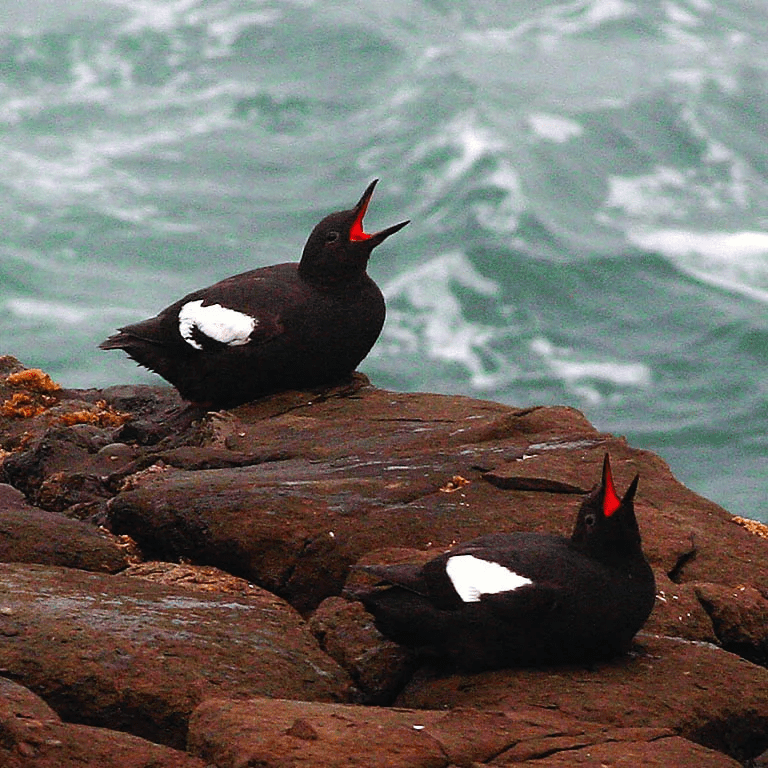
Nesting colonies can be quite large, especially on small offshore islands with few predators. And Pigeon Guillemots dress quite elegantly for the occasion: During the breeding season, males and females sport velvety black plumage with a broad, white, vaguely V-shaped wing patch, all set off by their flashy, bright red feet. After the breeding season concludes, however, these birds molt to a mostly white and ashy black-and-gray plumage. (snip-MORE)
From friends of Playtime, Bee and Sherky:
 Scottie's Playtime