
This is good news and shows why so many are moving into California and out of places like Florida. Students should feel free from fear while learning. They also should feel free to be their authentic self in a supportive atmosphere. School is a time to learn about the world, other people, subjects, and about one’s self. And not all kids have safe supportive homes. Hugs.
———————————————————————————————————–
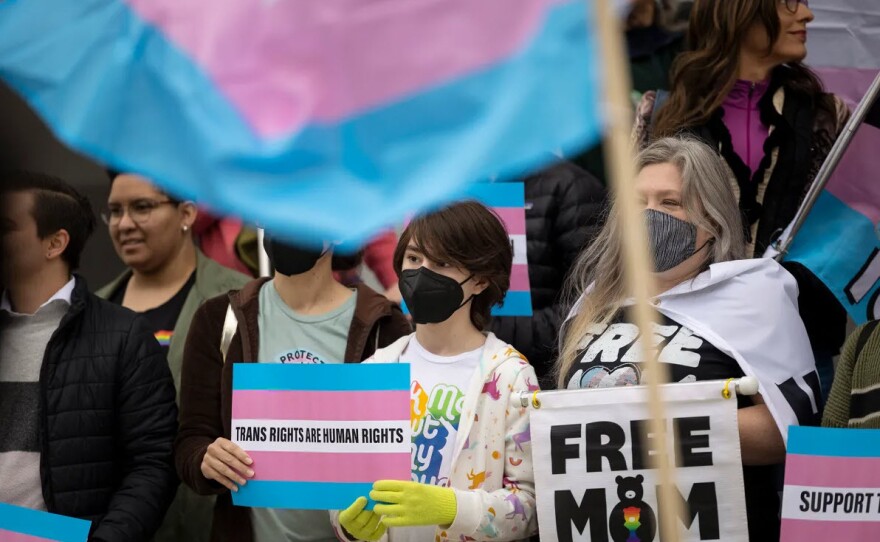
Miguel Gutierrez Jr./CalMattersSupporters of transgender rights gathered at the Capitol during a press conference on March 17, 2022.
Amid a flurry of recent school board policies aimed at the rights of transgender students, California passed a new law in July that prevents schools from requiring staff to notify parents if a student identifies as LGBTQ.
The new law, AB 1955, came in response to a handful of school boards adopting policies that require teachers and other school staff to notify parents if a student identifies as a gender other than what’s on their school records.
“Teachers can still talk to their parents,” Gov. Gavin Newsom said at a press conference on Monday in which he touted a new plan to improve career opportunities for adults. “What they can’t do is fire a teacher for not being a snitch. I don’t think teachers should be gender police.”
LGBTQ advocates said that “forced outing” policies, such as those adopted in Chino, Temecula and a dozen other districts, infringe on students’ privacy and could potentially harm students whose parents disapprove of their identity.
The state sued to stop Chino’s policy, and most districts either scrapped their policies, tweaked the language or put them on hold.
This act “could not be more timely or necessary, and LGBTQ+ students across California can breathe a sigh of relief,” Tony Hoang, executive director of Equality California, which advocates for LGBTQ rights, wrote. “LGBTQ+ youth can now have these important family conversations when they are ready and in ways that strengthen the relationship between parent and child, not as a result of extremist politicians intruding into the parent-child relationship.”
‘The battle continues’
Opponents of the new law said that parental notification policies actually strengthen ties between students and parents, and schools should not withhold information on such important matters. Even though a parental notification measure that would have applied to all schools failed to qualify for the ballot, opponents vowed to keep fighting.
“This (law) doesn’t clarify anything. And nothing prevents individual teachers from bringing the issue up with parents,” said Roseville school board member Jonathan Zachreson, an organizer of the failed ballot measure and whose district was among those that passed parental notification policies. “So the battle continues.”
The new law also requires the state Department of Education to update its LGBTQ resources and encourage school districts to offer counseling, support groups, clubs, anti-bullying policies and other measures to support LGBTQ students and their families. Schools would have to pay for those services with their existing funding.
“I don’t think teachers should be gender police.”Gov. Gavin NewsomLGBTQ young people are particularly vulnerable on school campuses. In a recent survey of 18,000 LGBTQ young people nationwide, nearly half said they had been bullied in the past year, and 10% said they had attempted suicide. Those whose schools supported LGBTQ rights were less likely to suffer from mental health challenges.
Even if the new law sparks a backlash in more conservative areas of the state, California was right to move forward with it, especially as some states push ahead with their own parental notification policies, said USC education professor Morgan Polikoff.
“Will everyone like this law? Certainly not. Will it lead to conflict? There is no doubt,” Polikoff said. “But I am hopeful this will be good for the queer kids in California’s schools and will point the way toward similar efforts in other states.”
CalMatters’ Adam Echelman contributed to this story.

 Scottie's Playtime