Bad News.

Simply very bad news. Precisely what Project 2025/Agenda 47/Republican National Platform said they want to do. I’m sorry; I don’t like to bring bad news. But people need to prepare. This is written in editorial/opinion style, but facts are within and there are citations. For people like us who need time to prepare for austerity, it’s news we ought to read.

Also, there are Senator names included for who we should write to regarding this bill. That’s our last chance. Shutdown is on Republicans, not Democrats, no matter how they try to deflect. We need to tell the Dem senators to speak what’s in this bill, every chance they get, and to refuse to vote in favor, pointing at Republicans the entire time.

There are parts in the article complaining about Democrats and their choices, etc., et. m. Read it if you want (you’ll have to click through for it,) but it won’t help anyone to read more complaining about Democrats. We the people need to energize Dem. Senators to speak out, and to vote no. Especially the speak out portion; Sen. Mark Kelly does that especially well, and is among those the author of this piece feels is wavering. I intend to start first thing in the morning, and I hope all of us will devote some time to this. It’s vital.

Senate Democrats’ Choice: Block the Republican Spending Bill or Dissolve Congress

The House’s continuing resolution would effectively hand over spending decisions to Donald Trump and Elon Musk.

by David Dayen  March 11, 2025

Snippets:

Without the luxury of Republicans falling apart, Democrats in the Senate need to decide whether to prevent a dangerous and harmful budget that shrinks the power of Congress in the government. Since operating on principle goes against their “adults in the room” mindset, they are wavering on what to do. But it should be an open-and-shut case.

A normal continuing resolution funds the government at the same level as the previous budget. This bill does not. It cuts non-defense discretionary spending by $13 billion below last year’s level, while increasing military spending by $6 billion. It zeroes out funding for programs that fund homeless shelters and prevent child abuse. It cuts health care funding for clinics and hospitals, emergency preparedness for communities, clean water projects and tribal assistance. Meanwhile, it adds money for mass deportations, just as Immigrations and Customs Enforcement has illegally detained a green card holder for his political beliefs.

Most of the budget cuts are achieved by removing earmarks, which members of Congress put in to direct projects. But usually when earmarks are removed, the money goes back to the agency to decide how to distribute it. This maneuver cuts the earmarks and the money.

The House Republican bill also fails to fix a carryover of a $20 billion rescission to IRS money from the Inflation Reduction Act, effectively doubling that cut. This was kind of pre-ordained when Democrats punted on this in a prior continuing resolution last December, but it still means that practically all of the IRA’s funding for greater enforcement of tax collection is now gone.

The bill not only adds $6 billion to the Department of Defense’s enormous budget, but adds $8 billion in “transfer authority” that allows the agency to shift spending where they deem important, a flexibility no other agency gets.

While Republicans tout a $6 billion increase in veterans health care in the bill, they neglect to mention the removal of a $23 billion appropriation to the Toxic Exposure Fund to implement the PACT Act, which cares for veterans exposed to burn pits and other cancer-causing chemicals. While there’s an extra $2.2 billion for the Federal Emergency Management Agency’s disaster relief fund, there’s no additional money to support the rebuilding in southern California after the January wildfires.

But most important, the bill grants an open invitation to Trump and Elon Musk to continue to ignore Congress and toss out disfavored spending. Vice President JD Vance, while selling the deal to House Republicans, stated outright that “Trump would continue cutting federal funding with his Department of Government Efficiency initiative and pursue impoundment — that is, holding back money appropriated by Congress.” This has been reiterated by others in the Trump administration.

In fact, the House Republican bill gives the president more leeway to move money around. It appropriates money for things that Musk has eliminated, meaning that money can operate as a floating slush fund for Trump’s priorities, as long as the courts don’t roll back the illegal impoundments.

… The Trump administration is saying that they will sign a bill appropriating specific funding, and then go about cutting funding anyway. If you’re a member of Congress, you’re being told that your work product doesn’t matter, that the constitutional power of the purse doesn’t matter, and that there’s no guarantee that anything you pass will actually reach the people you serve.

I can see why Republicans would take this deal: they want budget cuts but know they don’t have the votes for them, so they’re plenty happy to outsource that to the president, even if it turns Congress into a separate and unequal branch of government. But why would Democrats willingly submit to a fake budget on paper that can be so easily circumvented? As Rep. Greg Casar (D-TX), chair of the Congressional Progressive Caucus, said on X, “The Republican spending plan will supercharge Musk’s theft from working people to pay for billionaire tax cuts. Senate Democrats must stop it.”

So far, only Sen. John Fetterman (D-PA) has committed to voting yes. But as Josh Marshall has documented at Talking Points Memo, a number of Senate Democrats have stated no position on the bill, leaving their options open. In general, senators have been hedging their bets until forced to make a decision. That time has come.

Credible sources indicate that the most likely Democrats to offer up the remaining seven votes to avoid a shutdown are Mark Kelly (D-AZ), Ruben Gallego (D-AZ), Michael Bennet (D-CO), John Hickenlooper (D-CO), Jon Ossoff (D-GA), Gary Peters (D-MI), Elissa Slotkin (D-MI), Maggie Hassan (D-NH), and Mark Warner (D-VA).

Peace & Justice History for 3/11

March 11, 1988

Ten days of protest and direct action ensued demanding an end to nuclear testing at the Nevada Test Site. The site, larger than the state of Rhode Island, is an outdoor laboratory and national experimental center for testing nuclear weapons. The actions resulted in over 2,200 arrests, the largest number of arrests in U.S. history for a political protest outside Washington, D.C.
March 11, 2011
More than 85,000 Wisconsin citizens rallied outside the Capitol in Madison to welcome the return to the state of fourteen Democratic state senators. Known as the Wisconsin 14, they had left the state to deny the senate a quorum, thus delaying passage of legislation which took away public employees right to collectively bargain and restricting other rights of union members.
State Senate Minority Leader Mark Miller remarked about the gathering, “This is what democracy looks like!”

The Wisconsin 14

https://www.peacebuttons.info/E-News/peacehistorymarch.htm#march11

Bill Nye, The Science Guy!

Science Nerds Demand America’s New God-King Give Back Their Lunch And Cancer-Research Money by Rebecca Schoenkopf

And Dom was there! Read on Substack

Bill Nye the Science Guy speaks to people protesting the Trump administration’s federal funding cuts during the Stand-Up for Science Rally in Washington DC, Friday, March 7, 2025. Photo by Dominic Gwinn.

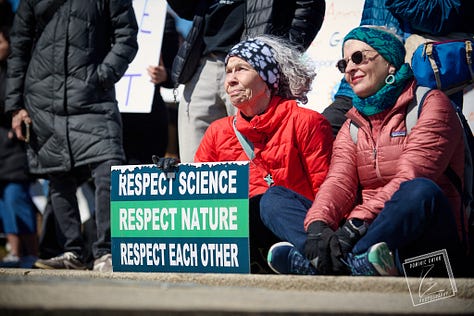
On Friday, nerds all over the US staged rallies to protest the Trump administration’s cuts to federal funding research. Thousands rallied on the steps of the Lincoln Memorial in Washington DC to plead about the benefits of funding science and research in the knowns, known-unknowns, and unknown-unknowns.

Like so many DC rallies before it, the steps of the Lincoln Memorial were transformed into a temporary stage. There wasn’t a big, black riser with rows of cameras and media crews. There weren’t throngs of journalists roaming around and shoving microphones in the faces of flag waving attendees. The crowd didn’t have any kind of uniform apparel, like colored hats and/or armbands.

With a few exceptions, like Bill Nye the Science Guy, and patients who owe their lives to federally funded medical research, a number of speakers were fairly boring. They stood awkwardly at podium and told corny jokes that fell flat. At one point, some of the older folks sang out-of-tune folk songs.

These were scientists. They proudly identify as nerds. They’ve dedicated their careers to saving lives and the planet we’ve all been mucking up for generations. And now many of them were facing unemployment because a merry band of bigots, buffoons, and bros decided science is, like, queer, or whatever.

People in the crowd cheered on speakers — their colleagues and fellow researchers — who lamented the loss of funding that didn’t just help find cures for cancers and disease, create new technologies, or reveal secrets of the universe; they were pissed there was no money for things like coolant used in specialized freezers that preserve decades of biological specimens.

Dr. Allison Agawu speaks to people protesting the Trump administration’s federal funding cuts during the Stand-Up for Science Rally in Washington DC, Friday, March 7, 2025. Photo by Dominic Gwinn.

“This will lead to more deaths,” summarized Dr. Allison Agawu, Professor of Adult and Pediatric Infectious Diseases at Johns Hopkins University School of Medicine. “Science is a beautiful art built on a canvas of ideas. The best science comes from diverse ideas, from diverse people with diverse perspectives, spurring innovation and progress … We collectively reject that inclusion, diversity, equity and access are bad words. In fact, programs championing these ideals should be celebrated and expanded, as that is how we get the best science and the best outcomes.”

A retired mathematician from the National Security Agency explained that it could be difficult for people to understand why research jobs were important. Not everything can be easily described in an elevator pitch. “Are there places we could cut,” they said, “Sure, but people just don’t understand what we do. We can’t talk about it. I know my work saved lives.”

Lloyd Franklin, 64, stood at the front of the stage wearing a blue NASA jacket. He is a retired aerospace engineer who, like many kids, grew up wanting to be an astronaut. He held a sign with a photo of Apollo astronaut Gene Cernan from 1972. Cernan is taking a selfie while holding the American flag as the Earth, a pale blue dot, floats in over his shoulder. It was the last time humans walked on the Moon.

Above the photo on Franklin’s sign were the words: “Science gave us this.”

“I know this is important,” Franklin said. “I know we have to make a stand.”

Lloyd Franklin, 64, protests the Trump administration’s federal funding cuts during the Stand-Up for Science Rally in Washington DC, Friday, March 7, 2025. Photo by Dominic Gwinn.

These types of protests have been happening almost daily over the last few weeks. Much of this is being carried out by federal workers themselves through private, encrypted chats and public message boards. Mustering a sizable crowd on short notice in the middle of the week in DC can be a Herculean task, but they have been showing up to protest regularly since congressional Republicans turned a blind-eye to Donald Trump’s sweeping cuts to federal agencies.

If they get any media attention, it’s from struggling freelancers or niche bloggers. National broadcasters or their local affiliates are not really showing up to show hundreds of federal workers protesting on the evening news. There’s a massacre being carried out in broad daylight and the pathetic reality is that much of the DC press corps is either too scared to do their jobs, or they just don’t care.

“It’s bad optics,” a colleague said.

Peace & Justice History for 3/10

March 10, 1968
Cesar Chavez ended a 23-day fast for U.S. farm workers in a Delano, California, public park with 4000 supporters at his side, including Senator Robert Kennedy (D-New York). Cesar Chavez led the effort to organize farm workers into a union for better pay, working and living conditions.

The story of Cesar Chavez 
March 10, 1969
James Earl Ray was sentenced to prison for 99 years by a court in Memphis, Tennessee, after admitting he murdered American civil rights leader Dr. Martin Luther King, Jr. King, who preached and practiced nonviolence, was shot dead by a sniper in Memphis as he stood on the balcony of the Lorraine Motel.
The building now houses the National Civil Rights Museum.

Witnesses pointing toward the source of the shot that killed King.
National Civil Rights Museum at the Lorraine Motel 
March 10, 2006
Turkish conscientious objector (CO) Mehmet Tarhan was released unexpectedly from a military prison after being held for having refused service in the army. A court decided that he had already been held longer (23 months) than any possible sentence for the crime. 
 Mehmet TarhanMehmet Tarhan’s supporters

He was ordered, however, to present himself again for military service and thus be subject to re-arrest for the same offense.

War Resisters’ International(WRI) led an international support campaign for him along with other CO activists in Turkey.

More on Mehmet Tarhan and other Turkish COs 

https://www.peacebuttons.info/E-News/peacehistorymarch.htm#march10

Lots Of Good Ones This Morning,

this one made me lol!

Sherman’s Lagoon by Jim Toomey for March 09, 2025

Sherman's Lagoon Comic Strip for March 09, 2025

Sunday Poetry, and Related Good News!

(Good news below the poetry. The poetry is more beautifully written.)

Readers may or may not recall I’ve been undergoing some major work around our house. Back in December was the first of the foundation work, in which piers were placed at strategic points around the house to raise it after drought and earthquakes caused major dirt shifting on our block (and others surrounding.) Anyway, some or maybe all of you may be aware of the amount and depth of digging required for the work. There were great trenches around the house, including the front flower bed (mostly dedicated to wildflowers for birds and bees; nothing at all formal, just nice in a simple way.) But there were a few daffodil plants, to which DH was quite partial. I figured the entire bed’s plants were gone after the work, but this past Tuesday I pulled into the driveway after an errand, and there are the daffodil plants (not yet blooming) out drinking in sunlight, in pretty close to the same spots they used to be! I’ve just been amazed by that, and it’s a really nice thing to see out front. Thanks for reading! ⚘

One From Worriedman

Calm was the even, and clear was the sky,/ And the new budding flowers did spring,/ When all alone went Amyntas and I/ To hear the sweet nightingale sing; by Worriedman Read on Substack

“Song: Calm was the even, and clear was the sky”. By John Dryden

Fun poem ! Bawdy! Go read it!

The whole poem-

The Poetry Foundation’ s biography of Dryden is quite good. I like the sound of his poetry. It’s good to read aloud. https://www.poetryfoundation.org/poets/john-dryden

“Fenn, did you see what happened to the Lemon Oreos I left on the table?”

My desktop at work

Hellebores

Amaryllis! At home –

At work –

Greenhouse sunrise

I spent some time with Barncat tonight

I had a great time out with Amos and the Minions .

I took a bunch of pictures – I’ll use them this weekend.

That’s all I got room for – thanks for dropping by! (snip)

Decent News Friday

I wish I could still say it’s amazing that these bills even come up, while now instead, it’s amazing that they’re not brought into law. But here we are. Decent news from Montana!

Powerful Speeches From Trans Dems Flip 29 Republicans, Anti-Trans Bills Die In Montana by Erin Reed

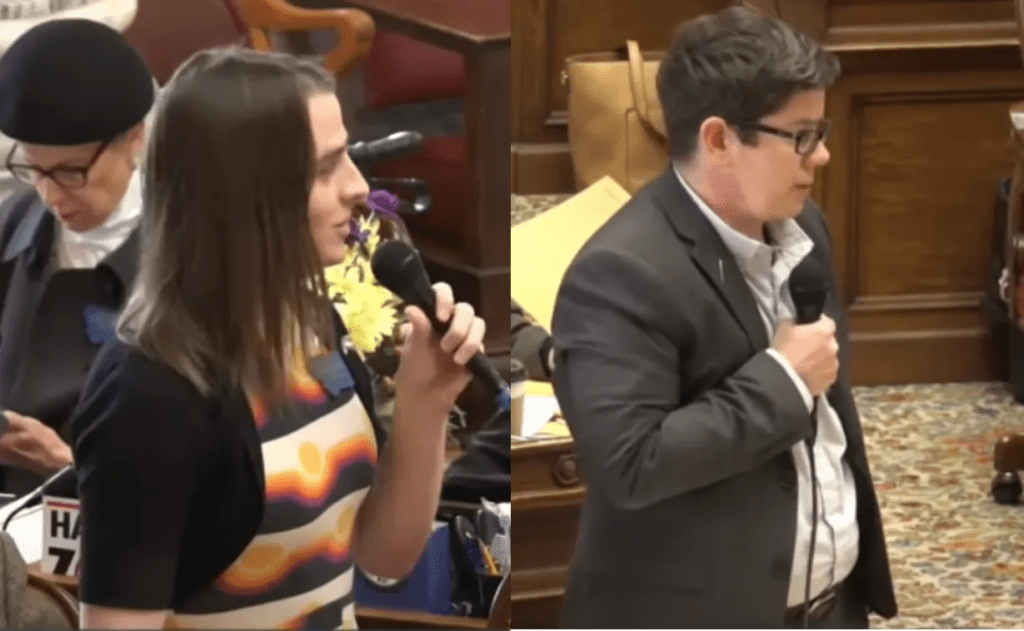
Transgender Reps Zooey Zephyr and SJ Howell delivered powerful speeches on the Montana House floor on Thursday. Republicans defected en masse to join them in voting against anti-trans bills. Read on Substack

Something remarkable happened in Montana today. As has become routine, anti-trans bills were up for debate—the state has spent more than half of its legislative days this session pushing such bills through committees and the House floor, with Republicans largely voting in lockstep. But something changed.

A week ago, transgender Representative Zooey Zephyr delivered a powerful speech against a bill that would create a separate indecent exposure law for transgender people. Since then, momentum on the House floor slowed. Today, two of the most extreme bills targeting the transgender community came up for a vote. Transgender Representatives Zooey Zephyr and SJ Howell gave impassioned speeches—this time, they broke through. In a stunning turn, 29 Republicans defected, killing both bills. One Republican even took the floor to deliver a scathing rebuke of the bill’s sponsor.

The first bill to reach the House floor was HB 675, a measure that would ban drag performances and Pride parades in Montana. A previous drag ban had already been struck down by the courts after it was enforced against a transgender woman—who was not a drag artist—to prevent her from speaking about public history at a library. In response, the bill’s sponsor, Rep. Caleb Hinkle, introduced HB 675 to circumvent that ruling.

Rather than relying on state enforcement, this bill would grant individuals the private right to sue if a public drag performance took place, making it more difficult to challenge in court. During committee hearings, Hinkle went even further, calling being transgender “a fetish” and arguing that the law was necessary to prevent trans people from dancing in public.

And that’s when transgender Representative Zooey Zephyr took to the floor.

“Here I am again to rise on another bill targeting the LGBTQ+ community,” she said, exasperated. “At its very core, drag is art. It is very beautiful art. It has a deep history in this country, and it is important to my community. You know, if you are a woman in this body wearing a suit today, you are in some way challenging gender norms that existed long ago… There were three-article-of-clothing laws 50 years ago that said if you wore three articles of clothing that were indicative of the opposite gender, they could stop you, arrest you… it was those laws that led to the police raiding an LGBTQ+ bar that led to the Stonewall riots, one of the most important civil rights moments in my community’s history,” she began.

“When the sponsor closed on this bill, he said, this bill is needed… and I quote his words… ‘because transgenderism is a fetish based on crossdressing.’ And I am here to stand before the body and say that my life is not a fetish. My existence is not a fetish. I was proud within a month ago to have my son up in the gallery here. Many of you on the other side met him. When I go to walk him to school, that’s not a lascivious display. That is not a fetish. That is my family. This is what these bills are trying to come after… not obscene shows in front of children, we have the Miller test for that, we have laws for that. This is a way to target the trans community, and that is in my opinion, and in the speaker’s own words.”

Then something even more remarkable happened: A Republican, Representative Sherry Essman, rose to defend Rep. Zephyr and chastised the bill’s sponsor. “I’m speaking as a parent and a grandmother. And I’m very emotional because I know the representative in seat 20 is also a parent. No matter what you think of that, she is doing her best to raise a child. I did my best to raise my children as I saw fit, and I’m taking it for granted that my children are going to raise my grandchildren as they see fit,” she began.

“Everybody in here talks about how important parental rights are. I want to tell you, in addition to parental rights, parental responsibility is also important. And if you can’t trust a decent parent to decide where and when their kids should see what, then we have a bigger problem,” she turned to parental rights and spoke about how people who claim those rights should vote against the bill.

And then, she closed by chastising the bill’s sponsor for bringing the bill, “Trust the parents to do what’s right, and stop these crazy bills that are a waste of time. They’re a waste of energy. We should be working on property tax relief and not doing this sort of business on the floor of this house and having to even talk about this.”

Following the speeches, 13 Republicans, the most of any anti-trans bill this cycle, flipped and voted against the bill. See it as it happened here:

Were this all that happened, it would have been remarkable enough—such aisle-crossing has become rare in modern politics, and on transgender issues, it is almost unheard of. But Representative Zephyr is not the only transgender lawmaker in Montana. Representative SJ Howell, a powerhouse in their own right, took the floor when an even more extreme bill followed immediately afterwards—HB754, a measure that would remove transgender children from their parents. They had a powerful speech to deliver as well.

Representative Howell opened, “I stand to oppose this bill… When a state intervenes to remove a child from their family, that is one of the most serious and weighty responsibilities that the state has. That is not something to be taken lightly. Every time a child is removed from their family, it’s a tragedy. Sometimes a necessary tragedy, but a tragedy nonetheless. This bill does not come close to the seriousness with which those decisions should be contemplated.”

They pointed directly to the bill’s language: “On page 1, line 19, any child protective service specialist, peace officer, or county attorney who has reason to believe any child is in immediate danger or harm may immediately remove the child. What we are adding… a child transitioning gender with the support of a parent or guardian is considered in immediate or apparent danger or harm.”

Howell then turned to the bill’s vagueness and the dangers it posed to transgender children as well as any child who defies gender norms. “Transitioning gender is not defined in this bill… so what does that mean? Maybe it means, as the sponsor said, surgery or medical treatment. Maybe it means therapy, mental healthcare. Maybe it means a kid who gets a haircut and a new set of clothes. Maybe a name change… a legal name change, or someone who wants to try out a different name… a strict reading of this bill could include all of that.”

They urged lawmakers to consider the real consequences. “Put yourself in the shoes of a CPS worker who is confronted with a young person, 15 years old maybe, who is happy… healthy… living in a stable home with loving parents, who is supported and has their needs met? And they are supposed to remove that child from their home and put them in the care of the state? We should absolutely not be doing that.”

Then, the bill went to a vote. This time, the Montana Republican Party fully fractured—29 Republicans crossed the aisle to defeat it.

Watch it as it happened here:

Following the vote, Representative Zephyr took to social media to discuss the implications. “These kind of votes are born out of transgender representation in government,” she posted on her bluesky account. “Howell & I have built solid relationships with Republicans and those relationships change hearts, minds, and (eventually) votes. It is painful, grueling work. But it makes a difference.”

At a time when anti-trans bills are sailing through red-state legislatures, many are left wondering how they can be stopped. Some Democrats, like Gavin Newsom, have chosen appeasement—standing alongside anti-trans hate leaders like Charlie Kirk instead of standing up for transgender people. But Representatives Zooey Zephyr and SJ Howell offer a different path. As transgender lawmakers in a Republican-dominated government, they have shown that representation, relationships, and the power of speaking truth in hostile spaces can move hearts and minds. Their success is a reminder that even in the most challenging environments, refusing to back down can make a difference.

Editor’s Note: The writer of this article is happily married to Representative Zooey Zephyr. While I am mindful of disclosing personal relationships in my reporting as a transgender journalist, I also recognize the importance of covering major moments like today’s events in Montana, and so I chose to report on this story with this disclosure. My goal remains delivering critical LGBTQ+ news to my readers with the integrity and urgency it deserves.

MacKenzie Scott, Philanthropist

And no, she didn’t “earn her money in the divorce”; she built Amazon into what it is/was. She earned her money by working. It’s important to note because of opposition comments about her.

MacKenzie Scott Nice Time Update! by Rebecca Schoenkopf

Turns out that the way she gives money is a really good way. Read on Substack

Marcie Jones Mar 04, 2025

green plant in clear glass vase
There’s like no photos of MacKenzie Scott. Photo by micheile henderson on Unsplash

And now let us check in with breath-of-fresh-air MacKenzie Scott, the heart-of-gold billionaire who spun her share of her divorce from Jeff Bezos after he cheated on her into philanthropy and Yield Giving, a foundation that has so far given out almost $20 billion in unrestricted gifts for social justice, human services (like abortions and health care), education, LGBTQ+ services, playgrounds, historically Black colleges and universities, a total of 2,450 excellent causes that happen to be the ones that piss off Elon Musk and other right-wing chuds the very most!

Turns out, according to a three-year-analysis by the Center for Effective Philanthropy of 800 of the donations her foundation has made, the no-strings-attached way she gives out money is quite effective!

When Scott started handing out unrestricted gifts in 2019, the world of philanthropy got shook. The usual way to go about doling out large sums of cash with a foundation is to give restricted gifts, like for eradicating the rockin’ pneumonia, but not the boogie-woogie flu, or a scholarship fund for sensitive boys with at least a 3.0 who play the flute, or constructing the Phineas Q. Oilman Center for Fracking Studies.

Donors like to direct exactly where their money goes. And they like to have their names on stuff, like etched on a plaque, or a “thank you” in the opera program. Also naming rights are a way to encourage ongoing involvement. Don’t you think dear departed Grandpa Oilman would have wanted his heirs to make sure that his building has plenty of money in trust to keep the center’s roof repaired?

And foundations usually give out grants in response to proposals. This usually starts with announcing the grant: The Betsy VonThundersnatch Foundation For The Arts intends to award $5 million to bring drag brunches to underserved populations. Then nonprofits that work in that area respond with a proposal that assesses the need, lays out project with objectives, includes a step-by-step timetable, detailed budget estimate for renting a van, buying wigs and champagne etc., a pitch of why their organization is the most capable one to meet the need, what the benchmarks for measuring success will be, and so on.

Then after a grantee gets the money, they’re usually required to regularly report back the details of their benchmark-hitting to a board. What some might call micromanaging and others might call responsible stewardship helps foundations and charities solicit gifts, because donors want to know exactly where their money is going and be reassured that it’s not going to get blown fast. Which makes sense! But all of that takes time, and wig money. It can be many months and sometimes even years between when a grant is announced and an awardee can cash a check, and charities have to pay overhead for people to look for grants to apply to, and write the proposals.

But MacKenzie Scott’s Yield Foundation does the opposite of this! They skip the solicitation-and-proposal part entirely, quietly and secretly researching organizations’ track records. And then the foundation cuts a surprise check, with no spending-timetable or strings attached, and lets the nonprofit roll with it. It is bold! It is brave! It is trusting!

And here’s the Center for Effective Philanthropy’s report on how it’s going: The grantees are actually not blowing all of the money. Most are using it to shore up longer-term stability and plan to spend it within two to five years. Some have been able to pay debt, and have reserves and health insurance for their employees for the first time, and they are able to provide more services and expand their missions.

Like the South Texas Food Bank. They were able to give their employees free health care, and also nearly doubled the amount of food they distributed to eight counties and one tribal nation in south Texas with the $9 million Scott’s foundation gave them. Also Kaboom! They build playgrounds, and with Scott’s $14 million they have quadrupled the size of their playgrounds, and have gotten into advocacy too, pushing for elimination of the use of toxic chemicals on playground surfaces.

Eighty-five percent of nonprofit recipients said that Scott’s gifts have helped them improve or expand their programming, and 52 percent reported a greater capacity to respond to the needs of the communities they serve. The organizations that received awards from Scott had double the amount of cash reserves as comparable nonprofits, which is vital for the long-term stability of any organization that depends on the kindness of strangers in a volatile economy.

Ninety-three percent reported that Scott’s grant moderately or significantly strengthened their ability to carry out their mission, and 90 percent said the gift bolstered their financial positions. More than 60 percent said they used the grant to establish credibility with other funders, though 53 percent were concerned that other funders might withdraw their support, believing that recipients didn’t need additional funding. But the other side to that is Scott’s foundation has already done the research, so her endorsement could also encourage more donations. How that will pan out in the end for charities remains to be seen.

And, though the grants don’t require them to, 70 percent of the recipients are tracking the impact of the money, some say even better than they actually were before, because now they have better capacity to do that. Said one, “This grant has allowed us to focus more deliberatively on our metrics and impact to better equip us to answer this question/tell our story/show our impact.”

And what an impact! Samples from the survey: 33,521 loans for a total of $1.26 billion to low-income households to buy homes, start or capitalize businesses, and address their financial needs. Health care for 100,000 new patients. Legal orientation for more than 12,000 refugees, and 200 unaccompanied immigrant minors re-unified with their families, and millions of meals served in the US and other countries.

And her freewheeling gifts are having an impact on other foundations also. More than half of foundation leaders surveyed said that they now thought that their foundations should consider giving out large, multiyear, unrestricted support, too. Which is not simple, because foundations are staffed, structured and budgeted to do things the way they’ve always done them, and it’s hard to get boards to agree on lunch, much less to a complete overhaul on how they do everything, and possibly to re-write of all of their bylaws. But now they have a fine example to follow, and success to point to.

That MacKenzie! She is so humble, it is hard to find pictures of her anywhere, unless they’re from her as Bezos’ plus-one in the old days. And while her ex is out here kissing Trump’s behind, whoring out the newspaper he bought and swanning around Aspen with his affair partner, she is making a difference in a good way. And still the 5th-richest woman in the world.

It’s all lovelier than a drag brunch in June.

OPEN THREAD. (We’ll have something up later too, you know what time.)

(snip)

For Fun On Sunday

Blue language within.