More racism. Plus what does this say about how the Republican Party which is the party that touts themselves as pro business yet in the name of racism they feel free to trash people’s places of business. Notice everyone they detained was working. Working. These are not criminals they are productive members of their community. Their real crime in the current US under Stephen Miller is not being white. Yes undocumented but how soon will it be before they come for US citizen brown people in their quest for a white ethnostate. We must stop them now. Hugs
————————————————————————————————————-
In a social media post, the business said immigration agents left behind a burned kitchen, torn ceiling tiles, broken doors and trashed food.
A local Mexican restaurant chain in Pennsylvania is trying to forge ahead a week after a worksite immigration raid left property damage at two of its storefronts and a workforce afraid to show up to their jobs, according to two employees and a witness who spoke with NBC News.
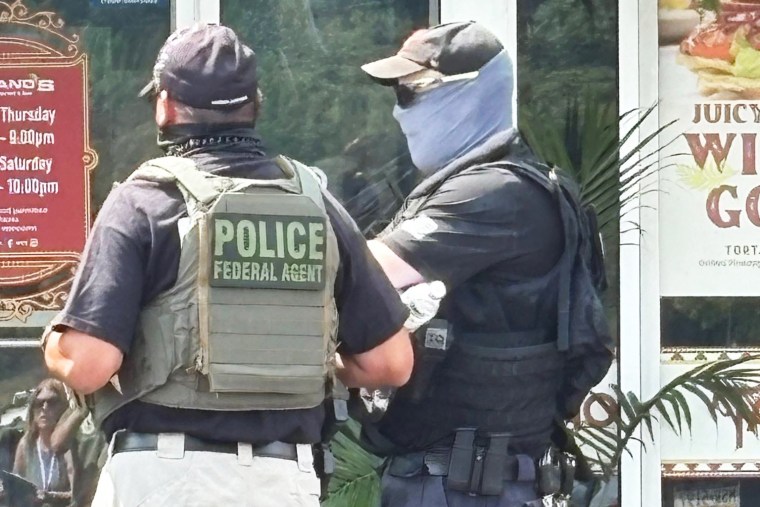
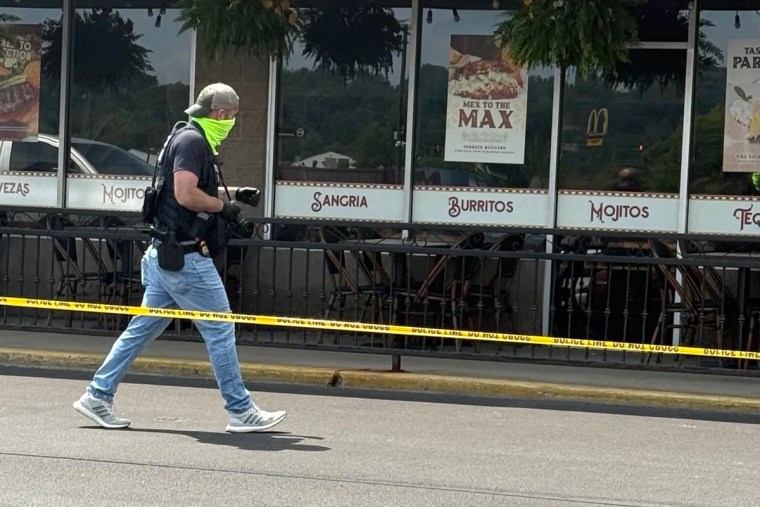
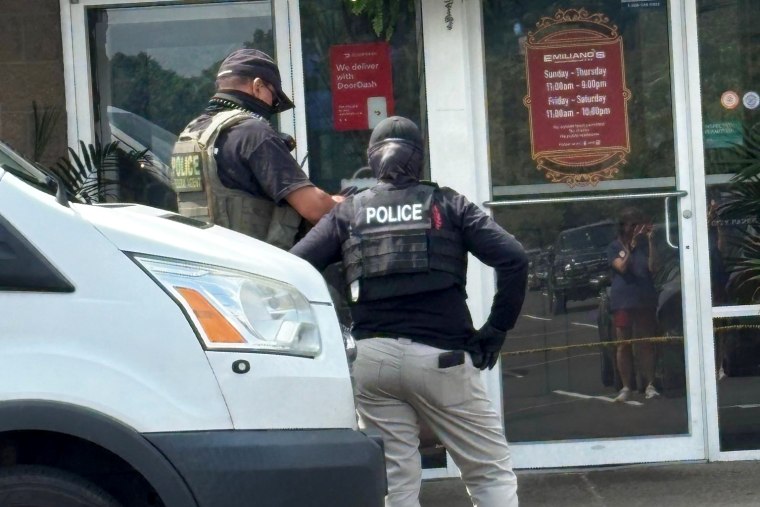
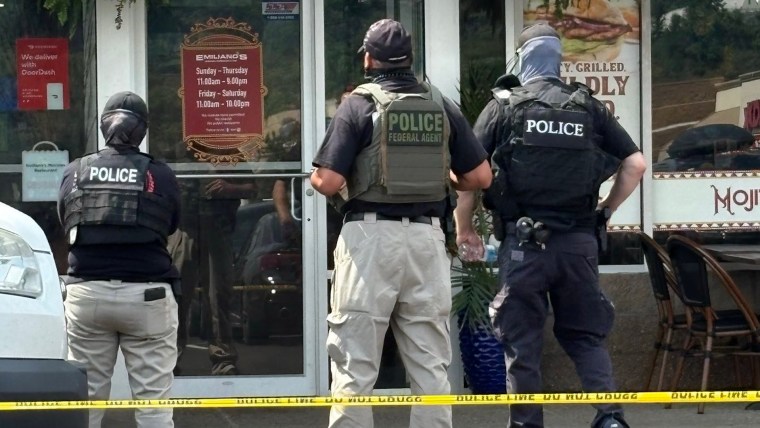
It all started Aug. 7 when immigration authorities showed up at two Emiliano’s Mexican Restaurant & Bar locations in the Pittsburgh area. As many as 16 workers were detained — nine worked at a location in Gibsonia, a suburb north of Pittsburgh, and seven others worked at another location in the nearby township of Cranberry.
In a social media post that same afternoon, which included a video taken by a worker, the business accused agents of storming into its restaurants and leaving “a trail of fear, confusion, and destruction” that included a burned kitchen, torn ceiling tiles, broken doors, a safe cut open by an agent and trashed food. The incident raises questions over the tactics used by authorities at this particular raid.
Immigration authorities conducted a workplace raid on two Emiliano’s Mexican Restaurant & Bar locations on Aug. 7. Courtesy Jaime Martinez
This week, gas plumbers fixed a stove that was damaged during the raid, according to two people working at the restaurant chain. Staffing was also thin at the locations targeted by immigration authorities as employees who witnessed the raid, including those who are U.S. citizens, remain “in shock,” they added. “No one wants to go back, everyone is scared.”
Both workers who spoke with NBC News requested to not be named to protect their family’s privacy because of an ongoing federal investigation in connection with last week’s events.
The U.S. Attorney’s Office for the Western District of Pennsylvania declined to clarify what the investigation it is leading is about.
As the immigration arrests were happening last week, someone alerted an emergency response immigration hotline run by Casa San Jose, a local nonprofit that advocates for Latino and immigrant communities.
The organization quickly dispatched about 20 volunteers to both locations to act as legal observers, collect testimonies and provide support to the workers and families affected, according to Jaime Martinez, a community defense organizer at Casa San Jose.
At the Gibsonia location, “the raid actually caused a kitchen fire that agents were unable to extinguish at the beginning, which put people in danger,” Martinez told NBC News on Tuesday.
Employees who spoke to Martinez and his volunteers said the stove was on when agents entered the kitchen because workers were cooking food as they prepared to open the restaurant Thursday morning. The restaurant’s manager warned agents that the open burners were on, but witnesses alleged that agents didn’t do anything until a fire sparked, he said.
The detained employees, who had their arms and ankles shackled, were the ones who directed the agents to find the fire extinguisher and instructed them on how to use it after initially failing to operate it, according to employees who spoke to Martinez and his volunteers.
“By the time the fire department got there, the fire had already been put out with a dry chemical extinguisher, but only after this delay,” Martinez said.
As many as 16 workers were detained at two locations in the Pittsburgh region.Courtesy Jaime Martinez
A spokesperson with U.S. Immigration and Customs Enforcement told NBC News in an email Thursday that the “damage to the restaurant, including the small fire, was created by the illegal aliens themselves while they were trying to escape or hide from law enforcement officers.”
According to ICE, the agents showed up at the locations in Gibsonia and Cranberry to execute federal search warrants based on information it got alleging that the restaurants were employing undocumented workers, WPXI, NBC’s affiliate in Pittsburgh, reported. The agency added that the 16 people detained lack legal status and are now in ICE custody, undergoing immigration proceedings.
“But in the process of coming in with that warrant, they also terrorized the community, pointed guns at people and destroyed a local business,” Martinez said.
In response to this, the ICE spokesperson told NBC News, “All agents and officers followed established legal procedures while executing the warrants.”
At the Cranberry location, Casa San Jose volunteers interviewed a worker who described seeing officers come into the restaurant, shouting “police” and pointing their long guns at the employees. One female employee who was in the kitchen said an agent “pointed the gun at her head” while telling her to stop cooking, according to Martinez.
While she was not detained after showing proper documentation, “this lady is now going to have to live with the trauma of having law enforcement point a gun at her head while she was at work,” Martinez said.
Martinez and one of the workers who spoke with NBC News said agents lined up all of the cuffed employees and made them kneel while pointing their weapons at them.
“Agents and officers operated within established law enforcement standards in order to ensure the safety of law enforcement officers, the public and the illegal aliens themselves,” the ICE spokesperson said in response to this allegation.
An ICE spokesperson said agents were also present in June as part of the same investigation.Courtesy Jaime Martinez
Last week was not the first time immigration authorities attempted to detain employees from Emiliano’s Mexican Restaurant & Bar.The ICE spokesperson confirmed to NBC News that a June incident was part of “an investigation that ultimately led to the execution of the warrants” this month.
Martinez said that on a night in June, he got a call on the hotline, reporting unmarked vehicles surrounding a nearby apartment complex. When the volunteer who was dispatched arrived at the area, she noticed the vehicles were parked with their engines still running, in front and behind the restaurant.
According to Martinez, it looked like federal agents inside the vehicles were waiting for workers to come out of the restaurant as it was closing. The vehicles left once TV crews arrived on the scene, he said.
“There were nine people in that restaurant on lockdown,” Martinez said, adding his group doesn’t know the immigration status of those workers since it doesn’t ask people about that as part of its policy. “But you don’t have to be undocumented to be afraid of getting detained.”
Since launching the hotline in March, Casa San Jose has received more than 650 calls reporting more than 100 immigration detentions in the area and has dispatched volunteers in at least 70 instances, according to Martinez.
In the wake of the raids at Emiliano’s Mexican Restaurant and Bar locations, the community came together and collectively donated more than $133,000. The workers who spoke with NBC News said the business plans to use the funds to cover bond expenses, one month worth of salary for each employee detained and repair damage done to the restaurant.
A 1647 witch-finder pamphlet. Via Wikimedia Commons
The printing press – and a particular manual it printed – played a big role in early modern witch trials, according to a fascinating new study.
Between 1450 and 1750, some 90,000 people were put on trial for being witches across Europe. About 45,000 of these people were executed.
Reasons for the fervour of this “witch craze” are murky. People had believed in witches for centuries, but brutal witch-hunts weren’t nearly as common until the 15th Century.
A study published in Theory and Society uses data on witch trials and witch-hunting publications to suggest that manuals may have been a big contributor.
In particular, they believe the Malleus maleficarum, which was first published in 1487, could explain a lot of the uptick – alongside trials in neighbouring cities.
Frontpiece for a 1576 edition of the Malleus maleficarum. Via Wikimedia Commons
“Cities weren’t making these decisions in isolation,” says lead author Dr Kerice Doten-Snitker, a postdoctoral fellow at the Santa Fe Institute, USA.
“They were watching what their neighbours were doing and learning from those examples. The combination of new ideas from books and the influence of nearby trials created the perfect conditions for these persecutions to spread.”
The researchers tracked the “ideational diffusion” – the spread of an idea, and behaviours linked to it – of witchcraft by looking at trial data and publication data from 553 cities in Central Europe.
They looked specifically for the publication of witch-hunting manuals, like the Malleus maleficarum.
This book contained a detailed explanation of “demonology” – the theory of witchcraft – as well as practical advice on finding and convicting witches.
“At the time of its appearance, there was only a shaky consensus among learned authorities on the crucial questions of who witches were, what they did, and why they had supernatural powers,” write the researchers in their paper.
“The willingness of [author Heinrich] Kramer to expound confidently on these questions is part of what made Malleus so influential.”
Each new edition of the Malleus maleficarum was linked to an increase in witch trials in the city where it was printed.
“The printing press did not cause the inception of the elaborated theory of witchcraft, but our results show that it fostered its spread,” write the researchers.
The team believes this ideational diffusion can be seen in many other areas.
“The process of adopting witch trials is not unlike how modern governments adopt new policies today,” says Doten-Snitker.
“It often starts with a change in ideas, which are reinforced through social networks. Over time, these ideas take root and change the behaviour of entire societies.”



 Scottie's Playtime