May 2, 1963 Hundreds of children ranging in age from six to eighteen were arrested in Birmingham, Alabama, as they marched from Kelly Ingram Park, across from 16th Street Baptist Church, to downtown singing, “We Shall Overcome.”Part of an ongoing effort to end segregation in that city, and following the arrests of many adults including Rev. Martin Luther King, Jr., the children had volunteered to minimize the threat to families if a breadwinner were jailed. A judge had issued an order preventing any of 133 civil rights leaders from organizing a demonstration. Birmingham, the capital of Alabama, had been the site of 18 unsolved bombings in black neighborhoods over recent years, and the place where mobs had attacked Freedom Riders on Mother’s Day in 1961. Leaving the park in groups of fifty, the kids were put in vans by police, led by Eugene “Bull” Connor, until there were 959 filling the city jails.
May 2, 1968 The Poor People’s Campaign began with groups from several locations around the U.S. setting out for Washington, D.C., to draw attention to the living conditions of the poorest Americans. It was conceived and organized by Reverend Martin Luther King, Jr. and, following his assassination the previous month, led by his successor at the head of the Southern Christian Leadership Conference (SCLC), Reverend Ralph David Abernathy. The first wave of demonstrators arrived in Washington on May 11. One week later, Resurrection City was built on the Washington Mall, a settlement of tents and shacks to house the protesters. Resurrection CityA Read more
Note From Ali in 2025: Not a dream, and while not yet fulfilled, the goal is not unfulfilled (“A Dream Unfulfilled” from the link above,) as The Poor People’s Campaign is still very active, operating in many US states. See if there’s a committee near you!
May 1, 1865 Memorial Day was started by former slaves in Charleston, South Carolina to honor 257 dead Union Soldiers who had been buried in a mass grave in a Confederate prison camp. They dug up the bodies and worked for 2 weeks to give them a proper burial as gratitude for fighting for their freedom. They then held a parade of 10,000 people led by 2,800 Black children where they marched, sang and celebrated. More of the story
May 1, 1886 May Day was called Emancipation Day in 1886 when 340,000 went on strike (though it was Saturday it was a regular day of work) in Chicago for the 8-hour workday.
May 1, 1890 May Day labor demonstrations spread to thirteen other countries; 30,000 marched in Chicago as the newly prominent American Federation of Labor threw its weight behind the 8-hour day campaign. More May Day info
May 1, 1933 Dorothy Day The Catholic Worker newspaper was founded by Dorothy Day and Peter Maurin. Dorothy Day said, “God meant things to be much easier than we have made them,” and Peter Maurin wanted to build a society “where it is easier for people to be good.” Peter Maurin Read more about the Catholic Worker
May 1, 1948 Senator Glen Hearst Taylor Senator Glen Hearst Taylor (D-Idaho) was arrested in Birmingham, Alabama, for trying to enter a meeting through a door marked for “Negroes” rather than using the “whites only” door, and convicted of disorderly conduct. Taylor was the Progressive Party candidate for Vice President, running mate of Henry Wallace. He was in Birmingham to address the Southern Negro Youth Congress.
May 1, 1965 Second Factory for Peace opened in Onllwyn, Dulais Valley, in south Wales, employing disabled miners. Tom McAlpine, active in the Committee for Nuclear Disarmament, and a supporter of cooperatives and industrial democracy, established Rowen Engineering in both Wales and Glasgow, Scotland.
May 1, 1966 500,000 Vietnamese marched for an end to the war dividing their country.
May 1, 1967 Soviet youths openly defied police and danced the twist in Moscow’s Red Square during May Day celebrations. In the early ‘60s the Twist had been banned in Buffalo, New York, and Tampa, Florida. The religious right claimed the Twist was actually a pagan fertility dance. Are you old enough to remember Chubby Checker?
May 1, 1971 Five days of anti-war May Day protests began in Washington, D.C., resulting in over 14,000 arrests—the largest mass civil disobedience in U.S. history.
May 1, 1986 One million South Africans demonstrated their opposition to apartheid in a strike organized by the Congress of South African Trade Unions (COSATU) COSATU: a brief history
May 1, 2003 President George W. Bush landed in a jet on the aircraft carrier USS Abraham Lincoln off the California coast and, in a speech to the nation, declared major combat in Iraq over. The banner his staff posted on the ship read, “Mission Accomplished.” Since that presidential declaration more than 4500 American and allied troops and nearly 9000 members of Iraqi security and police forces (Jan. 2005 through July 2011) have lost their lives. In addition, tens of thousands (more than 32,000 Americans) injured in the hostilities. The number of Iraqi civilian deaths is open to dispute, but minimally stands at well over 100,000. Details of Iraq military casualties Civilian casualties
It’s rare these days that I see a new product and think, this is really cool, but seriously, this is really cool:
“Meet the Slate Truck, a sub-$20,000 (after federal incentives) electric vehicle that enters production next year. It only seats two yet has a bed big enough to hold a sheet of plywood. It only does 150 miles on a charge, only comes in gray, and the only way to listen to music while driving is if you bring along your phone and a Bluetooth speaker. It is the bare minimum of what a modern car can be, and yet it’s taken three years of development to get to this point.”
So far, so bland, but it’s designed to be customized. So while it doesn’t itself come with a screen, or, you know, paint, you can add one yourself, wrap it in whatever color you want, and pick from a bunch of aftermarket devices to soup it up. It’s the IBM PC approach to electric vehicles instead of the highly-curated Apple approach. I’m into it, with one caveat: I want to hear more about how safe it is.
It sounds like that might be okay:
“Slate’s head of engineering, Eric Keipper, says they’re targeting a 5-Star Safety Rating from the federal government’s New Car Assessment Program. Slate is also aiming for a Top Safety Pick from the Insurance Institute for Highway Safety.”
I want more of this. EVs are often twice the price or more, keeping them out of reach of regular people. I’ve driven one for several years, and they’re genuinely better cars: more performant, easier to maintain, with a smaller environmental footprint. Bringing the price down while increasing the number of options feels like an exciting way to shake up the market, and exactly the kind of thing I’d want to buy into.
Of course, the proof of the pudding is in the eating – so let’s see what happens when it hits the road next year.
About the Tea Party, the direction the Republican Party took during the Obama administration, and then of Trump first riding down the escalator to announce his candidacy:
“If you saw in any of this a threat to liberal democracy writ large, much less one that could actually succeed, you were looked at with the kind of caution usually reserved for the guy screaming about aliens on the subway.”
And yet, of course, it got a lot worse.
The proposal here is simple:
“I propose we promote a simple rule for these uncertain times: Those who saw the danger coming should be listened to, those who dismissed us should be dismissed. Which is to say that those of us who were right should actively highlight that fact as part of our argument for our perspective. People just starting to pay attention now will not have the bandwidth to parse a dozen frameworks, or work backwards through a decade of bitter tit-for-tat arguments. What they might ask—what would be very sensible and reasonable of them to ask—is who saw this coming?”
Because you could see it coming, and it was even easy to see, if you shook yourself out of a complacent view that America’s institutions were impermeable, that its ideals were real and enduring, and that there was no way to overcome the norms, checks, and balances that had been in place for generations.
What this piece doesn’t quite mention but is also worth talking about: there are communities for whom those norms, checks, and balances have never worked, and they were sounding the alarm more clearly than anyone else. They could see it. Of course they could see it. So it’s not just about listening to leftists and activists and people who have been considered to be on the political fringe, but also people of color, queer communities, and the historically oppressed. They know this all rather well.
This Substack writer followed me, for some reason, so I followed him back on the free plan. He’s a heck of an author! Here is this that came out today. Just click on the Read on Substack hyperlink to get the whole piece. It’s a worthy click.
Canadian 🇨🇦 Speaking with American 🇺🇸 of Goodwill by Dr. Richard Francis Hogan Read on Substack
Canada K1R 7X1 Tuesday April 29, 2025 17:39
My dear American friend,
As a Canadian—rooted in the North’s enduring landscapes, shaped by the intellectual rigor of Princeton, Harvard, and Alistair—the perspective I bring carries both the weight of my country’s values and the lens of scholarship. Canada itself is a testament to resilience: vast, unyielding, and profoundly ethical, it stands as a quiet lodestar amid a fractured Western Alliance.
The Alliance, once a cathedral of shared ideals—its pillars of democracy, its arches of trust, and its foundation of justice—has weathered quakes of greed and waves of corruption. Criminal actors, conspiring in darkness, have sought to erode these sacred stones, testing the integrity of the principles that bind nations and people alike. Yet Canada, like the glacier’s edge cutting through stone, does not yield. It understands that sovereignty is not merely a possession, but a responsibility—a covenant to protect truth and justice, not only for itself but for all who look to it as a beacon.
Ethically, Canada reflects what true kinship should embody: colleagues whose integrity is a bridge over tumultuous waters; partners who root themselves in mutual respect, like the intertwining roots of the great boreal forests; and friendships, which are the wildflowers that flourish even in the harshest tundra, bringing color and life to the frostiest of divides. To betray these values, through complicity or complacency, is to allow darkness to encroach upon what light remains. (snip-MORE)
If they weren’t so pathetic, you might could possibly be sad for some MAGAts. Take Juanita Broaddrick as an example, whose entire national profile is built upon debunked claims she was raped by Bill Clinton in the 1970s and who is now a full-fledged lying MAGAt.
After Canada’s Conservative Party Leader Pierre Poilievre distanced himself from Donald Trump, Broaddrick claimed he would lose the election because Canada loved Trump so much, which didn’t make any sense.
If Canadians loved Trump so much, then why did they just elect Liberal Mark Carney to become their new Prime Minister? That’s like denying Trump’s current favorability numbers. They suck.
There’s also the fact that Trump lost this election for the Conservatives. The Conservatives were ahead by double digits when Trump entered office last January, then he started barking at Canada, waged a tariff war, and repeatedly insulted them by claiming they should be America’s 51st state.
If Donald Trump had kept his mouth shut and had waited at least 100 days for his stupid tariff war, Poilievre would be Prime Minister today.
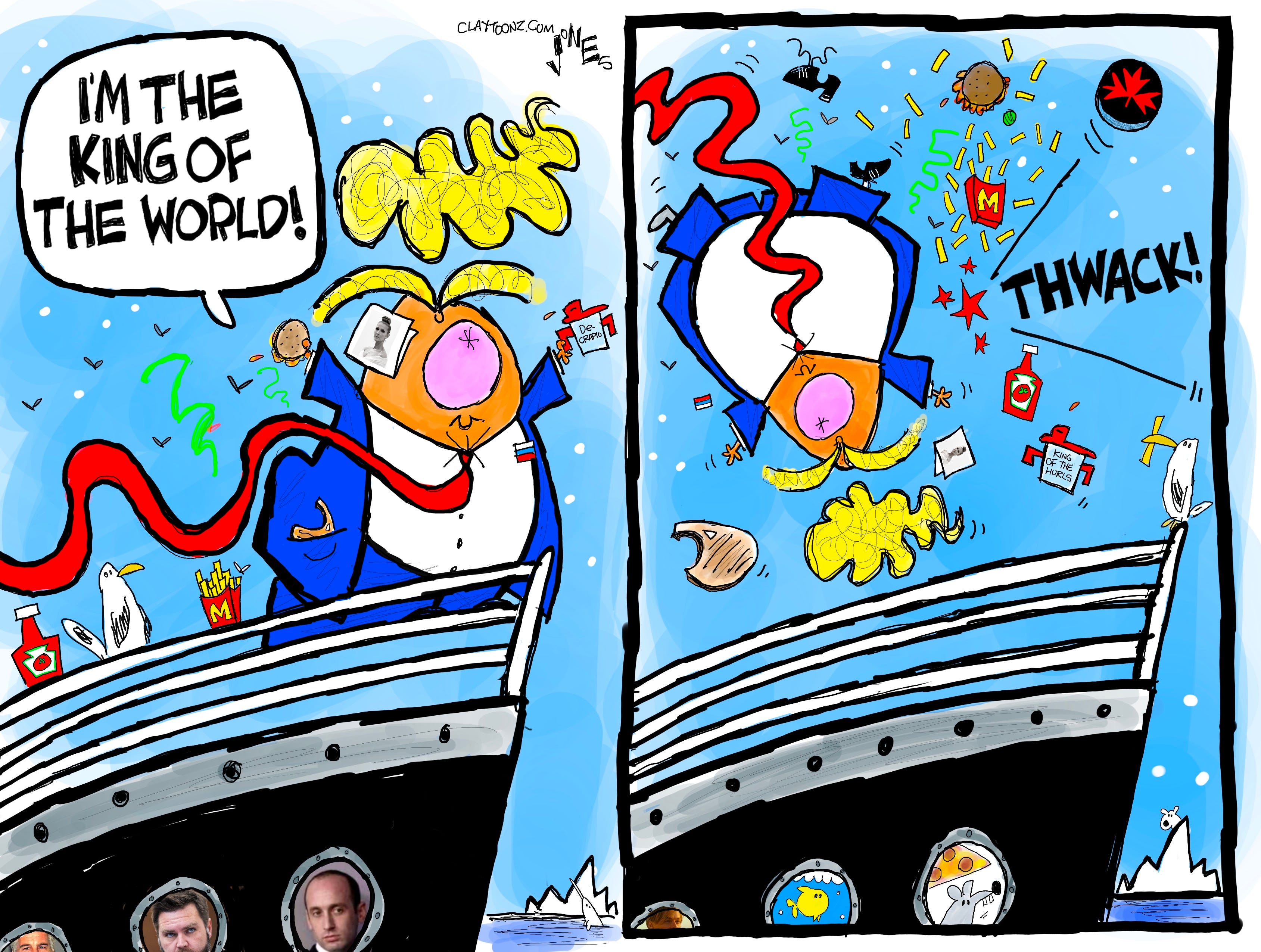
Yesterday, thanks to Donald Trump, Canadian Liberals won. Trump is now internationally toxic. Everything Trump touches…dies. Super Bowl champion running back Sequon Barkley played golf with Trump a few days ago, and now I expect his knees to give out during the preseason. Trump is poison. I would tell you to ask Elon, but he hasn’t figured it out yet.
Pierre didn’t just lose his race for Prime Minister, he also lost his seat in parliament. (snip-MORE)
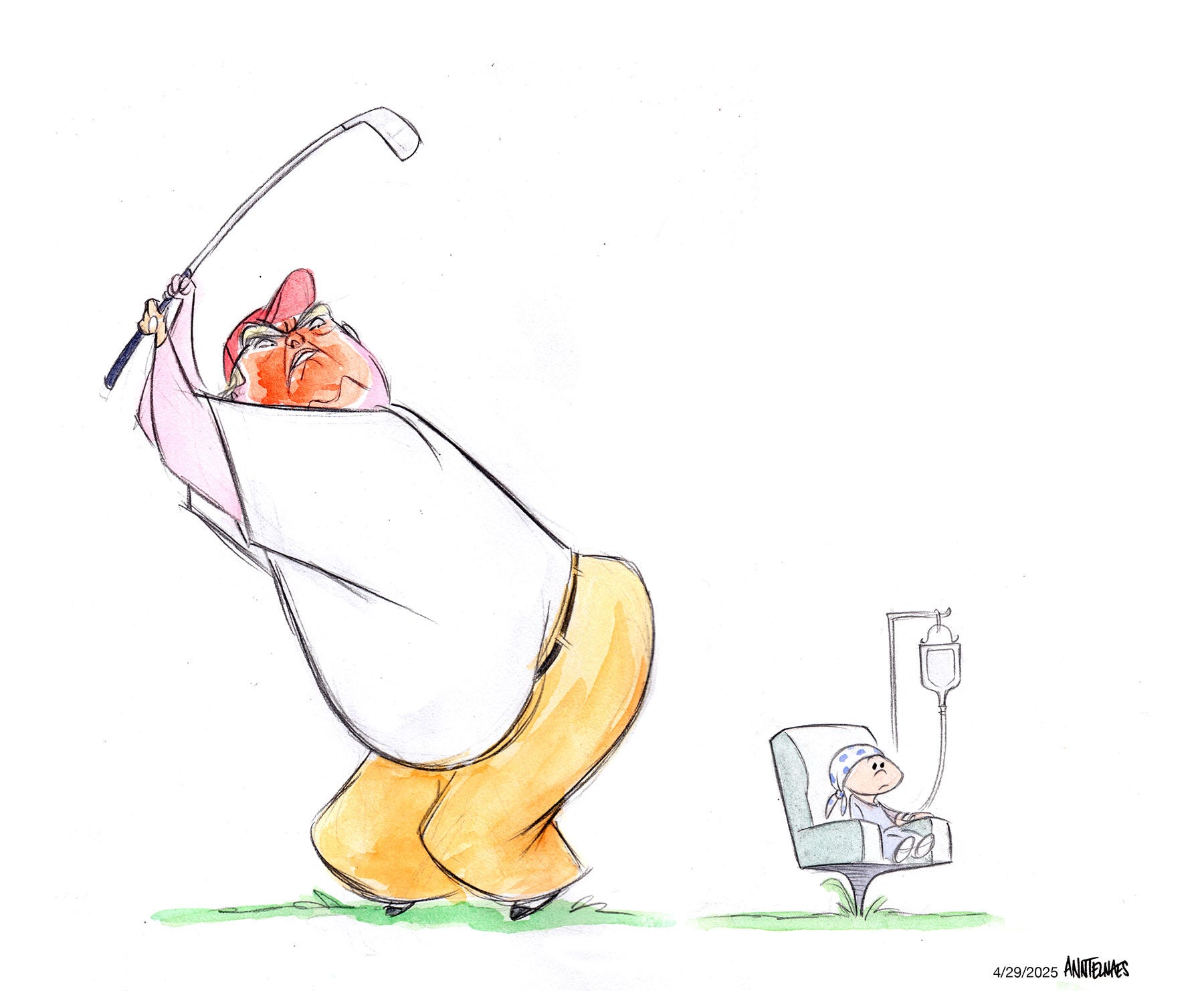
A four-year old cancer patient deported by Ann Telnaes
The boy and his sister, both U.S. citizens, were deported to Honduras with their undocumented mother Read on Substack
Exclusion Order No. 20 affected 660 people living in the area bounded by Sutter and California streets and Presidio and Van Ness Avenues in San Francisco. The Japanese Americans living in those neighborhoods were ordered to report to 2031 Bush St. for registration, and then, on this day, for removal to internment camps for the duration of the Second World War, and faced loss of their homes and businesses. Presentation on what happened (Check it out! Some of Dorothea Lange’s work.)
April 29, 1962 Nobel Prize-winner (for chemistry in 1954) Linus Pauling picketed the White House with others protesting the resumption of nuclear weapons testing. He had been invited there by President John Kennedy, to be honored at a dinner along with other Nobelists.
April 29, 1968 Peace message, Vanessa Redgrave, 1968 photo: Frank Habicht Actress Vanessa Redgrave was among 826 British anti-nuclear protesters arrested during a London demonstration protesting the Vietnam War. Film from the BBC and their take on the demonstration that day
April 29, 1970 U.S. and South Vietnamese troops invaded Cambodia and began a bombing campaign, known as Arclight, that widened the Vietnam War. They were after North Vietnamese and Vietcong troops and supplies that had been moved into Cambodia. By the time the bombing ceased in 1973, the U.S. had dropped more than half a million tons of ordnance on Cambodia, three and a half times that dropped on Japan in World War II. Background on the Cambodia “incursion”
April 29, 1992 Deadly rioting erupted in Los Angeles after an all-white jury in Simi Valley acquitted four Los Angeles police officers of almost all state charges in the beating of Rodney King, an African-American motorist who had been stopped for a traffic offense.Videotape of the abuse had been seen around the world. 17 other officers, who had been present and had not intervened, were never charged. The National Guard was called out to help restore civil order. By the time schools were able to re-open on May 4, more than 50 had been killed, over 4000 injured, 12,000 people arrested, and $1 billion in property damage. The Riot The trial (The original link to the trial news on History.com is no longer present. This link will take you to more about the rioting. Again, noting the loss of the info, this time, also again, that an all white jury acquitted police of battery of a Black man.)
April 29, 2016 Gary Tyler was released from Angola penitentiary in Louisiana. He was just 16 years old when charged with shooting a white student in 1974. Gary was wrongly convicted and sentenced to death by an all-white jury and became the youngest person on death row. His case sparked a movement to gain his release which persisted for 40 years. FreeGaryTyler.com Read more about the case and the movement to free him Listen/watch more about the case Democracy Now
April 28, 1915 The International Conference of Women for a Permanent Peace convened on this day in 1915 at The Hague in the Netherlands. More than 1,200 delegates from 12 countries—Britain, Germany, Austria-Hungary, Italy, Poland, Belgium and the United States—were all dedicated to the cause of peace and a resolution of the great international conflict that is now referred to as World War I. The conference selected a delegation of women that spent May and June meeting with government officials of the belligerent nations to demand an end to the war. Often called the Women’s Peace Congress, the meeting was the result of an invitation by a Dutch women’s suffrage organization, led by Aletta Jacobs, to women’s rights activists around the world. Jacobs believed that a peaceful international assemblage of women would “have its moral effect upon the belligerent countries,” as she put it.
Aletta Jacobs, Dutch suffragist and an organizer of the Women’s Peace Congress This was the origin of the organization known today as the Women’s International League for Peace and Freedom. WILPF history
April 28, 1965 U.S. troops landed in the Dominican Republic. In an effort to forestall what he claimed would be a “communist dictatorship” in the Dominican Republic, President Lyndon B. Johnson sent more than 22,000 U.S. troops to restore order on the island nation and to support the military junta. U.S. troops in the Dominican Republic, 1965 Learn more about the history
April 28, 1978 Demonstrators blocking the rail line into the Rocky Flats weapons facility At the Rocky Flats nuclear weapons facility, near Denver, over 5,000 protested and nearly 300 were arrested over the following eight months for blocking railroad tracks entering the plant where plutonium bombs used as detonators in hydrogen bombs were produced. Concert at the Rocky Flats demonstration in 1979
April 28, 1979 A few weeks after the Three Mile Island nuclear accident in Pennsylvania [see March 28, 1979], a crowd of close to 15,000 assembled at the Rocky Flats nuclear weapons production plant near Denver, Colorado. Singers Jackson Browne and Bonnie Raitt took the stage along with various speakers including Dr. Helen Caldicott. The following day, 286 protesters, including Pentagon Papers source Daniel Ellsberg, were arrested for trespassing in their civil disobedience at the Rocky Flats facility.
April 28, 1987 Benjamin Linder, a volunteer engineer from Seattle, was murdered in Nicaragua by the U.S.-sponsored insurgents known as the contras (characterized by then-President Ronald Reagan as “the moral equivalent of our founding fathers”). Linder had been working on a hydroelectric project in rural Nicaragua.
April 28, 1996 Sixty-one were arrested for dismantling railroad tracks leading out of the Gundremmingen nuclear power station in Bavaria, Germany.
April 28, 2004 The first photos of the Abu Ghraib prisoner abuse scandal were shown on CBS’s ”60 Minutes II.” The photos had been taken by U.S. military personnel responsible for detaining and interrogating Iraqi prisoners arrested following the U.S. invasion of Iraq. Article by investigative journalist Seymour Hersh, who helped break the story
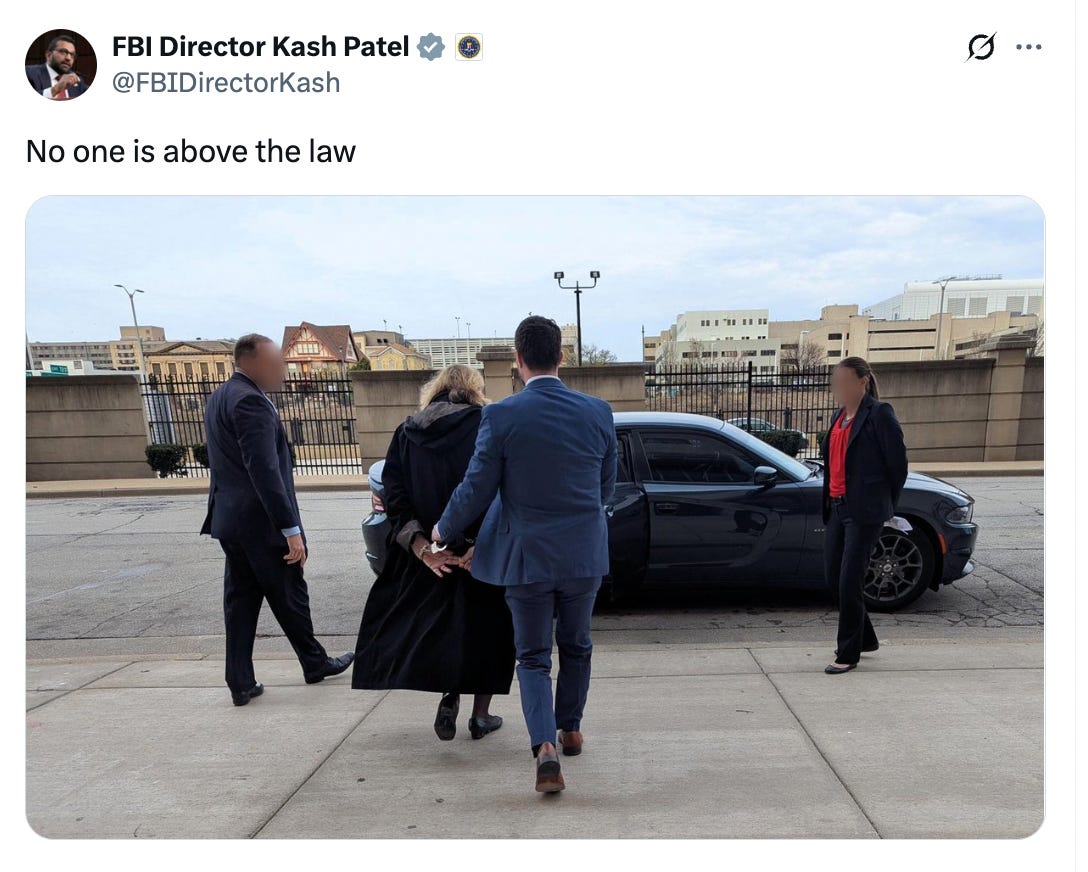
Judges across the country are undoubtedly wondering what sort of trumped-up charges might be used to storm into their courtrooms and arrest them if the attorney general of the United States doesn’t like the way they’re keeping order and conducting the people’s business in their courtrooms. Arresting judges isn’t something we should have to worry about in a democracy. But after Friday’s events, where federal agents arrested Milwaukee, Wisconsin, Judge Hannah Dugan to the loud cheering of their bosses, Attorney General Pam Bondi and FBI Director Kash Patel, it’s one more marker of the country’s constitutional distress.
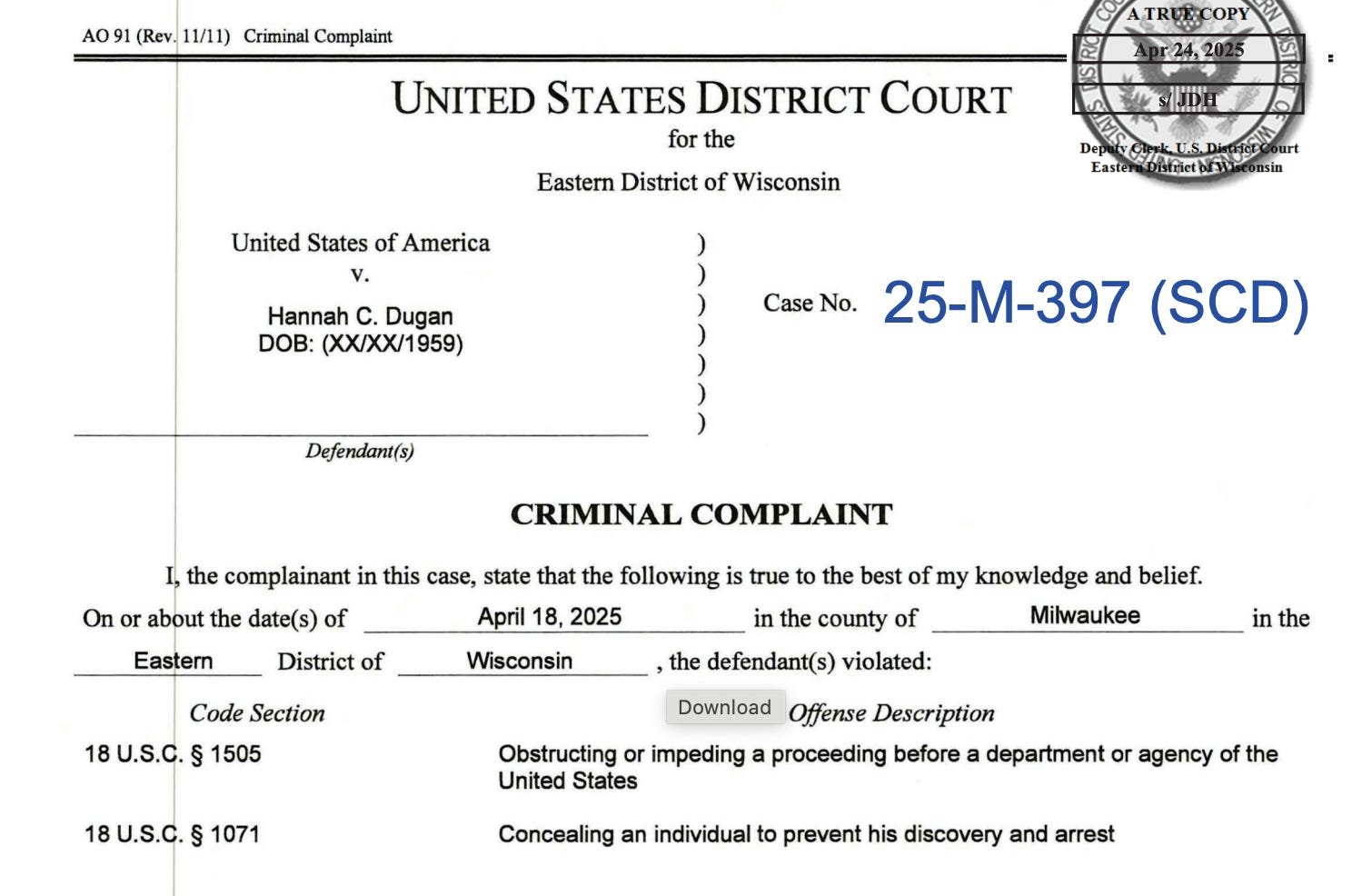
From Pacer: Compliant signed by Magistrate Judge Stephen C Dries
Dugan is charged with obstruction of proceedings before a department or agency of the United States, which carries a maximum penalty of five years in prison, and concealing a person to prevent arrest, which carries a maximum penalty of one year in prison. The allegations relate to efforts by federal agents to arrest a Mexican national, Eduardo Flores-Ruiz, on charges of illegally reentering the United States after being deported. He had not been indicted, and the warrant for his arrest was an administrative warrant issued by ICE, not a warrant issued by a federal judge.Flores-Ruiz was in Judge Dugan’s courtroom on misdemeanor assault charges—no one is saying he shouldn’t face both the state and federal charges.
We’ll get into the government’s specific allegations in a minute. Suffice it to say, the Judge was in her courtroom, trying to keep order and conduct proceedings, and the agents intruded into that space in a manner that is inconsistent with the way federal agents are, or at least used to be, taught to respect courtrooms.
There are practical implications too. If ICE can make arrests in courtrooms, defendants simply won’t show up. Witnesses may be hesitant too. People may become less willing to report crimes in immigrant communities. The ability of police to enforce the law, to obtain witness testimony, and to protect communities could be seriously hampered. This is not new territory. It’s been plowed again and again. ICE is free to make their arrests. They can do it outside of the courthouse—there are a limited number of exits. In some courthouses, they can do it in public spaces, but this courthouse in Milwaukee was still in the process of determining its policy, so Judge Dugan asked the agents to speak with the chief judge before they proceeded. An eminently reasonable request.
We don’t yet know the reason she escorted Flores-Ruiz out the side door of her courtroom that led to her jury box, and also back out to the main hall, according to one person familiar with the courtroom. But it makes sense, since the main hall is where they ended up and where agents saw them, following them out of the courthouse. It doesn’t sound nefarious, and even if the Judge took unusual steps to preserve public safety or order in her courtroom—we haven’t heard her version of the facts yet—it hardly rises to the level of criminality. She returned to the bench to continue with her docket after the incident; that’s hardly the conduct of a hardened criminal.
But here’s Attorney General Pam Bondi:
“What has happened to our judiciary is beyond me,” Bondi told Fox News, commenting on Judge Dugan’s arrest. “They’re deranged. I think some of these judges think they are beyond and above the law, and they are not. We are sending a very strong message today: If you are harboring a fugitive, we don’t care who you are. If you are helping hide one, if you are giving a [gang] member guns, anyone who is illegally in this country, we will come after you, and we will prosecute you. We will find you.”
Condemning the entirety of the judiciary in 50 states on the strength of two indictments is going overboard. And that’s precisely what we count on the attorney general of the United States not to do. It’s a position that calls for a calm, measured individual who gets the facts straight and understands the rules, because if they don’t, individuals’ rights get trampled upon and due process gets denied.
But what’s going on here is something more. It’s the negligent wave of the hand at “our judiciary,” a weak, sloppy, willingness to undercut the public’s confidence in an entire branch of government at the state level across the country in order to push Trump’s political agenda on immigration. As attorney general, Bondi’s job is to serve the president who appointed her but keep him at arm’s length when it comes to bringing cases against individuals.
My husband is a state court judge. It’s far too easy for me to imagine federal agents entering courtrooms across the country to arrest state court judges for running their courtrooms as they see fit. Getting rid of inconvenient judges on the path to autocracy is a well-worn step for would-be dictators to take. Viktor Orban did it in 2012 in Hungary, using forced retirements to strip out judicial opposition to his plans, despite a finding by the EU court that his steps were inconsistent with EU law. Perhaps in America in 2025, arresting a few judges in hopes of intimidating the rest is considered an easier path to get to the same place without the risk that seven judges on the Supreme Court might rule against you.Arrest judges in places like Milwaukee a few times, and on top of the threats to impeach federal judges who rule against the administration, a president might be able to create a climate of fear that would keep the rest of the judiciary in line. Dictators are adept at eroding democracy into a shell of itself, little more than an empty facade. Interfering with the judiciary is one of the keys to getting there.
Judges do get arrested for legitimate reasons from time to time. We had one of those cases in my office when I was a young prosecutor, and the nature of the alleged crimes is instructive. Jefferson County Circuit Judge Jack Montgomery’s house was searched pursuant to a warrant authorized by a federal judge in October 1993, and FBI agents found thousands of dollars in cash in his home. We indicted him on extortion and racketeering charges. Judge Montgomery was found shot dead in his home before a trial could take place. But despite the outcome of the case, no one had doubts it was the type of case the federal government should be prosecuting, as long as the evidence was solid. The charges were serious, involving corruption of the judicial system and interference with justice.
That’s a far cry from charging a judge with obstruction of justice and harboring a fugitive because a judge let a defendant out a side exit in her courtroom that fed him back into the main hall, which is what happened to Hannah Dugan. We don’t know all of the facts yet, and it’s important to remember that. But, we do have the government’s version—it’s the judge’s side of the story that is yet to be told. And the government’s version isn’t compelling. Even those who staunchly believe in mass deportations may find that prosecuting a judge for maintaining order in and around her courtroom is a bridge too far; the overblown allegations and absurd effort to connect the dots and come up with a crime in the affidavit used to obtain an arrest warrant don’t meet the standard of proof beyond a reasonable doubt.
Americans understand how outrageous this is. In Milwaukee, they flocked into the streets outside the courthouse by midday to protest. Suddenly, everyone was aware of what had happened, and there were protests in other cities too. Even at this early stage, there are some real questions about how the government is proceeding and the merit of the charges:
Why was the Judge arrested? Normally, in cases like this that don’t involve violence or risk to the community, or where there’s some indication that a defendant might flee, a case goes to the next grand jury. If an indictment is issued, the defendant receives a notice to appear in court for arraignment. Arrests like this one are unusual. Here, it appears to be an effort to sensationalize the case in a way that is unnecessary and seems designed to intimidate this judge and other judges.The government will still have to take the case to a grand jury to obtain an indictment within the next few weeks, or face a preliminary hearing in court, where they would have to present all their evidence —a step federal prosecutors typically avoid. I’m not sure I’ve ever seen a case where that happened, although there may be a few out there.
Why arrest her at the courthouse? Again, this is just an effort to sensationalize the case and intimidate other judges. She could have been safely arrested at her home. There is absolutely no doubt that if they had advised her of the situation, she would have turned herself in to be booked. In essence, this is the biggest, most outrageous perp walk of all time, complete with a tweet from the Director of the FBI.
State court judges have legitimate concerns about ICE operating inside of their courtrooms and courthouses. The agents were always going to get their guy. But the language in the affidavit reflects no respect for any of the Judge’s concerns, describing her as becoming “visibly angry” and calling their conduct “absurd” as though that was somehow objectionable on her part.
The affidavit used to obtain the arrest warrant for the Judge seems to view every action in the worst possible light. The defendant and his lawyer, after leaving the courtroom, walked down the hall to the elevators, passing one bank and heading to the next. Sounds suspicious if you read the agent’s affidavit. Except that the facts are, they walked past a bank of elevators that went to the parking lot and entered one that took them to an exit on the main floor that they used to leave the building. The agent’s complaint that they spoke Spanish in the elevator, and that he doesn’t, isn’t even worth addressing. At one point, the affidavit seems to object to the Judge walking down “a non-public hallway from which she could access her courtroom and chambers—a pretty standard way for judges to enter their courtroom. Courts are used to relying on agent’s relating the facts in a good faith manner. That’s simply not the case here, and the affidavit contains multiple inconsistencies and overreaches. You can read the complaint here and the DOJ press release here.
The government has to prove the Judge intended to obstruct justice when she permitted the defendant to leave her courtroom through the side door, and that’s difficult to do. We know that intent is often the most challenging issue prosecutors face. Here, when the defendant leaves the Judge’s courtroom and goes into a space where agents can, and in fact do, apprehend him, it’s going to be hard to show she had “an improper purpose,” as the law requires, and was trying to prevent them from going about their business. We still don’t know what all of the evidence is, but on its face, this looks like a burden the government will have difficulty overcoming.
As for harboring a fugitive, part of what the government would have to prove involves establishing the Judge actually harbored or concealed the fugitive. There is legal precedent that explains harboring means giving someone a place to stay or caring for them while they’re hiding from law enforcement. The government would also have to prove beyond a reasonable doubt that the Judge intended to prevent the fugitive’s discovery or arrest. Unless the government has more evidence, that looks like a heavy lift here.
Given all of these concerns, legal, factual, and policy, you would expect prosecutors to take their time to think things through instead of jumping in with a precipitous and highly public indictment. The concerns take us back to the question of why the case was charged at all, and the answer is that the motivation has little to do with what Judge Dugan did here. Trump is coming for the judges. It will be up to all of us to stand with them.
I was reading this on MPS; clicked through on the Blueshy link, read those photos, then saw “Capitol Protest”, which led to the above Substack note, which is actually pertinent to our interests, especially after reading this on MPS.







 Scottie's Playtime