October 24, 1935 Langston Hughes’s first play, “Mulatto,” opened on Broadway. It was the longest-running play (373 performances) by an African-American until Lorraine Hansberry’s “A Raisin in the Sun” which premiered in 1959. Langston Hughes First-rate bio of Langston Hughes
October 24, 1940 The 40-hour workweek went into effect under the Fair Labor Standards Act of 1938, requiring employers to pay overtime and restricting the use of child labor. Decades of labor agitation and a considerable number of lives made this change possible. More on The Fair Labor Standards Act of 1938:
October 24, 1945 The United Nations World Security Organization came into being when the Soviet Union (Union of Soviet Socialist Republics or USSR) in mid-afternoon deposited its instrument of ratification of the U.N. Charter. The USSR became the last of the five major powers and the 29th of 51 nations, the minimum necessary to bring this about. James F. Byrnes, U.S. Secretary of State, then signed the protocol formally attesting that the Charter of the United Nations had come into force.This is now considered United Nations Day. Read more (no paywall.)
October 24, 1970 Salvador Allende Gossens, an avowed Marxist and head of the Unidad Popular Party, became the president of Chile after being elected and confirmed by the Chilean Congress.For the next three years, the United States exerted tremendous pressure to destabilize and unseat the Allende government. In 1958, and again in 1964, Allende had run on a socialist /communist platform. In both elections, the United States government (as well as U.S. businesses such as International Telephone and Telegraph (ITT), which had significant investments in Chile) worked to defeat Allende by sending millions of dollars of assistance to his political opponents.
October 24, 1981 More than 250,000 people, organized by the Committee for Nuclear Disarmament (CND), marched through London to protest the siting of American nuclear missiles in the United Kingdom. More background and video
October 19, 1923 The War Resisters League was founded in New York City. WRL history Above: One of the founders, Jessie Wallace Hughan (r), 1942 photo: WRL/Swarthmore Peace Collection The War Resisters League home
October 19, 1960 Martin Luther King, Jr., and 36 others were jailed after being arrested during a sit-in at the snack bar of Atlanta’s Rich’s department store where they requested service and were refused on account of their race. More about this arrest
October 19, 1980 J.P. Stevens & Co. was forced to sign its first contract with a union after a 17-year struggle in North Carolina and other southern states. The workers, organized by the Amalgamated Clothing & Textile Workers Union, were supported by a widespread boycott of Stevens products by labor, progressive and religious organizations. Read more about the struggle and the movie “Norma Rae”
Sometimes, it seems to me that Robert Reich has lost his fire. Not in this story, though; this is the Robert Reich I remember!! Organize, speak out, make our government do our work!
One issue not being talked about enough during this election, although both parties are courting working-class voters, is the chilling extent to which corporations are maiming and killing their employees.
According to data Amazon reported to OSHA, for example, Amazon had 6.6 serious injuries for every 100 workers in 2022. More than half of all warehouse injuries in the U.S. happened at Amazon, though they employed only 36 percent of all factory workers.
What’s behind the injuries? Corporate demands for faster speed and higher productivity.
Last week, The Wall Street Journal featured a story about corporations not allowing workers to lock down machinery when the machinery has to be maintained or cleaned.
I wish this were new news, but I vividly recall one morning in 1994 when Joe Dear, who then ran OSHA, the Occupational Safety and Health Administration, stormed into my office at the labor department.
Joe was short and wiry, with the energy of a coiled spring. He had come to OSHA after serving as director of Washington state’s department of labor and industries. He was dedicated to worker safety.
Breathlessly, he told me that workers at Bridgestone’s tire plant in Oklahoma City were getting mangled, even killed, in assembly machines that suddenly restarted when the workers were unjamming or cleaning them. The company’s other plants had similar horrors.
OSHA investigators had repeatedly told Bridgestone executives to install a simple $6 device that would automatically cut off power to the machines whenever a worker wanted to lock them down to clean or repair them, but the company wouldn’t budge.
Joe thought it was because the company was afraid its workers would use the device to stop the assembly line in order to gain bargaining leverage in upcoming union negotiations.
“We’re hitting them with a $7.5 million fine, the maximum under the law,” Joe said.
Joe hadn’t sought a fight with the second-largest tire maker in the world. We both knew it would unleash a giant team of lawyers and might drag the case through the courts for years unless we settled for a fraction of the fine.
We also knew that the final settlement wouldn’t be enough to get Bridgestone to mend its ways anyway if the company figured it was cheaper to pay up and continue risking workers’ lives and limbs. Not for the first time had a company made this sort of calculation.
But something had to be done. Workers were getting maimed and killed.
I was indignant. I felt righteousness coursing through my veins. “We’ve got to stop this, Joe. Maybe they could get away with this shit under the Republicans, but I’ll be damned if they do it under our watch.”
Joe looked worried. “We can’t go any higher with the fine. We might be able to go to court in Oklahoma City and get an emergency order forcing them to comply there. It’s dicey.”
“Why not use all our ammo?” I felt like I was putting on my holster. “Let’s also mobilize public opinion.”
“Public opinion?” Joe’s worry deepened.
I explained my theory. “Big corporations like Bridgestone spend millions on advertising and marketing to boost their public image. If we get this story on television, we’ll embarrass the hell out of them and strike fear in the hearts of every other corporation that’s screwing its workers.”
Joe hadn’t planned on my fury.
“I want to go out there,” I said, now simmering. “I’ll deliver the legal papers in person. We’ll fly out Sunday night and do it Monday morning. Alert the media so they can be on hand. Hold a press conference, maybe with some of the injured workers, including the widows of workers who were killed.”
Press conference? Injured workers? Widows? Joe was warming to the idea. A smile spread across his face. This was no longer a legal matter. It had become an issue of public morality — and public relations.
“Will the employees be with us on this?” I asked.
“No question. You’ll be a hero.”
“Okay then. We go to Oklahoma City.”
It was like I was galloping into town on a large white stallion, a sheriff’s badge pinned to my vest. Few feelings in public office are more exhilarating than self-righteous indignation — or as dangerous.
Late Sunday night we met at the Murrah Federal Building in downtown Oklahoma City to plan the final details of our operation.
We planned it so the press could set up cameras outside the gate and film us as we entered and the time and place of the press conference afterward. Several of the injured workers along with the widow of one who died were ready to appear.
Joe and I and the rest of our team rode in silence to the Bridgestone plant. A half-dozen TV cameras were waiting at the gate to record the spectacle. A guard allowed us through. We parked.
“We’ve hit the beach, captain,” Joe said.
“Walk slowly and keep your ammo dry.”
We walked across the lot to the plant entrance. I imagined the scene on the evening news: barely visible through the mist, the silhouettes of America’s runty but courageous secretary of labor leading his small battalion of gallant men to their fates, as they took on Industrial Evil. We were taking on the bullies.
Once we were inside, a nervous receptionist asked us to follow her. We walked down a narrow corridor and into a linoleum-floored room with a Formica table in the center, encircled by several chrome-and-plastic chairs. She said two gentlemen would be with us shortly, then rushed off.
A few minutes later, two grim-faced men entered and asked us to sit. One was a top executive from the company’s U.S. headquarters, the other the plant manager.
I introduced myself and the others, trying not to let my voice betray my nervousness. “We have come here to present you with court papers alleging that this plant presents an imminent hazard to the safety of its employees,” I said gravely. Joe removed an inch-thick pile of legal papers from his briefcase and placed them in the center of the table. The two men stared at the pile, expressionless.
I continued to speak, more forcefully now. “We have urged you to correct these hazards, but they have not been corrected. We have no choice but to seek an emergency order that will require you to equip employees on the assembly line with a simple device to turn off the power when they must clean or unjam the machines. We’re also imposing a $7.5 million fine.”
I looked intently at the two men. They stared back. They said nothing.
We marched back out of the building and across the parking lot. I tried to look determined, like someone who has just summoned the full force of the United States government against a common enemy.
A half an hour later, the press gathered for the news conference at a downtown hotel to hear of our great battle. One of the widows, a frail woman in her late fifties, stood beside me. Around us were several of the workers who had been injured or maimed in the plant. In front of me, sitting in two rows of chairs, were other workers from the plant.
I explained why I had come to Oklahoma City, describing the mayhem that the company had caused and what actions the department would take, doing a weak imitation of William Jennings Bryan: “We will not allow workers to risk death and dismemberment simply because a company refuses to buy a $6 piece of safety equipment. American workers are not going to be sacrificed on the altar of profits. We are not going to allow a competitive race to the bottom when it comes to the lives and limbs of American workers.”
The workers applauded. The widow’s eyes filled with tears. Reporters asked a few questions. Then, having cleaned up Oklahoma City, we rode off into the sunset on the next commercial flight back to Washington, feeling triumphant.
The triumph was short-lived.
Soon after we left, Bridgestone’s vice president for public affairs held a news conference to announce that Bridgestone had decided to close its Oklahoma City tire factory. All 1,100 workers would be out of jobs in weeks. He blamed the federal government, asserting that its safety standards had made the plant uneconomical.
The next morning’s Daily Oklahoman used my expedition as an illustration of the worst sort of meddling from Washington. In a bitter editorial, it accused me of grandstanding for political purposes. Its front-page story quoted angry tire workers, soon to be unemployed, saying I never should have come to Oklahoma City. One even asserted that safety was never a problem at the plant and that machines must be kept running to be serviced properly.
If it’s a choice between a dangerous job and no job, people will choose the dangerous job. I can’t blame them. America’s safety nets were — still are — in tatters, and we repeatedly force workers to make this terrible choice.
In the end, I asked our legal staff to drop the emergency order if the company would keep its plant open, which they agreed to do.
The bullies won.
I was haunted by our failure. I hadn’t imagined Bridgestone would take hostage the livelihoods of more than a thousand people. I hadn’t understood that the mounting economic stresses across America would fuel anger at every major institution in society, including a federal government that sought to protect people from some of those stresses.
We must protect workers from corporate greed. That means fines must be high enough to make it truly costly for a corporation to ignore worker safety laws when it’s profitable to do so. And it means safety nets must be strong enough to enable workers to refuse to take on illegally dangerous work.
September 2, 1885 A mob of white coal miners, led by the Knights of Labor, violently attacked their Chinese co-workers in Rock Springs, Wyoming, killing 28 and burning the homes of 75 Chinese families. The white miners wanted the Chinese barred from working in the mine. The mine owners and operators had brought in the Chinese ten years earlier to keep labor costs down and to suppress strikes.Chinese fleeing Rock Springs The unfortunate story and illustrations of the scene (scroll down)
September 2, 1945 Revolutionary leader Ho Chi Minh declared Vietnam a republic and independent from France (National Day). Half a million people gathered in the capital of Hanoi to hear him read the Vietnamese Declaration of Independence, which was modeled on the U.S. Declaration of Independence. note: Ho Chi Minh translates to ‘He Who Enlightens’ Read about how it was influenced by the U.S. Declaration
September 2, 1966 On what was supposed to be the first day of school in Grenada, Mississippi—and the first day in an integrated school for 450 Negro children—the school board postponed opening of school for 10 days because of “paperwork.” Nevertheless, the high school played its first football game that night. Some of the Negro kids who had registered for that school tried to attend the game but were beaten, and their car windows smashed.
September 2, 1969 Vietnamese revolutionary and national leader Nguyen Tat Thanh (aka Ho Chi Minh), 79, died of natural causes in Hanoi. Uncle Ho, Ho Chi Minh Ho and his struggle for Vietnamese independence

 Langston Hughes

 Allende and supporters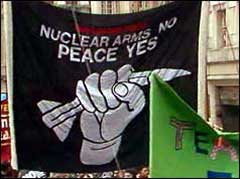


 Chinese fleeing Rock Springs

 Uncle Ho, Ho Chi Minh
 Scottie's Playtime