News On The KS Anti-Trans Law

Kansas AG offers to delay enforcement of anti-trans law until March 26 while judge weighs challenge

By:Morgan Chilson-March 6, 20266:25 pm

LAWRENCE — Kansans won’t know until at least Tuesday if a judge will delay implementation of the state’s new “bathroom law,” but a concession by Attorney General Kris Kobach means key components of the law can be delayed until March 26.

Douglas County District Judge James McCabria heard arguments Friday about Senate Bill 244, the controversial new law that forces people to use bathrooms in government buildings and gender markers on driver’s licenses based on sex assigned at birth.

The three-hour hearing focused on technicalities, including whether the law meets any one of five specific criteria that would lead the judge to approve a temporary restraining order and pause enforcement of the law for up to 14 days.

Attorneys with the American Civil Liberties Union and the Kansas Department of Administration  said the law’s speedy implementation provided no grace period to Kansans needing a new driver’s license and for government leaders statewide to put a system in place for tracking bathroom usage.

The law took effect Feb. 26, a little over a week after the GOP-led Legislature overrode Gov. Laura Kelly’s veto. Kansans who held driver’s licenses with a gender marker that didn’t match their sex at birth were told their licenses were immediately invalidated and government leaders statewide were told they had to immediately enforce the bathroom portion of the bill.

Kobach told McCabria he agreed to give Kansans who needed to update driver’s licenses until March 26 to complete that. He also said he wouldn’t enforce the law’s penalties — which could be as high as $125,000 per day for violations — for cities, counties, municipalities and schools that might violate the bathroom rules, as well.
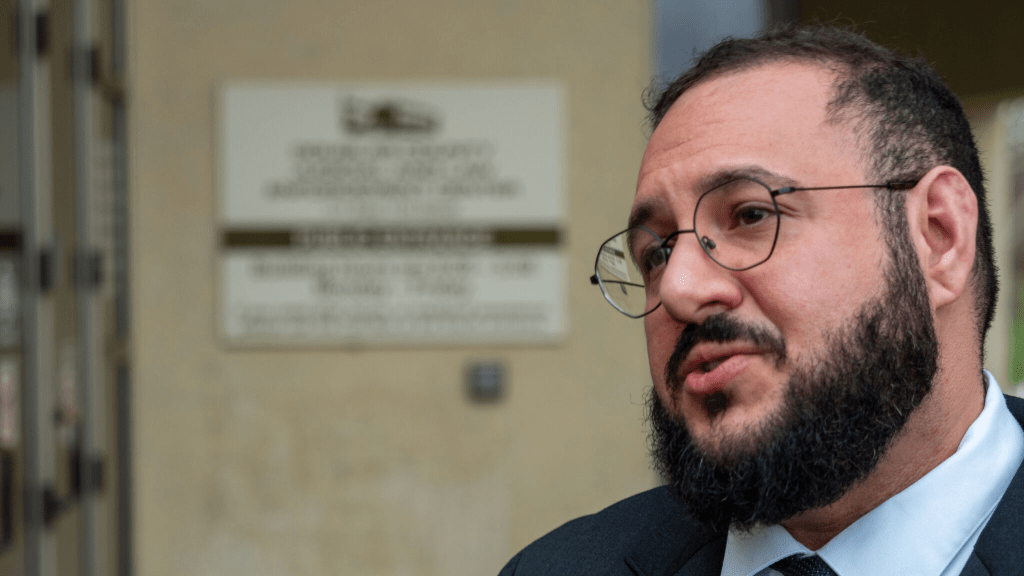
Harper Seldin, senior staff attorney for the American Civil Liberties Union, talks to reporters after a Douglas County District Court hearing on March 6, 2026. Seldin asked the judge to place a temporary restraining order on the state to stop implementation of a new law that forces Kansans to use bathrooms and have documentation in their biological sex at birth. (Photo by Sherman Smith/Kansas Reflector)

Harper Seldin, an ACLU attorney representing the two Lawrence transgender men who brought a case against the law under pseudonyms Daniel Doe and Matthew Moe, told the judge the law violates the Kansas Constitution.

SB 244 infringes on the rights of personal autonomy, expectations of privacy, and equal protection under the law, and has other issues, he said.

“The attorney general is incorrect when he says that we’re asking the court to break new ground,” Seldin said. “This is not a novel set of theories that require the government to do anything. The thread through these individual rights claims is that this is about Daniel and Matthew’s right to be left alone by the government.”

Seldin also said the law targets transgender individuals, which can be shown by the results of its implementation even if it’s not stated outright. He said the way SB 244 was implemented violated the Kansas Constitution when the bathroom portion of the bill was “logrolled” into the bill that originally addressed driver’s license and birth certificate gender markers.

Logrolling refers to dropping a bill into an unrelated bill, sidestepping the opportunity for public input. Seldin said cramming two separate subjects into one law violates the Kansas Constitution, which has a “single subject” clause.

Kobach said the two issues are congruent in that they both deal with defining sex within Kansas government.

“It’s this idea that bills should mean what they say and say what they mean,” Seldin said. “There’s a particular perniciousness to a law that hides the law.”

Kobach told the judge that a driver’s license is a government document, used for government purposes, and the state has the right to define the information contained in the document.

McCabria questioned Kobach about briefs included in the plaintiff testimony outlining the negative psychological effects on transgender people being made to use documents that don’t match their gender identity.

“Whatever a person may feel about their need to be perceived by the world in a certain way, what right do I have to compel the government to identify me in that way?” McCabria asked.

Kobach said the driver’s license is a document that records pertinent information, and sex is one of the elements, along with eye color and birthdate, that doesn’t change over time.

Kobach said the bathroom portion of the bill maintains the status quo in Kansas, where he contended residents have always gone to the bathroom that matches their biological sex at birth.

Seldin said trans people in the state have been going to the bathroom without any harms for decades.

Kobach said women who hear a man’s voice or see a man in private spaces could become anxious about their safety.

He acknowledged plaintiff’s assertions about the psychological or emotional harm they may suffer but told McCabria that in a balance of equities, that didn’t outweigh the harms of “99-plus percent of the population.”

When McCabria asked him to substantiate that number, Kobach said he didn’t mean to imply that everyone outside of transgender individuals were harmed by the law.

“Many courts have recognized the fear that ‘biological females’ have when a ‘biological male’ is in the bathroom with them, and that is something that I think any Kansan can identify with, especially a female,” Kobach said after the hearing.

Asked how women would be affected by seeing or hearing a transgender man who now has to use a woman’s bathroom, Kobach said, “All kinds of hypothetical cases are possible.”

McCabria said he had hoped to make a ruling Friday but that he needs more time to study the filings in the case and examine constitutional issues. He said he expects to rule by Tuesday.

“I think most people want to be respectful,” Seldin said after the hearing. “I think most people don’t want to pry into other people’s private lives. I think a law like this suggests the opposite, that Kansans have some prurient interest in other people’s habits and private spaces. And I don’t think that’s right.”

Z Kemp attended the hearing because her partner and many friends are affected. She said the law has caused “a lot of stress and anxiety.”

“That’s just unnecessary because as they’ve stated before, there was — especially with the bathroom situation —- no prior problem,” she said. “It’s only a problem whenever you make it a problem. I don’t think it’s that radical to just let trans people be. Just let them go to the bathroom.”

Avie Fallis said she has been through a lot of physical and legal changes to find herself. She said she is tired of well-meaning people recommending that she leave Kansas, which is her home state where her family and loved ones live.

“I feel like it’s a fire that’s just growing,” she said. “I’m not going to run away from fire. I feel like it should be extinguished.”
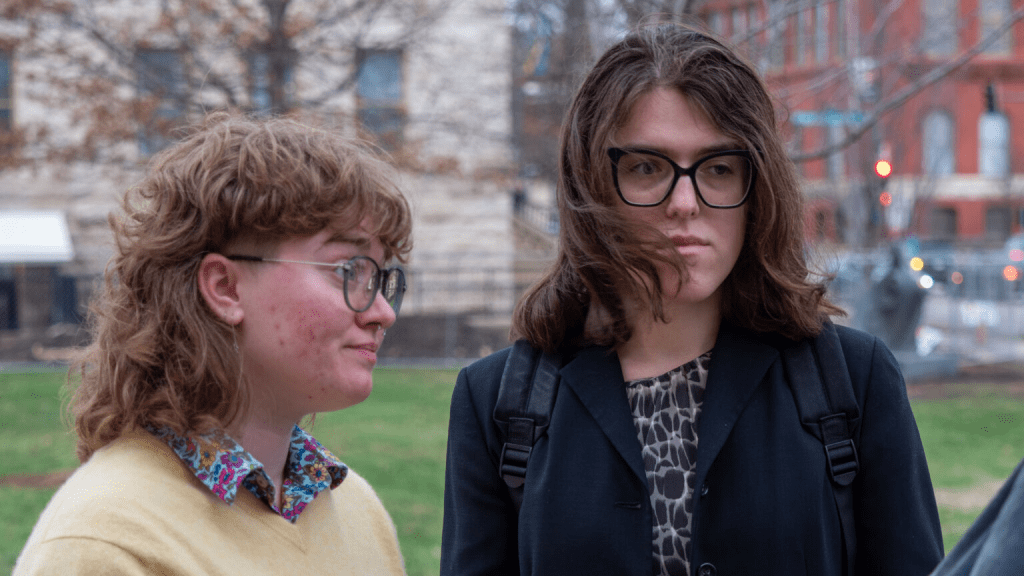
Z Kemp, left, and Avie Fallis attended a Douglas County District Court hearing March 6, 2026, about Kansas’ new law because it affects them and their loved ones. The law forces people to use the bathroom related to their biological sex at birth and to put that sex marker on their driver’s licenses and birth certificates. (Photo by Sherman Smith/Kansas Reflector)
A Bathroom Happening

I Was In The Women’s Restroom When A Man Came In And Called Out A Question That Left Me Nauseated

“I stopped breathing and my heart skipped. My pants were down around my ankles, and no one else was within earshot.”

By Rey Katz Mar 11, 2025, 08:25 AM EDT Updated Mar 11, 2025

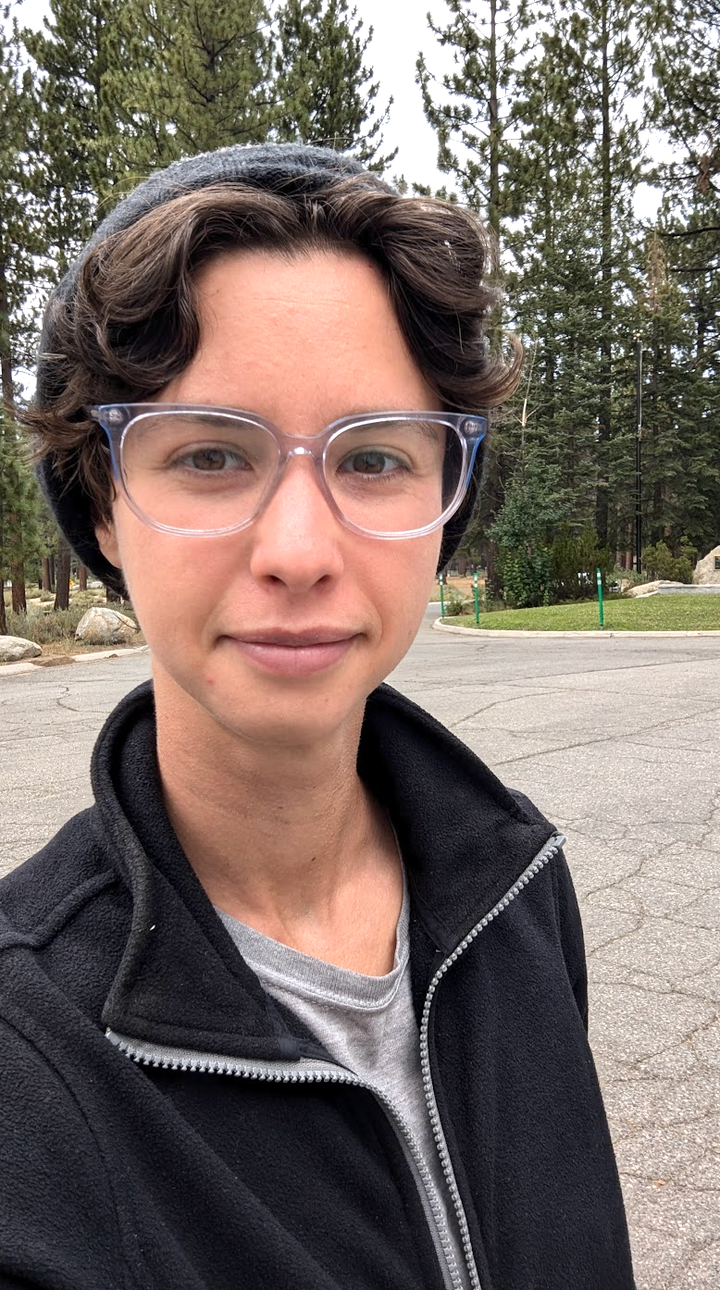
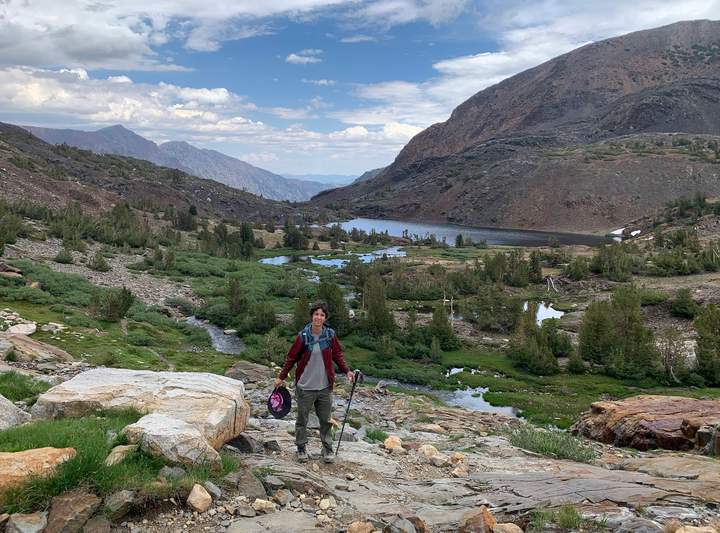
The author hiking just outside Yosemite National Park in July 2024, after cutting their hair short, holding their pink hat.

“Hello? Are you a male or female in there?” a rumbling voice called into the women’s restroom. A man’s boots stepped across the threshold, clunking on the tile floor, as I sat alone in the stall closest to the door.

I stopped breathing and my heart skipped. My pants were down around my ankles, and no one else was within earshot.

My hands went to where my freshly shorn curls used to be — fingers twining into my 2 remaining inches of hair — and I wondered if I had made a mistake. I had been using women’s restrooms my entire life, from when I had long braided pigtails and my mom taught me to lay down two layers of toilet paper on the seat, to my road trip around California as a white, skinny, short, nonbinary person in my early 30s.

***

My partner and I were on an adventure. We had sublet our apartment and were camping in a van for the summer. We slept every night on a memory foam mattress in the van and cooked most of our meals outdoors on a propane stove. Immersed in nature, at a distance from society and community, I could recognize my true self more clearly, and I took the opportunity to explore a more masculine appearance.

I don’t have much experience with people thinking I might be a man. Growing up, people always assumed I was a girl. I still can’t cut my hair without shame, hearing women’s voices in my head: “Oh, but your hair is so lovely, you should keep it long.” It’s as if I hurt my community every time I do it.

Despite the shame, I had cut my hair earlier that week, camped alongside a beautiful, remote river. I trimmed a couple of inches off to give myself the 2-inch-long “men’s” cut I usually give my partner. He is supportive of whatever hair length I want for myself. I squinted into a little travel mirror and lopped off chunks, feeling bits of hair drift down my bare shoulders. Finished with the trim, I dove into the brown river water and scrubbed my scalp with my fingers. I floated in the sun, naked and unjudged by the birds watching me from the trees.

I didn’t feel judged for my haircut until we traveled back into town. While I was washing my face at the sink in a restroom, someone peeked in and then left. I put my glasses back on and walked out. A woman with long hair was standing outside, uncertain, wearing a long skirt. As she turned to face me, I said hello.

“Is this the women’s room?” she asked.

“Yes,” I answered curtly, forced a smile, and walked away quickly, past the word “Women” in 6-inch green painted letters on the wooden wall of the building.

I guess I had been gendered as too-butch-to-be-in-the-women’s-room. Affirming? Slightly. But it was a preview to an unsolvable problem. If I’m not supposed to be in the women’s room, but I also can’t use the men’s, how can I use the bathroom?

***

My partner and I found a lovely city park with a picnic area and gazebo to eat breakfast in after camping on National Forest land nearby. After a mug of coffee, I visited the public restroom. I didn’t expect a stranger to yell at me through the flimsy stall door.

“Hello? Are you a male or female?”

I was the only person using the restroom — the kids who had been in there a minute ago had left. I felt this man’s eyes on my sneakers and blue hiking pants under the stall. I was scared this harassment could escalate if I didn’t say something to diffuse the situation. I gulped and called back, “Hello?”

“Oh, you’re a female. My bad.” He sounded reassured by my quavering voice. I heard his footsteps leaving the room. My heart raced as I fumbled with toilet paper, fingers shaking. I felt nauseated.

My voice had immediately identified me as the “female” I didn’t feel myself to be — and all it took was two syllables. But my “female” voice had also saved me from further harassment. Would that man have dragged me out of the stall if I sounded “like a man” or remained quiet? Would he have looked under the stall? Would he have tried to check what was between my legs while my pants were down? Did he have any idea how much of a violation these real and imagined threats were to me?

And why was a man even in the women’s room, questioning me? Did a kid’s mother report me to her husband for looking too much like a man in the women’s room? Perhaps they were alarmed that I, with my short hair, had been in the restroom with their young kids. I felt physically ill at the troubling thought that someone would assume I would do anything harmful to children. I hadn’t said anything, made eye contact with anyone or done anything other than sit quietly in the stall in the room that matches my assigned sex at birth.

I felt bad for looking masculine to make myself more comfortable, because I didn’t want to make anyone else uncomfortable. Some part of me longed to return to my habit of looking more like a woman, but I also felt sick from not feeling right in my body.

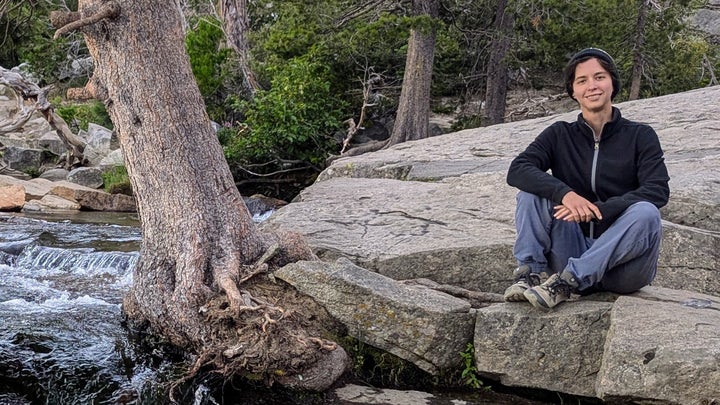
The author sitting beside a mountain stream in August 2024, wearing the same hat, jacket, pants and shoes they had on during the bathroom incident earlier that day.

I can empathize with these strangers viewing me and my body as a threat because I have also viewed my body as a threat. I have been unhappy with the shape of my body, my appearance in the mirror and the tone of my voice. And to have that thrown back in my face in such a vulnerable moment — pants down, defenseless, forced by my body’s very personal needs to be in this gendered room — hit close to home.

It did not occur to me to call the police, because the last thing I needed was to wait around for law enforcement to judge my qualifications to use a bathroom and give a police report about someone I hadn’t actually seen. Instead, I texted a friend — a woman with short hair — to tell her my story of being harassed in the bathroom and share how uncomfortable that made me. She responded that women have screamed after seeing her in the restroom, and she’d had security called on her. My experience seemed mild by comparison. I appreciated her perspective.

For the next several days, I felt intensely conflicted and full of gender dysphoria. I was tense and nervous using public restrooms. I wore my pink hat, forced a big smile and strode in confidently, femininely, trying to look like the kind of woman no one would object to. But I’m not a woman. I came out as a transmasculine, nonbinary person in my late 20s — a person who feels more like a boy than a girl on the inside. A person whose anxiety and depression eased once I no longer had to hide who I am.

I have to choose between a women’s or men’s restroom in most public spaces, as unisex bathrooms are uncommon. Laws restricting bathroom access, which are becoming more prevalent in the United States, attempt to define sex based on whether an individual can produce eggs or sperm. In practice, people look at your body shape, clothes and hair and make an assumption about which restroom you should use. Most people assume I would use the women’s room, so that’s what I continue to use. Trans women often have harder choices. Anyone who pushes back on my use of the women’s room suspects that I am a trans woman. They correctly identify me as trans, but in the incorrect direction.

Trans women are the target of these “bathroom bills” and may encounter harassment and violence in either restroom. Being legally required to use the “wrong” restroom can out people as trans, which can be dangerous for them.

Trans women may need to go more frequently on average. One of the most common testosterone blockers, spironolactone, is a diuretic which means you need to pee often while taking it. The constant stress of navigating public spaces as a trans person with a filling bladder is incredibly — literally — painful.

At the park the day of the bathroom incident in August 2024, the author was wearing a hat, glasses and a fleece jacket.

***

A couple of weeks later, my partner and I returned to the same city park. After relaxing at the picnic tables, I walked over to the bathroom. A new porcelain toilet sat whimsically outside the building, prepped for installation. Uh oh, I thought, rounding the corner to see a plumber with a pickup truck. A “closed for cleaning” sign was braced across the door of the women’s restroom.

The plumber, burly, with a beard, glanced at me and asked, “You need to use the restroom?” gesturing to the men’s door. I nodded, but looked back to peer past the closed sign into the women’s room.

“Oh, you want to use that one?” he asked, squinting at me. It was a cold morning. I was bundled up in a knit cap and two layered jackets. Looking at me, the plumber honestly seemed to think I was heading for the men’s. I shrugged and took what I hoped was a few casual steps toward the men’s room.

“Use the toilet in the last stall,” he prompted me. Perhaps the other plumbing hadn’t been hooked up yet.

“All right, thanks,” I said, pitching my voice down, trying to sound like I’d meant to go in the men’s room all along.

I used the toilet in the empty men’s room to pee, washed my hands, walked out, nodded to the plumber and walked off. I felt rattled but also surprisingly comfortable. Someone had told me that I could use that bathroom, that stall, and I felt validated in doing the right thing. It was the opposite of being questioned for being in the women’s room. I hadn’t made anyone else uncomfortable by existing. Was that a success? Is not making anyone uncomfortable except myself a healthy baseline?

***

Although that experience felt validating, using the “wrong” bathroom can have very real consequences. In California, I didn’t face legal consequences for using a men’s bathroom. If I had instead been in Florida and refused to leave the men’s bathroom if asked, I could have been charged with criminal trespass, likely a first-degree misdemeanor, which carries a prison term of up to one year or a $1,000 fine.

Proponents of “bathroom bills” claim they protect children from predators, but assaulting children in restrooms (or anywhere else) is already illegal. A bathroom law doesn’t physically prevent male abusers already willing to break the law from stepping into women’s spaces. However, these laws can prevent trans women from comfortably and legally using any public bathroom, including restrooms in their workplace.

U.S. Rep. Nancy Mace introduced the Protecting Women’s Private Spaces Act in November 2024. If enacted, this law would prohibit transgender individuals from using restrooms that align with their gender identity on federal property, specifically targeting U.S. Rep. Sarah McBride, the first openly transgender member of Congress, who would no longer be allowed to use the women’s bathroom at her workplace in the Capitol.

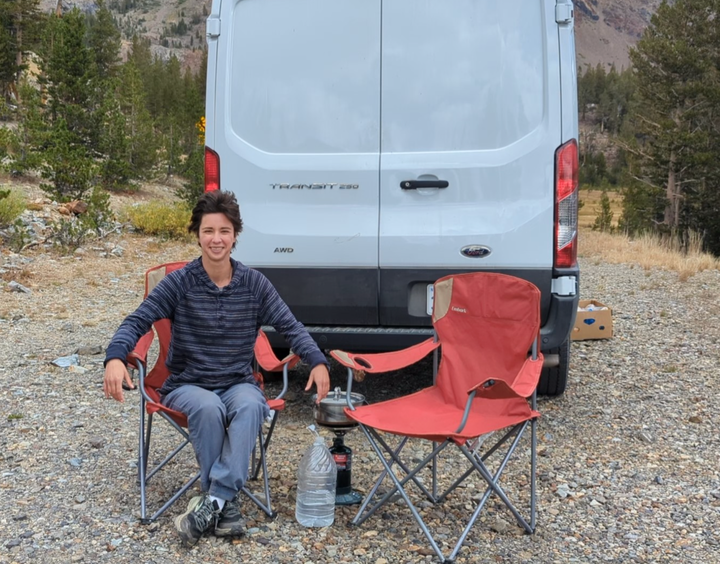
The author relaxing in a camp chair behind the van, with short hair and wearing masculine clothes, in September 2024.

I am lucky I don’t work in a place where I can’t use the bathroom, but navigating my gender identity is still a constant struggle — not solely with myself, but with everyone I interact with. I have to justify my gender expression to strangers and negotiate with them, whether or not our interactions are negative or positive. So why do I subject myself to this frustration? Because it would hurt more to hide myself every moment of every day.

Finding more authentic ways to express myself feels like a weight that I wasn’t aware of has been lifted off my chest, and suddenly, I can breathe deeply, newly grounded in the reality of my body. Swimming in the river after I cut my hair, I felt distantly afraid but excited about what was to come. I felt grateful I took this step toward my true self.

Rey Katz is a nonbinary writer, MIT alum, small-business owner, and black belt in Kokikai Aikido. They are working on a memoir about coming of age as a nonbinary martial artist. Check out their relatable true stories at Amplify Respect and small biz services at reykatz.com.