This is the answer to yesterday’s Free The Ocean Trivia. I got it correct, but it was a guess because the other ones didn’t really seem correct. Anyway, it’s good eco news for Tuesday, taken from nature!
In the shallows of Papua New Guinea’s Kimbe Bay, scientists have documented a surprising adaptation among one of the ocean’s most recognizable fish. During a 2023 marine heatwave, orange clownfish—familiar to many as the inspiration behind *Finding Nemo*—began shrinking. Not just slimming down, but actually shortening their bodies to weather the rising temperatures of their coral reef home, as reported by AP News.
This previously undocumented response was observed across dozens of breeding pairs tracked over several months. The findings, now published in *Science Advances*, offer rare insight into how marine species are physically changing to survive extreme climate conditions.
Clownfish are shrinking their bodies during marine heatwaves.
The Heatwave That Triggered a Transformation
Between February and August 2023, researchers repeatedly measured 134 clownfish as ocean temperatures soared to levels resembling a “hot bath,” according to Newcastle University doctoral researcher Melissa Versteeg, whose team led the study alongside local organizations Mahonia Na Dari and Walindi Resort. The scientists discovered that nearly three-quarters of the adult fish shrank at least once during the period, decreasing in total length by several millimeters. These changes happened in mere weeks—not over a lifetime, as previously assumed in similar cases, according to Vox.
Unlike earlier studies that linked climate to stunted growth in birds and mammals over generations, this was physical shrinkage in mature individuals. The observation challenges assumptions about static adult body sizes and opens new possibilities for understanding animal adaptability.
This size reduction is a physical adaptation, not just weight loss.
A Strategy Rooted in Survival and Social Balance
The shrinking wasn’t random. It was synchronized, particularly within breeding pairs. Versteeg’s team found that pairs where both fish shrank together had better odds of surviving the heatwave. The behavior, documented in the wild for the first time in reef fish, helps sustain clownfish social structure, Sustainability Times reports.
Clownfish live in tight-knit social hierarchies, often with one dominant breeding pair and several subordinate members. Size plays a critical role in that hierarchy. When heat stress reduced food availability or oxygen levels, shrinking may have reduced the energy and oxygen needs of the fish. Coordinated downsizing likely helped avoid social conflict and maintain reproductive bonds.
Speaking to the The Washington Post, Newcastle marine ecologist Dr. Theresa Rueger emphasized how this size shift offered advantages: smaller fish may manage heat stress better and require fewer resources—both of which are scarce in warming seas.
The phenomenon was discovered during a 2023 heatwave in Papua New Guinea.
Beyond Clownfish: A Broader Pattern in a Warming Ocean
Clownfish aren’t alone. Scientists have linked higher global temperatures to shrinking trends in a range of species, from birds to mammals. A 2019 study showed that North American birds shrank by an average of 2.6% over several decades. But the clownfish response is distinct because it occurs rapidly, during the adult life stage, and in direct response to a single environmental event.
Thermal stress may trigger these changes by limiting the availability of oxygen and nutrients. Smaller bodies have less demand and are more efficient under strained conditions. There’s even speculation that clownfish, like marine iguanas, may be reabsorbing bone or fat tissue to reduce size, though more study is needed to confirm this hypothesis, BBC News reports.
Scientists measured 134 clownfish monthly and saw widespread shrinkage.
The Limits of Adaptation
Despite this remarkable display of flexibility, adaptation has its limits. The heatwave that prompted this discovery was the first of three consecutive ones in the region. Many of the clownfish studied didn’t survive them all. Coral bleaching—another side effect of heat stress—is stripping clownfish of their sea anemone homes. These vibrant, venomous hosts are essential for clownfish survival, offering shelter and protection. Without them, even the most adaptive clownfish may struggle to persist.
Moreover, this shrinking behavior is not a cure-all. As pointed out by University of Massachusetts fish biologist Joshua Lonthair in The Washington Post, if shrinking turns out to be a widespread response to environmental pressures, it may fundamentally alter how scientists understand growth and maturity in marine life.
Looking Ahead
The clownfish shrinking phenomenon marks a breakthrough in how marine biologists interpret resilience. It’s a glimpse into the extraordinary ways wildlife tries to keep pace with a planet in flux. While researchers continue to explore the exact mechanisms behind this body-size shift, one thing is clear: even iconic species like the clownfish are being reshaped by climate change—literally.
Understanding these changes is crucial, not just for preserving individual species, but for forecasting the health of entire marine ecosystems. In a world growing hotter by the year, adaptation may be the difference between survival and extinction.
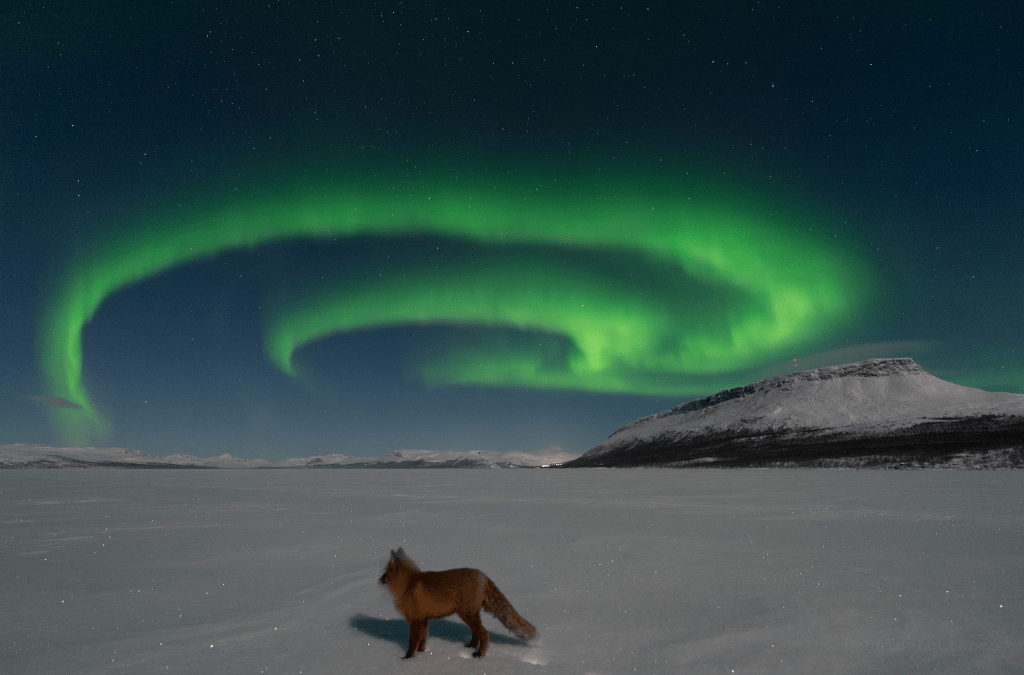
Explanation: In a Finnish myth, when an arctic fox runs so fast that its bushy tail brushes the mountains, flaming sparks are cast into the heavens creating the northern lights. In fact the Finnish word “revontulet”, a name for the aurora borealis or northern lights, can be translated as fire fox. So that evocative myth took on a special significance for the photographer of this northern night skyscape from Finnish Lapland near Kilpisjarvi Lake. The snowy scene is illuminated by moonlight. Saana, an iconic fell or mountain of Lapland, rises at the right in the background. But as the beautiful nothern lights danced overhead, the wild fire fox in the foreground enthusiastically ran around the photographer and his equipment, making it difficult to capture in this lucky single shot.
(Well, the Science and Art parts, anyway! This is originally a year-old story, republished by Cosmos today. I scouted around for some sort of an update, but didn’t find one. I still thought this is interesting, and at least now we know another area in which A.I. might be applied. I think that’s good to know, since A.I. does make mistakes, as noted below.)
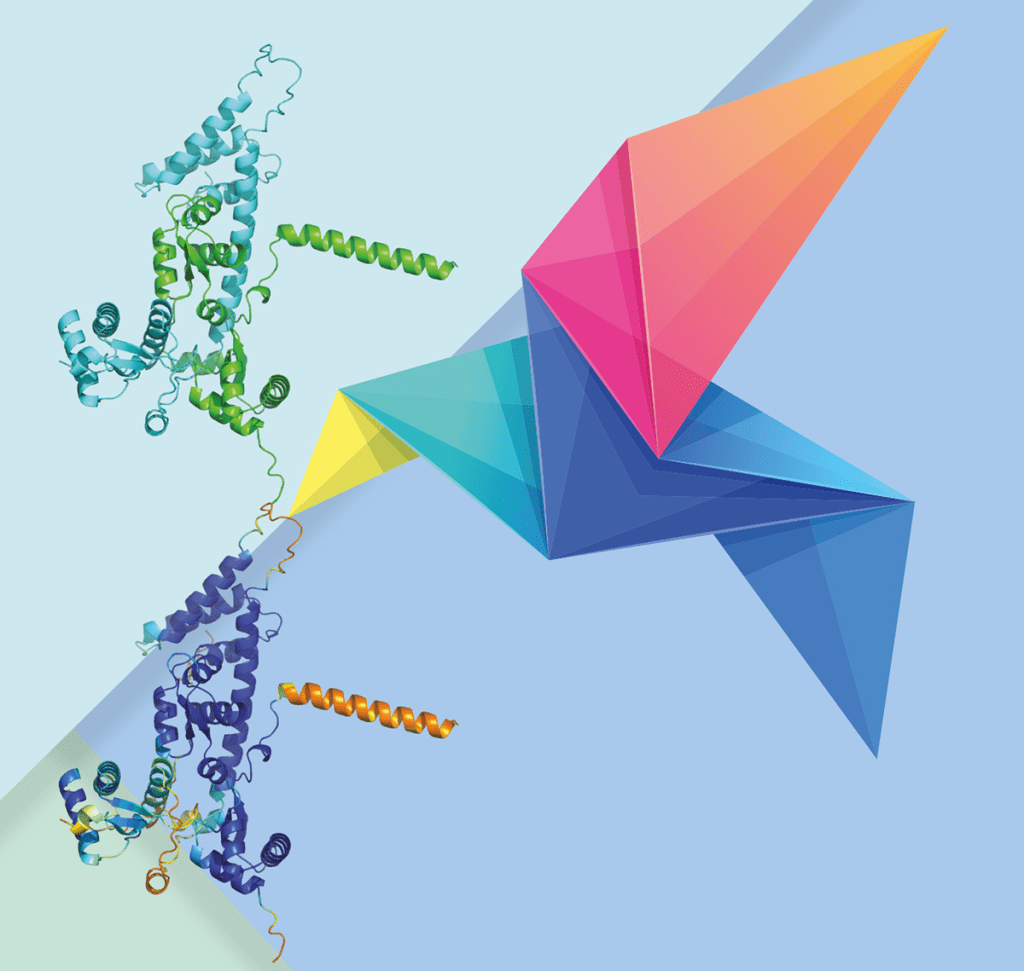
This artwork of an origami bird holds AlphaFold 3 predictions of a complex of two proteins (ScpA and ScpB) in its beak. The protein complex is important during cell division in bacteria. Top: ScpA is cyan and ScpB is green. Bottom: Confidence measures, where dark blue is very high confidence, light blue is confident, yellow is low confidence, and orange is very low confidence in the structural prediction. Credit: AlphaFold 3, Katie Michie.
A protein is made from of a chain of amino acids strung together like beads on a necklace. This chain spontaneously folds, like origami, into intricate pleats, folds, and loops through interactions between its amino acids. The resulting unique 3D structure largely determines its vital function within the lifeform. Solving the structure allows biologists to better understand how the protein works and design experiments to affect and modify it.
The smallest known protein, TAL, influences development of the fruit fly Drosophila melanogaster and has just 11 amino acids. The largest, Titin, is found in human muscle cells and is made up of roughly 35,000.
Proteins are far too tiny to inspect under a regular microscope. For decades researchers used complex experimental techniques, such as X-ray crystallography, nuclear magnetic resonance (NMR) spectroscopy, and cryogenic electron microscopy (cryo-EM) to solve their structures. It’s painstaking, time-consuming work that takes specialised skill and sometimes hundreds of thousands of dollars. And, as Kate Michie can attest, success is not always guaranteed.
“I spent four years trying to solve the crystal structure of a complex of two human proteins and got scooped. You know, I got nothing out of four years. I worked really hard at it, and it was a really difficult project. AlphaFold can calculate those in a few hours,” says Michie, who is chief scientist of the Structural Biology Facility at the Mark Wainwright Analytical Centre, of the University of New South Wales Sydney.
On 8 May 2024 Nature dropped a paper introducing the third and latest iteration of the artificial intelligence (AI) system AlphaFold, which predicts the 3D structure of proteins from their amino acid sequences. Google DeepMind and Isomorphic Labs, both subsidiaries of Alphabet, co-developed the new model. They say AlphaFold 3 (AF3) is “a revolutionary model that can predict the structure and interactions of all life’s molecules with unprecedented accuracy”. But, while AF3 has generated significant interest since its release, it has simultaneously sparked criticism among those in the scientific community.
Let’s take a closer look at how AI is changing the world of structural biology.
A revolution in protein structure
AF3’s predecessor, AlphaFold 2, was released as open source code in July 2021 and immediately changed the game in structural biology.
“I contacted the high-performance computation people and said, ‘we really need to get this piece of code running’. And then I asked my colleague, ‘Do you have any structures that you never submitted to the Protein Data Bank?’” says Michie.
The Protein Data Bank (PDB) is the global archive of all the experimentally solved structures for large biological molecules. As of June 2024, its estimated to include more than 220,000 proteins, which sounds like a lot until you consider the number of proteins we know of exceeds 200 million.
“My colleague sent me a sequence of a small protein he never submitted to the PDB, I ran it, and I just sent him the result. His email response to me was: ‘My mind is blown!’ And he said, ‘I immediately thought someone else must have solved the structure.’”
But they hadn’t, AF2 had accurately predicted the 3D structure of the protein from its amino acid sequence alone. What had taken years to describe experimentally had been done in just a few hours.
AF2 is a deep learning algorithm. In the world of AI that means it simulates the neural networks found in human brains. First, it takes the protein sequence of interest and searches several databases for similar proteins. By comparing these sequences, it can identify areas of similarity and difference to understand how the protein has changed across evolution.
For instance, if two amino acids are in close contact in 3D space then a mutation in one will usually be accompanied by a mutation in the other (to conserve the structure of the protein). But if they are far apart then they tend to evolve independently from each other. Using this to work out the relative positions of the amino acids, AF2 then takes its training on PDB structural data and iteratively constructs a 3D model of the protein’s structure with relatively high accuracy.
Scientists can take advantage of that predicted structure to accelerate their science by doing smarter, more strategic experiments in the laboratory right off the bat. “I’ve done work with some scientists working with immune complexes, and the models coming out of AlphaFold enable them to really trim down the number of animal experiments they do,” says Michie. “So instead of making say 20 CRISPR mice, they only might make two.”
As seen in AlphaFold 3, a structural prediction of Fos and Jun transcription factors with the DNA sequence they bind. The top panel shows the model and confidence data, and the green chart shows the high confidence of them binding to each other. Credit: AlphaFold 3, Katie Michie.
Crystal clues
An accurate AlphaFold structure can also be the crucial missing piece of the puzzle that allows researchers to experimentally solve the structure using X-ray crystallography.
“One of my other colleagues is virologist and he’d been working on a protein that had eluded structural elucidation for 20–30 years. It was from the world’s first known retrovirus,” says Michie.
“The trick of crystallography is you need to know two components of the maths to solve them,” she continues. The diffraction data provided by X-ray crystallography gives you one of those components, but you don’t have the other: the phase.
Traditional methods of obtaining phase information had proved unsuccessful, until Michie suggested using AlphaFold instead.
“Immediately the structure came out. AlphaFold helped him get the crystals but then actually enabled him to phase the structure. It told us that the Alpha Fold model was very good, but it also fixed up this problem in structural biology.”
To Michie, AlphaFold represents a massive step forward: “it’s genuinely the biggest scientific advance in my career”.
“The Alpha Fold model was very good, but it also fixed up this problem in structural biology.”
Predicting the structures of life’s molecules
Proteins don’t exist in a vacuum. They move around, bind to and modify each other, and even form large, complicated complexes.
Peter Czabotar, joint head of the Structural Biology Division at WEHI, the oldest medical research institute in Australia, says one of the early limitations of AF2 was you could only ever get structural predictions of one protein, alone. “Often what you’re interested in is how different proteins will interact with each other. For example, we work on proteins that are involved with cell death and the interactions between those proteins will dictate whether a cell will live or die.”
The gap has since been bridged by other research groups adapting and building upon AF2’s open source code, and with the AlphaFold-Multimer extension in October 2021.
The newest version, AF3, extends upon this capability by predicting interactions of multiple proteins, and nucleic acids (DNA and RNA). It can predict the impact of ions and post-translational modifications – the addition of chemical groups to amino acids – on these molecular systems too. AF3 can also be used to predict how a selection of small molecules called ligands bind to proteins, though this is restricted to ligands that have high-quality experimental data available in the PDB.
“But where the real power is, something that we do a lot of, is in the drug discovery world,” says Czabotar. “And it is extremely powerful for that, potentially, but they haven’t enabled that in the way that it’s released. We’ve done drug discovery against cell death proteins, for example. I can’t take one of the drugs that we’ve worked with and see how it interacts with my target protein, I can only use the [ligands] that they’ve enabled us to use.”
That capability to predict the structure of novel drug molecules interacting with target proteins seems to be restricted to Isomorphic Labs, which was launched in 2021 to pursue commercial drug discovery.
AF3 uses a very different approach for this new suit of predictions: generative AI. After processing the sequence inputs, it assembles its predictions using a diffusion network, the likes of which power AI image generators. According to Isomorphic Labs’ website: “the diffusion process starts with a cloud of atoms, and over many steps converges on its final, most accurate molecular structure”. Diffusion has been applied to protein structure prediction before, for example, in the seminal RoseTTAFold diffusion (RFdiffusion) by the Baker Laboratory at the Institute for Protein Design, the University of Washington.
But generative AI is not without its limitations. AF3 will occasionally produce structures with overlapping atoms (this is physically impossible) or replace a detail of the structure with its mirror image (chemically impossible). As a generative model, it is also prone to hallucinations in which it invents plausible-looking structures – particularly in disordered regions of the protein that lack a stable 3D structure – similarly to how a text to image AI struggles to create realistic-looking hands. In-built confidence measures help to identify when AF3 isn’t so sure about its structural prediction, but ultimately it takes a scientist with understanding of the underlying structural biology to come along and identify what’s gone wrong, and why.
“It’s very, very powerful. But it doesn’t exclude the need to necessarily confirm things experimentally. Whether that is by solving structures themselves or by, for example, testing the structures in some way in an experiment,” says Czabotar.
Concerns about code
In a major departure from AF2, access to the newest iteration of AlphaFold is limited to a web server and for non-commercial research only. “We have various structure-based drug discovery projects and some of them are purely academic, as students, PhDs and honours projects. But we also have had commercial partnerships, because that’s a way to push your discoveries into a clinical setting,” says Czabotar. “So generally, anything that is going to make an impact is done by an academic lab in a commercial partnership. Now, I guess it puts us in a bit of an awkward situation. Even if we could look at our compounds bound to the target [protein], there’s some projects where we won’t be able to do it because, you know, we’ve ticked a box.”
AF3’s accompanying Nature paper was also published without the source code, but with a ‘pseudocode’ instead – a detailed description of what the code can do and how it works. This prompted an open letter to the Editors of Nature, published 16 May and endorsed by more than 1,000 scientists as of June.
The letter raised concerns that “the absence of available code compromises peer review” and that the pseudocode released would “require months of effort to turn into workable code that approximates the performance, wasting valuable time and resources”. Access to the web server was also initially capped at 10 predictions per day, which the letter stated, “restricts the scientific community’s capacity to verify the broad claims of the findings or apply the predictions on a large scale”.
The sentiments appear to have hit home. Shortly after the letter’s release, DeepMind’s Vice President of research, Pushmeet Kohli announced via X that they would double the daily job limit to 20 and are “working on releasing the AF3 model (incl weights) for academic use … within 6 months”.
On 22 May Nature responded in an editorial, stating its reasoning for publishing the paper without code: “the private sector funds most global research and development, and many of the results of such work are not published in peer-reviewed journals. We at Nature think it’s important that journals engage with the private sector and work with its scientists so they can submit their research for peer review and publication.”
In the meantime, other researchers won’t be sitting idly by until the code release at the end of 2024. Already, multiple teams are racing to develop their own open source versions of AlphaFold 3, without any strings attached.
In a groundbreaking global mission, researchers have identified 866 new marine species, offering fresh insights into ocean biodiversity. The discovery comes after a two-year collaboration among scientists, governments, and research institutions.
This large-scale effort combines data from 400 institutions and more than 800 scientists to accelerate the cataloguing of life beneath the waves. The study confirms that much of the ocean remains unexplored, with only about 10% of marine species currently documented, leaving a vast number of creatures to be discovered, Faharas reports.
Photo YouTube / Your Wyoming Link
The Guitar Shark was found 200 meters deep off Africa.
Breakthrough Discoveries: Guitar Shark and Venomous Harpoon Snail
Among the newly identified species, the Guitar Shark stands out. Found at depths of approximately 200 meters off the coasts of Mozambique and Tanzania, this elusive shark adds to a critically endangered group, Afloat.ie reports. With only 38 known guitar shark species worldwide and a significant proportion threatened, its discovery sparks urgent calls for conservation measures.
Equally intriguing is the discovery of a venomous marine gastropod, Turridrupa magnifica. This creature, encountered in the South Pacific near New Caledonia and Vanuatu, possesses a specialized predatory mechanism. It employs harpoon-like teeth to inject toxins into its prey, a feature that opens potential avenues for developing novel pain relief and cancer treatments, according to Ocean Census. The promising medical applications of these peptides highlight the unforeseen benefits that emerging species can offer.
Photo YouTube / Your Wyoming Link
Scientists discovered 866 new marine species.
A Collaborative Effort Across the Globe
The ambitious mission, led by the Nippon Foundation and Nekton, kicked off in April 2023. It involved 10 global expeditions and 8 Species Discovery Workshops, creating an international network dedicated to marine research, IFL Science reports. By deploying divers, remotely operated vehicles, and submersibles, teams explored depths ranging from near-surface waters to nearly 5,000 meters below sea level. Such an extensive range allows researchers to capture a diverse snapshot of ocean life, from colorful reef fish to mysterious deep-sea creatures that dwell in near-total darkness.
The traditional process of species registration is lengthy, sometimes taking up to 13.5 years. This delay means that many species face extinction before they can be formally documented. Accelerated efforts, like the Ocean Census, aim to reduce this gap and develop conservation strategies rapidly, CBS News reports. The initiative has already facilitated a series of Species Discovery Awards, encouraging taxonomists worldwide to share their findings and enrich our understanding of marine ecosystems.
Photo YouTube / Your Wyoming Link
Discoveries inspire hope for future biotechnology advances.
Implications for Marine Conservation
The revelations extend beyond the thrill of new discoveries. They serve as a stark reminder that the ocean still holds many secrets critical to the health of our planet. With climate change, overfishing, and pollution increasingly threatening marine environments, the need for protective measures has never been more urgent.
A unified treaty reached by over 100 nations now aims to conserve 30% of the world’s oceans by 2030, CBS News reports. This commitment underscores the pivotal role that newly discovered species play in advancing marine conservation, as each new creature contributes to the broader ecological balance.
The comprehensive data gathered during these expeditions are now accessible through an online biodiversity platform. This initiative not only supports ongoing research but also informs policy decisions aimed at safeguarding marine habitats, according to Faharas. As more species become known, conservationists can design more effective strategies to protect fragile ecosystems. The discovery of species such as the Guitar Shark and Turridrupa magnifica becomes a clarion call for further exploration and immediate action to preserve oceanic life.
Charting a Course for Future Discoveries
This monumental effort in marine exploration opens the door to new scientific questions. Researchers now face the challenge of studying the biology, behavior, and ecological roles of these species. The data collected will fuel future expeditions and drive technological innovations in underwater research. A sustained commitment to cataloguing and conserving ocean life will help protect the planet’s largest ecosystem against ongoing environmental threats.
The Ocean Census project represents a major step forward in understanding marine biodiversity. Its findings remind us that the ocean remains a vast and vibrant frontier, rich with life forms that continue to captivate scientific curiosity and drive innovation. As nations work together to expand marine protected areas, these discoveries will serve as a cornerstone for global conservation efforts.
I want to say I’ve seen this bird, but I don’t know how I could have, other than maybe when I was younger on one of dad’s business trips through the South, as a combo summer vacation. Over 50 years ago, but the bird looks familiar. I bet there are readers here who get to see them often! Click through for facts and to hear their song.
Black garden ant (Lasius niger). Credit: Aditya Vistarakula/Getty Images
Previous research has shown that ant colonies are more likely to behave aggressively towards neighbouring colonies, but less likely to do so against unfamiliar ones.
It’s known as the “nasty neighbour effect” and, until now, researchers weren’t sure why it exists.
A new Current Biology study has discovered that ants remember the smell of their enemies.
“We often have the idea that insects function like pre-programmed robots,” says Volker Nehring from the University of Freiburg, Germany.
“Our study provides new evidence that, on the contrary, ants also learn from their experiences and can hold a grudge.”
The researchers pitted colonies of the black garden ant, Lasius niger, against each other. In the first phase of the experiment, they were exposed either exposed to nestmates or to ants from a different colony.
Each meeting lasted for one minute and was repeated once per day for 5 consecutive days. Ants’ aggression when encountering non-nestmates increased significantly during this training phase.
On day 6, the team found that ants acted most aggressively when encountering the non-nestmate colony they had previously fought but were less aggressive towards ants from a non-nestmate colony they hadn’t yet encountered. Unsurprisingly, they weren’t aggressive towards their own nestmates.
In the second phase of the experiment, encounters were repeated with either aggressive or passive ants from a different colony. They found the ants that had previously only encountered passive competitors behaved significantly less aggressively.
Because ants use odours to distinguish between members of their own nest and those from other nests, the study suggests that ants learned to associate aggression with the non-nestmate colony’s specific scent.
Nehring and his team now plan to investigate whether and to what extent ants adapt their olfactory receptors to their experiences.


 The phenomenon was discovered during a 2023 heatwave in Papua New Guinea.















 Scottie's Playtime