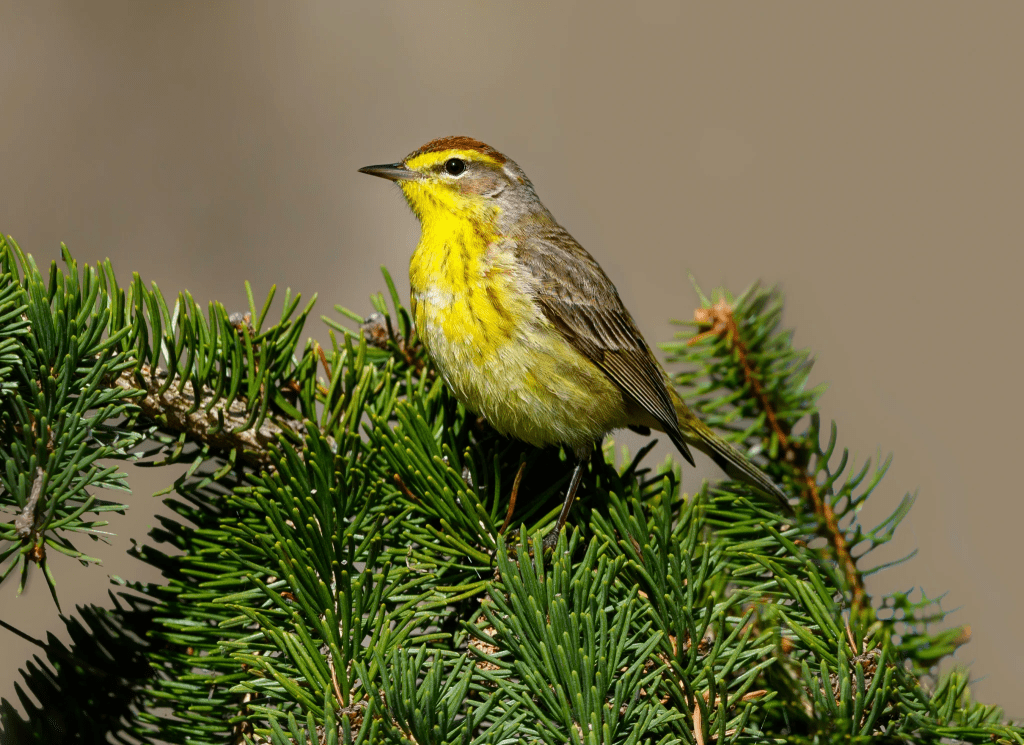
The Palm Warbler is unusual among the Western Hemisphere’s wood-warbler family. While the majority of warblers are sexually dimorphic, with males noticeably brighter in the breeding season, the male and female Palm Warbler are nearly identical, and can be impossible to tell apart. Warblers, in general, spend a majority of their time in trees and shrubs, but the Palm Warbler is quite comfortable on the ground. Rather than hopping like their arboreal relatives, these birds take to walking or running. Like other warblers, the Palm Warbler often joins mixed-species flocks outside of the breeding season. However, though most warblers tend to flock up with other arboreal species, the Palm Warbler is just as likely to be found foraging with sparrows along hedgerows and in open weedy fields.
Palm Warblers share another habit more typical of ground-dwelling birds in that they continuously bob their tails. This behavior is also seen in other birds typical of open habitats, including the Spotted Sandpiper and Black Phoebe, where the rate of bobbing is thought to vary with the bird’s level of excitement, and thus plays a role in communication. In many ways, the Palm Warbler behaves more like a sparrow or pipit than a typical wood-warbler — even its monotonous trilled song is remarkably similar to that of a Dark-eyed Junco or Chipping Sparrow. Though perhaps an oddball among its own family, this unique bird has found a niche all its own, somewhere between a sparrow and a warbler. (snip-MORE)
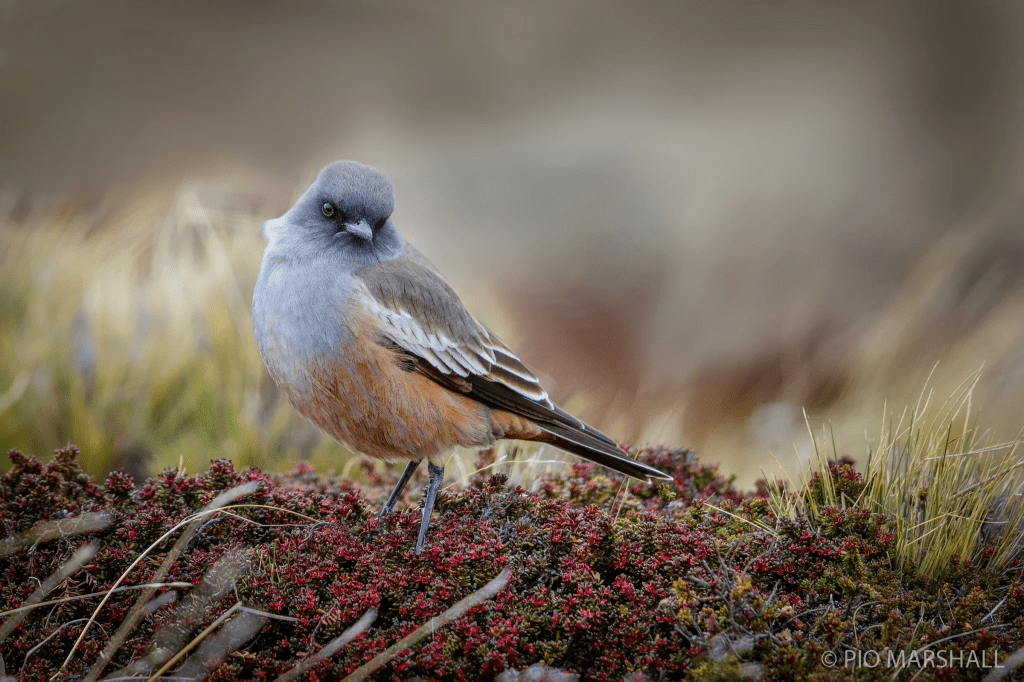
A handsome bird of open landscapes, the Chocolate-vented Tyrant is an unusual species to be included among the so-called “flycatchers.” Inhabiting flat grassland and scrub, this bird is primarily a ground-dweller, rarely seen higher than a fencepost or tussock. Furthermore, this flycatcher is not one to catch insects on the wing (to “fly-catch” in ornithology lingo), preferring instead to hunt its prey on the ground. In keeping with this terrestrial lifestyle, the Chocolate-vented Tyrant has notably long legs and is more likely to run or walk than to hop or fly. In combination with its large size and rusty belly, the tyrant’s appearance and behavior are reminiscent of birds in the thrush family, such as the American Robin.
The Chocolate-vented Tyrant breeds in the cold, dry, and infamously windy Patagonian Steppe, also known as the Patagonian Desert. In an environment largely devoid of trees, this bird takes advantage of the open sky to perform an expansive aerial display, similar to other birds like the Red Knot and American Woodcock that use flat, open habitat in the breeding season. The Chocolate-vented Tyrant is also known to forage alongside wintering shorebirds — yet another habit unusual for its family, but typical of others, like the groups of sandpipers and plovers it sometimes joins.
Threats
Birds around the world are declining, and many of them, including the Chocolate-vented Tyrant, are facing urgent threats. Throughout the tyrant’s range in South America, livestock grazing, agricultural expansion, and invasive species all hinder this bird’s ability to thrive. Furthermore, sparse protected areas may be insufficient to support the species, particularly on its nonbreeding grounds in the Pampas, the vast grasslands region east of the Andes.
Habitat Loss
The Chocolate-vented Tyrant is losing habitat in both its breeding and nonbreeding ranges. On the Patagonian Steppe, where this species breeds, overgrazing by sheep disrupts the limited vegetation afforded by a dry climate, resulting in erosion and eventually desertification. The Pampas faces similar threats from overgrazing by cattle, as well as the clearing of native habitat in favor of agriculture.
The Chocolate-vented Tyrant is a habitat specialist, making it particularly vulnerable to threats like habitat loss and degradation. In addition to protecting habitat through our network of reserves, ABC also works to reduce the threat of invasive species and restore habitat. At ABC, we’re inspired by the wonder of birds and driven by our responsibility to find solutions to meet their greatest challenges. With science as our foundation, and with inclusion and partnership at the heart of all we do, we take bold action for birds across the Americas.
Creating & Maintaining Reserves
Habitat is the foundation for birds’ survival. Working with dozens of partners and local communities throughout Latin America, ABC supports a growing network of protected areas in more than a dozen countries. Totaling more than 1.3 million acres, nearly one-third of the world’s birdlife (more than 3,000 species) is protected by an ABC-supported reserve.



 Scottie's Playtime