Greater pipefish, Syngnathus acus 54, and Sargassum pipefish, Syngnathus pelagicus 55,56. Handcolored copperplate engraving from Gottlieb Tobias Wilhelm’s Encyclopedia of Natural History: Fish, Augsburg, 1804. Wilhelm (1758-1811) was a Bavarian clergyman and naturalist known as the German Buffon. (Photo by: Florilegius/Universal Images Group via Getty Images)
A new study out of the University of Canterbury in Christchurch, New Zealand has called into question traditional perceptions of mating.
“In most species, males compete to attract females. But with pipefish, the males carry and protect the embryos,” says PhD student Nicole Tosto, who led the research.
“Pipefish are unique because they don’t follow the usual ‘rules’ of evolution.”
The research highlights how biological differences in male and female pipefish influence their survival and mating habits.
While females have genes to support egg production, males activate genes to strengthen their immune system.
This is a key adaptation that allows the males to nurture and care for embryos in their bodies.
The study, published in Molecular Ecology, also uncovered how this switch in activated genes impacts mating selection.
In most species, females prefer larger, dominant males as mates because it often increases their chance of having healthy offspring, as the strong male can provide security and defence from predators.
Instead, the study found that female pipefish swim against this trend and tend to choose smaller males with high fitness levels.
Tosto suggests that this selection is based on efficiency as smaller males may need fewer resources.
Robust Ghost Pipefish, Solenostomus cyanopterus, Bali, Indonesia (Photo by Reinhard Dirscherl\ullstein bild via Getty Images)
She also believes smaller males could be better suited for the synchronised water movements that are a part of the species’ courtship rituals.
In many animals, males and females of the same species can have physical features that are different between the sexes and are often used to attract mates. These visible traits are known as sex-specific ornaments.
However, the pipefish species involved in the study were monomorphic, meaning that male and female pipefish looked almost identical and had no visible differences.
“Nicole’s research has brought up important questions for evolutionary biologists when it comes to current vs past selection,” says her doctoral supervisor, Dr Sarah Flanagan, a senior lecturer in Biological Science at the University of Canterbury.
Natural selection is a process where individuals with traits that help them survive become more likely to reproduce and therefore pass on those traits to their offspring. Overtime these advantageous traits become more commonly inherited among the species.
“For example, whether the existence of sex-specific ornamentation is evidence that selection is currently acting strongly on those sex-specific traits or whether ornaments are evidence of selection having happened in the past.”
Pipefish don’t have sex chromosomes meaning both sexes share the same genetic blueprint, they just use the genes in different ways.
For example, females focus on producing egg-enhancing proteins, whereas males produce immune-boosting proteins for pregnancy.
“Knowing how these pressures shape mating systems helps us better understand how species survive and adapt to their environments,” says Tosto.
While there is no current extinction concern for dusky pipefish (Syngnathus floridae), the species of pipefish investigated in the study, other pipefish species such as the estuarine pipefish are critically endangered.
Twice on other travels a wolf stood on the periphery of lamplight. Our eyes intensified in the silent distance between sanctity. There is one who appreciates secondhand revelations of wolves.
Sparrow hawk waves fast hinges of small capture in its apex of watch. Where are the absent coyotes of Willamina? Winter-sleepy mice are slow.
The salmon pass the fishers’ drift into deadline. The count is a button pushed in the rapture of instinctual homing. An eye squint records the shrapnel glimpses of Chinook.
Our river’s low, as manly winds blur the edges of inland clouds. Aspiring rain is a sleepy feminine whisper. Grasses sweep patterns of mock celestial visitations.
Otter pelts feel soothingly moist in the rich depth of velvety pelage Small bare edged ears are symbolic of ocean’s chill. One secret otter strip is owned for future weaving.
Otter woven into a 1Ravenstail robe is royal and tide riddled. The otter dances on prominent lineage hidden through survival. Copper light resumes ceremony from absence to embrace our shoulders.
1. Tlingit weaving and a form that nearly died out.
Deep in the forest lies a wildflower that defies expectations. Often mistaken for a fungus, the plant is a pale, translucent white in bloom—sometimes tinted pink or, rarely, a deep red. The ephemeral flower blackens if touched and quickly decays if plucked from the earth.
This month, as we celebrate all things spooky and supernatural, it’s only fitting to spotlight a species that is both ghost and vampire: Monotropa uniflora.
This peculiar plant can be found throughout much of North America, East Asia, and in northern regions of South America. It typically grows in moist, shaded areas of mature forests, springing from the soil to flower between June and September. Each plant has only one cup-shaped flower per stem, which droops toward the ground at first bloom. This downward orientation is thought to protect its nectar and pollen from rain. Carl Linnaeus had these properties in mind when he classified the plant as Monotropa uniflora in 1753. “Monotropa” is Greek for “one turn,” a reference to the arched stem that supports the nodding flower, and “uniflora” means “one-flowered” in Latin. Once pollinated and fertilized, the flower gradually turns upright, eventually maturing into a dry, woody capsule filled with thousands of seeds.
Monotropa uniflora’s hooked appearance has also inspired its common names. “Indian pipe,” for instance, derives from the flower’s resemblance to ceremonial smoking pipes used by many North American Indigenous communities. Other common names are more closely linked to the plant’s eerie coloration, including “ghost pipe,” “ghost plant,” “corpse plant,” and “ice plant.”
Monotropa uniflora’s ghostly presence has just as much to do with what’s happening beneath the surface as above ground. Like any plant, Monotropa uniflora needs sugar to grow and reproduce. Most plants meet this need through photosynthesis, but Monotropa uniflora lacks chlorophyll, the pigment that gives plants their green color and powers the process by absorbing energy from light. It must seek sugar from another source.
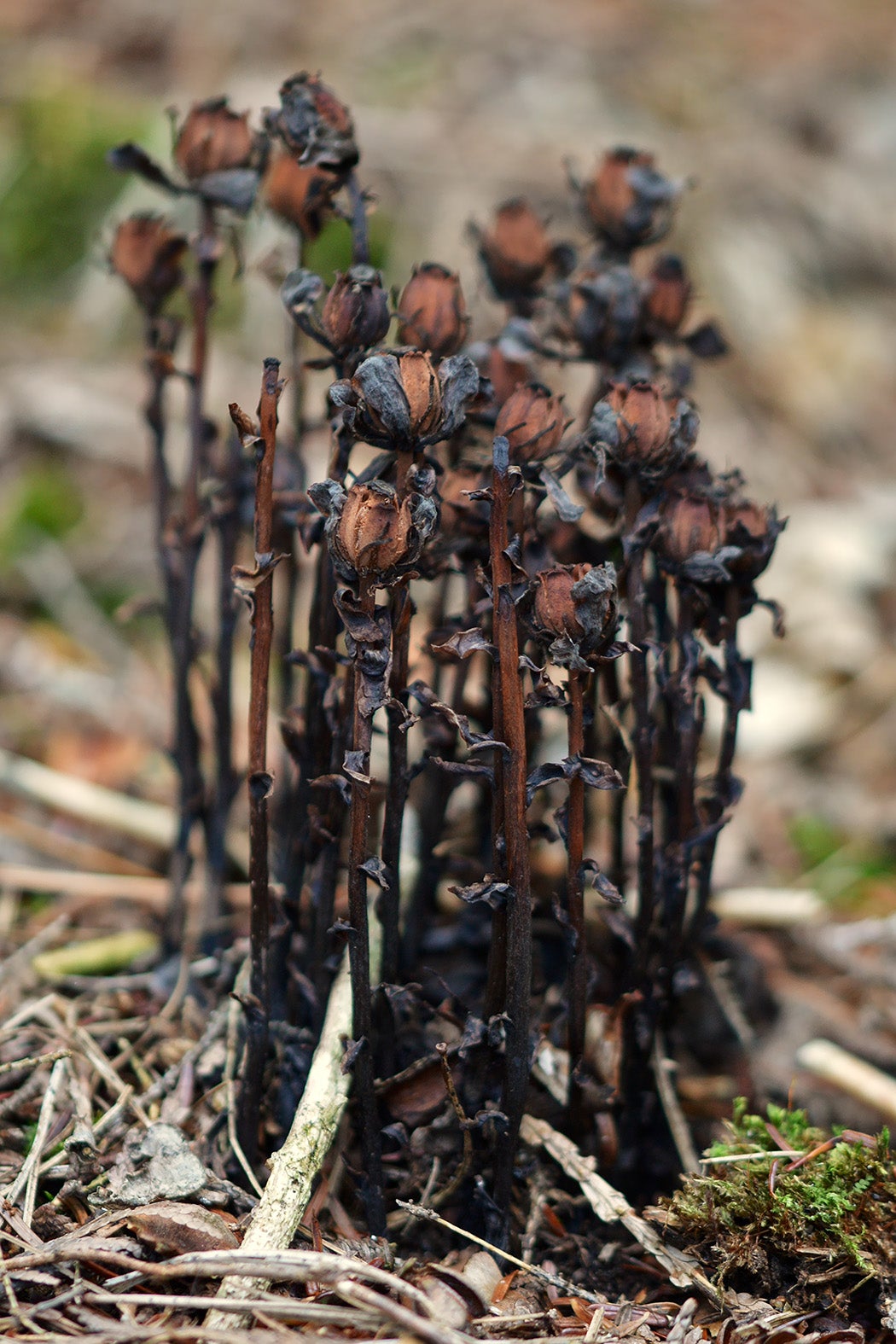
The solution? Mycoheterotrophy: a form of plant nutrition in which plants obtain nourishment through networks of mycorrhizal fungi rather than photosynthesis. In this case, tiny threads of fungi in the Russulaceae family act as an underground bridge between the roots of Monotropa uniflora and those of nearby trees. The mycorrhizae deliver water and essential minerals to the trees in exchange for sugar. Monotropa uniflora takes advantage of this relationship by acting as a parasite on the fungal network, taking sugar and nutrients and giving nothing in return.
Monotropa uniflora seed capsules by Ryan Hodnett via Wikimedia Commons
Mycoheterotrophy is a stroke of evolutionary genius. Monotropa uniflora essentially cheats the mycorrhizal fungi and trees from which it receives sustenance.
“The photosynthetic host cannot select against the mycoheterotroph without selecting against its own mutualist mycorrhizal fungi,” explain scientists Sylvia Yang and Donald H. Pfister. Additionally, because mycoheterotrophs aren’t dependent on light for photosynthesis, Monotropa uniflora can flourish in dark environments where many plants would fail.
Monotropa uniflora in Lore and Literature
All of these curious traits have made Monotropa uniflora an object of fascination for generations of storytellers. The plant is woven into oral histories and written narratives across cultures.
Cherokee storyteller Lloyd Arneach chronicles the plant’s creation as a product of human selfishness. As the legend goes, the chiefs of two quarreling nations smoked a pipe together before resolving their weeklong dispute. According to Arneach, “[The Great Spirit] decided to do something to remind all people to smoke the pipe only when making peace. So He turned them into grayish-looking flowers we now call ‘Indian Pipes’ and made them to grow wherever friends and relatives have quarreled.”
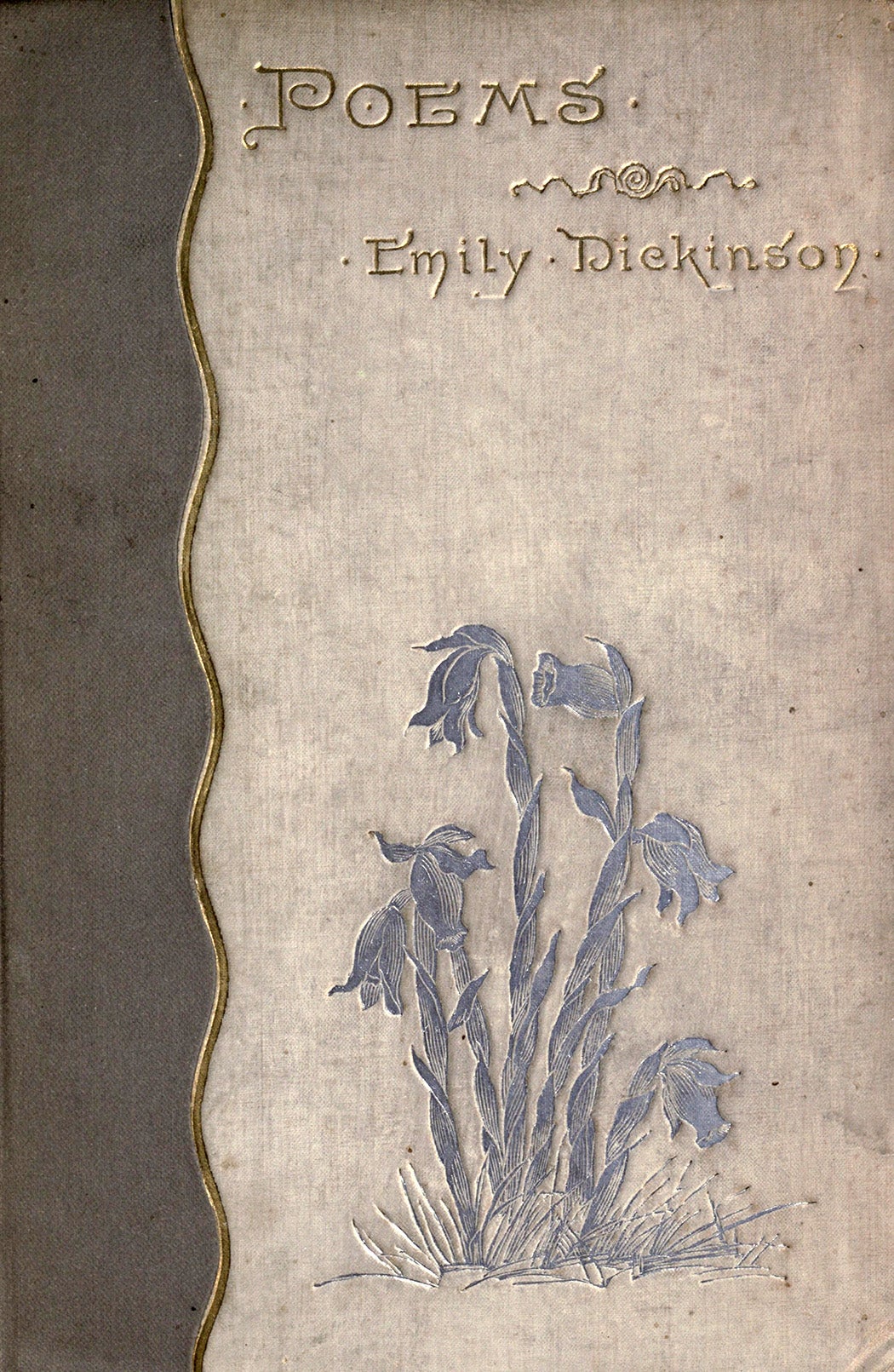
Cover of the first edition of Poems by Emily Dickinson via Wikimedia Commons
One of the most prominent storytellers to depict Monotropa uniflora was Emily Dickinson. Although widely recognized for her poetic prowess, Dickinson was also an amateur botanist. While taking botany courses at Amherst Academy and Mount Holyoke Female Seminary, she assembled more than 400 plant specimens in an herbarium that resides in Harvard’s Houghton Library today. Monotropa uniflora is among the hundreds of pressed plants that fill the book’s pages.
Plants provided constant inspiration for Dickinson’s literary works.
“Like flowers in an herbarium, the odd little poems are a faithful inventory of the natural world,” writes Barbara C. Mallonee. Monotropa uniflora is no exception, appearing in a number of Dickinson’s poems and letters. In one quatrain, she writes:
White as an Indian Pipe Red as a Cardinal Flower Fabulous as a Moon at Noon February Hour—
Scholars including Yanbin Kang are working to decipher the symbolism of Monotropa uniflora in Dickinson’s poetry. The plant’s white color could represent purity. Its nodding flower could suggest humility. Its ability to thrive where other plants cannot calls to mind both strength and loneliness—qualities that might have resonated with Dickinson, who lived reclusively at her family’s homestead later in life.
In 1882, Dickinson received a painting of Monotropa uniflora from Mabel Loomis Todd, a family friend who would become the poet’s first posthumous editor. In her letter thanking Todd for the gift, Dickinson wrote “[t]hat without suspecting it you should send me the preferred flower of life, seems almost supernatural, and the sweet glee that I felt at meeting it, I could confide to none.”
Eight years later, Todd shared Dickinson’s words with the world by publishing the first collection of her poems. Todd’s illustration of the poet’s beloved “preferred flower of life” graced the front cover.
Dickinson wasn’t the only poet to pay homage to this otherworldly plant. Sylvia Plath, another Massachusetts resident with botanical interests, mentions Monotropa uniflora in her poem “Child.” She wrote this poem in January 1963, only two weeks before her death. It’s addressed to an infant discovering the world, unburdened by the darkness that casts a shadow over the narrating mother. Immersed in “the zoo of the new,” the child learns of “Indian pipe” along with “April snowdrop”—two white, nodding flowers linked with the fleeting innocence of childhood.
More recently, Christine Butterworth-McDermott’s 2019 poem “Monotropa Uniflora” plays with the plant’s simultaneous embodiment of force and fragility. The employment of bold, active language (“you feast off other hosts”) and softer expressions (“how pale! how delicate!”) reminds us of the complex nature of Monotropa uniflora’s existence. It’s both a skillful parasite and a sensitive species that begins to decompose upon separation from the fungal network that provides its nourishment.
Medicinal Benefits and Modern Use
Monotropa uniflora’s significance isn’t only poetic, it’s practical. Several Indigenous groups in North America used the plant to treat ailments including inflamed eyes, epileptic fits, and toothaches. These properties were later echoed in books on the medicinal benefits of plants. In 1887, Monotropa uniflora was even deemed “an excellent substitute for opium,” easing pain and inducing sleep.
Today, tinctures made with Monotropa uniflora are sold on various online platforms. Foragers have also taken to social media to share the process of gathering the plant and making tinctures of their own. Their posts often advocate responsible harvest practices, namely leaving pollinated flowers untouched and collecting only in regions where the plant is abundant. Monotropa uniflora is at risk of local extinction in states including California, Nebraska, and South Dakota. It faces increasing pressure from wild collection for medicinal use, although more research is needed to determine the scope and severity of this existential threat.
With ties to ecology, poetry, medicine, and more, the ghost of the forest has several stories to tell. If you spot Monotropa uniflora in bloom, bright against the darkness of the forest floor, take a moment to contemplate the many ways in which humans have interacted with it for centuries. This is the mission of the Dumbarton Oaks Plant Humanities Initiative: to appreciate the unparalleled significance of plants to human culture.
Marine biologists have challenged the claim that lack of food is driving a population crash in killer whales in the Pacific Ocean saying boat noise may be the issue.
Killer whales (Orcinus orca) frequent the waters of British Columbia and feed on Chinook salmon.
Killer whale pod in Johnstone Strait, British Columbia. Credit: Francois Gohier/VW Pics/Universal Images Group via Getty Images.
Researchers from the University of British Columbia in Canada used echosounder data to determine prey salmon densities, as well as discussions with local anglers and whale watching crews in British Columbia, Canada.
There are 2 different populations. One population is local to northern waters. These killer whales have tripled their numbers to about 300 individuals since monitoring began in the 1970s.
The other population inhabits the waters between British Columbia and California to the south. Their numbers fluctuated between 66 and 98 individuals with the latest census putting their numbers at just 73.
“The differing trajectories of these two populations of fish-eating killer whales have been attributed to ecological and biological differences between regions such as prey availability, diet breadth, competition, physical disturbance, underwater noise, contaminants and inbreeding,” the authors write. “However, food availability likely plays the greatest role in limiting their carrying capacities.”
Previous research has shown a correlation between salmon numbers and killer whale population health. But the authors say these studies have never been able to show why the southern population was struggling.
In fact, the southern population of killer whale is the only marine mammal that is struggling in the region. Harbour seals, sea lions, other types of whale and porpoises are all thriving.
Nevertheless lack of access to the Chinook salmon was always put down as the reason for the killer whales’ woes.
But sport anglers told the researchers that they have noticed no drop in salmon numbers. And whale watchers have reported that they have regularly seen the endangered orcas swimming among salmon.
The researchers suggest that the issue isn’t lack of salmon, but that the southern population of killer whales are having trouble catching their prey. This, they say, is likely due to noise from boats. The area where the southern orca population lives has far higher sea traffic than the regions further north.
It’s also possible the orca struggle to hunt at different times of year. They may find enough salmon in summer, but have trouble during spring.
The findings are presented in a paper published in PLOS ONE.

 Greater pipefish, Syngnathus acus 54, and Sargassum pipefish, Syngnathus pelagicus 55,56. Handcolored copperplate engraving from Gottlieb Tobias Wilhelm’s Encyclopedia of Natural History: Fish, Augsburg, 1804. Wilhelm (1758-1811) was a Bavarian clergyman and naturalist known as the German Buffon. (Photo by: Florilegius/Universal Images Group via Getty Images)


 Scottie's Playtime
_-_Algonquin_Provincial_Park,_Ontario.jpg)
