Peace & Justice History for 12/12

December 12, 1870

Joseph H. Rainey (R-South Carolina) took his seat in the U.S. House of Representatives, becoming the first African-American Member of Congress.
More about Rainey 
December 12, 1916
Dr. Ben Reitman was arrested in Cleveland for organizing volunteers to distribute birth control information at an Emma Goldman lecture on birth control. He was sentenced to six months in jail and a $1,000 fine plus court costs.

Dr. Ben Reitman
December 12, 1947
The United Mine Workers union withdrew from the American Federation of Labor over the AFL’s failure to organize workers in mass production industries such as textiles, automobiles, steel and rubber.
December 12, 1969
The Philippine Civic Action Group, a 1350-man contingent from the Army of the Philippines, left South Vietnam. The contingent had been part of the Free World Military Forces, an effort by President Lyndon Johnson to enlist allies for the United States and South Vietnam, similar to President George Bush’s “Coalition of the Willing,” the multi-national force in Iraq.
December 12, 1983
Seventy people were arrested in Boston outside a hotel where a “New Trends in Missiles” trade conference was being held.

Inside the hotel, over 1,000 cockroaches were released to symbolize the likely survivors of nuclear war. 

 
December 12, 1986

From a pershing plowshares action 1984
Plowshares activists disarmed a Pershing missile launcher in West Germany. In a statement of intent the four said, “With awareness of our responsibility we understand that we are the ones who make the arms race possible by not trying to stop it.” 
Details of their action in Pershing to Plowshares 

https://www.peacebuttons.info/E-News/peacehistorydecember.htm#december12

Peace & Justice History 12/11

December 11, 1946

The General Assembly of the United Nations voted to establish the United Nations International Children’s Emergency Fund (UNICEF) to provide health and rehabilitation to children living in countries devastated by World War II.
What does UNICEF do today? 
December 11, 1946
The United Nations General Assembly unanimously passed Resolution 95 affirming the principles of international law recognized by the charter and judgment of the Nuremberg Tribunal. These Principles of International Law were formulated and published by the International Law Commission on July 29, 1950:
These Principles of International Law were formulated and published by the
International Law Commission on July 29, 1950:

Read the UN Resolution 95  (pdf)
December 11, 1961
Two U.S. Army air cavalry helicopter companies arrived in Vietnam, including 33 Shawnee H-21C helicopters and 425 ground and flight crewmen. They were to be used to airlift South Vietnamese Army troops into combat, the first direct military combat involvement of U.S. military personnel.President Kennedy had sent them to bolster the U.S. advisors, in the country since the 1950s, in light of the inability of the Government of Vietnam’s armed forces to resist the Viet Cong insurgency movement and the Army of the Republic of [North] Vietnam.

Shawnee helicopter
December 11, 1961
A U.S. Supreme Court decision outlawed the use of disorderly conduct statutes as grounds for arresting African Americans sitting-in at segregated public facilities to obtain equal service.
The case began in Baton Rouge, Louisiana, where a group of negro Southern University students bought some items then sat at the lunch counter of Kress Department Store. Their polite requests to order food were ignored because the lunch counter was only for the use of whites, and police arrived to arrest them. Convicted of “disturbing the peace,” they were expelled from Southern University and barred from all public colleges and universities in the state of Louisiana.
The Court overturned their convictions because there was no evidence indicating a breach of the peace.

The decision in Garner v. Louisiana 
December 11, 1972
New Zealand Prime Minister Norman Kirk (Labour Party) announced withdrawal of his country’s troops from Vietnam and a phase-out of his country’s draft just three days after taking office.

Prime Minister Norman Kirk


Anti-War demo Parliament Buildings in Wellington, 1969
3,890 New Zealand military personnel had served there, suffering 37 dead and 187 wounded. This had given rise to a large and vocal anti-war movement.
History of the anti-war movement in New Zealand 
December 11, 1980
President Carter signed a law creating a $1.6 billion environmental Superfund to pay for cleanup of chemical spills and toxic waste dumps.
Do You Live Near Toxic Waste?   See 1,317 of the Most Polluted Spots in the U.S.
December 11, 1984
More than 20,000 women turned out for an anti-nuclear demonstration at Greenham Common Air Base in England, where U.S. nuclear-armed cruise missiles were deployed. Some tried to rip down the fence surrounding the base. 

Poster of Broken Missile taped to the fence of Greenham Common by a protester, 1982
A Greenham Peace Camp scrapbook
December 11, 1992
The three major U.S. television networks (ABC, CBS, NBC) agreed on joint standards to limit entertainment violence by the start of the following season. 
Violence in the Media – Psychologists Help Protect Children from Harmful Effects 
December 11, 1994
In the largest Russian military offensive since its 1979 invasion of Afghanistan, thousands of troops and hundreds of tanks crossed the border into the Muslim republic of Chechnya. Just two weeks prior, a Russian covert operation to undermine the government in Grozny, the capital, had been foiled and Dzhokhar Dudaev, Chechnya’s first elected president, had threatened to have the perpetrators executed.The Chechens had declared their independence from the Commonwealth of Independent States, comprising Russia and most of the countries previously part of the Soviet Union. Chechnya had been a Russian colony since 1859, and in 1943 Josef Stalin deported the population en masse, their return to their homeland not allowed until 1957.


Russian President Boris Yeltsin, who ordered the invasion, would not deal with Dudaev, and had raised him to the rank of chief enemy, ignoring Chechen-Russian history. The main attack was halted by the deputy commander of Russian ground forces, Colonel-General Eduard Vorobyov, who resigned in protest, stating that he would not attack fellow Russians. Yeltsin’s advisor on nationality affairs, Emil Pain, and Russia’s Deputy Minister of Defense, Colonel-General Boris Gromov (esteemed hero of the Soviet-Afghan War), also resigned in protest of the invasion, as did Major-General Borys Poliakov. More than 800 professional soldiers and officers refused to take part in the operation. Of these, 83 were convicted by military courts, and the rest were discharged.

https://www.peacebuttons.info/E-News/peacehistorydecember.htm#december11

Peace & Justice History for 11/20:

November 20, 1816
The term “scab” was first used in print by the Albany (N.Y.) Typographical Society.
A scab is someone who crosses a union’s picket line and takes the job of a striking worker.

 
Read The Scab by Jack London 
November 20, 1945
The International War Crimes Tribunal began in Nuremberg, Germany, and continued until October 1, 1946, establishing that military and political subordinates are responsible for their own actions even if ordered by their superiors.Twenty-four high-ranking Nazis were on trial for atrocities committed during World War II, ranging from crimes against peace to crimes of war, to crimes against humanity. The Nuremberg Trials were conducted by judges from the United States, the Soviet Union, France, and Great Britain.The Nuremberg defendants
Read more 
November 20, 1959
The United Nations proclaimed “The Declaration of the Rights of the Child,” because “the child, by reason of his physical and mental immaturity, needs special safeguards and care, including appropriate legal protection, before as well as after birth.”
Read the text of the Declaration 
November 20, 1962
President John F. Kennedy issued an executive order forbidding racial discrimination in public housing.
November 20, 1969
Eighty-nine American Indians seized Alcatraz Island in San Francisco Bay, offering to buy the island from the federal government for $24 worth of beads (the alleged price paid to the Canarsee Delaware Indians for Manhattan Island; it was actually 60 Dutch guilders).
Their numbers swelled into the hundreds at times; the General Services Administration, which had responsibility for the site of the former federal prison, and Coast Guard gave them the opportunity to leave the island peacefully.They were reclaiming it as Indian land by right of discovery, and demanding fairness and respect for native peoples. The occupation lasted for more than a year. Said Richard Oakes, a Mohawk from New York, “We hold The Rock.”

Indian people and their supporters wait for the ferry.
Photo/Ilka Hartmann
 
a new entrance to Alcatraz; Photo/Michelle Vignes 
Read more about the occupation 

LaNada Boyer (formerly Means) inside one of the Alcatraz guard barracks where occupiers lived from 1969-71. Much of the graffiti from 30 years ago remains throughout the island today. Photo by Linda Sue Scott.
November 20, 1977

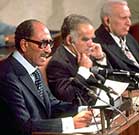
Egyptian President Anwar El-Sadat addressed the Israeli Knesset (parliament).
“I come to you today on solid ground to shape a new life and to establish peace. “But to be absolutely frank with you, I took this decision after long thought, knowing that it constitutes a great risk….”
Text of Sadat’s speech to the Israeli Knesset 
Listen to the speech 
November 20, 1987
SANE (The Committee for a Sane Nuclear Policy) and FREEZE (the campaign to freeze all testing of nuclear weapons) merged at their first combined convention in Cleveland, Ohio, becoming the largest U.S. peace organization.
Peace Action today 
November 20, 1993
The U.S. Senate approved the North American Free Trade Agreement (NAFTA), creating the world’s largest trade area covering Canada, the U.S. and Mexico.

https://www.peacebuttons.info/E-News/peacehistorynovember.htm#november20

Peace & Justice History for 11/18:

November 18, 1910
Hundreds of suffragists marched on the House of Commons in London, England, with reinforcements arriving to replace the “fallen” and arrested. Protesting government inaction on the Conciliation Bill, which would have enfranchised about a million women, they were brutally forced back by London police, leading to a public outcry.
Read more
November 18, 1964
 
FBI director J. Edgar Hoover publicly characterized Reverend Martin Luther King, Jr. as “the most notorious liar in the country.” King replied that Hoover “has apparently faltered under the awesome burden, complexities, and responsibilities of his office.”

The FBI vs. Martin Luther King  Democracy Now
November 18, 1970
President Richard Nixon asked Congress for supplemental appropriations for the Cambodian government of Premier Lon Nol. Nixon requested $155 million in new funds for Cambodia — $85 million of which would be for military assistance, mainly in the form of ammunition.
November 18, 1989

More than 50,000 people took to the streets of Sofia, the capital of Bulgaria, demanding political reform. In the biggest demonstration in the country’s post-war history, protesters held up banners and chanted:
“We want democracy now.”

Read more
November 18, 1993

South Africa’s ruling National Party, and leaders of 20 other parties representing both blacks and whites, approved a new national constitution that provided fundamental rights to blacks and other non-whites, ending the apartheid system. South Africa held its first democratic multi-racial election on April 26, 1994.From the preamble: “WHEREAS there is a need to create a new order in which all South Africans will be entitled to a common South African citizenship in a sovereign and democratic constitutional state in which there is equality between men and women and people of all races so that all citizens shall be able to enjoy and exercise their fundamental rights and freedoms….”

South African citizens in line to vote.
Constitutional history of South Africa  (2 separate pages)
November 18, 2001
In London, 100,000 marched against the U.S. and British attacks against Afghanistan.


https://www.peacebuttons.info/E-News/peacehistorynovember.htm#november18

Peace & Justice History for 11/2:

November 2, 1920

Socialist Party candidate Eugene V. Debs received nearly one million votes for President though he was serving a prison sentence at the time for his criticism of World War I and his encouraging resistance to the draft.
More on Debs  
November 2, 1982
Voters in nine general elections passed statewide referenda supporting a freeze on testing of nuclear weapons. Only Arizona turned it down.

Dr. Randall Forsberg, a key person behind the Freeze movement
Dr. Randall Forsberg
November 2, 1983

A bill designating a federal holiday honoring Dr. Martin Luther King, Jr. (to be observed on the third Monday of January) was signed by President Ronald Reagan.
King was born in Atlanta in 1929, the son of a Baptist minister. He received a doctorate degree in theology and in 1955 organized the first major protest of the civil rights movement: the successful Montgomery Bus Boycott. Influenced by Mohandas Gandhi, he advocated nonviolent civil disobedience of the laws that enforced racial segregation.
 
The history of Martin Luther King Day   (pdf)

https://www.peacebuttons.info/E-News/peacehistorynovember.htm#november2

Peace & Justice History for 11/1:

November 1, 1872

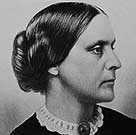
Susan B. Anthony and her three sisters entered a voter registration office set up in a barbershop.  They were part of a group of fifty women Anthony had organized to register in her home town of Rochester.  Anthony walked directly to the election inspectors and, as one of the inspectors would later testify, “demanded that we register them as voters.”
The election inspectors refused, but she persisted, quoting the Fourteenth Amendment’s citizenship provision and the article from the New York Constitution pertaining to voting, which contained no sex qualification. She persisted: “If you refuse us our rights as citizens, I will bring charges against you in Criminal Court and I will sue each of you personally for large, exemplary damages!”
The inspectors sought the advice of the Supervisor of elections: “Young men,” he said, “do you know the penalty of law if you refuse to register these names?” Registering the women, the registrars were advised, “would put the entire onus of the affair on them.” The inspectors voted to allow Anthony and her three sisters to register.   In all, fourteen Rochester women successfully registered that day. But the Rochester Union and Advertiser editorialized: “Citizenship no more carries the right to vote that it carries the power to fly to the moon . . . if these women in the Eighth Ward offer to vote, they should be challenged, and if they take the oaths and the Inspectors receive and deposit their ballots, they should all be prosecuted to the full extent of the law.”
November 1, 1929
Australia abolished peace-time compulsory military training.
November 1, 1954
A war of independence to end French colonial rule over the north African nation of Algeria began when 60 bombs were set off on this day in Algiers, the capital. Over the next eight years 1.5 million Algerians would die, along with about 30,000 French. The French had dominated the country since 1830.

French troops clash with Algerian civilians 
Read more 
November 1, 1954
The U.S. produced the biggest ever man-made explosion in the Pacific archipelago of Bikini, part of the Marshall Islands. The hydrogen bomb, equivalent of 20 million tons of TNT was up to 1,000 times more powerful than the atomic bomb that destroyed Hiroshima.
It overwhelmed the measuring instruments, indicating that the bomb was much more powerful than scientists had anticipated. One of the atolls was totally vaporized, disappearing into a gigantic mushroom cloud that spread at least 100 miles wide, dropping back to the sea in the form of radioactive fallout.
November 1, 1961
50,000-100,000 women joined protests against the resumption of atmospheric nuclear tests by both the U.S. and the Soviet Union. The demonstrations, in at least 60 U.S. cities, led to the founding of Women Strike for Peace. Their slogan: “End the Arms Race – Not the Human Race.”
See Photos from Swarthmore College Peace Collection 
 
“Women’s Strike for Peace” storming the Pentagon in a 1967 protest against the war in Vietnam.

Bella Abzug demonstrating with WSP
photo: Dorothy Marder
November 1, 1970
Detroit’s Common Council voted for immediate withdrawal of U.S. armed forces from Vietnam.
November 1, 1983
A senior State Department official, Jonathan T. Howe, told Secretary of State George P. Shultz about intelligence reports that showed Iraqi troops resorting to “almost daily use of CW [chemical weapons]” against the Iranians.

Saddam Hussein had invaded Iran in 1980.


But the Reagan administration had already committed itself to a large-scale diplomatic and political overture to Baghdad, culminating in several visits by the president’s recently appointed special envoy to the Middle East, Donald H. Rumsfeld.
November 1, 1990
As part of the adoption of the International Law of the Sea, forty-three nations agreed to ban dumping industrial wastes at sea by 1995. Neither the U.S. nor Canada (along with Albania, Burundi, Ethiopia, Uzbekistan and San Marino) have ever ratified the treaty which thus lacks the force of U.S. federal law.
More on the Law of the Sea 
November 1, 2003
The Tel Aviv memorial for Israeli leader Yitzhak Rabin, slain eight years previously, was transformed into a peace rally with over 100,000 protesting the military policies of Prime Minister Ariel Sharon.”Yitzhak was right, and his path just,” said Shimon Peres, the former prime minister and architect of the Oslo peace accords with Mr Rabin. “His views today are clear and enduring. There will be no retreat; we will continue.”

Read more

https://www.peacebuttons.info/E-News/peacehistorynovember.htm#november1

Peace & Justice History for 10/31:

October 31, 1929
George Henry Evans, an English-born printer and journalist, published the first issue of the Working Man’s Advocate, “edited by a Mechanic” for the “useful and industrious classes” of New York City. Evan covered the Workingmen’s Party (which he helped found) and the early trade union movement.
In his Prospectus, Evans focused on the inequities between the “portion of society living in luxury and idleness” and those “groaning under the oppressions and miseries imposed on them.” He advocated “a system of education which shall be equally open to all, as in a real republic it should be” and opposed “every thing which savors of a union of church and state.”
Evans became a U.S. citizen one week later.
October 31, 1950

Earl Lloyd became the first of three African Americans who began to play in the National Basketball Association (NBA) when he started with the Washington Capitols. He and Jim Tucker went on to become the first African Americans to play on a championship team in 1955 as members of the Syracuse Nationals, which is now the Philadelphia 76ers.

After retiring as a player, Lloyd was a Detroit Pistons assistant coach for two seasons, and a scout for five.
October 31, 1952
The U.S. successfully detonated “Mike,” the world’s first hydrogen (or fusion) bomb, in the atmosphere at the Eniwetok Proving Grounds on the Elugelab Atoll, part of the Marshall Islands in the southern Pacific.
The 10.4-megaton device was the first thermonuclear device built upon the Teller-Ulam principles of staged radiation implosion.

Mike’s Mushroom cloud

The incredible explosive force of Mike was apparent from the sheer magnitude of its mushroom cloud – within 90 seconds the mushroom cloud climbed to 57,000 feet and entered the stratosphere at a rate of 400 mph. One minute later it reached 108,000 feet, eventually stabilizing at a ceiling of 120,000 feet. Half an hour after the test, the mushroom stretched sixty miles across, with the base of the head joining the stem at 45,000 feet.The explosion wiped Elugelab off the face of the planet, leaving a crater more than 50 meters (175 feet) deep, and destroyed life on the surrounding islands.
The details and the results 
Early U.S.nuclear tests 
October 31, 1958
The U.S., the U.S.S.R. (Union of Soviet Socialist Republics aka Soviet Union) and Great Britain began negotiations in Geneva on whether to let the nuclear testing moratorium become a permanent test ban. General Secretary Nikita Kruschev had unilaterally declared a moratorium on Soviet testing earlier in the year, President Dwight Eisenhower and Prime Minister Harold MacMillan following suit in August.
There had been growing concern over the health effects of radioactive fallout in the atmosphere from the nuclear explosions. Nonetheless, all three nations did further last-minute tests before the moratorium took effect.
October 31, 1972
20-POINT POSITION PAPER

PREAMBLE
AN INDIAN MANIFESTO FOR RESTITUTION, REPARATIONS, RESTORATION OF LANDS FOR A RECONSTRUCTION OF AN INDIAN FUTURE IN AMERICA
THE TRAIL OF BROKEN TREATIES:


“We need not give another recitation of past complaints nor engage in redundant dialogue of discontent.  Our conditions and their cause for being should perhaps be best known by those who have written the record of America’s action against Indian people.  In 1832, Black Hawk correctly observed: You know the cause of our making war. It is known to all white men. They ought to be ashamed of it.
The government of the United States knows the reasons for our going to its capital city.  Unfortunately, they don’t know how to greet us. We go because America has been only too ready to express shame, and suffer none from the expression – while remaining wholly unwilling to change to allow life for Indian people.
We seek a new American majority – a majority that is not content merely to confirm itself by superiority in numbers, but which by conscience is committed toward prevailing upon the public will in ceasing wrongs and in doing right.  For our part, in words and deeds of coming days, we propose to produce a rational, reasoned manifesto for construction of an Indian future in America.  If America has maintained faith with its original spirit, or may recognize it now, we should not be denied.”
October 31, 1978
30,000 Iranian oil workers went on strike against the repressive rule of the U.S.-installed Shah and for democracy, civil and human rights.
Striking Iranian oil workers. Photo: December 1978 issue of Resistance. A publication of the Iranian Students Association in the U.S. (ISAUS)
Read more 
October 31, 1984
Indian Prime Minister Indira Gandhi was shot to death by two Sikh members of her own security guard while walking in the garden of her New Delhi home. Gandhi’s son, Rajiv, a member of parliament and a leader in the Congress-I Party, was sworn in as Prime Minister following the assassination.

https://www.peacebuttons.info/E-News/peacehistoryoctober.htm#october31

Peace & Justice History for 10/29:

October 29, 1940
The first national lottery for drafting young men (21-35) was held after passage of the first compulsory peacetime draft in United States. At the time the U.S. Army was smaller than that of Poland.
What it was like
Recommended: Washington Goes to War by David Brinkley
October 29, 1966
National Organization for Women (NOW) was founded in Washington, D.C. The 30 attendees at that first meeting elected Betty Friedan, author of The Feminine Mystique, as NOW’s first president.

Read about NOW 
October 29, 1969
anti ROTC demo
One hundred demonstrators disrupted the University of Buffalo’s ROTC (Reserve Officer Training Corps) with “nonviolent ridicule.” The urgency of opposition to the Vietnam War made many military-related activities targets of anti-war activity that had previously seemed otherwise legitimate.
October 29, 1969
U.S. Federal Judge Julius Hoffman ordered a defendant in the courtroom gagged and chained to a chair during his trial after he repeatedly asserted his right to an attorney of his own choosing or to defend himself.
The defendant, Black Panther Party leader Bobby Seale, and seven others had been charged with conspiring to cross state lines

Bobby Seale
“with the intent to incite, organize, promote, encourage, participate in, and carry out a riot” by organizing the anti-war demonstrations in Chicago during the 1968 Democratic National Convention.
Chicago 10 by Brett Morgen, an animated film about the trial
watch trailer
The Chicago Eight included Seale, David Dellinger, Rennie Davis, Thomas Hayden, Abbie Hoffman, Jerry Rubin, Lee Weiner, and John Froines.
October 29, 1975
In “Alice Doesn’t Day,” tens of thousands of women in cities across the US took to the streets to demand equality. Defying mounted police, 50,000 marched down New York City’s 5th Avenue. Dutch women marched on the U.S. embassy in Amsterdam to show their support, while French feminists demonstrated at the Arc de Triomphe, carrying a banner that read: “More Unknown Than the Unknown Soldier: His Wife.”

More about Alice Doesn’t Day 
October 29, 1983
Because the U.S. planned to site 48 nuclear-tipped cruise missiles in their country, over 500,000 Dutch took part in a rally in the Netherlands’ capital city, The Hague. The numbers at the protest were swelled by anger over the U.S. invasion of Grenada, a small Caribbean island, earlier in the week.

https://www.peacebuttons.info/E-News/peacehistoryoctober.htm#october29

Peace & Justice History for 10/28:

Things it’s important we remember, and things to Never Forget.

October 28, since 304
Catholics celebrate the feast of St. Fidelis of Como.  According to one legend, Fidelis deserted the Roman Army’s Theban Legion during Emperor Maximian’s persecution of Christians.  In another legend, he was assigned to guard Christian prisoners at Milan and secured freedom for five of them.
October 28, 1818
Abigail Adams, former First Lady of the United States, died. 
Many of her ideas, documented in her correspondance with her husband, John (later elected president), influenced the government of the United States.  She was politically active to the point where opponents referred to her as “Mrs. President” [see March 31, 1776]

Abigail Adams
More about Abigail Adams 
October 28, 1886

The Statue of Liberty, a gift of friendship from the people of France to the people of the United States, is dedicated in New York Harbor by President Grover Cleveland.
Originally known as “Liberty Enlightening the World,” the statue was proposed by the French historian Edouard de Laboulaye to commemorate the Franco-American alliance during the American Revolution. Designed by French sculptor Frederic-Auguste Bartholdi, the 151-foot statue was the form of a woman with an uplifted arm holding a torch.
In 1903, a bronze plaque mounted inside the pedestal’s lower level was inscribed with “The New Colossus,”a sonnet by American poet Emma Lazarus that welcomed immigrants to the United States with the declaration,“Give me your tired, your poor, / Your huddled masses yearning to breathe free,/ The wretched refuse of your teeming shore. / Send these, the homeless, tempest-tost to me. / I lift my lamp beside the golden door.” 
Read more 
October 28, since 1940
In Greece, Ohi Day (meaning Day of No) marks the refusal of Greece to submit to the Axis Powers.
October 28, 1950

Birth of Sihem Bensedrine, Tunisian human rights activist and journalist.  In 2008, she was awarded the Danish Peace Fund Prize for her commitment to democracy and the rule of law in the Arab world.
About Sinem Bensefrine  
October 28, 1962
Soviet leader Nikita Khrushchev announces the removal of Soviet missle bases in Cuba, ending the Cuban Missile Crisis.
October 28, 1984

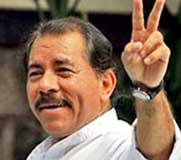
Sandinista Daniel Ortega won the general election for president of Nicaragua, and later attempted to make peace with the United States. 
The United States replied by continuing to support the Contras
.

https://www.peacebuttons.info/E-News/peacehistoryoctober.htm#october28

Peace & Justice History for 10/22:

October 22, 1963
200,000 students boycotted Chicago schools to protest
de facto segregation.

Why MLK Encouraged 225,000 Chicago Kids to Cut Class in 1963 
October 22, 1968
More than 300,000 protesters marked International Antiwar Day
in Japan.
The U.S. war in Vietnam and the ongoing (since the end of World War II) and massive American military presence on the Japanese island of Okinawa helped swell the ranks of the demonstrators; nearly 1400 were arrested.
October 22, 1979

The deposed Shah of Iran, Mohammed Reza Pahlavi, arrived in New York for medical treatment from Mexico. He received permission to do so from the U.S. government (which had installed him as shah in a 1954 coup) despite warning from the newly established Islamic republic in Iran demanding that the Shah be turned over to them for trial.
More on the Shah
October 22, 1983
Capping a week of protests, more than two million people in six European cities marched against U.S. deployment of Cruise and Pershing nuclear missiles: 1.2 million Germans, including 180,000 in Bonn; a 64-mile human chain between Stuttgart and New Ulm (and Hamburg, W. Berlin); 350,000 Rome; 100,000 Vienna; 25,000 Paris; 20,000 Stockholm; 4000 Dublin; plus 140 sites in U.S.
In London, the Campaign for Nuclear Disarmament (CND) held its biggest protest ever against nuclear missiles with an estimated one million people taking part.

Read more 

https://www.peacebuttons.info/E-News/peacehistoryoctober.htm#october22