Peace & Justice History for 10/6

(Peace History’s links were misdirected for a few days, but the links are back now.)

October 6, 1683
Thirteen Mennonite families from the German town of Krefeld arrived in Philadelphia on the ship Concord. Having endured religious warfare in Europe, the Mennonites were pacifists, similar to the Society of Friends (often known as Quakers) who opposed all forms of violence. The first Germans in North America, they established Germantown which still exists as part of Philadelphia.
Modern Mennonite peace activism: 
October 6, 1955
Poet Allen Ginsberg read his poem “Howl” for the first time at Six Gallery in San Francisco. The poem was an immediate success that rocked the Beat literary world and set the tone for confessional poetry of the 1960s and later.
“Howl and Other Poems” was printed in England, but its second edition was seized by customs officials as it entered the U.S. City Lights, a San Francisco bookstore, published the book itself to avoid customs problems, and storeowner (and poet) Lawrence Ferlinghetti was arrested and tried for obscenity, but defended by the American Civil Liberties Union (ACLU).


Working on Howl in San Francisco,
circa June, 1956
Following testimony from nine literary experts on the merits of the book, Ferlinghetti was found not guilty.

Lawrence Ferlinghetti outside City Lights 
More about City Lights 
Read Howl 
Read more about Allen Ginsberg 
 
October 6, 1976
An airliner, Cubana Airlines Flight 455, exploded in midair, killing 73 mostly young passengers including the entire Cuban youth fencing team. The plot was engineered by Orlando Bosch and Luis Posada Carriles, a Cuban former CIA agent, who was based in Venezuela at the time.

The Posada Carriles file from the National Security Archive 
October 6, 1978
346 protestors were arrested at the site of the proposed Black Fox Nuclear Power Plant in Inola, Oklahoma.
In 1973 Public Service of Oklahoma announced plans to build the Black Fox plant about 15 miles from Tulsa.
It was also near Carrie Barefoot Dickerson’s family farm. She became concerned as a nurse and a citizen about the potential health hazards.
Carrie Barefoot Dickerson
Through her group, Citizens’ Action for Safe Energy (CASE), and the consistent opposition of informed and persistent allies, the project was canceled in 1982. There are no nuclear plants in the state of Oklahoma, and no nuclear plant has been built in the U.S. since then.
Carrie Dickerson Foundation 
October 6, 1979

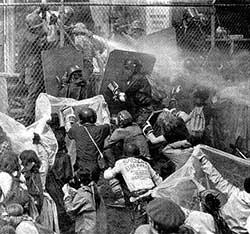
Seabrook Nuclear Power Plant protest – late 1970s
Over 1400 were arrested at Seabrook, New Hampshire, the construction site of two new nuclear power plants. The occupation was organized by the Clamshell Alliance.
Clamshell history 

https://www.peacebuttons.info/E-News/peacehistoryoctober.htm#october6

Peace & Justice History for 9/27:

September 27, 1962
Rachel Carson’s book indicting the pesticide industry, Silent Spring, was published.

The scientist (17 years with the U.S. Fish and Wildlife Service) and writer demonstrated the connection between the excessive and ubiquitous use of DDT and its long-term effect on plants and animals.

Rachel Carson at work c. 1936
The impact of her book proved seminal to a new ecological awareness. But even 30 years later, Carson was denounced for “preservationist hysteria” and “bad science.” But she had said when the book was published: “We do not ask that all chemicals be abandoned. We ask moderation. We ask the use of other methods less harmful to our environment. Rachel Carson, her Silent Spring and its impact
 September 27, 1967
An advertisement headed “A Call To Resist Illegitimate Authority,” signed by over 320 influential people (professors, writers, ministers, and other professional people), appeared in the New Republic and the New York Review of Books, asking for funds to help youths resist the draft.
September 27, 1990
The last U.S. Pershing II tactical nuclear missiles were removed from Germany, fewer than ten years after their installation provoked a massive anti-nuclear movement across Europe.The range and accuracy of the Pershing II pushed the Soviet Union to negotiate the Treaty on Intermediate Range Nuclear Forces (INF) which completely eliminated all nuclear-armed ground-launched ballistic and cruise missiles with ranges between 500 and 5,500 kilometers (about 300 to 3400 miles) and their infrastructure.
The INF Treaty was the first nuclear arms control agreement to actually reduce nuclear arms, and the signatories destroyed almost 2700 nuclear weapons (including 234 Pershing II) by May of 1991.
September 27, 1991
President George H.W. Bush announced a major unilateral withdrawal of U.S. tactical nuclear weapons:
“I am . . . directing that the United States eliminate its entire worldwide inventory of ground-launched short-range, that is, theater, nuclear weapons. We will bring home and destroy all of our nuclear artillery shells and short-range ballistic missile warheads. We will, of course, insure that we preserve an effective air-delivered nuclear capability in Europe.
“In turn, I have asked the Soviets . . . to destroy their entire inventory of ground-launched theater nuclear weapons . . . .
“Recognizing further the major changes in the international military landscape, the United States will withdraw all tactical nuclear weapons from its surface ships, attack submarines, as well as those nuclear weapons associated with our land-based naval aircraft. This means removing all nuclear Tomahawk cruise missiles from U.S. ships and submarines, as well as nuclear bombs aboard aircraft carriers.”

https://www.peacebuttons.info/E-News/peacehistoryseptember.htm#september27

Peace & Justice History for 9/23:

September 23, 1949
President Harry Truman announced that the Soviet Union had exploded its first atomic bomb, an implosive plutonium weapon, the previous month (it had happened on August 29). “We have evidence,” the White House statement said, “that within recent weeks an atomic explosion occurred in the U.S.S.R.”
September 23, 1979

200,000 attended an anti-nuclear rally in New York City’s Battery Park. It was the largest political protest of the late ’70s in the U.S., six months after the partial meltdown of the nuclear reactor at Three Mile Island, Pennsylvania. Two days earlier the ‘No Nukes’ concert, also known as the “Muse (Musicians United for Safe Energy) concert,” was held in Madison Square Garden, featuring Bruce Springsteen, Crosby Stills & Nash, Jackson Browne and others.
More about the concert, the record and the film 
September 23, 1982
Dr. Jane Goodall created Roots & Shoots Day of Peace in 1982 in honor of U.N. International Day of Peace; each year, Roots & Shoots Day of Peace is observed in late September. Roots & Shoots groups around the world fly Giant Peace Dove puppets to celebrate Roots & Shoots Day of Peace for its symbolic meaning. They also plan and implement peace project initiatives to help make the world a better place for animals, the environment and the human community.
Hear Jane Goodall on World Peace Day 
Dr. Goodall was appointed a Messenger of Peace in 2002 by U.N. Secretary-General Kofi Annan. People selected as Messengers of Peace are widely recognized for their achievements in music, literature, sports and the arts.To commemorate her appointment, Roots & Shoots members at the University of Wisconsin-Stevens Point first conceived of and created the Giant Peace Dove puppets. Since then, Roots & Shoots groups have flown doves in over 40 countries around the world.

https://www.peacebuttons.info/E-News/peacehistoryseptember.htm#september23