Peace & Justice History 12/15

December 15, 1791
The Bill of Rights became law when Virginia ratified the first 10 amendments to the United States Constitution.
Read The Bill of Rights 
The Bill of Rights Defense Committee  (emphasis mine -A. It’s an important site these days!)

December 15, 1930


Albert Einstein, 1930
Albert Einstein urged militant pacifism and the creation of an international war resistance fund. Einstein stated in New York that if two percent of those called for military service were to refuse to fight, and were to urge peaceful means of settling international conflicts, then governments would become powerless since they could not imprison that many people.
He struggled against compulsory military service and urged international protection of conscientious objectors. He concluded that peace, freedom for individuals, and security for societies depended on disarmament; otherwise, “slavery of the individual and the annihilation of civilization threaten us.”

Einstein on Peace and World Government 
December 15, 1946
Vietnamese leader Ho Chi Minh sent a note to French Premier Leon Blum congratulating him for his selection as French Premier and asking for peace talks. France had exercised colonial power over the Vietnamese as part of French Indochina, formed in October 1887 from the provinces of Annam, Tonkin, Cochin China, and the Kingdom of Cambodia; Laos was added in 1893. Vietnamese nationalists, however, had demanded independence for the three provinces at the end of World War II.
December 15, 1973

The American Psychiatric Association reversed its long-standing position and declared that homosexuality is not a mental illness and
“…deplores all public and private discrimination in such areas as employment, housing, public accommodation…”

Read the APA policy on discrimination against [gays]
December 15, 2000
The Chernobyl nuclear power plant was shut down 14 years after becoming the site of the world’s worst nuclear accident ever. Nearly nine tons of radioactive material – dozens of times as much as the Hiroshima and Nagasaki bombs – were released in the explosion.
The radioactive fallout affected 23% of Belarus, with 4.8% of Ukrainian territory and 0.5% of Russia. The Belarussian government spends 30% of its annual budget dealing with the aftermath of Chernobyl.

https://www.peacebuttons.info/E-News/peacehistorydecember.htm#december15

Peace & Justice History for 10/6

(Peace History’s links were misdirected for a few days, but the links are back now.)

October 6, 1683
Thirteen Mennonite families from the German town of Krefeld arrived in Philadelphia on the ship Concord. Having endured religious warfare in Europe, the Mennonites were pacifists, similar to the Society of Friends (often known as Quakers) who opposed all forms of violence. The first Germans in North America, they established Germantown which still exists as part of Philadelphia.
Modern Mennonite peace activism: 
October 6, 1955
Poet Allen Ginsberg read his poem “Howl” for the first time at Six Gallery in San Francisco. The poem was an immediate success that rocked the Beat literary world and set the tone for confessional poetry of the 1960s and later.
“Howl and Other Poems” was printed in England, but its second edition was seized by customs officials as it entered the U.S. City Lights, a San Francisco bookstore, published the book itself to avoid customs problems, and storeowner (and poet) Lawrence Ferlinghetti was arrested and tried for obscenity, but defended by the American Civil Liberties Union (ACLU).


Working on Howl in San Francisco,
circa June, 1956
Following testimony from nine literary experts on the merits of the book, Ferlinghetti was found not guilty.

Lawrence Ferlinghetti outside City Lights 
More about City Lights 
Read Howl 
Read more about Allen Ginsberg 
 
October 6, 1976
An airliner, Cubana Airlines Flight 455, exploded in midair, killing 73 mostly young passengers including the entire Cuban youth fencing team. The plot was engineered by Orlando Bosch and Luis Posada Carriles, a Cuban former CIA agent, who was based in Venezuela at the time.

The Posada Carriles file from the National Security Archive 
October 6, 1978
346 protestors were arrested at the site of the proposed Black Fox Nuclear Power Plant in Inola, Oklahoma.
In 1973 Public Service of Oklahoma announced plans to build the Black Fox plant about 15 miles from Tulsa.
It was also near Carrie Barefoot Dickerson’s family farm. She became concerned as a nurse and a citizen about the potential health hazards.
Carrie Barefoot Dickerson
Through her group, Citizens’ Action for Safe Energy (CASE), and the consistent opposition of informed and persistent allies, the project was canceled in 1982. There are no nuclear plants in the state of Oklahoma, and no nuclear plant has been built in the U.S. since then.
Carrie Dickerson Foundation 
October 6, 1979

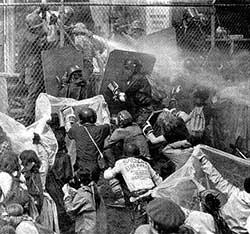
Seabrook Nuclear Power Plant protest – late 1970s
Over 1400 were arrested at Seabrook, New Hampshire, the construction site of two new nuclear power plants. The occupation was organized by the Clamshell Alliance.
Clamshell history 

https://www.peacebuttons.info/E-News/peacehistoryoctober.htm#october6