This Is A Thing In Which I Am Very Interested

I’ve even made plans, presuming some of this becomes legal in the next 10 years where I live. I have high hopes for sky burials and terramation, at least those are my 2 favorites.) I have links to more info, but this is good for some who maybe haven’t thought of this aspect of the circle of life.

Think Outside the Coffin: Green Burials Gain Popularity

Green burials have been gaining favor for nearly 30 years, offering an eco-friendly way to say goodbye.

Chi Sherman

As Ben Franklin once said, “In this world, nothing can be said to be certain except death and taxes.” While the subject of taxes may be unpleasant, conversations about death don’t have to be.

“Most families are close enough to know what their loved ones want, [but] a lot of people don’t learn about death care until a loved one dies,” says B. Milton, a retired death care industry professional in Indiana. End-of-life discussions can be uncomfortable to broach — a lot of people don’t pre-plan, according to Milton — but having direction for your post-life care allows for peace of mind, both emotionally and financially.

As most people know, conventional burials — those that include options like a viewing, a funeral service, and burial in a casket — can be very expensive. The national median cost of a funeral with a burial in 2023 was $8,300, according to the National Funeral Directors Association. Caskets alone can cost thousands of dollars. Of course, the sentiment is wonderful; there is a true gift in being able to choose a beautiful vessel as a loved one’s final resting place. A growing number of people, however, prefer to keep funeral costs lower and more eco-friendly with green burial options, including burial shrouds, terramation, and aquamation.

Burial Shrouds

“Green burials are in their infancy,” says Russ Burns, director of All Saints Cemetery and The Preserve, a natural burial site in Michigan. “In 20 to 30 years, they’ll be up there with traditional burials,” noting that customers interested in green burial are well-informed and concerned less about themselves post-mortem and more about how the area where they will be interred will remain green.
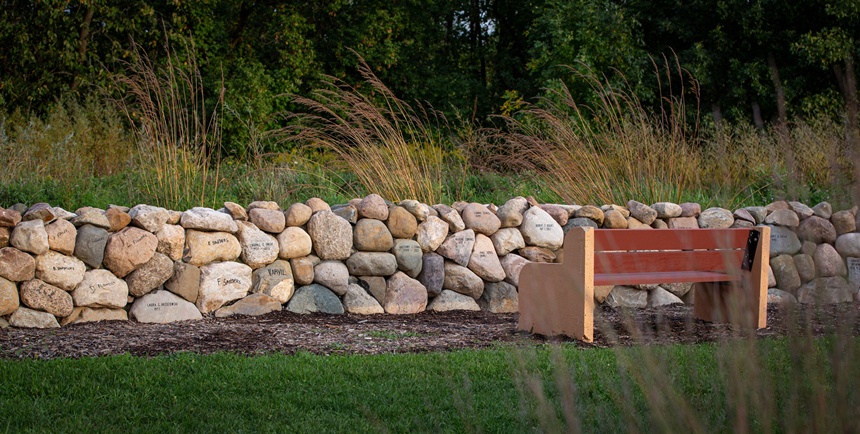
A cenotaph wall at The Preserve. The wall is a collection of rocks engraved with names of those buried on the property. It offers a physical place for family and friends to visit their loved ones as graves are inaccessible after the burial service. (Image courtesy of Mt. Elliott Cemeteries)

The use of a burial shroud is simple: The deceased is placed in a shroud made of a biodegradable material like canvas and committed to the earth about three feet underground. The shallower depth allows for more oxygen flow than the standard six-foot depth for coffins, which helps the body decompose and return to the soil. The process takes about a year and costs, at the lower end, around $1,800.

Burns cautions customers to do their research and make sure they work with an organization that is fully funded and has “more than good intentions.” Following burial, the land continues to require maintenance you would expect, like mowing and landscaping, but may also need an environmental impact study or a controlled burn to get rid of invasive plant species.

Terramation

Terramation, to put it simply, is human composting. If you’ve ever joked about having a green thumb, now you can have green everything and quite literally be turned into soil.

The first stage of terramation takes about a month. The deceased is placed in a vessel and covered in organic materials like straw, alfalfa, and wood chips. Families who attend the preparation of the body also known as a laying-in ceremony — sometimes bring garden clippings and assist in the process. The vessel is then closed and stored while microbes break the body down to roughly one cubic yard (or several hundred pounds) of soil. The material is examined for any remaining organic matter like bone or non-organic matter like surgical implants and then left to cure. Before being released to the family, the soil must pass safe compost regulations, including tests for the presence of arsenic or lead.

The process of composting people has only been around for about 10 years and is currently legal in 12 states, including Minnesota, Arizona, California, Colorado, New York, and Washington state. Cost can range from $5,000 to $7,000. In the video below, mortician and green death advocate Caitlin Doughty chats with Katrina Spade, the founder and CEO of Recompose, a green funeral home near Seattle that specializes in terramation.

(snip-some MORE)

https://www.saturdayeveningpost.com/2025/04/think-outside-the-coffin-green-burials-gain-popularity

May Day, Original Memorial Day, Emancipation Day, “Mission Accomplished” Day, and Much More, all 5/1 in Peace & Justice History

My annual May Day musical offering. Enjoy!

May 1, 1865
Memorial Day was started by former slaves in Charleston, South Carolina to honor 257 dead Union Soldiers who had been buried in a mass grave in a Confederate prison camp.
They dug up the bodies and worked for 2 weeks to give them a proper burial as gratitude for fighting for their freedom.
They then held a parade of 10,000 people led by 2,800 Black children where they marched, sang and celebrated.
 
More of the story 
May 1, 1886

May Day was called Emancipation Day in 1886 when 340,000 went on strike (though it was Saturday it was a regular day of work) in Chicago for the 8-hour workday.

May 1, 1890
May Day labor demonstrations spread to thirteen other countries; 30,000 marched in Chicago as the newly prominent American Federation of Labor threw its weight behind the 8-hour day campaign.
 
More May Day info 
May 1, 1933

Dorothy Day
The Catholic Worker newspaper was founded by Dorothy Day and Peter Maurin. Dorothy Day said, “God meant things to be much easier than we have made them,” and Peter Maurin wanted to build a society “where it is easier for people to be good.”

Peter Maurin

Read more about the Catholic Worker 
May 1, 1948

Senator Glen Hearst Taylor
Senator Glen Hearst Taylor (D-Idaho) was arrested in Birmingham, Alabama, for trying to enter a meeting through a door marked for “Negroes” rather than using the “whites only” door, and convicted of disorderly conduct.
Taylor was the Progressive Party candidate for Vice President, running mate of Henry Wallace. He was in Birmingham to address the Southern Negro Youth Congress.
May 1, 1965
Second Factory for Peace opened in Onllwyn, Dulais Valley, in south Wales, employing disabled miners. Tom McAlpine, active in the Committee for Nuclear Disarmament, and a supporter of cooperatives and industrial democracy, established Rowen Engineering in both Wales and Glasgow, Scotland.
May 1, 1966
500,000 Vietnamese marched for an end to the war dividing their country.
May 1, 1967
Soviet youths openly defied police and danced the twist in Moscow’s Red Square during May Day celebrations. In the early ‘60s the Twist had been banned in Buffalo, New York, and Tampa, Florida. The religious right claimed the Twist was actually a pagan fertility dance.

Are you old enough to remember Chubby Checker?
May 1, 1971
Five days of anti-war May Day protests began in Washington, D.C., resulting in over 14,000 arrests—the largest mass civil disobedience in U.S. history.
May 1, 1986
 
One million South Africans demonstrated their opposition to apartheid in a strike organized by the Congress of South African Trade Unions (COSATU)
COSATU: a brief history
May 1, 2003
President George W. Bush landed in a jet on the aircraft carrier USS Abraham Lincoln off the California coast and, in a speech to the nation, declared major combat in Iraq over. The banner his staff posted on the ship read, “Mission Accomplished.”

Since that presidential declaration more than 4500 American and allied troops and nearly 9000 members of Iraqi security and police forces (Jan. 2005 through July 2011) have lost their lives. In addition, tens of thousands (more than 32,000 Americans) injured in the hostilities.
The number of Iraqi civilian deaths is open to dispute, but minimally stands at well over 100,000.

Details of Iraq military casualties
 Civilian casualties 

https://www.peacebuttons.info/E-News/peacehistorymay.htm#may1

Two From Werd.io: About An EV, And More

 The $20,000 American-made electric pickup with no paint, no stereo, and no touchscreen

[Tim Stevens at The Verge]

It’s rare these days that I see a new product and think, this is really cool, but seriously, this is really cool:

“Meet the Slate Truck, a sub-$20,000 (after federal incentives) electric vehicle that enters production next year. It only seats two yet has a bed big enough to hold a sheet of plywood. It only does 150 miles on a charge, only comes in gray, and the only way to listen to music while driving is if you bring along your phone and a Bluetooth speaker. It is the bare minimum of what a modern car can be, and yet it’s taken three years of development to get to this point.”

So far, so bland, but it’s designed to be customized. So while it doesn’t itself come with a screen, or, you know, paint, you can add one yourself, wrap it in whatever color you want, and pick from a bunch of aftermarket devices to soup it up. It’s the IBM PC approach to electric vehicles instead of the highly-curated Apple approach. I’m into it, with one caveat: I want to hear more about how safe it is.

It sounds like that might be okay:

“Slate’s head of engineering, Eric Keipper, says they’re targeting a 5-Star Safety Rating from the federal government’s New Car Assessment Program. Slate is also aiming for a Top Safety Pick from the Insurance Institute for Highway Safety.”

I want more of this. EVs are often twice the price or more, keeping them out of reach of regular people. I’ve driven one for several years, and they’re genuinely better cars: more performant, easier to maintain, with a smaller environmental footprint. Bringing the price down while increasing the number of options feels like an exciting way to shake up the market, and exactly the kind of thing I’d want to buy into.

Of course, the proof of the pudding is in the eating – so let’s see what happens when it hits the road next year.

#Technology

[Link]

=====================

 Trump ‘Alarmists’ Were Right. We Should Say So.

[Toby Buckle at LiberalCurrents]

This resonates for me too.

About the Tea Party, the direction the Republican Party took during the Obama administration, and then of Trump first riding down the escalator to announce his candidacy:

“If you saw in any of this a threat to liberal democracy writ large, much less one that could actually succeed, you were looked at with the kind of caution usually reserved for the guy screaming about aliens on the subway.”

And yet, of course, it got a lot worse.

The proposal here is simple:

“I propose we promote a simple rule for these uncertain times: Those who saw the danger coming should be listened to, those who dismissed us should be dismissed. Which is to say that those of us who were right should actively highlight that fact as part of our argument for our perspective. People just starting to pay attention now will not have the bandwidth to parse a dozen frameworks, or work backwards through a decade of bitter tit-for-tat arguments. What they might ask—what would be very sensible and reasonable of them to ask—is who saw this coming?”

Because you could see it coming, and it was even easy to see, if you shook yourself out of a complacent view that America’s institutions were impermeable, that its ideals were real and enduring, and that there was no way to overcome the norms, checks, and balances that had been in place for generations.

What this piece doesn’t quite mention but is also worth talking about: there are communities for whom those norms, checks, and balances have never worked, and they were sounding the alarm more clearly than anyone else. They could see it. Of course they could see it. So it’s not just about listening to leftists and activists and people who have been considered to be on the political fringe, but also people of color, queer communities, and the historically oppressed. They know this all rather well.

#Democracy

[Link]

Gary Tyler and More in Peace & Justice History for 4/29

April 29, 1942
Exclusion Order No. 20 affected 660 people living in the area bounded by Sutter and California streets and Presidio and Van Ness Avenues in San Francisco. The Japanese Americans living in those neighborhoods were ordered to report to 2031 Bush St. for registration, and then, on this day, for removal to internment camps for the duration of the Second World War, and faced loss of their homes and businesses.
Presentation on what happened  (Check it out! Some of Dorothea Lange’s work.)
April 29, 1962
Nobel Prize-winner (for chemistry in 1954) Linus Pauling picketed the White House with others protesting the resumption of nuclear weapons testing. He had been invited there by President John Kennedy, to be honored at a dinner along with other Nobelists.

April 29, 1968

Peace message, Vanessa Redgrave, 1968 photo: Frank Habicht
Actress Vanessa Redgrave was among 826 British anti-nuclear protesters arrested during a London demonstration protesting the Vietnam War.
Film from the BBC and their take on the demonstration that day
April 29, 1970
U.S. and South Vietnamese troops invaded Cambodia and began a bombing campaign, known as Arclight, that widened the Vietnam War. They were after North Vietnamese and Vietcong troops and supplies that had been moved into Cambodia. By the time the bombing ceased in 1973, the U.S. had dropped more than half a million tons of ordnance on Cambodia, three and a half times that dropped on Japan in World War II.
Background on the Cambodia “incursion” 
April 29, 1992
Deadly rioting erupted in Los Angeles after an all-white jury in Simi Valley acquitted four Los Angeles police officers of almost all state charges in the beating of Rodney King, an African-American motorist who had been stopped for a traffic offense.Videotape of the abuse had been seen around the world. 17 other officers, who had been present and had not intervened, were never charged. The National Guard was called out to help restore civil order.
By the time schools were able to re-open on May 4, more than 50 had been killed, over 4000 injured, 12,000 people arrested, and $1 billion in property damage.


The Riot 
The trial  (The original link to the trial news on History.com is no longer present. This link will take you to more about the rioting. Again, noting the loss of the info, this time, also again, that an all white jury acquitted police of battery of a Black man.)
April 29, 2016
Gary Tyler was released from Angola penitentiary in Louisiana.
He was just 16 years old when charged with shooting a
white student in 1974.

Gary was wrongly convicted and sentenced to death by an all-white jury and became  the youngest person on death row.
His case sparked a movement to gain his release which persisted for 40 years.


FreeGaryTyler.com 
Read more about the case and the movement to free him
Listen/watch more about the case Democracy Now

https://www.peacebuttons.info/E-News/peacehistoryapril.htm#april29

Peace & Justice History for 4/28

April 28, 1915
The International Conference of Women for a Permanent Peace convened on this day in 1915 at The Hague in the Netherlands. More than 1,200 delegates from 12 countries—Britain, Germany, Austria-Hungary, Italy, Poland, Belgium and the United States—were all dedicated to the cause of peace and a resolution of the great international conflict that is now referred to as World War I.

The conference selected a delegation of women that spent May and June meeting with government officials of the belligerent nations to demand an end to the war.
Often called the Women’s Peace Congress, the meeting was the result of an invitation by a Dutch women’s suffrage organization, led by Aletta Jacobs, to women’s rights activists around the world. Jacobs believed that a peaceful international assemblage of women would “have its moral effect upon the belligerent countries,” as she put it.


Aletta Jacobs, Dutch suffragist and an organizer of the Women’s Peace Congress
This was the origin of the organization known today as the Women’s International League for Peace and Freedom.
 WILPF history  
April 28, 1965
U.S. troops landed in the Dominican Republic. In an effort to forestall what he claimed would be a “communist dictatorship” in the Dominican Republic, President Lyndon B. Johnson sent more than 22,000 U.S. troops to restore order on the island nation and to support the military junta.

U.S. troops in the Dominican Republic, 1965
Learn more about the history 
April 28, 1978

Demonstrators blocking the rail line into the Rocky Flats weapons facility
At the Rocky Flats nuclear weapons facility, near Denver, over 5,000 protested and nearly 300 were arrested over the following eight months for blocking railroad tracks entering the plant where plutonium bombs used as detonators in hydrogen bombs were produced.

Concert at the Rocky Flats demonstration in 1979
April 28, 1979
A few weeks after the Three Mile Island nuclear accident in Pennsylvania [see March 28, 1979], a crowd of close to 15,000 assembled at the Rocky Flats nuclear weapons production plant near Denver, Colorado. Singers Jackson Browne and Bonnie Raitt took the stage along with various speakers including Dr. Helen Caldicott. The following day, 286 protesters, including Pentagon Papers source Daniel Ellsberg, were arrested for trespassing in their civil disobedience at the Rocky Flats facility.
April 28, 1987
Benjamin Linder, a volunteer engineer from Seattle, was murdered in Nicaragua by the U.S.-sponsored insurgents known as the contras (characterized by then-President Ronald Reagan as “the moral equivalent of our founding fathers”). Linder had been working on a hydroelectric project in rural Nicaragua.
April 28, 1996
Sixty-one were arrested for dismantling railroad tracks leading out of the Gundremmingen nuclear power station in Bavaria, Germany.
April 28, 2004
The first photos of the Abu Ghraib prisoner abuse scandal were shown on CBS’s ”60 Minutes II.” The photos had been taken by U.S. military personnel responsible for detaining and interrogating Iraqi prisoners arrested following the U.S. invasion of Iraq.

Article by investigative journalist Seymour Hersh, who helped break the story

About Standard Operating Procedure, a new documentary by Erroll Morris on Abu Ghraib

https://www.peacebuttons.info/E-News/peacehistoryapril.htm#april28

Posting In Order To Comment-

Stop by here whenever you feel; there’ll be a light on, I bet! And I get what you’re saying, I believe. It does seem a good time to look around oneself locally, take stock, and be surrounded with the little things.

Peace & Justice History for 4/27

April 27, 1936
The UAW (United Automobile, Aerospace, and Agricultural Implement Workers of America), gained autonomy from the AFL (American Federation of Labor), becoming the first democratic, independent labor union concerned with the rights of unskilled and semi-skilled laborers.
April 27, 1937
The Social Security Administration began operation by making its first payment to an American protected under the law, principally the elderly, and children who’ve lost their parents. 
April 27, 1942
Sixteen pacifists, including Evan Thomas and A.J. Muste, refused to register for the World War II draft. Muste was a Quaker activist, founder of the Fellowship of Reconciliation, and author of two pamphlets that same year, War is the Enemy and Wage Peace Now.

A.J. Muste still working for peace 25 years later with Dorothy Day, leader of the Catholic Worker movement.
Read about War is the Enemy 
April 27, 1974
Ten thousand marched in Washington, D.C., calling for impeachment of President Richard M. Nixon.
April 27, 1987
Central Intelligence Agency headquarters in Langley, Virginia, was blockaded by people protesting U.S. policies in Central America and Southern Africa. 700 were arrested.
April 27, 1989
Thousands of Chinese students took to the streets in Beijing to protest government policies and issued a call for greater democracy in the communist People’s Republic of China.
The protests grew until the Chinese government ruthlessly suppressed them in June during what came to be known as the Tiananmen Square Massacre. Ignoring government warnings of violent suppression of any mass demonstration, students from more than 40 universities began a march to Tiananmen this day.

The students were joined by workers, intellectuals, and civil servants and, by mid-May, more than a million people filled the square.
April 27, 1994

Nelson Mandela casting his first vote
South Africa held its first multiracial elections and chose anti-apartheid leader Nelson Mandela (with more than 62% of the vote) to head a new coalition government that included his African National Congress Party.
More on that historic election 

https://www.peacebuttons.info/E-News/peacehistoryapril.htm#april27

This Is Beautiful-

go see the entire post! 🐙

“Mighty Monarch”

Peace & Justice History For 4/26

April 26, 1954
The Geneva Conference began for the purpose of bringing to an end the conflicts in Korea and Indochina. This followed the defeat of the French in Vietnam at Dien Bien Phu. France had been trying to reassert colonial control over Indochina following World War II.
The conferees included Cambodia, France, Laos, the People’s Republic of China, the Democratic Republic of Vietnam, the Soviet Union, Vietnam, the U.S. and the United Kingdom.
As a result, Vietnam was temporarily partitioned pending elections on reunification to be held in 1956; those elections were never held.
April 26, 1966

Rodolfo “Corky” Gonzales
Rodolfo “Corky” Gonzales founded the Crusade for Justice, a Chicano activist group, in Denver, Colorado, and marked his departure from the Democratic Party. It was the beginning of a nationalist strategy for the attainment of Chicano civil rights.
Read more
video  Democracy Now
April 26, 1968
A national student strike against the Vietnam war enlisted as many as one million high school and college students across the U.S.
April 26, 1986
A major accident occurred at the Chernobyl nuclear power plant in the Ukraine near the border with Belarus, both then part of the Soviet Union (Union of Soviet Socialist Republics). An explosion and fire in the No. 4 reactor sent radioactivity into the atmosphere. Only after Swedish authorities reported the fallout over their country 1385 km away (860 miles), did Soviet authorities reluctantly admit that an accident had occurred.
During a fire that burned for 10 days, 190 tons of toxic materials were expelled into the atmosphere (3% of the reactor core). Winds blew 70% of the radioactive material into neighboring Belarus.


The explosion at Chernobyl was the world’s largest-scale nuclear accident. Approximately 134 power-station workers were exposed to extremely high doses of radiation directly after the accident. About 31 of these people died within 3 months. Another 25,000 “liquidators”—Soviet soldiers and firefighters who were involved in clean-up operations — have died since the incident of diseases such as lung cancer, leukemia, and cardiovascular disease.
400,000 were evacuated and over 2,000 towns and villages were bulldozed to the ground in areas considered permanently contaminated.
Deaths and illnesses directly attributable to radiation exposure continue.

“Chernobyl is a global environment event of a new kind. It is characterized by the presence of thousands of environmental refugees, long-term contamination of land, water and air, and possibly irreparable damage to ecosystems.”
– Christine K. Durbak, Chairwoman of the World Information Transfer, New York
Chernobyl for Kids
April 26, 1998

Bishop Juan Gerardi Conedera
Bishop Juan Gerardi Conedera, a leading human rights activist in Guatemala, was bludgeoned to death two days after a report he had compiled was made public. The report blamed the U.S.-backed Guatemalan military government and its agencies for atrocities committed during Guatemala’s 36-year civil war.
About Bishop Gerardi’s murder  (Democracy Now)

https://www.peacebuttons.info/E-News/peacehistoryapril.htm#april26