
Tag: Peace
I Declare World Peace! 🕊
Memorial Day actions in Peace & Justice History for 5/30
| May 30, 1868 Memorial Day, originally known as Decoration Day, was first observed some say [see May 1, 1865] when two women in Columbus, Mississippi, placed flowers on the graves of Civil War soldiers, both Confederate and Union. War widow Augusta Murdoch Sykes, one of the Columbus planners, pointed out that “after all, they are somebody’s sons.” It is now celebrated to honor all those who have died in America’s wars.  “The 30th day of May, 1868, is designated for the purpose of strewing with flowers, or otherwise decorating the graves of comrades who died in defense of their country….” -from an order from the Grand Army of the Republic ========================================================= May 30, 1937  1000 striking steel workers (and members of their families), on their way to picket at the Republic Steel plant in south Chicago where they were organizing a union, were stopped by the Chicago Police. In what became known as the “Memorial Day Massacre,” police shot and killed 10 fleeing workers, wounded 30 more, and beat 55 so badly they required hospitalization. More on the incident Watch a video of oral history with historic footage |
https://www.peacebuttons.info/E-News/peacehistorymay.htm#may30
Barbara Gittings, and More, in Peace & Justice History for 5/29
| May 29, 1932 In the depths of the Great Depression, the “Bonus Expeditionary Force,” a group of 1000 World War I veterans seeking to cash in their veterans’ bonus certificates, arrived in Washington, D.C. Though issued to the veterans in 1924, the certificates were not scheduled to be paid until 1945. By mid-June, the vets had set up a massive “Hooverville,” a contemporary term for an encampment of the homeless.  The St. Louis contingent of the Bonus Expeditionary Force is pictured here as it starts for Washington, D.C., in May 1932. One month later, other veteran groups made their way to the nation’s capital, swelling the Bonus Marchers to nearly 20,000 strong, most of them unemployed veterans in difficult financial straits. President Herbert Hoover ordered the Army to clear out the veterans when they resisted being evicted by Washington police. Infantry and cavalry supported by six tanks were dispatched with Chief of Staff General Douglas MacArthur in command. Major Dwight D. Eisenhower served as his liaison with Washington police and Major George Patton led the cavalry. This was a direct violation of the Posse Comitatus Act, which prohibits the armed forces’ being used against U.S. citizens. More on the Bonus Army |
May 29, 1965 In one of the first demonstrations promoting equal treatment of homosexuals, Jack Nichols, Barbara Gittings and others picketed in front of the White House. Her sign read, “Sexual preference is irrelevant to federal employment.” More about Barbara Gittings |
| May 29, 1986 The Christic Institute filed a lawsuit charging U.S. government complicity in an assassination bombing at La Penca, Nicaragua, and that the CIA had a role in smuggling cocaine into the U.S. to fund the Contras, an insurgent military force working to bring down the government of Nicaragua. Find out more about the Christic Institute |
https://www.peacebuttons.info/E-News/peacehistorymay.htm#may29
Options
I ran Harry Potter tours in Edinburgh – here’s why I’m stopping them for good
- May 28 Written by Fraser Horn

Fraser Horn is dropping Harry Potter tours from his roster (Dan Chiu-Lezeau)
The decision to drop Harry Potter tours in Edinburgh was not an easy one to make, but was necessary, says guide and Edinburgh Street Historians founder Fraser Horn, writing exclusively for PinkNews.
I was about 11 when I first got into Harry Potter, the kid looked a lot like me at the time.
My mum gave me a copy [of one of the books] and, like so many others, I felt the series captured the mood at the time: a sense of peril, mixed with optimism that the world could turn out OK if people stood up for what was right against what was wrong.
It was an instant classic of a kids book and that’s probably why so many millennials still hold such affection [for it] to this day. But we all grew after the series finished, some of us into decent people and others into cartoon villainy.
This is why today I’m announcing that following the success of the LGBTQ+ tour replacing Harry Potter, come July, the Harry Potter tour will not be coming back.
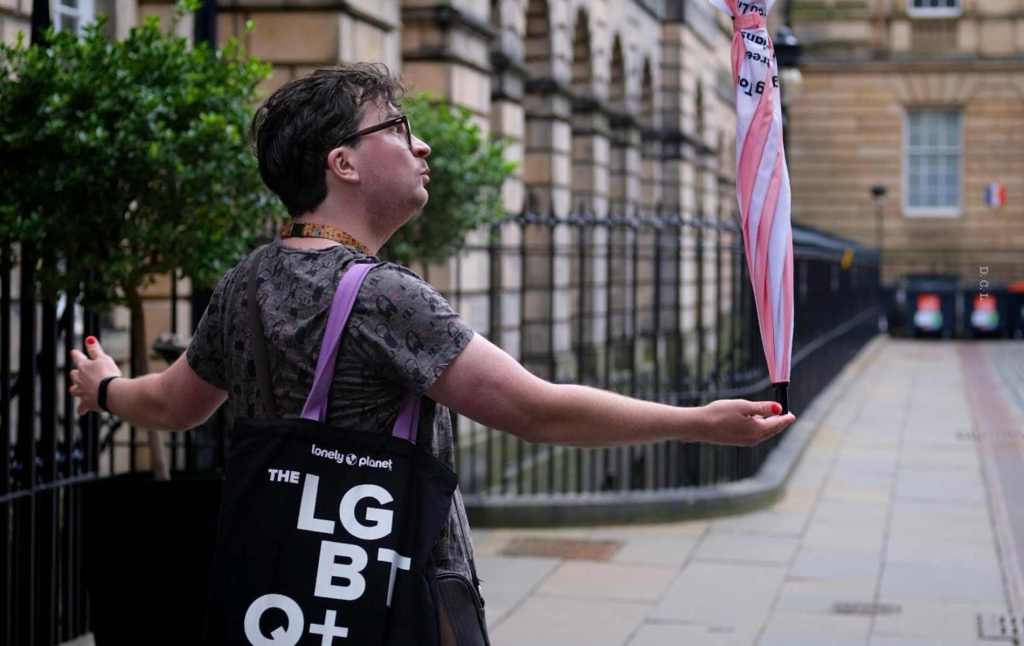
This decision was not made lightly. Although I wanted out of Potter ever since JK Rowling’s essay in 2020, the simple fact of the matter is that the story is so deeply ingrained in the Edinburgh tourism industry that it feels almost impossible to dislodge.
The connections between Edinburgh and Harry Potter very clearly involve Rowling, since it was [here] that the series was written. The films make demand stronger, bringing in a new audience, and repeat showings keep young people interested. With the new TV show, I expect Potter tourism to increase [here] and across the UK.
If any of those tourists are queer and want a tour that’s more important, they can book the LGBTQ+ one here.
I have been a guide since 2019 but went independent in February. Street Historians was a name that came from the idea that we would be like street magicians, but of history rather than magic. We’re fun, different and the best way to see Edinburgh, in my view.
The initial plan was to do a couple of tours – Edinburgh’s Old Town and Harry Potter – on a free/pay-what-you-want basis. I planned on doing this because I knew it worked. It was around March that I got in touch with LGBT Health and Wellbeing, a Scottish charity which focuses on supporting the health and wellbeing of LGBTQ+ adults. I wanted to discuss donating money from my Harry Potter profits to them but I also [said] I had offered an LGBTQ+ tour privately in the past.
They were particularly interested in the LGBTQ+ tour so I decided to run that every Friday at 6pm. It involves medical innovators, spies and [the] Aids [crisis], as well as how activists helped reshape society for the LGBTQ+ community. It is essential stuff.
I was motivated to drop Potter for Pride month because of the recent Supreme Court decision which will make our trans siblings unsafe. Rowling has confirmed she donated money to the organisation that advocated for the court decision and celebrated with a cigar picture on a boat, which made me want to drop Potter even more.

The response – both to the original LGBTQ tour and to replacing Potter with it – has been overwhelming.
People who have come on the LGBTQ+ tour love having an event which is a bit different from the standard fare, both in terms of walking tours and queer events. Guests have been making friends and these are the kind of life-long connections from which community is made. The decision to drop Potter for LGBTQ+ history has been a success and most have been positive about it.
However, some thought I was doing it for the wrong reason: rainbow capitalism, or purely to make money for Pride, before switching back to the Potter tours. It’s fair that the community might expect this sort of thing because as we’ve seen, companies change very quickly. A great example of this would be Barclays Bank, which has a very proud LGBTQ+ section. Then I read how they are banning trans people from using the toilets of their gender, based on the court ruling.
To reassure people, Potter will not be coming back to the Street Historians roster. We have been looking for more interesting stories to tell, for example on forgotten women.
Even with significant economic considerations, it seems necessary for me to drop Potter. The series may be a draw for other people but it is proving harder as time goes by to conjure up enthusiasm. Some may be upset, but I guess that’s the lesson I took from the sort of books I read growing up. We have to take a stand eventually or nothing will ever change.
Share your thoughts! Let us know in the comments below, and remember to keep the conversation respectful. (snip)
Women Fasted, Amnesty Int’l Founded, and Much More in Peace & Justice History for 5/28
May 28, 1892 The Sierra Club, America’s oldest, largest and most influential grassroots environmental organization, was organized in San Francisco with wilderness explorer John Muir as its first president. The organization’s initial effort was to defeat a proposed reduction in the boundaries of Yosemite National Park. Muir introduced President Theodore Roosevelt to Yosemite the following year, inspiring him during his presidency to establish the U.S. Forest Service, create 5 national parks, and sign the 1906 Antiquities Act, under which he proclaimed 18 national monuments. “Everybody needs beauty as well as bread, places to play in and pray in, where nature may heal and give strength to body and soul alike.” – John Muir, The Yosemite (1912)  John Muir The Sierra Club today |
May 28, 1961 Amnesty International (AI) was founded on this date in Great Britain. It is a worldwide movement of people who campaign for internationally recognized human rights, particularly as laid out in the United Nations Universal Declaration of Human Rights. Members of AI help maintain a media focus on political prisoners, and organize public pressure to afford them their legal rights and obtain their release. Visit Amnesty International Read the Universal Declaration of Human Rights: Amnesty International projects |
| May 28, 1963 Black and white civil rights advocates were attacked as they sat-in at a Woolworth’s lunch counter in Jackson, Mississippi. They were defying state laws against serving “colored” citizens at “whites-only” public facilities. According to John Salter, AKA Hunter Bear, one of those who sat in: “This was the most violently attacked sit-in during the 1960s and is the most publicized. A huge mob gathered, with open police support while the three of us sat there for three hours. I was attacked with fists, brass knuckles and the broken portions of glass sugar containers, and was burned with cigarettes. I’m covered with blood and we were all covered by salt, sugar, mustard, and various other things.”  Attacked for trying to eat at Woolworth’s (L to R): John Salter (Hunter Bear), Joan Trumpauer (now Mulholland), and Anne Moody. More photos and the story of the struggle against segregation Freedom Movement Bibliography |
| May 28, 1982 Seven women fasted for 10 days in Springfield, Illinois, in support of ratification of the Equal Rights Amendment by the Illinois state legislature. The amendment had already been ratified by 35 other states of the 38 required. |
| May 28, 1998 Pakistan exploded five underground nuclear devices in response to India’s most recent nuclear tests.  Since the British partitioned the subcontinent in 1947, there have been three wars between the two countries and numerous border clashes over the disputed Kashmir province. Kashmir had a majority (77%) Muslim population at the time of partition, but became part of predominantly Hindu (80%), though constitutionally secular, India.  Dr. Abdul Qadeer Khan, widely proclaimed as the ” Father of Pakistan’s atomic bomb,” stands in the access tunnel inside the Chagai Hills nuclear test site before Pakistan’s 28 May 1998 underground nuclear test. Read more |
https://www.peacebuttons.info/E-News/peacehistorymay.htm#may28
My Favorite Sport is Spelling Bees
Leave it to the Republicans to mess up sports. They don’t like anybody, and they don’t want anybody to be happy. The word in question is a word: it’s in the dictionary, is used by people, and it makes sense in a sentence. What a story! Peace and good spelling to all. ☮
How the word ‘womyn’ dragged the National Spelling Bee into the US culture wars
In an age of division where authoritarianism is seeping into every corner of American discourse, the Spelling Bee offers up a reminder of what America should truly be
Scott RemerTue 27 May 2025 05.00 EDTShare
We’re living through turbulent times, to say the least. Authoritarianism and fascism threaten the United States. The conspiracy thinking, paranoia and manufactured outrage so characteristic of QAnon and the big lie about the 2020 election have colonized our political discourse like a fungus. Even the National Spelling Bee, a cultural institution which will be celebrating its centennial this year and which is generally exempted from the far right’s paranoid vitriol, hasn’t been immune. Earlier this year, a foofaraw erupted when right-wing outlets reported on the acceptance of “womyn” as an alternate spelling of “women” in the regional-level wordlist which the National Spelling Bee issues each year.
The reason “womyn” was included in the wordlist wasn’t some shadowy feminist plot by the Bee’s organizers. The competition simply allows any word in the Merriam-Webster Unabridged dictionary, unless it is obsolete. “Womyn” is in the dictionary, along with tens of thousands of other words, such as “pointless”, “culture” and “war”.
With zero self-awareness, an anti-trans podcast host raged that the Bee’s uncontroversial decision to allow “womyn” was a manifestation of “fabricated issues” and “totally manufactured outrage.” On Fox News, she snarled, “How lucky are we to live in the United States of America, where the spelling of women, never mind the definition, has become a national debate.” Samantha Poetter-Parshall, a Kansas state representative, joined in the criticism, calling the inclusion of womyn an instance of “crazy indoctrination of our children.” A parent quoted in reportage on the faux scandal shared Poetter-Parshall’s concern, asserting, “This is supposed to be about spelling and language, not ideology.”
George Orwell, the author of Animal Farm, 1984, and the essay Politics and the English Language, would be startled to hear such a complaint. Orwell deeply understood the intimate relationship between language, thought, and politics. He keenly observed how “in our time, political speech and writing are largely the defense of the indefensible … Political language has to consist largely of euphemism, question-begging and sheer cloudy vagueness. Defenseless villages are bombarded from the air, the inhabitants driven out into the countryside, the cattle machine-gunned, the huts set on fire with incendiary bullets: this is called pacification. Millions of peasants are robbed of their farms and sent trudging along the roads with no more than they can carry: this is called transfer of population or rectification of frontiers. People are imprisoned for years without trial, or shot in the back of the neck or sent to die of scurvy in Arctic lumber camps: this is called elimination of unreliable elements.”
In our time, imprisoning and attempting to deport legal residents of the US for their political views and sending legal residents and gay people fleeing persecution in Venezuela – and potentially US citizens – to prisons in El Salvador where torture is widespread based on flimsy evidence from disgraced police officers is called “securing our homeland”. The announcement of economically ruinous tariffs which have wiped trillions off the stock market is called “liberation day.” Orwell believed that “to think clearly is a necessary first step towards political regeneration.” To combat the creep of Orwellian language, he argued that we should “recognize that the present political chaos is connected with the decay of language, and that one can probably bring about some improvement by starting at the verbal end,” aiming to always use “language as an instrument for expressing and not for concealing or preventing thought”.
In its emphasis on linguistic precision and its heartfelt delight in words, the National Spelling Bee is already political in Orwell’s sense. The Bee also has an implicit politics of appreciation for cultural and linguistic diversity. Though most spellers are American, the competition has an international flavor: it regularly features participants from Ghana, Canada, Jamaica, South Korea, China, and Nigeria, and spelling bees have sprung up in countries like Zimbabwe too. The welcome which the Bee extends to logophiles from all over the world inculcates in kids an appreciation of other cultures and promotes a cosmopolitan worldview. Spellers study words from Latin, French, Greek, Italian, Portuguese, Spanish and German; this cultivates their love of linguistic variety. What’s more, the fact that the South Asian community regularly dominates the upper echelons of the competition reaffirms the importance of immigration to our society.
These days, even if many Americans reject the Trump regime’s ugly attitudes and practices, xenophobia and racism are rampant, hearkening back to the bad old days of the Know-Nothing Party and the Chinese Exclusion Act. The US government has become increasingly hostile to international travelers: there have been a spate of horrific stories of tourists, visitors, and legal residents from Germany, Canada, France, the United Kingdom, Australia, and elsewhere who have done nothing wrong being arrested, detained, and held for weeks by Ice, or being refused entry to the US and deported. In such a context, the National Spelling Bee’s steadfast commitment to multiculturalism is all the more essential.
Despite its unfortunate Covid-induced cancellation in 2020 and some turbulence from rule changes and regional sponsor attrition in 2021 and 2022, the National Spelling Bee has been a relative constant for students in an age of extreme dislocation and upheaval. In these politically polarized times, it offers Americans an opportunity for joy and collective uplift. It celebrates education, attention, focus, dedication, and quiet, patient effort. It teaches students grit, discipline, and linguistics. It reminds us of the importance of the human in an age of AI. It reinforces the importance of good sportsmanship and fair play. It promotes respect and friendship towards humanity at large. It invites us to honor and remember the values that ought to unite us all. The National Spelling Bee is a reminder of what America has been – and what it must continue to be.
Scott Remer is a professional spelling bee tutor, freelance writer, and the author of the textbooks Words of Wisdom: Keys to Success in the Scripps National Spelling Bee, Sesquipedalia!: A Rigorous Vocabulary Study Guide, Regional Bee Ready!, and A Few Final Words of Wisdom.
“Blowin’ In The Wind”, And An Important SCOTUS Decision in Regard to Labor in Peace & Justice History for 5/27
| May 27, 1940 The U.S. Supreme Court ruled a sit-down strike was not a violation of the Sherman Anti-Trust Act even if it interfered with interstate commerce. The company had sued for treble damages (triple their financial loss) under the Act. The Court said that if the strike were found to be a restraint of trade, then “practically every strike in modern industry would be brought within the jurisdiction of the federal courts under the Sherman Act.” The American Federation of Full Fashioned Hosiery Workers under its president, William Leader, had declared a strike at Apex Hosiery Co. in Philadelphia, and had organized support among other workers in the city. When Apex refused to recognize the union, he declared a sit-down strike and led an occupation of the factory which lasted for seven weeks. Unlike the UAW sit-down at the GM plant in Flint, however, violence was committed against the management personnel and significant damage was done to manufacturing equipment. Summary and full text of the Supreme Court decision |
May 27, 1963 The record album, The Freewheelin’ Bob Dylan, which featured the song “Blowin’ in the Wind,” was released. The song warns of the perils of nuclear war.“ …how many times must the cannon balls fly Before they’re forever banned?” The song and the lyrics |
https://www.peacebuttons.info/E-News/peacehistorymay.htm#may27
The First US Witch Execution in 1647, and More in Peace & Justice History for 5/26
May 26, 1647 The first person in America was executed for the crime of witchcraft. Alse Young was arrested, tried in Windsor, Connecticut, and hanged at Meeting House Square in Hartford, the site of what is now the Old State House. There is no further record of Young’s trial or the specifics of the charge — only that she was a woman, as 80% of those executed for witchcraft were. The Salem witch trials would not begin for another 45 years. Some 300 years later the U.S. experienced another “witch hunt” as Senator Joe McCarthy and the House Un-American Activities Committee pursued communists. Arthur Miller makes this comparison in his famous play “The Crucible.” Read more about the play “The Crucible” The Guardian |
| May 26, 1937 United Auto Workers organizers and Ford Service Department men clashed in a violent confrontation on the Miller Road Overpass outside Gate 4 of the Ford River Rouge Plant in Dearborn, Michigan. It became known as “The Battle of the Overpass.” Henry Ford announced: “We’ll never recognize the United Automobile Workers Union or any other union.” Though General Motors and Chrysler signed collective bargaining agreements with the UAW in 1937, Ford held out until 1942. More background and photos Read more  T TThe Ford Servicemen (goons) approach Walter Reuther and Richard Frankensteen, third and second from right, and the other unionists.  UAW official Richard Frankensteen being beaten by Ford goons |
| May 26, 1946 A patent was filed in the U.S. for the H-Bomb, the hydrogen, or fusion-based, nuclear explosive device. |
May 26, 1969 John Lennon and Yoko Ono (along with her 5-year-old daughter Kyoko) held their second Bed-in for Peace at the Queen Elizabeth Hotel in Montreal, Quebec. A late-night rendition of “Give Peace a Chance,” recorded in the hotel room with their visitors singing and accompanying, reached No.14 on the Billboard pop music charts. John and Yoko meet cartoonist Al Capp in their hotel room |
| May 26, 1972 The Anti-Ballistic Missile (ABM) Treaty was signed by U.S. and U.S.S.R. (Union of Soviet Socialist Republics which included Russia and 15 other republics). The two countries agreed not to build defensive missile systems and thus to limit escalation of the nuclear arms race. It was reasoned that if either side deployed defensive missiles, the other would be forced to respond by increasing the number, explosive yield or effectiveness of their offensive nuclear weapons and delivery systems to maintain the balance of nuclear deterrence. Research and development of defensive systems was allowed under the ABM treaty, the U.S. having spent about $100 billion in the 20 years before the treaty was abrogated by President George W. Bush in the first months of his presidency. |
| May 26, 1991 20,000 Israeli Jews and Palestinians participated in a peace rally in Israel’s capital, Tel Aviv. |
https://www.peacebuttons.info/E-News/peacehistorymay.htm#may26
John T. Scopes Indicted This Date, + More in Peace & Justice History for 5/25
| May 25, 1774 A group of African slaves in Massachusetts Bay colony petitioned the British royal governor for freedom as their natural right: “. . . we have in common with all other men a natural right to our freedoms without Being depriv’d of them by our fellow men as we are a freeborn Pepel [people] and have never forfeited this Blessing by aney compact or agreement whatever.” |
| May 25, 1925 John T. Scopes was indicted for teaching Darwin’s theory of evolution. Scopes, a football coach and substitute high school biology teacher in Dayton, Tennessee, agreed to be arrested and put on trial for teaching evolution. He was challenging the legitimacy of a four-day-old state law barring Darwin’s theory from the public school curriculum.  The Scopes “Monkey Trial” ACLU |
May 25, 1948 Garry Davis, formerly a member of the U.S. military, renounced his American citizenship to become a Citizen of the World. Davis continued to promote “world citizenship” for over 50 years; 400,000 have, at one time or another, joined the movement. watch trailer “THE WORLD IS MY COUNTRY” Read more about Garry Davis NY Times |
| May 25, 1963 Leaders of 32 African nations met in Addis Ababa, Ethiopia, to set up the Organization of African Unity (OAU), giving them a united voice for the first time in the continent’s history. The primary aim of the OAU was to end European colonial control in the countries where it still existed at the time: Southern Rhodesia (now Zimbabwe), South Africa, Mozambique and Angola.  OAU flag Read more |
May 25, 1986 An estimated 7 million Americans participated in Hands Across America, forming a line across the country from Los Angeles to New York to raise public awareness of the issues of hunger and homelessness in the U.S. Participants paid ten dollars [almost $20 in 2009] to reserve their place in line; the proceeds were donated to local charities to feed the hungry and help the homeless. |
| May 25, 2003 Four activists, members of the Catholic Worker movement and known as “Riverside Ploughshares,” were arrested for pouring blood and hammering on the USS Philippine Sea’s Tomahawk cruise missile hatches. The ship was visiting New York City for the annual “Fleet Week.” “With hammers we have initiated the process of disarming this battle ship, of transforming this carrier of mass destruction into a vessel for peace…”  pouring blood and hammering.. Details of the Riverside Ploughshares action |
https://www.peacebuttons.info/E-News/peacehistorymay.htm#may25

