Peace & Justice History for 2/3

February 3, 1816
Paul Cuffee, a shipowner and a free negro (born to slave parents in Massachusetts), arrived in Sierra Leone with 38 African Americans intent on setting up a colony for free blacks from the United States. He had earlier set up the Friendly Society of Sierra Leone, a trading organization, to encourage commerce between England, the U.S. and the British colony on the Atlantic coast of Africa.
February 3, 1893
Abigail Ashbrook of Willingboro, New Jersey, refused to pay taxes because she was denied the right to vote because she was a woman.
February 3, 1964
In New York City, more than 450,000 students, mostly black and Puerto Rican, comprising nearly half the citywide enrollment, boycotted the New York City schools to protest the system’s de facto segregation. The Parents’ Workshop for Equality, led by Reverend Milton Galamison, had proposed a plan to integrate the city’s schools but it was rejected by the school board. Freedom Schools were set up for the kids during the one-day direct action.
February 3, 1973
Three decades of armed conflict in Vietnam officially ended when a cease-fire agreement signed in Paris the previous month went into effect. Vietnam had endured almost uninterrupted hostility since 1945, when a war for independence from France was launched. A civil war between the northern and southern regions of the country began after the country was divided by the Geneva Convention in 1954 following France’s military defeat and troop withdrawal. American military “advisors” began arriving in 1955.
Between 1954 and 1975, 107,504 South Vietnamese government troops, approximately 1,000,000 North Vietnamese and National Liberation Front soldiers, and 58,209 American troops died in combat. The number of Vietnamese civilian deaths is unknown, estimated between one and four million killed, and millions
more wounded or affected by defoliants such as Agent Orange.
February 3, 1973
President Richard Nixon signed the Endangered Species Act, intended to avoid species extinction, especially through loss of habitat.
February 3, 1988
The U.S. House of Representatives rejected President Ronald Reagan’s request for at least $36.25 million in aid to the Nicaraguan Contras, an insurgent group trying violently to overthrow the Sandinista government.
February 3, 1994
President Bill Clinton lifted the trade embargo against Vietnam, which had been in place since the end of the Vietnam war.

https://www.peacebuttons.info/E-News/peacehistoryfebruary.htm#february3

Feb. 2d Traditions-What Is Yours?

Please tell us about yours, or what you wish it was, or anything else, in the comments!

Arlo and Janis by Jimmy Johnson for February 02, 2025

Arlo and Janis Comic Strip for February 02, 2025

https://www.gocomics.com/arloandjanis/2025/02/02

Literally Watching Again In Real Time, Peace & Justice History For 2/2

February 2, 1779
Anthony Benezet and John Woolman, both prominent Quakers (Society of Friends), urged refusal to pay taxes used for arming against Indians in Pennsylvania. Since William Penn established the state two generations earlier, the Friends had dealt with the Indian tribes nonviolently, and had been treated likewise by the native Americans. Benezet and the Quakers were also early and consistent opponents of slavery.

More about Anthony Benezet 
February 2, 1848
The Treaty of Guadalupe Hidalgo was signed in the Mexican city of the same name, ending the Mexican War. In 1845 Congress had voted to annex Texas, and President James K. Polk sent General Zachary Taylor and troops to patrol the border, newly defined by Congress as the Rio Grande, though it previously had been the Nueces River.
Following an encounter between Mexican and U.S. troops, Polk called for Congress to declare war on Mexico. General Winfield Scott and troops eventually seized Mexico City.The treaty’s provisions called for Mexico to cede 55% of its territory (present-day California, Nevada and Utah, New Mexico, most of Arizona,
and portions of New Mexico, Wyoming and Colorado), and to recognize the Rio Grande as the southern border of Texas, in exchange for fifteen million dollars in compensation for war-related damage to Mexican property. According to the treaty, U.S. citizenship was offered to any Mexicans living in the 500,000 sq miles (1.3 million sq km) of new U.S. territory.


Land ceded to the U.S. after the Mexican War.
The Treaty of Guadalupe Hidalgo 
February 2, 1931
The first of well over 400,000 Mexican-Americans from across the country, some of them citizens and many of them U.S. residents for as long as 40 years, were “repatriated” as Los Angeles Chicanos were forcibly deported to Mexico.
More on those deported, Los Repatriados
February 2, 1932
The Conference on the Reduction and Limitation of Arms, the world’s first disarmament meeting, opened in Geneva, Switzerland. Sponsored by the League of Nations, and attended by delegates from 60 nations, no agreement was reached. The U.S. delegation called for the abolition of all offensive weapons as the basis for negotiations but found little support.
February 2, 1966 
The first burning of Australian military conscription papers as a protest against the Vietnam War occurred in Sydney, Australia.
February 2, 1970

Bertrand Russell later in life
Bertrand Russell, mathematician, Nobel laureate in literature and philosopher of peace, died in Penryndeudreaeth, Merioneth, in Wales at age 97.

Bertrand Russell at age 10
“Patriots always talk of dying for their country but never of killing for their country.”
— Bertrand Russell  
More of Russell’s wisdom 
February 2, 1980
Reports surfaced that the FBI had conducted a sting operation targeting members of Congress. In what became known as ”Abscam,” members suspected of taking bribes were invited to meetings with FBI agents posing as Arab businessmen, offering $50,000 and $100,000 payments for special legislation.
Audio and video recordings of the meetings were made surreptitiously. Six members of the house were convicted of accepting bribes. Another member of the House and one senator were targeted but took no money.

 
FBI agents in Abscam sting operation
Actual FBI videotape of one attempted scam 
February 2, 1989

Soviet participation in the war in Afghanistan ended as Red Army troops withdrew from the capital city of Kabul. They left behind many of their arms for use by Afghan government forces. They were driven out principally by the insurgent mujahadin, armed through covert U.S. funding.
Read more 
“Charlie Wilson’s War” movie trailer 
February 2, 1990
South African President F.W. De Klerk unbanned (lifted the legal prohibition on) opposition parties: the African National Congress (ANC), the Pan-Africanist Congress and the South African Communist party were officially considered legal. He also announced the lifting of restrictions on the UDF, COSATU and thirty-three other anti-apartheid organizations, as well as the release of all political prisoners and the suspension of the death penalty. This was the result of his negotiations with the imprisoned Nelson Mandela, a leader of the ANC.
The ecstatic reaction to De Klerk’s beginning the end of apartheid on BBC video 

Yes, I believe it is worthwhile to challenge hate speech.

And this is a blog well worth following, though I don’t read there often enough.

Observing Black History Month, Because This Is The Fkn’ US, Dammit!

The Negro’s “America” by Frank Barbour Coffin 1870–1951

My country, ’tis of thee,
Sweet land of liberty,
     Would I could sing;
Its land of Pilgrim’s pride
Also where lynched men died
With such upon her tide,
     Freedom can’t reign.

My native country, thee
The world pronounce you free
     Thy name I love;
But when the lynchers rise
To slaughter human lives
Thou closest up thine eyes,
     Thy God’s above.

Let Negroes smell the breeze
So they can sing with ease
     Sweet freedom’s song;
Let justice reign supreme,
Let men be what they seem
Break up that lyncher’s screen,
     Lay down all wrong.

Our fathers’ God, to Thee,
Author of liberty,
     To Thee we sing;
How can our land be bright?
Can lynching be a light?
Protect us by thy might,
     Great God our king!

This poem is in the public domain. Published in Poem-a-Day on February 1, 2025, by the Academy of American Poets.

As always, click the title to get more about the poet and their work. Today’s background is especially poignant, and work the click.

Peace & Justice History for 2/1

February 1, 1960

Greensboro first day: Ezell A. Blair, Jr. (now Jibreel Khazan), Franklin E. McCain, Joseph A. McNeil, and David L. Richmond leave the Woolworth store after the first sit-in on February 1, 1960.

Four black college students sat down at the Woolworth’s lunch counter in Greensboro, North Carolina, and were refused service because of their race. To protest the segregation of the eating facilities, they remained and sat-in at the lunch counter until the store closed.
Four students returned the next day, and the same thing happened. Similar protests subsequently took place all over the South and in some northern communities.
By September 1961, more than 70,000 students, both white and black, had participated, with many arrested, during sit-ins.


On the second day of the Greensboro sit-in, Joseph A. McNeil and Franklin E. McCain are joined by William Smith and Clarence Henderson at the Woolworth lunch counter in Greensboro, North Carolina.

“Segregation makes me feel that I’m unwanted,” Joseph McNeil, one of the four, said later in an interview, “I don’t want my children exposed to it.”

Listen to Franklin McCain’s account of what happened 
February 1, 1961
On the first anniversary of the Greensboro sit-in, there were demonstrations all across the south, including a Nashville movie theater desegregation campaign (which sparked similar tactics in 10 other cities). Nine students were arrested at a lunch counter in Rock Hill, South Carolina, and chose to take 30 days hard labor on a road gang. The next week, four other students repeated the sit-in, also chose jail.
February 1, 1968

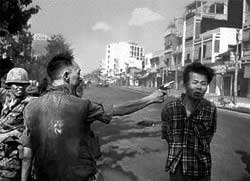
General Nguyen Ngoc Loan executes Nguyen Van Lem a NLF officer.

Saigon police chief Nguyen Ngoc Loan summarily executed Nguyen Van Lem, suspected leader of a National Liberation Front (NLF aka Viet Cong) assassination platoon, with a pistol shot to the head on the street. AP photojournalist Eddie Adams’s Pulitzer Prize-winning photograph of the incident became one of the most famous, ubiquitous and lasting images of the war in Vietnam, affecting international and American public opinion regarding the war.

https://www.peacebuttons.info/E-News/peacehistoryfebruary.htm#february1

“Extreme Habitat Specialist”

Right On!

Lard’s World Peace Tips by Keith Tutt and Daniel Saunders for January 30, 2025

Lard's World Peace Tips Comic Strip for January 30, 2025

https://www.gocomics.com/lards-world-peace-tips/2025/01/30

Peace & Justice History for 1/30

Longest. January. Ever. But it’s also Fred Korematsu Day-Woot!

January 30, 1948
Mohandas K. Gandhi was killed in Delhi by an assassin, a fellow Hindu, who fired three shots from a pistol at a range of three feet.
An American reporter who saw it happen
January 30, 1956
As Martin Luther King, Jr. stood at the pulpit, leading a mass meeting during the Montgomery, Alab
ama, bus boycott, his home was bombed. King’s wife and 10-week-old baby escaped unharmed. Later in the evening, as thousands of angry African Americans assembled on King’s lawn, he appeared on his front porch, and told them:
“If you have weapons, take them home . . . We cannot solve this problem through retaliatory violence . . . We must love our white brothers, no matter what they do to us.”

Martin Luther King, Jr. and wife Coretta Scott, 1960
January 30, 1968
The Tet (lunar new year) Offensive began as North Vietnamese and Viet Cong forces launched surprise attacks against major cities, provincial and district capitals in South Vietnam.
Though an attack had been anticipated, half of the South’s ARVN troops (Army of the Republic of Vietnam) were on leave because of the holiday. There were attacks in Saigon (the South’s capital) on the Independence Palace (the residence of the president), the radio station, the ARVN’s joint General Staff Compound, Tan Son Nhut airfield, and the United States embassy, causing considerable damage and throwing the city into turmoil.
January 30, 1972
In Londonderry (aka Derry), Northern Ireland, unarmed civil rights demonstrators were shot dead by British Army paratroopers in an event that became known as “Bloody Sunday.” The protesters, all Catholics, had been marching in protest of the British policy of internment without trial of suspected Irish nationalists.
British authorities had ordered the march banned, and sent troops to confront the demonstrators when it went ahead. The soldiers fired indiscriminately into the crowd of protesters, ultimately killing 14 and wounding 17. By the end of the year 323 civilians and 144 military and paramilitary personnel would be dead.


Mural: Bloody Sunday martyrs
Eyewitness accounts 
January 30, 2010

Thousands of protesters from across Japan marched in central Tokyo to protest the U.S. military presence on Okinawa.
Some 47,000 U.S. troops are stationed in Japan, with more than half on the southern island of Okinawa. Residents have complained for years about noise, pollution and crime around the bases.

News about the protest (This link is to the 2016 protest; P&J’s link for the 2010 protest links to Not Found.)
January 30, since 2011 Fred Korematsu Day

Fred Korematsu
Fred Korematsu, was born in Oakland, California, to a Japanese-American family. When World War II broke out Japanese-American citizens were subject to curfews and, following an executive order from Pres. Roosevelt,
were sent to internment camps. Fred Korematsu refused to go and was convicted and sent to a camp.

He challenged the constitutionality of Executive Order 9066 all the way to the Supreme Court. In 1944 the Supreme court ruled against him. Finally in 1983, a Federal court in San Francisco overturned the original conviction. In 1988 Congress passed legislation apologizing for the internments and awarded each survivor $20,000.
The “Fred Korematsu Day of Civil Liberties and the Constitution” is observed every January 30th and in an increasing number of states.

“Protest, but not with violence. Don’t be afraid to speak up. One person can make a difference, even if it takes 40 years…” – Fred Korematsu 
More about Fred Korematsu 

https://www.peacebuttons.info/E-News/peacehistoryjanuary.htm#january30

Pax Christi in Peace & Justice History for 1/29

January 29, 1996
Three Ploughshares activists, Lotta Kronlid, Andrea Needham and Joanna Wlson, caused millions in damage and were arrested in Warton, Lancashire, England, for disarming a British Aerospace F-16 fighter jet destined to be sold to Indonesia for use in its illegal occupation and genocide of the people of East Timor.
Seeds of Hope/East Timor Ploughshares activists >
Angie Zelter was arrested later for saying she planned to finish what the other three had started. The four were later acquitted of all charges on the grounds of preventing a greater crime.
Read more about this action Pax Christi’s history 

https://www.peacebuttons.info/E-News/peacehistoryjanuary.htm#january29