Putin doesn’t see Ukraine as a sociergn nation but as a puppet state of Russia’s that he can control. He doesn’t see them as having the right to determine their own future. Here is a quote from the article.
Putin signalled no movement in Russia’s long-held demands, which also include a veto on Kyiv’s desired membership in the NATO alliance.
————————————————————————————————————————
Source says Putin demands control of entire Donetsk region
Trump says Zelenskiy has ‘gotta make a deal’
Zelenskiy reported to have rejected demand
Zelenskiy to visit Trump on Monday with European back-up
Europeans say they will maintain or increase pressure on Russia
WASHINGTON/MOSCOW/KYIV, Aug 16 (Reuters) – U.S. President Donald Trump said on Saturday that Ukraine should make a deal to end the war with Russia because “Russia is a very big power, and they’re not”, after a summit where Vladimir Putin was reported to have demanded more Ukrainian land.
After the two leaders met in Alaska on Friday, Trump told Ukrainian President Volodymyr Zelenskiy that Putin had offered to freeze most front lines if Kyiv ceded all of Donetsk, the industrial region that is one of Moscow’s main targets, a source familiar with the matter said.
Zelenskiy rejected the demand, the source said. Russia already controls a fifth of Ukraine, including about three-quarters of Donetsk province, which it first entered in 2014.
Trump also said he agreed with Putin that a peace deal should be sought without the prior ceasefire that Ukraine and its European allies had demanded. That was a change from his position before the summit, when he said he would not be happy unless a ceasefire was agreed on.
“It was determined by all that the best way to end the horrific war between Russia and Ukraine is to go directly to a Peace Agreement, which would end the war, and not a mere Ceasefire Agreement, which often times do not hold up,” Trump posted on Truth Social.
Zelenskiy said Russia’s unwillingness to pause the fighting would complicate efforts to forge a lasting peace. “Stopping the killing is a key element of stopping the war,” he said on X.
Nevertheless, Zelenskiy said he would meet Trump in Washington on Monday.
That will evoke memories of a meeting in the White House Oval Office in February, where Trump and Vice President JD Vance gave Zelenskiy a brutal public dressing-down. Trump said a three-way meeting with Putin and Zelenskiy could follow.
Kyiv’s European allies welcomed Trump‘s efforts but vowed to back Ukraine and tighten sanctions on Russia. European leaders might join Monday’s White House meeting as well, German Foreign Minister Johann Wadephul said.
Russia launched a full-scale invasion of Ukraine in February 2022 and has been gradually advancing for months. The war – the deadliest in Europe for 80 years – has killed or wounded well over a million people from both sides, including thousands of mostly Ukrainian civilians, according to analysts.
RUSSIA LIKELY TO WELCOME TRUMP’S COMMENTS
Trump’s various comments on the three-hour meeting with Putin mostly aligned with the public positions of Moscow, which says a full settlement will be complex because positions are “diametrically opposed”.
Putin signalled no movement in Russia’s long-held demands, which also include a veto on Kyiv’s desired membership in the NATO alliance. He made no mention in public of meeting Zelenskiy. Kremlin aide Yuri Ushakov said a three-way summit had not been discussed.
In an interview with Fox News’ Sean Hannity, Trump signalled that he and Putin had discussed land transfers and security guarantees for Ukraine, and had “largely agreed”.
“I think we’re pretty close to a deal,” he said, adding: “Ukraine has to agree to it. Maybe they’ll say ‘no’.”
Asked what he would advise Zelenskiy to do, Trump said: “Gotta make a deal.”
“Look, Russia is a very big power, and they’re not,” he added.
Item 1 of 10 U.S. President Donald Trump looks on next to Russian President Vladimir Putin during a press conference following their meeting to negotiate an end to the war in Ukraine, at Joint Base Elmendorf-Richardson, in Anchorage, Alaska, U.S., August 15, 2025. REUTERS/Kevin Lamarque
[1/10]U.S. President Donald Trump looks on next to Russian President Vladimir Putin during a press conference following their meeting to negotiate an end to the war in Ukraine, at Joint Base Elmendorf-Richardson, in Anchorage, Alaska, U.S., August 15, 2025. REUTERS/Kevin Lamarque Purchase Licensing Rights, opens new tab
Graphic: Map of Ukraine shows the eastern oblasts and the areas under Russian control
NEED FOR SECURITY GUARANTEES FOR UKRAINE
Zelenskiy has consistently said he cannot concede territory without changes to Ukraine’s constitution, and Kyiv sees Donetsk’s “fortress cities” such as Sloviansk and Kramatorsk as a bulwark against further Russian advances.
Zelenskiy has also insisted on security guarantees to deter Russia from invading again. He said he and Trump had discussed “positive signals” on the U.S. taking part, and that Ukraine needed a lasting peace, not “just another pause” between Russian invasions.
Canadian Prime Minister Mark Carney welcomed what he described as Trump’s openness to providing security guarantees to Ukraine under a peace deal. He said security guarantees were “essential to any just and lasting peace.”
Putin, who has opposed involving foreign ground forces, said he agreed with Trump that Ukraine’s security must be “ensured”.
For Putin, just sitting down with Trump represented a victory. He had been ostracised by Western leaders since the start of the war, and just a week earlier had faced a threat of new sanctions from Trump.
‘1-0 FOR PUTIN’
Trump spoke to European leaders after returning to Washington. Several stressed the need to keep pressure on Russia.
British Prime Minister Keir Starmer said an end to the war was closer than ever, thanks to Trump, but said he would impose more sanctions on Russia if the war continues.
European leaders said in a statement that Ukraine must have “ironclad” security guarantees and no limits should be placed on its armed forces or right to seek NATO membership, as Russia has sought.
Some European commentators were scathing about the summit.
“Putin got his red carpet treatment with Trump, while Trump got nothing,” Wolfgang Ischinger, former German ambassador to Washington, posted on X.
Both Russia and Ukraine carried out overnight air attacks, a daily occurrence, while fighting raged on the front.
Trump told Fox he would postpone imposing tariffs on China for buying Russian oil, but he might have to “think about it” in two or three weeks.
He ended his remarks after the summit by telling Putin: “We’ll speak to you very soon and probably see you again very soon.”
“Next time in Moscow,” a smiling Putin responded in English.
Additional reporting by Kanishka Singh, Trevor Hunnicutt, Jeff Mason, Lidia Kelly, Jasper Ward, Costas Pitas, Ismail Shakil, Bhargav Acharya, Alan Charlish, Yuliia Dysa, Pavel Polityuk, Gwladys Fouche, Dave Graham, Paul Sandle, Joshua McElwee, Andreas Rinke, Felix Light and Moscow bureau; Writing by Andy Sullivan, Kevin Liffey, Mark Trevelyan, Joseph Ax and James Oliphant; Editing by Raju Gopalakrishnan, Gareth Jones and Cynthia Osterman
US taxpayers paid 10s of millions dollars by having the US Air Force escort Putin to and from Russia. Including the F-35 Presidential escorts for Air Force One. The Russian State media is laughing, having a propaganda field day. Putin came home as a victor
— Donbas Samizdat (Донбасс Самиздат) (@DonbasDIY) August 16, 2025
Russian state media is showing American soldiers on their knees for Putin. This was a massive Trump failure and a humiliating day for the United States pic.twitter.com/xqYyoQvWXu
Trump: "Vladimir Putin said something — one of the most interesting things. He said 'your election was rigged because you have mail in voting.' He said, 'mail in voting, every election — no country has mail in voting. It's impossible to have mail in voting and have honest… pic.twitter.com/glEXFHWp6u
Some examples of countries that use postal ballots include: Australia Austria Canada Czechia Denmark Finland France (for citizens abroad) Germany Greece Hungary India Indonesia Italy Malaysia Mexico Norway Philippines Singapore Spain Sweden (for citizens abroad) Switzerland United Kingdom United States (various states)
Tapper: So despite the fact that president Trump called this an extremely productive meeting.. there doesn't seem to have actually been anything achieved, at least according to what the two men just said pic.twitter.com/S1eQg4Plu8
Absolutely nothing of value was said or done in Alaska. All that happened was putin got the legitimacy he craves & then invited Trump to Moscow. Total joke pic.twitter.com/Zz63jGxt8Z
Putin invites Trump to Moscow. Putin says the war in Ukraine wouldn't have happened if Trump had been President. (It was ongoing when Trump became President). NOTHING Announced. Trump thanked him. Took no questions and both men walked off stage. pic.twitter.com/0NXU1uVS1Y
This is how an American president should treat Putin. No laughs, no fun handshakes, no casual conversation. You treat him like the war criminal that he is.
Neo-Nazis, the KKK and other hate groups are now routinely visiting Springfield, marching through city streets or distributing recruitment flyers and raising fears of intimidation and violence.
Over the weekend, the Blood Tribe — a violent Neo-Nazi hate group, according to the Southern Poverty Law Center (SPLC) — stood outside Springfield Mayor Rob Rue’s home waiving swastika flags. In a previous march through the city, some carried guns.
Also this weekend, an unidentified group stood outside Springfield city hall with a banner that said “Haitians Have No Home Here” in English and Haitian Creole.
These groups are responding to the growth of Springfield’s Haitian community, an issue that made the national spotlight following unsubstantiated rumors circulated on social media and parroted by politicians that Haitian immigrants were eating Springfield residents’ pets.
Since then, Springfield NAACP president Denise Williams says residents have also reported to her agency flyers being distributed in local neighborhoods from a group associated with the Ku Klux Klan.
“They’re trying to intimidate us. But we’re not a city that’s easily intimidated,” Williams said. “We need to stand together.”
The group, the Trinity White Knights, has a P.O. Box based in Kentucky. The Lexington Herald-Leader reported in September that similar flyers from the same group were distributed in Covington, Ky.
Springfield Police Chief Allison Elliott said the department is aware of the flyers.
Some residents have reported harassment from a group of people purporting to be members of the Proud Boys, which the SPLC designates as a hate group that believes in “Western chauvinism” and “an anti-white guilt agenda.”
Clark County Democratic Party chairman Austin Smith said a volunteer canvassing near the political party’s Springfield headquarters earlier this month was returning to the office to drop off campaign materials when a truck with large flags that appeared to say “Proud Boys” pulled up.
A group of men in the truck, the volunteer told Smith, made “vaguely threatening” statements.
“We’ve had threats and things pour into the office. No bomb threats, but ‘You better watch out.’ ‘We’re watching you.’ So that definitely created a lot of fear,” Smith said.
The party increased security measures for its recent meeting as a safety precaution, Smith said.
Members of the religious group Israel United in Christ (IUIC) were also in Springfield in September, gathering in multiple public places around the city.
The members, clad in purple shirts with the group’s name and logo, were seen marching and passing out literature to passersby.
At one point, group members gathered in the parking lot of Groceryland on South Limestone Street, near the corner of East John St. Members were preaching into a microphone about the organization’s teachings. Members also met with NAACP leaders from Dayton and Springfield.
According to its website, the IUIC is a Bible-based organization that believes people within the Black, Hispanic, and Native American communities represent “the true and historical descendants of the Biblical Israelites.”
SPLC categorizes IUIC as one of the handful of “Radical Hebrew Israelites” groups in the U.S. The SPLC designates these groups as hate groups. IUIC denies that it is a hate group, according to a post on the IUIC Classrooms Facebook page. The newspaper reached out to IUIC but did not hear back.
Williams said the Springfield NAACP chapter has plans to host a virtual community meeting to talk about recent activity in the city.
Springfield’s police chief asked residents to remain vigilant and “say something if you see something suspicious or out of the norm.”
“We know our city has looked a little different lately, and you also may notice an increased public safety presence. We assure you that our top priority has always been and will continue to be safety,” Elliott said. “Safety is a shared responsibility and our officers, along with our public safety partners, take all tips and information seriously.”
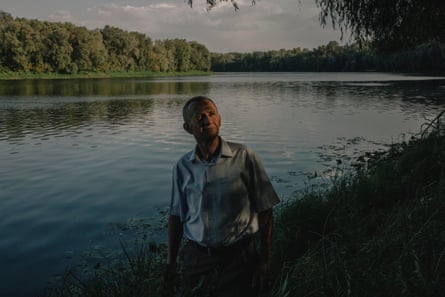
Serhiy Kraskov picked up a twig and poked at a small fish floating in the Desna River. “It’s a roach. It died recently. You can tell because its eyes are clear and not blurry,” he said. Hundreds of other fish had washed up nearby on the river’s green willow-fringed banks. A large pike lay in the mud. Nearby, in a patch of yellow lilies, was a motionless carp. “Everything is dead, starting from the tiniest minnow to the biggest catfish,” Kraskov added mournfully.
Kraskov is the mayor of the village of Slabyn, in Ukraine’s northern Chernihiv region. The rustic settlement – population 520 – escaped the worst of Russia’s 2022 full-scale invasion. But the war arrived last week in a new and horrible form. Ukrainian officials say the Russians deliberately poisoned the Seym River, which flows into the Desna. The Desna connects with a reservoir in the Kyiv region and a water supply used by millions.
Serhiy Kraskov, the mayor of the village of Slabyn, near the banks of the Desna River in northern Ukraine. Photograph: Alessio Mamo/The Guardian
A toxic slick was detected on 17 August coming from the Russian border village of Tyotkino. According to Kyiv, chemical waste from a sugar factory had been dumped in vast quantities into the Seym. It included ammonia, magnesium and other poisonous nitrates. At the time, fierce fighting was going on in the surrounding area. Ukraine’s armed forces had launched a surprise incursion into Russia and had seized territory in Kursk oblast.
The pollution crossed the international border just over a mile away and made its way into Ukraine’s Sumy region. The Seym’s natural ecosystem crashed. Fish, molluscs and crayfish were asphyxiated as oxygen levels fell to near zero. Settlements along the river reported mass die-offs. Kraskov got a call from the authorities warning him a disaster was coming his way. He spotted the first dead fish on 11 September. “There were a few of them in the middle of the river,” he said.
He returned the following weekend to find the Desna’s banks clogged with rotting fish, stretching out from the shore for three metres into the water. Volunteers wearing rubber boots, masks and protective gloves shovelled the fish into sacks. They found a metre-long catfish. “The stench was terrible. You could scarcely breathe. The river was quiet. Nothing moved apart from a few frogs,” Kraskov said. A tractor took the sacks to an abattoir that used to belong to the village’s Soviet-era collective farm. They were buried in a pit.
Serhiy Zhuk, the head of Chernihiv’s ecology inspectorate, described what had happened as an act of Russian ecocide. “The Desna was one of our cleanest rivers. It’s a very big catastrophe,” he said. Zhuk traced the slick’s route on a map pinned to his office wall: a looping multi-week journey along the Seym and Desna. “More than 650km is polluted. Not a single organism survived. This is unprecedented. It’s Europe’s first completely dead river,” he said. (snip-MORE)


 Scottie's Playtime