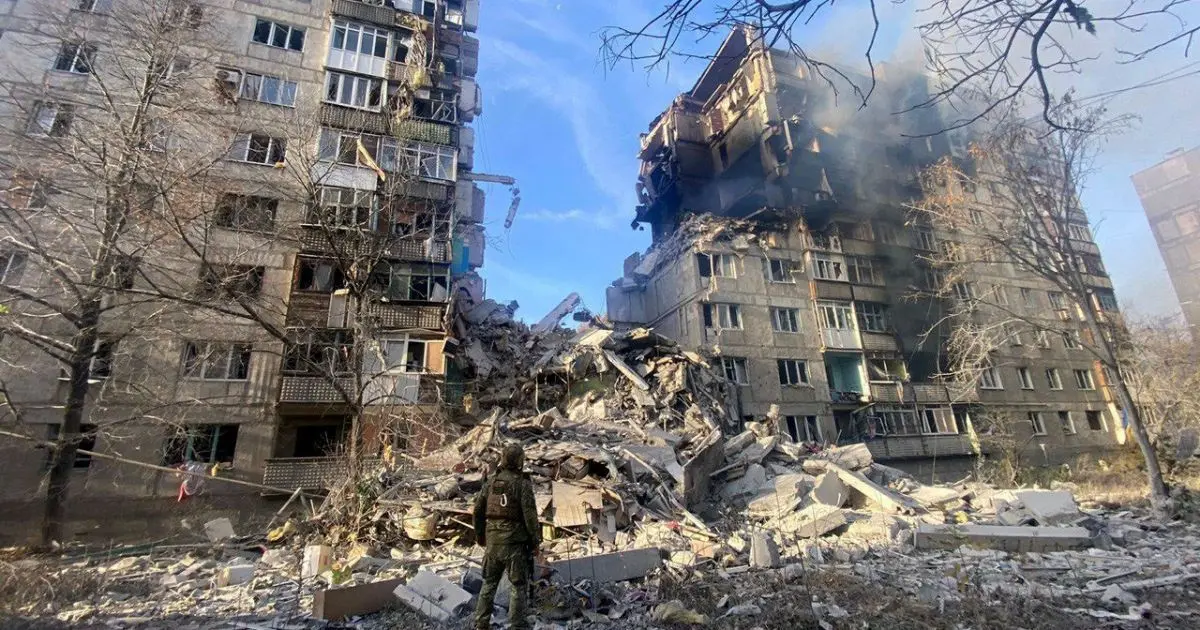
For far too long Ukraine has been restrained and forced to fight under different rules than Russia. While Russia constantly attacks civilians, apartments, schools, and hospitals, Ukraine was forbidden todo so inorder to get arms to defend itself. Ukraine was forbidden to hurt the Russians in similar ways. Leaving Ukraine to feel all the pain of the war while Russia doesn’t. Recently that has changed. Maybe if Ukraine is allowed to make the Russian public feel as afraid as the Ukrainians, they will tell their government enough. Hugs
Residents of a damaged Kyiv apartment building recovered what remained of their belongings as rescuers sifted through rubble for survivors, a day after a Russian attack killed at least 30 people in the deadliest strike on the city this year.
‘The Special Relationship only exists when the Americans want something,’ a former Downing Street aide observed after Donald Trump rejected the Chagos Islands deal. There are profound differences between London and Washington over military action against Iran while the fourth anniversary of the war in Ukraine this week has exposed further fault lines. The result is that Anglo-American relations are at their worst point since the general election.
Starmer’s team argues he should not be ousted at a time of huge international instability. But the reality of the Anglo-American relationship raises three questions. Where did things go wrong? Does the PM still have some kind of relationship with Trump? And would it matter if he were replaced by Angela Rayner, Wes Streeting or anyone else?
The PM apparently hates the way Trump calls him at random when he is with his family
During the first 18 months of his premiership, it became accepted, correctly I think, that one of the few areas where Starmer excelled was foreign affairs. He seemed particularly good at handling the often capricious President. But it is also true that the two great cleavages of recent weeks – Iran and Chagos – are intimately tied to Starmer’s personal fetish for subordinating the sovereignty of parliament to international law.
If the Prime Minister believes in anything, it is that the web of international treaties constructed to constrain rogue states after the second world war overrides domestic law. His appointment of Richard Hermer as his Attorney General was proof that this would form the backbone of his premiership.
Hermer’s numerous legal opinions flow from this belief in the primacy of international law: that Britain must not support an American attack on Tehran and must not allow America to use British air bases for the attacks. This is what prompted Trump to change his mind on the Chagos deal, by which Britain would cede control of the islands to Mauritius and then lease back British airbases which America also uses.
My understanding is that the US has not made a specific request to use the base for an Iranian operation, nor has the UK explicitly rejected the idea. However, ‘general soundings’ have made clear what the answer would be. Insiders say that Starmer and Hermer’s approach is no different from what any other PM would do. The belief in government is that allowing the US to use our bases without legal backing ‘smells like Iraq’.
This has outraged Team Trump. ‘It’s just not how they roll,’ says one insider who has dealt with the Americans. ‘Their risk spectrum is significantly different. International law, due legal process – they don’t give a shit about that.’ Privately there have been threats that the US will not be there in Britain’s hour of need. The Iran decision led directly to Trump pulling the plug on Chagos. Those who deal with the Trumpies say there is no point ‘continually making the same argument’ and the deal is now ‘in the medium-length grass’.
However, by far the bigger issue is Ukraine and that is where Starmer has deployed most of his capital with Trump. The President and his envoy Steve Witkoff began with a fundamentally misguided understanding of the conflict. ‘All of them basically come back to this belief that it’s about territory, that peace is a real estate deal,’ one insider said. On calls with British officials, Witkoff openly ridiculed the French for saying ‘root causes’ were behind Vladimir Putin’s invasion. ‘He would mock the idea that if there’s peace, the Russians will just rearm and be a threat to Europe.’
The view of Britain’s political and military leaders is quite different after four years of working closely with the Ukrainians. ‘There is a whole generation of Europeans who have made the trip to Kyiv and it feels like the most meaningful thing they’re doing in their political careers,’ a diplomat says.
The key achievement of the Starmer government, in this telling, is that ‘we have persuaded the Americans to listen to us’. A senior adviser says: ‘People are saying that Starmer’s foreign policy is a failure because of Chagos. But if you look at Ukraine, it’s been a success.’
Intercepted phone calls and messages from senior Russians ridiculing Trump have been shared by the British with the Americans. ‘We have continually shown them intelligence that shows the Russians are lying,’ a senior security source revealed. ‘The Russians are privately mocking Trump over his naivety about Putin’s intentions. Putin doesn’t want to end the war.’
‘Of course, he’s always denied any wrongdoing.’
Yvette Cooper, the new Foreign Secretary, spent an hour last week with Marco Rubio, US Secretary of State. But the four key relationships that have moved the dial are Starmer and Trump; David Lammy and Vice President J.D. Vance; the US embassy in Washington, which enjoys closer ties to the White House than any other D.C. diplomats; and, most important, Jonathan Powell, the national security adviser, and Witkoff.
Henry Kissinger is said to have asked: ‘Who do I call if I want to call Europe?’ Now a senior member of the Trump administration refers to Powell as ‘dean of the European national security advisers’. A Foreign Office source concludes that if there is regime change in London: ‘The one relationship I fear might be irreplaceable is Jonathan Powell and Witkoff.’
Opinions are divided about whether Starmer’s departure would make any difference. The PM apparently hates the way Trump calls him at random when he is with his family but he has built a ‘load-bearing relationship’ with the President. This is based, in part, on the fact that both have lost brothers. In their first meal together, Trump interrupted a conversation about tariffs to ask if Starmer’s brother had ‘a good death’, genuinely troubled by his loss.
But those who want Starmer gone will agree with the official who says: ‘Trump’s mum was British. He loves the UK and he views having a great relationship with the PM as part of his job.’
Diplomats doubt that any new leader would be given the same space by Labour MPs to develop ties with Trump. But that is another reason why foreign policy will not save Starmer. As one MP puts it: ‘If Keir thinks sucking up to Trump is the argument which saves him, he is going to be in for a rude shock.’
I want to thank https://personnelente.wordpress.com/2025/12/31/attacking-ukraine/ for the link to this news article. I think it is seriously important we realize Ukraine is suffering to keep the rest of the world safe. If Putin has his way he will recreate the world of the USSR in the 1980s again, taking territory of other countries by force and stealing their resources, just as tRump thinks the US should be able to do the countries the US deals with or are in our hemisphere. None of this will come to any good for the world. Right from the start Ukraine should have been given the weapons it needed with no restraint on how to use them. Biden did as much to damage Ukraine as Putin’s military did. Biden forced Ukraine to fight with their hands tied behind their backs. Thankfully Europe is realizing that mistake and removing the no attacks on Russian soil restrictions. Hugs
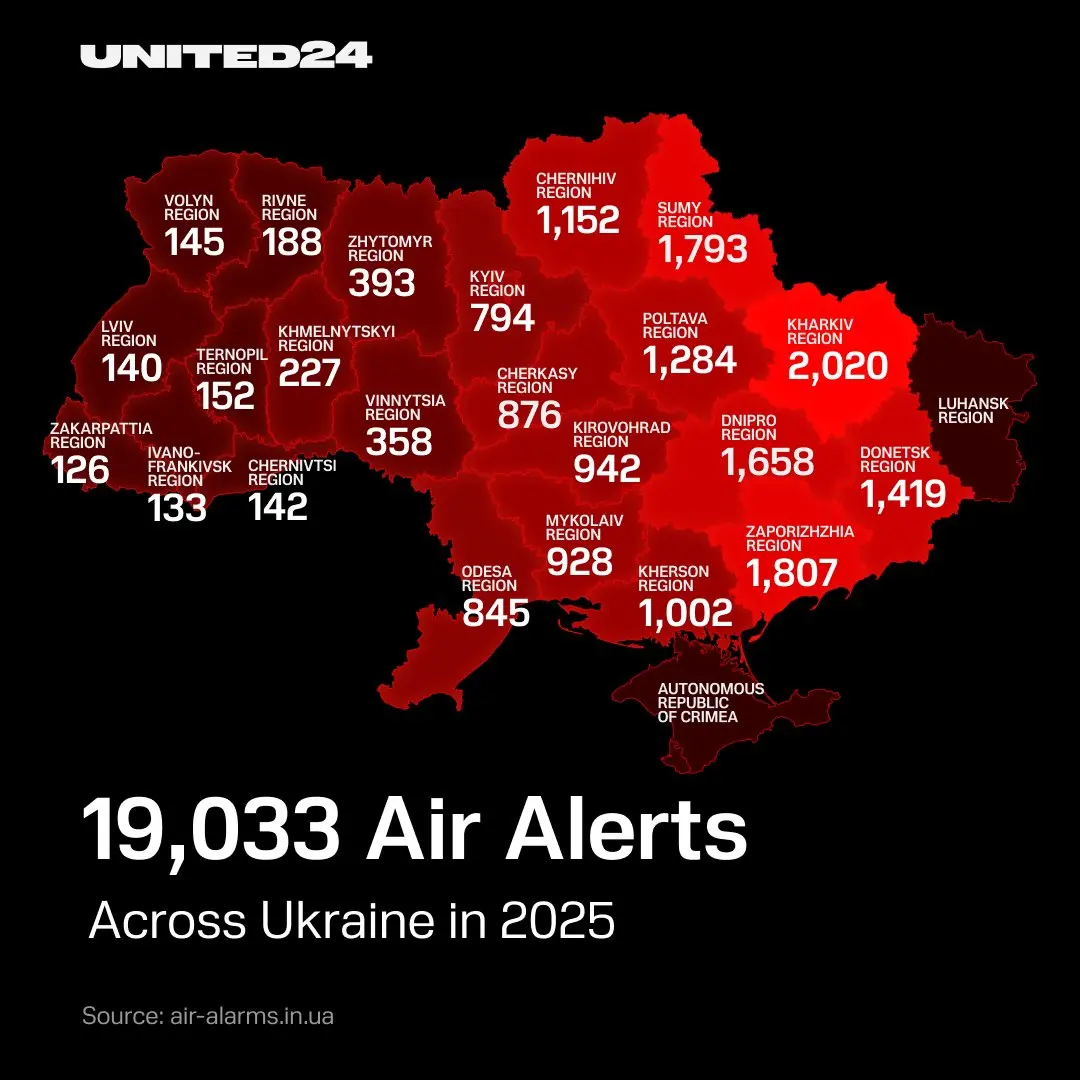
In 2025, Russian troops carried out a record number of air attacks on the territory of Ukraine. According to the United24 platform, the enemy used more than 60 thousand guided bombs, about 2.4 thousand missiles and more than 100 thousand drones of various types.
Number of air alerts in Ukraine in 2025 / United 24
During the year, at least 19,033 air alerts were announced throughout the country. The sirens sounded most often in the Kharkiv region (2,020 times), Zaporizhia (1,807 times) and Sumy region (1,793 times). The fewest alerts were recorded in Transcarpathia (126 times), Ivano-Frankivsk region (133 times) and Lviv region (140 times).
If in the winter and spring months there were one or two major attacks per month, then since June-July their number has increased significantly. During individual strikes, the enemy used up to 60 missiles and hundreds of drones, sometimes up to 700–800 drones in a single attack.
The most massive attacks of 2025:
January 15: 177 targets (of which 43 missiles and 74 drones, air defense destroyed 30 missiles and all drones)
February 1: 165 targets (of which 42 missiles and 123 drones)
March 7: 261 (of which 67 missiles and 194 drones)
April 24: 215 (of which 70 missiles and 145 drones)
May 25: 367 (of which 69 missiles and 298 drones)
Starting in June, the shelling has intensified significantly:
June 29: 537 targets (of which 60 missiles and 477 drones)
July 9: 728 drones.
In August, the number of attacks remained at a high level:
August 21: 614 targets (including 40 missiles and 574 drones)
August 28: 629 targets (including 31 missiles and 598 drones)
August 30: 582 targets (including 45 missiles and 537 UAVs).
Consequences of the shelling of Donetsk : National Police of Ukraineregion
A record number of drones was recorded on September 7 – 823 targets (including 810 drones and 13 missiles), and on October 30 the enemy launched 705 targets (including 52 missiles and 653 drones). During November and December, massive attacks continued: the number of missiles reached 51, drones – up to 653 in one shelling.
United24 emphasizes that human suffering cannot be fully measured in numbers, but statistics clearly demonstrate the scale of the threat and confirm that Ukraine needs enhanced air defense and support from international partners.
The United States is offering Ukraine security guarantees for a period of 15 years as part of a proposed peace plan, Ukrainian President Volodymyr Zelenskyy said Monday, though he said he would prefer an American commitment of up to 50 years to deter Russia from further attempts to seize its neighbor’s land by force.
U.S. President Donald Trump hosted Zelenskyy at his Florida resort on Sunday and insisted that Ukraine and Russia are “closer than ever before” to a peace settlement.
Negotiators are still searching for a breakthrough on key issues, however, including whose forces withdraw from where in Ukraine and the fate of Ukraine’s Russian-occupied Zaporizhzhia nuclear power plant, one of the 10 biggest in the world. Trump noted that the months long U.S.-led negotiations could still collapse.
“Without security guarantees, realistically, this war will not end,” Zelenskyy told reporters in voice messages responding to questions sent via a WhatsApp chat.
Ukraine has been fighting Russia since 2014, when it illegally annexed Crimea and Moscow-backed separatists took up arms in the Donbas, a vital industrial region in eastern Ukraine.
Details of the security guarantees have not become public, but Zelenskyy said Monday they include how a peace deal would be monitored as well as the “presence” of partners. He didn’t elaborate, but Russia has said it won’t accept the deployment in Ukraine of troops from NATO countries.
Trump and Putin discuss peace efforts by phone
Trump on Monday had “a positive call” with Russian President Vladimir Putin about the war, White House press secretary Karoline Leavitt said in a post on X. The two leaders had also spoken shortly before Trump’s talks with Zelenskyy on Sunday as the American president tries to steer the countries toward a settlement.
Later, to reporters, the U.S. president similarly characterized the call as “a very good talk” and said “we have a few very thorny issues, as you can imagine” in the negotiations to end the war.
“If we get them resolved, you’re going to have peace,” he added.
Putin’s foreign affairs adviser Yuri Ushakov said Trump is pushing Ukraine to seek a comprehensive peace agreement and not demand a temporary respite for its military through a ceasefire. Putin has insisted on a full settlement before any truce.
In Monday’s call, Putin told Trump that Ukraine attempted to attack the Russian leader’s residence in northwestern Russia with long-range drones almost immediately after Trump’s Sunday talks with Zelenskyy.
The attack “certainly will not be left without a serious response,” Ushakov said, adding that Moscow will now review its negotiating position.
Zelenskyy denied the Russian claim of an attack, describing it as an attempt to manipulate the peace process. He said it was “another lie” and came about because Moscow is unnerved by progress in peace efforts.
Russian Foreign Minister Sergey Lavrov said Ukraine launched an attack on Putin’s residence in the Novgorod region overnight from Sunday to Monday using 91 long-range drones.
“I don’t like it. It’s not good,” Trump said of the alleged attack on Putin’s home, confirming the Russian leader informed him of it during their call Monday morning.
Russia claims its forces are advancing
As indications suggest negotiations could come to a head in January, before the fourth anniversary of Russia’s full-blown invasion of Ukraine on Feb. 24, 2022, Putin on Monday claimed that Russian troops are advancing in the eastern Donetsk region of Ukraine and are also pressing their offensive in the southern Zaporizhzhia region.
Putin has sought to portray himself as negotiating from a position of strength as Ukrainian forces strain to keep back the bigger Russian army.
He emphasized at a meeting with senior military officers the need to create military buffer zones along the Russian border. “This is a very important task as it ensures the security of Russia’s border regions,” Putin said.
French President Emmanuel Macron said Kyiv’s allies will meet in Paris in early January to “finalize each country’s concrete contributions” to the security guarantees.
Trump said he would consider extending U.S. security guarantees for Ukraine beyond 15 years, according to Zelenskyy. The guarantees would be approved by the U.S. Congress as well as by parliaments in other countries involved in overseeing any settlement, he said.
Zelenskyy said he wants the 20-point peace plan under discussion to be approved by Ukrainians in a national referendum.
However, holding a ballot requires a ceasefire of at least 60 days, and Moscow has shown no willingness for a truce without a full settlement.
Ukrainians doubt Putin’s sincerity
On the snowy streets of Kyiv, the Ukrainian capital, people were skeptical about the chances of peace.
One military veteran who uses the call sign Sensei, in keeping with the rules of the Ukrainian military, said Putin’s record in power shows he can’t be trusted. Sensei joined the military in 2022 and was wounded that year during the battle for the Ukrainian city of Bakhmut. Now, he said, almost nobody from his company is still alive.
“But all these sacrifices, they are not in vain, because we need to prove … that we exist, that we are, that we have the right to our existence, to our territory, to our culture, to our language,” the 65-year-old veteran told The Associated Press.
Denys Shpylovyi, a 20-year-old student who was home for the holidays, said Trump’s willingness to accept Putin’s arguments has put Zelenskyy in a difficult situation.
“But I’m thankful for some progress. They are speaking, and maybe someday there will be hope,” he said.
Oleh Saakian, a Ukrainian political scientist, said it was a good sign that Zelenskyy is managing to build a relationship with Trump, although he noted that “nothing has been adopted yet, nothing has been signed yet.”
“I don’t see these negotiations bringing us closer to real peace, because they are based on equality between the aggressor and the victim, they are based on complete disregard for international law, and … disregard for European security,” he said.
___
Associated Press journalists Seung Min Kim in Washington, and Vasilisa Stepanenko and Volodymr Yurchuk in Kyiv, Ukraine, contributed to this report.
Is tRump a controlled asset or just a useful old idiot, does it matter. He is giving Putin everything he every wanted. The fact is he has decided to be Putin in the west while he lets Russia and China divide up Europe and the Asia. Hugs
The White House in Washington DC, USA. Illustrative image via Wikimedia Commons.
The United States has removed sanctions from several foreign companies previously accused of supplying equipment to Russia, including items linked to its defense and military-industrial sectors.
The changes were published on the US Treasury Department’s website on December 18, without any explanation for the move.
Cyprus-based investment firm and its owner delisted
Among the firms removed is Cyprus-based Veles International Limited and its owner, Dmytro Buhaienko. While the company is tied to an investment group based in Moscow, US sanctions remain in place against its Russian legal entities.
Veles was originally sanctioned in 2023 for operating in Russia’s financial sector and working with wealthy Russian private individuals.
Dubai and Turkish firms linked to military exports also dropped
Other companies taken off the sanctions list include Dubai-based 365 Days Freight Services FZCO and Türkiye’s Etasis, both of which had been linked to exports of restricted equipment used for military purposes in Russia.
When 365 Days was originally sanctioned in November 2023, the Treasury said the company “specializes in moving high-value goods and computer components” and “has shipped high-priority goods, including machines for the reception, conversion, and transmission of data, to Russia.”
Finnish supplier of optoelectronic equipment removed
The Treasury also lifted restrictions on Finland’s Hi-Tech Koneisto and its director, Yevheniia Dremova. The company had supplied optoelectronic and laboratory equipment to Russian firms already under sanctions.
CPS Proses Kontrol Urunleri, a Turkish company, had previously been sanctioned for sending German- and US-made machine tools to a Russian defense contractor. While the company itself is no longer under US sanctions, the Russian contractor it supplied remains restricted.
US authorities did not indicate whether the removals reflect changes in compliance, enforcement priorities, or broader sanctions policy toward Russia.
The delistings come as White House negotiators have met with Russian President Vladimir Putin in Moscow to push a US deal to end the war in Ukraine, and days after the Treasury extended authorization for Lukoil-branded gas stations outside Russia to continue operating.