Black holes are one of our favorite cosmic objects
So we created Black Hole Week to celebrate them.
Throughout the week, science communicators from across the globe will be sharing news, videos, and social media posts about black holes. Our goal is that no matter where people turn that week, they’ll run into a black hole. (Figuratively, of course — we don’t want anyone falling in!) (snip)
=====
=====
First Tip: Don’t Visit Black Holes!
But if you must, read our safety guide.
Learn more about black holes, how to find them, and how to stay safe on your travels!Read More snip) Enjoy!
Snippet-go read this, the videos are delightful- Sen. Prof. Warren remains outstanding!
Oh yeah, baby, talk dirty to us.
Professor Senator Elizabeth Warren stopped by CNBC’s “Squawk on the Street”on Friday for some chattin’ and some rantin’ and some tarriffsplainin’ for the benefit of the show’s blow-dried hosts. We don’t normally watch financial news shows, because what are we, the Vanderbilts? But put Warren on anytime, and we’ll consider tuning in more. She can be entertaining!
Especially if your anchor isn’t following her argument, which sends her into her professorial did-you-not-do-the-reading voice. Which is what happened to Sara Eisen, who must have thought for one moment that she was back at the Medill School and had skipped that week’s assignment. (snip)
Black Mirror, eat your heart out. Researchers have apparently just figured out how to make people see a color completely new to humanity.
Scientists at the University of California, Berkeley conducted the research, published Friday in Science Advances. Using a technique called Oz, the research team induced human volunteers into seeing a color beyond the “natural human gamut.” Oz could allow scientists to conduct experiments previously not possible before, the authors say, and the lessons we learn from it might even someday help color-blind people regain their missing color vision.
Our retinas contain certain photoreceptive cells, known as cones, that allow us to see color. There are three cone types that correspond to different wavelengths of light: short-wavelength (S) cones, medium-wavelength (M) cones, and long-wavelength (L) cones.
Typically, when we try to reproduce color in front of someone’s eyes, we do so by manipulating the spectrum of light seen by the retina’s cones. But since some of our cones, particularly M cones, share overlap in how they respond to certain wavelengths, there are theoretically colors out there that our eyes can never truly see. The UC Berkeley researchers, based on their earlier work studying cone cells, say they’ve found a way around this limitation. (snip)
What is the South African Renewable Energy Masterplan?
It is an industrial strategy that sets out how South Africa can set up a new manufacturing industry in renewable energy and battery storage value chains.
The masterplan was developed by the government, some sections of organised labour, a non-profit organisation advocating for renewable energy, and representatives of the renewable energy industries. It sets out a framework to produce renewable technologies locally. These include solar photovoltaic panels, wind turbines and batteries.
The masterplan has been drawn up so that it aligns with South Africa’s existing national target of adding 3–5 gigawatts of renewable energy capacity each year to 2030. This is a scale that can support the development of local manufacturing hubs. (One gigawatt can supply electricity to about 700,000 average homes.) This steady supply will be enough to give businesses and investors the confidence to commit to long-term investments in local manufacturing hubs. These are zones where renewable systems and components are produced or assembled for domestic and export markets.
The state-owned electricity company, Eskom, has not directly guaranteed that it will buy 3-5 gigawatts of renewable energy each year. But the government’s national electricity plan (the Integrated Resource Plan) provides a strong indication of future demand. (snip)
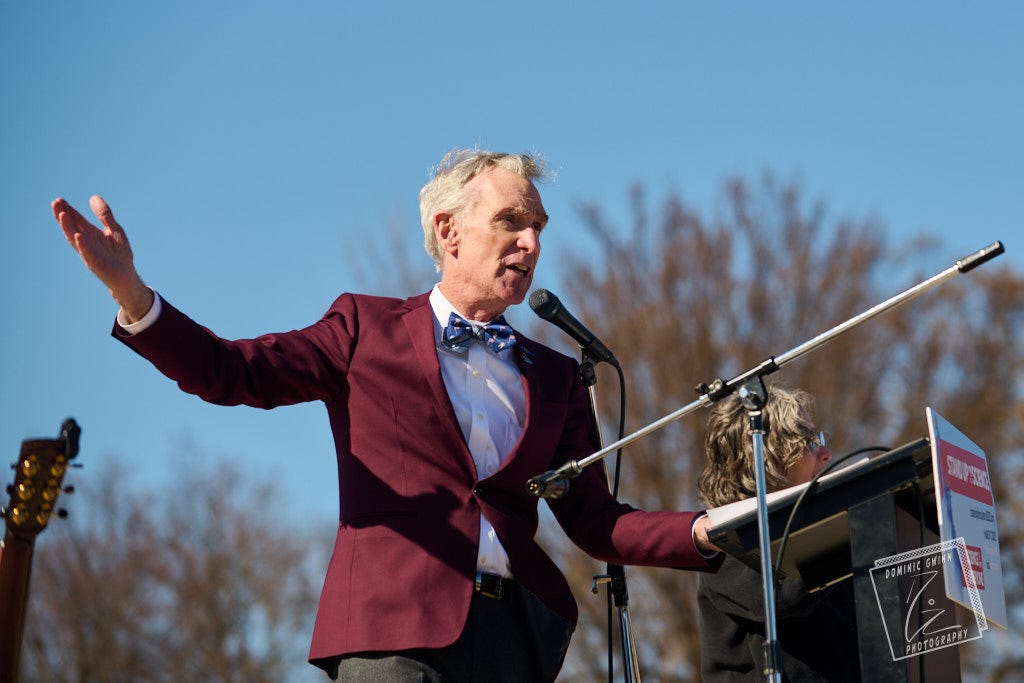
Bill Nye the Science Guy speaks to people protesting the Trump administration’s federal funding cuts during the Stand-Up for Science Rally in Washington DC, Friday, March 7, 2025. Photo by Dominic Gwinn.
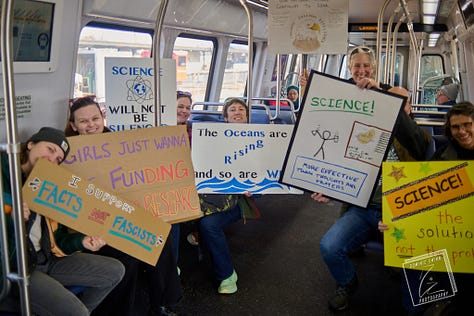
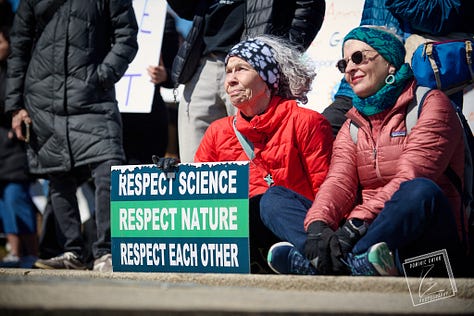
On Friday, nerds all over the US staged rallies to protest the Trump administration’s cuts to federal funding research. Thousands rallied on the steps of the Lincoln Memorial in Washington DC to plead about the benefits of funding science and research in the knowns, known-unknowns, and unknown-unknowns.
Like so many DC rallies before it, the steps of the Lincoln Memorial were transformed into a temporary stage. There wasn’t a big, black riser with rows of cameras and media crews. There weren’t throngs of journalists roaming around and shoving microphones in the faces of flag waving attendees. The crowd didn’t have any kind of uniform apparel, like colored hats and/or armbands.
With a few exceptions, like Bill Nye the Science Guy, and patients who owe their lives to federally funded medical research, a number of speakers were fairly boring. They stood awkwardly at podium and told corny jokes that fell flat. At one point, some of the older folks sang out-of-tune folk songs.
These were scientists. They proudly identify as nerds. They’ve dedicated their careers to saving lives and the planet we’ve all been mucking up for generations. And now many of them were facing unemployment because a merry band of bigots, buffoons, and bros decided science is, like, queer, or whatever.
People in the crowd cheered on speakers — their colleagues and fellow researchers — who lamented the loss of funding that didn’t just help find cures for cancers and disease, create new technologies, or reveal secrets of the universe; they were pissed there was no money for things like coolant used in specialized freezers that preserve decades of biological specimens.
Dr. Allison Agawu speaks to people protesting the Trump administration’s federal funding cuts during the Stand-Up for Science Rally in Washington DC, Friday, March 7, 2025. Photo by Dominic Gwinn.
“This will lead to more deaths,” summarized Dr. Allison Agawu, Professor of Adult and Pediatric Infectious Diseases at Johns Hopkins University School of Medicine. “Science is a beautiful art built on a canvas of ideas. The best science comes from diverse ideas, from diverse people with diverse perspectives, spurring innovation and progress … We collectively reject that inclusion, diversity, equity and access are bad words. In fact, programs championing these ideals should be celebrated and expanded, as that is how we get the best science and the best outcomes.”
A retired mathematician from the National Security Agency explained that it could be difficult for people to understand why research jobs were important. Not everything can be easily described in an elevator pitch. “Are there places we could cut,” they said, “Sure, but people just don’t understand what we do. We can’t talk about it. I know my work saved lives.”
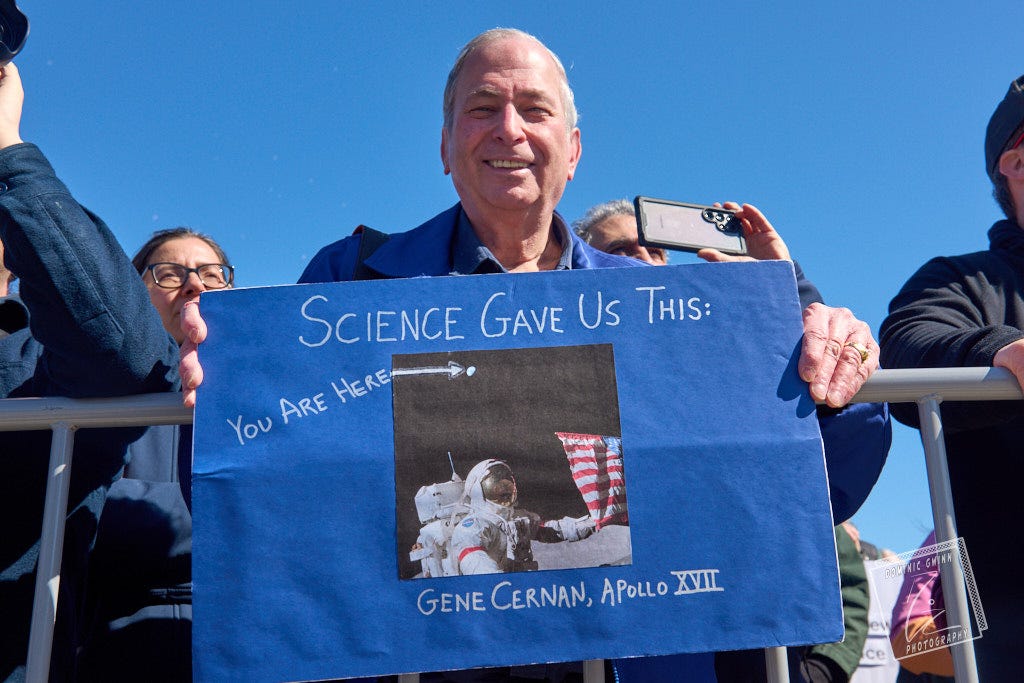
Lloyd Franklin, 64, stood at the front of the stage wearing a blue NASA jacket. He is a retired aerospace engineer who, like many kids, grew up wanting to be an astronaut. He held a sign with a photo of Apollo astronaut Gene Cernan from 1972. Cernan is taking a selfie while holding the American flag as the Earth, a pale blue dot, floats in over his shoulder. It was the last time humans walked on the Moon.
Above the photo on Franklin’s sign were the words: “Science gave us this.”
“I know this is important,” Franklin said. “I know we have to make a stand.”
Lloyd Franklin, 64, protests the Trump administration’s federal funding cuts during the Stand-Up for Science Rally in Washington DC, Friday, March 7, 2025. Photo by Dominic Gwinn.
These types of protests have been happening almost daily over the last few weeks. Much of this is being carried out by federal workers themselves through private, encrypted chats and public message boards. Mustering a sizable crowd on short notice in the middle of the week in DC can be a Herculean task, but they have been showing up to protest regularly since congressional Republicans turned a blind-eye to Donald Trump’s sweeping cuts to federal agencies.
If they get any media attention, it’s from struggling freelancers or niche bloggers. National broadcasters or their local affiliates are not really showing up to show hundreds of federal workers protesting on the evening news. There’s a massacre being carried out in broad daylight and the pathetic reality is that much of the DC press corps is either too scared to do their jobs, or they just don’t care.
The earliest evidence that humans inhabited rainforests has been found in Africa, a surprising find which pushes human settlement in these habitats much further back than previously thought.
Modern humans, Homo sapiens, evolved about 300,000 years ago in Africa. The ecological and environmental circumstances in which our species evolved are still not well understood.
It is likely that our ape-like ancestors millions of years ago did live in dense rainforests. But the retreat of Africa’s forests and the spread of savannah and grasslands as Earth’s climate dried is usually linked to the evolution of bipedalism in early human ancestors as far back as 7 million years ago.
As a result, rainforests have often been overlooked as important habitats in the evolution of early modern humans.
New research published in Nature has put a dent in this assumption.
The evidence comes from a site which dates to 150,000 years ago in present-day Côte d’Ivoire on the southern coast of West Africa.
“Before our study, the oldest secure evidence for inhabitation in African rainforests was around 18,000 years ago and the oldest evidence of rainforest inhabitation anywhere came from southeast Asia at about 70,000 years ago,” says lead author Eslem Ben Arous, from Spain’s National Centre for Human Evolution Research (CENIEH) and the Max Planck Institute of Geoanthropology in Germany.
The site was first investigated in the 1980s when ancient stone tools were discovered. But the age of the tools and the ancient ecology couldn’t be determined with the technology of the day.
The trench initially excavated by Professor Guédé’s team was overgrown when researchers returned for the current study. Credit: Jimbob Blinkhorn, MPG.
“Several recent climate models suggested the area could have been a rainforest refuge in the past as well, even during dry periods of forest fragmentation,” says senior author Eleanor Scerri, from the Max Planck Institute of Geoanthropology. “We knew the site presented the best possible chance for us to find out how far back rainforest inhabitation extended.”
The anthropologists used several dating techniques including optically stimulated luminescence and electron-spin resonance to determine the stone tools were 150,000 years old.
Stone tools like this one, excavated at the Anyama site, reveal that humans were present at the rainforested site roughly 150,000 years ago. Credit: Jimbob Blinkhorn, MPG.
Sediment samples also showed the region was heavily wooded, with pollen and leaf waxes typically found in humid West African rainforests. Low levels of grass pollen show it wasn’t a narrow strip of forest either, but in a dense woodland.
This evidence suggests that some early modern humans lived in rainforests while others stuck to their grassland and savannah homes.
“Convergent evidence shows beyond doubt that ecological diversity sits at the heart of our species,” says Scerri. “This reflects a complex history of population subdivision, in which different populations lived in different regions and habitat types.
“We now need to ask how these early human niche expansions impacted the plants and animals that shared the same niche-space with humans. In other words, how far back does human alteration of pristine natural habitats go?”
“This exciting discovery is the first of a long list as there are other Ivorian sites waiting to be investigated to study the human presence associated with rainforest,” says Guédé.
The site which yielded these stone tools has since been destroyed by mining.
Swedish researchers have invented a fully-recyclable perovskite solar cell that may provide a solution to the growing problem of solar panel waste.
All renewable technologies have a life span — with solar panels it’s 25 to 30 years — which means our solar waste pile is rapidly becoming mountainous. Just 17 % of solar panel components were recycled in Australia in 2023, specifically the aluminium frames and junction boxes. The remaining 83% (glass, silicon and polymer back sheeting) was shuttled out to landfill. Other countries do better; France’s ROSI was an early starter in what could be a $2b market by 2050.
Linköping University researchersmay have a solution — fully recyclable perovskite solar cells.
These cells are also flexible, transparent and inexpensive — who needs aluminium frames when your PVs are stuck to your windows?
Professor Feng Gao with postdocs Xun Xiao and Niansheng Xu at Linköping University (Image Thor Balkhed)
“There is currently no efficient technology to deal with the waste of silicon panels. That’s why old solar panels end up in the landfill,” says coauthor, Xun Xiao, at the Department of Physics, Chemistry and Biology (IFM) at Linköping University (LiU).
“Huge mountains of electronic waste that you can’t do anything with.”
Perovskites used in photovoltaic solar cells are ‘metal-halide perovskites’ — made from organic ions, metals and halogens. Such cells’ active layers are much thinner and cheaper than those of conventional silicon PV and show efficiencies of more than 26%, comparable with silicon PVs (20% – 22%).
But perovskite PVs are not yet produced at scale.
Recyclability is the key.
“We need to take recycling into consideration when developing emerging solar cell technologies,” says Professor Feng Gao, also at IFM at LiU and a co-author. “If we don’t know how to recycle them, maybe we shouldn’t put them on the market at all.”
The inhospitable Antarctic Peninsula hosts only one native insect, and scientists from Japan have just identified an unprecedented combination of adaptations that allow it to thrive in the extreme cold.
The Antarctic midge is a tiny, flightless insect that lives most of its two-year life as a larva, the grub-like stage that follows the egg stage. (Complete metamorphosis in insects includes egg, larva, pupa, and adult stages).
Adult Antarctic midges. Credit: Yuta Shimizu / Osaka Metropolitan University.
How these larvae overwinter in Antarctica could have implications for cryopreservation technology but, perhaps more pressingly, better understanding of the species’ response to climate change. Previous researchers have suggested that the Antarctic midge be developed as a model organism for survival in extreme and fluctuating temperatures.
The Japanese research team led by Shin Goto of Osaka Metropolitan University studied the unique midge after developing a specialised rearing method, which took them six years to establish.
The team then tracked the growth and physiology of the midge larvae through their natural lifecycle. In a first for science, they documented two distinct forms of dormancy used as seasonal survival adaptations.
In general, dormancy is a state of inactivity, suspended development and reduced metabolism, but insect scientists distinguish between two types: quiescence and diapause.
In the first winter, the Antarctic midge larvae adapted via quiescence, a form of dormancy triggered by external conditions, such as cold temperatures. This means all the midge larvae go dormant at the same time. Quiescence ends when the temperature rises.
(Snip-MORE; it’s fascinating and worth the click. Also not long.)
Since 1997, five Swedish-based scientists were involved in an interesting practice that went on for 17 years, the parameters of which were revealed in 2014. The goal? See who can use as many Bob Dylan songs in their research paper titles before retirement.
John Jundberg and Eddie Weitzburg started the trend. Two professors at Stockholm’s Karolinska Institute, they titled a research paper “Nitric Oxide and inflammation: The answer is blowing in the wind” (Predictably, it was about flatulence). However, in a 2014 story with Swedish outlet The Local, Weitzburg cleared up some things about the wager. (Snip-More; just click the article title)
The edits to the webpage offer a glimpse into how far the Trump administration will go in refusing to acknowledge today’s inequalities as it purges federal initiatives promoting diversity, equity and inclusion.
Vera Rubin was an astronomer who earned the National Medal of Science for her research on dark matter, an invisible substance that makes up much of the universe. Credit: AIP Emilio Segrè Visual Archives, Rubin Collection
During his first presidential term, Donald Trump signed a congressional act naming a federally funded observatory after the late astronomer Vera Rubin. The act celebrated her landmark research on dark matter — the invisible, mysterious substance that makes up much of the universe — and noted that she was an outspoken advocate for the equal treatment and representation of women in science.
“Vera herself offers an excellent example of what can happen when more minds participate in science,” the observatory’s website said of Rubin — up until recently.
By Monday morning, a section of her online biography titled, “She advocated for women in science,” was gone. It reappeared in a stripped-down form later that day amid a chaotic federal government response to Trump’s campaign against diversity, equity and inclusion programs.
While there are far more seismic changes afoot in America than the revision of three paragraphs on a website, the page’s edit trail provides an opportunity to peer into how institutions and agencies are navigating the new administration’s intolerance of anything perceived as “woke” and illuminates a calculation officials must make in answering a wide-open question:
How far is too far when it comes to acknowledging inequality and advocating against it?
“Vera Rubin, whose career began in the 1960s, faced a lot of barriers simply because she was a woman,” the altered section of the bio began. “She persisted in studying science when her male advisors told her she shouldn’t,” and she balanced her career with raising children, a rarity at the time. “Her strength in overcoming these challenges is admirable on its own, but Vera worked even harder to help other women navigate what was, during her career, a very male-dominated field.”
That first paragraph disappeared temporarily, then reappeared, untouched, midday Monday.
That was not the case for the paragraph that followed: “Science is still a male-dominated field, but Rubin Observatory is working to increase participation from women and other people who have historically been excluded from science. Rubin Observatory welcomes everyone who wants to contribute to science, and takes steps to lower or eliminate barriers that exclude those with less privilege.”
That paragraph was gone as of Thursday afternoon, as was the assertion that Rubin shows what can happen when “more minds” participate in science. The word “more” was replaced with “many,” shifting the meaning.
“I’m sure Vera would be absolutely furious,” said Jacqueline Mitton, an astronomer and author who co-wrote a biography of Rubin’s life. Mitton said the phrase “more minds” implies that “you want minds from people from every different background,” an idea that follows naturally from the now-deleted text on systemic barriers.
She said Rubin, who died in 2016, would want the observatory named after her to continue her work advocating for women and other groups who have long been underrepresented in science.
It’s unclear who ordered the specific alterations of Rubin’s biography. The White House, the observatory and the federal agencies that fund it, the National Science Foundation and the Department of Energy, did not respond to questions from ProPublica.
The observatory’s page on diversity, equity and inclusion was also missing Thursday afternoon. An archived version from Dec. 19 shows that it described the institution’s efforts “to ensure fair and unbiased execution” of the hiring process, including training hiring committee members “on unconscious bias.” The DEI program also included educational and public outreach efforts, such as “meeting web accessibility standards” and plans to build partnerships with “organizations serving audiences traditionally under-represented” in science and technology.
Similar revisions are taking shape across the country as companies have reversed their DEI policies and the Trump administration has placed employees working on DEI initiatives on leave.
If the changes to Rubin’s biography are any indication of what remains acceptable under Trump’s vision for the federal government, then certain facts about historical disparities are safe for now. But any recognition that these biases persist appears to be in the crosshairs.
The U.S. Air Force even pulled training videos about Black airmen and civilian women pilots who served in World War II. (The Air Force later said it would continue to show the videos in training, but certain material related to diversity would be suspended for review.)
One of Rubin’s favorite sayings was, “Half of all brains are in women,” Mitton said. Her book recounts how Rubin challenged sexist language in science publications, advocated for women to take leadership roles in professional organizations and declined to speak at an event in 1972 held at a club where women were only allowed to enter through a back door.
Jacqueline Hewitt, who was a graduate student when she met Rubin at conferences, said she was inspired by Rubin’s research and how she never hid the fact that she had kids. “It was really important to see someone who could succeed,” said Hewitt, the Julius A. Stratton professor of physics at the Massachusetts Institute of Technology. “It felt like you could succeed also.”
Rubin was awarded the National Medal of Science by then-President Bill Clinton in 1993. The observatory, located in a part of Chile where conditions are ideal for observational astronomy, was named after her in 2019 and includes a powerful telescope; it will “soon witness the explosions of millions of dying stars” and “capture the cosmos in exquisite detail,” according to its website.
Mitton said the observatory is a memorial that continues Rubin’s mission to include not just many people in astronomy, but more of those who haven’t historically gotten a chance to make their mark.
“It’s very sad that’s being undermined,” she said, “because the job isn’t done.” (Snip)
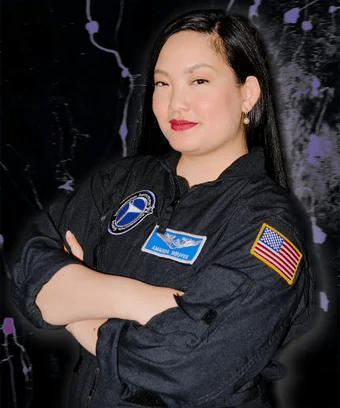
Amanda Nguyen is an activist. And a bestselling author. She’s also a Nobel Peace Prize nominee, founder of a nonprofit, and she happens to love makeup. (Oh, and one more thing: She is the first Vietnamese woman to go to space.) A quick scroll on her Instagram feed reveals snippets of her incredible career, which has spanned her groundbreaking aerospace achievements, critically-acclaimed memoir Saving Five, appearances as TIME’s Woman of the Year, and her work with Rise, a non-governmental organization she created to protect sexual assault survivors. (In 2016, the United States Congress passed the Sexual Assault Survivor Bill of Rights after she publicly testified, which guaranteed, for the first time, statutory rights in federal code for survivors of sexual assault and rape.) Point is, she’s already a veritable force for change — but wasn’t too busy to add one more line to her already-impressive CV: Star of e.l.f. Cosmetics’ Show Your(s)e.l.f. campaign.
The editor-beloved makeup brand is known for its accessible, high-quality products, but it is a shared mission of inclusivity and joy of beauty that made this partnership a natural fit for Nguyen. “e.l.f. is all about democratizing beauty,” she tells Refinery29. “And for me what that means is seeing myself reflected in the ways people consume beauty, either through content, film, or advertisements — and I actually do use e.l.f. every day.”
In addition to the campaign film, Nguyen is preparing to literally take flight as she embarks on an upcoming space expedition with Blue Origin, making her the first Vietnamese woman to go to space.
In our latest Power Diaries, the trailblazer candidly speaks about how she stays inspired and empowered, and shares more about her new role as an e.l.f. ambassador.
I feel most powerful when…
I show up as my authentic self.
Power to me means…
The freedom to make my own choices.
What do you do when you feel powerless?
I remember that no one is powerless when we come together and no one is invisible when we demand to be seen.
What’s your power anthem?
Our voice. It’s the most powerful tool we have, so use it.
Who is your power icon?
My power icon is Sally Ride. She trailblazed so that I could fly.
What do you wear when you want to feel powerful?
I wear red lipstick.
Keep reading for the rest of our Q&A with Nguyen.
(snip-More on the page; not all about makeup. Click the article title above)
A new discovery adds to the mystery of the source of fast radio bursts.
Fast radio bursts (FRBs) are extremely energetic pulses of radio-frequency light which travels across the universe that last just a few seconds or even milliseconds.
Canadian Hydrogen Intensity Mapping Experiment (CHIME). Credit: CHIME, Andre Renard, Dunlap Institute for Astronomy & Astrophysics, University of Toronto.
More than 1,000 FRBs have been reported since the first was discovered in 2007. (snip-More; click the title see it all.)
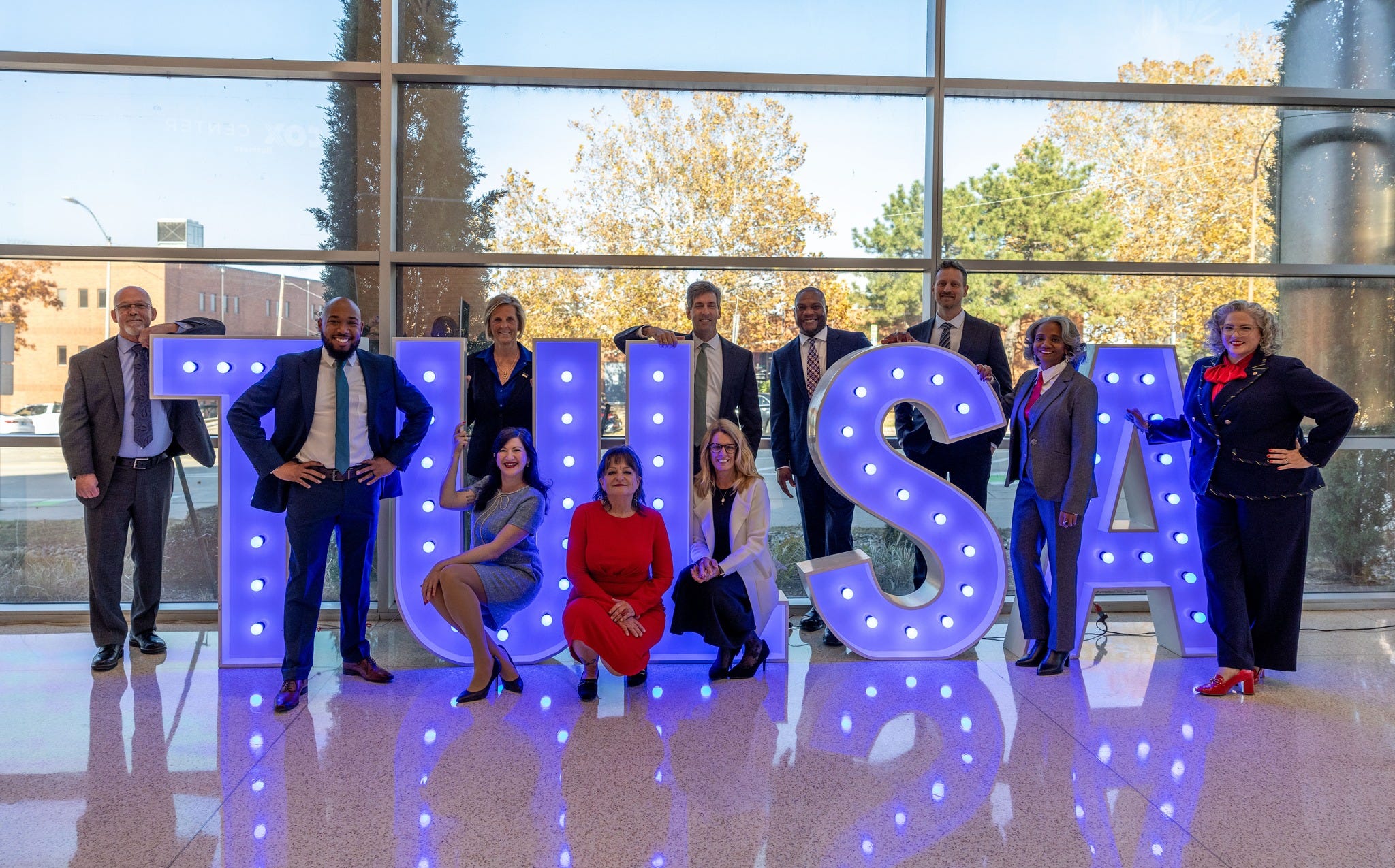
The City Council of Tulsa, Oklahoma — faced with the choice of upsetting Christian Republican legislators or making non-Christian community members feel like they didn’t belong — voted 8-0 (with one abstaining) this week to eliminate the practice of starting each meeting with a prayer invocation.
Now, instead of invocations, there will be a moment of silence, so that everyone will have to sit there and feel uncomfortable instead of just those whose religion is not represented by the opening prayer.
As Hemant Mehta of Friendly Atheist reports, this all started last year after the invocation was delivered by Amy Hardy-McAdams, co-owner and creator of the Strawberry Moon Herbal Apothecary & Ritual Center in Broken Arrow. Hardy-McAdams, who described herself as “a Third-Degree High Priestess of the Artemisian Faerie Faith Tradition of Witchcraft” (which I’m sure is a real thing), was invited by retiring City Councilmember Crista Patrick, who also happened to be a Pagan and wished to see her faith represented at the meeting just as Christianity had been. (snip-More; the statements from the Gov and Schools Supt. are worth the click by themselves, but the entire thing is gold!)








 Scottie's Playtime