Peace & Justice History for 10/24:

October 24, 1935
Langston Hughes’s first play, “Mulatto,” opened on Broadway. It was the longest-running play (373 performances) by an African-American until Lorraine Hansberry’s “A Raisin in the Sun” which premiered in 1959.
Langston Hughes
First-rate bio of Langston Hughes 
October 24, 1940
The 40-hour workweek went into effect under the Fair Labor Standards Act of 1938, requiring employers to pay overtime and restricting the use of child labor.
Decades of labor agitation and a considerable number of lives made this change possible.


More on The Fair Labor Standards Act of 1938: 
October 24, 1945

The United Nations World Security Organization came into being when the Soviet Union (Union of Soviet Socialist Republics or USSR) in mid-afternoon deposited its instrument of ratification of the U.N. Charter.
The USSR became the last of the five major powers and the 29th of 51 nations, the minimum necessary to bring this about. James F. Byrnes, U.S. Secretary of State, then signed the protocol formally attesting that the Charter of the United Nations had come into force.This is now considered United Nations Day.

Read more  (no paywall.)
October 24, 1970
Salvador Allende Gossens, an avowed Marxist and head of the Unidad Popular Party, became the president of Chile after being elected and confirmed by the Chilean Congress.For the next three years, the United States exerted tremendous pressure to destabilize and unseat the Allende government. In 1958, and again in 1964, Allende had run on a socialist /communist platform. In both elections, the United States government (as well as U.S. businesses such as International Telephone and Telegraph (ITT), which had significant investments in Chile) worked to defeat Allende by sending millions of dollars of assistance to his political opponents.

Allende and supporters
More on Allende 
October 24, 1981

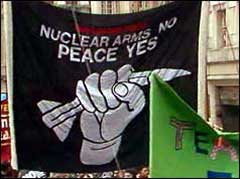
More than 250,000 people, organized by the Committee for Nuclear Disarmament (CND), marched through London to protest the siting of American nuclear missiles in the United Kingdom.
More background and video

https://www.peacebuttons.info/E-News/peacehistoryoctober.htm#october24

Peace & Justice History for 10/18:

Woot! The first labor union is born in Boston!

October 18, 1648
I. Marc Carlson  
The Shoemakers Guild of Boston became the first labor union in the American colonies. 
Labor organization in colonial times 
October 18, 1929
The Persons Case, a legal milestone in Canada, was decided.
Five women from Alberta, later known as the Famous Five, asked the Supreme Court of Canada to rule on the legal status of women.
Some decisions of Magistrate Emily Murphy had been challenged on the basis that she was not a legal person, and she was a candidate for appointment to the Canadian Senate. After the Supreme Court ruled against them, they appealed to the British Privy Council.The Privy Council found for the women on this day (eight years after the case began and eleven years after women received the federal vote), declaring that women were persons under the law. October 18 has since been celebrated as Persons Day in Canada, and October as Women’s History Month.

Sculpture by Barbara Paterson of the Famous Five in Ottawa, first on Parliament Hill to honor women
The other women activists in the Famous Five: Henrietta Muir Edwards, Nellie McClung, Louise McKinney, and Irene Parlby.
The Persons Case 

https://www.peacebuttons.info/E-News/peacehistoryoctober.htm#october18

Peace & Justice History for 10/12:

October 13, 1934
The American Federation of Labor (AFL) voted to boycott all German-made products as a protest against Nazi antagonism to organized labor within Germany.
Watch The U.S. and the Holocaust  2022, A new documentary by Ken Burns, Lynn Novick and Sarah Botstein

https://www.peacebuttons.info/E-News/peacehistoryoctober.htm#october13

Peace & Justice History 8/11

https://www.peacebuttons.info/E-News/peacehistoryaugust.htm#august111894

August 11, 1894
Federal troops forced some 1,200 jobless workers across the Potomac River and out of Washington, D.C.

  Jack London
Led by an unemployed activist, “General” Charles “Hobo” Kelly, the jobless group’s “soldiers” included young journalist Jack London, known for writing about social issues, and miner/cowboy William ”Big Bill” Haywood who later organized western miners and the Industrial Workers of the World (IWW). “Big Bill” Haywood 
Read about “Big Bill”: https://apwu.org/news/big-bill-haywood-wobbly-giant
August 11, 1958
A drugstore chain in Wichita, Kansas, agreed to serve all its customers after weeks of sit-ins at Dockum’s lunch counter by local African-Americans who wanted an end to segregation. On this day, as several black Wichitans were sitting at the counter even though the store refused to serve them, a white man around 40 walked in and looked at them for several minutes. Then he looked at the store manager and said, simply, “Serve them. I’m losing too much money.” He was the owner, Robert Dockum. That day the lawyer for the local NAACP branch called the company and was told by the a vice president ”he had instructed all of his managers, clerks, etc., to serve all people without regard to race, creed or color,” statewide. This was the first success of the sit-in movement which soon spread to Oklahoma City and other towns in Kansas, but is often thought to have started in Greensboro, North Carolina, in 1960.
August 11, 1984 

Prior to his weekly radio address, unaware that the microphone was open and he was broadcasting, President Ronald Reagan joked, “My fellow Americans, I’m pleased to tell you today that I’ve signed legislation that will outlaw Russia forever. We begin bombing in five minutes.” Many Americans and others throughout the world were concerned about the President’s apparently flippant attitude towards nuclear war at a time of increasing tension between the two major nuclear powers.Among other things, the U.S. had begun a major strategic arms buildup, adding many thousands of additional nuclear warheads along with a broad range of new delivery systems: long-range bombers including 100 B-1B stealth bombers and MX (10-warhead) ICBMs, considered first-strike weapons; intermediate-range missiles to be deployed in Europe; 3000 cruise missiles; and Trident nuclear submarines with sea-launched cruise missiles.
Additionally, Reagan had proposed building the space-based Strategic Defense Initiative of anti-ballistic missiles, a destabilizing influence on the nuclear balance.
The Nuclear Arms Control Legacy of Ronald Reagan: https://www.armscontrol.org/act/2004-07/arms-control-today/looking-back-nuclear-arms-control-legacy-ronald-reagan

The UAW

Ten Bears posted this yesterday, and it’s great. Earlier yesterday, I saw the video linked below, also great. Morning cheer!