Because this is important history that we really ought to review, because the leopards who were “only” going for certain parts of the population are going for all the population, these days.
“Not all Republicans are racist, but racists vote Republican, and they do it for racist reasons.”
While the explicit nature of the “monkey” and “cannibal” slurs is jarring, it sits within a long, documented tradition of presidential prejudice that has shaped the nation’s policies.
History always has a funny way of spinning the block, and every once in a while, we run into something that refuses to stay buried no matter how much time has passed. Recordings reported by CBS revealed a deeply disturbing discussion between former Republican presidents Richard Nixon and Ronald Reagan—and you guessed it, it’s super racist.
Per the news outlet, former President Richard Nixon was speaking with then-California Governor Ronald Reagan following a United Nations meeting to recognize the People’s Republic of China. While global attention should’ve been centered on the diplomatic shift, Reagan reportedly phoned Nixon’s White House to voice his frustration over African delegates who celebrated the decision. At one point, Reagan flat out called them “monkeys”—and it only went downhill from there.
Before we get to that, here’s the real question: Why is anyone shocked? To treat these recordings as a singular, shocking “glitch” in the American presidency is to ignore the very fabric of the office. Yes, the explicit nature of the “monkey” and “cannibal” slurs is jarring, but it sits within a long, documented tradition of presidential prejudice against Black folks that has shaped the nation’s policies for decades.
Long before Reagan and Nixon shared a laugh at the expense of African diplomats, Woodrow Wilson was busy re-segregating the federal workforce and praising the post-Civil war Ku Klux Klan as an “Invisible Empire of the South,” per History. Andrew Jackson publicly framed Native Americans as an “inferior race” to justify the brutal displacement of the Trail of Tears. Even Lyndon B. Johnson, who signed the Civil Rights Act, was notoriously recorded using the N-word in private to describe the very people he was legislating for—often viewing civil rights through the lens of political leverage rather than inherent humanity.
When we look at the timeline, Nixon’s own history of referring to Black people as “genetically inferior” or Reagan’s later “welfare queen” trope aren’t outliers; they are the quiet parts being said out loud. So, as these clips circulate on social media, the most revealing part of the story isn’t the racism itself—it’s our collective lack of surprise that it happened at all.
Let’s get back to the audio. Reagan told Nixon “Last night, I tell ya, to watch that thing on television as I did. To see those monkeys from those African countries, damn them. They’re still uncomfortable wearing shoes.”
Laughter is heard on the other end of the call after the disgusting statement. But that’s not all.
After Reagan’s reckless and racist phone call, Nixon later spoke with William Rogers—then Secretary of State—and doubled down on Reagan’s racist remarks. And if you thought the last phone recording was bad… just wait, it gets worse.
(snip-embedded TikTok; click the story title above to go to the page, if you wish)
“He saw these cannibals on television last night, and he says ‘Christ, they weren’t even wearing shoes, and here the U.S. is going to submit its fate to that…” Nixon said.
Later that month Nixon had a laugh with his long time best friend, former Florida banker and businessman Charles “Bebe” Rebozo. And as you may have expected, the racist banter continued to roll.
“That reaction on television was that it proves how they ought to be still hanging from the trees by their tails,” Rebozo said with a laugh during his call with Nixon.
Tiktok’s comments section was riddled with folks asking, “Where’s the surprise?” and “The way my jaw did not drop,” alongside emojis. And let’s be real, we get it.
While there’s certainly shock value in hearing these recordings, none of this is entirely surprising. This is a country built on Black labor and Black suffering—one where federal power has long been used to contain Black political movements, including COINTELPRO, which targeted organizations like the Black Panther Party and other Black-led groups working toward progress and self-determination.
That said, these tapes don’t feel like an isolated incident, but rather a reminder of how deeply racism has been woven into political life at even the highest levels. And while the exposure of this kind of rhetoric may be unsettling, it ultimately tells a familiar reality of Black folks’ lived experience in America.
This column first appeared in The Amendment, a newsletter by Errin Haines, The 19th’s editor-at-large. Subscribe today to get early access to her analysis.
When Alexis McGill Johnson took the helm as leader of Planned Parenthood in 2020, the nation’s largest provider of reproductive care and a major force in American politics was already at a critical juncture.
The organization’s last president had lasted just eight months; she followed Cecile Richards, the charismatic and connected leader who was in the role for a dozen years. The future of abortion rights looked potentially shaky, and Donald Trump was in his first term.
In the six years since, the U.S. Supreme Court ended federal protections for abortion, a major challenge both for providing care and for the organization’s political arm — then Trump won a second term and moved to take away federal funding, slashing a third of Planned Parenthood’s budget. Under the first Trump administration, Planned Parenthood had more than 600 health centers. Since the start of 2025, 53 have closed. More are threatened since Trump on July 4 signed into law a measure to block them from accepting Medicaid.
The end of federal abortion protections led to a surge in energy around the issue from Democrats and the left. It has faded since then as the president’s military actions and mass deportation strategy dominate attention — but McGill Johnson still has to figure out how to galvanize supporters; keep Planned Parenthood clinics serving patients; and elect Democrats in key races in states including Georgia, North Carolina and Ohio.
As one of the abortion rights movement’s key standard bearers, McGill Johnson is navigating expectations from activists, donors and voters who want a fighter and expect her to deliver. Their sense of urgency can obscure what it means to both lead the fight and provide essential care to millions of Americans in an intentionally overwhelming and chaotic news cycle.
Alexis McGill Johnson’s presence at the top of Planned Parenthood reflects a broader pattern in American institutions, in which Black women are often called on to lead in moments of crisis while having limited room for error and a lack of support. (Jessica Rinaldi/The Boston Globe/Getty Images)
“When I look at where Planned Parenthood is in this moment, we are navigating all of the chaos, but also looking for where the opportunities are inside that chaos,” McGill Johnson said. “Chaos is a strategy: throw everything at people so they don’t know where to look or how to fight.”
McGill Johnson describes her style as collaborative; those who know her best say she’s a master strategist, confronting a challenging political climate with courage, clarity and creativity.
The political climate in which McGill Johnson has led can really not be compared to any other past leader, said Fatima Goss Graves, president of the National Women’s Law Center.
“This isn’t something that’s happened over three decades; this has been the last six years,” said Goss Graves, who first met McGill Johnson in 2017 after Goss Graves became the first Black woman to head her organization. “Alexis was the right person at the right time. It is a big deal that surviving the level of attacks they have faced, that they are still here, they are serving patients, they are still committed, and they have had to make adjustments. The work is what she’s doing.”
Planned Parenthood is shorthand for dual entities: Planned Parenthood Federation of America, the nonprofit supporting affiliate clinics across two dozen states; and Planned Parenthood Action Fund, the group’s political arm, focused on organizing, advocacy and voter education.
McGill Johnson’s path to leading both came after a career working on voting rights and civil rights, and she approaches the work through a racial and gender lens. She is only the second Black woman leader in the organization’s existence of more than a century.
Her presence at the top of Planned Parenthood reflects a broader pattern in American institutions, in which Black women are often called on to lead in moments of crisis, with limited room for error and a lack of support.
McGill Johnson talked about the added weight of doing this work as a Black woman in a movement that has been largely White at the national level. She said that having lived and worked at the intersection of race and gender has been an asset in her current role.
McGill Johnson is familiar with leading in moments like the one Planned Parenthood is facing, “moments where our leadership is judged more harshly, where we may be granted more scrutiny, less grace.”
“Those are the places where I’ve had to find my center, to remind myself that I’m in this role to be unapologetic about fighting for the liberation of women of color, Black women, at the center of that liberation, because I think that actually transforms the liberation of everyone else,” she said.
Former Democratic U.S. Sen. Laphonza Butler, the first Black woman to head EMILY’s List, the political action committee focused on electing Democratic women, put it this way when asked about the challenges of leadership for Black women: “It is an expectation whose bumper sticker reads: ‘Fix it for us, please.’ When you look across the movement spaces where both crisis and care are on a collision course, it is Black women like Alexis who are stepping up.”
The Supreme Court’s 2022 decision in Dobbs v. Jackson Women’s Health Organization, which ended the nearly 50-year precedent of legal abortion access nationwide, angered many Democratic women and motivated them in record numbers in the 2022 midterm elections.
Then-Vice President Kamala Harris championed reproductive rights as a pillar of her 2024 presidential campaign — but her loss was criticized by some, in part, as prioritizing abortion access over the economy. Now, the Democratic Party’s uncertainty around whether and how to talk about abortion to voters adds to McGill Johnson’s challenges in this moment.
The stakes on the ground are still life and death for many Americans, but political strategists say the issue of abortion has proved less politically potent as the national spotlight has moved on.
“For someone fighting on this issue, the progressive movement that was so galvanized is less so because they’re focused on many of the other things that Trump is doing that are dangerous to the country,” said Democratic strategist Karen Finney.
Abortion can still be a motivating issue for Democrats — especially as it’s related to the two biggest issues at the moment, health care and affordability, said Democratic pollster Celinda Lake.
“It’s still motivating to voters for turnout,” Lake said. “Right now, everything is being pushed out by the war and the economy. I think it will reemerge as a much more powerful issue in 2028. Health is the number one issue, the number one pocketbook issue. When you talk about abortion and broaden it, it’s very powerful there.”
McGill Johnson worked to do just that, emphasizing Planned Parenthood’s presence particularly in communities with a lack of options for reproductive care. Politically, she has framed the issue as one of affordability and of democracy, and is focused on a message to voters about how the administration’s actions in recent years are impacting them.
“It may not feel as though abortion is as front and center as it was in the year or two after the Dobbs decision … but when you bring it to people and remind them that these things are happening, it taps directly into that rage,” McGill Johnson said.
She added that part of the job now also looks like acknowledging the concerns of those in the movement as a leader of a complex organization with little room for error. Supporters of abortion rights — and even supporters of McGill Johnson herself — have criticized her for not responding strongly enough to attacks on access, saying they don’t see her fighting in the way they want.
What does it mean when some on the left are more in the mood for a wartime general than a collaborator?
“In the day-to-day, it is a lot of navigating people’s frustrations, anxieties and hopes, and how to keep people focused on that hope and a strategy for how to get there,” McGill Johnson said. “We’re living in moments where philanthropy has pulled back from a number of institutions where there is a federal defund, which has impacted a lot of my colleagues. One day, you’re navigating ICE and the next day, the country’s at war, right? All within the same time period. I think my kind of special superpower is the ability to kind of keep myself at the 30,000-foot view to understand how all of these things are interacting with each other.”
McGill Johnson said the urgent question for her is: Who are we going to be now that we’re no longer defending Roe? It’s one that no other president of Planned Parenthood had to grapple with after the landmark 1973 case that made abortion the law of the land.
Since 2019 when she became interim leader, Planned Parenthood’s supporter base — which includes volunteers, donors, activists and email subscribers — has grown from 13 million to 20 million.
In addition to her focus on the campaign trail, McGill Johnson will also have to continue the work of reimagining Planned Parenthood’s network of clinics as part of the national health care infrastructure. According to the organization, 1 in 3 women in the United States has visited a Planned Parenthood clinic.
“I believe that Planned Parenthood could become the Cleveland Clinic of sexual and reproductive health care, because we have such great clinical excellence,” McGill Johnson said. “We are already a leader in standardizing best-in-class care, on sexual, reproductive health care, including abortion, so I think a lot about what it would mean for us to to focus on seeing as many patients as Planned Parenthood can, but to also export that influence into ensuring everybody else’s is standard of care is raised.”
To get there, McGill Johnson will have to endure and survive the current climate and the demands of the post-Roe era. Reproductive Freedom for All President Mini Timmaraju said meeting the multiple challenges at the local, state and federal level with diminished resources and competing areas of attention is daunting.
“We have to do more than we’ve ever done before, and the funding is not what it should be,” said Timmaraju, the first woman of color to lead her organization. “We are all scrambling to make sure that in the moment where abortion funds need funding, clinics need funding, we also have enough resources for advocacy at every single level, and that’s really challenging in an environment where donors are understandably a little frustrated with progressive entities right after 2024 so we’re having to prove ourselves again, and continually having to prove and reprove, over and over again, the salience of abortion electorally.”
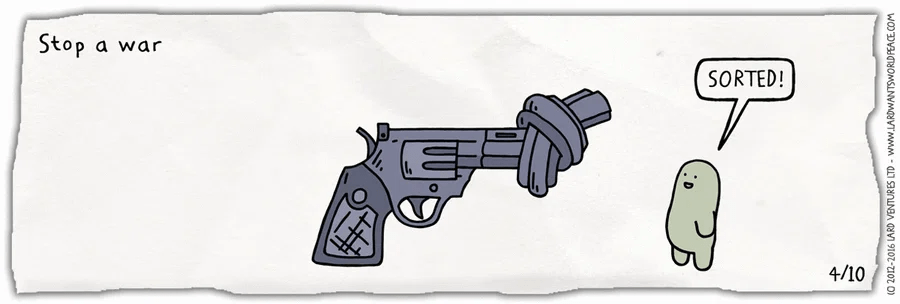
April 12, 1935 60,000 students across the U.S. took part in the first nationwide student strike. The protest was against fascism and participation in any war. Posters from the anti-war movement of the 1930’s One of the events that day
April 12, 1963 Martin Luther King, Jr. and his fellow ministers Fred Shuttlesworth and Ralph Abernathy, along with 60 others were arrested on Good Friday in Birmingham, Alabama, for marching downtown. They had been denied a parade permit, and were violating a court order banning them from all protest activities. Public Safety Commissioner Theophilus Eugene “Bull” Connor had sought the injunction to put an end to a series of sit-ins, kneel-ins, boycotts and other nonviolent actions designed to challenge the local and state segregation laws. Fred Lee Shuttlesworth (left), Ralph David Abernathy (center), and Martin Luther King Jr. (right) march on Good Friday on April 12, 1963, in Birmingham. The Birmingham campaign of 1963Arrest in Birmingham
April 12, 1971 Protest at Fessenheim The first European demonstration against nuclear power brought together 1300 peacefully to oppose construction of a nuclear power plant at Fessenheim, on the Rhine in the Alsace region of France. The four 900 megawatt reactors have been in operation since 1977.
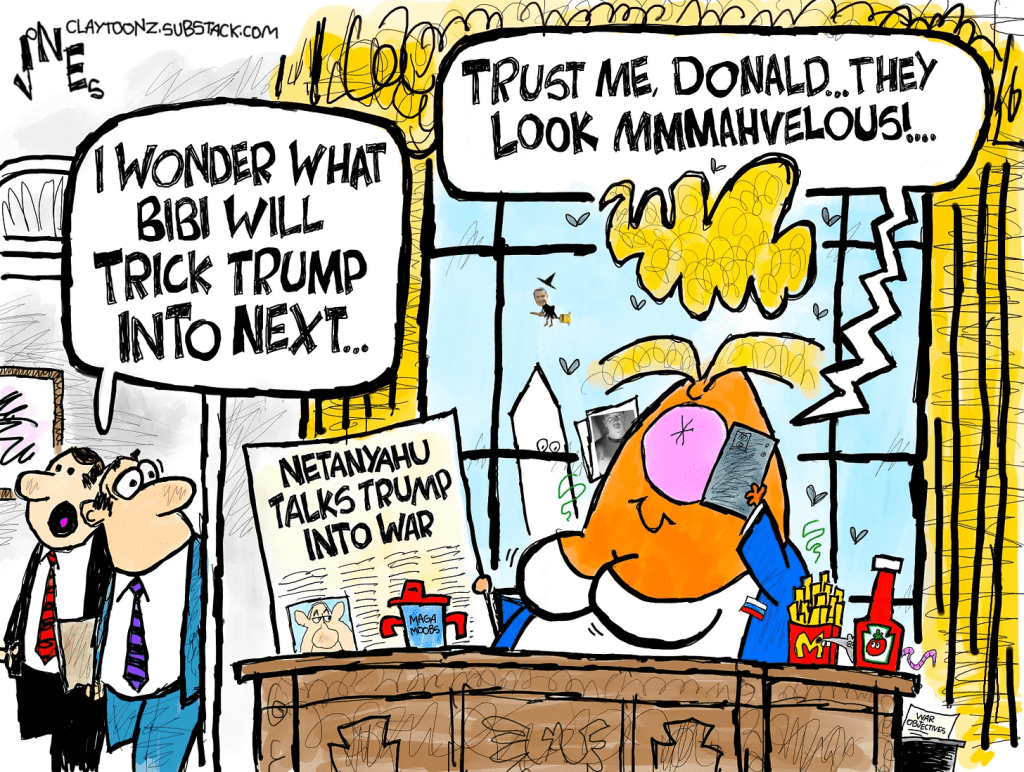
A new report by The New York Times details how Israeli Prime Minister Benjamin Netanyahu persuaded Donald Trump into going to war with Iran. Details in the story show that Donald Trump was oversold on the idea. But Trump wasn’t just oversold; he wanted to be told what he wanted to hear, even if it was wrong.
There was deep skepticism from his inner circle about going to war, and despite polling his top advisers, he often only heard “what he wanted to hear,” and his team wound up serving as an echo chamber for his gut instincts.
According to story written byJonathan Swan and Maggie Haberman, JD Vance was the most vocal in his opposition to the United States going to war with Iran, while CIA Director Jim Ratcliffe, Secretary of State Marco Rubio, and Gen. Dan Caine, Chairman of the Joint Chiefs of Staff, warned Trump that Netanyahu had “oversold” him on what could be achieved by the bombing campaign. Defense Secretary Pete Hegseth, on the other hand, was gung-ho on going to war. (snip-MORE, and it’s hot)
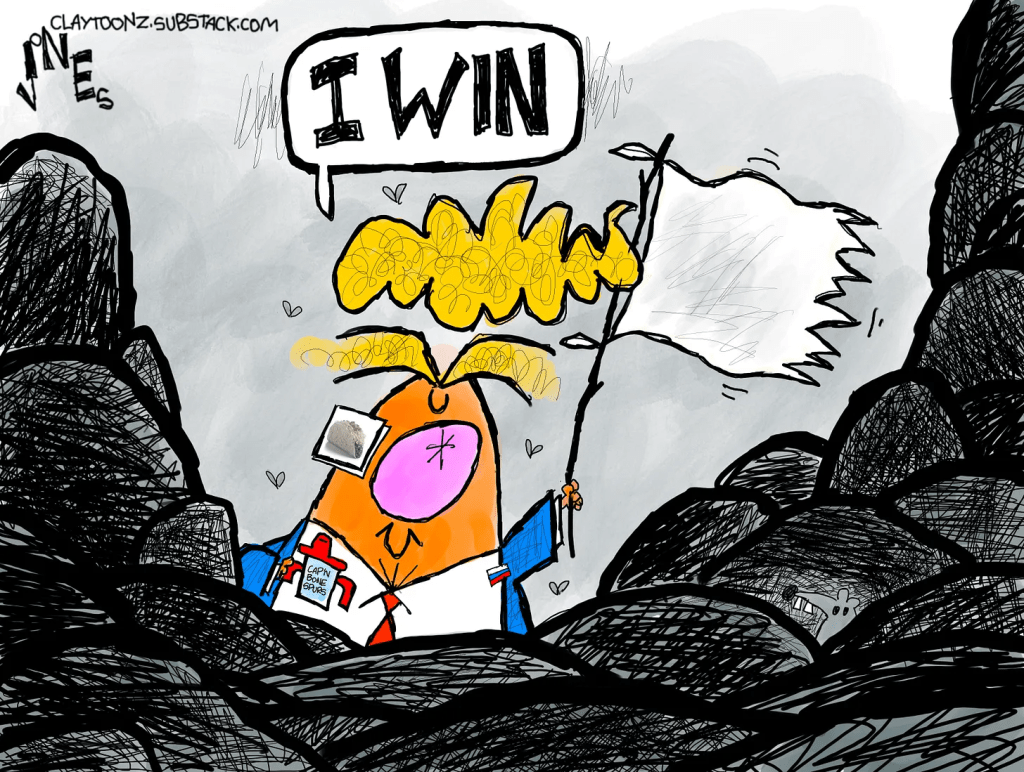
As predicted, Donald Trump taco’ed out again after threatening to commit genocide against the Iranian people.
Make no mistake about it, threatening to destroy an entire civilization is threatening genocide. Donald Trump was threatening to commit war crimes. (snip-MORE, also hot)
At a New York party, attendees spent Trans Day of Visibility dancing, DJing, and learning how to become less visible online.
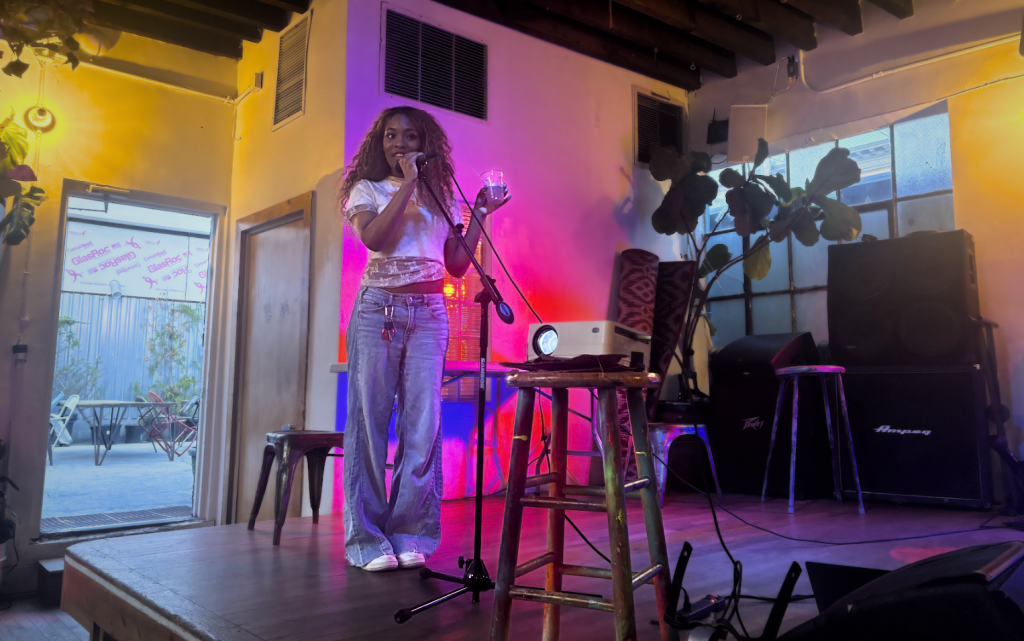
Imani Thompson, digital security trainer and organizer of the event / Photo by Janus Rose
It’s Trans Day of Visibility, and I’m at an event space in the heart of New York City’s Commie Corridor to learn how to become less visible online.
The crowd gathered at the aptly-named Trans Pecos in Ridgewood, Queens is here for “404: Deadname Not Found,” a digital self-defense workshop which promises to teach trans people how to find and remove their sensitive personal information from the internet (and which also has no relation to this website). The vibe is giving OpSec rave happy hour—attendees sip colorful drinks, groove to DJ sets, and huddle around laptops using online tools to track down their own digital footprints.
The goal of the exercise is to find holes in your digital defenses, a practice cybersecurity folks call “red-teaming.” A slide deck guides participants through this “self-doxing” ritual, instructing them to use websites like IntelBase, PimEyes, and haveibeenpwned to find addresses, selfies, passwords, old names and aliases, and other personal info that might have been left sitting around on the open internet.
It makes for great cocktail party banter. One participant raises their arms in triumph upon receiving a clean bill of health while checking if their information was leaked in a data breach. Others swivel laptop screens and compare notes on the various places their digital detritus had cropped up. In my case, I was lucky: I mostly found data brokers with incorrect information, a long-forgotten MySpace page, and a woman whose spam calls I’ve been receiving for the past 10 years. Finally, participants are directed to various pages where they can request data to be removed, or sign up for discounted services like Kanary and DeleteMe that do the removals on your behalf.
Behind the fun and light atmosphere, everyone here knows the unspoken reality that drives tonight’s activities: an unrelenting wave of discriminatory bills and executive orders that are rapidly demolishing trans rights across the US. “Trans Visibility” is a nice idea, but it turns out it really sucks to be visible in a fascist surveillance state where the highest levels of government are obsessively trying to destroy your ability to live.
“In this world of hyper-surveillance, I want to make sure all my stuff is safe and that no one is trying to harvest my data for anything,” Anna, a workshop participant, told 404 Media. Anna asked to use a pseudonym to protect her identity, which is not surprising given that the goal of the workshop is to make it harder to be doxed. “Especially now that there’s lots of incentives for the federal government to get into that business, I just wanna make sure all of that is under wraps.”
Like the event’s name suggests, many attendees are looking for traces of their “deadnames,” which is how some trans folks refer to the names they were given pre-transition. Trans people face a disproportionatelyhigh risk of being doxed online, and deadnames and other sensitive info are frequently dug up on right-wing hate forums like KiwiFarms and social media sites like Elon Musk’s X, where harassment campaigns and hate speech are allowed and even encouraged.
“We have to protect ourselves,” said Ryan, who also used a pseudonym. “It’s great to know how to find stuff like this, because you never know what’s still out there.”
Imani Thompson, a digital security trainer who organized the event as part of her series Cache Me Outside, says she started hosting the free workshops at queer bars in Brooklyn a year ago, after noticing trans and intersex friends who were noticeably shaken by the opening salvos of the second Trump administration.
“I hadn’t seen cybersecurity events that looked like they would attract or resonate with the crowds I felt needed this information the most,” she told 404 Media. “I wanted to make this fun and un-intimidating and doing digital security training at the bar is kind of silly and fun and gives us a built-in VPN and protection from sensitive convos being recorded.”
There are specific reasons many trans people are anxious about their personal data and online presence these days. For one, trans identities often don’t fit neatly into government boxes, and the name and gender they are assigned at birth may or may not match their government-issued IDs. Recently, a new law in Kansas resulted in hundreds of trans people being told that theirdrivers licenses and IDs had been invalidated overnight, forcing them to obtain new documents that revert to the sex marker assigned at birth. JournalistMarissa Kabas later reported that the 300 trans IDs in question had been flagged and not immediately invalidated, but the goal of the law and its ensuing chaos was clear: requiring trans people to have IDs that don’t match their appearance or lived reality, forcing them to out themselves and introducing friction and discrimination into their everyday lives.
The same Kansas law also implemented the first state-level “bathroom bounty,” making it a crime for trans people to use appropriate bathrooms and changing rooms and promising rewards to random passersby who feel “aggrieved” by someone they think might be trans. Lawmakers in Idaho have passed an even harsher bill, which would charge repeat trans bathroom-users with a felony and up to 5 years of jail time. These bills threaten not only trans people, but anyone whose appearance might fall outside of someone’s normative expectations of “male” and “female.” And they are especially dangerous at a time when facial recognition can near-instantly identify someone with a quick search.
Thompson also worries about the information that queer folks can reveal while asking for help online. Trans people experienceunemployment,housing insecurity, andviolence at exponentially higher rates than cis people, and it’s not uncommon to see Gofundme pages and Venmo accounts flooding social media feeds. These posts will sometimes include personal details like a person’s name, face, transition status, location, immigration status, and even how much they have in their bank account—great for getting donations, but not so great for the doxable breadcrumbs they leave behind.
“I think the risk is tenfold for the dolls and Black trans siblings because of disproportionate scrutiny in light of these bathroom bills and also how we do mutual aid,” said Thompson. “Whenever I see a mutual aid request being reposted or processed it makes me nervous, because we’re basically doxing our most vulnerable friends.” To reduce risk, she recommends people take down mutual aid posts as soon as needs are met and set their Venmo activity to private. “I feel like the intention in listing off how all these systems of oppression impact our friends are meant to create a sense of urgency and care, but then months later it’s still floating around and is a goldmine for someone who wants to claim they were made to feel unsafe in a bathroom so they can claim $3k or further an agenda.”
The privacy attitudes on display at the event contrast with the dominant media narratives about trans communities a decade ago. Fresh off the Supreme Court victory in Obergefell vs. Hodges that legalized same-sex marriage, many at that time were convinced that trans visibility would pave the way to equality, as glossy magazine covers featuring stars like Laverne Cox declared a “Trans Tipping Point.” But while conditions for some trans people marginally improved, we all know what happened next: a wave of reactionary anti-trans state laws, culminating in the re-election of Donald Trump and a series of executive orders aimed at destroying trans peoples’ access to healthcare, sports, bathrooms—essentially the ability to live a normal life.
At the same time, protection can’t be a retreat back into the closet. “It’s still important for trans voices to be heard in online spaces,” said Anna. “It’s not like I wanna go into the shadows or anything. I just don’t want people to know my personal data, my personal records, any of that.”
“Being Black, I also understand the distinction between visibility and hypervisibility and the precarity and lack of agency that hypervisibility creates,” said Thompson. “It’s tricky to find language around digital security that doesn’t imply queerness is something to hide or a shameful thing, because of course it’s not. I think having agency and purpose in how we can show up online and interact with tech as well as literacy around how technology and surveillance operates makes us better equipped.”
Janus Rose is New York City-based journalist, educator and artist whose work explores the impacts of A.I. and technology on activists and marginalized communities. Previously a senior editor at VICE, she has been published in digital and print outlets including e-Flux Journal, DAZED Magazine, The New Yorker, and Al Jazeera.