William McKinley is having a moment (which I confess is a sentence I never expected to write).
Republican presidential nominee Donald Trump is elevating McKinley, representative from Ohio from 1877 to 1891 and president from 1897 to 1901, to justify his plan to impose new high tariffs.
Trump’s call for tariffs is not an economic plan; it is a worldview. Trump claims that foreign countries pay tariff duties and thus putting new tariffs of 20% on all imports, and as much as 60% on Chinese imports, will bring enough foreign money into the country to fund things like childcare, end federal budget deficits, and pay for the tax cuts he wants to give to the wealthy and corporations.
This is a deliberate lie. Tariffs are essentially taxes on imported products, and they are paid not by foreign countries but by American consumers. Economists warn that Trump’s tariff plan would cost a typical family an average of more than $2,600 a year, with poorer families hardest hit; spike inflation as high as 20%; result in 50,000 to 70,000 fewer jobs created each month; slow economic growth; and add about $5.8 trillion in deficits over ten years. It would tank an economy that under the Biden administration, which has used tariffs selectively to protect new industries and stop unfair trade practices, has boomed.
Trump simply denies this economic success. He promises to make the economy great with a tariff wall. On September 27, he told rally attendees in Warren, Michigan: “You know, our country In the 1890s was probably…the wealthiest it ever was because it was a system of tariffs and we had a president, you know McKinley, right?… He was really a very good businessman, and he took in billions of dollars at the time, which today it’s always trillions but then it was billions and probably hundreds of millions, but we were a very wealthy country and we’re gonna be doing that now….”
By pointing to McKinley’s presidency to justify his economic plan, Trump gives away the game. The McKinley years were those of the Gilded Age, in which industrialists amassed fortunes that they spent in spectacular displays. Cornelius and Alva Vanderbilt’s home on New York’s Fifth Avenue cost more than $44 million in today’s dollars, with stables finished in black walnut, cherry, and ash, with sterling silver metalwork, and in cities across the country, the wealthy dressed their horses and coachmen in expensive livery, threw costly dinners, built seaside mansions they called “cottages,” and wore diamonds, rubies, and emeralds. When the daughter of a former senator married, she wore a $10,000 dress and a diamond tiara, and well-wishers sent “necklaces of diamonds [and] bracelets of diamonds, sapphires, and rubies.”
Americans believed those fortunes were possible because of the tariff walls the Republicans had begun to build in 1861. Before the Civil War, Congress levied limited U.S. tariffs to fund the federal government, a system southerners liked because it kept prices low, but northerners disliked because established industries in foreign countries could deliver manufactured goods more cheaply than fledgling U.S. industries could produce them, thus hampering industrial development.
So, when the Republican Party organized in the North in the 1850s, it called for a tariff wall that would protect U.S. manufacturing. And as soon as Republicans took control of the government, they put tariffs on everything, including agricultural products, to develop American industry.
The system worked. The United States emerged from the Civil War with a booming economy.
But after the war, that same tariff wall served big business by protecting it from the competition of cheaper foreign products. That protection permitted manufacturers to collude to keep prices high. Businessmen developed first informal organizations called “pools” in which members carved up markets and set prices, and then “trusts” that eliminated competition and fixed consumer prices at artificially high levels. By the 1880s, tariffs had come to represent almost half a product’s value.
Buoyed by protection, trusts controlled most of the nation’s industries, including sugar, meat, salt, gas, copper, transportation, steel, and the jute that made up both the burlap sacks workers used to harvest cotton and the twine that tied ripe wheat sheaves. Workers, farmers, and entrepreneurs hated the trusts that controlled their lives, but Republicans in Congress worked with the trusts to keep tariffs high. So, in 1884, voters elected Democrat Grover Cleveland, who promised to lower tariffs.
Republicans panicked. They insisted that the nation’s economic system depended on tariffs and that anyone trying to lower them was trying to destroy the nation. They flooded the country with pamphlets defending high tariffs. Cleveland won the popular vote in 1888, but Republican Benjamin Harrison won the electoral votes to become president.
After the election, steel magnate Andrew Carnegie explained that the huge fortunes of the new industrialists were good for society. The wealthy were stewards of the nation’s money, he wrote in what became known as The Gospel of Wealth, gathering it together so it could be used for the common good. Indeed, Carnegie wrote, modern American industrialism was the highest form of civilization.
But low wages, dangerous conditions, and seasonal factory closings and lock-outs meant that injury, hunger, and homelessness haunted urban wage workers. Soaring shipping costs meant that farmers spent the price of two bushels of corn to get one bushel to market. Monopolies meant that entrepreneurs couldn’t survive. And high tariffs meant that the little money that did go into their pockets didn’t go far. By 1888 the U.S. Treasury ran an annual surplus of almost $120 million thanks to tariffs, seeming to prove that their point was to enable wealthy men to control the economy.
“Wall Street owns the country,” western organizer Mary Elizabeth Lease told farmers in summer 1890. “It is no longer a government of the people, by the people, and for the people, but a government of Wall Street, by Wall Street, and for Wall Street.” As the midterm elections of 1890 approached, nervous congressional Republicans, led by Ohio’s William McKinley, promised to lower tariff rates.
Instead, the tariff “revision” raised them, especially on household items—the rate for horseshoe nails jumped from 47% to 76%—sending the price of industrial stocks rocketing upward. And yet McKinley insisted that high tariff walls were “indispensable to the safety, purity, and permanence of the Republic.”
In a chaotic congressional session with members shouting amendments, yelling objections, and talking over each other, Republicans passed the McKinley Tariff in May 1890 without any Democratic votes. They cheered and clapped at their victory. “You may rejoice now,” a Democrat yelled across the aisle, “but next November you’ll mourn.”
Democrats were right. In the November 1890 midterm elections, angry voters repudiated the Republican Party. They gave the Democrats a two-to-one majority in the House; McKinley himself lost his seat. Even Republicans thought their party had gone too far, and in 1892, voters gave Democrats control of the House, Senate, and White House for the first time since before the Civil War.
Republican stalwarts promptly insisted that Democrats would destroy the economy by cutting tariff rates, and their warnings crashed the economy ten days before Cleveland took office. Democrats slightly lowered the tariff, replacing the lost income with an income tax on those who made more than $4,000 a year. Republicans promptly insisted the Democrats were instituting socialism.
As the nation recovered from the economic panic of 1893, Republicans doubled down on their economic ideology. In 1896 they nominated McKinley for president. While he stayed home and kept his mouth shut, the party flooded the country with speakers and newspaper articles paid for with the corporate money that flowed into the Republicans’ war chest, all touting the protective tariff. Warned that the Democrats were trying “to create a red welter of lawlessness as fantastic and as vicious as the dream of a European communist,” voters elected McKinley.
And then the Republicans had a stroke of luck. After the election, the discovery of gold on Bonanza Creek near the Klondike River in Canada’s Yukon Territory brought enough gold into the U.S. to ease the money supply, letting up pressure on both farmers and workers, and the fight over the tariff eased.
It reemerged in 1913 when Democratic president Woodrow Wilson challenged the ideology behind Republican tariffs. A Democratic Congress cut tariff rates almost in half, from close to 50% to 25%, and to make up for lost revenue, Democrats put a tax on incomes over $3,000. Republicans complained that the measure was socialistic and discriminated against capitalists, especially the Wall Street community.
As soon as Republicans regained control of the government, they slashed taxes and restored the tariff rates the Democrats had cut. This laid the groundwork for World War II by making it difficult for foreign governments to export to the United States and thus earn dollars to pay their debts from World War I.
It also recreated the domestic economy of the 1890s. Congress gave the president power to raise or lower the tariffs at will, and in the 1920s, Republican presidents Harding and Coolidge changed tariff rates thirty-seven times; thirty-two times they moved rates upward. (They dropped the rates on paintbrush handles and bobwhite quails.) Business profits rose but wages did not, and wealth moved upward dramatically. By 1929, 5% of the population received one third of the nation’s income, and more than 60% of American families earned less than they needed for basic necessities.
When the bottom fell out of the stock market in 1929, ordinary Americans had too little purchasing power to fuel the economy. In June 1930, Republicans fell back on their faith in tariffs once again when they passed the Smoot-Hawley Tariff,* raising rates to protect American business. Other countries promptly retaliated, and the resulting trade war dramatically reduced foreign trade, exacerbating the Great Depression.
When Smoot-Hawley failed, it took with it Americans’ faith that tariffs were the key to a strong economy. After World War II, ideological fights over the structure of the economy would be waged over taxes rather than tariffs.
Trump’s insistence that a tariff wall will make America rich is not based in economics; indeed, it would destroy the current system, which is so strong that modern economists are marveling. Trump is fantasizing about a world without regulations or taxes, where high tariffs permit the wealthy to collude to raise prices on ordinary Americans and to use that money to live like kings while workers, farmers, and entrepreneurs barely scrape by… a world like McKinley’s.
…..
*In 2009, then-representative Michele Bachmann (R-MN) made history by referring to this as the “Hoot-Smalley” tariff and blaming FDR for passing it (FDR didn’t take office until 1933).
—
Notes: (on the page; some links don’t embed properly.) (snip)
Before internet memes, postcards offered a popular, accessible, shareable means to combine image and word. Messages could be as simple as “wish you were here,” but in their “golden age” (circa 1898–1917), postcards provided a powerful way to promote political agendas, writes scholar Kenneth Florey. The golden age neatly coincided with the height of the women’s suffrage movement in the United States and Britain. More than a thousand varieties of pro- and anti-suffrage-themed postcards were produced then, 200 of which are included in “Votes and Petticoats,” a Johns Hopkins University digital collection available on JSTOR. Of these, a significant number, curiously, depict cats—both as women’s pets and as women.
Associations between ladies, cats, and cat ladies—childless and otherwise—are rooted in a long, complicated cultural history. In Edwardian times, cats were linked to women as creatures of the domestic domain: woman was Angel of the House, the cat her companion, both of them sweet, warm, helpful, and cute. At the same time, animal lovers, “spinsters,” and suffragists represented overlapping, suspect categories of womanhood. It’s the perennial paradox in which women find themselves: somehow looked down upon while also placed on a pedestal.
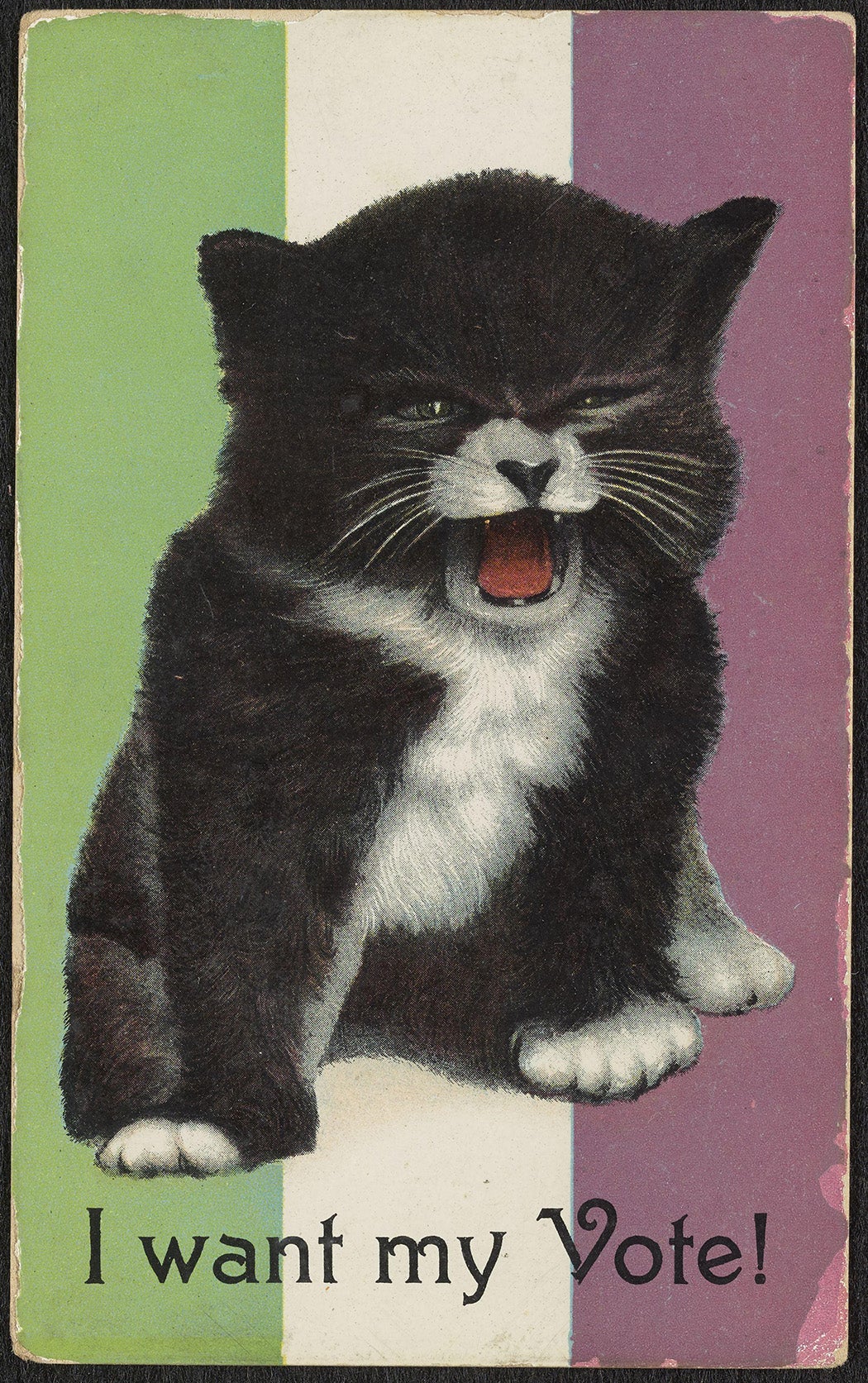
I Want My Vote! Courtesy Votes and Petticoats: Postcards, The Sheridan Libraries, Johns Hopkins University.
This postcard captures many of the themes that recur across the collection: it suggests that a woman demanding the vote is as silly as a kitten so doing, their protests as ineffective as the kitten’s mewls. The green, white, and purple stripes behind the kitten were the colors of the Women’s Social and Political Union (WSPU), one of the more militant British suffrage societies. Historian Krista Cowman interprets the sexism in this postcard as infantilizing though not especially cruel. Similarly, Florey describes the use of cats in suffrage postcards as softening a message that might otherwise seem harsh.
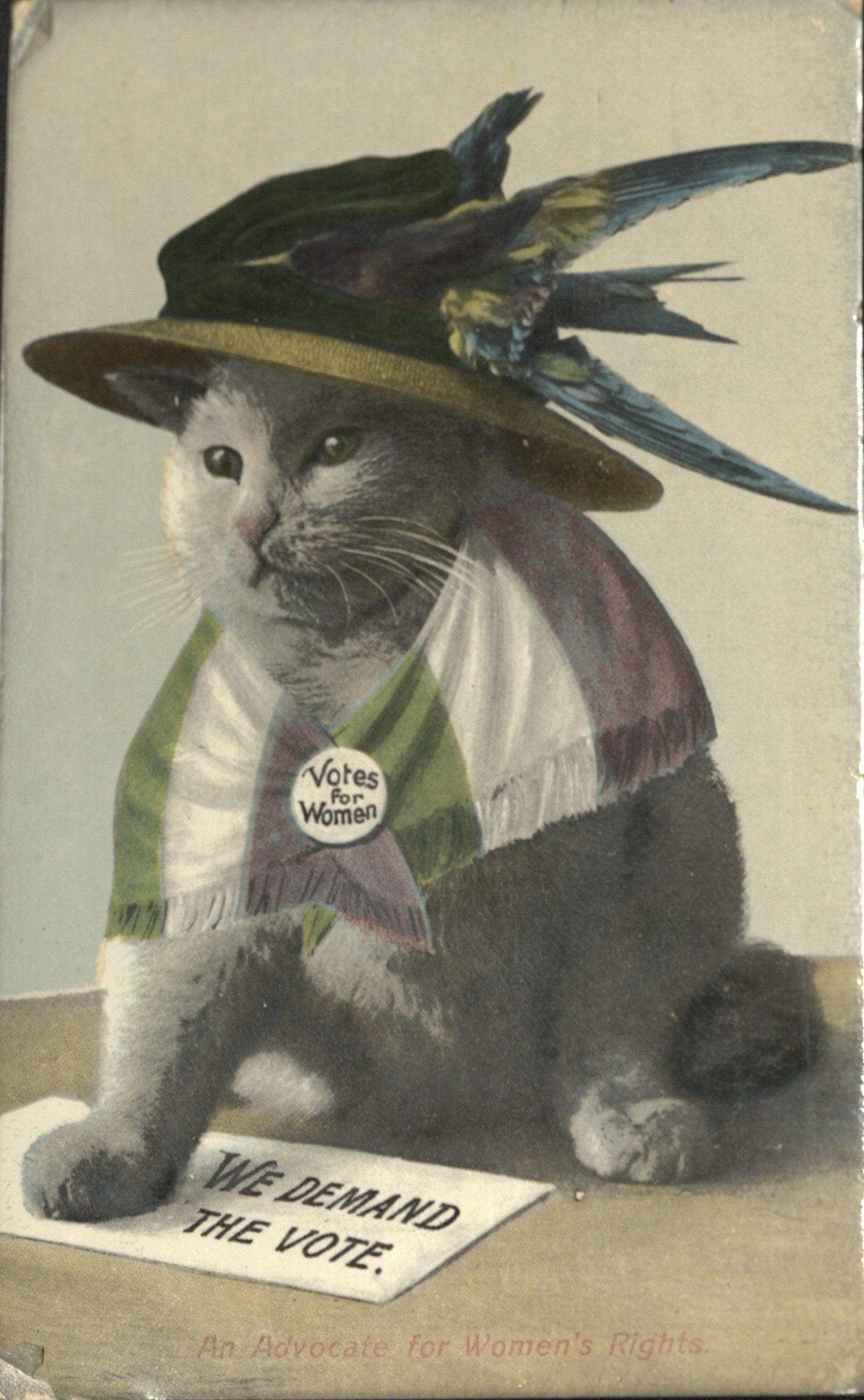
We Demand the Vote: An Advocate for Women’s Rights. Courtesy Votes and Petticoats: Postcards, The Sheridan Libraries, Johns Hopkins University.
In a similar vein, this cat is draped in the colors of the WSPU and wearing a fashionably magnificent hat. The message is ambiguous: Larissa Schulte Nordholt contends that it’s probably meant to satirize the concept of women participating in politics, the well-groomed, fat feline playing on the perception of suffragists as spoiled. It was published by a company that produced other, more clearly anti-suffrage postcards. But there’s a certain dignity in the cat’s determined forward gaze and assertive paw that perhaps suffragists could have embraced, regardless of the creator’s intention. Then again, that seriousness can also be interpreted as the very thing an anti-suffragist postcard maker was mocking by attaching it to a fluffy house cat.
Less whimsically, other postcards feature cats as pets in human scenes.
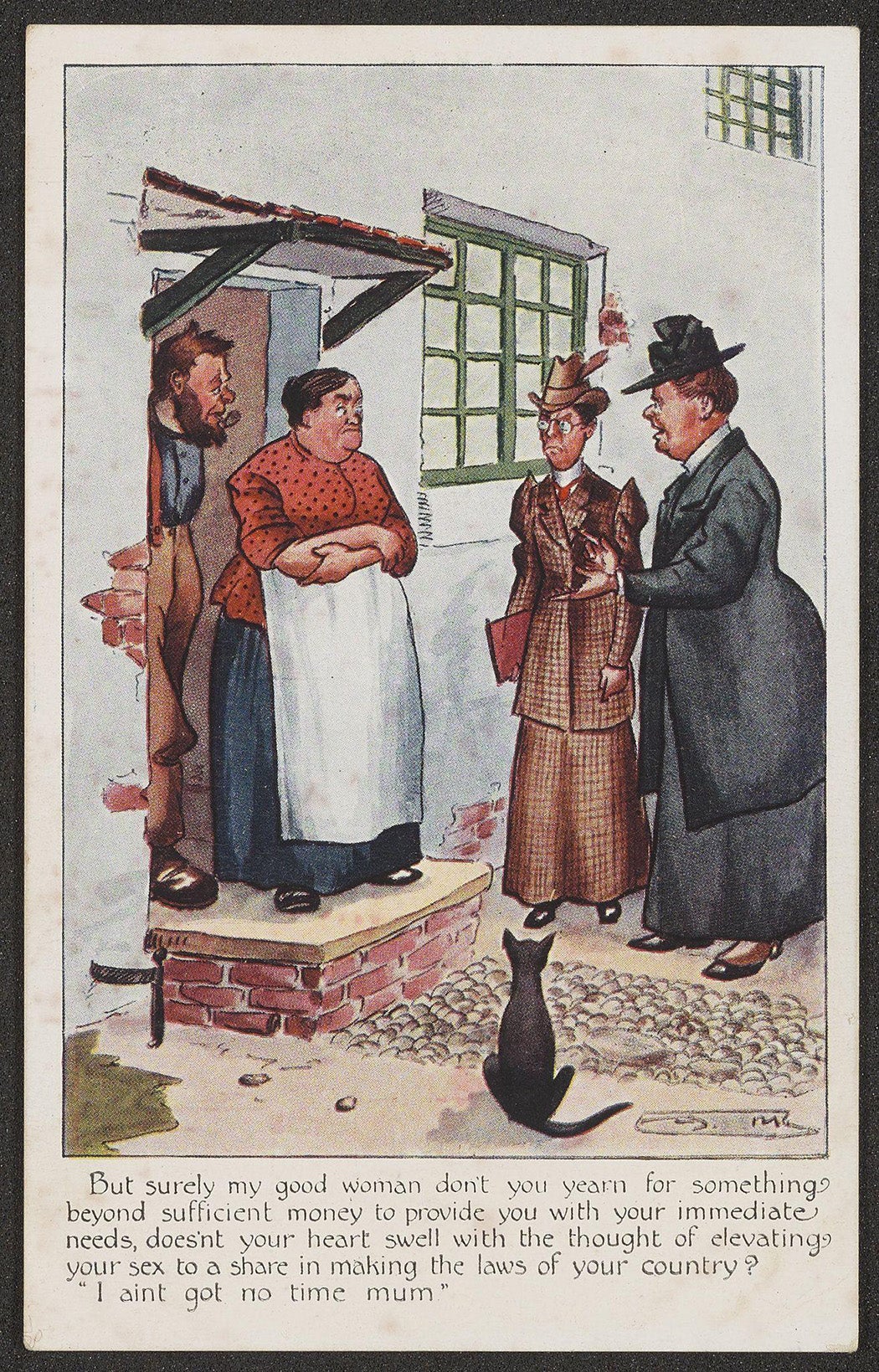
Courtesy Votes and Petticoats: Postcards, The Sheridan Libraries, Johns Hopkins University.
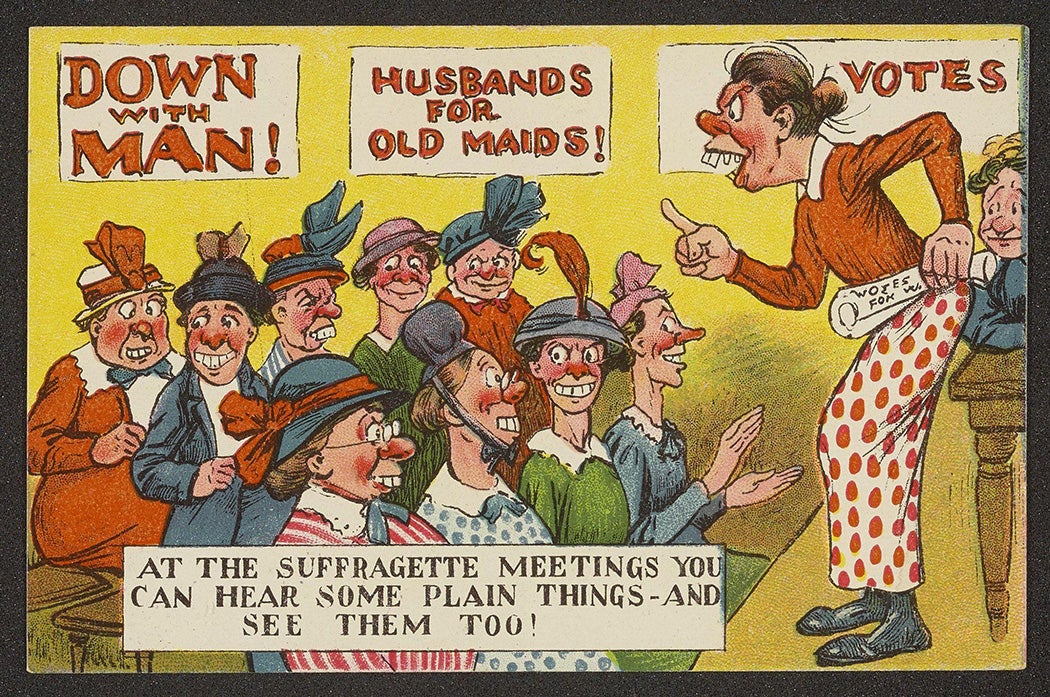
Here, the suffragists portrayed are mannish and middle-aged, typical of many negative suffragist depictions, stereotyping them as unsexed spinsters. While the housewife they address isn’t an idealized Angel of the House, she has a traditionally “motherly” figure and wears more feminine clothing. The suffragists, the viewer thus understands, are out of touch with what “real” working women want. If the suffragists had families to occupy them, they wouldn’t worry about the vote. And if lower-class women had the vote, they wouldn’t care to exercise it.
The cat in this postcard is outside the house and thus linked to the suffragists (it sits slightly apart, but arguably that positioning is dictated by compositional rather than symbolic reasons). The suffragists are “outdoor cats,” less benign and more feral—less feminine—than their indoor counterparts. It’s also worth noting that the cat is black, which taints it, and thus the suffragists, with associations of witchcraft and bad luck.
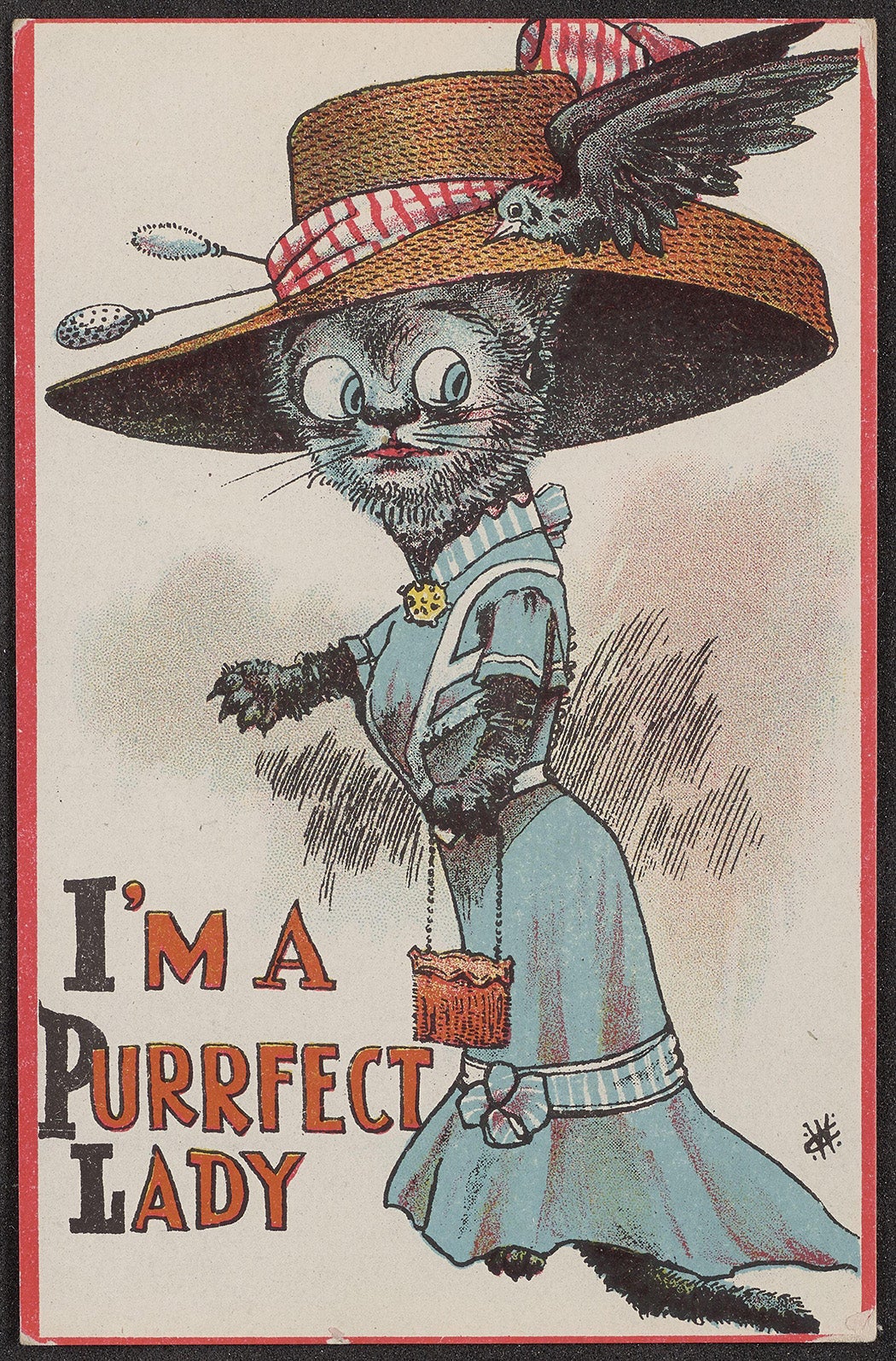
I’m a Purrfect Lady. Courtesy Votes and Petticoats: Postcards, The Sheridan Libraries, Johns Hopkins University.
Here too the suffragist is associated with a black cat, to unflattering, ridiculous effect. Although it was considered appropriately feminine for women to care for animals, women and femininity were also considered weaker, sillier, and more frivolous than men and masculinity; caring too much for other creatures came was considered a sign of fragility and triviality.
Tobias Menely has traced the disparagement of animal welfare through the evolution of gender norms in the modern period. As an early example, he cites a 1786 Scottish magazine story about a “Mrs. Sensitive” who dotes on a menagerie of pets yet cares little for “poor Christians.” In Menely’s analysis, Mrs. Sensitive is “immoral and unnatural, an ancestor of our own crazy cat ladies, women whose maternal instincts, we are led to believe, have been attenuated by an affinity for animals.”
By 1909, around the time these postcards were produced, sensitivity to animals was fully pathologized, as Menely relates: one doctor, Charles Dana, called it “zoöphilpsychosis” and published an article about it in the Medical Record. A case study pronounced a “childless woman who transformed her house into a hospital for sick felines” as “beyond medical redemption.” Sufferers of “zoöphilpsychosis” were described as “sentimental,” “weak,” and “hysterical”—terms loaded with sexist connotations.
These stereotypes are further repeated in conversations surrounding the anti-vivisection movement, another woman-dominated cause that reached its height in the Victorian and Edwardian eras.
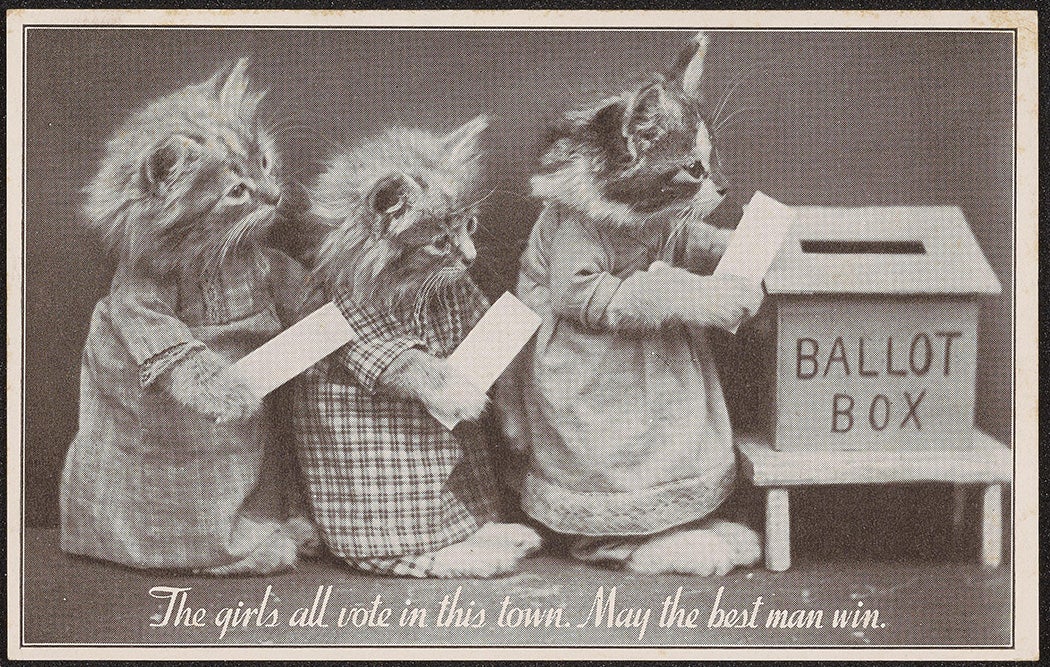
The Girls All Vote in This Town. May the Best Man Win. Courtesy Votes and Petticoats: Postcards, The Sheridan Libraries, Johns Hopkins University.
This is one of several suffrage postcards that feature photographs of live and presumably taxidermized kittens dressed up and posed. Although this postcard’s message could be interpreted multiple ways, Nordholt points out that the use of taxidermy speaks to the “synchronous oppressions of women and cats.”
Indeed, Susan Hamilton quotes a contemporary critic of anti-vivisection using misogyny to defend animal cruelty:
Is it necessary to repeat that women—or rather, old maids—form the most numerous contingent of [antivivisectionists]? Let my adversaries contradict me, if they can show among the leaders of the agitation one young girl, rich, beautiful, and beloved, or some young wife who has found in her home the full satisfaction of her affections!
Although suffragettes and antivivisectionists didn’t always align, the two movements had much in common, including the consistent stereotyping of their members as spinsters. And as we have seen in “But Surely My Good Woman…,” spinsters were objects of mistrust and derision.
Courtesy Votes and Petticoats: Postcards, The Sheridan Libraries, Johns Hopkins University.
It wasn’t always that way. For a time in the nineteenth century, single women could claim feminine power through the “Single Blessedness” movement. Where women had long been shamed or pitied for not marrying, they began to frame their singleness as reflective of a higher calling: still nurturing, still Christian, but outside of marriage. Harriet Tubman, for example, spent eighteen of her most productive and prominent years without a husband. As a Black woman, Tubman faced extra scrutiny for being unmarried. She leveraged the concept of Single Blessedness for respectability.
As women began to agitate more for equal rights, however, Single Blessedness fell out of favor. Lee Chambers-Schiller provides an overview, writing that
[a]s the century wore on, spinsters were increasingly defined as unacceptable childcare providers, guardians, or even teachers of children. Their spinsterhood took on an ominous cast, their celibacy no longer evidence of pure, Christian love, but now suggestive of physical, emotional, and intellectual degeneracy.
It wasn’t just that spinsters lacked the feminine graces needed to attract a man—their “degeneracy” was a result of their childlessness:
The woman whose reproductive organs went unused would experience their atrophy and derangement, together with a painful menopause and general physical and mental deterioration. A spinster could look forward to a shortened life span and quite possibly insanity.
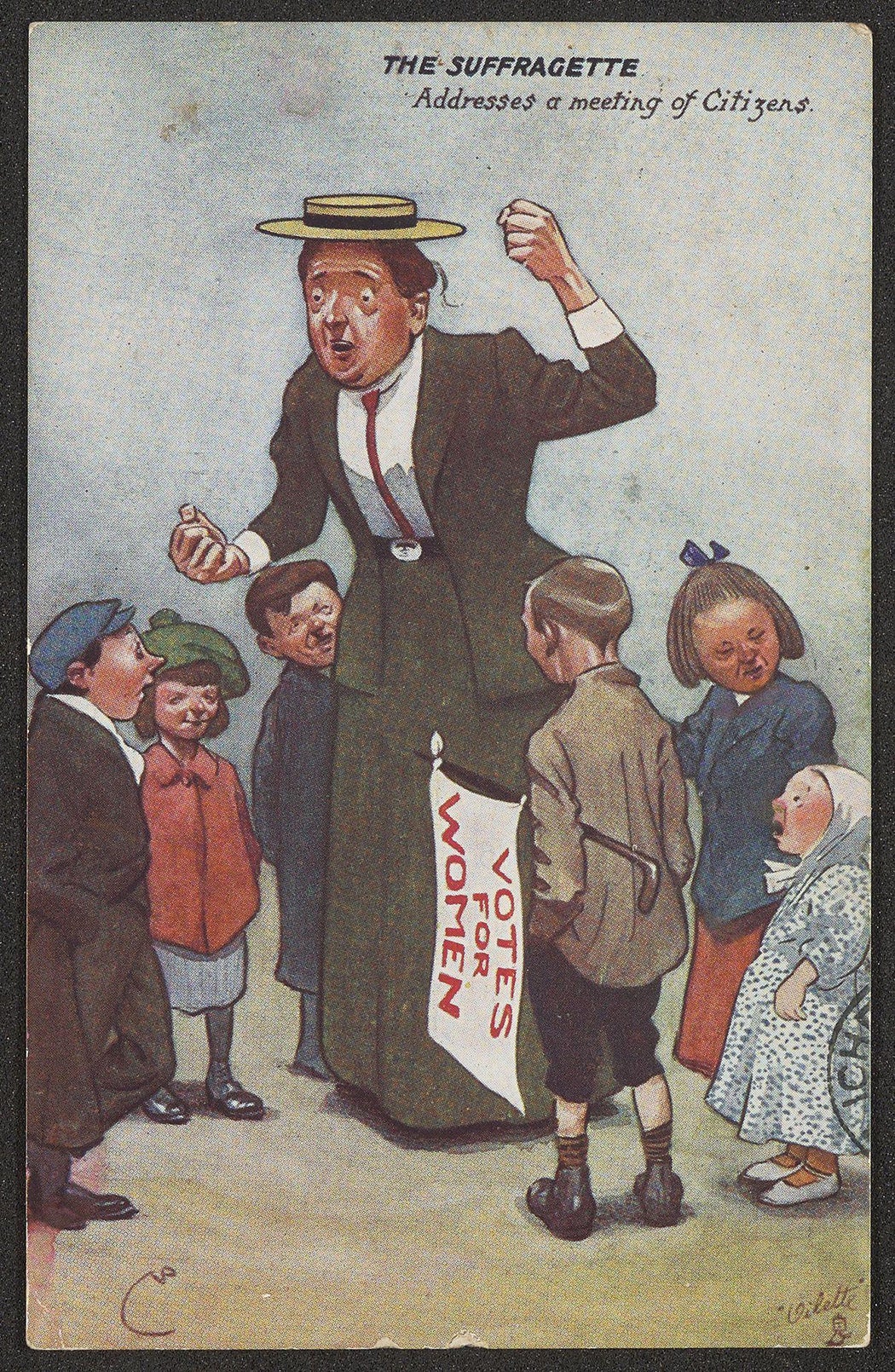
Courtesy Votes and Petticoats: Postcards, The Sheridan Libraries, Johns Hopkins University.
The suffragist in this postcard is marked as a spinster; her masculine features, hat, and clothing tell us as much. Wild-eyed and staring off the page, she’s so out of touch with reality and with her maternal instincts that she doesn’t even realize her audience of “Citizens” consists only of confused children.
Opponents of women’s suffrage argued that banning women from voting was actually a way of protecting them and preserving their angelic femininity. Politics, they claimed, was a nasty business that would take women away from their divine calling in the home, to the detriment of the race.
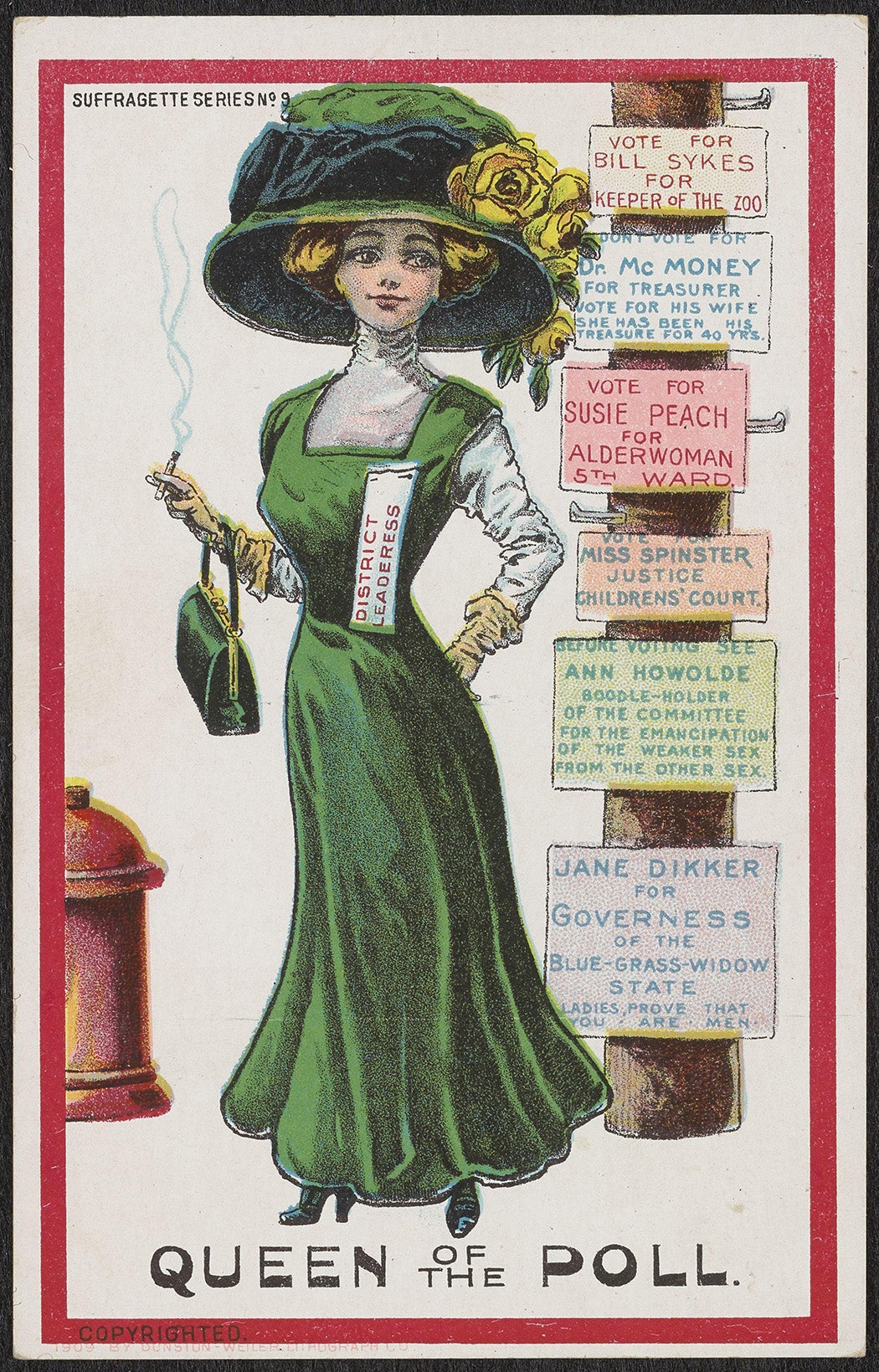
The Queen of the Polls. Courtesy Votes and Petticoats: Postcards, The Sheridan Libraries, Johns Hopkins University.
This woman represents anti-suffragists’ fears of what society would look like if women gained the vote. In contrast to the depictions of suffragists as dowdy old maids, the woman portrayed in this postcard is conventionally attractive and fashionably dressed. But her decadent New Woman status is given away by her cigarette—proper women didn’t smoke!—and her “District Leaderess” sash. The pole behind her is covered in campaign signs for mostly female candidates, including “Miss Spinster” for justice of the children’s court, which viewers are of course meant to interpret as an outrageous irony.
The role-reversal that women’s suffrage would supposedly bring about is communicated in several postcards, once again, through cat imagery.
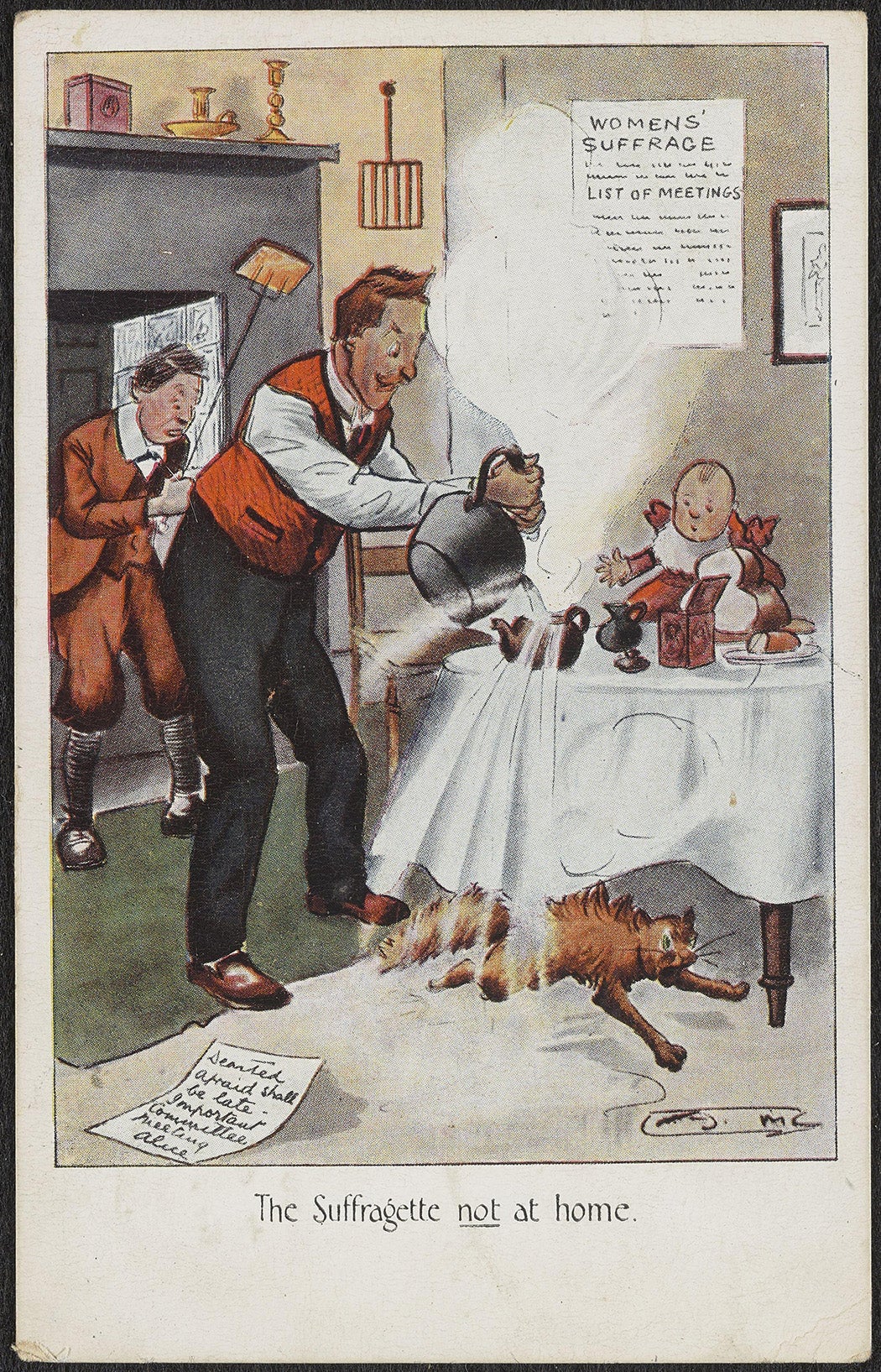
The Suffragette Not at Home. Courtesy Votes and Petticoats: Postcards, The Sheridan Libraries, Johns Hopkins University.Courtesy Votes and Petticoats: Postcards, The Sheridan Libraries, Johns Hopkins University.
Here, the man of the house is substituting for the absent woman by staying home, caring for the children, and making tea. The cat suffers the consequences of his ineptitude in the unnatural role.
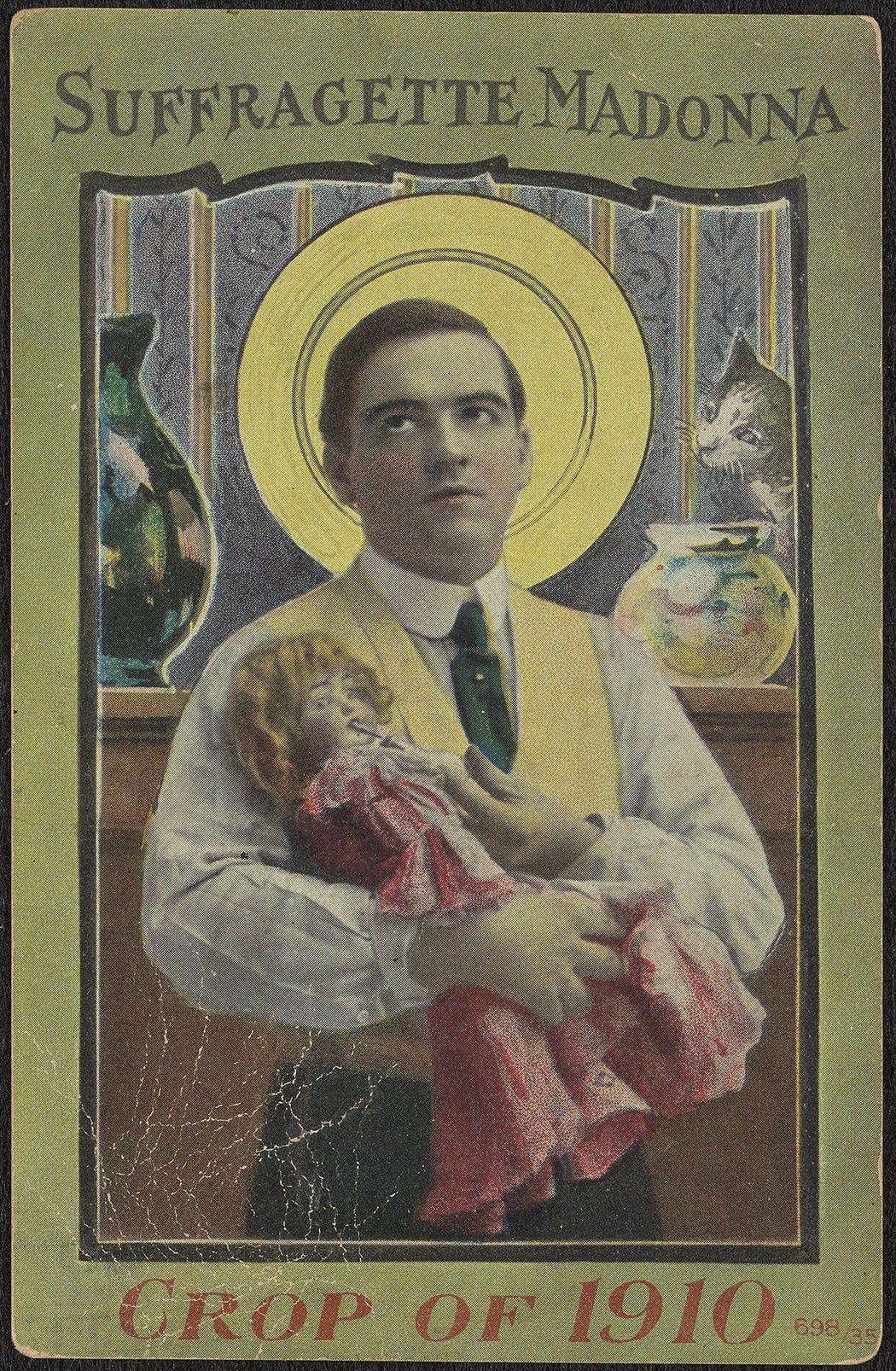
Suffragette Madonna Crop of 1910. Courtesy Votes and Petticoats: Postcards, The Sheridan Libraries, Johns Hopkins University.
Alternately, this man is taking good care of the home and family for his suffragist wife, but he’s thus emasculated. The halo of the golden plate, evoking the Virgin Mary, as well as the cat on the hearth behind him, emphasize his domesticity.
The absurdity of men in the women’s/cats’ sphere is surpassed by the absurdity of women/cats in the men’s sphere.
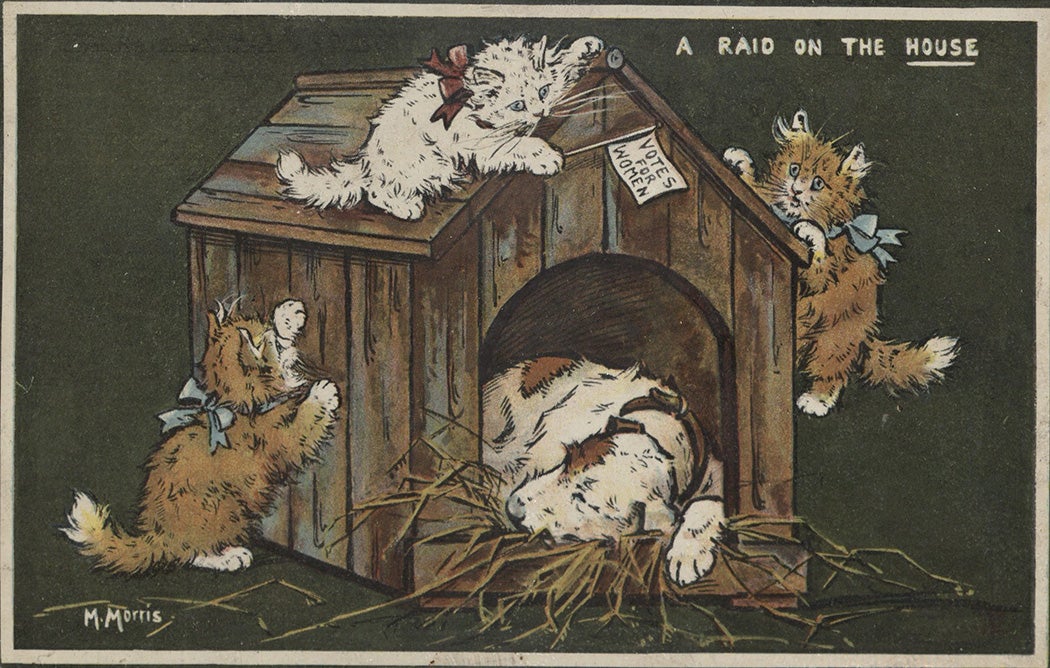
A Raid on the House. Courtesy Votes and Petticoats: Postcards, The Sheridan Libraries, Johns Hopkins University.
This British postcard seems to reference suffragists’ “raids” on the Houses of Parliament, during which women attempted to occupy the legislative chambers to protest their exclusion from them. The symbolism of this image is a striking echo of how the Daily Express described a suffrage raid in 1907: “[T]he sight reminded one very much of the removal of naughty kittens from a room in which they had been disporting themselves freely.” Cowman cites this description as example of voices in the press that often made light of the women’s suffrage movement, thus “making it appear over-feminine and consequently somewhat frivolous.”
Like “I Want My Vote!”, both this postcard and the Daily Express article infantilize women by portraying them as kittens. Viewers are meant to chuckle at the silly kittens’ attempt to infiltrate the doghouse—the kittens are cute, but they’ll never displace or even disturb the dog, who sleeps through their efforts.
“A Raid on the House” is particularly insulting when contrasted with the reality of the women’s suffrage movement, in which participants faced violent attacks. One march on the House of Commons in 1910 became known as “Black Friday” when suffragists were brutally beaten by police.
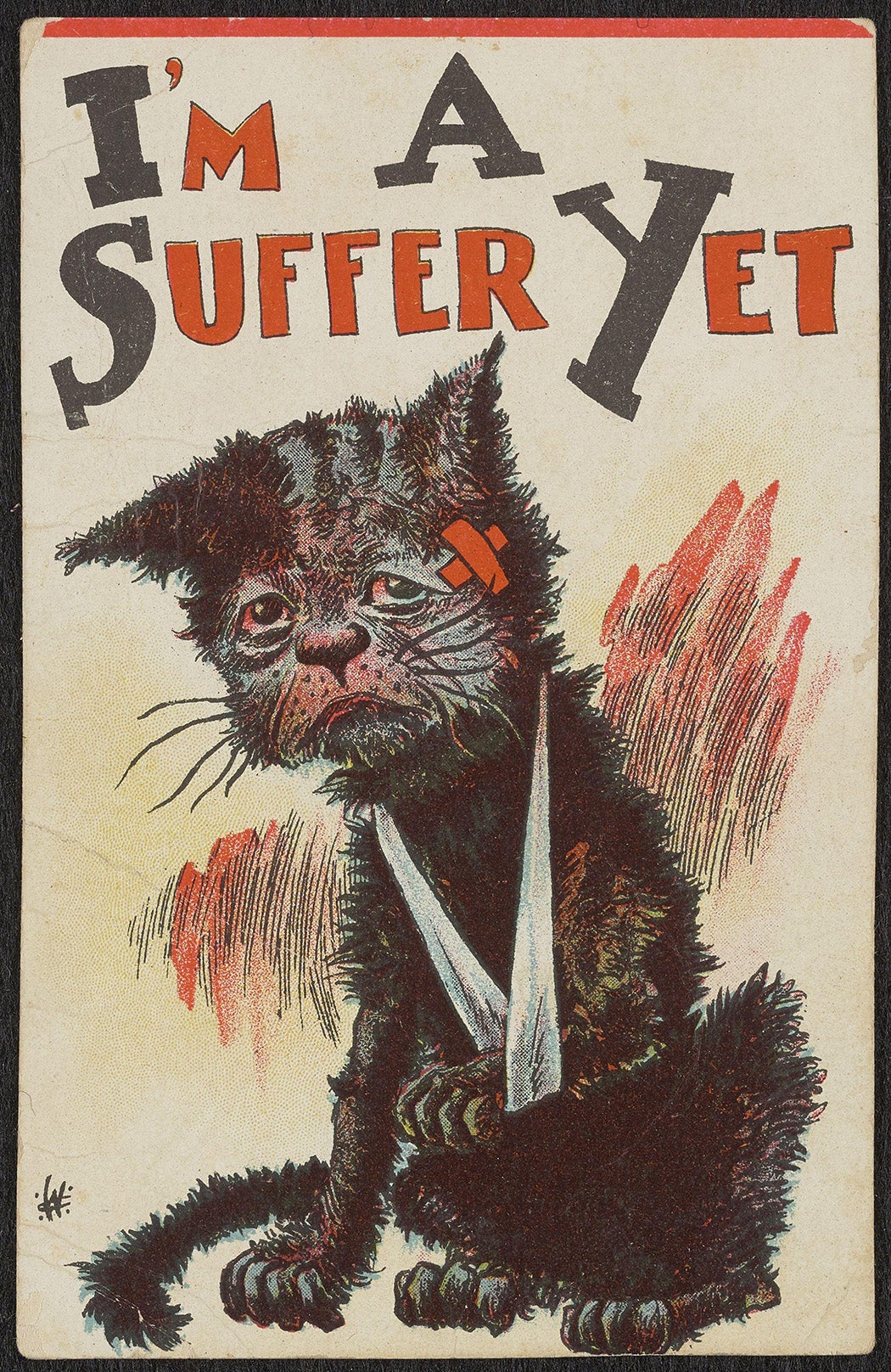
I’m A Suffer Yet. Courtesy Votes and Petticoats: Postcards, The Sheridan Libraries, Johns Hopkins University.
Bandaged and bruised, this bedraggled cat seems to represent a suffragist who has been beaten but is still dedicated to the cause. Whether the cat’s determination makes it sympathetic or stupid is a matter of interpretation.
Cats, as it turns out, are difficult to pigeonhole. So are women. According to Alleyn Diesel, the association between cats and women goes back at least as far as Ancient Egypt. Goddesses in ancient and contemporary religions have frequently been portrayed as either part-cat or accompanied by cats. And when it comes to goddesses, being catlike doesn’t mean being sweet and domestic. On the contrary, feline-linked deities are known for “self-reliance, elegance, and… willingness to be tamed strictly on their own terms”: powerful qualities that patriarchal societies mistrust in women.
When JD Vance questioned why a childless person would want to be a teacher or a leader, infamously calling Kamala Harris and her ilk “miserable” and “childless cat ladies,” he was invoking old, sexist stereotypes. The Harris campaign responded by selling “childless cat lady” merch. This tactic of reclaiming an insult and turning it into a badge of honor also has rich historical precedent.
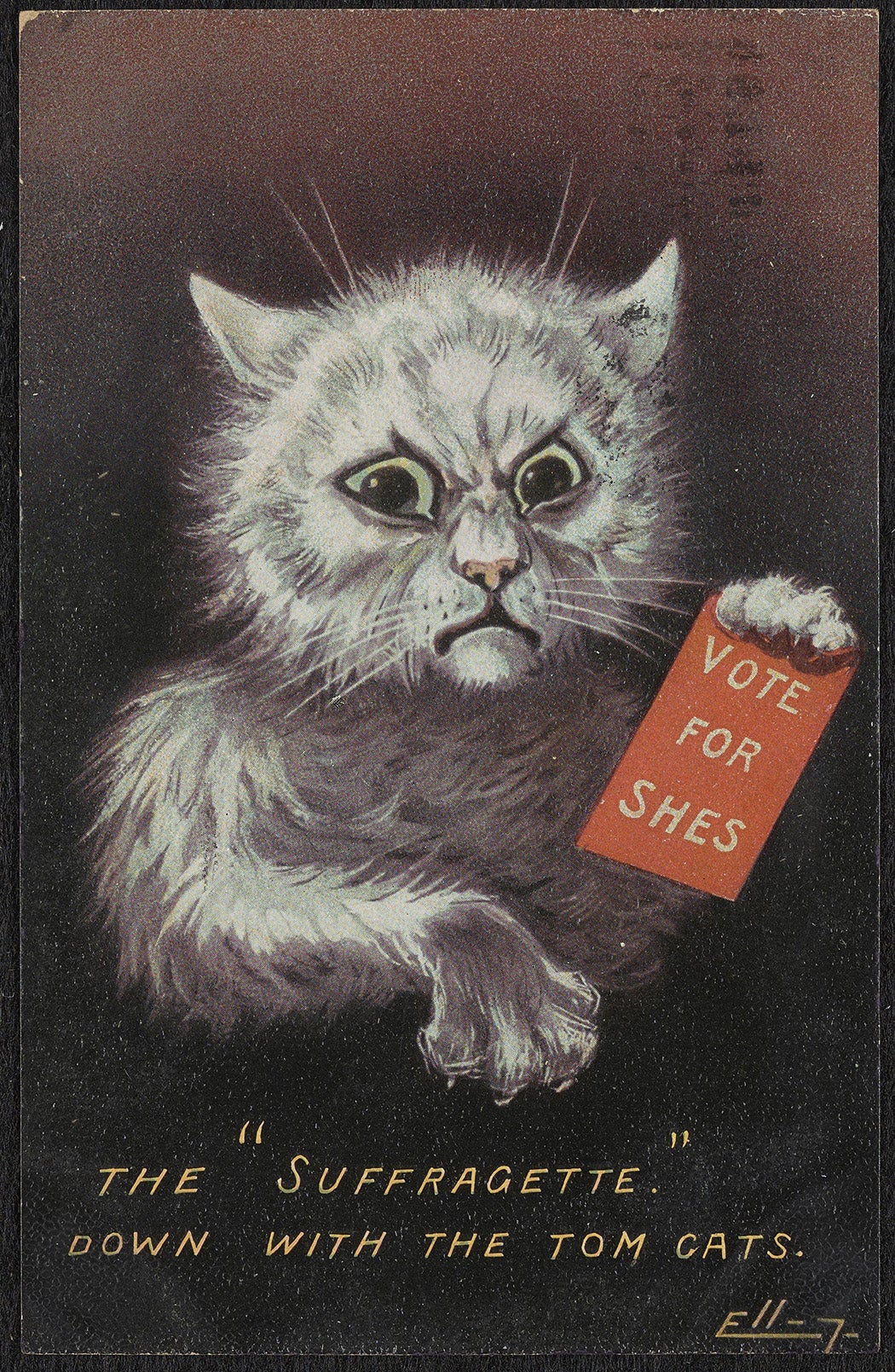
The Suffragette Down with the Tom Cats. Courtesy Votes and Petticoats: Postcards, The Sheridan Libraries, Johns Hopkins University.
The intention behind this final postcard may have been, yet again, to paint the fight for suffrage as absurd, to make suffragists seem like willful, unfeminine animals.
But the sender of the postcard wrote on the back, “See the expression: In town for the fight. Have used my night off for training my guns in the new campaign. Ha! Ha! You will see the signs soon.” We can’t be sure, but the writer seems to have been a suffragist, claws out.
Editor’s Note: Harry Whittier Frees, the likely photographer of the image depicting clothed kittens in line to vote, used live animals in his work, not taxidermy. The text has been amended to account for this fact.
Several hours before this tweet, North Carolina was declared a federal major disaster, which means @FEMA will rush federal aid to 25+ affected counties and reimburse local governments + nonprofits for restoring facilities and infrastructure.
Well, uh, let’s hear it for a fact-check from Frank Luntz, because open-faced lying to struggling people is, my God, why do we have to explain this? Completely wrong and unnecessarily divisive and totally unhelpful.
And also, what Trump is stunting about right now. He did a little photo-op in Valdosta and lied behind a tiny brick wall someone had to stop everything and make for His Nibs. And he had an emotional support evangelical by his side to sanctify his lying. Who prayed for HIM and his election because of course.
People have died. Some of the survivors have lost everything they had. They have family photo albums and keepsake Bibles and all kinds of records of their life they can’t get back. They are going to be homeless for a while. And Trump shows up in his MAGA hat like this was a campaign event. Costing local security. Taking away resources from search and rescue or whatever else for his hot minute criticizing the Biden Administration for–what they already are doing.
And Trump, snowbird, Florida Man, tells us he didn’t know this was peak hurricane season, because he is just as dumb as drying paint. And a whole attention whore. And I don’t even think he brought pallets of Trump water like he did to East Palestine this time. (But correct me if I am wrong)
But he, the man banned from having a charity in New York, has set up a Gofundme. He, the billionaire who supposedly could do a lot more than take credit for things he did not provide, like Starlink, is raising a fraction of other people’s money vs, say, what he owes for his rape settlement. Or his white collar fraud settlement.
Trump’s actions are as funny as a rubber crutch. He better not be leaning too hard on this weak effort of his to be relevant himself.
But for the still dubious, of course Biden or Harris aren’t supposed to swan on down there for a photo op as if they drive truck loads of supplies or all that. I don’t even know why people are supposedly making that a thing–except I do and it is dumb. They make sure the assistance is sent and coordinate with local government.
“Nothing I have experienced prepared me for the very public and relentless implosion of my father’s life,” writes Caroline Giuliani, announcing her support for Kamala Harris.
I am constantly asking myself how America is back here, even considering the possibility of electing Donald Trump again, after all of the damage he has caused, both in office and since. While Kamala Harris has gained extraordinary momentum by infusing this election with vitality and hope, I worry that too many Americans remain disconnected from the visceral, psychologically draining memory of Trump’s deeply destabilizing presidency. If enough people truly remembered what that chaos felt like, another Trump term wouldn’t even be on the table. But for those open to seeing the bare and unvarnished truth, there are unmistakable reminders of Trump’s destructive trail all around us, and it has broken my heart to watch my dad become one of them.
As Rudy Giuliani’s daughter, I’m unfortunately well-suited to remind Americans of just how calamitous being associated with Trump can be, even for those who are convinced he’s on their side. Watching my dad’s life crumble since he joined forces with Trump has been extraordinarily painful, both on a personal level and because his demise feels linked to a dark force that threatens to once again consume America. Not to disregard individual accountability in the slightest, but it would be naive for us to ignore the fact that many of those closest to Trump have descended into catastrophic downward spirals. If we let Trump back into the driver’s seat this fall, our country will be no exception.
My dad and I have a cartoonishly complicated relationship. But he is still my father, and despite his faults, I love him. I’ve seen him experience surreal heights, and, now, unfathomable lows. The last thing I want to do is hurt him, especially when he’s already down. Plus we never know how much time we have left with our parents. The totality of that makes this the most difficult piece I’ve ever written. Yet this moment and this election are so much bigger than any of us.
From reproductive rights and the economy, to foreign and environmental policy, we need experienced, sane, and fundamentally decent leaders who will fight for us instead of against us—who will safeguard our democracy rather than dismantle it. And as a recently engaged-to-be-married, 35-year-old who hopes to feel more joyous than fearful about the potential of becoming a parent myself, I need to advocate for a future worth bringing children into, which is why I am voicing my adamant support for Kamala Harris and Tim Walz. (snip-MORE) This is a worthy read, and it’s free.
Through public remarks, Truth Social screeds and more than 100 preemptive lawsuits, Donald Trump is assembling a detailed catalog of excuses for rejecting the results of the 2024 election — if he loses.
Why it matters: The Trump-aligned efforts to overturn the 2020 election — both overtly and covertly, peacefully then violently — shocked the American public. No one should be surprised this time around.
Listen to Trump: The former president, who risks jail time and more criminal trials if he loses, has expanded his range of baseless attacks on U.S. voting procedures in recent weeks and months.
Overseas voting: Trump falsely claimed Monday that Democrats are exploiting an overseas ballot program for expats and military members in order to circumvent “any citizenship check or verification of identity.”
Early voting: At a rally in Pennsylvania last week, Trump denounced what he called the “stupid” concept of voting 45 days before the election — floating conspiracy theories about his loss in the crucial swing state four years ago.
Mail-in voting: Trump has long despised mail-in ballots. He’s recently attacked the U.S. Postal Service as incompetent and untrustworthy — even as the GOP has pushed its voters to embrace the practice.
Zoom in: The millions of undocumented migrants who have crossed into the U.S. during the Biden administration are a top campaign issue. They’re also being used to fuel new voter fraud conspiracy theories.
Earlier this month, Trump demanded that House Republicans use the threat of a government shutdown to pass a measure requiring proof of citizenship to register to vote in federal elections.
That effort failed, but it gave Trump and Republicans a new excuse to claim election fraud — even though it’s already illegal and exceedingly rare for non-citizens to vote in U.S. elections.
Between the lines: Even without evidence of voting irregularities, Trump is preparing to deploy broader rhetorical arguments for why the election was fundamentally unfair.
The former president has accused Democrats of “cheating” by swapping out President Biden for Vice President Kamala Harris in June, and engaging in “lawfare” through criminal prosecution.
“If there was no cheating — if God came down from on high and said ‘I’m going to be your vote tabulator for this election,’ I would leave this podium right now,” Trump said Sunday at a rally in Pennsylvania.
“We have to have a landslide because they cheat so damn much.”
The big picture: Since 2020, the Republican Party apparatus has been reorganized — from the top down — to give credence to Trump’s false claims that election fraud is a scourge on American politics.
Trump’s campaign and the Republican National Committee say they’ve built a network of about 175,000 volunteer poll watchers and poll workers, part of a relentless focus on “election integrity.”
In Georgia, a hard-right election board has passed new rules that Democrats fear could be used to undermine confidence in the results if Trump loses the critical battleground state.
House Speaker Mike Johnson (R-La.) drew outrage last week by pledging to certify the 2024 election and “follow the Constitution” only if it’s a “free, fair and safe election.”
What to watch: On Nov. 1, 2020, Axios reported that Trump had privately told confidants he planned to prematurely declare victory on election night if it looked like he was “ahead.”
The republican’s know their policies and ideas are very, very unpopular. They can’t win on them, so they are forced to cheat and drum up fake fears to scare voters to vote for them. Hugs. Scottie
‘Congratulations’ the fake letter reads, ‘you have been selected as a Wayward Steward exchange home for homeless immigrants and victims of foreign wars.’
A Bala Cynwyd couple received a fraudulent letter from the Pennsylvania Congressional Office of Immigration Affairs this week informing her that she’d been selected as a “wayward steward” to house five refugees. The office does not exist, nor does the program. Elizabeth Bennett holds the letter on Sept. 27, 2024.Read moreCharles Fox / Staff Photographer
A Bala Cynwyd voter got a detailed letter this week from the made-up Pennsylvania Congressional Office of Immigration Affairs notifying her that her household had been selected to house five migrant refugees.
No office exists, nor does such a government-mandated housing program, but the letter, doctored to look like an official government document, provided specific details designed to mislead someone less attuned to a scam — and laid the blame for the fake program at the feet of President Joe Biden and Vice President Kamala Harris during a heated and close election in which immigration has increasingly become a focal point.
“I’m concerned to find out how many people might have actually gotten it and to make sure the record’s set straight so people aren’t getting fearful or angry and deciding to vote another way,” Elizabeth Bennett, 62, said.
The letter says Bennett was selected as a “wayward steward” as part of “US5Ca12-B … written into Law by President Joe Biden and Vice President Kamala Harris.” No such law exists.
It advised Bennett she’d been selected based on property and income records and would receive an $80 weekly stipend for food costs. The letter suggested a “minimum of one bedroom be prepared with a minimum of 5 beds,” with a link to “government-approved” bunk beds.
The return address listed is for an intersection in front of the Capitol building in Harrisburg.
Neither the governor’s office nor the department of state immediately returned a request for comment.
Bennett is unsure why she was targeted. She has a large Harris/Walz sign in her front yard. Ironically, she’s also done volunteer resettlement work with immigrants for the last 30 years but she assumes that was just a coincidence.
“Of all the people they could send this to, I would be the one who is like, ‘OK let’s get the room set up, we gotta take care of these people,’” she said. But as she read on, she realized the program was fake and intended to scare people.
“I could definitely see, even for me reading this letter it felt threatening even though I’m very pro-immigrant because it felt like something that was being imposed on me,” she said.
It’s unclear if other Pennsylvanians received the letter. Bennett posted about it in small Facebook groups but hasn’t heard from others who received it.
But whoever created the letter took time to make it look like an official document, including an imprint of a fake Pennsylvania seal on the letterhead and a stamped date informing Bennett when to expect the migrants.
A listed phone number for the fake office, with a Harrisburg area code, goes to a voicemail for the named office where a messaging service invites the caller to press one for housing vouchers, two for reimbursements, and three to “expand your footprint to help more people.”
The letter Bennett received went on to specify garages or sheds without electricity and running water could not be used.
“Thank you for your dedication to the health and safety of these future Americans!” it concluded.
Misinformation about migrant resettlement and illegal immigration has been rampant in the campaign. Former President Donald Trump and his running mate JD Vance have made it a focus of their bid for the White House claiming that migrant resettlement has drained resources from small towns and that illegal immigration has driven crime and economic hardship, with little evidence.
The federal Office of Refugee Resettlement does invite people to be part of a government hosting program but participation is entirely optional.
State Rep. Joe Hohenstein (D., Philadelphia) is an immigration attorney who called the letter “a betrayal of the actual spirit of our country.”
“It’s definitely designed to make people think that there’s a broader government program to resettle refugees and my guess is that the intention is to stir up fear of immigrants and refugees,” he said. “That’s reprehensible It’s a betrayal of the actual spirit of our country of being a welcoming beacon to people who are seeking freedom.”
In the next week, Hohenstein is cosponsoring a bill to establish an Office of New Pennsylvanians, which would help provide support services for refugee businesses and migrants fleeing persecution in Pennsylvania.
“This would provide help to people who need it,” he said. “It would not be a mandate to anyone.”



/2024/09/27/1727456622728.gif?w=1920)
/cloudfront-us-east-1.images.arcpublishing.com/pmn/FAKIWMSCXVGIDIVVRUCZQ7NRIM.jpg)
/s3.amazonaws.com/arc-authors/pmn/b1bd3a0d-2d7c-4401-a7e3-5ae6984bf698.png)
 Scottie's Playtime