September 8, 1756 Colonel John Armstrong and troops under his command destroyed the Indian village of Kittanning. The Corporation of the City of Philadelphia awarded a silver medal to Armstrong and his officers for their action.
September 8, 1941 In Norway, 2000 workers in the shipyards went on strike against diversion of milk, “depriving mothers and babies,” to military use by the German soldiers in Finland. In retaliation, Oslo was placed under a 7 o’clock nightly curfew, after which transportation was stopped, public meetings prohibited, radios seized, dancing forbidden. Boy Scouts, Girl Guides and Salvation Army organizations were all dissolved. More about the Milk strike
September 8, 1965 Table grape pickers, the mostly Filipino members of the Agricultural Workers Organizing Committee (AWOC), led by Larry Itliong, went on strike for higher wages in Delano, California. Larry Itliong More about Larry Itliong
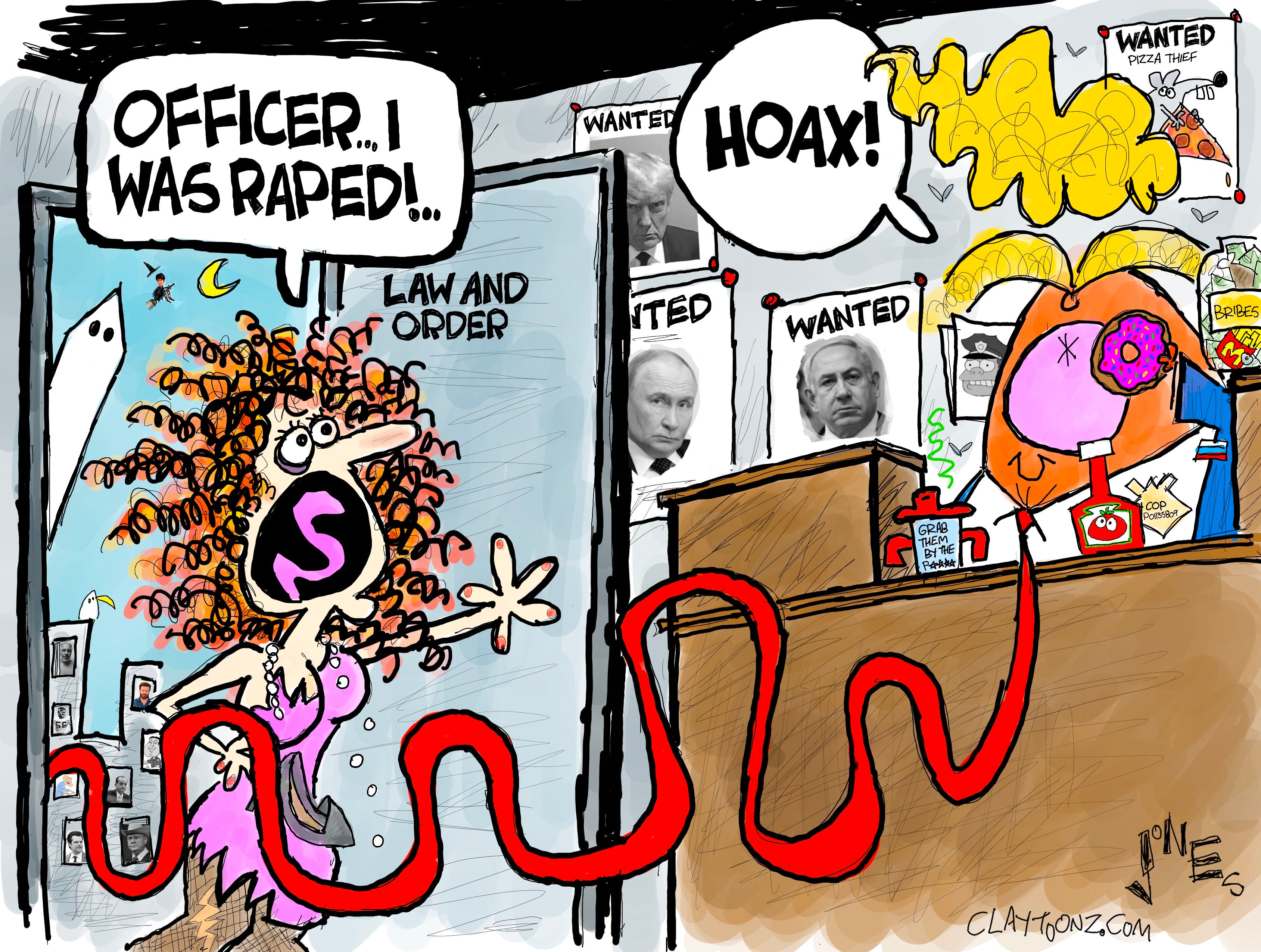
A group of Epstein abuse survivors held a press conference on Capitol Hill yesterday, calling for the release of all the documents related to the investigation into Jeffrey Epstein. Donald Trump replied to this, calling it a “Democrat hoax,” which was weird since his name didn’t even come up, other than pleas to help release the files. So, what exactly is the “hoax” he’s speaking of?
This is like a case where someone ran a bus full of nuns off a cliff, and then a friend says to you, “Hey, did you hear about that bus full of…” And you interrupt, shouting, “I didn’t do it! Those nuns are lying!”
Has Donald Trump ever sexually assaulted a nun?
Bipartisan lawmakers and Survivors of Epstein’s abuse gathered on the steps of the Capitol to demand that Congress vote to release all the files related to the investigation. These are files that Speaker Mike Johnson, who told his colleagues to ignore the petition, does not want released. Today on GoComics, one of the trolls said that the Epstein Files won’t implicate Trump. If that’s the case, then Trump should release them.
This is weird because MAGAts are either demanding the release of the files or helping Trump with the cover-up. Is that what Watergate was like, with Republicans stating that nobody needs to hear the missing 18 minutes?
I’ve never said the Epstein Files would implicate Trump, but I’m all for pressuring the regime to release them. There’s a reason why the regime won’t release them. What is that reason? (snip-MORE, and it’s excellent)
Trump Revamps the Smithsonian Art Collection by Ann Telnaes Read on Substack
WASHINGTON—Denouncing the Smithsonian Institution’s art collection for being “toxically woke”, Donald J. Trump announced today that he is replacing it with newly commissioned works depicting himself and members of his inner circle: Melania Trump, Pam Bondi, Stephen Miller, JD Vance, and Kristi Noem.
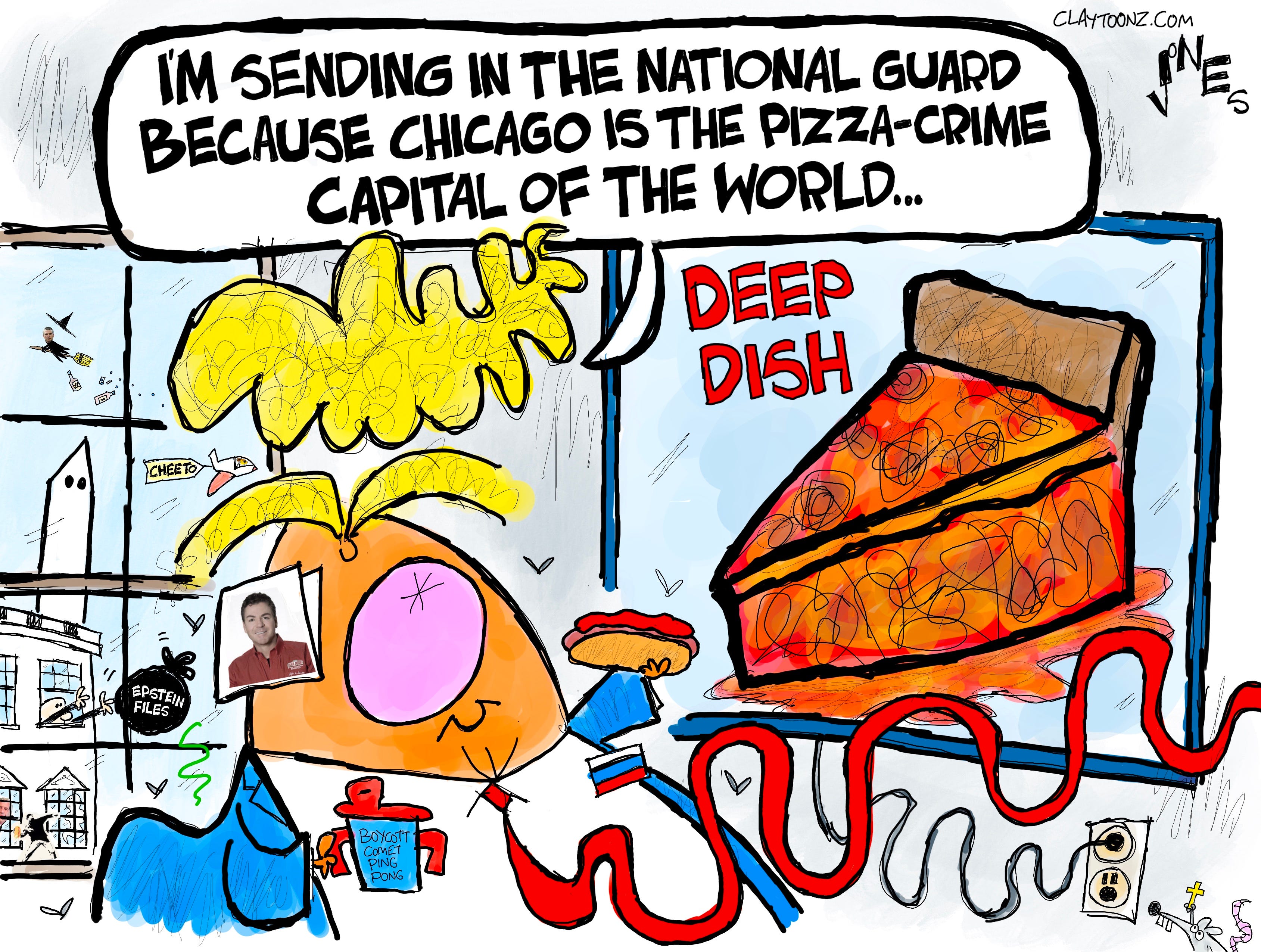
Describing the city as the “murder capital of the world, Donald Trump said yesterday that he’s going to send the National Guard into Chicago, saying, “We’re going in.” Actually, Memphis is the “murder capital” of the United States, but it’s in Tennessee, which is a red state. These are all photo-ops, you know.
Trump reversed course today while entertaining Poland’s new president, who, like Putin, got a military flyover. A lot of DC residents didn’t appreciate the flyover, as those things tend to be loud, and they shake things off shelves, like cats do.
I can’t tell you how many times I’ve been to the District, and I’ve never gotten a military flyover.
Trump said that now he’d like for the military to be invited by governors before he sends the military into their cities for photo-ops, like he did with DC.
Trump said, “We are making a determination now. Do we go to Chicago? Or do we go to a place like New Orleans where we have a great governor, Jeff Landry, who wants us to come in and straighten out a very nice section of this country that has become quite – quite tough, quite bad?” Make up your mind, Trump. Is it nice or is it bad?
Someone must have told Trump that it’s illegal to send the military into cities without formal requests by governors. DC is a different situation as it is under the exclusive constitutional authority of Congress, which has the power to directly intervene in local governance. This arrangement is due to the city’s status as a federal district, not a state, and gives DC residents limited self-government and no voting representation in Congress. The citizens of Washington, DC have taxation without representation.
But other cities are different, and a judge just ruled that Trump broke the law when he sent Marines into Los Angeles to break up anti-ICE protests. Trump can probably expect the same verdict if he invades Chicago, which the city will reject. (snip-MORE)
September 4, 1954 The Peace Pledge Union (PPU) organized a demonstration against the H-Bomb in London’s Trafalgar Square. The PPU dates back to October 1934. Young Peace Pledge Union members today. The PPU today History of the Peace Pledge Union __________________________________________________ September 4, 1957 Elizabeth Eckford and eight other young Negroes were blocked from becoming the first black student at Central High School in Little Rock, Arkansas. Elizabeth Eckford Governor Orval Faubus had called out the National Guard to prevent the court-ordered integration of the public schools in the state’s capital. President Dwight Eisenhower eventually sent in federal troops to guarantee the law was enforced. Elizabeth Eckford followed and taunted by mob, 1957.Read more Read More A very interesting related story: ____________________________________________________ September 4, 1970 Vietnam Veterans Against the War (VVAW) began Operation RAW (Rapid American Withdrawal). Over the following three days more than 200 veterans, assisted by the Philadelphia Guerilla Theater, staged a march from Morristown, New Jersey, to Valley Forge, Pennsylvania, reenacting the invasion of small rural hamlets along the way. Operation Rapid American Withdrawal 1970-2005: Memories ______________________________________________________________ September 4, 1978 Simultaneous demonstrations in Moscow’s Red Square and in front of the White House in Washington, D.C. were organized by the War Resisters League, calling for nuclear disarmament.
From left: Sen. Elizabeth Warren, Sen. Bernie Sanders, and Former Speaker of the House Nancy Pelosi, photos by Gage Skidmore, Sen. Joe Manchin, photo by Benedikt von Loebell | CC
According to End the Bribe System, “A ‘corporate democrat’ is a term used to describe a politician or political candidate who is associated with the Democratic Party in the United States and who is perceived to be more aligned with corporate interests than with progressive or left-leaning values.” The term is generally used by individuals critical of those politicians, who they believe prioritize the interests of corporations over their ordinary constituents.
These politicians are generally seen in the mainstream media as more moderate or centrist, and they are more likely to support policies that are beneficial to corporations, such as deregulation and tax cuts. Some corporate Democrats also call themselves “New Democrats.”
They also receive campaign contributions from large corporations and wealthy donors, which creates the perception that they are beholden to their donors rather than their constituents.
The term “corporate democrat” tends to be used by those on the left of the political spectrum who are critical of the influence of corporate money in politics and who support more progressive policies. They might view these politicians as too willing to compromise on important issues, or as not doing enough to address issues such as income inequality, climate change, or access to healthcare.
Although this term can be used in a derogatory manner, not all politicians within the Democratic Party who receive corporate donations are necessarily “corporate Democrats.”
There are different definitions of what a “corporate Democrat” is depending on who you ask. Some argue that a corporate Democrat is any politician who supports corporations, but that is not the best definition. End the Bribe System defines corporate Democrats as “…any Democratic Politician who accepts money from rich donors for favors (but claims it doesn’t influence them).”
Although corporate Democrats may support some policies their constituents want, when they have to make a decision, they will do what their wealthy donors prefer.
Most Republicans today can be considered “corporate Republicans,” given the majority of them accept corporate PAC money, and their policies almost always favor the desires of corporations, rather than their constituents.
Although the common wisdom is that Republicans raise more corporate political donations than Democrats, the actual difference is less dramatic when it comes to PACs. In 2022, Republicans received 55% of their contributions from corporate PACs and business-related associations while Democrats received 45%.
According to the Othering & Belonging Institute, Corporate Democrats have employed a narrative of pragmatism in the face of increasing political polarization. They see themselves as the brokers between Republicans and progressive Democrats. They also claim not to tow party lines and to only vote with their constituents’ interests.
Corporate Democrats see themselves as bipartisan and willing to compromise with Republicans to enact legislation in a time of partisan gridlock.
Examples of corporate Democrats on the state level include California Assembly members Rudy Salas, Adam Gray, and Jim Cooper, who describe themselves as fiscally conservative, “middle of the road”, and voices for the “silent majority,” as in the middle and working-class people who are not represented by the liberal coastal elite.
On the federal level, some examples of centrist or corporate Democrats include Senator Joe Manchin (D-W.Va.), Senator Dianne Feinstein (D-Calif.) and former Speaker of the House Nancy Pelosi (D-Calif.). Senator Kyrsten Sinema from Arizona was also a notorious corporate Democrat until she recently became an independent.
Progressive Senator Bernie Sanders even attacked Senator Kyrsten Sinema in 2022, calling her a “corporate Democrat” who “sabotaged” party priorities following her announcement that she was becoming an Independent.
Sanders said Sinema did not have the guts to take on special interest groups while attacking Sinema’s voting record.
“She is a corporate Democrat who has, in fact, along with Sen. [Joe] Manchin [D-W.Va.] sabotaged enormously important legislation,” Sanders said.
According to the Othering & Belonging Institute, Corporate Democrats say increasing government regulations on corporations negatively impacts job prospects for their middle-class and low-income constituents.
Despite the fact that some of them use anti-elite, populist rhetoric, corporate Democrats consistently vote in direct opposition to the well-being of their working-class constituents. Many progressives even argue that corporate Democrats’ failure to deliver for the working class for decades led to Trump getting elected president.
There is also some empirical evidence of the existence of corporate Democrats. According to a Princeton University study in 2014, there is no correlation between what the average American wants policy-wise and what is adopted. But there is a high correlation between what special interest groups and rich Americans prefer, and what policies are adopted.
Some political scientists argue that the study, along with others, provides enough evidence to conclude that the United States is not really even a representative democracy, Rather, it would be more accurately described as an oligarchy with democratic features.
Some Democrats have decided the only way to combat this issue of money in politics is to pledge not to accept any corporate PAC money. In 2022, more than 70 members, almost all Democrats, said they would not accept such contributions.
“Refusing corporate PAC money is one way to show a commitment to addressing the problem of money in politics, and its popularity helps keep the issue at the top of the agenda,” said Adam Bozzi, vice president for communications at End Citizens United, a group aligned with Democrats that tracks which members pledge to decline donations from corporate PACs.
“We expect the trend to continue to grow, and it will help us work toward progress on anti-corruption legislation, like ending dark money,” Bozzi said, using a term for committees that spend money to influence elections or policy but do not disclose their donors.
It is unclear if there will be any real widespread change though anytime soon, given major campaign finance reform or legislative changes have not even been proposed or voted on.
This is an article but one I wanted to share as I will soon be posting on what is a corporate democrat. The Democratic Party went to the right under Pelosi’s management / guidance. She pushed that for two reasons, one to chase the mythical center voters that as the republicans went ever harder right the center moved and the Democratic Party rather than staying where they were moved right to keep the “center voters”. Also Pelosi and the older elected members of congress felt they needed corporate money so they had to stop fighting businesses so hard to help the workers and the poor to instead play nice with the upper incomes. Hugs
Ever since Donald Trump won the election last month, bringing the GOP not just the White House but the House, the Senate, and the popular vote for the first time in 20 years, Democratic pundits, consultants, elected officials, and influencers have written think pieces, taken to social media, and sat down on podcasts to theorize why Democrats lost in the spectacular fashion they did. They blame this constituency group or that constituency group, this policy tweak or that policy tweak, this campaign decision or that campaign decision, but the truth is very simple:The Democratic Party is trying to serve two masters—the people and the corporate donors. And until it picks the people over its corporate masters, the Democratic Party will keep losing.
For as long as I can remember, the Democratic Party has marketed itself as the party of working class people, while the Republican Party has been painted as the out-of-touch, elitist, uncool party. When you’ve marketed yourself as the party of the working class, you cannot spend years in power and say the economy is booming while people struggle to afford rent and groceries. It was out of touch, and Democrats lost credibility by claiming “Bidenomics” was successful.
While some will point to the fact that the U.S. economy fared better than others during the pandemic in terms of inflation, that does not mean the economy is “good.” Working-class Americans from all backgrounds have been hurting. I cannot go to someone’s doorstep in my hometown of Cleveland, Ohio, one of the poorest big cities in America where one out of every two children lives in poverty, and tell them that the economic pain they are feeling is not bad because other countries have it worse.
US President Joe Biden speaks to the press during his visit to the National Slavery Museum in Morro da Cruz, near Luanda, on December 3, 2024. ANDREW CABALLERO-REYNOLDS/AFP via Getty Images
Democrats should have spent the past four years tackling corporate greed aggressively, fighting for those communities hit hardest by this greed. They should have championed bold policies like Medicare for All and tuition-free college, things that would ease economic burdens on working class Americans.
“You should not go into debt if you get sick or pursue an education” would be one hell of a rallying cry for the Democratic Party. Currently, the Democratic Party cannot stand for policies that get at the root causes of corporate greed.
Why? Because the corporate donor class, those who write the checks, have ensured that those who hold titles in the Democratic Party do not champion policies that might hurt their profits.
When I hear from Democratic voters as I travel this country, I notice that most believe that Democrats broadly support things like universal healthcare and raising the minimum wage, but the Republican Party is standing in the way. While the Republican party does stand in the way of those policies, so too does the Democratic Party establishment. For instance, when Democrats held power in the Senate in 2021, the unelected Senate Parliamentarian, the official advisor to the United States Senate on the interpretation of Standing Rules of the United States Senate and parliamentary procedure, would not allow the Senate to vote on raising the federal minimum wage to $15 per hour. However, the Senate Parliamentarian can be overruled by the Vice President. The Biden-Harris administration decided against overruling the decision and allowing the Democratic-controlled Senate to vote on raising the minimum wage.
Decisions like these are made with donors in mind. I always say that inaction is bought. Eventually in politics, inaction catches up to you. On November 5, inaction caught up to the Democratic Party.
Everyday Americans do not live the same lives as the ultra-wealthy donor class. Everyday Americans sit at tables and make tough budget cuts for things they may need because bills start piling up. Sixty percent of Americans are living paycheck to paycheck. If Democrats continue to prioritize policies that benefit their ultra-wealthy donors over policies that help the working class, they can expect to see Republicans harness the anger of those feeling left behind.
On February 1, the Democratic National Committee will meet in Maryland to elect a new party Chair. Currently, the DNC Chairman is Jaime Harrison, formerly a lobbyist for tobacco companies, coal producers, and big banks. These are industries that have repeatedly hurt the working class.
If Democrats want to win back the trust of the people, they must champion bold policies that help people. To do that, they cannot take money from the very corporations that stand in the way of those bold policies.
When the Democratic National Committee votes on a new chair, it must be someone who commits to getting corporate money out of the party. Otherwise, Democrats will be stuck in the same position: fighting for corporate interests while trying to convince the people the party is on the side of the working class.
Nina Turner is a former Ohio state senator, a senior fellow at the Institute on Race, Power and Political Economy at the New School, and the founder of We Are Somebody.
The views expressed in this article are the writer’s own.






 Newsweek Is A Trust Project Member
 Scottie's Playtime