
What You Need To Know About the Charges Against the Correspondents’ Dinner Attacker
Today, the government charged Cole Tomas Allen with attempt to assassinate the president, interstate transportation of a firearm, and discharging a firearm during a crime of violence. Prosecutors asked a judge in the District of Columbia to detain Allen in custody pending trial.
The charges filed against Allen differ from what U.S. Attorney Jeanine Pirro suggested they would be over the weekend, but, as we discussed, that was to be expected, with charging decisions remaining fluid as officials learn new information. A prosecutor indicated that the attempt to assassinate Trump was made with a 12-gauge pump action shotgun, but that Allen was also carrying a .38 caliber semi-automatic pistol, three knives, “and other dangerous paraphernalia.”
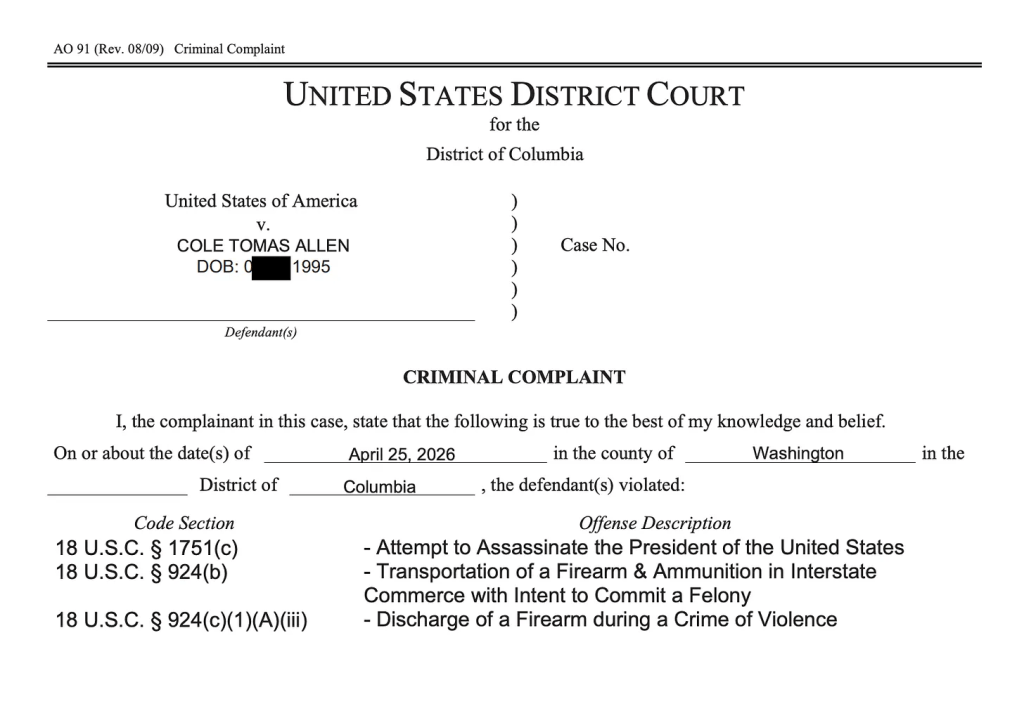
This is a criminal complaint, issued by a judge based on an agent’s affidavit, attesting to probable cause. The government will almost certainly follow up with a grand jury indictment in the next week or two. If they don’t, the judge will hold a preliminary hearing within 14 days if Allen remains in custody, 21 days if he’s released (which isn’t happening here), to determine whether probable cause exists. Federal prosecutors almost never go this route because it requires them to put their evidence on full display at this early stage in the proceedings, and unlike grand jury proceedings, where the defense doesn’t have a role, it permits cross-examination of the government’s witnesses. Expect a grand jury indictment shortly.
The lead charge here is “attempt” to assassinate the president, in violation of 18 U.S.C. 1751, so we need to understand a little bit about that crime and what prosecutors will have to prove. An attempt is referred to as an inchoate, or incomplete crime. With attempt charges, the key questions center around whether the defendant had the intent to commit the underlying crime and whether he took a substantial step—more than mere preparation—toward completing it. Here, based on the details in the government’s affidavit, which we’ll get to in a moment, its case looks solid. Allen evidenced an intent to kill the president. And the government has plenty of evidence to argue he went beyond “mere preparation” and took a substantial step toward committing the offense, since he was armed and running for the door to the ballroom, at the point when he was arrested.
The penalties for attempt and for the underlying offense are almost always the same under federal law, and that’s true here, with the statute providing for up to life imprisonment upon conviction.
Allen is also charged, as we expected last night, with violating 18 USC 924(c), which prohibits using a firearm “in furtherance of” a crime of violence. It carries a 10-year penalty if the firearm is fired, which is how Allen is charged. The complaint adds in one count of 18 U.S.C. 924(b), which makes it a crime for anyone who intends to commit a felony to transport a firearm across state lines. The punishment for that crime is up to 10 years in prison.
In order to get the complaint, the government had to provide the judge with a sworn affidavit from a federal agent. The 7-page affidavit provides some interesting details about the government’s evidence, but contains standard language advising the judge that “This affidavit is intended to show merely that there is sufficient probable cause for the requested complaint and does not set forth all of my knowledge about this matter.”
On March 2, President Trump announced he would attend the White House Correspondents’ Dinner, according to the affidavit. Allen then:
- Made a hotel reservation at the Washington Hilton on April 6 for the night before, the night of, and the night after the dinner.
- Traveled by train from his home near Los Angeles to Chicago, and from Chicago to Washington, D.C.
- Checked into the Washington Hilton hotel the night before the dinner and remained there overnight.
We also get detail that we’ve been lacking until now about what happened when Allen approached the security checkpoint ahead of the ballroom. The affidavit recites that, “ALLEN approached and ran through the magnetometer holding a long gun. As he did so, U.S. Secret Service personnel assigned to the checkpoint heard a loud gunshot. U.S. Secret Service Officer V.G. was shot once in the chest; Officer V.G. was wearing a ballistic vest at the time. Officer V.G. drew his service weapon and fired multiple times at ALLEN, who fell to the ground and suffered minor injuries but was not shot. ALLEN was subsequently arrested.” Both of the firearms in Allen’s possession were purchased in California, which explains the transportation charge.
The affidavit also gives us a look at Allen’s full “manifesto,” some parts of which will have legal significance for the prosecution. He begins with a series of apologies to family and friends, including one that confirms his intent to kill:
“I apologize to everyone who was abused and/or murdered before this, to all those who suffered before I was able to attempt this, to all who may still suffer after, regardless of my success or failure.”
And he specifies who his targets are, “Administration officials (not including Mr. Patel): they are targets, prioritized from highest-ranking to lowest.” He writes that Secret Service agents, hotel security, Capitol police, and the National Guard are “targets only if necessary,” if they get in his way, and that hotel employees and guests are “not targets at all.” This careful delineation will be used by the government to establish his intent to assassinate the president. Although he doesn’t mention Trump by name, he writes: “And I am no longer willing to permit a pedophile, rapist, and traitor to coat my hands with his crimes,” an apparent reference to the president.
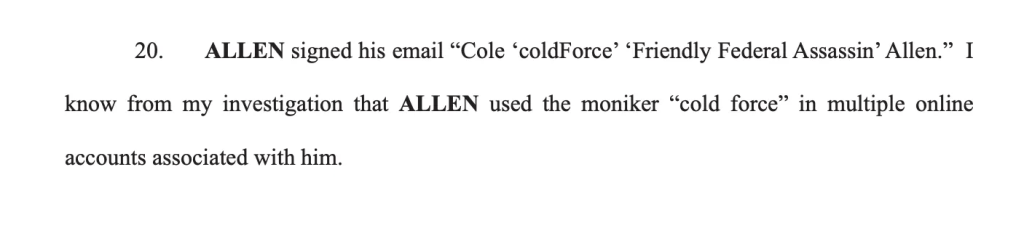
The government will offer the manifesto as evidence of the intent they have to show to convict on the attempt charge. He signed the manifesto “Cole ‘coldForce’ ‘Friendly Federal Assassin’ Allen.”
At the end, he seems to have added a rant about what he says is the Secret Service’s incompetence after he arrived at the hotel, discussing the absence of security or suspicion when he entered the hotel, before writing, “Like, if I was an Iranian agent, instead of an American citizen, I could have brought a damn Ma Deuce [This is a nickname for the M2 Browning, a heavy machine gun] in here and no one would have noticed s–t.”
The government brought its charges promptly, they appear to be based on solid evidence, and a career prosecutor was in the courtroom today, handling the case. All of which is as it should be.
Unfortunately, it’s also now all about the ballroom, after the president did a lightning-fast pivot at his hasty press conference after the incident Saturday night to say it was why the ballroom he is building at the White House is needed. We’ve already discussed why that doesn’t make sense—the president is an invited guest to the White House Correspondents’ Dinner, not the host. The dinner celebrates the freedom of the press, as in their freedom from government control, making the controversial ballroom about the last place on earth it would be appropriate to hold the dinner, unless the press association wanted to make a mockery of that treasured freedom.
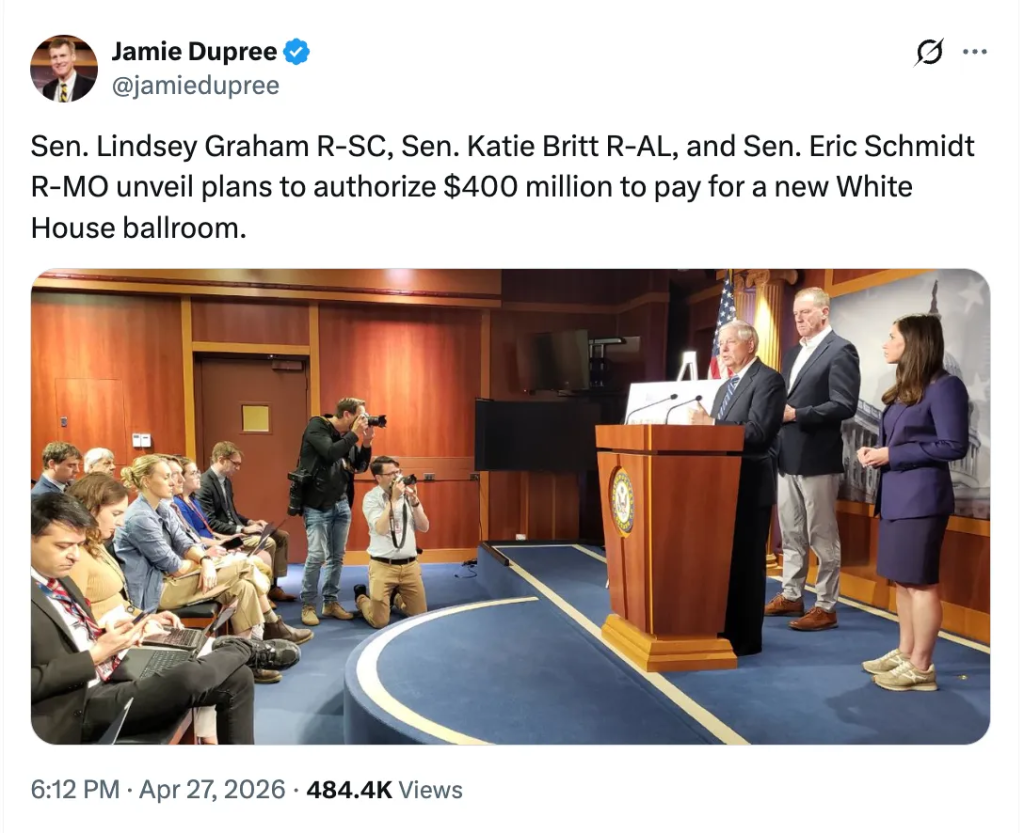
But that didn’t stop certain senators from deciding taxpayers need to foot the bill for the construction project Trump has previously said he’s using private funding to complete.
In 1786, Thomas Jefferson wrote, “Our liberty depends on the freedom of the press, and that cannot be limited without being lost.” Political violence is horrific and deserves the condemnation from both sides of the political spectrum this incident is receiving. It’s fortunate that this incident did not result in any loss of life. There still needs to be a careful after-action report to ensure any mistakes that were made are not repeated. What this cannot become is an excuse to muddy up the freedom of the press or restrict any of the other constitutional rights Americans enjoy.
(snip; about subscribing)
We’re in this together,
Joyce
 Scottie's Playtime