
Quick update on me before the video that has information that everyone should hear. I hurt so bad right now I can only stand a few minutes before the pain is so bad I either have to sit or fall. Of course it is better earlier when I first get up by noon or 1 PM I can barely get up and go to the bathroom before the pain is so severe I am in danger of falling down. But if I sit the pain builds up in the upper part of my back instead of the lower part so again I have to move. Mostly right now it seems I get about 3 hours up at most and then 2 hours laying down. When I take enough medication to help cover the pain which lately has been the maximum of my medications, the next day I am sick to my stomach and have nausea issues. Think of it like being on a drunken night out at the bars, and how you would feel the next day. That lasts until I get enough medication back in my system again, and then if I take the maximum again I am sick the next day. It is a cycle I cannot stand. Be pain controlled in the afternoon and rest of the day while befuddled with confusion of the medications and the next morning wake up sick with a rolling stomach and nausea that either makes me vomit (three times yesterday) or just feel like I am going to vomit such as today when I did not vomit but felt I could until about 1 PM. I have an MRI on the 25th. I am losing the good from the last set of spine shots in the bottom of my spine, so tomorrow I need to call the pain clinic and see if they can adjust my appointment to get another set of spine epidurals for all three sections. Right now I am spending as much time laying down as I am upright. However this morning and yesterday morning Ron and I did take a short walk as we used to before the hurricane. It is much shorter than the other walks were because my back gives out and his hip starts to bother him too much to do a longer one. If the new spine shots don’t fix this, then I need to change medications to fentanyl or something as strong. The doctor tells me that fentanyl is much stronger than the medications I am currently taking. One last thing. Randy my wonderful brother has tried to get me to look at getting an over the bedside table like hospitals use and using a couple of the old laptops we have or at least the bedroom TV and a laptop to read and answer comments which I bitch constantly I am missing. Today Ron and I have started talking about it. It will depend on what the doctors can do. Hugs
Month: January 2023
Why saying “I don’t see race at all” just makes racism worse
Anson ChanWhen I was growing up in the 1980s, we were taught that the way to be a good person was to swear that race didn’t matter, at least not anymore.
We had all learned the lessons of the civil rights movement — that everybody is equal, and according to the morals of the sitcoms we watched after school (Diff’rent Strokes, Webster, Saved by the Bell), what was racist was pretending that people were any different from one another. Furthermore, the most un-racist people didn’t even see race at all; they were color blind.
We now know that color blindness is a form of racial denial that took one of the aspirations of the civil rights movement — that individuals would one day “not be judged by the color of their skin but by the content of their character” — and stripped it from any consideration of power, hierarchy or structure. The moral logic and social appeal of color blindness is clear, and many well-meaning people have embraced it. But when it’s put into practice in a still-racist world, the result is more racism.
The sociologist Eduardo Bonilla-Silva, author of the groundbreaking book Racism Without Racists: Color-Blind Racism and the Persistence of Racial Inequality in America, describes how once we stop seeing racism as a factor and treat equality as a reality rather than an aspiration, our minds naturally seek other explanations for the disparities all around us.
In a way, color blindness makes the civil rights movement a victim of its own success: Legal segregation is over, so now it must be up to people of color to finish the work themselves. As Bonilla-Silva puts it, if racism is no longer actively limiting the lives of people of color, then their failure to achieve parity with whites in wealth, education, employment, and other areas must mean there is something wrong with them, not with the social systems that somehow always benefit white people the most.
Social scientists look to this question — whether you believe that racism is to blame for disparities or that Black people just need to work harder — to help them determine what they call racial resentment. And racial resentment, in turn, is a predictor of opposition to policies that would improve the economic security of millions.
Instead of being blind to race, color blindness makes people blind to racism, unwilling to acknowledge where its effects have shaped opportunity or to use race-conscious solutions to address it. Denial that racism still exists; denial that, even if it does exist, it’s to blame for the situation at hand; denial that the problem is as bad as people of color say it is — these denials are the easy outs that the dominant white narrative offers to people. Wellesley College professor Jennifer Chudy’s research finds that only one in five white Americans consistently expresses high levels of sympathy about anti-Black discrimination.
Color blindness has become a powerful weapon against progress for people of color, but as a denial mindset, it doesn’t do white people any favors, either. A person who avoids the realities of racism doesn’t build the crucial muscles for navigating cross-cultural tensions or recovering with grace from missteps. That person is less likely to listen deeply to unexpected ideas expressed by people from other cultures or to do the research on her own to learn about her blind spots.
When that person then faces the inevitable uncomfortable racial reality — an offended coworker, a presentation about racial disparity at a PTA meeting, her inadvertent use of a stereotype — she’s caught flatfooted. Denial leaves people ill-prepared to function or thrive in a diverse society. It makes people less effective at collaborating with colleagues, coaching kids’ sports teams, advocating for their neighborhoods, even chatting with acquaintances at social events. Nor is denial easy to sustain.
To uphold the illusion of effortless white advantage actually requires unrelenting psychological exertion. Sociologist Dr. Jennifer Mueller explains that color blindness is a key step in “a process of knowing designed to produce not knowing surrounding white privilege, culpability and structural white supremacy.”
But it was a white poet, novelist and farmer named Wendell Berry whose words brought home to me most poignantly the moral consequences of denial. In August 2017, I traveled to Northern Kentucky to meet with a multiracial grassroots organization called Kentuckians for the Commonwealth.
After a day of workshops, one of the members gave me a dog-eared copy of a book by Berry, a local hero who had grown up in rural Kentucky during the Jim Crow era. The book was called The Hidden Wound — Berry wrote it in 1968, in the midst of widespread protest and unrest — and that night in my hotel room, I read it from cover to cover.
By denying the reality of racism and their own role in it, Berry explained, white Americans have denied themselves critical self-knowledge and created a prettified and falsified version of American history for themselves to believe in, one built on the “wishful insinuation that we have done no harm.” Of course, he understood the impulse of white people — himself included — to protect themselves from “the anguish implicit in their racism.”
A few years before Berry published The Hidden Wound, James Baldwin, as keen an observer of human behavior as there’s ever been, wrote his own account of what happens when white people open their eyes to racism.
“What they see is a disastrous, continuing, present condition which menaces them, and for which they bear an inescapable responsibility. But since, in the main, they seem to lack the energy to change this condition, they would rather not be reminded of it.” Baldwin went on to observe that white Americans “are dimly, or vividly, aware that the history they have fed themselves is mainly a lie, but they do not know how to release themselves from it, and they suffer enormously from the resulting personal incoherence.”
Wendell Berry calls this suffering “the hidden wound.” He counsels that when “you begin to awaken to the realities of what you know, you are subject to staggering recognitions of your complicity in history and in the events of your own life.” Of this wound — this psychic and emotional damage that racism does to white people — he writes, “I have borne it all my life . . . always with the most delicate consideration for the pain I would feel if I were somehow forced to acknowledge it.”
As I closed Berry’s book in that Kentucky hotel room, I thought about what it must it be like to be part of the dominant group in an unfair “meritocracy” that denies its oppressions and pathologizes the oppressed.
“I think white folks are terribly invested in our own innocence,” says the scholar Catherine Orr. The belief that the United States is a meritocracy, in which anyone can succeed if only they try hard enough, also supports the notion that anyone who is financially successful is so because they’ve worked harder or are somehow more innately gifted than others.
Both ideas operate as a justification for maintaining our profoundly unjust economic system. Recent research from social psychologists at Yale and Northwestern finds that “Americans, on average, systematically overestimate the extent to which society has progressed toward racial economic equality, driven largely by overestimates of current racial equality.”
Wealthy white Americans, they find, have the most unrealistic assessment of how much progress the United States has made in terms of economic equality (and thus how fair the competition has been that they seem to have won). In a 2019 public opinion survey, majorities of both Black and white people said that being Black makes it more difficult to get ahead in America. Yet only 56 percent of white respondents believed the corollary — that being white helps you get ahead.
And of those who recognized the obstacles Black people face in terms of economic mobility, Black respondents attributed this to systemic discrimination, such as having less access to good schools and high-paying jobs. White people, on the other hand, were more likely to blame problems such as the lack of good role models and family instability — pathologies, in other words, that ultimately lay blame at the feet of Black people themselves.
Morally defending your position in a racially unequal society requires the fierce protection of your self-image as a person who earns everything you receive. From the tradition that trade unions make a place for members’ sons and legacy admissions at colleges to college students who can choose career-building but unpaid or low-paying internships because families can support them and employers who seek “a good fit” by hiring younger versions of themselves, the deck is stacked on behalf of white people in ways that are so pervasive we rarely notice them.
Within this context, many white people both resent affirmative action and imagine that it is vastly more widespread than it really is. The share of Black and brown students at selective colleges has actually declined over 35 years despite stated affirmative action policies, and the overwhelmingly white categories of children of alumni, faculty, donors or athletes made up 43 percent, for example, of students admitted to Harvard from 2010 to 2015.
Meanwhile, according to a 2016 study by Harvard Business School professor Katherine DeCelles, Black job applicants who removed any indications of their race from their résumés were significantly more likely to advance to an interview. Many other studies bear out similar findings, including an economic research paper that traced improved job prospects to whether applicants had names like “Greg” or “Emily” as opposed to “Lakisha” or “Jamal,” and a sociological study in New York City that found that “Black applicants were half as likely as equally qualified whites to receive a callback or job offer.”
Still, the idea that people of color are taking jobs from white people is another zero-sum belief that lumbers on from era to era. As Ronald, a middle-aged white man from Buffalo, New York, told the Whiteness Project, “I think affirmative action was nice. It had its time, but I think that time is over with. Are we going to keep this up another one hundred fifty years? ‘Oh, we gotta have so many Asians in the fire department, we gotta have so many Blacks in the fire department.’ . . . The white guys will never have a chance to be a fireman or a cop anymore.” Although using such numerical quotas to achieve affirmative action in employment was outlawed in 1978 by the Supreme Court, Ronald’s grievance is evergreen, as is his certainty that white guys getting all the public service jobs was the natural order of things, not its own form of white affirmative action.
Excerpted from the new book The Sum of Us: What Racism Costs Everyone and How We Can Prosper Together by Heather McGhee. Copyright © 2021 by Heather McGhee. Reprinted by arrangement with One World, an imprint of Random House, a division of Penguin Random House LLC. All rights reserved.
Watch her TEDWomen Talk now:
Dad designs line of swimwear for trans girls named after his own daughter
https://www.today.com/parents/dad-designs-swimwear-transgender-girls-daughter-t206361
So now something so much more impressive and wanted to talk about. Grand dad. I love what this dad did for his trans daughter and other trans girls but it shouldn’t be such an issue in the first place. Why some people are so hurtful and angry to those who are different from them I don’t understand. Medical science has determined that gender identification that differs from assigned sex at birth is a real medical condition, and that affirming that gender identification is the best medical practice. That is a fact. Medical science and biologist have determined that sex is not binary but it is a spectrum. That also is a fact. To deny these facts is the same as denying evolution or to insist the earth is only 6 thousand years old. Hugs
After watching his own daughter Ruby, then 12, struggle to find bikini bottoms that made her feel both comfortable and confident as a transgender girl, Toronto dad Jamie Alexander decided to solve the problem himself.
Alexander created a clothing brand, Rubies, with the specific goal of producing form-fitting clothing for transgender children up to a size 20. His first product: the Ruby Shaping Bikini Bottom.
Though he told TODAY Parents Ruby was drawn to high heels, Disney princesses, and Beyoncé’s “Single Ladies” video as early as age 3, Alexander and his wife Angela were not sure at first whether her preferences meant anything significant about her gender. After all, who doesn’t love Beyoncé?
Never miss a parenting story with the TODAY Parents newsletter! Sign up here.
With the help of their local public school system, the Alexanders gave their child space and support to figure out if she identified as male, the gender she was assigned at birth, female, or neither. By grade 3, it became clear she knew the answer.
But as Ruby grew into adolescence, Alexander noticed that transgender girls have one specific issue when it comes to fashion: finding bikini bottoms they could confidently wear in public — that can “magically turn a pointy poker into a dainty dune, no tucking required,” as the Rubies website explains.
“An item of clothing like Rubies swimwear can be a total game-changer for transgender and gender-creative children,” said Jessica Herthel, co-author of children’s book “I Am Jazz” with transgender activist Jazz Jennings.
“Being able to do something that most of us take for granted — namely, to go swimming without fear of being stared at or teased, or even targeted — can give a child a feeling of normalcy and belonging,” said Herthel.
Alexander, an entrepreneur and veteran of the tech start-up world, developed the swimwear with Ryerson University’s tech start-up incubator The DMZ, where he had access to a fashion accelerator and a garment engineer.
“Everything I saw was heavily branded just to trans people and had a quilted pad in the front. They didn’t look like normal bikinis,” Alexander said. “I wanted to create a garment that looks and feels like a regular bikini and a brand that resonates with kids, not just trans kids.”
He interviewed 50-60 different families he found in Facebook groups for parents of transgender children to see what they were looking for in swimwear. “The best businesses are ones that solve real problems,” Alexander said. “I knew we had a problem, but I didn’t know if everyone else did.”
His designer made a prototype bikini bottom using spandex on the outside with a mesh liner that is able to gently compress and “pull things in” without causing discomfort. Alexander sent samples to 25 families in North America and Australia in December 2019 to solicit feedback. “The key was, they had to functionally work,” he said.
Now, after finding children who have bought the bikini bottoms are wearing them as underwear because they make them feel so much more confident, Alexander is expanding the company to include real underwear made with a cotton fabric.
His goal, he says, is to make the lives of trans children like his own daughter better — and more unremarkable. “I want to focus on the positive stories about these kids and normalize them,” Alexander said. “They’re just kids. That’s how people need to see them.”
Herthel said the fact the swimwear line was developed by the father of a trans kid makes Rubies all the more inspiring. “The world needs more dads like Jamie Alexander who don’t just accept their children’s gender, but celebrate it,” she said.
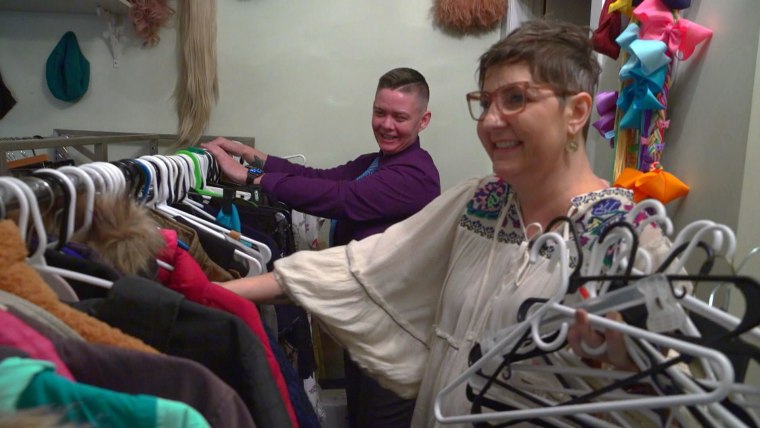
Mom creates nonprofit for trans teens to get new wardrobe for free
https://twitter.com/Scottiestoybox/status/1616438971428667395?s=20&t=XAsgjv83z1GmgdbLT0W6Bw
NPR: NPR uncovered secret execution tapes from Virginia. More remain hidden
NPR uncovered secret execution tapes from Virginia. More remain hidden
Four tapes mysteriously donated to a library reveal uncertainty behind the scenes of the death chamber — and indicate the prison neglected to record evidence during an execution gone wrong.
Read in NPR: https://apple.news/AejAdz8VVS5aOutbhXc0w3A
Shared from Apple News
Best Wishes and Hugs,Scottie
VICE: George Santos Accused of Stealing Thousands from Dying Dog’s GoFundMe
George Santos Accused of Stealing Thousands from Dying Dog’s GoFundMe
A veteran says Santos stole $3000 from a fundraiser for his sick service dog.
Read in VICE: https://apple.news/AX7NKLyC_Q7SZZjk1dQm__A
Shared from Apple News
Sent from my iPad
NBC NEWS: The federal government is investigating the possible human trafficking of children who cleaned slaughterhouses
The federal government is investigating the possible human trafficking of children who cleaned slaughterhouses
There is no indication that the sanitation company is under investigation for trafficking the children who worked there.
Read in NBC News: https://apple.news/AppBhXtrVRVSuVbaE4fmgKA
Shared from Apple News
Best Wishes and Hugs,Scottie
Randy sent me some thought provoking tweets.
You should go to the actual tweet and read the comments. Hugs
Why do kids need guns made for them? They seem to do well with adult guns at shooting people. But seriously everyone understands that kids emotional control and reasoning ability are limited. Some adults never grow out of those limitations. Again the comments are all over the map. Hugs
I just started to follow this guy above on YouTube. He has a veery reasonable take on things and is easy to understand. Hugs
https://www.youtube.com/@TizzyEnt
The story below is amazing because it took kids to figure out something the adults should have seem a long time ago. Grand kids. Hugs
Let’s talk about “just asking questions”….
HUFFPOST: There’s A Massive Uptick in Searches For This Kind Of Porn
There’s A Massive Uptick in Searches For This Kind Of Porn
Pornhub’s Year in Review revealed the site’s searches are getting a lot more queer — but is it about liberation or fetishization?
Read in HuffPost: https://apple.news/A_Vh6z5MwR0-6q6W4SCc9rg
Shared from Apple News
Best Wishes and Hugs,Scottie
 Scottie's Playtime