Remember this is the same person Tildeb uses as an authority against trans people. Ragnarsbhut just recently used the arguments pushed by this guy and his cohorts to attack vaccines, especially covid vaccines specifically. Hugs
The surgeon general’s guidance against the vaccine for young men ignored results showing infection was a greater risk for cardiac-related deaths.
Florida Surgeon General Joseph Ladapo, left, speaks at a news conference with Florida Gov. Ron DeSantis in 2022. State officials removed data from a state analysis of cardiac-related deaths that Ladapo used in October to justify his recommendation that young men should not get the mRNA COVID-19 vaccine. The missing data showed that catching the virus created a far higher risk of a heart-related death. [ WILFREDO LEE | AP ]
Florida Surgeon General Joseph Ladapo announced in October that young men should not get the COVID-19 vaccine, guidance that runs counter to medical advice issued by the Centers for Disease Control and Prevention.
His recommendation wasbased on a state analysisthat showed the risk of cardiac-related deaths increased significantly for some age groups after receiving a vaccine. It has been criticized by experts, including professors and epidemiologistsat the University of Florida, where Ladapo is employed as a professor.
Now, draft versions of the analysis obtained by the Tampa Bay Times show that this recommendation was made despite the state having contradictory data. It showed that catching COVID-19 could increase the chances of a cardiac-related death much more than getting the vaccine.
That data was included in an earlier version of the state’s analysis but was missing from the final version compiled and posted online by the Florida Department of Health. Ladapo did not reference the contradictory data in a release posted by the state.
The Times’ records request asked for all previous versions of the state analysis made public on Oct. 7. The documents show that, before the final version was released, at least five drafts had been produced. One version included a data table showing the number of cardiac-related deaths from infection. The conclusion in four of the drafts provided a counterpoint to Ladapo’s assertion about the vaccine.
Four epidemiologists who reviewed the drafts said the omission is inexplicable and flawed from a scientific standpoint. They said that, based on the missing data, Ladapo’s recommendation should be rescinded.
Matt Hitchings, an infectious disease epidemiologist and professor of biostatistics at the University of Florida, said it seems that sections of the analysis were omitted because they did not fit the narrative the surgeon general wanted to push.
“This is a grave violation of research integrity,” Hitchings said. “(The vaccine) has done a lot to advance the health of people of Florida and he’s encouraging people to mistrust it.”
The surgeon general and the state’s health department have frequently questioned the safety of messenger ribonucleic acid or mRNA vaccines developed to counter COVID-19. Last year, Florida became the first state to recommend against vaccines for healthy children and it was the only state to not preorder coronavirus vaccines for children under 5.
Ladapo declined to answer specific questions about why the data showing the higher risk to Floridians from infection was removed. In an emailed statement, he said that he stands by his guidance and that this is not the first time he has faced criticism for his approach to COVID-19.
“As surgeon general, my decisions continue to be led by the raw science — not fear,” he said. “Far less attention has been paid to safety of the COVID-19 vaccines and many concerns have been dismissed — these are important findings that should be communicated to Floridians.”
“It is irresponsible to roll over and allow the pharmaceutical companies to dictate health guidance that allows them to line their pockets when public health officials experience the severity of the impacts firsthand in their communities,” Ladapo said in his statement. The court has yet to take any action.
The published eight-page state analysis linked data from Florida’s reportable disease repository known as Merlin, the Florida State Health Online Tracking System, and death records from the state’s vital statistics bureau.
It examined cases of adult Floridians who died within a 25-week period from the start of the vaccination roll-out in December 2020 and detailed deaths occurring within 28 days of receiving a vaccination.
It reported that there was only a “modest” increased risk from the vaccine except for males ages 18 to 39, where it found an 84% higher incidence of cardiac-related deaths.
Ladapo cited that number in the state’s nonbinding recommendation, saying the “abnormally high” risk of cardiac complications from a COVID-19 shot “likely” outweighs the benefits of vaccination.
That finding was based on 20 deaths, too small a sample size for such a far-reaching conclusion, according to a column by four University of Florida epidemiologists that highlighted concerns and flaws with the analysis. The scientists also noted that Ladapo’s finding was not backed up with clinical data proving that the cause of deaths fits the criteria.
Further, the data on the risk of infection omitted from the published report shows that catching COVID presents a far greater risk for that same age group.
For Floridians ages 18 to 24, the incidence of cardiac-related deaths from infection was more than 10 times higher than from the vaccine and more than five times higher for ages 25 to 39. That data was not broken down by sex.
The state epidemiologists who worked on the report also arrived at a different conclusion than Ladapo, the drafts suggest.
“The risk associated with COVID-19 infection clearly outweighs any potential risks associated with mRNA vaccination,” one version states.
“The small risk associated with mRNA vaccination should be balanced against the much larger risk associated with COVID-19 infection,” another version says. A similar sentence appeared in the published conclusion but the “much larger” modifier had been removed.
The state’s analysis was also criticized for not including a sensitivity analysis, a method of proving that the results remain consistent even when changing some of the assumptions used in the calculations.
A sensitivity analysis was present in three versions of the draft and suggests that the increased risk for young men from the vaccine is not significant, said Jonathan Laxton, a physician and assistant professor of medicine at the University of Manitoba.
“It’s a double check that didn’t confirm that finding,” Laxton said.
Faculty at the University of Florida’s College of Medicine, including Hitchings, circulated a report in January that was critical of the published analysis. It characterized the research and the subsequent recommendation as being of “highly questionable merit” but concluded it did not rise to research misconduct.
David Norton, UF vice president for research, said in a statement that because Ladapo oversaw this research in his role with the state and not in his role as a faculty member, UF’s Office of Research Integrity, Security and Compliance “has no standing to consider the allegations or concerns regarding research integrity” mentioned in the report.
After reviewing the draft reports, Hitchings said the final analysis is akin to academic dishonesty.
“You can call it a lie by omission,” he said.
The downplaying of the elevated risk of cardiac-related deaths from infection remains the biggest concern for Katrine Wallace, an epidemiologist at the University of Illinois, Chicago. The state has denied Floridians the information they need to make an informed decision on the vaccine, she said.
“As a scientist, and as a parent, it would be important for me to know the cardiac risk from COVID versus that of the vaccine,” she said. “That context is huge — and it’s gone.”
How Disney maneuvered to save its Florida kingdom, leaving DeSantis threatening retaliation
In his yearlong battle with Disney, Florida Gov. Ron DeSantis has repeatedly leaned on the element of surprise in his attempts to outmaneuver the entertainment giant and its army of executives, high-priced lawyers and politically connected lobbyists.
Hello everyone. Again I want to thank Ali for sending another trans positive article. The sea change is happening on trans rights as they did in the US a decade ago. Yes we are seeing a backlash against acceptance and tolerance by the right as they try to force intolerance and bigotry on everyone. But in the arch of history the progressive acceptance of equality wins. If we keep fighting for it. We know the right will fight for intolerance and enforced removal from society of those the right thinks shouldn’t get equality. Hugs
A new national law for “real and effective equality for trans people” came into force in Spain on 2 March 2023, allowing a person to change their gender identity in the civil register without undergoing a two-year hormonal treatment or obtaining a medical diagnosis of gender dysphoria, as required by previous legislation.
Euronews reporters Valerie Gauriat and Davide Rafaelle Lobina travelled to Madrid to hear the testimonies of those who are affected by the law.
Ezekiel: Gender transition ‘not a decision you take lightly’
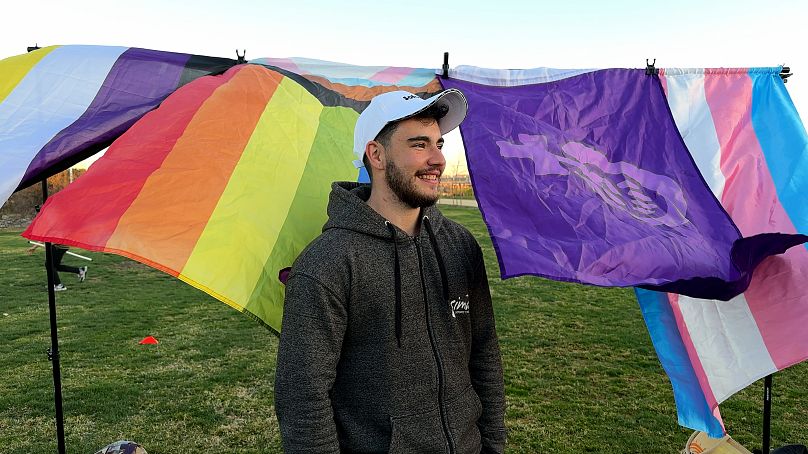
Ezekiel is a 23-year-old sports coach whose dream is to become a firefighter. But behind his athletic figure lie years of inner struggle, as Ezekiel was born a woman.
He started his physical transformation after years of feeling like he didn’t belong in his own skin.
“I looked in the mirror and thought to myself that I couldn’t take it anymore. I needed to talk to people about it, to be recognized for who I was, and that I had to start my transition to feel comfortable with myself”.
Ezekiel started hormone therapy two and a half years ago, and underwent a mastectomy.
“It’s a big change. It’s like jumping into the void, hoping there is some water below,” Ezekiel told Euronews. “It is a very difficult process. It is not a decision you take lightly.”
Thanks to the new law, Ezekiel is glad that he will be officially recognised as a man. Spain is one of the few European countries that allow citizens to determine their official gender through a simple administrative declaration.
We followed Ezekiel to the Madrid Civil Register Office, where he submitted his gender change request; he will have a new identity card in three months, after ratifying his demand.
“I’m happier than ever!”, he exclaimed, coming out of the Register office.”This will make a lot of things easier. I won’t have to give all sorts of explanations when applying for a job for instance. It will also help with my courses to become a fireman; my diploma will be consistent with my gender,” he explains.
Ezekiel Latorre Fernandez, 23, sports coach: “Happy as ever”Euronews
The new law for broke all the locks remaining the previous legislation.
Like the World Health Organization, it depathologizes transsexuality.
And allows self-determination of gender on simple request from the age of 16, and with parental consent from the age of 12.
A first in the European Union. And one of the most controversial points of the law.
“At 16 people can work, have sexual relations, abort; they should also be able to chose their gender”
Spain’s Ministry of Equality claims it’s Europe’s most progressive law LGBTIQ+ rights
“In Spain, at 16 people can work, they can have sexual relations, women can have an abortion if they want”, said Secretary of State for Equality, Ángela Rodríguez Martínez. “It is reasonable that people should also be able to declare their own gender. In addition, this law dissociates the change of sex in the civil register from the need to take hormones or undergo any type of surgical intervention. In the event of a change of mind, it would just be a matter of canceling the change at the register with all the legal guarantees needed.”
Arguments which do not convince those who feel the new law is too lax.
Vicenta Esteve Biot is a member of the working group on transsexuality at the General Council of Psychology of Spain. For this psychologist, the abolition of medico-psychological diagnoses for sex change in the civil register could encourage too hasty transitions.
“The problem with this law is that it does not leave time to reflect.It’s not the same thing to follow a process accompanied by a professional who can help you make your own decisions when you need to make them, and not before or in a rush. People need to make well-considered decisions.And not just trans people, but also families.There are parents who take the initiative to avoid the suffering of their children. And it’s just as bad to be ahead of your kids as it is to be behind and holding them back. »
Encarni Bonilla Huete: ‘The problem is society, not gender identity’
Encarni Bonilla Huete is the president of the Chrysallis Association, which brings together families with transgender children who are fighting against stigmatisation.
“Our youths are increasingly diverse and demand diversity. Either we adapt to it or we move further apart from them,” she said.
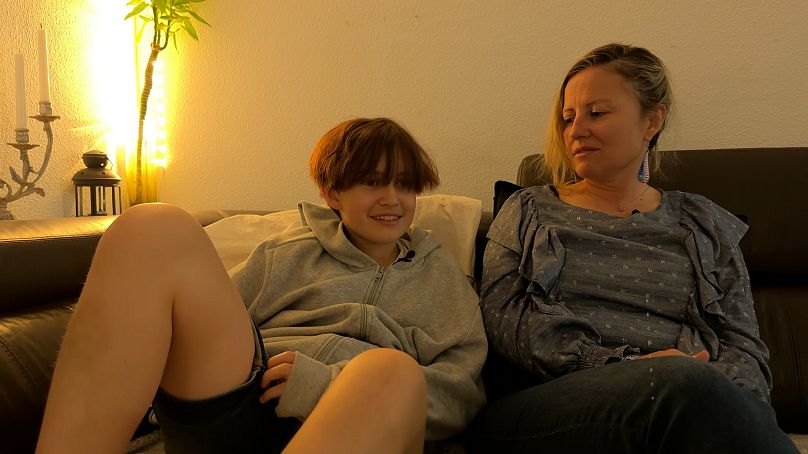
Born a girl, Encarni’s 12-year-old son, Marc, chose to become a boy a year and a half ago. Encarni and her husband decided to support his transition, after he verbalised it and asked them for help.
“I knew I was out of place somehow, but I didn’t know how to express myself. When I started to develop, I felt very bad.I didn’t want to see my body.” explains Marc. And then when I realized I was a boy, I felt much better. My relationship with my parents, with my friends, with myself is now much better. » Asked whether he thinks about the future, Marc briefly ponders and smiles:
“Sometimes I think about what it will be like to take hormones, what people will think of me when I go to school, or what it will be like to work as a trans person. The world may be very different tomorrow. Anything can happen. I try to focus on the present. »
His mother is adamant that the family’s life has changed for the better.
“He had an inner rage that prevented him from being happy. All that has disappeared, and he’s a very happy child now.” says Encarni. “It’s not gender identity that’s the problem, it is society, which doesn’t accept diversity and doesn’t accept difference. And that’s why it must evolve,” she added.
Encarni Bonilla Huete, supportive of Marc’s transitionEuronews
“I’m asking those who are against my transition to let me live my life. They shouldn’t speak about it as they don’t know what it’s like, and I’m asking them to let me be happy,” concludes Marc.
Thanks to Ali for sending me the link. In case it has not been clear to most people, I love wild life, learning about nature, and trying to be a good steward to the planet Earth. I want to care for and keep well the environment I need to live, and that includes keeping all the diverse species alive as possible. Perhaps the one thing I took from my years of being in the SDA religion was the idea that mankind was given dominion over the planet and its life forms but demanded to care for and nurture it. That is why the current idea from right wing religious groups that humans can trash the environment with impunity because god will fix it seems so strange to me. Maybe our friends of the blog who are of different religious faiths will weigh in and give us their opinions, as I am serious, I don’t understand the idea of destroying the place you need to live. Last I knew this was the only place within our reach that can support us, maybe we should do everything we can to keep it healthy? Hugs
A new study is the first of its kind to document the widespread basking of freshwater turtles at night.
Freshwater turtle basking at night. Image captured for study on nocturnal basking habits.
Dr Donald McKnight / La Trobe University
While the rest of us are sleeping, freshwater turtles from Central America to Asia are slinking out of the water and basking at night. There have been occasional anecdotal reports of this behavior before, but now a new study is the first to document the widespread occurrence. The findings suggest that nocturnal basking “may be a common and almost entirely overlooked aspect of many species’ ecology,” write the authors.
The study was led by La Trobe University and published in Global Ecology and Conservation. In it, the authors document nocturnal basking in six families of freshwater turtle species, occurring in Central America, Trinidad and Tobago, Seychelles, Africa, Asia, and Australia.
Postdoctoral Researcher at La Trobe University Dr. Donald McKnight said he and a colleague, Dr. Eric Nordberg from the University of New England, first observed freshwater turtles nocturnal basking at the Ross River in Townsville, Australia.
“We think it’s related to temperature. The water is staying so warm at night that it’s actually warmer than the turtles like to be and they can cool down by coming out of the water,” says McKnight.
“It’s widespread across the turtle family tree, with the caveat that it is only in the tropics and the subtropics where it occurs,” he added. “They were coming up at night and sitting on logs exhibiting very much the same behavior they do during the day; when we looked into it, it wasn’t something that turtles reportedly did.”
For the study, researchers from around the world did what anyone would do when wondering what turtles do at night: They put cameras on basking logs to monitor the nocturnal activity of as many freshwater turtle species as possible.
The cameras were set up in 25 locations across Australia, Belize, Germany, India, Seychelles, Senegal, Trinidad and Tobago, the United States, and South Africa. They were programmed to take a photo every two minutes; they captured data on 29 species from seven of the freshwater turtle families.
Freshwater crocodile and turtles daytime basking in Townsville Queensland. Image taken as part of the study on nocturnal basking.
Dr. Eric Nordberg / The University of New England
It would be lovely to think the turtles are just enjoying some leisure time when things are quiet and the diurnal world is asleep. But the researchers note that in most cases, the turtles emerged from the water when the water was too warm and the air was cooler. Given the warming planet, that’s admittedly a bit depressing. However, not all of the nighttime baskers were escaping too-warm water. From the study:
“… [T]urtles in India exhibited more nocturnal basking on cooler nights, rather than warmer nights, and P. adansonii in Africa spent more time basking nocturnally in winter than in summer. The reasons for these differences are unclear. It may be that at some sites or seasons, turtles are escaping unfavourably warm water temperatures, while at others, they are taking advantage of the warm tropical air to increase their body temperature and escape unfavourably cold water.”
“Alternatively,” the authors add, “at some locations, nocturnal basking may not be directly for the purpose of thermoregulation, but the higher night-time temperatures in the tropics may allow turtles to emerge for other purposes, such as predator avoidance.”
Regardless of the “why” behind different species’ reasons for midnight basking, it’s a fascinating look at behavior not previously documented by scientists. And it is at least heartening to know that turtles are figuring out important behaviors tied to thermoregulation. As the study concludes, this “could have implications for turtles’ persistence and behavioural changes under climate change.”


:max_bytes(150000):strip_icc():format(webp)/freshwater-turtles-9d10eb44a67b48c3bf9c86e52d5c7ae7.jpeg)
:max_bytes(150000):strip_icc():format(webp)/basking-animals-c0d8356c53a446ada9611dc1f24c6b89.jpg)
 Scottie's Playtime