January 7, 1953 President Harry S. Truman announced in his State of the Union address that the United States had developed a hydrogen (fusion) bomb.
January 7, 1971 The U.S. District Court of Appeals ordered William Ruckelshaus, the Environmental Protection Agency’s first administrator, to begin the de-registration procedure for DDT so that it could no longer be used. DDT being sprayed next to livestock It was a widely used pesticide in agriculture (principally cotton). This happened nine years after the publication of Rachel Carson’s “Silent Spring”, a book which cautioned about the dangers of excessive use of pesticides and other industrial chemicals to plants and animals, and humans. Rachel Carson Read more about Rachel Carson
January 7, 1979 Vietnamese troops seized the Cambodian capital of Phnom Penh, toppling the regime of Pol Pot and his Khmer Rouge, the Cambodian Communist party. Pol Pot and his allies had been directly responsible for the death of 25% of Cambodia’s population. When he seized power in 1975, capitalism, Western culture, city life, religion, and all foreign influences were to be extinguished in favor of an extreme form of peasant Communism. All foreigners were thus expelled, embassies closed, and any foreign economic or medical assistance was refused. The use of foreign languages was banned. Newspapers and television stations were shut down, radios and bicycles confiscated, and mail and telephone usage curtailed. Money was forbidden. All businesses were shuttered, religion banned, education halted, health care eliminated, and parental authority revoked. Thus Cambodia was sealed off from the outside world.All of Cambodia’s cities were then forcibly evacuated. At Phnom Penh, two million inhabitants were evacuated on foot into the countryside at gunpoint. As many as 20,000 died along the way. Pol Pot’s legacy: Skulls of the killing fields
Jan 06, 2025 Mariel Padilla Originally published by The 19th
Rep. Becca Balint of Vermont, who was elected to the 118th Congress in 2022, said she was shaped and largely motivated by January 6, 2021 — the day a mob of President Donald Trump’s supporters stormed the U.S. Capitol and temporarily halted the certification of the legitimate results of the 2020 election.
“A lot of the members who ran in the 118th and 119th Congress understood that we were running towards a house on fire and that being honestly democracy itself,” Balint said.
Balint said she vividly remembers January 6, 2021, because it was supposed to be one of the happiest days of her life: She was being sworn in as the first woman to lead the Vermont Senate. When her security team popped into her office to tell her that the U.S. Capitol was under attack, Balint said the footage “shook me to my core.”
The attack, which the Federal Bureau of Investigation called an act of domestic terrorism, sparked the Department of Justice’s largest criminal investigation in the country’s history and led to more than 1,500 people being federally charged. Rioters brought firearms, knives, hatchets, pepper spray, baseball bats, stun guns and explosive devices to fight Capitol Police officers and storm the building where lawmakers were actively voting to certify the 2020 election. Five people died during or soon after the riot, approximately 140 law enforcement officers were injured and $2.9 million worth of damage was done to the Capitol.
The day after the Capitol riot, Trump referred to the event as a “heinous attack” but has since promised to pardon those who were arrested in connection with the insurrection. Trump himself was indicted on felony charges in 2023 for attempting to overturn the results of the 2020 election — a criminal case that was dismissed shortly after he won the 2024 presidential election. The president-elect has since started describing January 6 as a “day of love,” as he did on the campaign trail.
As Congress votes again to certify the results of the 2024 presidential election, the country prepares to welcome back to the Oval Office the same man who denied his loss four years ago and threatened the country’s tradition of a peaceful transfer of power.
“It always sends a shiver down my spine when I hear people say ‘Americans don’t care about January 6 anymore — move on,’” Balint said. “I’m not moving on. It was a dark day in our history, and I’m not moving on.”
The 19th reached out to every woman in Congress — just as it did in 2021 and 2022 — to collect reflections on how January 6 continues to impact them and the country. Seventeen Democratic congresswomen and one senator responded and talked about their remaining trauma, their concern about the normalization of violence and their strong sense of duty to combat any efforts to whitewash that day.
‘There’s a record of this.’
Here’s what they said about how the spread of misinformation and disinformation surrounding that day has downplayed the severity of violence and the gravity of what was almost destroyed.
Rep. Suzanne Bonamici of Oregon: I still have seared in my memory the images of Capitol Police officers and other people being beaten. People lost their lives. … It’s not like somebody made this up. There are videos. There are pictures. There are statements. There’s a record of this. And there were people that were convicted by juries of their peers.
Rep. Deborah Ross of North Carolina: I think the most important thing is to be brutally honest about what happened that day. Many of us were there to witness, and we’re here to testify. We cannot allow Donald Trump and his cronies to deny what needs to be preserved for history. The next generation should know how fragile our democracy is and march forward, clear-eyed and ready to fight.
Balint: My grandfather was killed in the Holocaust and so I was raised in a family in which we were taught to be vigilant when people start eroding rights, upending norms, scapegoating people. When up is down and black is white and we can’t agree on basic facts, that is all an indication that we are headed in a very scary direction as a country.
Rep. LaMonica McIver of New Jersey: I think [Trump] is going to do whatever he can to make January 6 be remembered like it’s July 4. In his mind, I think it’s going to be put in the highest regard and glorify the day as much as he can. And he’s going to have four years to try and get the rest of the country to do the same.
Rep. Chellie Pingree of Maine: I think it’s very troubling that this incoming president could convince people that he either wasn’t responsible or that somehow all that didn’t matter. But sometimes it takes us a while to process big, complicated changes like this. Maybe there will be a time when we can reflect back and say that this was a mistake, that we overlooked it, that it took us time to realize how serious that movement was.
Rep. Jill Tokuda of Hawaii: As we approach January 6 once again, we all have a responsibility to stand up against the normalization of political violence and disinformation. We cannot forget what happened that day and as Americans, it is incumbent on us to reject violence in any form from infecting our politics and our democracy.
‘Deeply, deeply disappointed.’
Many of the lawmakers said they are still processing what it means about the state of our country that the same man who incited an insurrection could be re-elected four years later. Several emphasized that those involved in planning, executing or inciting the riot still need to be held accountable before the country can heal and move forward.
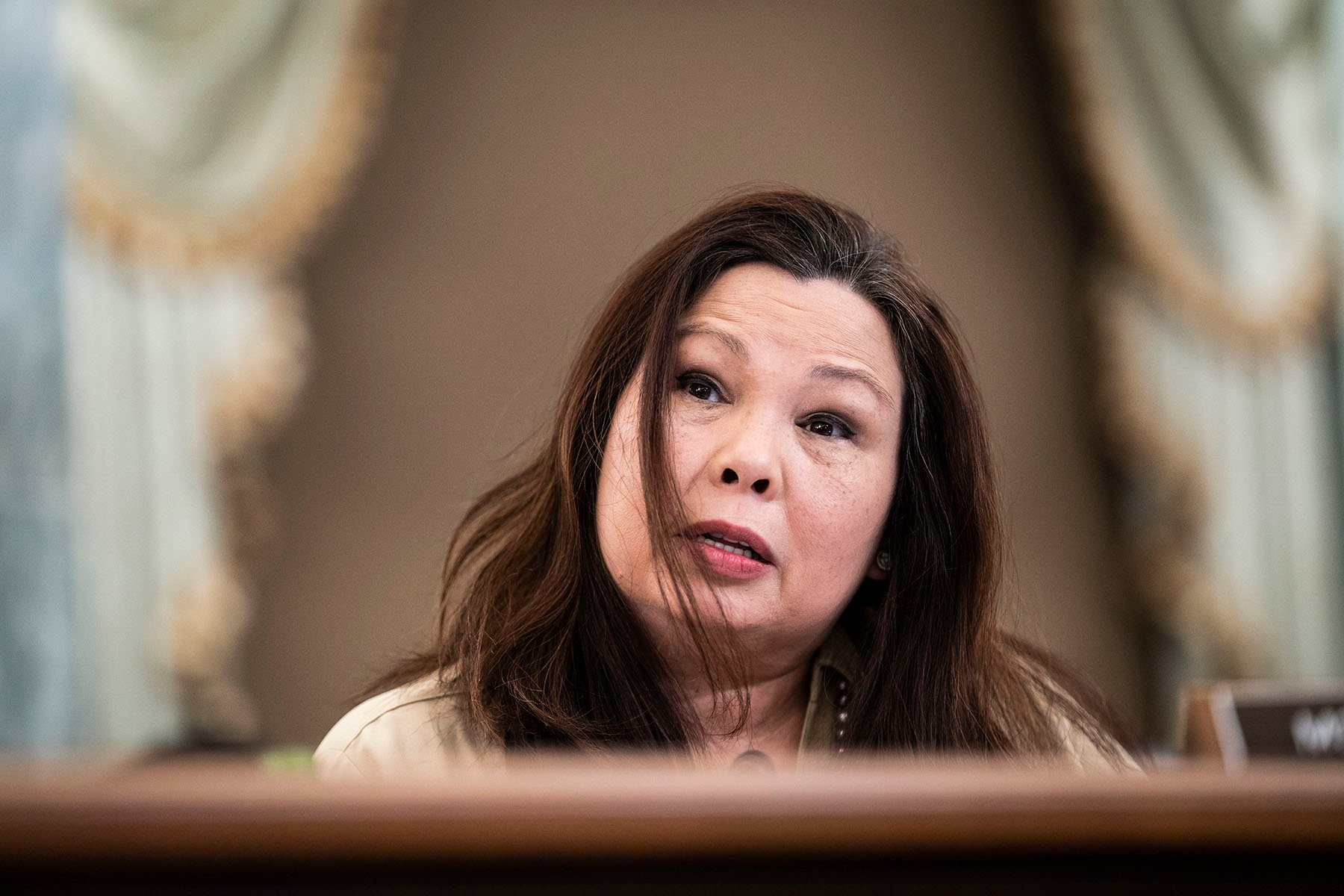
Sen. Tammy Duckworth speaks on Capitol Hill on in February 2023, in Washington D.C. (Jabin Botsford/The Washington Post/Getty Images)
Sen. Tammy Duckworth of Illinois: As deeply, deeply disappointed as I am that that same twice-impeached president who led a coup against our government is headed back to the Oval Office, make no mistake: My Democratic colleagues and I, unlike many Republicans after the 2020 election, will uphold the will of the American people, fulfill our constitutional duty and do our part to ensure a peaceful transfer of power.
Rep. Rosa DeLauro of Connecticut: As Donald Trump returns to the presidency, I feel an even greater responsibility to ensure that we do not let an election outcome diminish the gravity of what happened that day. His re-election does not change the reality of the insurrection or absolve those who incited and participated in it. It does not erase the trauma experienced by Capitol staff and Capitol Police officers who defended our democracy at great personal risk.
Rep. Gwen Moore of Wisconsin: Donald Trump, a convicted felon and aspiring autocrat, is promising to let loose dangerous rioters into our communities and threatening lawmakers and journalists with imprisonment. Trump’s lawlessness and thirst for political revenge is why I have repeatedly said he is unfit for office.
Rep. Lois Frankel of Florida: People have short memories. People are more consumed with their own lives [when they go to the polls]. And I’m not saying that’s a bad thing; it’s just an observation. What was probably on people’s minds? Their bank account, their rent, price of food, right?
Rep. Joyce Beatty of Ohio: We learned a lot of lessons through this last election. The American people know what they want to hear, whether it’s true or not.
Rep. Judy Chu of California: No matter what happens during Trump’s second term, the events of January 6, 2021, will forever be his legacy. He refused to concede or even acknowledge that there was a free and fair election in 2020, and he is still pressuring the Justice Department and intends to continue to pressure the Justice Department.
Rep. Ayanna Pressley of Massachusetts: Trump’s return to the highest office in the land, despite his central role in the insurrection, is a gut punch to anyone who cares about our democracy. But it does not absolve us of our responsibility to pursue accountability and continue telling the story of what happened that day.
Rep. Pramila Jayapal of Washington: I still put the onus on the Republicans in the Senate who refused to convict him. That’s something I think about all the time being on the Judiciary Committee. I think our founding fathers assumed that perhaps there would be a dictator as president — that’s envisioned in the Constitution. But they also assumed that an entire party would not just enter into a cult and follow that dictator. They assumed that there would be enough people on both sides of the aisle willing to do what it takes to preserve democracy, and that is clearly not the case.
‘I still tremble at the mere mention of the date.’
For many of the women, there is lingering trauma.
Jayapal: It will always be a day that is very, very tough emotionally. I started a gallery group after, a very close support group to process the trauma — it’s something that none of us will ever forget.
Rep. Frederica Wilson of Florida: I still tremble at the mere mention of the date January 6, a day that is forever tainted with fear, violence and terror. To have lived it is to never ever forget it. America can never fathom what we experienced. It was like playing a role in a horror movie and hoping that it would soon come to an end.
Rep. Teresa Leger Fernandez of New Mexico: It makes me sick to my stomach that the people who desecrated our democracy will be pardoned and potentially invited back into the Capitol. It makes me incredibly sad to think that there will be Capitol Police — police who were brutalized and beaten by the mob — who will just have to stand there.
Rep. Sara Jacobs of California: I’ve been very nervous thinking about and leading up to January 6. I still have lingering trauma from the first one. I don’t like big crowds and loud noises. And I just keep thinking that they have no incentive to be violent this time, right? But it still makes me very nervous because we haven’t actually done the sort of reconciliation and hard work and accountability work that we need to do as a country. … I know that people’s trust and faith in institutions is a key part of addressing political violence because political violence only happens when people don’t feel like the nonviolent, institutional way of doing things is actually going to create the effect they want.
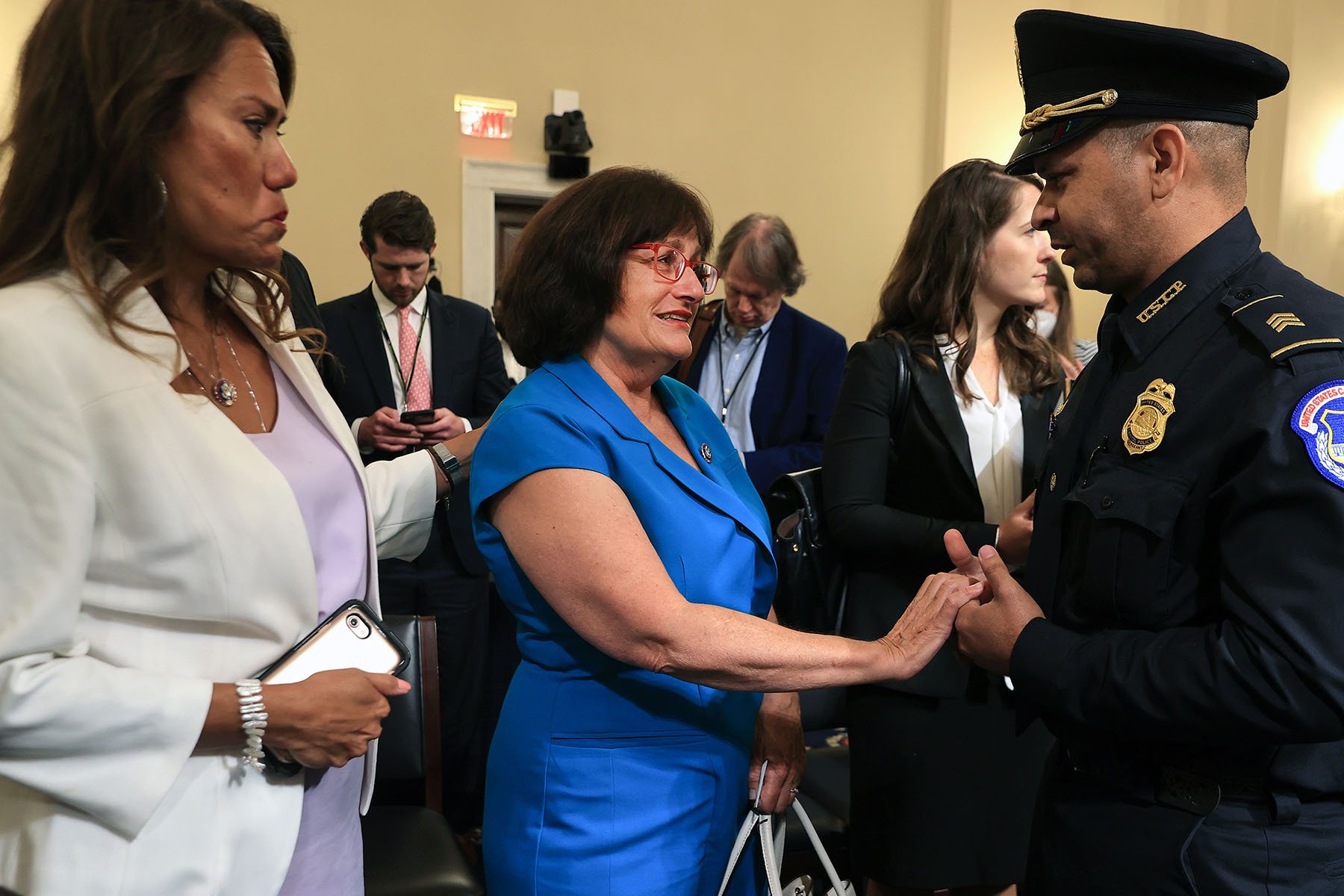
Rep. Ann McLane Kuster talks to Capitol Police officer Sgt. Aquilino Gonell after he testified before the House Select Committee investigating the January 6 attack on the Capitol on July 27, 2021, in Washington, D.C. (Chip Somodevilla/Getty Images)
Rep. Ann McLane Kuster of New Hampshire said she is still dealing with lasting post-traumatic stress disorder from January 6, one the “most impactful events” in her life. Kuster was also one of the last five lawmakers to be evacuated from the House floor. She could hear the thundering crowds and pounding on the doors and experienced a panic attack as officers snuck them into an elevator and rushed them through an underground tunnel to safety. Kuster later saw security footage of insurrectionists with backpacks, bear mace and zip ties entering the same hallway she had just evacuated 30 seconds earlier.
“I’m haunted by the idea that if the police hadn’t pushed back five seconds here, five seconds there, pushing back on the bicycle racks, pushing back on the people who were crushed in the doors — that the five of us would have been kidnapped, murdered or maimed,” Kuster said. “It was only a five-vote majority and if we hadn’t been there, America might not have woken up to Joe Biden as the lawfully elected president of the United States.”
Kuster decided to retire this year before Trump is sworn in as the 47th President of the United States and attributes January 6 as one of the reasons for that decision. In addition to the lingering trauma, Kuster said she’s received more and more death threats and has noticed a marked increase of violent rhetoric in public discourse.
“He tried to kill me once,” Kuster said. “I’m not available for it again.”
President-elect Donald Trump repeatedly pledged to roll back rights for transgender people during his campaign. Kate Sosin, LGBTQ+ reporter for The 19th, joins “America Decides” to discuss how those Americans are preparing for the incoming Trump administration.
Three transgender youths and their families from Arizona traveled across the country to ensure their voices were heard on the steps of the Supreme Court as justices heard oral arguments for the most important transgender rights case the court has ever reviewed — one that could have significant consequences on the future of lifesaving gender-affirming care for youth in the country. About a third of the teenagers in the United States who identify as transgender live in states that have limited access to puberty-blocking medication and hormone therapies. In an election cycle that saw Republicans spend at least $215 million on attack ads about transgender rights, these families share their fears, hopes, and determination to fight for their right to exist. Lucy Kafanov explores the emotional toll of anti-trans legislation, the fight for bodily autonomy, and what it means for trans youth to lose access to life-saving care.
Ben Shapiro vs Neil deGrasse Tyson: The WAR Over Transgender Issues
Ok I know I posted a clip of this from a different channel but this one gives more of Neil deGrasse Tyson’s full answer with a calmer host who did not chop it up. I like this version better because you can see how forceful and direct Tyson is being and that he is clearly amused by the trans hater who think someone’s gender expression is their business. It also shows Shapiro’s growing apprehension as he realizes that Tyson doesn’t agree with him. He clearly thought incorrectly that Tyson would echo his own bigoted opinion. He gets flustered because at the point he normally bullies someone and talks over them, Tyson doesn’t let him do it. This is a beautiful short well crafted answer to any transphobe. Hugs
Join renowned astrophysicist Neil deGrasse Tyson and political commentator Ben Shapiro in a thought-provoking debate exploring one of today’s most complex and polarizing topics: transgender identity and rights.
In this intellectual face-off, Tyson brings his scientific expertise and philosophical perspective, emphasizing individual identity, societal progress, and inclusivity. Meanwhile, Shapiro approaches the topic from a traditionalist and legalistic angle, focusing on biological realities, societal norms, and policy implications.
The discussion between Ben Shaprio and Neil deGrasse Tyson dives deep into the intersections of science, culture, and ethics, tackling questions about gender identity, biological sex, free speech, and the role of government in regulating such matters. As always, both figures present their arguments with their characteristic wit and rigor, challenging viewers to think critically about the nuanced dimensions of the topic.
Whether you’re here to learn, debate, or deepen your understanding of the issues, this conversation promises to spark reflection and dialogue. Don’t forget to share your thoughts in the comments below—respectful discussion is encouraged!
Please notice the part of the story that talks about Robby Starbuck, if you don’t know of him clicking on his blue highlighted name leads to another story of how he coerced John Deere. McDonald’s claims they are doing this because of the SCOTUS actions on school admissions, but sorry they are not colleges or universities. They are a private business and have the right to set their own no discrimination goals and policies. By blaming the court ruling they are trying to divert attention from the real reason.
Back to Robby Starbuck, This sub human pond scum is winning because he uses threats of hurting the profit of these companies. Now maybe the shareholders are predetermined to be racist bigots. But if we want this coercion to stop, we must be as loud, willing to band together, and use our money even when it hurts. So far only one company has stood against him and Stephen Miller’s white power legal company. We must rise up as we once did, make the haters ashamed again like we did over 1970s to 1990s. We can retire meekly to our self-imposed prisons of our homes and acting straight or cis, but that will only encourage them. This is how it went down in Russia and the Russian controlled influenced nations. The maga cultist and fundamentalist Christian bigots are following the Putin playbook in lockstep. We have to show them the playbook won’t work here. And trust me it is easier to do now than in a future where they have removed all sign of the LGBTQ+ people from society. Hugs
Four years after launching a push for more diversity in its ranks, McDonald’s is ending some of its diversity practices, citing a U.S. Supreme Court decision that outlawed affirmative action in college admissions.
McDonald’s is the latest big company to shift its tactics in the wake of the 2023 ruling and a conservative backlash against diversity, equity and inclusion programs. Walmart, John Deere, Harley-Davidson and others rolled back their DEI initiatives last year.
McDonald’s said Monday it will retire specific goals for achieving diversity at senior leadership levels. It also intends to end a program that encourages its suppliers to develop diversity training and to increase the number of minority group members represented within their own leadership ranks.
McDonald’s said it will also pause “external surveys.” The burger giant didn’t elaborate, but several other companies, including Lowe’s and Ford Motor Co., suspended their participation in an annual survey by the Human Rights Campaign that measures workplace inclusion for LGBTQ+ employees.
McDonald’s, which has its headquarters in Chicago, rolled out a series of diversity initiatives in 2021 after a spate of sexual harassment lawsuits filed by employees and a lawsuit alleging discrimination brought by a group of Black former McDonald’s franchise owners
“As a world-leading brand that considers inclusion one of our core values, we will accept nothing less than real, measurable progress in our efforts to lead with empathy, treat people with dignity and respect, and seek out diverse points of view to drive better decision-making,” McDonald’s Chairman and CEO Chris Kempczinski wrote in a LinkedIn post at the time.
But McDonald’s said Monday that the “shifting legal landscape” after the Supreme Court decision and the actions of other corporations caused it to take a hard look at its own policies.
A shifting political landscape may also have played a role. President-elect Donald Trump is a vocal opponent of diversity, equity and inclusion programs. Trump tapped Stephen Miller, a former adviser who leads a group called America First Legal that has aggressively challenged corporate DEI policies,as his incoming deputy chief of policy.
Vice President-elect JD Vance introduced a bill in the Senate last summer to end such programs in the federal government.
Robby Starbuck, a conservative political commentator who has threatened consumer boycotts of prominent consumer brands that don’t retreat from their diversity programs, said Monday on X that he recently told McDonald’s he would be doing a story on its “woke policies.”
McDonald’s said it had been considering updates to its policies for several months and planned to time the announcement to the start of this year.
In an open letter to employees and franchisees, McDonald’s senior leadership team said it remains committed to inclusion and believes a diverse workforce is a competitive advantage. The company said 30% of its U.S. leaders are members of underrepresented groups, up from 29% in 2021. McDonald’s previously committed to reaching 35% by the end of this year.
McDonald’s said it has achieved one of the goals it announced in 2021: gender pay equity at all levels of the company. It also said it met three years early a goal of having 25% of total supplier spending go to diverse-owned businesses.
McDonald’s said it would continue to support efforts that ensure a diverse base of employees, suppliers and franchisees, but its diversity team will now be referred to as the Global Inclusion Team. The company said it would also continue to report its demographic information.
The McDonald’s Hispanic Owner-Operators Association said it had no comment on the policy change Monday. A message seeking comment was left with the National Black McDonald’s Operators Association.
Durbin is an Associated Press business writer focusing on the food and beverage industry. She has also covered the auto industry and state and national politics in her nearly 30-year career with the AP.
(I started a post, looked for a share link, and got this. We’ll see how it goes. I’m not up to much today, but this is so good I want to share it. Totally off topic, just enjoy.)
A small conservative group in Lancaster, Ohio targeted local businesses and institutions that were LGBTQ+ friendly in response to an annual family-friendly pride event that held an outdoor drag show. When the group failed to get the city to penalize drag performers—and ban drag altogether—they then circulated a boycott list. Local business owners, however, were not harmed by the boycott. In fact, they saw a major influx in traffic after people drove from out of town to support the businesses after seeing them on the anti-LGBTQ+ boycott list.
Another cis woman from Africa has become the target of a transvestigation from Harry Potter author J. K. Rowling. This time it’s Barbra Banda, a Zambian soccer star who was voted BBC’s footballer of the year. J.K. Rowling insinuated that Banda was a trans woman and that her award was offensive to all women. This comes after she spearheaded a global cyberbullying campaign against Imane Khelif, an Algerian gold medalist who competed in the Paris Olympics.
January 6, 1832 William Lloyd Garrison, along with 15 others, founded the New England Anti-Slavery Society at the African Meeting House in Boston. William Lloyd Garrison By 1833, Garrison helped establish the American Anti-Slavery Society with fellow abolitionists Arthur Tappan, Lewis Tappan, and Theodore Dwight Weld. This organization sent lecturers across the North to convince whites of slavery’s brutality. Garrison went on to be publisher of The Liberator, a newspaper dedicated to education about, and the abolition of, slavery. He published it until passage of the 13th Amendment which made the practice unconstitutional. Read about the Anti-Slavery Society today About William Lloyd Garrison
January 6, 1941 President Franklin D. Roosevelt, in his 1941 State of the Union address, introduced the idea of the “Four Freedoms”: freedom of speech and expression; freedom of every person to worship God in his own way; freedom from want; and freedom from fear. Excerpt from his speech to the Joint Session of Congress The full text (pdf)




 Scottie's Playtime