
Month: February 2025
A few news stories that I wanted to post but was unable. Read as you wish. Hugs
New videos and stuff coming tomorrow.
Hi Everyone. Hope all is well for everyone. I have been in bed for the last 48 hours. Two days. The first day I was in too much pain to function well. This morning I got up to watch the morning Sunday news shows and was in so much pain I took so much pain I had to go to bed by 10 am. Great news is I got all the issues surrounding my video recording taken care of. I can and will start doing them very soon. Hugs and so much love to all. Scottie
CNN: Not 1. Not 2. Not 3. Not 4. 5 winter storms could deliver more snow to some than the last two winters combined
A reader of Scotties Playtime sent this to me.
Climate change is real. The change in the intensity of hurricanes is figured into insurance rates and costs in Florida and other places. It is also figured into the projections northern states use to budget for snow removal and sand / road salt requirements. I worry about any of our readers in these states. Hugs and love to all of them. Hugs
Not 1. Not 2. Not 3. Not 4. 5 winter storms could deliver more snow to some than the last two winters combined
The second of five storms that will slam the eastern half of the United States with snow and ice over a two week period is on the way – and this one has more snow than the first.
Read in CNN: https://apple.news/Ac4_qPa_PTbevgaK4iSysCg
Shared from Apple News
Best Wishes and Hugs,Scottie
Here’s An Important Resource!
Sunday AM Poetry Courtesy of Janet
Mid Century Women’s Publications Did Important Medical Work
It reminds me of how “Cosmopolitan” was one of the early ‘mainstream’ magazines honestly discussing the AIDS virus, where to find care, and knowledge to avoid contracting it. They knew and reported early on that any- and everyone can catch what we now know as HIV. This piece is about early cancer info dissemination.
How Midcentury Women’s Magazines Fought Cancer
At a time when people wouldn’t even say the word, journalists at Good Housekeeping, Redbook, and other women’s magazines were informing readers how to recognize, protect against, and talk about cancer.
Maxine Davis wrote about plenty of tough topics during her long career in journalism, but none of them frightened her as much as the assignment she received in the spring of 1940. Her editors at Good Housekeeping wanted her to cover cancer, a disease so cloaked in stigma that Davis, like many other Americans, was afraid to say its name out loud.
The sweeping series of articles she produced that year changed her thinking. “My research has dispelled that terror,” she wrote in an article that appeared in Good Housekeeping’s April 1940 issue, declaring that cancer could be cured especially if it was caught early through education and hypervigilance. Cancer, she explained, was “sneaking, insidious. Only you and you alone can guard yourself against it.”
At the time Davis wrote these words, cancer was a taboo topic. The term itself wouldn’t be spoken on the radio until 1945. Rumors about its causes were rampant. (Many Americans at the time believed it to be contagious or a sign of poor character.) Physicians routinely withheld cancer diagnoses from patients to spare them shame. Although it wasn’t always a death sentence, the treatments we rely on today were nascent or nonexistent. And yet, the editors at Good Housekeeping still decided to devote pages and pages to in-depth coverage of the disease.
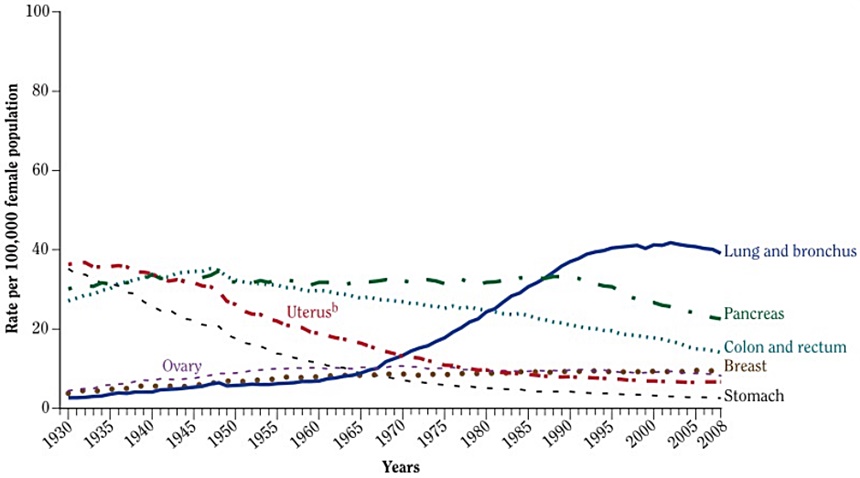
This is one example of how, during the 1940s and 1950s, women’s magazines played a vital and largely forgotten role in educating average Americans about burgeoning efforts to prevent and treat cancer. It was a pivotal era for modern medicine thanks to scientific advancements and increased attention to public health. Cancer was among the leading causes of death, and rates were increasing in part because people were living longer. Print media in all its forms played a major role in normalizing public conversations about cancer, but women’s magazines took a unique approach. They made disease prevention personal, calling upon women to become cancer watchdogs for themselves and their families.
Davis was among the best-known of the women’s magazine journalists covering cancer. By the early 1940s, she had reported on the League of Nations, driven all over the United States to research a book about American youth, and founded a wire service aimed at explaining politics to women. Her cancer stories for Good Housekeeping launched her to a new level of prominence, one akin to modern day health influencers. Her editors promoted her work heavily, framing her as a lay expert with carefully cultivated sources. “Doctors like to work with her,” they wrote in an introduction to her spring 1940 cancer series, “and they give her all the help they can.”
Writing in May of 1940, Davis introduced readers to the basics of cancer treatment, explaining in plain language how surgery, X-rays, and radium were being used to help patients.
Sometimes X-ray, radium, and surgery are all used to treat a malignant condition. Take the case of Ada Johnson. Ada put off going to hospital longer than she should have after she felt a lump in her breast; but the doctor didn’t think the situation was hopeless. This is what he did:
First, there was a surgical operation. When that had been successfully accomplished, the specialist in cancer of the breast applied radium to the chest wall. That wasn’t all. The doctor then used deep X-ray therapy on Ada’s breast and armpit….This was repeated for thirty-five treatments. Ada is perfectly well today.
Davis was not, however, the only women’s magazine reporter working the cancer beat at midcentury. Seventeen magazine’s beauty editor Jean Campbell urged her young readers to get involved in efforts to bring specialized cancer to more communities. “Demand them,” she wrote in the April 1948 issue, “and raise funds for them.” That same year Miriam Zeller Gross deftly described the history of stomach cancer treatment in a gripping feature story that appeared in Better Homes and Gardens. In the early 1950s, Redbook’s Collie Small encouraged women to overcome “false modesty” and allow physicians to screen them for breast cancer. Women’s magazines were publishing hundreds of articles on cancer by dozens of writers. Women also wrote about cancer for general magazines including The Saturday Evening Post, which featured a handful of stories in the 1950s by female cancer survivors.
Stories about cancer were far less common before World War II, but they did sometimes appear in women’s magazines. Ladies Home Journal has been credited by medical historians with publishing the very first general interest article about cancer detection in 1913. Others, including Good Housekeeping, featured occasional educational columns by physicians during the 1920s.

In addition to becoming quick experts on complex medical topics, these journalists managed often-fraught relationships with health professionals who tended to distrust journalists. It became common practice during this time for physicians to review stories before they were published. Sometimes, one of those physicians would write a sidebar: In 1955, American Cancer Society vice president Dr. Charles S. Cameron had reviewed a draft of an April 1955 article on cervical cancer by health journalist Gladys Denny Shultz for Ladies Home Journal, and wrote a public note of thanks, proclaiming that the magazine was “offering its readers a great service by publishing this excellent article. It should be a means of saving thousands of lives.”
While most of the bylines atop women’s magazine stories about cancer belonged to female journalists, editors did occasionally invite physicians, almost always men, to contribute. Cosmopolitan published a 14-page essay by Walter Alvarez, who had just retired from clinical practice to pursue a second career in medical writing. The piece, which appeared in January of 1953, sprawled across 14 pages under the headline “Danger Signals in Your Life” and includes tips to spot illnesses like cancer in children, teens, and adults. Alvarez assured readers he wasn’t out to scare them. Instead, he hoped to save “wise persons from avoidable illness or death.”
Much of this coverage was driven by coordinated public relations campaigns initiated by the American Cancer Society and similar organizations. In addition to connecting journalists with expert sources and organizing junkets to prominent research centers, such campaigns included advertising blitzes promoting new treatments, championing medical breakthroughs, and reminding Americans of the importance of cancer screenings. Women’s magazines were a popular venue for such ads, so it wasn’t uncommon for some issues to feature a reference to cancer on nearly every page.
While groundbreaking, the cancer coverage provided by midcentury women’s magazines was imperfect. Race and class were seldom addressed because these publications — like much of the news media — assumed their audience was white and financially stable. Some coverage also illustrates the era’s rudimentary and fast-evolving scientific knowledge. One example is a story that appeared in Parents magazine in 1943. Written by journalist Constance J. Foster and prominently endorsed by the New York City Cancer Committee, the article proclaimed that “cancer is not hereditary.” A piece that appeared in Redbook a decade later explained new research showing that some forms of cancer do run in families.
The role of women’s magazines in the fight against cancer is a fascinating chapter in media history, one laced with a type of gender politics that feels familiar today. The cancer beat gave women journalists like Davis access to male-dominated sectors like medicine, public policy, and journalism, but it also kept them firmly tethered to domestic matters and subservient to male physicians. Their work, while educational, put undue pressure on individual women to spot the signs of cancer. But it also brought hope to families facing a terrifying diagnosis. As Davis wrote in the October 1948 issue of Good Housekeeping, “Cancer is not necessarily fatal. Cures do exist.”
Northeastern University student Elsa O’Donnell contributed archival research for this article.
Peace & Justice History for 2/9

| February 9, 1780 Captain Paul Cuffe, his brother John, two free negroes, and other residents of Massachusetts petitioned the state legislature for the right to vote. A few years earlier, Cuffe and his brother had refused to pay local taxes, reasoning that there was a connection between an obligation to pay taxes to a government and the right to vote for that government.  Captain Paul Cuffe Cuffe’s memoir available Cuffe’s career as ship captain, shipowner, African colonizer and generous citizen |
| February 9, 1950 United States Senator Joseph P. McCarthy (R-Wisconsin) accused more than 200 staff members in the State Department of being Communists, launching his anti-red crusade. He made the allegation in a public speech in Wheeling, West Virginia, saying that state was infested with communists, and brandished a sheet of paper which he said contained the alleged traitors’ names.  “I have here in my hand,” he said, “the names of 205 men that were known to the Secretary of State [Dean Acheson] as being members of the Communist party and who nevertheless are still working and shaping the policy of the State Department.” The number changed repeatedly over the following months. Some years later, he confided the paper was actually just a laundry list. Anti-Communist fear ran high in the U.S. at the time. Federal civil servant and Soviet spy Alger Hiss had been recently convicted, and a communist government had just come into power in China. Those accused by McCarthy and others often lost their jobs, regardless of the validity of the accusation of their connection to the Communist Party. McCarthy’s career of irresponsible accusation Joe McCarthy’s Oversight Abuses (The Levin Center) Released 50 years later, transcripts of closed committee hearings reveal more abuse |
February 9, 1964 The G.I. JOE action figure made its debut as an 11.5 inch “doll” for boys with 21 moving parts, named after the movie, The Story of G.I. JOE.  Puts you in the action! |
| February 9, 1965 President Lyndon Johnson ordered a U.S. Marine Corps Hawk air defense missile battalion deployed to Da Nang, South Vietnam, to provide protection for the key U.S. air base there. American military advisers had been in country since the defeat and withdrawal of the French in 1954, but this was the first commitment of combat troops to South Vietnam.There was considerable reaction around the world to this new level of U.S. involvement. Both the People’s Republic of China and the Soviet Union threatened to intervene if the United States continued its military support of the South Vietnamese government. In Moscow, some 2,000 demonstrators, led by Vietnamese and Chinese students and clearly supported by the authorities, attacked the U.S. Embassy. Britain and Australia supported the U.S. action, but France called for negotiations.  A Marine HAWK missile launcher is in position at the Danang Airfield. |
| February 9, 2002 Ten thousand, organized by Gush Shalom (peace bloc in Hebrew), a coalition of Israeli peace groups, marched in Tel Aviv against the Ariel Sharon government’s increasingly brutal attacks on Palestinian civilians. The harsh tactics were part of Israel’s continuing occupation of the West Bank (of the Jordan River) and the Gaza Strip, territory beyond Israel’s internationally recognized 1967 borders. |
| February 9, 2003 Six weeks before the Iraq War began, Secretary of State Colin Powell on ABC-TV’s “This Week” dismissed the need for U.N. weapons inspectors to continue searching Iraq for weapons of mass destruction. He said the administration saw no further need for ”inspectors to play detectives or Inspector Clouseau running all over Iraq.” Clouseau was the bumbling detective played originally by Peter Sellers (and lately Steve Martin) in the Pink Panther films.  Peter Sellers as Inspector Clouseau U.N. weapons inspectors, left, and Iraqi National Monitoring Directorate members visit a Baghdad storage facility in this photo taken Feb. 5, 2003, just hours before U.S. Secretary of State Colin Powell appeared at the U.N. Security Council to offer evidence of alleged Iraqi attempts to hide banned weapons.  |
https://www.peacebuttons.info/E-News/peacehistoryfebruary.htm#february9
David Nihill: Cultural Appreciation | FULL COMEDY SPECIAL
This is one of the funniest things I have seen in ages. Randy sent me a clip of this guy’s comedy knowing the horrible stressful week Ron and I have had. I am so glad he did. I subscribed to his channel. He tells jokes like I do and that I like, which is very joke has a story to it and is the set up for a funny event. The ending is totally spectacular and worth watching by itself. Hugs.
Not Only KS Legislators On This Ball, But Some Of Them Are
On this issue, at least. The other senator from KS can be read toward the end of the article, and he’s just a maga nut, so read at your own discretion. I’m wondering if he’s beginning dementia, or else how he earned an MD. Anyway, here’s this. Sen. Moran can usually get an R coalition happening, and KS is not the only ag state who stands to not only lose, but to literally watch crops rot waiting to be shipped to people who need to eat. Wasting food is a cardinal sin, IMO.
Kansas’ Moran, Davids sound alarm on delay of USAID food aid to starving people worldwide
Marshall proponent of crackdown on alleged fraud, abuse at humanitarian agency
By: Tim Carpenter – February 7, 2025 1:59 pm
TOPEKA — U.S. Sen. Jerry Moran of Kansas said a freeze on federal funding and change at the U.S. Agency for International Development left $340 million in lifesaving food grown in the United States sitting at domestic ports awaiting delivery to locations around the world where people were starving.
On Friday, President Donald Trump said he wanted to shut down USAID, which served as the federal government’s primary provider of development and humanitarian aid worldwide. Much of USAID’s funding has been frozen. Thousands of USAID employees expect to be indefinitely suspended or laid off as the Trump administration, in collaboration with billionaire Elon Musk, worked to gut an agency the president said was operated by “radical lunatics.”
Moran, among farm-state senators on the Senate Agriculture Committee, said he encouraged Marco Rubio, the U.S. secretary of state and acting administrator of USAID, to make certain U.S.-grown commodities were promptly shipped and distributed to people in need.
The World Food Programme estimated $340 million in U.S. food aid was idled at domestic ports by order of the Trump administration. In total, $566 million in U.S.-grown commodities designated for humanitarian purposes was locked down in warehouses throughout the world.
“Time is running out before this lifesaving aid perishes,” Moran said. “Food stability is essential to political stability, and our food aid programs help feed the hungry, bolster our national security and provide an important market for our farmers, especially when commodity prices are low.”
Moran said there was a “moral component to food aid,” but he understood administrative issues with U.S. aid programs had to be addressed. That reform, he said, must go beyond presidential directives so Congress could be “involved in making the decision of what this should look like.”
Rep. Tracey Mann, the Kansas Republican on the House Agriculture Committee, has led relaunch of the bipartisan House Hunger Caucus dedicated to international and domestic hunger and food insecurity. He said in a previous statement that growing up on a Kansas farm taught him the sacred responsibility of feeding people.
“Hunger destabilizes countries, starts wars, eliminates markets and causes human suffering. America benefits on multiple levels from making investments that address it,” Mann said. “America is the leader of the free world, which comes with certain responsibilities. Addressing global hunger is both the morally right and strategically wise thing do to.”
‘Irresponsibility’
U.S. Rep. Sharice Davids, a Kansas Democrat also on the House Agriculture Committee, said dismantling USAID would have ramifications in terms of world hunger and the future of Kansas agriculture.
“Elon Musk’s reckless and illegal shutdown of USAID isn’t lowering prices as promised — it’s hurting our economy, national security and hardworking Kansans,” Davids said. “My team has heard from many who have lost their jobs, small businesses facing bankruptcy and Kansas farmers struggling to sell their crops. This level of irresponsibility cannot go unchecked.”
USAID’s website said at midnight Friday all USAID direct-hire personnel would be “placed on administrative leave globally, with the exception of designated personnel responsible for mission-critical functions, core leadership and specially designated programs.”
The U.S. Department of Agriculture has facilitated the purchase of U.S. commodities funneled into the USAID pipeline. USAID has been responsible for booking cargo ships to deliver food aid and to coordinate distribution of assistance in various countries.
USDA paused the purchase of food for USAID purposes in response to Trump’s executive order establishing a 90-day freeze on funding. Rubio issued a temporary waiver for food and other lifesaving assistance, but there was confusion about what qualified for the exemption. U.S.-grown agriculture products in domestic ports included wheat, sorghum, rice, lentils, peas as well as vegetable or sunflower oils.
USAID, with a staff of approximately 10,000, also has oversight of U.S. disaster relief and health initiatives in over 100 countries. (snip-MORE. The next graf is our insane senator explaining that he thought he saw awful things happening, meanwhile literal food is actually spoiling while he tells us of his hallucinations. I’d have to take the puter to the carwash to get the stupid off if I copy it to paste here. However, a few of the farmers who grow this food also have cogent commentary, so it’s worth clicking through to finish the article. Everyone but Marshall and Estes are aware of the national security element of this stupidity.)
 Scottie's Playtime