Scottie-Tell Ron! A Lighthouse Story

Ida Lewis, Newport’s Legendary Lighthouse Keeper

In the mid-1800s, Ida Lewis’s daring sea rescues became a media sensation, leading to hundreds of telegrams, gifts, and marriage proposals. All Ida wanted to do was tend to her lighthouse.
Nancy Rubin Stuart

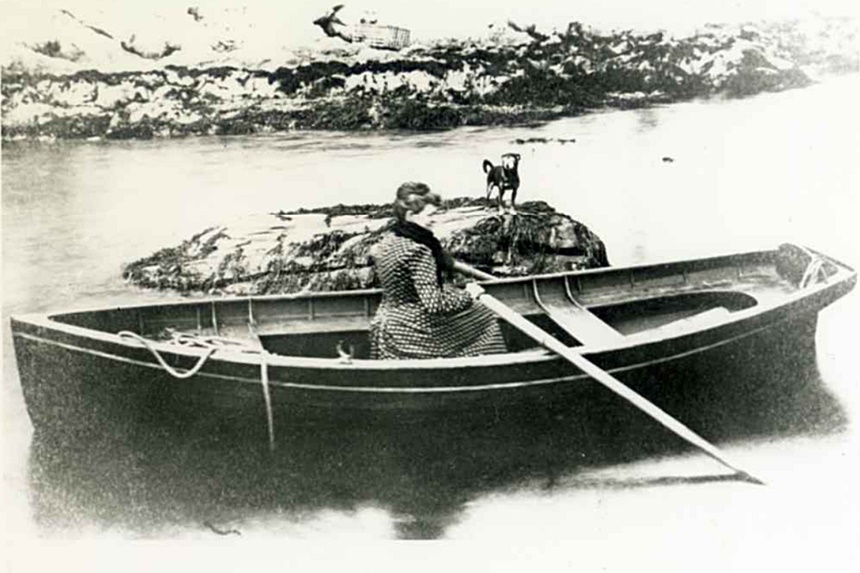
Ida Lewis in a rowboat, ca. 1900 (Newport Historical Society)

The events that led to Ida Lewis being called “The Bravest Woman in America” began on the blustery night of March 29, 1869, on Lime Rock Island, after her mother Zoradia spotted two men clinging to an overturned boat in the churning waves and screaming for help. “Ida, O my god! Ida, run quick! A boat has capsized, and men are drowning. Run quick, Ida!” she yelled to her daughter.

Ida and her younger brother Hosea immediately ran out of the house and jumped into a small skiff. Taking the icy oars, she rowed against a high wind to rescue the drowning men. Despite the freezing, wintery weather, she and Hosea lifted the choking men into the skiff, rowed them back to shore, and brought them into their home. The men were soldiers from nearby Fort Adams. As told in Lighthouse Keeper’s Daughter, Sergeant James Adams was barely able to “totter up to the house” and Private John McLoughlin was unconscious, but once revived and fed both recovered. Later, Sergent Adams told Ida’s other brother, Rudolph, “When I saw the boat approaching and a woman rowing, I thought She’s only a woman and she will never reach us. But I soon changed my mind.”
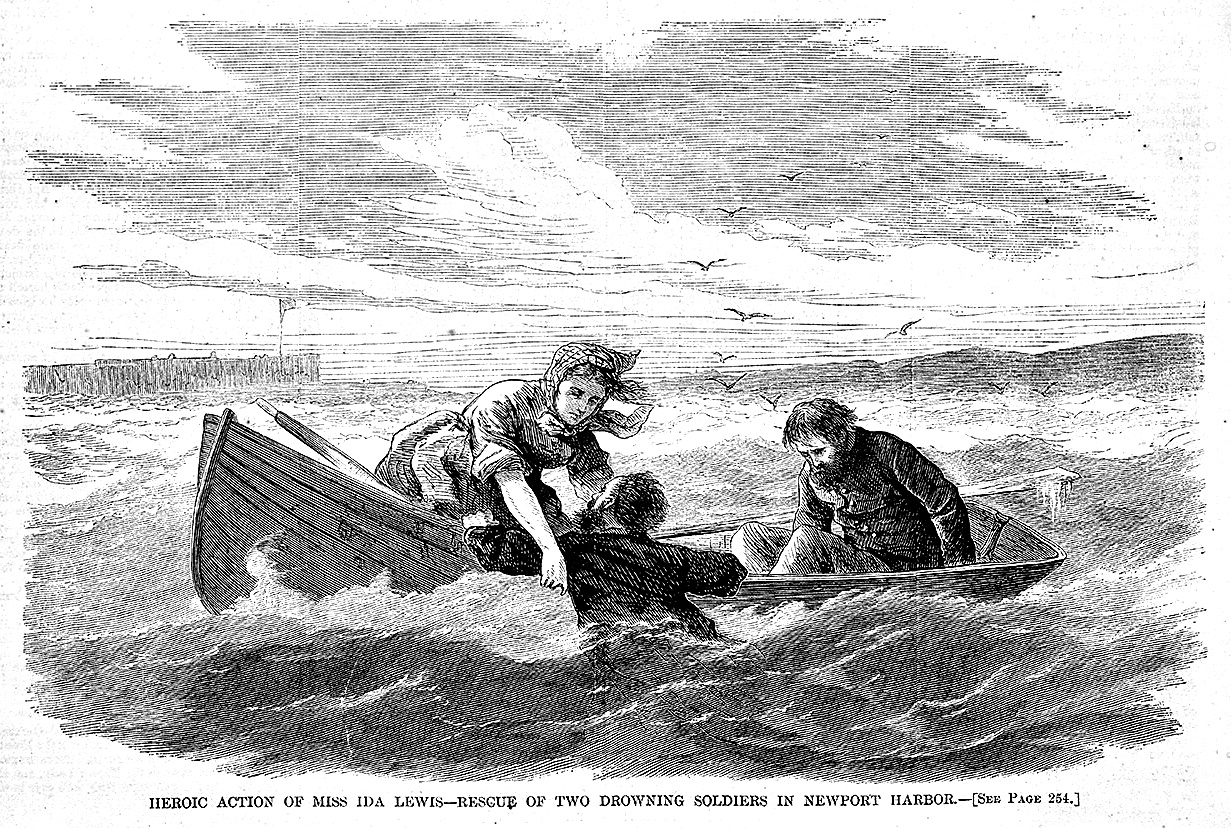
Illustration of Ida Lewis rescuing Sergeant James Adams and Private John McLoughlin, from the April 17, 1869, issue of Harper’s Weekly (Mariner’s Museum)

That was not the first time Ida had saved lives. By then she had already rescued three schoolboys and two other groups of men from drowning; during one rescue, Ida had saved four men whose boat had capsized in Newport Harbor. She was only twelve.

The New York Tribune’s story on Ida Lewis from their April 12, 1869 issue (Library of Congress)
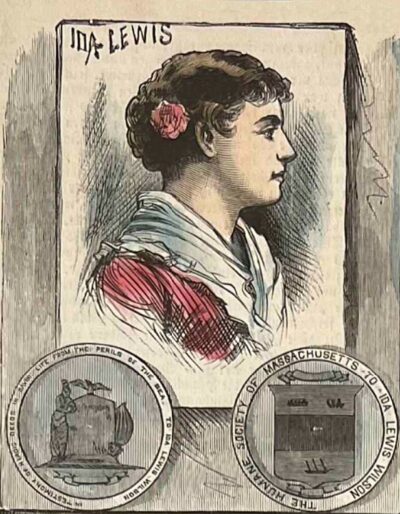
Illustration of Ida Lewis from Frank Leslie’s Illustrated, November 1881 (Newport Historical Society)

But her rescue of 1869 was so improbable that reporters flocked to Newport to interview her. On April 12, the New York Tribune carried Ida’s story, followed by articles in Harper’s Weekly and Frank Leslie’s Illustrated Newspaper, which printed an etching of Ida’s pleasant face, strong features and wide-set hazel eyes. Adding to the story’s sensationalism was her weight of 103 pounds. Readers were riveted and soon besieged Ida with hundreds of telegrams, phone calls, gifts, and marriage proposals.

Shy and modest, Ida recoiled from the attention. When asked what motivated the rescue, she explained it as a moral obligation. “If there were some people out there who needed help, I would get into my boat and go to them even if I knew I couldn’t get back. Wouldn’t you?”

The boat presented to Ida in Boston on Independence Day (Stinson: Newport Firsts: A Hundred Claims to Fame2018, Arcadia Publishing via WindCheck magazine)

Readers were so overwhelmed by her courage that they collected funds to honor her. On July 4, 1869, in a public ceremony in Boston, they paraded a magnificent rescue boat through the streets, which was then presented to Ida. Among the audience were politicians and military leaders like Ulysses S. Grant, General Tecumseh Sherman, and Admiral George Dewey along with many wealthy Gilded Age summer residents of Newport who were then building estates along the shore. To the audience’s disappointment, she refused to address the crowd, leading prominent abolitionist Colonel Thomas Wentworth Higginson to explain, “Miss Lewis desires me to say that she has never made a speech in her life and…doesn’t expect to begin now.”

Later that summer, women’s rights leaders Susan B. Anthony and Elizabeth Cady Stanton visited Newport and met Ida, whom they cited as a “young heroine” and an example of women’s unsung abilities.

Born on February 25, 1842, Idawalley Zoradia Lewis was the oldest of the four children of Zoradia and Captain Hosea Lewis of the Revenue Cutter Service, the forerunner of the U.S. Coast Guard. In 1854 after the Lighthouse Service appointed Ida’s father as keeper, young Ida routinely sailed with him from Newport to Lime Rock Island to help maintain the light. Three years later when a house was built on the island and the light relocated there in a special second floor “lanthern” room, the Lewises moved to Lime Rock. Tragedy struck four months later when Ida’s father suffered a paralytic stroke, forcing her mother Zoradia to assume his keeper duties.
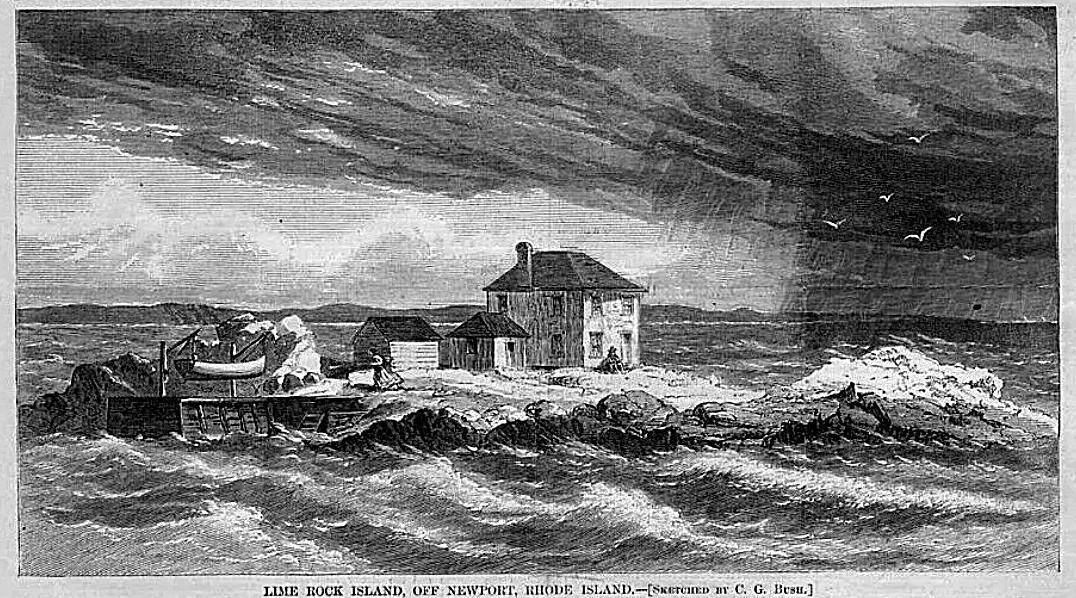
Illustration of Lime Rock Island from Harper’s Weekly, July 31, 1869 (Wikimedia Commons)

By then everyone in the family knew Ida was dependable, had unusual strength, and was a skilled sailor. Her brother Rudolf bragged, “Ida… can hold one to wind’ard in a gale better than any man I ever saw, wet an oar, and yes do it too when the sea is breaking over her.” Consequently, after her father’s stroke, she rowed her siblings to school and returned to the island with supplies from Newport.

Over the next 14 years, Ida helped her mother tend the light until her father died in 1877. A year later, Zoradia, who was ill with cancer, also died, leaving Ida to serve as keeper, maintain the family home, and care for a frail sister.

Ida Lewis posing with an oar (U.S. Coast Guard / Arlington National Cemetery)

Being a lighthouse keeper was demanding. It was a job traditionally done by men. The beacon came from an oil-burning lantern housed in a wooden or iron frame surrounded by thick panes of glass. A solid wick suspended from the top of the frame enabled the oil (which needed to be refilled two or three times a night) to burn through the darkness. A Fresnel lens 17 inches tall and 11 ¾ inches in diameter reflected the burning oil, its light beaming far out beyond Newport Harbor. Every evening before dusk Ida trimmed the wick and adjusted the glass vents of the lens to create a proper draft. During the day, she cleaned the delicate panes of the lens, inspected and cleaned parts of the lantern, and removed carbon and other impurities. Those duties had to be performed carefully. If not, and the beacon failed, the lives of sailors at sea could be endangered.

Since Ida never kept records, no one knows how many rescues she achieved. Besides the famous 1869 rescue, several others were well known. The first occurred on a February 1866 night when she pulled three drunken soldiers from the waters after they “borrowed” her brother’s skiff and capsized it. The second happened the next January when three farmhands herded one of tycoon August Belmont’s prize sheep down Newport’s Main Street. Unexpectedly, the animal bolted and plunged into the harbor. Panicked, the trio jumped into Ida’s brother’s skiff to capture it but then overturned the boat. Again, Ida leapt into her own skiff and saved the drowning men whose hands were so numb from the frigid water that they barely grasped the sides of the capsized hull.

In 1870 Ida was officially appointed the Lighthouse Keeper of Lime Rock and awarded a salary of $750 per year (about $17,000 today). That same year she married Captain William Heard Wilson but became so unhappy that she soon left him and returned to her duties at Lime Rock Lighthouse.

Later, she rescued two more soldiers from Fort Adams who had fallen through the ice, prompting the United States government to award her the Gold Lifesaving Medal in 1881. Decades later, in 1907, Congress bestowed the first American Cross of Honor upon the aging Ida.

But awards, even national ones, meant little to her. “The light is my child and I know when it needs me, even if I sleep,” she once said. It was only when Ida died at age 69 on October 24, 1911, that her light finally went out.

Nancy Rubin Stuart often writes about women and social history. She is the author of The Muse of the Revolution: The Secret Pen of Mercy Otis Warren and the Founding of a NationVisit  nancyrubinstuart.com.

Interesting, And I’m Glad There Are People Thinking of Such Things!

 TikTok’s “cute winter boots” meaning explained

[Taylor Lorenz at UserMag]

This is like something from a cyberpunk novel:

“The phrase “cute winter boots” is not about footwear. It’s a code phrase being used to discuss resistance to Trump and how to fight back against the draconian immigration policies his administration is enacting. Users talking about “cute winter boots” keeping people safe from “ice,” are referencing U.S. Immigration and Customs Enforcement. “Cute winter boots” is just the latest example of algospeak, coded phrases and words aimed at subverting algorithmic filters.”

The reason is a perceived idea – which may well have basis in fact – that actual discussion of how to combat ICE raids and so on will be demoted by the platform’s content algorithm. It’s also clearly a way of trying to avoid scrutiny from authorities. But it also reveals a strong knowledge of what the TikTok algorithm likes to promote:

“The videos discussing “cute winter boots” leverage the TikTok algorithm’s preference for product-focused content to amplify their reach. “What the algorithm likes is products,” said Diana, the admin of @/citiesbydiana, a TikTok account about urban planning. “It’s a way to talk about resisting the federal government in a way that will actually reach people.””

This is absolutely dystopian police state stuff, but at the same time, it shows a ton of initiative, and illustrates that people aren’t going to take any of this lying down. Power to them.

#Technology

[Link]

https://werd.io/2025/tiktoks-cute-winter-boots-meaning-explained

Literally Watching Again In Real Time, Peace & Justice History For 2/2

February 2, 1779
Anthony Benezet and John Woolman, both prominent Quakers (Society of Friends), urged refusal to pay taxes used for arming against Indians in Pennsylvania. Since William Penn established the state two generations earlier, the Friends had dealt with the Indian tribes nonviolently, and had been treated likewise by the native Americans. Benezet and the Quakers were also early and consistent opponents of slavery.

More about Anthony Benezet 
February 2, 1848
The Treaty of Guadalupe Hidalgo was signed in the Mexican city of the same name, ending the Mexican War. In 1845 Congress had voted to annex Texas, and President James K. Polk sent General Zachary Taylor and troops to patrol the border, newly defined by Congress as the Rio Grande, though it previously had been the Nueces River.
Following an encounter between Mexican and U.S. troops, Polk called for Congress to declare war on Mexico. General Winfield Scott and troops eventually seized Mexico City.The treaty’s provisions called for Mexico to cede 55% of its territory (present-day California, Nevada and Utah, New Mexico, most of Arizona,
and portions of New Mexico, Wyoming and Colorado), and to recognize the Rio Grande as the southern border of Texas, in exchange for fifteen million dollars in compensation for war-related damage to Mexican property. According to the treaty, U.S. citizenship was offered to any Mexicans living in the 500,000 sq miles (1.3 million sq km) of new U.S. territory.


Land ceded to the U.S. after the Mexican War.
The Treaty of Guadalupe Hidalgo 
February 2, 1931
The first of well over 400,000 Mexican-Americans from across the country, some of them citizens and many of them U.S. residents for as long as 40 years, were “repatriated” as Los Angeles Chicanos were forcibly deported to Mexico.
More on those deported, Los Repatriados
February 2, 1932
The Conference on the Reduction and Limitation of Arms, the world’s first disarmament meeting, opened in Geneva, Switzerland. Sponsored by the League of Nations, and attended by delegates from 60 nations, no agreement was reached. The U.S. delegation called for the abolition of all offensive weapons as the basis for negotiations but found little support.
February 2, 1966 
The first burning of Australian military conscription papers as a protest against the Vietnam War occurred in Sydney, Australia.
February 2, 1970

Bertrand Russell later in life
Bertrand Russell, mathematician, Nobel laureate in literature and philosopher of peace, died in Penryndeudreaeth, Merioneth, in Wales at age 97.

Bertrand Russell at age 10
“Patriots always talk of dying for their country but never of killing for their country.”
— Bertrand Russell  
More of Russell’s wisdom 
February 2, 1980
Reports surfaced that the FBI had conducted a sting operation targeting members of Congress. In what became known as ”Abscam,” members suspected of taking bribes were invited to meetings with FBI agents posing as Arab businessmen, offering $50,000 and $100,000 payments for special legislation.
Audio and video recordings of the meetings were made surreptitiously. Six members of the house were convicted of accepting bribes. Another member of the House and one senator were targeted but took no money.

 
FBI agents in Abscam sting operation
Actual FBI videotape of one attempted scam 
February 2, 1989

Soviet participation in the war in Afghanistan ended as Red Army troops withdrew from the capital city of Kabul. They left behind many of their arms for use by Afghan government forces. They were driven out principally by the insurgent mujahadin, armed through covert U.S. funding.
Read more 
“Charlie Wilson’s War” movie trailer 
February 2, 1990
South African President F.W. De Klerk unbanned (lifted the legal prohibition on) opposition parties: the African National Congress (ANC), the Pan-Africanist Congress and the South African Communist party were officially considered legal. He also announced the lifting of restrictions on the UDF, COSATU and thirty-three other anti-apartheid organizations, as well as the release of all political prisoners and the suspension of the death penalty. This was the result of his negotiations with the imprisoned Nelson Mandela, a leader of the ANC.
The ecstatic reaction to De Klerk’s beginning the end of apartheid on BBC video 

History, and Why Some Women Ought To Know Better Than How They Behave…

In the Ladies’ Loo

Gender-segregated bathrooms tell a story about who is and who is not welcome in public life.

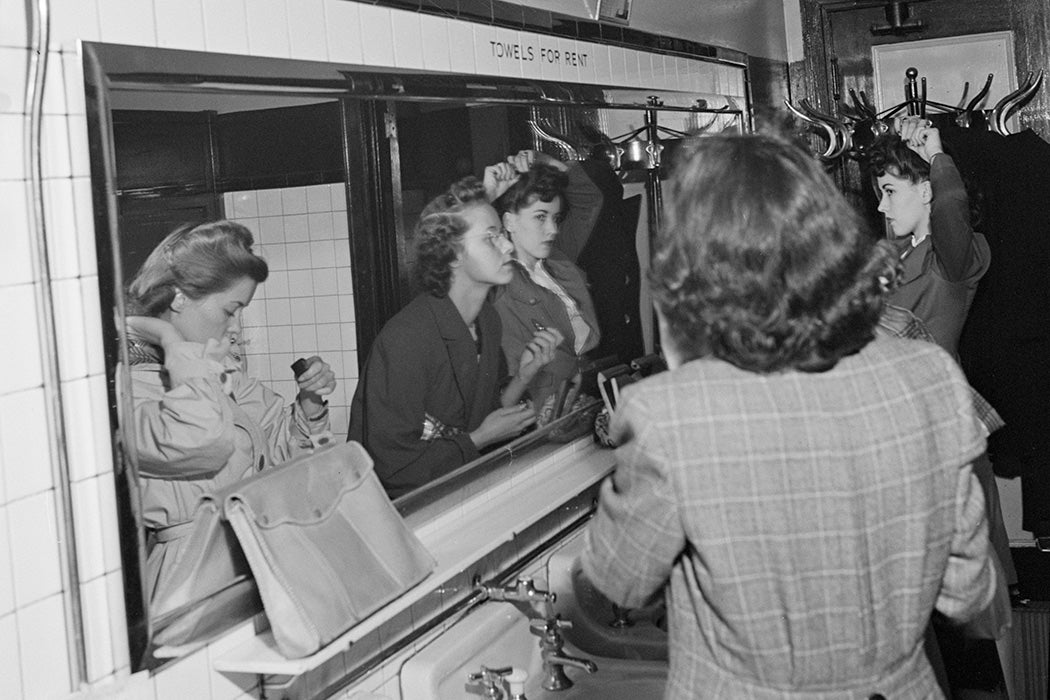
Passengers freshening up in the ladies' restroom at the Greyhound bus terminal, Chicago, 1943

Passengers freshening up in the ladies’ restroom at the Greyhound bus terminal, Chicago, 1943 via LOC

By: Emily McCrary-Ruiz-Esparza 

Women’s entry into public life around the turn of the twentieth century was a major catalyst for the creation of sex-segregated public restrooms. As scholar Daphne Spain writes, female civic reformers lobbied municipal governments to make cities more inclusive places for women, pushing for amenities such as health clinics and kindergartens. And in both small towns and big cities, notes historian Peter C. Baldwin, women worked to ensure the availability of public toilets. The first gender-segregated public bathrooms afforded women privacy, safety, and autonomy—if, that is, the women were white and of means; otherwise, access to bathrooms served as a tool of segregation. The history of the women’s bathrooms in the United States is a story of who does—and who doesn’t—get to belong in public life.

The first public bathrooms in the United States appeared in the late 1800s. Pub owners offered them to paying customers to drum up business and keep drinkers drinking. But, as Baldwin notes, pubs and saloons were improper, unwelcoming, and sometimes dangerous environments for women, and were effectively male-only establishments whose facilities only catered to men.

Just a few decades later, according to Spain, women had begun to challenge their “proper place” in society. While middle- and upper-class women increasingly ventured out of the home into the burgeoning urban environment to shop and to socialize, their lower-class counterparts increasingly found work in factories and other non-domestic environments where they could earn their own money. And some, many of whom belonged to the upper classes, forced their way into political and civic life, lobbying for, and winning, suffrage. Changing social stations pushed women and men together in public. They shared sidewalks, transportation, parks, stores, and restaurants. Women entered public life, and standards of decorum shifted to accommodate them, though certainly not to include them—gender segregation became a paramount concern, according to Baldwin, for preserving the modesty and propriety of women. Still, a dramatic shift had occurred: Men no longer wielded a monopoly on public life.

While men were afforded the opportunity to take care of their most basic needs—the need to relieve themselves—women were not given the same.

In the absence of an available pub bathroom, men were accustomed to relieving themselves in the street. Not only did that suddenly seem crass in mixed company, but the new science of germ theory made it clear that using the city as a toilet posed a health hazard, Baldwin says. Urban designers, physicians, and civic groups lobbied municipal governments in Chicago, Boston, New York, and elsewhere to provide a sanitary solution to the problem of human waste.

The first public toilets, euphemistically called “comfort stations,” appeared in American cities in the 1890s, according to Baldwin. By 1919, roughly one hundred cities, including Denver, Cleveland, Detroit, Philadelphia, and Seattle made toilet facilities available to the public for free or a small fee. Some were funded by health-minded philanthropists and reformers concerned not only with physical cleanliness, but “moral cleanliness,” writes sociologist Alexander K. Davis. They believed the two were intrinsically linked.

Comfort stations were gender segregated but not gender equal. While men were afforded the opportunity to take care of their most basic needs—the need to relieve themselves—women were not given the same. Women’s facilities were often smaller and had fewer toilets than the men’s, writes Baldwin, and were consistently inferior to the semi-private “customers only” bathrooms available in the “Adamless Eden” of a department store, as one such store owner Spain quotes called them; these were available only to patrons.

For those women denied the privilege of department store entry owing to race or lack of means, the comfort station was the only option for getting some privacy in public. Businesses, manufacturing plants, offices, and government buildings almost entirely lacked gender-segregated bathrooms, and because it was scandalous for a woman to enter a bathroom that men used, the lack of women’s toilets sent a clear signal about who was and wasn’t welcome in a particular space. Without equitable access, women were not able to fully participate in life outside the home. If you can’t empty your bladder or your bowels with dignity, it’s hard to be away from home for long.

Public stations were expensive to maintain and quickly became dirty and malodorous. Many were underground or in secluded areas and were dangerous for female users. Baldwin points out that by the early 1920s, cities cut budgets and patrons abandoned the cause, so stations fell into disrepair almost as soon as they appeared, and some of the same women’s groups that had petitioned for their creation eventually pressed for their closure. The provision of bathrooms became largely the remit of private business owners who could provide or restrict access as they pleased.

Women's restroom at the Arizona Biltmore in Phoenix, AZ, 1930s
Women’s restroom at the Arizona Biltmore in Phoenix, AZ, 1930s via Wikimedia Commons

Though the truly public bathroom—where access is free to all—is increasingly rare today, the semi-public toilet is taken for granted. The ladies’ room in restaurants, bars, airports, train and bus stations, hotel lobbies, schools, and event venues remains one of the few spaces where men are strictly prohibited. Though many are accessible only to those who can patronize a business or afford a ticket for travel.

It’s such an important part of female culture that the women’s bathroom is a convenient prop in movies, TV, and books. Writers set a scene in the ladies’ room, where women gather to complain, cry, confide, confess, gossip, preen, or bully. And though such scenes sometimes lean on tired tropes of female behavior, the gender-segregated bathroom is a place to exist beyond the gaze and reach of men. Here, women speak candidly about feelings, bodies, periods, sex, romantic partners, friends, jobs, and family.

“They offer a space for bonding, the exchange of information, and personal recovery,” writes scholar Christine Overall. “Sex-segregated toilets provide ‘the element of sociability important to many women, who also use the women’s room as a refuge, ‘a place to feel safe, both physically safe but also psychologically safe.’” On the wall and in stalls, it’s not uncommon to see phone numbers for domestic violence helplines or, in bar bathrooms, instructions for ordering an “angel shot”: a coded way to ask a bartender for help in the face of harassment.

Of course, the ladies’ room by design isn’t a safe space for all women.

“At various points in US history, the absence of toilet facilities has signaled to [B]lacks, to women, to workers, to people with disabilities, to transgender people, and to homeless people that they are outsiders to the body politic and that there is no room for them in public space,” writes the feminist scholar Judith Plaskow. If these bathrooms are supposedly for the public, then by virtue of excluding certain people, the message is that their needs are not for consideration.

Access to public space in the US has even been explicitly exclusionary. When the Boston-based advocacy organization Women’s Educational and Industrial Union pressed for the creation of health clinics and lunch rooms in the early twentieth century, it made it clear that their goal was to segregate classes and create spaces, Spain explains, where only “middle-class and elite women could appear without being declassed and working women could appear in public without having their virtue questioned by being ‘on the streets.’”

In the Jim Crow south, writes Baldwin, Black women had to use separate bathrooms, typically older and poorly maintained, and were not afforded the privacy of gender-segregated facilities. In some cases, Black people in the segregated South had no access to public bathrooms at all.

Now, the current campaigns of exclusion seek to bar transgender women from accessing the ladies’ room. In 2016, the North Carolina state legislature passed “the bathroom bill,” which forced people to use the bathroom that corresponds to the gender they were assigned at birth. The next year, eight more states moved to impose similar restrictions. North Carolina’s bill was met with such anger on behalf of the LGBTQ community that some elements were quickly scrapped, and the remainder was left to lapse in 2020. While campaigns for equity have made such laws and restrictions exceedingly unpopular, they have not yet made them extinct.

In November 2024, Sarah McBride became the first openly transgender person elected to Congress, representing the state of Delaware. Within weeks, representative Nancy Mace of South Carolina introduced a resolution banning transgender women from the ladies’ bathrooms on Capitol Hill. Within days, House Speaker Mike Johnson announced the official ban.

Yes, I believe it is worthwhile to challenge hate speech.

And this is a blog well worth following, though I don’t read there often enough.

Wee Pals’s Soul Circle:

Wee Pals by Morrie Turner for February 01, 2025

Wee Pals Comic Strip for February 01, 2025

https://www.gocomics.com/weepals/2025/02/01

I Found This Beautiful To Read, So I Want To Share

The writing style is frank. The title directly beneath is the link. -A

“Sex, Love, And Longing In 1970’s New York: Edmund White on His Past Lovers

“He was a Peter Pan, the puer aeternus. I was abject in my longing for him.”

By Edmund White

Throughout the 1970s I was in love with Keith McDermott, ten years younger than me. When I first met him, I was living in a third-floor walk-up studio on Horatio Street in the West Village. He was living across the street with Larry Kert (he’s dead), the original young male lead in West Side Story. I was one of Larry’s rainy-day fucks—he’d call me midday or early evening when he was horny and the weather forbade open-air cruising (snow, rain, or tropical heat).

Maybe I met Keith at Larry’s or through someone else; I don’t remember. Keith was living rent-free with Larry. They’d started out as lovers but now, after a year, Keith was expected to help in maintaining their big, luxurious apartment by cleaning and doing chores—and disappearing when Larry had a trick he was bringing home.The sound of the whirring wheels as he came racing around the corner and glided to a halt became the very whisper of desire for me.

Keith wanted to move and I had a lead on an eight-room prewar apartment on the Upper West Side, a block away from Central Park and just four hundred dollars a month. The landlady lived downstairs from us and had decided to rent only to gays—but, what narrowed the field, gay men without dogs. In those days gay couples had dogs, not yet children. We were too poor and unsettled to think of wanting a dog. It never crossed our minds.

Keith was a famous beauty (famous in the West Village and Fire Island among gay men). He was blond, blue-eyed, just twenty-one, and perfectly formed (an expert gymnast). In good weather he rode his bike everywhere. The sound of the whirring wheels as he came racing around the corner and glided to a halt became the very whisper of desire for me. He was fleet, funny, and so handsome that Bruce Weber, the most famous photographer of handsome men back then (Abercrombie & Fitch, GQ, Calvin Klein), took his picture. Weber’s men, often nude or in wet white underpants, were twenty-something, athletic, Ivy League, and passably heterosexual—perfect eye candy for gay men of the period, who liked their men to be iconic and unobtainable, i.e. straight.

Of course I wanted to sleep with this beauty, but he found a way to forestall my lust. He said he was sick of “meaningless” sex and invited me to join his chastity club. We could sleep side by side as long as we never touched. I was content to have that constant access to his beauty and company—and he was happy, I guess, to reap the devotion of a fit, charming, bewitched man in his early thirties who was just publishing his first novel. Before long we were living in our vast eight-room apartment. Whenever I would buy an ugly but big dining room table and six high-backed chairs at Goodwill, Keith would be so outraged that he would drag the furniture out the front door into the hallway. He was a resolute artist and had a horror of looking or being middle-class.

Keith was careful with his “instrument,” i.e., his body. He drank tiny cups of liquid buffalo grass, ate sparingly, mainly vegetables, and visited the gym daily for two hours, where he’d twist and turn on the exercise rings, climb ropes, and strengthen his arms and core, his shoulders and legs, but he never wanted to become a heavily built muscleman. He was a Peter Pan, the puer aeternus. I was abject in my longing for him. I can’t bear to recall the scenes of my crawling toward him, arms outstretched, or the moment when I saw him as an emanation of God. Once I organized an orgy of several guys I dragged back from the Candle Bar in the neighborhood, hoping to be able to touch Keith in the melee. It worked.I can’t bear to recall the scenes of my crawling toward him, arms outstretched, or the moment when I saw him as an emanation of God.

Larry Kert had had a cruel streak—maybe that had rubbed off on Keith. Or maybe my idolatry was just that absurd and I needed vinegar poured in my wounds. I suppose some of the mystical strains in Nocturnes for the King of Naples, the book I was writing then, were a spillover from my almost religious love for Keith.

And then Keith was cast in the Broadway hit Equus, in which he was naked onstage eight performances a week for years. Dirty old men would sit with binoculars in the front row night after night. A pimple on his ass would send Keith into an anxiety attack. He was brilliant in the role; I saw him in the play dozens of times opposite Richard Burton or Anthony Perkins. It was such a titanic strain (no colds, no hemorrhoids, no weight gain or perceptible loss), thousands of lines, gymnastic feats blinding the “horses” (dancers dressed as stylized horses), rowdy adolescents seated in the cheap seats onstage making wisecracks, kids who were so used to TV that they thought these performers, too, couldn’t hear their remarks. His life became one of iron discipline. I like to think he even came to appreciate our domestic life.

He moved to Los Angeles but was a little too openly, rebelliously gay for Hollywood in those days (no one wanted to see the fag kiss the girl and there were almost no gay roles in the seventies). Then I moved to Paris for sixteen years. When I came back to New York in the late nineties, Keith was living with a sweet, talented Israeli painter; he’d mellowed, was just as funny as ever, became a close associate of the avant-garde director Robert Wilson.

Keith himself directed plays at La MaMa and had published a book. We’re great friends. He insists that I helped form some of his tastes in music and literature. His own curiosity and experience in so many domains of the arts, however, didn’t need my influence, I’m sure. When I told him I’d be writing about him in my sex memoir, he said, “Just say I have a big dick.” That’s easy—his dick is huge.

________________________________

Observing Black History Month, Because This Is The Fkn’ US, Dammit!

The Negro’s “America” by Frank Barbour Coffin 1870–1951

My country, ’tis of thee,
Sweet land of liberty,
     Would I could sing;
Its land of Pilgrim’s pride
Also where lynched men died
With such upon her tide,
     Freedom can’t reign.

My native country, thee
The world pronounce you free
     Thy name I love;
But when the lynchers rise
To slaughter human lives
Thou closest up thine eyes,
     Thy God’s above.

Let Negroes smell the breeze
So they can sing with ease
     Sweet freedom’s song;
Let justice reign supreme,
Let men be what they seem
Break up that lyncher’s screen,
     Lay down all wrong.

Our fathers’ God, to Thee,
Author of liberty,
     To Thee we sing;
How can our land be bright?
Can lynching be a light?
Protect us by thy might,
     Great God our king!

This poem is in the public domain. Published in Poem-a-Day on February 1, 2025, by the Academy of American Poets.

As always, click the title to get more about the poet and their work. Today’s background is especially poignant, and work the click.

MR Crew Exposes The Truth About Trans Kids In America

Trans People Are Real and Detransitioning Isn’t That Common – SOME MORE NEWS

Ok the first few minutes are sort of campy and over the top, it is the guy’s style thing I guess.  But then he settles down and delivers the facts and debunks a lot of stuff by showing the actual studies the right wrong claim back them up, but he shows how the studies say the opposite of that the trans haters claimed.  Great info on trans people and the made up faked outrage caused by a small group of trans haters who are making big money off of pushing lies about trans kids and trans issues.  Hugs

Hi. Right-wing politicians, lawyers, and grifters (and some liberals) want to convince you that trans youth are the victims of a social contagion and that the majority of those who transition will detransition. This is a lie that puts all trans people at risk. Get the world’s news at https://ground.news/SMN to compare coverage and see through biased coverage. Subscribe for 40% off unlimited access through our link.