
August 21, 1831 Nat Turner, a 30-year-old man legally owned by a child, and six other slaves began a violent insurrection in Southampton County, Virginia.They began by killing the child’s stepfather, Joseph Travis, and his family. Within the next 24 hours, Turner and, ultimately, about 40 followers killed the families who owned adjacent slaveholding properties, nearly 60 whites, while freeing and inciting other slaves to join them.Militia and federal troops were called out, and the uprising was suppressed with 55 African Americans including Turner executed by hanging in Jerusalem, Virginia, and hundreds more killed by white mobs and vigilantes in revenge. More about Nat Turner Nat Turner’s confession |
| August 21, 1968 The Czechoslovakian people spontaneously and nonviolently resisted invasion of their country of 14 million by hundreds of thousands of troops and 5000+ tanks from the Soviet Union and four other Warsaw Pact countries.The troops were enforcing the overthrow and arrest of Alexander Dubcek and his government. They had been implementing significant democratic reforms known collectively as “socialism with a human face,” or the Prague Spring.  Cover of the magazine Kvety, with a photograph of the statue of St. Wenceslas in Wenceslas Square in the center of Prague. Graffiti on the statue reads “Soldiers go home” in Russian and “Dubcek – Svoboda” in Czech.  Hundreds attempted to obstruct invading tanks. Both Czechs and Slovaks argued with the soldiers and refused all cooperation with the occupying armies while showing broad support for the deposed government and its reform program. Moscow relented and returned Dubcek to office, at least temporarily. Prague Spring in retrospect Czech perspective |
| August 21, 1971 Two grenades killed and wounded members of the leadership of the Philippines’ Liberal Party during a rally in Manila’s Plaza Miranda. Philippine President Ferdinand Marcos accused a leader of the party, Benigno Aquino, of the bombing and arrested him, labeling him a communist. Liberal Party Secretary-General Aquino, an effective young leader and Marcos opponent, was imprisoned, mostly in solitary confinement, for seven years until allowed exile to the U.S., ostensibly for medical treatment. |
| August 21, 1976 Approximately 20,000 people, mainly women, from both Protestant and Catholic areas of Belfast, Northern Ireland, attended a Peace People’s rally at Ormeau Park. |
| August 21, 1983 Exiled popular Philippine political leader Benigno Aquino was assassinated by soldiers of the Aviation Security Command as he crossed the tarmac at Manila International Airport.  Benigno Aquino He had spent three years of asylum in the U.S. Upon his return, he intended to lead the political opposition to President Ferdinand Marcos and the martial law he had imposed. During the plane trip across the Pacific, he had commented to reporters, “I suppose there’s a physical danger because you know assassination’s part of public service . . . My feeling is we all have to die sometime and if it’s my fate to die by an assassin’s bullet, so be it.”  Hundreds of thousands demonstrated against Marcos.  Ferdinand Marcos The Aquino funeral drew millions and gave impetus to the broad-based People’s Power movement which eventually forced Marcos from power. Read more about Aquino |
| August 21, 1991 A coup against Soviet Union President Mikhail S. Gorbachev by hard-line Communist Party members (State Emergency Committee), collapsed in the face of popular opposition. Russian Federation President Boris N. Yeltsin, having quit the Party the previous year, had called for a general strike.  Mikhail S. Gorbachev | Boris N.Yelsin |
| August 21, 1998 Samuel Bowers, the 73-year-old former Imperial Wizard of the White Knights of the Ku Klux Klan, was convicted in Hattiesburg, Mississippi, of ordering a firebombing that killed civil rights activist Vernon Dahmer 32 years before. Bowers had also been instrumental in the killing of three other civil rights workers in Philadelphia, Mississippi for which he was never charged. On Vernon Dahmer’s tombstone are the words, “If you don’t vote, you don’t count.”  Samuel Bowers 32 years to justice  Dahmer’s home after the bombing |
https://www.peacebuttons.info/E-News/peacehistoryaugust.htm#august21
And From Lit Hub, “This Week In Literary History”
(It’s a newsletter I receive, and I don’t have a link for what I’ve copied and am pasting, but there are links within the piece. Enjoy.)
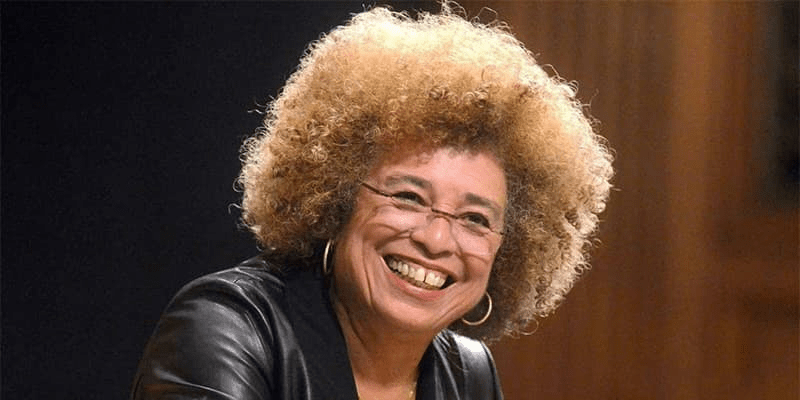
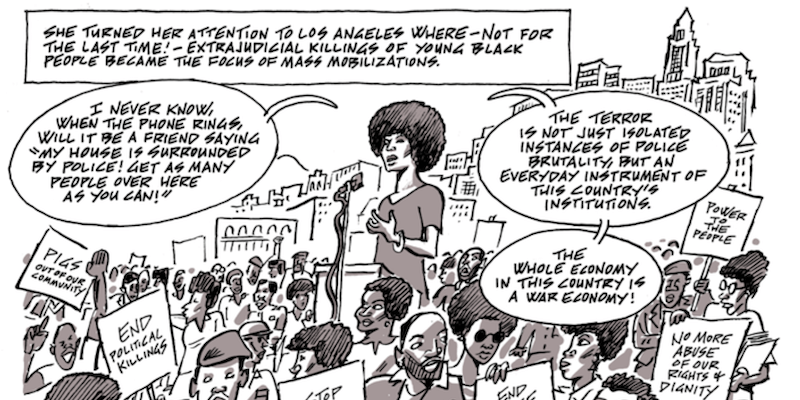
| Angela Davis debuts on the FBI’s Ten Most Wanted List. In 1969, the legendary author and activist Angela Davis was a newly minted assistant philosophy processor at UCLA. But she was also an avowed Communist, and as a result, then-Governor Ronald Regan tried to have her fired before she’d begun any actual teaching. No luck: Davis’s dismissal didn’t hold up in court, and her first class had to be moved to a bigger classroom to accommodate the 2,000 students who had signed up for it—but she would finally be fired again nine months later, for “inflammatory rhetoric” in public speeches. Davis was an outspoken supporter of the Black Panthers and was fervently against the Vietnam War, but arguably her most scandalous activist activities at the time were in defense of the Soledad Brothers, three Black inmates imprisoned in Soledad, CA, who were accused of killing a white guard. In 1970, guns registered to Davis were used in an attack on the nearby Marin County Civic Center; the perpetrators hoped to take hostages to bargain for the inmates’ release, but instead left four casualties. Davis, despite not being at the scene, was charged with murder, kidnapping, and criminal conspiracy charges. She couldn’t be found, and so on August 18, 1970, by order of J. Edgar Hoover, Davis became the third woman ever to be included on the FBI’s Most Wanted List. Eight weeks later, Davis was finally arrested in a New York motel; the trial that followed catapulted her to international fame—and turned her into a revolutionary icon—as her supporters, who viewed her as a political prisoner, chanted “Free Angela!” across the globe.In 1972, after 16 months in prison, she was acquitted of all charges by an all-white jury. “It took a worldwide movement of people to acquit Miss Davis,” noted one of her attorneys, Howard Moore Jr., but it shouldn’t have. “Justice should be the routine of the system,” he added. |
| THIS IS WHY THEY BAN IT: “Progressive art can assist people to learn not only about the objective forces at work in the society in which they live, but also about the intensely social character of their interior lives. Ultimately, it can propel people toward social emancipation. ” –Angela Davis |

 Scottie's Playtime