
Ollie has endeared himself to some house finches who come here to eat. He’s done this by chasing the squirrel off the feeder they prefer. He doesn’t realize he’s doing favors for the birds; he wants to play with the squirrel, especially zoomies. But, for 2 days in a row, I’ve watched house finches, in pairs, chase a squirrel back in Ollie’s direction by swooping the squirrel. They also are, so far, the only birds who don’t fly up away from this feeder when Ollie goes outside. Even the crows tend to fly into the trees until he comes back inside. So the house finches fascinate me this year. Anyway, here are these about more birds, and a bat, too.
Also Known As
- Trile (Colloquial, Chile)
- Alférez (Colloquial, Uruguay)
- Varillero ala amarilla (Spanish)
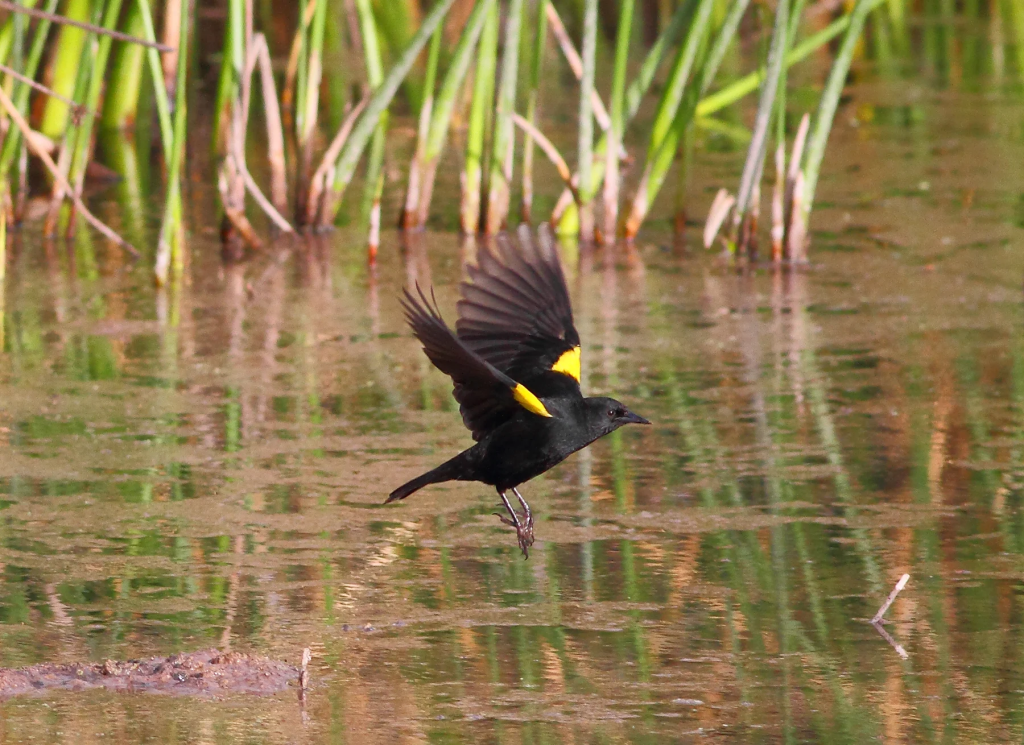
About
The Yellow-winged Blackbird is a conspicuous species of the Southern Cone of South America, congregating in colonies in marshes during the breeding season, and forming larger flocks in wetlands, grasslands, and agricultural fields the rest of the year. These birds are also extremely vocal, giving a startling variety of calls, including sharp and percussive sounds, clear and musical whistles, and a range of other rattling, chirping, whining, whirring, and gargling vocalizations. Their song in particular makes use of virtuosic trills, robotic whistles, and mechanical whirring or buzzing sounds, coming across as half bird, half sci-fi robot. This iconic song is also the source of one of the Yellow-winged Blackbird’s nicknames, “trile,” and some authors propose it may also be the origin of the name of the country Chile! As if to make the most of their raucous acoustic capacity, the males of an entire colony will sometimes sing together in one big, cacophonous chorus.
In addition to nesting together in the same space, Yellow-winged Blackbirds also synchronize their nesting in time. Most of the females in a colony will lay within several days of each other. As a result, most of the nests in the colony will be on the same timeline, with eggs and nestlings developing at about the same time across the marsh. (snip)
Historic Oregon Bill Generating Conservation Funding Is Signed Into Law
Oregon will soon have a new, dedicated source of conservation funding to support the recovery of struggling bird and wildlife species across the state. House Bill 4134, dubbed 1.25% for Wildlife Bill, passed the Oregon State Senate in February and has now been signed into law by Governor Tina Kotek. American Bird Conservancy (ABC) strongly supported the 1.25% for Wildlife Bill, a proactive measure expected to raise up to $30 million annually for wildlife conservation in the state.
“This is monumental: Oregon has chosen to invest in its wildlife and its future with the passage of this historic law. Habitat restoration, recovery programs, and anti-poaching efforts are just a few of the programs that will be funded by this landmark legislation,” said Hardy Kern, ABC’s Director of Government Relations.
The Act will create a sustainable funding source dedicated to conserving imperiled species like the Marbled Murrelet, a seabird that nests in mature and old-growth forests in the state. Nest predation by jays and ravens contributes to the species’ declining population. Actions that could boost nesting success, such as campground cleanup efforts to reduce jay and raven numbers near sensitive nesting sites, are currently unfunded, but could benefit from the revenue generated by the newly signed law. (snip-MORE)


Was just having a conversation the other day with my grandson, a report on bats, and how it’s not just the white-nosed fungus killing them off. By killing off all the bugs we have starved them, weakened them, and left them susceptible to the fungus
It’s up to him to figure out how to fit that into his report without a credible source … 😏
LikeLiked by 1 person
That does make perfect sense.
With the late-July and August weather we’ve been having (till today, which is “normal,”) there are plenty of bugs this year. I don’t want ’em in the house, but I’m trying to resist spraying anything stronger than Skin So Soft on me when I go outside.
What I’m happy to notice is that I’ve been having to watch the ground out there, not for dog land mines, but for bees! There are so many bees feeding on the clover in the backyard, and I’m very happy about that! And since you commented here, I get to tell you about that. I’m thinking of asking the lawn guys about planting clover in front; it’s got some spaces with bare dirt. I like the flowers, too, but bees!
LikeLike
All we are saying, is give bees a chance!
LikeLiked by 1 person
House finches be smart! Ollie not only chases off the squirrels, the bigger birds stay away, too (at least until the crows figure out what the finches are doing, or that Ollie is not able to fly 🙂
LikeLiked by 1 person
The crows watch. I think they know. But they’re not getting in the middle of it! It’s a lot of fun to watch.
LikeLike