
Yellow-breasted Chat
Icteria virens
Also Known As
- Buscabreña (Spanish)
- Reinita Grande (Spanish)
- Chipe Parlanchín (Spanish)
- Chipe Arriero (Spanish)
About
At first glance, the Yellow-breasted Chat seems to be a mishmash of many bird families: its larger size and stout bill resemble a Scarlet Tanager’s, while its skulking habits and complex vocalizations seem more like those of a thrasher or mockingbird. Taxonomically, this bird was considered an unusual wood warbler in the family Parulidae. However, in 2017, the American Ornithologists Union gave this bird its own family — Icteriidae — based on its unique physical and genetic features. It is considered to be related to the blackbirds and meadowlarks of the Western Hemisphere.
Among birders, the Yellow-breasted Chat is best-known for two features of its behavior: its habit of staying hidden at most times within the thickest vegetation available, and its loud, wild, weird song and flight display. In 1953, ornithologist Arthur Cleveland Bent described the Chat’s song as a “medley of strange sounds, musical and otherwise, catcalls, whistles, and various bird notes coming from points now here, now there in the bushes” — sounds which would “betray the presence of this furtive and elusive clown among birds.” The song is indeed a strange and wonderful mix of cackles, clucks, whistles, and hoots. Only males are known to sing, and they do so from deep inside the densest cover. A male chat may sometimes sound as if he’s laughing at the frustrated birders trying to locate him. (snip-MORE)
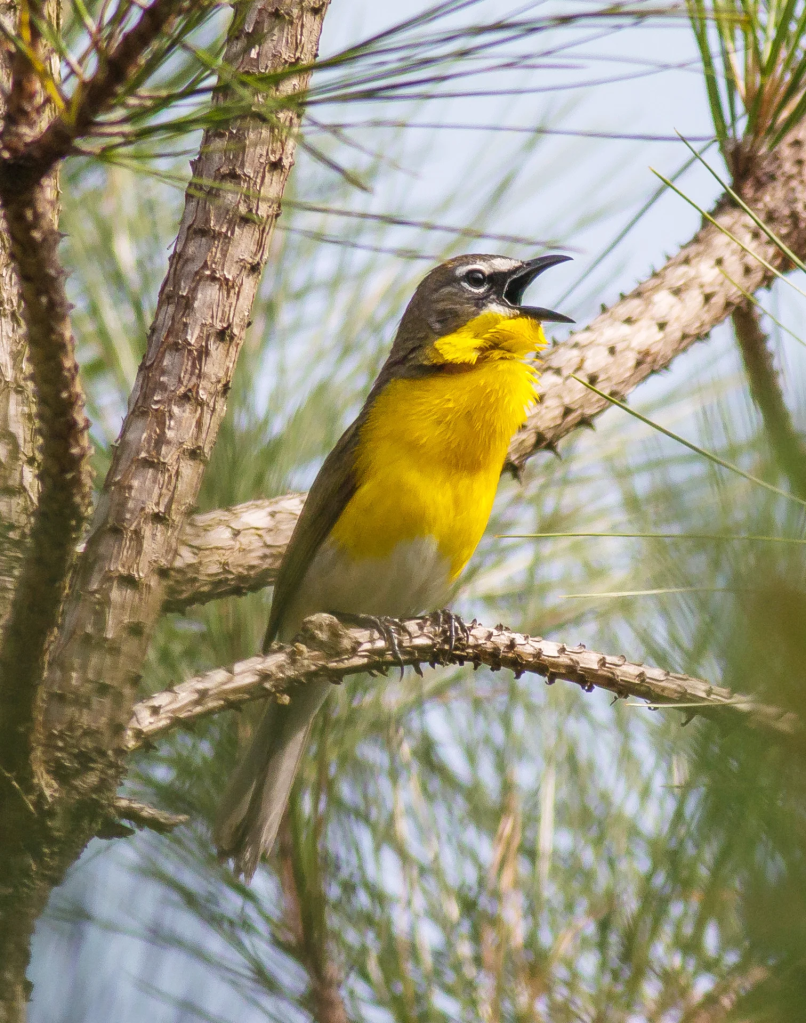
And thanks to MDavis for intro’ing this guy, who is great!


