
Because it’s important to re-read this proclamation every year, at least on Mother’s Day. And especially so in this year of strikes and other activism to get our government back to we the people, and in comparison to the retail profits from this holiday.
History of Mother’s Day as a Day of Peace: Julia Ward Howe
Too few Americans are aware that early advocates of Mother’s Day in the United States originally envisioned it as a day of peace, to honor and support mothers who lost sons and husbands to the carnage of the Civil War.
MOTHER’S DAY PROCLAMATION
Boston, 1870
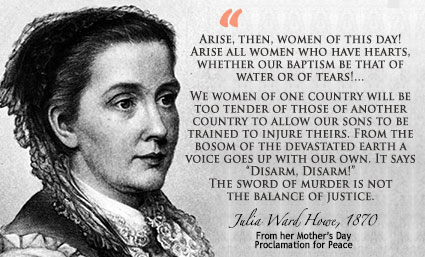
“Arise, then… women of this day!
Arise, all women who have hearts,
whether our baptism be that of water or of tears!
Say firmly:
We will not have great questions decided by irrelevant agencies.
Our husbands shall not come to us, reeking with carnage,
for caresses and applause.
Our sons shall not be taken from us to unlearn
all that we have been able to teach them of charity, mercy and patience.
We, women of one country, will be too tender of those of another country
to allow our sons to be trained to injure theirs.
From the bosom of the devastated earth a voice goes up with our own.
It says: Disarm, Disarm!
The sword of murder is not the balance of justice.
Blood does not wipe out dishonor,
nor violence vindicate possession.
As men have often forsaken the plough and the anvil
at the summons of war,
let women now leave all that may be left of home
for a great and earnest day of council.
Let them meet first, as women, to bewail and commemorate the dead.
Let them then solemnly take council with each other as to the means
whereby the great human family can live in peace,
each bearing after his own kind the sacred impress, not of Caesar,
but of God.
In the name of womanhood and of humanity, I earnestly ask
that a general congress of women, without limit of nationality,
may be appointed and held at some place deemed most convenient,
and at the earliest period consistent with its objects,
to promote the alliance of the different nationalities,
the amicable settlement of international questions,
the great and general interests of peace.“
~ Julia Ward Howe
| May 10, 1857 The Sepoy Rebellion was triggered in Meerut, India, when native troops (known as Sepoys, which also designated a rank equivalent to private) turned on their British officers.It was the first instance of armed resistance against colonial rule. Indians constituted 96% of the 300,000-man British Army. Loading the Lee-Enfield Rifled Musket assigned to the Sepoys involved biting the end of a cartridge greased in a combination of pig fat and beef tallow.  “Attack of the Mutineers,” a British illustration of the Sepoy Rebellion The former is haraam (forbidden) under Islamic law, the latter offensive to Hindus who consider the cow as aghanya (that which may not be slaughtered). When the Sepoys, including both Hindu and Muslim Indians, became aware of this, some refused to load their weapons. Mangal Pandey, a soldier in the Army shot his commander for forcing the Indian troops to use the controversial rifles. When others were charged with mutiny for refusing, Sepoys turned on their officers and released the imprisoned soldiers. The rebellion is now considered the first Indian war for independence. More on the rebellion |
| May 10, 1967 Army Captain Howard Levy, a physician, was imprisoned three years for refusing to train U.S. Special Forces soldiers for Vietnam. He refused an order to perform the training as he considered it a violation of his medical ethics. “The United States is wrong in being involved in the Viet Nam War. I would refuse to go to Viet Nam if ordered to do so. I don’t see why any colored soldier would go to Viet Nam: they should refuse to go to Viet Nam and if sent should refuse to fight because they are discriminated against and denied their freedom in the United States, and they are sacrificed and discriminated against in Viet Nam by being given all the hazardous duty and they are suffering the majority of casualties.” From the Supreme Court case, Parker, Warden, et al. v. Levy. |
May 10, 1968 Peace talks began in Paris between the U.S. and North Vietnam with businessman, former New York governor, ambassador and cabinet secretary W. Averell Harriman representing the United States. Former Foreign Minister Xuan Thuy, heading the North Vietnamese delegation, immediately demanded cessation of U.S. bombing.  |
| May 10, 1972 Jane Briggs Hart, the wife of Senator Philip A. Hart (D-Michigan), informed the Internal Revenue Service that she wouldn’t pay some of her taxes; instead, she deposited her quarterly estimated tax of $6,200 in a special bank account. She wrote: “I cannot contribute one more dollar toward the purchase of more bombs and bullets.”  Jane Briggs Hart More about Jane Briggs Hart |
May 10, 1980 The National Organization for Women (NOW) organized 85,000 people to march in Chicago in support of Illinois’s ratification of the Equal Rights Amendment to the U.S. Constitution.  A chronology of the Equal Rights Amendment, 1923-1996 Visit the NOW Foundation |
May 10, 1980 A federal judge in Salt Lake City, Utah, found the U.S. government negligent for its above-ground testing of nuclear weapons in Nevada from 1951 to 1962.  The land of the Nevada Test Site is scarred with craters from nuclear testing. |
May 10, 1994 Nelson Mandela was inaugurated as South Africa’s first black president. He had won the country’s first election in which all South Africans could vote, regardless of race. Mandela had spent nearly three decades imprisoned for his part in the struggle to attain political and civil rights for black and colored citizens. This ended more than three centuries of white rule, beginning with the Dutch in 1652. Biography of Nelson Mandela South African chronology |


Thanks for the reminder on this very important information. I also think, that most of the younger ones don`t know this piece of history. Best wishes, and enjoy a nice Sunday! xx Michael
LikeLiked by 1 person
Thank you, Michael! I hope your day is very good; you enjoy a nice Sunday, too!
Believe it or not, I didn’t learn about this until 2002 when I read about it in the Peace & Justice History newsletter, because the dates of now-Mother’s Day and Ms. Howe’s Proclamation were the same that year. I think it’s a simply beautiful piece of writing, and I hope to inspire all women and parents to take it up on behalf of any children they know and love.
It’s a sample of how women would run things if we had things to run. 😉 🕊 💖
LikeLike